

Introduction — The Shift from Hindsight to Foresight in UAE Public Governance
There is a moment every director-general or undersecretary eventually reaches. It arrives in a meeting room, usually mid-morning, with a presentation on the screen built from last quarter's data. The numbers are clean. The visualisations are polished. The analyst who prepared it knows the material cold. But the question being asked — the one that actually matters to the minister sitting at the head of the table — is about what is going to happen next, what the agency should do differently, and what decisions made today will prevent a crisis three months from now. And none of that is in the slides.
That gap — between the intelligence an agency has and the intelligence it actually needs to govern well — is the precise problem predictive analytics is built to solve. In the UAE, it is a problem the government can no longer afford to tolerate at scale.
The Emirates has committed publicly, explicitly, and with significant financial backing to becoming one of the world's most advanced digital governments. The UAE National AI Strategy 2031 is not a vision document that sits on a shelf — it is a funded, structured mandate with named deliverables, sector-specific targets, and a monitoring framework. The Smart Dubai initiative has already produced quantifiable improvements in citizen experience metrics, service digitisation rates, and cross-agency data integration. The broader push toward Government Digital Transformation Services dubai has created an institutional appetite for AI-powered infrastructure that simply was not present at this scale five years ago.
But appetite is not deployment. And deployment without strategic design is not transformation.
What has changed over the past two years, specifically, is a convergence of factors that makes this the optimal moment for UAE government entities to move from analytical ambition to operational predictive capability. The technology has matured past the pilot stage — enterprise-grade predictive systems are now production-proven in comparable government contexts globally. The data pipelines exist inside most UAE agencies, built through years of e-government investment. The talent pool — both local national data scientists developed through university and government training programmes, and international specialists available through AI development services firms operating in the UAE — is sufficient to staff and sustain serious government-grade deployments. And the competitive pressure between emirates, combined with the international benchmarking that comes with ranking ambitions in global governance indices, has made standing still genuinely and measurably costly.
Predictive analytics is not a luxury technology feature being layered onto an already-functional system. For any government agency that has digitised its core operations — which describes the majority of federal and emirate-level entities in the UAE today — predictive analytics is the logical and necessary next step. Once you have structured data flowing through your systems at scale, the question is no longer whether you should use it predictively. The question is how quickly you can deploy that capability before the decisions you are making on incomplete foresight today become tomorrow's avoidable service failures, infrastructure crises, or compliance disasters.
This blog is written specifically for decision-makers inside UAE public sector entities: director-generals building five-year capability roadmaps, chief digital officers evaluating vendor landscapes, procurement officers designing RFP criteria for technology contracts, and policy advisors who need to build the internal business case for predictive analytics investment. It is not a technology primer. It is a strategic assessment with commercial specificity, regulatory grounding, and the honest perspective on disadvantages that vendor-produced content consistently omits.
What Predictive Analytics Actually Means in a Government Context
The term "predictive analytics" has been so thoroughly colonised by software marketing that it has become nearly meaningless as used in most vendor conversations. Before anything else, precision matters here — because the gap between what the term actually means and what most vendors are selling under that label is significant, and UAE government procurement officers deserve clarity.
True predictive analytics in a government context means this: the systematic use of historical operational data, combined with real-time inputs and statistical or machine learning models, to generate probabilistic forecasts about future states — and then using those forecasts to drive decisions before outcomes occur rather than in response to them.
That definition has three components that are each essential. Historical data provides the pattern base from which the model learns. Real-time inputs allow the model to update its forecasts as conditions change. The probabilistic forecast is the output — not a certainty, but a structured estimate of likelihood with quantified confidence levels. And the critical phrase is "before outcomes occur." If the system is telling you what happened, it is reporting. If it is telling you what will likely happen, it is predicting. The difference is operationally decisive.
To be clear about what predictive analytics is not: it is not a reporting platform with status indicators that change colour when performance falls below target. It is not a government dashboard software that shows you whether last month's service delivery hit its KPI benchmarks. It is not an automated BI tool that generates charts faster than a human analyst could. Each of those things has value. None of them is predictive analytics.
What a genuine predictive analytics capability allows a government agency to do is answer questions that retrospective reporting structurally cannot address. Questions like: which citizens are most likely to become eligible for social support benefits in the next six months, enabling pre-emptive outreach before crisis point? Which road segments are at elevated failure probability within the next 90 days given current weather patterns, traffic loads, and maintenance history? Which businesses registered in the emirate show behavioural signatures that correlate historically with VAT non-compliance before the non-compliance is formally detected? Which hospital departments are likely to experience demand surges in the next four weeks that require pre-positioned staffing and supply chain adjustments?
These are not abstract hypotheticals. They are live operational questions that predictive analytics systems are answering — with measurable accuracy — in UAE and comparable government contexts right now. The agencies that have built these capabilities are making materially better decisions. The agencies that have not are managing crises rather than preventing them, allocating resources reactively rather than optimally, and reporting outcomes they could have influenced if they had seen them coming.
Understanding this distinction — deeply, not just conceptually — is the prerequisite for building an effective business case, selecting the right implementation partner, and designing a deployment that actually transforms how your agency makes decisions rather than simply adding an impressive technology layer to existing processes.
The Market Gap: What Most UAE Government Entities Are Getting Wrong
Here is the uncomfortable truth about predictive analytics adoption by UAE public sector agencies in 2026: the majority of entities that believe they have a predictive capability actually have a sophisticated reporting capability with a predictive interface painted over it. This is not a small distinction. It is the difference between a system that changes how decisions get made and a system that makes existing reporting look more futuristic.
The market gap in the UAE government analytics space is real, it is significant, and closing it is where the genuine competitive advantage for forward-thinking agencies lies. There are four specific gaps that repeat across the sector with remarkable consistency.
Gap One: Data Exists But Is Not Decision-Ready
The majority of UAE government agencies have digitised their operations sufficiently that substantial volumes of structured data exist across their systems. Transaction records, service request logs, infrastructure maintenance histories, financial compliance data, citizen interaction records — in most agencies, this data is being generated and stored. The gap is not in data volume. The gap is in data readiness.
For data to support predictive modelling, it needs to satisfy several conditions that most government data currently does not: it needs to be structured consistently over time so that the model can identify genuine patterns rather than artefacts of system changes; it needs to be integrated across the relevant source systems so that cross-domain correlations can be identified; it needs to be cleaned to a standard where outliers and errors do not corrupt model training; and it needs to be accessible through a unified data architecture that a modelling environment can query efficiently.
Most UAE government data meets none of these conditions without significant preparatory investment. The data exists. It is not decision-ready. And this gap — the data infrastructure gap — is consistently the most expensive and time-consuming part of a predictive analytics deployment to close. Agencies that go directly to model development without addressing data infrastructure will produce predictions that are technically impressive and operationally unreliable.
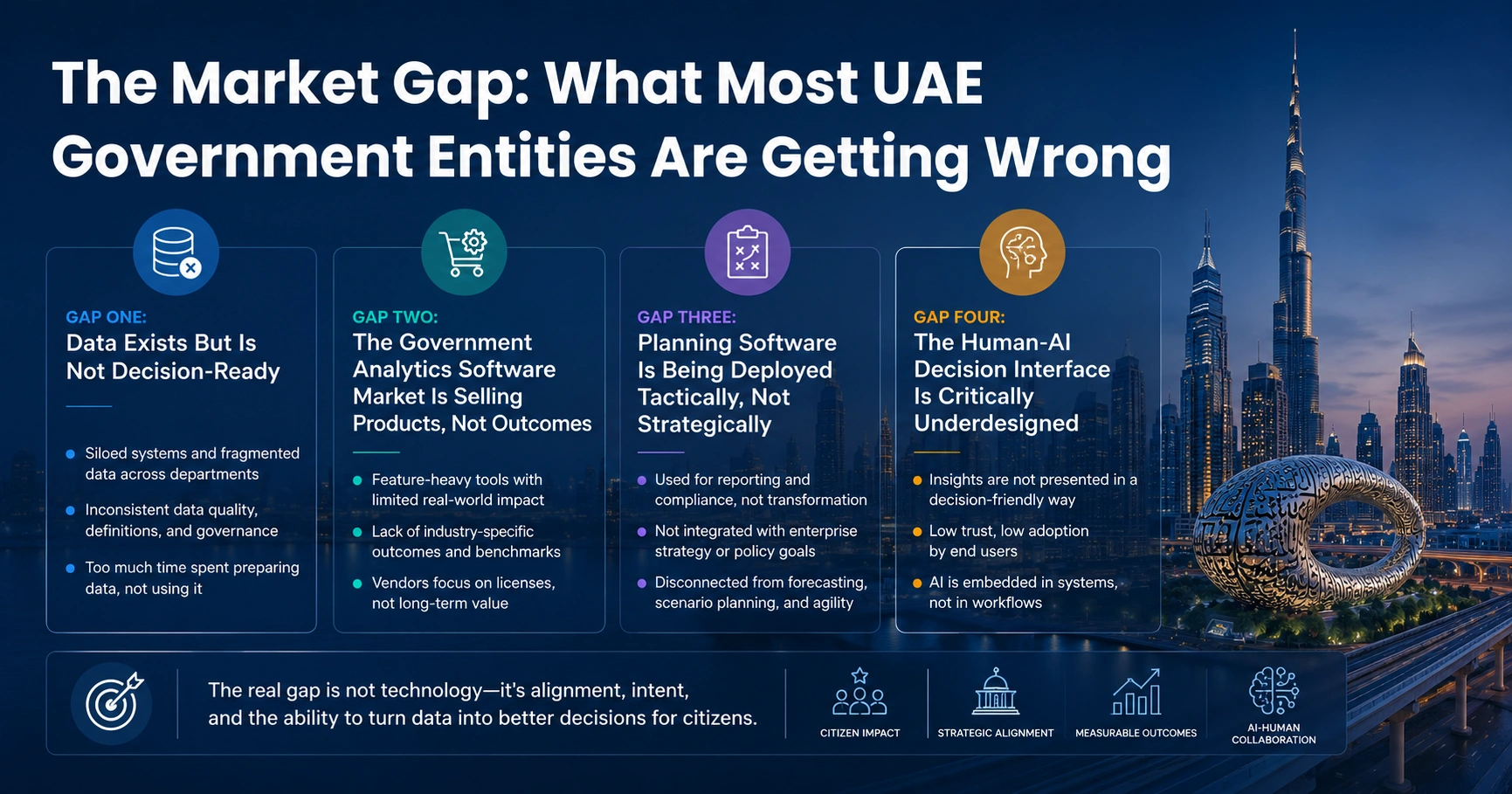
Gap Two: The Government Analytics Software Market Is Selling Products, Not Outcomes
The government analytics software market is populated with vendors who are excellent at demonstrating capabilities and poor at delivering operational outcomes. A government procurement officer evaluating government forecasting tools and public sector analytics platforms will routinely be shown sophisticated interface designs, AI feature sets with compelling names, and reference statistics about accuracy and performance. What they will not be shown — unless they specifically demand it — is the data science methodology behind the predictions, the validation framework used to test model accuracy against real outcomes, the failure rate data from comparable deployments, or the specific steps required to make that vendor's platform work with the agency's actual data infrastructure.
This information asymmetry between vendor and buyer is the primary driver of government analytics project failures. The platform works as demonstrated. The gap is in everything the demonstration did not show: the six months of data engineering required before the model can be trained, the organisational change management investment required before predictions will actually influence decisions, and the ongoing recalibration effort required to keep the model accurate as operational conditions evolve.
Gap Three: Planning Software Is Being Deployed Tactically, Not Strategically
Strategic planning software for government is being purchased at scale across UAE agencies — but it is frequently being used to automate existing processes rather than to transform decision-making. Government KPI dashboards, when used in isolation without predictive layers, tell leaders where they have been — not where they are heading. Automating a broken process makes the broken process faster. It does not make it better. And deploying sophisticated analytics infrastructure in service of decisions that are still being made the same way they were made before the technology was deployed produces a very expensive version of the same outcome.
The agencies generating real value from analytics investments have started with strategic questions: what decisions do we need to make differently, and what would better information about the future allow us to do that we cannot do now? They have then designed the technology solution backwards from those questions. Most agencies do the opposite: they select a platform, often driven by vendor relationships or reference-site visits, and then try to find decision problems it can address. The mismatch between platform capability and genuine organisational need is the predictable result.
Gap Four: The Human-AI Decision Interface Is Critically Underdesigned
Even in agencies where the predictive models are technically sophisticated and demonstrably accurate, the interface between model output and human decision-maker is frequently so poorly designed that the predictions have little or no influence on actual decisions. A forecast that cannot be interrogated, contextualised, or challenged by a non-technical senior official — one who did not build the model and may not be comfortable with probabilistic reasoning — is a forecast that will be ignored in favour of experienced intuition.
The earned value management discipline of systematically comparing forecasts to outcomes, calibrating model confidence, and building a track record of predictive accuracy over time is what builds the organisational trust that allows predictions to actually drive decisions. Very few UAE government predictive analytics deployments have invested seriously in this trust-building process. And without it, even technically excellent systems fail to produce the decision-making transformation they were purchased to enable.
Where Predictive Analytics Is Already Working Inside UAE Government
Grounding the strategic discussion in operational reality matters. The following are examples of predictive analytics producing measurable results inside UAE government contexts — not pilots or proof-of-concepts, but scaled deployments producing ongoing operational value.
Smart Dubai: Urban Mobility and Infrastructure Intelligence
Dubai's Roads and Transport Authority has deployed predictive modelling across several dimensions of urban mobility management. Demand forecasting for public transport allows pre-emptive scheduling adjustments rather than reactive service changes. Predictive road condition monitoring flags segments approaching maintenance intervention thresholds before surface deterioration becomes a safety issue. Accident probability modelling using historical incident data, environmental conditions, and real-time traffic patterns has supported targeted preventive interventions in high-risk zones. The outcomes are visible in reduced incident rates, improved transport satisfaction scores, and more efficient allocation of the Roads Authority's substantial maintenance budget.
Federal Tax Authority: From Reactive Audit to Proactive Risk Management
The Federal Tax Authority has invested significantly in analytics infrastructure that supports a fundamental shift in compliance management philosophy. Traditional compliance monitoring is reactive — non-compliance is detected through audit, after the financial damage has already occurred. Predictive compliance monitoring changes this. Behavioural models trained on filing patterns, transaction sequences, and sector-specific indicators identify entities whose profile suggests elevated non-compliance probability before the compliance failure occurs. The FTA can then direct audit resources toward high-probability targets with far greater efficiency, and can deploy educational or advisory outreach to entities that show early-warning signatures rather than waiting for the non-compliance to materialise. The revenue protection implications of this shift are substantial.
Abu Dhabi Healthcare: Predictive Resource Positioning
Abu Dhabi Health Services Company has used predictive analytics to transform how healthcare resources are positioned across its hospital network. Patient admission forecasting, ICU utilisation modelling, and supply chain demand prediction allow hospital administrators to pre-position staff, equipment, and consumables in advance of demand spikes rather than in reaction to them. During the COVID-19 period, this capability was operationally decisive — the difference between managed surge and crisis-level overcapacity in multiple instances was the lead time that predictive modelling provided. Post-pandemic, the capability has matured into routine operational infrastructure, with measurable improvements in resource utilisation efficiency and patient flow metrics.
Civil Defence: Predictive Incident Preparedness
Multiple emirate-level civil defence and emergency management agencies have deployed predictive incident modelling that identifies high-probability risk zones and time periods based on historical incident data, seasonal patterns, construction activity, and population density shifts. The ability to pre-deploy resources to high-probability zones rather than positioning them centrally and redeploying reactively produces measurable improvements in response times — and measurable reductions in incident severity when early arrival enables intervention before escalation.
These deployments share a common set of design decisions: each started with a specific, high-value operational question rather than a technology selection; each invested heavily in data infrastructure before model development; each worked with implementation partners who understood both the technical requirements and the UAE government operational context; and each built an ongoing model governance process into the operational design from the beginning rather than treating go-live as the end of the project.
Advantages of Predictive Analytics for the UAE Public Sector
5.1 Evidence-Based Policy Decisions at Ministerial Scale
The most transformative advantage of mature predictive analytics is what it does to the quality and character of policy deliberation. When a minister or director-general can examine not just what is happening across their agency's operations but what the model projects will happen under different policy scenarios — and can see those projections updated as assumptions change — the entire character of strategic planning shifts. Assumptions that were previously unchallengeable because they were based on experience become testable against data. Competing priorities that were previously resolved through negotiation become quantifiable in terms of projected outcomes. Policy trade-offs that were previously invisible become visible before commitment rather than after.
This is not fundamentally a technology benefit. It is a governance benefit. And in the UAE context, where the government's explicit ambition is to rank among the world's most effective, most efficient, and most citizen-centric public administrations globally, governance quality is a strategic priority that justifies significant technology investment.
5.2 Radical Resource Allocation Efficiency
Government agencies at all levels operate under the constant pressure of doing more with finite resources. The traditional approach to managing this pressure is to build buffer capacity — over-provision resources in areas where demand uncertainty is highest, and accept the efficiency cost of that over-provisioning as the price of service reliability. Predictive analytics changes this trade-off fundamentally. When you can forecast demand with sufficient accuracy to pre-position resources precisely where they will be needed, when they will be needed, the buffer requirement shrinks dramatically.
In practical terms, this means staff scheduling based on predicted service demand rather than historical averages. It means infrastructure maintenance budgets allocated toward highest-probability failure assets rather than distributed evenly across portfolios. It means emergency response resources positioned based on incident probability models rather than geographic centrality. Each of these shifts produces measurable efficiency improvements — and collectively, they can represent a 20-30% reduction in the operational cost of delivering equivalent service quality.
5.3 Proactive Citizen Service — The UAE Vision Imperative
The shift from reactive to proactive service delivery is one of the most prominent themes in UAE government digital strategy — and predictive analytics is the technology that makes this shift operationally possible at scale. The AI revolutionizing government in UAE narrative is frequently focused on chatbots, digital service portals, and process automation. These are real contributions. But the deeper transformation enabled by predictive analytics — identifying which citizens will need which services before they request them, reaching out proactively rather than waiting for the service request, and pre-approving or streamlining processes for citizens whose eligibility is predictable — represents a fundamentally different model of government service delivery.
This shift has direct implications for citizen satisfaction, which UAE government agencies are explicitly measured and ranked on. It also has direct implications for operational efficiency: a proactive service interaction is typically significantly cheaper to deliver than a reactive crisis response to a citizen whose need has become urgent.
5.4 Institutional Knowledge Capture and Continuity
One of the structural vulnerabilities of any government agency — and a particularly acute one in UAE agencies with significant expatriate specialist talent — is the concentration of operational knowledge and decision intelligence in individual people. When those people leave, retire, or transfer, their accumulated pattern recognition about what conditions predict what outcomes leaves with them. Predictive analytics systems, when properly designed and maintained, encode that pattern recognition in a form that persists beyond individual tenure. The model does not retire. The decision intelligence it embodies is institutionalised rather than personalised.
This is particularly valuable in the UAE context, where the government's emiratisation programmes are building local national talent pipelines that will over time replace specialist expatriate capabilities — but where the knowledge transfer challenge in the transition period is real and significant.
5.5 Inter-Emirate Competitiveness and Investment Attraction
The competitive dynamic between UAE emirates for investment, talent, and institutional prestige is a genuine driver of public sector technology investment — and one that is sometimes underweighted in purely technical business cases. An emirate whose government agencies are demonstrably more intelligent — faster to respond, more accurate in their resource positioning, more proactive in their service delivery — has a competitive advantage in attracting the next generation of high-value economic activity, international headquarters decisions, and knowledge economy investment. Predictive analytics is one of the clearest and most visible expressions of government intelligence in the modern digital economy. It belongs in the competitive positioning argument, not just the operational efficiency argument.
Disadvantages and Honest Downsides — With Practical Fixes
A strategic assessment that does not address disadvantages is a sales pitch, not an analysis. The following are the real downsides of predictive analytics deployment in government — stated with the clarity that decision-makers deserve, alongside the practical mitigations that experienced practitioners have developed.
6.1 Model Accuracy Degrades Over Time Without Active Maintenance
The Downside: Every predictive model is trained on historical data that reflects the conditions that existed during the training period. As conditions change — due to regulatory shifts, economic shocks, demographic changes, or structural shifts in the domain being modelled — the historical patterns the model learned become progressively less predictive of future outcomes. Model accuracy degrades over time, and this degradation is often not immediately obvious. The model continues to produce predictions with apparent confidence, but the accuracy of those predictions is declining. Decisions made on the basis of a degraded model can be significantly worse than decisions made on no model at all — because the model creates false confidence.
The Fix: Model governance must be designed into the operational architecture from day one, not added as an afterthought. This means establishing regular backtesting processes where model predictions from past periods are compared to actual outcomes. It means defining accuracy thresholds below which the model triggers a recalibration process. It means assigning dedicated technical resources to model performance monitoring rather than assuming the model will self-maintain. The discipline of earned value management — systematic comparison of forecasts to actuals, with structured responses to variance — applied to AI model performance is exactly the right framework here.
Q: How frequently does a government predictive model need to be recalibrated to remain operationally reliable?
A: This varies significantly by domain. In stable, slow-changing domains like infrastructure aging patterns, meaningful accuracy degradation typically takes 18-24 months to emerge, and annual recalibration is usually sufficient. In faster-moving domains — economic behaviour, public health demand, or compliance patterns in evolving regulatory environments — meaningful accuracy degradation can appear within 3-6 months of a significant external change. The recalibration cadence must be matched to the volatility of the domain, not set at a convenient administrative interval.
6.2 Data Quality Problems Produce Confident Wrong Predictions
The Downside: There is an important asymmetry in how data quality affects predictive systems that is not intuitive and is frequently underestimated. A model trained on limited but clean data produces uncertain predictions — low confidence intervals, wide forecast ranges, appropriately hedged outputs. A model trained on large but poor-quality data produces confident wrong predictions — narrow confidence intervals, precise-appearing forecasts, and no visible signal that the predictions are unreliable. The second condition is more dangerous, because confident wrong predictions drive confident wrong decisions.
Government data in the UAE — like government data everywhere — typically has significant quality issues: inconsistent coding conventions across time, missing values in systematically biased ways, duplicate records, definitional changes that are not flagged in the data, and integration errors that arise when data from different systems is combined. These are normal characteristics of real-world government data. They are also characteristics that must be identified and addressed before a predictive model is trained, not after.
The Fix: Invest in data quality assessment and remediation as the first phase of any predictive analytics project, before model development begins. This investment typically represents 25-40% of total project cost in a mature, honest budget. Agencies that try to skip or compress this phase to accelerate model development consistently produce unreliable systems and then spend more correcting the problems than the upfront investment would have cost.
Q: What does poor data quality actually cost in a predictive analytics deployment?
A: Beyond the technical costs of remediation, poor data quality in a government predictive analytics system can produce decisions that misallocate significant public resources, compliance monitoring that misses genuine risks while flagging false positives, and infrastructure maintenance decisions that prioritise the wrong assets. The reputational and political cost of a high-profile decision made on the basis of a flawed predictive model — and then traced back to data quality failures — can exceed the financial cost by orders of magnitude.
6.3 Institutional Resistance Is the Rule, Not the Exception
The Downside: Senior government officials who have built careers on the quality of their experienced judgment are not automatically receptive to an algorithm that challenges that judgment. This resistance is not irrational, and treating it as such is one of the most common mistakes made by technically-focused implementation teams. The resistance reflects legitimate and important concerns: accountability for decisions made on the basis of model outputs, transparency about how the model reaches its conclusions, and the appropriate limits of automated reasoning in complex human systems.
An official who cannot explain a decision — cannot articulate the reasoning, defend the assumptions, or describe what evidence would change the conclusion — is in a professionally vulnerable position. If the decision was driven by a model the official does not understand, that vulnerability is acute.
The Fix: Model explainability is not a technical nicety — in a government context it is a governance requirement. Design for explainability from the beginning: use model architectures that support interpretable outputs alongside predictive accuracy. Invest in visualisation and communication layers that allow senior officials to interrogate the model's reasoning — to see which factors are driving a prediction, how sensitive the prediction is to changes in key inputs, and what historical precedents the model is drawing on. And invest seriously in the organisational change management process: workshops, pilot experiences, and graduated introduction of model outputs into decision processes, rather than a cold transition from intuition-based to model-influenced decision-making.
6.4 Vendor Lock-In Creates Long-Term Strategic Risk
The Downside: The government analytics market structure creates significant vendor lock-in risk. Many platforms use proprietary data formats, bespoke integration architectures, and licensing structures that make migration to an alternative platform prohibitively expensive once the agency is deeply integrated. The initial investment looks manageable. The total cost of ownership over a 7-10 year period — including annual license escalations, integration dependency costs, and the de facto monopoly the vendor acquires over the agency's analytical capability — frequently exceeds initial estimates by a factor of two or three.
The Fix: Procurement design is the primary mitigation. Require open data standards, documented API specifications, and explicit data portability provisions in every analytics contract. Engage a digital transformation company in the UAE that provides independent advisory services — not one with a financial relationship with the platform being evaluated — to assess vendor lock-in risk as part of the procurement process. Structure contracts with meaningful break clauses and technology refresh provisions rather than long-term commitments that remove the agency's negotiating leverage.
6.5 Algorithmic Bias Carries Legal and Ethical Exposure
The Downside: Models trained on historical government data learn historical patterns — including patterns that reflect historical inequities in how services were delivered, resources were allocated, or enforcement was applied. A predictive model used to identify citizens at risk of benefit non-compliance, or to prioritise infrastructure maintenance in different neighbourhoods, or to allocate regulatory attention across business registrants, can systematically replicate and amplify historical biases — at scale and with the apparent authority of mathematical objectivity. This is not a hypothetical risk. It is a documented failure mode in government AI systems globally.
The Fix: Embed algorithmic fairness testing into the model development, validation, and ongoing governance process. Define fairness criteria explicitly before model development — which groups should the model's predictions be equally accurate for? — and measure model performance against those criteria as a standard part of quality assurance. In a UAE government context where equitable service delivery is both a legal obligation and a constitutional commitment, algorithmic fairness is not an optional enhancement.
Cost Effectiveness and Compliance: The Real Numbers for 2026
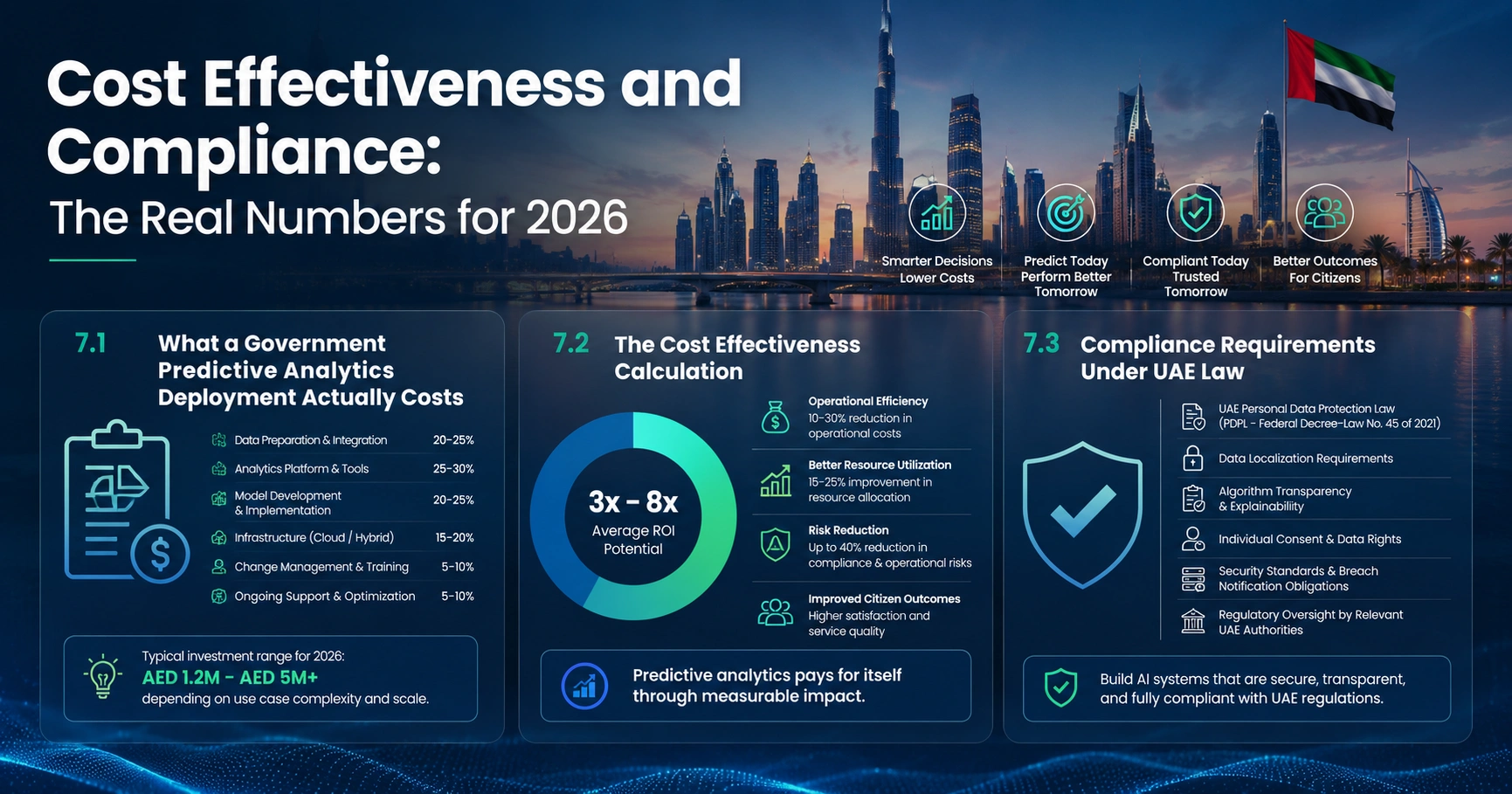
The most consistent failure mode in government predictive analytics business cases is vagueness about cost. Agencies approve projects based on high-level budget estimates, then discover the real cost during implementation — when it is too late to make a rational decision about whether the investment is justified. The following cost ranges are grounded in actual project data from UAE and comparable GCC government deployments in 2025-2026.
7.1 What a Government Predictive Analytics Deployment Actually Costs
The AI development cost in Dubai 2026 for a government-grade predictive analytics deployment cannot be reduced to a single number — but it can be placed in meaningful ranges based on project scope and complexity.
A foundational deployment — covering data quality assessment and basic infrastructure remediation, model development for two or three clearly defined use cases, integration with primary source systems, a basic government dashboard software interface for operational users, and first-year model governance support — will typically require an investment in the range of AED 900,000 to AED 2.8 million for an agency of moderate scale and reasonable data maturity.
A mid-scale deployment — covering multiple departments, more complex inter-agency data integration, custom model development across five to eight use cases, a comprehensive government performance management interface accessible to senior leadership, and an 18-month model governance and recalibration programme — will typically fall in the range of AED 2.8 million to AED 6 million.
An enterprise-grade deployment — covering agency-wide data infrastructure redesign, advanced AI model development including deep learning and ensemble approaches for complex prediction tasks, full integration across all major operational systems, real-time dashboard infrastructure, and a dedicated ongoing data science capability built into the agency's permanent structure — will typically require AED 6 million to AED 15 million or more over a three-to-five year programme.
These figures represent total investment — including data engineering, model development, integration architecture, user interface design, testing and validation, staff training, and first-year operational support. Agencies that evaluate predictive analytics investments solely on software license costs, which can appear significantly lower, are comparing incomparable things and setting themselves up for cost surprises that create political problems during implementation.
7.2 The Cost Effectiveness Calculation
The cost effectiveness case for government predictive analytics is built from three distinct value components, each requiring a different measurement approach.
Direct efficiency gains represent the most straightforward component of the business case: quantifiable reductions in staff time spent on reactive crisis management, manual data analysis, duplicate reporting processes, and post-hoc explanations for outcomes that a predictive capability would have anticipated. For a mid-sized UAE government agency, the efficiency gains from a well-implemented predictive analytics capability across three operational domains typically fall in the range of 15-25% reduction in total analyst and operational staff effort in the affected domains. At average UAE government staff cost levels, this represents a significant and defensible ROI component.
Cost avoidance from better decisions represents a larger but harder-to-quantify value component. Infrastructure assets maintained predictively rather than reactively cost 20-30% less to maintain over their operational life, and avoid the significantly higher cost of catastrophic failure. Compliance interventions made proactively when behavioural signals are detected recover revenue that would have been lost under reactive audit approaches. Service delivery crises that are identified and addressed before they occur avoid the cost — financial, operational, and reputational — of the crisis itself.
Outcome improvements represent the highest-value and most difficult-to-measure component. Better citizen health outcomes from predictive health resource positioning. Better public safety outcomes from predictive incident preparedness. Better economic participation from predictive social support targeting. These outcomes have real value — often extremely large value — but quantifying them in a business case that survives CFO scrutiny requires careful methodology and intellectual honesty about uncertainty.
7.3 Compliance Requirements Under UAE Law
Operating a predictive analytics system in the UAE government context requires compliance with an evolving but increasingly well-defined regulatory framework. Understanding this framework — and building compliance into the system architecture from the beginning — is both a legal obligation and a significant cost management strategy, because retrofitting compliance into a deployed system is dramatically more expensive than designing for compliance upfront.
The UAE Personal Data Protection Law (Federal Decree-Law No. 45 of 2021, known as the PDPL) establishes the primary framework for personal data processing in the UAE. Government predictive analytics systems that use citizen-level data — which describes most meaningful government AI applications — must address consent requirements where applicable, data minimisation principles, purpose limitation obligations, retention restrictions, and breach notification requirements. The PDPL applies extraterritorially in certain contexts and interacts with sector-specific regulations in ways that require careful legal analysis.
The UAE National Cybersecurity Strategy, administered by the UAE Cybersecurity Council, establishes security standards for government digital infrastructure that are directly applicable to predictive analytics systems. These include requirements for security architecture design, penetration testing, vulnerability management, and incident response planning. Government agencies are also subject to cloud data residency requirements that affect where AI model training data and outputs can be stored and processed.
Sector-specific regulatory requirements add additional compliance dimensions in health, financial services, education, and other domains. A health analytics deployment must satisfy both the PDPL and the health sector-specific data regulations administered by the relevant health authority. A financial compliance analytics deployment must satisfy both the PDPL and the applicable financial regulatory requirements.
Building a compliance architecture that satisfies all of these requirements simultaneously — and remains compliant as the regulatory framework evolves — is a specialist capability that very few UAE government agencies have developed internally. It is one of the most important criteria for evaluating potential implementation partners.
Security, Legal Exposure, and Regulatory Considerations
Security in a government predictive analytics deployment is not an IT checkbox. It is a strategic risk management consideration that has direct implications for the agency's legal exposure, its operational continuity, and the trust of the citizens whose data it holds.
8.1 The Threat Profile Is Specific and Serious
A government predictive analytics system is a high-value target by definition. It aggregates data across multiple government systems. It contains patterns of citizen behaviour, infrastructure vulnerability, compliance risk, and government operational patterns that would be extraordinarily valuable to state-sponsored adversaries, organised criminal enterprises, and opportunistic attackers. The threat profile is qualitatively different from a standalone government IT system — both because of the data it contains and because of the decisions it influences.
Security architecture for a government predictive analytics system must address the full threat surface. At rest, all data — training datasets, model parameters, operational predictions, and audit logs — must be encrypted to AES-256 standard as a minimum. In transit, all data movement between the analytics system and source systems, user interfaces, and management infrastructure must use TLS 1.3 or equivalent. Access control must implement role-based access control with the principle of least privilege applied consistently — no user, including system administrators, should have broader data access than their specific role requires. And audit logging must be comprehensive, tamper-evident, and retained for a period consistent with both operational needs and regulatory requirements.
8.2 Legal Liability Exposure Requires Proactive Management
The legal exposure created by government AI decision-making is more complex than most agencies initially appreciate, and the legal framework governing it is still evolving rapidly in the UAE and globally. The primary liability areas that require attention before deployment are:
Algorithmic accountability in administrative decisions — if a predictive model influences a decision that negatively affects a citizen's interests or rights, does the decision-making process satisfy the UAE's administrative law requirements for procedural fairness, transparency, and the right to reasons? This question does not have a settled answer in UAE law, and agencies deploying predictive analytics in areas that affect individual citizen rights should seek specific legal advice before go-live.
Data breach liability — the PDPL establishes mandatory breach notification requirements and potential enforcement consequences for personal data breaches. A breach of a government predictive analytics system — which aggregates data from multiple government sources — would trigger these requirements with potentially significant scope.
Vendor liability allocation — when a predictive analytics system built or operated by a third-party vendor produces a failure that causes harm, the contractual allocation of liability between the agency and the vendor must be resolved before deployment. Standard vendor contracts typically minimise vendor liability significantly. Government agencies negotiating these contracts need legal support to ensure that the liability allocation reflects the actual risk distribution.
8.3 Why AI Software Is Replacing Traditional Software in Government
The question of why AI software is replacing traditional software in government contexts deserves a direct answer, because it helps frame the investment decision clearly. Traditional government software is designed to execute defined processes with maximum efficiency and reliability. It does what it is told to do, consistently, within the parameters it was designed for. For stable, well-understood processes, this is exactly what is needed.
But government agencies do not primarily operate stable, well-understood processes. They operate complex, changing environments where the nature of citizen needs, the character of risks, and the demands on resources shift constantly. Traditional software that executes a defined process with maximum efficiency cannot adapt when the process is wrong for the conditions it is operating in. AI software — specifically, AI software that learns from data and updates its outputs as conditions change — can adapt. That adaptation is not a luxury feature. It is a functional requirement for effective government in a dynamic environment.
The cumulative cost of maintaining legacy government software that cannot adapt is also a significant driver of the transition. Most UAE government agencies carry substantial technical debt in aging systems that are expensive to maintain, difficult to integrate with modern data infrastructure, and fundamentally incapable of supporting the decision intelligence that modern governance increasingly demands. The economics of maintaining inadequate legacy systems often justify investment in AI-powered replacement, even before the operational benefits of the new capability are counted.
The Desire Check — Does Your Agency Actually Need This Right Now?
Not every UAE government agency is positioned to deploy predictive analytics effectively at this moment. Deploying it before the foundational conditions are in place does not accelerate the transformation — it produces an expensive implementation that underdelivers, creates organisational scepticism about AI more broadly, and sets the genuine transformation back by years. A rigorous self-assessment before committing to procurement is not caution. It is strategic intelligence.
There are four questions that every senior official considering a predictive analytics investment should answer honestly before approving a procurement.
Question One: Do we have structured, accessible, and relevant data?
This question has two parts that are both necessary. The data must exist — structured, historically consistent records of the operational domain you want to model. And the data must be accessible — retrievable through APIs or data extraction processes without requiring months of custom engineering work for every query. If either condition is not met, the first investment must be in data infrastructure. Not analytics software. Predictive analytics applied to missing, inconsistent, or inaccessible data produces predictions that are worse than no predictions at all.
Question Two: Do we have a specific, high-value decision problem?
Agencies that go to procurement with a general interest in predictive analytics produce implementations that solve no specific problem well. The technology deployment must be anchored to a specific decision — ideally one that is currently being made with inadequate information, on a recurring basis, with significant consequences for getting it wrong. What is that decision? What does a better forecast of the relevant variables allow the agency to do differently? What does that difference produce in operational and outcome terms? If these questions cannot be answered specifically before procurement, they will not be answerable after it.
Question Three: Can the organisation act on what the predictions tell it?
A prediction is operationally valuable only if the organisation receiving it has the capacity to respond — the authority, the resources, and the operational agility to take a different action based on what the model says. If approval processes are too slow, resource allocation too inflexible, or operational workflows too rigid to allow pre-emptive response to a forecast, the predictive capability produces insight without action. That is not transformation. That is expensive reporting.
Question Four: Is senior leadership genuinely committed to changing how decisions are made?
Predictive analytics is a decision-making transformation, not a technology upgrade. It changes how the agency's most consequential decisions are made — introducing structured quantitative intelligence into processes that were previously driven by experience, intuition, and committee deliberation. If the senior leadership of the agency is not genuinely committed to making different decisions based on what the model predicts — including the cultural shift of accepting that data analysis can legitimately challenge experienced judgment — the technology deployment will stall at the human layer regardless of how well it is technically implemented.
If all four conditions are met, the agency is positioned to proceed. If any of them is not, closing the gap is the first priority — and it is a priority that should be embraced rather than viewed as an obstacle, because the gap that exists right now is exactly what will limit the return on any analytics investment made before it is addressed.
How to Choose the Right Software Development Firm for Government AI Projects
The selection of the implementation partner for a government predictive analytics project is the highest-leverage decision in the entire programme. Technology selection matters. Architecture decisions matter. Data governance design matters. But none of these factors has more influence on whether the project succeeds or fails than the capability, integrity, and government-sector experience of the firm leading the implementation. Here is the framework for making this decision with the rigour it deserves.
10.1 Government Sector Experience Is a Baseline Requirement, Not a Differentiator
A software development company dubai that has excellent credentials in commercial AI development — fintech applications, retail analytics, logistics optimisation — may be technically impressive and genuinely capable in those domains. That capability does not transfer automatically to government sector AI deployments. Government implementations involve procurement frameworks that require specific compliance expertise; security standards that differ materially from commercial requirements; regulatory obligations under the PDPL, the National Cybersecurity Strategy, and sector-specific frameworks; and organisational change management dynamics in bureaucratic contexts that commercial implementation experience does not prepare a team for.
Government sector experience is therefore not a differentiator that moves a firm from good to excellent. It is a baseline requirement that distinguishes firms that can execute a government predictive analytics deployment from firms that cannot. Evaluate: can the firm demonstrate specific, scaled AI deployments in UAE or GCC government contexts? Can they provide references from government clients who will speak candidly — about challenges as well as successes — and whose situations are genuinely comparable to yours?
10.2 The AI Capability Must Be Substantive, Not Marketed
The market for AI software development company credentials has grown faster than actual AI capability across the industry. Many firms that present themselves as AI specialists have competent software development teams, a data science practice of varying depth, and a marketing narrative that substantially overstates their genuine AI modelling capability.
Evaluate this with precision. Ask for the specific academic and professional background of the data scientists who would work on your project — not the firm's CV, the individuals'. Ask them to walk through the model development methodology they would use for your specific use case: how would they approach feature engineering, model selection, validation, and accuracy benchmarking? Can they explain the trade-offs between different modelling approaches — and the specific reasons they would recommend one over another for your context — in language that a technically capable but non-specialist government official can evaluate? Firms with genuine AI capability can do this. Firms with AI marketing cannot.
10.3 UAE Regulatory Depth Is Non-Negotiable
An AI development services firm that does not have specific, deep knowledge of the UAE PDPL, the National Cybersecurity Strategy, and the sector-specific regulations applicable to your agency's domain cannot build a compliant government AI system. This is not a detail. It is a project-risk that will manifest as either expensive remediation during implementation, or legal exposure after deployment.
Evaluate: can the vendor walk through specifically how their implementation architecture addresses PDPL data minimisation requirements? Can they demonstrate prior experience obtaining government security certifications applicable to your context? Do they have relationships with relevant UAE regulatory bodies — and a track record of successfully navigating the regulatory dimension of comparable government AI deployments?
10.4 Data Engineering Depth Matters More Than Analytics Showmanship
The most consistent predictor of predictive analytics project failure in government is underinvestment in data engineering relative to model development and interface design. The analytics layer is visible, impressive in demonstrations, and easy to sell. The data engineering layer — the pipelines that extract and transform data from source systems, the quality controls that identify and remediate data issues, the integration architecture that connects disparate government data sources, and the governance framework that keeps data quality high over time — is invisible in demonstrations and difficult to sell, but absolutely decisive for whether the system actually works.
When evaluating implementation partners, ask explicitly about the data engineering component of their approach. What proportion of the implementation team would be dedicated to data engineering versus analytics and model development? What is their methodology for data quality assessment? Have they successfully integrated with the specific legacy government systems your agency runs — and can they demonstrate this with specific examples?
10.5 Long-Term Partnership Commitment Is as Important as Initial Capability
A predictive analytics system is not a construction project that ends at go-live. It is a living operational capability that requires ongoing maintenance, model recalibration, governance support, and evolution as the agency's needs and the external environment change. A firm that excels at implementation but lacks a robust managed services capability is a risk that will manifest 12-18 months after go-live.
Evaluate the vendor's post-implementation model with the same rigour as their implementation approach. What does ongoing model governance look like under their engagement model? How do they handle recalibration when model accuracy degrades? What is the process for adding new use cases as the agency's analytical ambitions evolve? What are the contractual provisions for knowledge transfer and system portability if the agency decides to change partners? These questions separate partners from vendors — and in a multi-year government AI programme, the distinction is critically important.
10.6 Demand Independent Validation Before Go-Live
For government agencies investing at scale in predictive analytics — and AED 2 million or more is a scale that warrants this — engaging an independent technical reviewer to validate the implementation before go-live is worth the investment. The independent reviewer — separate from both the procuring agency and the implementing vendor — should assess: model methodology and accuracy claims, security architecture against government standards, compliance posture under applicable UAE law, and data governance framework adequacy.
This practice is standard in high-stakes technology deployments in mature government digital markets globally. It is not yet universal in UAE government AI procurement but is increasingly being required by sophisticated procurement offices. It catches problems when they can still be fixed — rather than after go-live, when correction is significantly more expensive and politically complex.

The Commercial Case: ROI That CFOs and DGs Can Defend
Every predictive analytics investment in a UAE government context must eventually be defended in front of a Chief Financial Officer, a Director of Internal Audit, and potentially a Minister's office. The business case must therefore be built in a format that survives that scrutiny — specific, defensible, honest about uncertainty, and grounded in comparable precedent rather than theoretical projection.
11.1 The Four Return Components
Operational efficiency represents the most immediately quantifiable return component. Across comparable government deployments, predictive analytics consistently produces 15-25% reductions in analyst and operational staff time in the affected process domains within 18 months of full deployment. This is driven by the elimination of reactive crisis management cycles, the automation of routine pattern detection that previously required manual analysis, and the reduction in duplicate reporting effort enabled by unified analytical infrastructure. At UAE government staff cost rates, this efficiency improvement typically represents an annual saving that is both significant and auditable.
Revenue protection is particularly relevant for UAE government agencies with revenue collection responsibilities — tax authorities, licensing bodies, permit-issuing agencies, and others. Predictive compliance monitoring consistently demonstrates collection rate improvements of 1-3% in comparable deployments. Across the revenue bases typical of federal and emirate-level UAE agencies, a 1% improvement in collection rates represents a financial return that can exceed the entire analytics investment within a single year.
Infrastructure cost avoidance is one of the most robust ROI components for agencies managing physical assets. Predictive maintenance approaches — identifying assets approaching failure probability thresholds and scheduling intervention before failure occurs — consistently demonstrate 20-30% cost reduction compared to schedule-based or reactive maintenance approaches. The saving comes from two sources: earlier intervention at lower intervention cost, and the avoidance of catastrophic failure events that are dramatically more expensive than planned maintenance. For UAE government agencies managing roads, utilities, public buildings, and transportation infrastructure, this is a substantial and defensible number.
Outcome improvements — in citizen health, public safety, economic participation, and other domains — represent the largest potential value component but the most difficult to quantify in a CFO-defensible business case. The most honest approach is to identify one or two specific outcome improvements that are directly attributable to the predictive capability — not the broad social value of better government, but a specific, measurable outcome change — and build the case conservatively on those, acknowledging that other benefits exist but are not included in the primary business case.
11.2 The Risk-Adjusted Frame
The most compelling component of many government predictive analytics business cases is not the projected return but the cost of the risk that the capability avoids. What is the full cost — financial, operational, reputational, and political — of a major infrastructure failure that a predictive maintenance capability would have caught in advance? What is the cost of a compliance crisis that a predictive monitoring capability would have flagged before it became systemic? What is the cost of a service delivery failure during a demand surge that predictive resource positioning would have handled proactively?
In each case, the cost of the avoided failure — calculated honestly and completely, including all dimensions — frequently justifies the analytics investment in its own right. One avoided catastrophic infrastructure failure, one averted compliance crisis, one prevented service delivery collapse: any one of these can produce a return that exceeds the total investment. The business case that includes this risk-adjusted framing, alongside the efficiency and revenue components, is the one that survives ministerial scrutiny.
11.3 AI Use Cases in UAE Government Services — The Highest-ROI Starting Points
The specific AI use cases in UAE government services that produce the most defensible ROI in a first-deployment business case are those where the prediction problem is specific, the data exists, the decision is recurring, and the consequence of better prediction is clearly measurable. These include: predictive maintenance for public infrastructure assets with historical maintenance and condition monitoring records; proactive compliance risk scoring for tax and regulatory agencies with multi-year filing history; demand forecasting for high-volume citizen services where staffing and resource allocation decisions are made regularly; early warning systems for public health demand trends where the cost of reactive versus proactive resource positioning is quantifiable; and resource optimisation for emergency services where response time improvement has a direct relationship to outcome quality.
For each of these use cases, the benchmarks from comparable deployments are available. Any digital transformation company in the UAE with genuine government sector experience and intellectual honesty should be able to help build the business case from empirical reference points drawn from comparable deployments — rather than from theoretical projections that will not survive the scrutiny of a well-briefed government audit committee.

Conclusion — The Strategic Imperative Is Now
The window for first-mover advantage in AI-driven analytics for UAE government is open but not infinite. The agencies that have already invested in serious predictive analytics infrastructure are building institutional capability, data maturity, and organisational muscle memory that produces compounding returns over time. The models improve as more operational data is accumulated. The organisations learn how to act on predictions as they accumulate experience doing so. The data infrastructure investment pays dividends across successively more sophisticated analytical use cases. The gap between agencies that are doing this now and agencies that begin in two or three years is not a gap that closes quickly.