
The Government That Never Sleeps
Let me be direct with you.
If you're a business leader, a government official, a CTO, or a decision-maker reading this in the UAE, you already know something has shifted. The question isn't whether AI will change how governments operate. That ship has sailed. The question now is, are your systems, your workflows, and your vendor partnerships positioned to capture that change—or are you still running a 2019 operation in 2026?
Modern governments are under a pressure that didn't exist a decade ago. Citizens expect Amazon-level service from their municipalities. Parliament members want real-time data dashboards to make policy decisions. Border agencies need to process thousands of travelers per hour without friction. Tax authorities need to detect fraud in milliseconds, not months. And all of this has to happen across multiple languages, across distributed geographies, with zero tolerance for downtime.
This is exactly where AI in government stops being a buzzword and starts becoming infrastructure.
We've spent years working with public sector clients and enterprise technology leaders across the Middle East, helping them navigate what AI can actually do — not what the pitch decks promise. And in this article, I want to give you a grounded, honest, data-driven picture of what generative AI and AI-powered systems are doing for modern governments right now, what they can do for yours, and how to think about the implementation journey.
Whether you're part of a federal ministry in Abu Dhabi, a smart city initiative in Dubai, or a regional government authority across the GCC, this article is written for you.
As part of our work delivering Government IT Services Dubai, we've seen firsthand how AI adoption in the public sector is accelerating—and which organizations are capturing the value fastest. Let me walk you through what we know.
1. Why AI in Government Is No Longer Optional
Here's a number that should matter to every public sector leader: according to McKinsey's 2025 Global Government AI Report, governments that have deployed AI across core administrative functions have cut operational costs by an average of 28% while improving citizen satisfaction scores by over 40%.
That's not marginal improvement. That's transformation.
And yet, the majority of government institutions globally are still in the pilot phase — testing small proofs of concept, waiting for regulatory clarity, or simply struggling with legacy infrastructure that makes AI adoption feel impossible.
The governments that are moving fastest — Singapore, Estonia, Saudi Arabia, and especially the UAE — share one thing in common: they stopped treating AI as a technology project and started treating it as a governance strategy.
The UAE's National AI Strategy 2031 is one of the most ambitious government AI frameworks in the world. It aims to make the UAE a global leader in AI by 2031, with a projected contribution of AED 335 billion to the national economy. The government has already deployed AI in healthcare triage, judicial processing, customs clearance, and smart traffic management. Dubai's Roads and Transport Authority uses AI to predict traffic congestion up to 45 minutes in advance. The Federal Tax Authority uses machine learning to detect VAT fraud patterns that human auditors would miss.
This is not the future. This is happening right now. And if your organization — whether you're a government entity or a company that serves government clients — isn't actively building AI capability, you're already falling behind.
2. The Real Difference Between AI and Generative AI (and Why It Matters for Policy)
There's a lot of confusion in boardrooms and government briefings between AI and generative AI. Let me clear it up quickly because the distinction has real operational implications.
Traditional AI (which includes machine learning, predictive analytics, computer vision, and natural language processing) is pattern recognition at scale. You train it on historical data, and it learns to classify, predict, detect, or recommend. The Dubai Police Department's Crime Prediction System is a good example — it uses historical crime data and environmental variables to predict where incidents are most likely to occur, allowing officers to be positioned proactively.
Generative AI is different. It doesn't just recognize patterns — it creates new content, drafts, summaries, responses, code, reports, and simulations based on complex contextual understanding. Think of the difference between a system that flags a suspicious tax return (traditional AI) versus a system that drafts a complete legal explanation of why it flagged the return, in Arabic and English, with citations to the relevant law (generative AI).
For governments, this distinction is massive. Generative AI means:
- A ministry official can ask a question in natural language and get a fully synthesized policy brief in seconds
- Citizens can receive personalized, context-aware responses from government portals instead of generic FAQ pages
- Legal teams can draft contract clauses, review regulations, and compare policy options across 50 jurisdictions in hours instead of weeks
- Parliament members can receive AI-generated summaries of 10,000-page budget documents tailored to their specific portfolio
The implications for how governments communicate, legislate, and serve are profound. Generative AI for government is not just automation — it's cognitive augmentation at institutional scale.
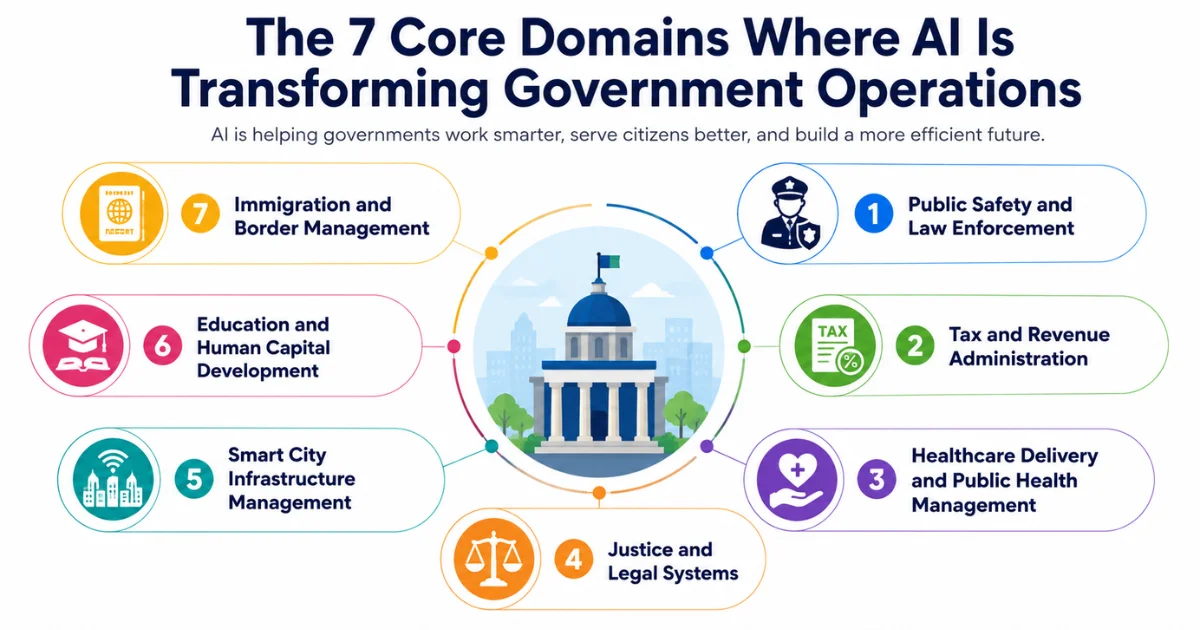
3. The 7 Core Domains Where AI Is Transforming Government Operations
3.1 Public Safety and Law Enforcement
AI-powered video surveillance systems are now capable of identifying suspicious behavior patterns, not just faces. Dubai's Safe City program integrates over 300,000 CCTV cameras with AI analytics that can detect crowd surge risks, abandoned objects, and behavioral anomalies in real time. When combined with generative AI, law enforcement officers receive natural language alerts that include contextual information, suggested response protocols, and auto-escalation pathways.
Predictive policing, when done ethically and transparently with proper data governance frameworks, has been shown to reduce response times by 20–30% in pilot deployments across the UAE and Europe.
3.2 Tax and Revenue Administration
Machine learning models have transformed tax compliance. The UK's HMRC has used AI to recover over £1.5 billion in additional tax revenue by detecting fraud patterns invisible to manual auditors. In the UAE, the Federal Tax Authority has been piloting AI-enhanced audit selection models that prioritize which companies to audit based on risk scoring — moving from random sampling to targeted intelligence.
Generative AI is now being used to help taxpayers self-resolve queries. Instead of calling a helpdesk and waiting on hold, a business submits a query, and the AI cross-references the tax code, the business's filing history, and recent regulatory updates to produce a plain-language guidance note.
3.3 Healthcare Delivery and Public Health Management
During COVID-19, governments that had invested in AI-powered health surveillance systems were able to detect outbreak clusters days faster than those relying on manual reporting. Post-pandemic, AI is being used for hospital bed management, diagnostic triage, drug procurement forecasting, and population health risk stratification.
Abu Dhabi's Department of Health has been leveraging AI to manage patient flow across public hospitals, reducing average emergency wait times significantly. Generative AI is enabling doctors to produce discharge summaries, referral letters, and patient education materials in minutes instead of hours.
3.4 Justice and Legal Systems
AI-assisted legal research tools are reducing the time judges, lawyers, and government counsel spend on case preparation. Systems trained on decades of legal precedent can surface relevant case law, draft contract summaries, and flag inconsistencies in legal documents with a speed and thoroughness no human team can match.
More importantly, generative AI is helping governments translate complex legal language into accessible, plain-language explanations that citizens can actually understand — a critical step toward legal equity.
3.5 Smart City Infrastructure Management
From water treatment plants to electrical grids to road maintenance scheduling, AI is enabling governments to manage urban infrastructure proactively rather than reactively. Sensor data from thousands of IoT devices feeds into machine learning models that predict equipment failures before they happen.
Dubai's DEWA (Dubai Electricity and Water Authority) uses AI-powered predictive maintenance that has reduced unplanned outages by 35% and saved hundreds of millions of dirhams in reactive repair costs.
3.6 Education and Human Capital Development
AI is transforming how governments deliver education—not just in classrooms, but across workforce training programs. Adaptive learning platforms use AI to personalize curriculum based on individual learner performance, ensuring that government-funded training programs actually produce measurable skills outcomes.
In the UAE's school system, AI tutoring tools are being trialed to support students in Arabic and English simultaneously — a critical capability for a multilingual, multicultural population.
3.7 Immigration and Border Management
The speed and accuracy of border processing is a direct determinant of economic competitiveness for trade-dependent nations like the UAE. AI-powered passport readers, biometric verification systems, and risk-scoring algorithms have reduced average processing time at Dubai International Airport to under 10 seconds per traveler for pre-registered passengers.
Generative AI is now being applied to visa processing — analyzing application documents, cross-referencing international watchlists, and generating decision-support briefs for immigration officers that would take a human analyst hours to produce manually.
Quick Question: What is the difference between AI and generative AI in a government context?
Answer: Traditional AI in government recognizes patterns — detecting fraud, flagging anomalies, predicting traffic. Generative AI goes further by creating content — drafting policy briefs, writing legal summaries, responding to citizen queries in natural language. For government operations, generative AI effectively acts as an intelligent colleague that can write, explain, and communicate, not just analyze.
4. Workforce Transformation: The Human Side of AI Adoption
Let's talk about the conversation that every government HR director and every cabinet minister is quietly nervous about.
Will AI replace government workers?
Here is the honest answer: AI will not replace government workers. But government workers who use AI will replace those who don't.
The evidence from early adopters is clear. When Estonia implemented AI-assisted document processing across its digital government platform, it didn't lay off civil servants — it redeployed them. Workers who previously spent 80% of their time on data entry and document routing were freed up for constituent engagement, policy research, and strategic work that actually requires human judgment.
Workforce transformation in the public sector means three things: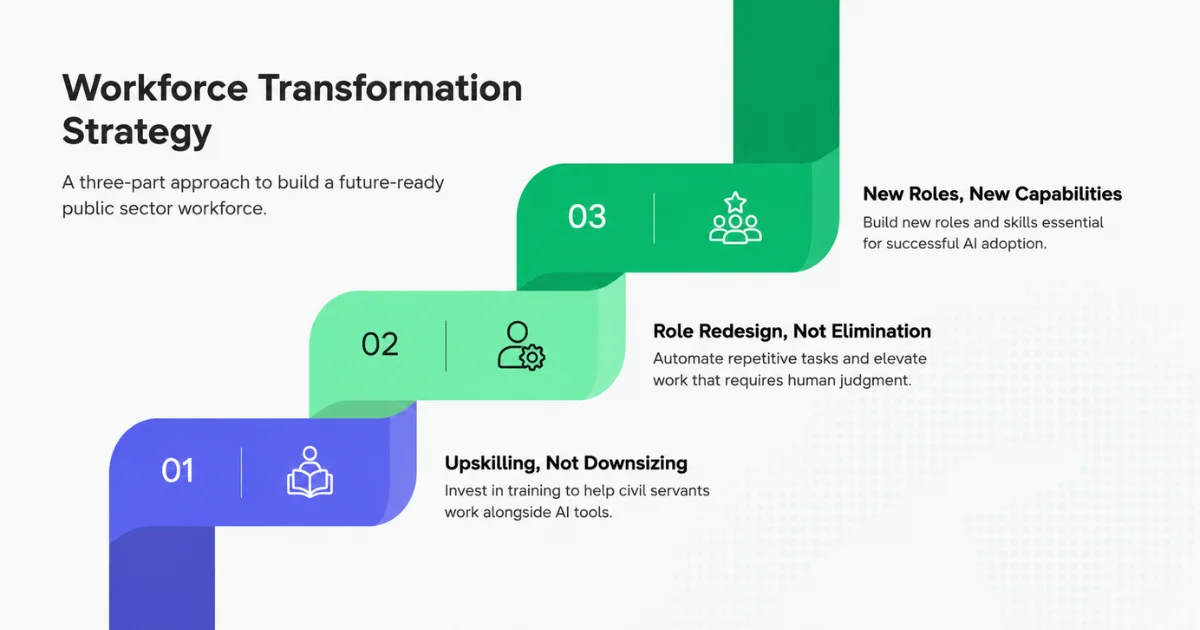
- Upskilling, not downsizing. Governments need to invest in training programs that give civil servants the skills to work alongside AI tools. Prompt engineering, AI output verification, data literacy, and change management are becoming core competencies for every government role — not just IT departments.
- Role redesign, not role elimination. The repetitive, low-value tasks that consume 40–60% of most civil servants' time (manual data entry, form processing, standard correspondence, basic reporting) will be automated. The work that requires empathy, judgment, negotiation, and ethical reasoning will be elevated. This is fundamentally a good thing for workforce morale and government effectiveness.
- New roles, new capabilities. AI governance officers, prompt engineers, AI ethics reviewers, data stewards, and digital transformation leads are becoming essential hires for any government serious about AI implementation. The UAE's government talent pipeline needs to include these roles.
As an ai development services provider working with government and enterprise clients, we consistently see that organizations that treat workforce transformation as a technical project fail. The ones that treat it as a people project — with investment in change management, communication, and role clarity — succeed.
The transformation isn't coming. It's here. The question is whether your people are ready for it.
5. Citizen Support at Scale: What AI-Powered Public Service Looks Like
Think about the last time you interacted with a government service. Maybe you renewed a license, filed a tax return, applied for a permit, or registered a business. How long did it take? How many forms did you fill out? How many times did you call a helpline and get routed through an automated menu that eventually told you to call back during business hours?
Now imagine a different experience.
You open an app or a web portal. You type a question in Arabic, English, Hindi, or any of the dozen languages spoken across the UAE's diverse population. An AI assistant responds instantly — not with a generic FAQ answer, but with a personalized, context-aware response that references your specific situation, your existing account data, and the current regulatory requirements. If you need to submit a document, the AI extracts the relevant information automatically and pre-fills the form. If there's an issue with your application, the AI explains exactly what's wrong, what you need to correct, and how to do it — in plain language, without bureaucratic jargon.
This is not a vision. This is what best-in-class AI-powered citizen support looks like today.
Saudi Arabia's Absher platform, which handles millions of government service transactions, has integrated AI assistants that resolve over 70% of citizen queries without human agent involvement. Singapore's Singpass system uses AI for identity verification and service routing that has reduced government service transaction times by an average of 60%.
The UAE's government entities, particularly MOHRE (Ministry of Human Resources and Emiratisation) and the Federal Authority for Identity and Citizenship, have already deployed AI chatbots and document processing tools. But there is enormous headroom for deeper, more integrated AI-powered citizen engagement.
For business leaders reading this: if your company serves the public sector, or if your government clients are evaluating AI solutions, the citizen experience is the metric that matters most. Operational efficiency is important — but it's the citizen satisfaction score, the resolution time, and the accessibility across languages and channels that will determine whether an AI implementation is considered a success.
Quick Question: How does AI improve citizen support in government services?
Answer: AI enables 24/7 multilingual support, instant query resolution, personalized responses based on a citizen's specific data, and automated document processing — reducing wait times from days or hours to seconds. Government call centers and service counters are supplemented (not replaced) by AI that handles routine transactions, freeing human agents for complex, high-empathy interactions.
6. Digital Transformation in UAE Government: Where Things Stand Today
The UAE isn't starting from zero. It's arguably the most digitally ambitious government in the Arab world — possibly in the world.
The country's Vision 2031 and the UAE National AI Strategy are backed by genuine political will, real budget allocation, and a track record of execution. The Smart Dubai initiative has digitized over 1,000 government services. The Dubai Now app consolidates services from 55 government entities into a single platform. UAE PASS provides a digital identity framework that enables citizens to authenticate once and access all government services.
But here's what I want to be honest about: infrastructure and ambition are not the same thing as capability.
Many UAE government entities have excellent digital front-ends but legacy back-end systems that make true AI integration difficult. They have digital portals but siloed data architectures that prevent AI models from accessing the cross-departmental information they need to be genuinely intelligent. They have AI strategies but procurement processes designed for the pre-AI era.
As a digital transformation company in UAE with deep experience in government systems integration, we see this pattern regularly. The intent is there. The talent is increasingly available. The missing piece is often the right implementation partner — one that understands both the technical architecture of enterprise AI and the regulatory, linguistic, and cultural context of the UAE public sector.
The countries that are winning the digital government race — Estonia, Singapore, Denmark — share a common trait: they partnered with specialist technology vendors who could bridge the gap between AI capability and government reality. They didn't try to build everything in-house, and they didn't trust generic enterprise software providers who applied a global template. They found partners with contextual depth.
The UAE has an extraordinary opportunity to be the global benchmark for AI-powered government in the next decade. But it requires the right technical foundation — and that means investing in the right partnerships now.
7. Data-Driven Reality: Key AI in Government Statistics for 2026
Let me ground this conversation in numbers, because strategy without data is just aspiration.
According to a 2025 PwC Government Digital Intelligence Report:
- 68% of global government leaders say AI is already part of their core operational strategy (up from 31% in 2022)
- Governments that have deployed AI across 3+ domains have seen average ROI of 340% over a 3-year period
- AI-powered document processing in government reduces manual processing time by 75–85% on average
- Natural language AI chatbots for citizen services resolve 65–80% of queries without human escalation
- Governments using AI for predictive analytics in infrastructure maintenance report 25–40% reduction in unplanned downtime costs
- AI-assisted fraud detection in tax and benefits systems has recovered an average of $1.2 billion per country in previously undetected fraud (Deloitte, 2025)
For the UAE specifically:
- The UAE AI economy is projected to reach $96 billion by 2031 (UAE Ministry of Economy)
- Over 50 UAE government entities have active AI initiatives as of Q1 2026
- The Dubai Future Foundation has incubated 120+ AI-focused government programs since 2020
- UAE government AI investments grew by 47% year-over-year in 2025
These are not projections from optimistic consultants. These are observed results from governments that have made the investment.
The question for every government leader and every technology vendor in the UAE right now is not "should we invest in AI?" The answer to that question is settled. The question is: "How do we make sure our AI investments produce these results — and not become expensive pilot projects that never scale?"
Quick Question: What is the ROI of AI implementation in government?
Answer: According to PwC's 2025 data, governments that have deployed AI across multiple domains report an average ROI of 340% over three years. Key savings come from reduced manual processing costs, fraud recovery, infrastructure maintenance optimization, and citizen service efficiency — with some departments reporting cost reductions of 28–40%.
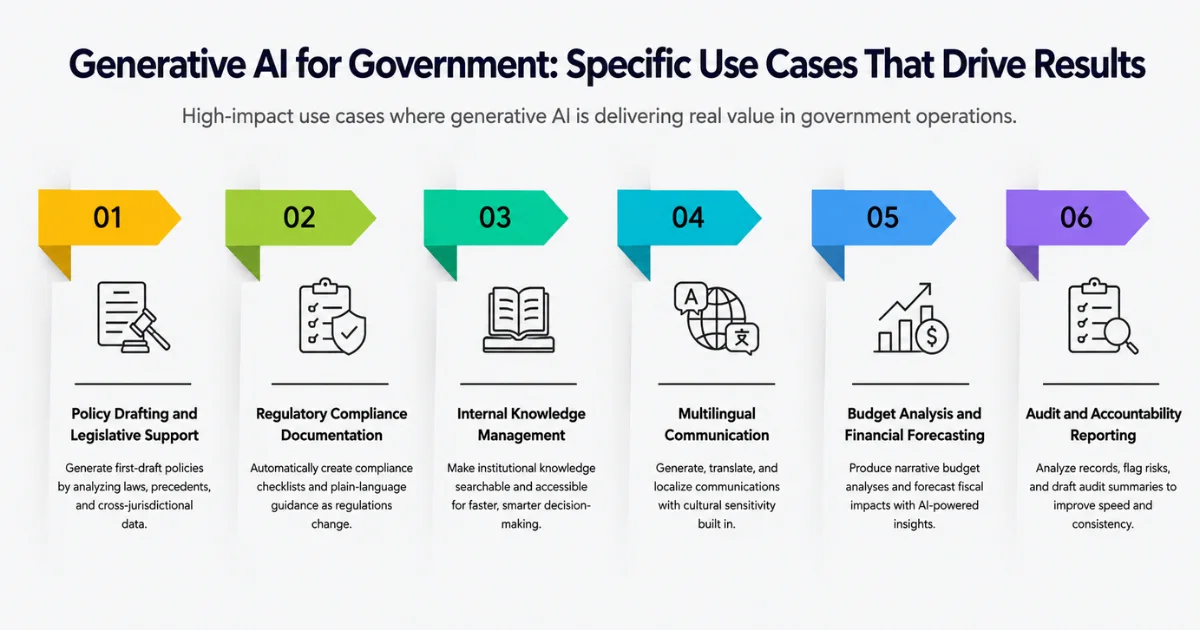
8. Generative AI for Government: Specific Use Cases That Drive Results
Let me get specific about where generative AI is delivering the most tangible value in government operations — because this is where decision-makers need clarity.
8.1 Policy Drafting and Legislative Support
Generative AI can synthesize legislative data from dozens of jurisdictions, identify precedents, flag inconsistencies with existing law, and produce first-draft policy documents in hours rather than weeks. The UK Parliament has piloted AI-assisted research tools that help MPs access complex briefing data faster. The UAE's Federal National Council can benefit similarly.
8.2 Regulatory Compliance Documentation
For both government regulators and the businesses they oversee, generative AI can automatically generate compliance checklists, update regulatory guidance documents as laws change, and produce plain-language summaries of complex regulatory requirements — dramatically reducing compliance friction on both sides.
8.3 Internal Knowledge Management
Every government ministry has decades of institutional knowledge locked in unstructured documents, email archives, and internal reports. Generative AI retrieval-augmented generation (RAG) systems can make this knowledge searchable and accessible — so a new official joining a ministry can get intelligent, contextual answers to questions that would otherwise require asking the right person on the right day.
8.4 Multilingual Communication
For UAE government entities serving a population where Arabic, English, Hindi, Urdu, Tagalog, and dozens of other languages are spoken daily, generative AI's multilingual capability is transformative. Citizen communications can be generated, translated, and localized automatically — with cultural sensitivity built into the model rather than patched on afterward.
8.5 Budget Analysis and Financial Forecasting
Generative AI combined with traditional financial modeling tools can produce narrative budget analyses, identify anomalies in spending patterns, and generate fiscal impact assessments for proposed policy changes. Treasury departments that previously required teams of economists to produce quarterly reports are now doing it in hours with AI assistance.
8.6 Audit and Accountability Reporting
Government audit bodies face enormous workloads. Generative AI can read financial statements, cross-reference procurement records, flag potential irregularities, and draft audit findings summaries — dramatically accelerating the audit cycle while improving consistency and coverage.
If you want to understand more about how AI is being applied at a technical level across UAE enterprise and government contexts, our detailed piece on Artificial Intelligence revolutionizing government in UAE covers the operational architecture behind these transformations.
9. The Risks Nobody Talks About (And How to Mitigate Them)
Every conversation about AI in government tends to focus on the upside. I want to be the voice that's honest about the downside—because if you're a decision-maker, you need to understand the risks as clearly as you understand the opportunities.
Risk 1: Algorithmic Bias in Public Decision-Making
AI systems trained on historical data inherit historical biases. If a loan approval AI was trained on data from an era when certain demographics were systematically disadvantaged, it will perpetuate that disadvantage unless actively corrected. For government systems that make decisions affecting citizens' lives—benefits eligibility, visa applications, law enforcement prioritization—this risk is not abstract. It's consequential.
Mitigation: Every government AI system must undergo bias auditing before deployment. Model outputs must be explainable. Human review must remain in the decision loop for high-stakes determinations.
Risk 2: Data Privacy and Sovereignty
Government AI systems process vast amounts of sensitive citizen data. The risk of breach, misuse, or unauthorized transfer to foreign entities is existential for government trust. The UAE's Personal Data Protection Law (Federal Decree-Law No. 45 of 2021) establishes a framework, but implementation varies significantly.
Mitigation: AI systems for government use must be deployed on UAE-sovereign infrastructure or certified UAE cloud environments. Data governance frameworks must be embedded in every AI procurement contract.
Risk 3: Hallucination and Misinformation in Generative AI Outputs
Generative AI models can produce confident-sounding incorrect information. For a citizen support chatbot, a hallucination might cause a citizen to miss a deadline or submit incorrect documents. For a policy drafting tool, it could introduce legal errors.
Mitigation: Retrieval-augmented generation (RAG) architectures that ground model outputs in verified, authoritative knowledge bases. Human review protocols for all AI-generated documents with legal or policy implications. Confidence scoring and uncertainty flagging in AI outputs.
Risk 4: Vendor Lock-In
Governments that adopt proprietary AI platforms without adequate portability provisions can find themselves permanently dependent on a single vendor's pricing, roadmap, and availability.
Mitigation: Open standards, modular architecture, and procurement frameworks that require API portability and data export capabilities.
Risk 5: Implementation Failure
The biggest risk in government AI is not that the technology doesn't work — it's that organizations implement it without adequate change management, integration planning, or realistic success metrics.
Mitigation: Start with well-defined use cases, measurable outcomes, and a phased implementation approach. Treat AI deployment as organizational change, not just IT deployment.
10. The Evolving Role of the CIO and CTO in Government AI
If you're a technology leader in a government entity reading this, your role has fundamentally changed.
The CIO of 2020 was a systems manager. The CIO of 2026 is a strategic transformation architect. The decisions you make about AI architecture, data infrastructure, vendor partnerships, and workforce capability will determine whether your ministry leads or lags over the next decade.
Here's what the most effective government technology leaders are doing differently:
They're thinking in platforms, not projects. Instead of approving isolated AI pilots, they're building shared AI infrastructure—centralized data lakes, API management layers, AI model registries—that allow multiple departments to deploy AI capabilities without starting from scratch each time.
They're building AI governance frameworks proactively, not reactively. Ethics committees, bias review boards, explainability requirements, and audit trails are built into AI deployment processes from day one—not bolted on after a problem emerges.
They're partnering with specialist AI vendors who understand government context. Generic enterprise software providers can sell you AI tools, but they can't tell you how those tools need to behave within the specific regulatory, linguistic, and operational reality of UAE government.
As you evaluate AI implementation options, it's worth understanding the full economic dimension of these decisions. Our analysis on AI development cost in Dubai 2026 provides a realistic picture of what government-grade AI implementation actually costs — and what drives that cost.
11. Specific AI Use Cases for UAE Government Services
The UAE government has unique characteristics that shape how AI must be designed and deployed. The population is approximately 90% expatriate. Arabic and English are both official languages but the actual linguistic reality is far more complex. The regulatory environment intersects federal, emirate, and free zone jurisdictions. Islamic finance principles apply across significant portions of the economy.
Any AI system deployed for the UAE government must be designed for this specific context—not adapted from a Western framework.
Here are the most high-impact AI use cases specifically relevant to UAE government operations:
Golden Visa and Residency Processing: AI can accelerate visa processing by automatically verifying documents, cross-referencing international databases, and generating officer decision-support briefs. Current processing times that take weeks can be reduced to hours.
Emiratisation (Nafis) Programme Management: AI can match Emirati job seekers with private sector opportunities, predict placement success rates, monitor program compliance, and generate personalized career development recommendations at a population scale.
Business Licensing and Setup (DED, Free Zones): Generative AI can guide entrepreneurs through the business setup process in natural language, reduce the time required to navigate licensing requirements, and automatically generate draft applications.
Smart Procurement and Contract Management: Government procurement departments can use AI to analyze vendor bids, flag anomalies, generate contract summaries, and monitor supplier performance against contractual KPIs.
Emergency and Crisis Response Coordination: During natural disasters, public health emergencies, or security incidents, AI coordination platforms can manage resource allocation, communication routing, and situational awareness in real time.
For a deeper look at how these use cases are being implemented across the UAE specifically, our article on AI use cases in UAE government services provides detailed operational context.
12. Building Your Government AI Roadmap: A Practical Framework
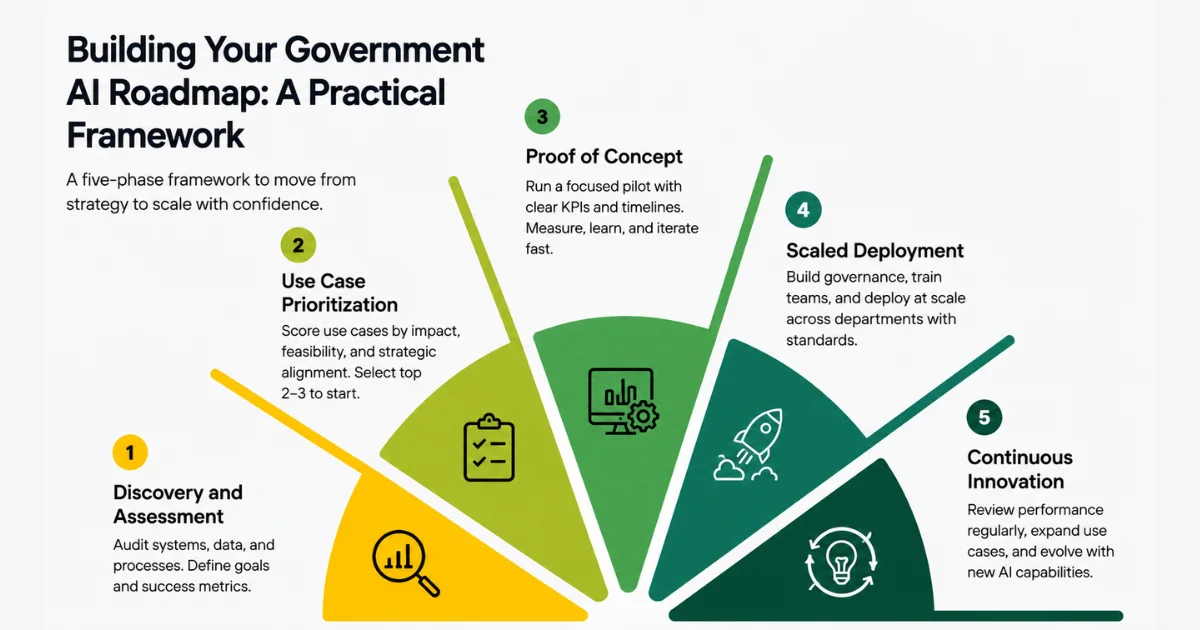
If you're a decision-maker trying to move from interest to action, here is a practical framework we use with our government and enterprise clients.
Phase 1: Discovery and Assessment (Months 1–2)
Audit your current digital infrastructure. Identify your most data-rich, process-heavy, and citizen-facing operations. Map your data governance situation—where your data lives, how clean it is, who owns it. Define what "success" looks like in specific, measurable terms. Do not start with AI technology. Start with the business problem.
Phase 2: Use Case Prioritization (Month 2–3)
Score your identified use cases on three dimensions: business impact (time saved, cost reduced, and citizen satisfaction improved), technical feasibility (data availability and integration complexity), and strategic importance (alignment with UAE Vision 2031 and department mandate). Select 2–3 use cases that score highest across all three dimensions for your initial implementation.
Phase 3: Proof of Concept (Months 3–6)
Deploy a controlled AI pilot in your selected use cases with clear KPIs, defined test populations, and a structured evaluation framework. This is not a forever project — it's a time-boxed validation. Measure rigorously. Iterate quickly.
Phase 4: Scaled Deployment (Months 6–18)
Once you have proof of value, build the organizational infrastructure for scaling: AI governance frameworks, integration standards, workforce training programs, change management plans, and vendor management protocols. Deploy across departments with a center-of-excellence model.
Phase 5: Continuous Innovation (Ongoing)
AI is not a one-time deployment. The models improve. New capabilities emerge. Your use case portfolio should expand as your organizational AI maturity grows. Build in quarterly review cycles that assess AI performance, identify new opportunities, and retire underperforming use cases.
This isn't theoretical. It's the framework that's working for our government and enterprise clients across the Middle East. And it's the framework that every software development company uae worth working with should be able to implement—not just describe.
13. The Intersection of AI and the Private Sector in Government Services
Here's something government leaders sometimes overlook: the private sector is a delivery partner, not a competitor.
In the UAE, PPP (Public-Private Partnership) models are central to how government digital transformation gets done. The best AI implementations in the UAE government have involved specialist technology companies that bring AI capability, development capacity, and implementation experience that government IT departments can't maintain internally.
This is a mature and intelligent approach. Singapore's government doesn't try to build AI from scratch—it partners with Google, Microsoft, and specialist regional vendors to deploy world-class AI capability. Estonia's digital government is built on a combination of government architecture and private sector technology partners.
For UAE government entities evaluating AI vendors, here's what actually differentiates a partner worth working with from a vendor that will disappoint:
- UAE-specific experience: Do they understand Arabization requirements, Islamic finance principles, UAE data sovereignty laws, and the cultural context of the country's diverse population? A global template won't work here.
- End-to-end capability: Can they cover the full stack — from data engineering and model development to UI/UX, integration, deployment, and ongoing support?
- Track record with government: Have they delivered at government scale before? Government requirements around security, compliance, uptime, and audit are categorically different from commercial projects.
- Transparent pricing: Can they give you a realistic, itemized projection of implementation costs? Vendors who can't be transparent about costs early are usually surprises later.
You would also like to read: why AI software is replacing traditional software
Quick Question: How should UAE government entities choose an AI vendor?
Answer: Look for vendors with proven UAE or GCC government experience, end-to-end AI development capability (not just consulting), transparent pricing, Arabic language AI capability, UAE data sovereignty compliance, and a track record of implementations that scaled beyond the pilot phase. A vendor that can only describe AI but not build and deploy it is a strategy firm, not an implementation partner.
14. What Governments Get Wrong About AI (And How to Get It Right)
I've been in technology long enough to watch organizations spend significant budgets on technology transformations that failed. Here are the patterns I see most often in government AI projects — and what the successful ones do differently.
What goes wrong: Starting with the technology, not the problem. Teams get excited about ChatGPT or a specific AI platform and try to find government problems it can solve. This is backwards. Start with the most painful, time-consuming, data-rich operational problem you have, then identify the AI capability that addresses it.
What goes right: Problem-first, technology-second.
What goes wrong: Underestimating the data problem. AI is only as good as the data it's trained on. Most government data is messy, siloed, inconsistently labeled, and stored in legacy systems that are difficult to integrate. Organizations that don't invest in data infrastructure before AI deployment are setting themselves up for failure.
What goes right: Data governance investment before AI deployment.
What goes wrong: No change management investment. Technology transformation fails when people don't change. Government employees who feel threatened by AI will resist it. Managers who don't understand AI will refuse to trust its outputs. Executives who haven't been educated about AI risks and opportunities will make poor governance decisions.
What goes right: Treat AI as an organizational change and invest in it accordingly.
What goes wrong: Measuring activity instead of outcomes. Teams report on the number of AI tools deployed, the number of models trained, and the number of datasets processed—and call it success. Meanwhile, citizen wait times haven't changed, fraud losses haven't decreased, and employee workload hasn't reduced.
What goes right: Define outcome-based KPIs from day one and measure them relentlessly.
What goes wrong: Siloed implementation. Each department builds its own AI solution, with different vendors, different data standards, and different security protocols. The result is fragmented capability, duplicated cost, and interoperability nightmares.
What goes right: Centralized AI governance and infrastructure with decentralized use case implementation.
15. The ROI Conversation: How to Make the Business Case for Government AI
If you need to present the business case for AI investment to a minister, a budget committee, or a board, here's how to frame it.
Operational Efficiency Savings: Government operations in the UAE involve millions of transactions annually—license renewals, permits, inspections, registrations, and payments. Each manual transaction costs between AED 50 and 500 in processing time depending on complexity. AI-automated processing at even 50% of current volume creates hundreds of millions in operational savings annually.
Fraud and Revenue Recovery: AI-powered fraud detection in tax, benefits, and procurement typically recovers 2–5x the cost of implementation in the first year. For a government the size of Dubai, that's a compelling number.
Citizen Experience Value: Every percentage point improvement in citizen satisfaction with government services directly affects city competitiveness, FDI attraction, and talent retention. Abu Dhabi Global Market, Dubai International Financial Centre, and the UAE's entire strategy of attracting global business depends partly on government services being world-class.
Strategic Positioning: The UAE's Vision 2031 and its global competitiveness ambitions require AI leadership. The cost of not investing in AI is not zero — it's the opportunity cost of falling behind Singapore, Riyadh, and Nairobi.
The ROI conversation for government AI is multidimensional. But it is always positive when implementation is done well.
Final Thoughts
Let me come back to where I started.
The question for government leaders in the UAE and across the GCC is no longer whether to adopt AI. It's how fast you can move from intent to implementation. It's whether your organization's data infrastructure, talent, procurement processes, and governance frameworks are ready to support AI at scale. And it's whether you have the right partners to get you from strategy to operational reality.
Generative AI and AI-powered systems are not magic. They require investment, expertise, change management, and disciplined implementation. But for governments willing to make that investment, the returns — in operational efficiency, citizen satisfaction, fraud recovery, and strategic positioning — are transformative.
The UAE has every advantage: political will, budget, a technology-forward culture, a clear national AI strategy, and a track record of executing ambitious digital initiatives. What it needs now is for the organizations within it — government entities, technology vendors, and business leaders — to move from discussion to deployment.
The governments that move fastest right now will define the standard for public sector AI for the next decade. The ones that wait will spend the next decade catching up.
Your Government AI Implementation Partner in the UAE
If this article has given you clarity on where your AI journey needs to go, the next step is finding the right partner to take you there.
SISGAIN is a UAE-based technology company with deep expertise in government IT, enterprise AI, and digital transformation. We have a proven track record of delivering AI implementations that move beyond pilots to production—at the scale, security standard, and linguistic capability that UAE government operations require.
We don't just advise. We build, deploy, integrate, and support. Our teams understand the specific regulatory environment of the UAE, the importance of Arabic language AI capability, and the operational realities of government technology at scale.
Here's what working with SISGAIN looks like:
- Discovery workshop — We spend time understanding your specific operational challenges, data landscape, and strategic priorities before recommending anything.
- Use case roadmap — We deliver a prioritized AI roadmap with realistic implementation timelines, cost projections, and expected ROI.
- End-to-end delivery — From data engineering and model development to UI/UX, integration, security, and deployment — our teams cover the full stack.
- Government-grade security — All implementations meet UAE data sovereignty requirements and can be deployed on UAE-compliant infrastructure.
- Ongoing partnership — AI doesn't stop at go-live. We provide continuous monitoring, model retraining, and capability expansion as your needs evolve.
Whether you're a federal ministry, an emirate-level authority, a free zone entity, or a private company that serves the government—SISGAIN has the experience, the team, and the UAE context to make your AI investment deliver real results.