
Key takeaways:
-
AI software development costs in Dubai typically range from AED 40,000 to AED 3 million+, depending on solution complexity, infrastructure requirements, and AI model sophistication.
-
Chatbots, predictive analytics, computer vision, NLP applications, and enterprise AI platforms represent the most common AI investments among Dubai businesses in 2026.
-
Finance, healthcare, e-commerce, logistics, and smart city sectors are driving the highest AI adoption rates across the UAE.
-
Training data preparation, AI infrastructure, cloud resources, system integrations, and development expertise significantly influence total project costs.
-
Businesses can reduce AI development expenses by 25–40% through MVP development, cloud-native deployment, open-source frameworks, and modular architecture.
-
Dubai's growing AI ecosystem is supported by government initiatives, smart city programs, and increasing private-sector investments in digital transformation.
-
AI-powered solutions help organizations improve operational efficiency, automate repetitive tasks, enhance customer experiences, and generate data-driven business insights.
-
SMEs typically allocate AED 100K–500K for AI initiatives, while enterprises often invest AED 2 million or more in large-scale AI platforms.
-
Selecting an AI development partner with industry expertise, compliance knowledge, MLOps capabilities, and transparent pricing is essential for long-term project success.
-
Companies that invest strategically in AI today are expected to gain competitive advantages through automation, cost reduction, and scalable business growth.
Artificial intelligence has rapidly moved from experimentation to essential business infrastructure in the United Arab Emirates. Companies across sectors are adopting AI-powered software development UAE solutions to automate operations, improve decision-making, and deliver more personalized customer experiences. As digital transformation accelerates, the AI software demand in Dubai 2026 continues to grow, supported by strong government initiatives, technology investments, and the region's ambition to lead global innovation.
Dubai has become a key hub for AI innovation, attracting startups, global enterprises, and investors focused on advanced technologies. Increasing Dubai's investment in smart cities, fintech platforms, healthcare systems, and logistics automation is driving organizations to explore scalable AI software development Dubai solutions. However, one of the most important questions businesses ask before adopting AI is understanding the cost of Dubai's artificial intelligence services and the factors that influence development budgets.
The AI app development cost in Dubai can vary widely depending on the complexity of the solution, the amount of data required, and the expertise of the AI software company in the UAE delivering the project. Partnering with experienced AI software experts in UAE allows businesses to build efficient AI systems while managing costs and maximizing long-term ROI.
This guide explains the real cost structure of AI software development in the UAE, the industries driving adoption, and the strategic considerations companies should evaluate before investing in artificial intelligence in Dubai.
Why AI Is Becoming a Core Business Investment in Dubai
Artificial intelligence is no longer just an experimental tool—it is a core business investment in Dubai. Companies in the UAE are moving beyond small pilot projects and integrating AI into their core operations to enhance efficiency, reduce costs, and unlock new revenue streams. This trend is a major factor behind the rising AI software demand in Dubai 2026, as organizations compete to adopt intelligent technologies faster than ever.
A key driver of this transformation is the surge in Dubai AI investment. The UAE government has positioned AI at the center of its economic diversification strategy, promoting innovation across smart cities, autonomous transport, digital banking, and advanced healthcare systems. With robust infrastructure and regulatory support in place, businesses are increasingly relying on AI software development Dubai solutions to maintain competitiveness in a technology-driven market.
Businesses seeking a scalable AI software solution in Dubai are increasingly leveraging intelligent technologies to automate operations, improve decision-making, and accelerate digital transformation initiatives.
AI delivers advantages that traditional software systems cannot match. Through AI-powered software development, companies can analyze large datasets, predict market trends, automate repetitive tasks, and enhance customer experiences via personalization. Logistics firms optimize delivery routes, financial institutions detect fraud using machine learning models, and retailers implement recommendation engines to boost conversions. Many of these organizations partner with an experienced software company in the UAE to ensure their AI solutions are tailored, scalable, and aligned with local regulations.
These capabilities explain why enterprises are investing heavily in AI initiatives. Working with skilled AI software experts in UAE allows businesses to design solutions that address industry-specific challenges while improving operational performance. The financial upside is also hard to ignore — companies that have implemented AI in their supply chains, customer service operations, or fraud prevention systems have reported efficiency gains of 20 to 45 percent, depending on the maturity of the solution and the quality of the underlying data strategy.
Another important dynamic shaping Dubai's AI landscape is the DIFC (Dubai International Financial Centre), which has emerged as a nucleus for AI-driven financial services innovation. DIFC AI companies are developing everything from robo-advisory platforms to automated compliance engines, and the regulatory sandbox environment within DIFC has made it easier for businesses to pilot and scale AI solutions without the friction of traditional approval cycles. As Dubai continues to cement its role as a global technology hub, AI is evolving from a competitive advantage into a business necessity—companies adopting it strategically today are set to lead innovation, while those delaying risk falling behind in an increasingly data-driven economy.
AI Investment as Dubai's Business Lifeline
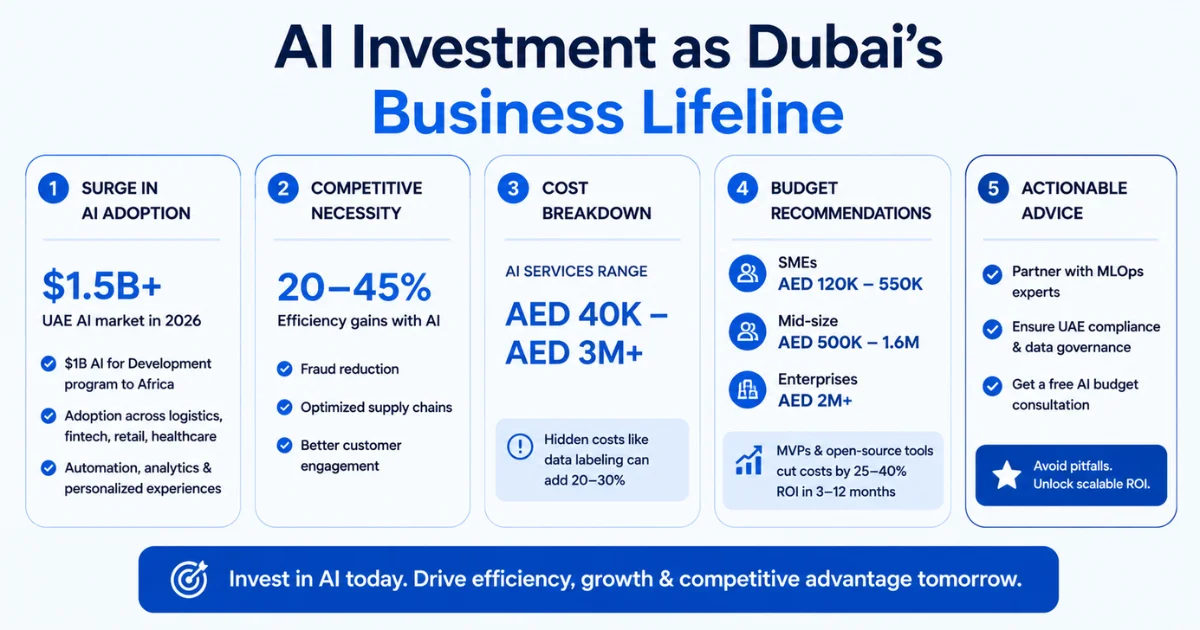
Surge in AI Adoption: The UAE's AI market is set to exceed $1.5 billion in 2026, boosted by initiatives like the $1 billion AI for Development program to Africa. Businesses across logistics, fintech, retail, and healthcare are leveraging AI for automation, analytics, and personalized experiences.
Competitive Necessity: Companies ignoring AI risk falling behind. Efficiency gains of 20–45% are reported, including fraud reduction, optimized supply chains, and better customer engagement through AI-powered software development.
Cost Breakdown: The cost of Dubai artificial intelligence services ranges from AED 40,000 for chatbots to AED 3M+ for enterprise platforms. Hidden costs like data labeling can add 20–30%.
Budget Recommendations: SMEs: AED 120K–550K; mid-size: AED 500K–1.6M; enterprises: AED 2M+. MVPs and open-source tools can reduce costs by 25–40%, achieving ROI in 3–12 months.
Actionable Advice: Work with partners having MLOps expertise and UAE compliance. A free AI budget consultation helps avoid pitfalls and unlock scalable ROI.
Current AI Software Demand in Dubai (2026 Market Outlook)
AI adoption in Dubai is reaching unprecedented levels in 2026. The AI software demand in Dubai 2026 is growing rapidly as companies accelerate digital transformation initiatives, aiming to automate operations, analyze large datasets, and enhance decision-making. With strong Dubai AI investment and government-backed innovation programs, artificial intelligence has become a critical component of modern business infrastructure. Organizations are increasingly relying on AI-powered software development to create advanced tools for analytics, operational efficiency, and superior customer experiences. This surge in demand has also heightened the need for skilled AI software experts in the UAE who can design scalable, industry-specific solutions and build efficient AI apps for various business needs.
The growing demand for enterprise generative AI development Dubai services highlights how organizations are adopting advanced AI capabilities to automate workflows, generate business insights, and improve operational efficiency.
Today, multiple industries are driving the growth of AI adoption in Dubai. These sectors are integrating artificial intelligence into their daily operations to stay competitive in a fast-evolving digital economy.
Key industries driving AI software demand in Dubai include:
Finance and Fintech: Banks and financial institutions are adopting AI for fraud detection, automated compliance monitoring, predictive analytics, and intelligent customer service systems.
Healthcare: Hospitals and medical technology providers use AI for medical imaging analysis, patient data management, predictive diagnostics, and AI-assisted treatment planning.
Retail and e-commerce: AI helps businesses analyze consumer behavior, personalize shopping experiences, improve demand forecasting, and optimize inventory management.
Logistics and Transportation: Companies use AI for route optimization, predictive fleet maintenance, warehouse automation, and supply chain intelligence.
Real Estate and Smart Cities: AI-powered analytics tools help developers evaluate property demand, forecast market trends, and optimize property management operations.
As these industries continue to adopt advanced technologies, the demand for AI software development in Dubai will continue to grow. Businesses are increasingly partnering with experienced AI development teams to build intelligent applications that improve productivity, reduce operational costs, and support long-term digital growth.
Quick Question: Is AI development in Dubai suitable for small and medium businesses, or is it only for large enterprises?
AI development in Dubai is absolutely suitable for SMEs. In fact, many AI consulting companies in Dubai work specifically with small and mid-sized businesses to build cost-effective, modular solutions. Starting with a focused MVP — such as an AI chatbot or a basic recommendation engine — allows smaller businesses to validate ROI before committing to larger investments. SMEs typically budget between AED 100K and AED 500K and still achieve meaningful automation, customer service improvements, and operational efficiencies within three to six months of deployment.

What Does AI Development Actually Cover?
One of the most common sources of confusion for businesses exploring AI implementation in Dubai is understanding what the term "AI development" actually encompasses. Many decision-makers assume AI development means simply licensing a software tool or integrating an existing platform. In reality, custom AI development in the UAE involves a much broader and more layered process—and understanding this is critical for accurate budget planning in the UAE.
At its core, AI software development covers several interconnected phases. The first is discovery and scoping, where the AI development company Dubai works with your business to identify specific use cases, define success metrics, and evaluate existing data infrastructure. This phase is often underestimated but has significant implications for total cost, because the clearer the problem definition, the more efficient the development process.
The second phase is data engineering. AI systems are only as good as the data they learn from. This includes collecting raw data from your existing systems, cleaning and normalizing that data, labeling it for supervised learning tasks, and structuring it in a way that a machine learning model can interpret effectively. Data engineering can account for 30 to 40 percent of total AI development costs, particularly for industries like healthcare or logistics where data is complex, unstructured, or fragmented across legacy systems.
The third phase is model development and training. This is where your AI solution takes shape — algorithms are selected, neural networks are trained, and models are validated against test datasets to ensure accuracy and reliability. The sophistication of the model directly correlates with development time and cost. A simple rule-based chatbot takes weeks to build; a multimodal deep learning system for computer vision development in Dubai might take six to nine months.
The fourth phase involves integration and deployment — connecting your AI solution to existing business systems such as CRMs, ERPs, mobile applications, or cloud platforms. This is where AI solutions for business UAE become operational and begin generating measurable value.
Finally, there is ongoing maintenance and MLOps, which covers model monitoring, retraining on new data, performance audits, and infrastructure scaling. Businesses that skip planning for this phase often face unexpected costs six to twelve months post-launch. Understanding that AI development is a continuous process — not a one-time project — is essential for long-term success and accurate budget planning UAE.
For businesses exploring industrial applications, industrial AI introduces additional complexity, covering predictive maintenance, sensor data processing, and real-time anomaly detection in manufacturing or energy environments. These use cases typically sit at the higher end of the cost spectrum and require specialized engineering expertise.
Cost of Dubai Artificial Intelligence Services in 2026
The cost of Dubai artificial intelligence services varies depending on the complexity of the solution, the technology used, and the level of customization required. As the AI software demand in Dubai 2026 continues to grow, businesses across industries are investing in AI solutions to automate operations, improve analytics, and enhance customer experiences. The overall AI app development cost in Dubai can range from moderate investments for simple AI tools to large-scale budgets for enterprise AI platforms.
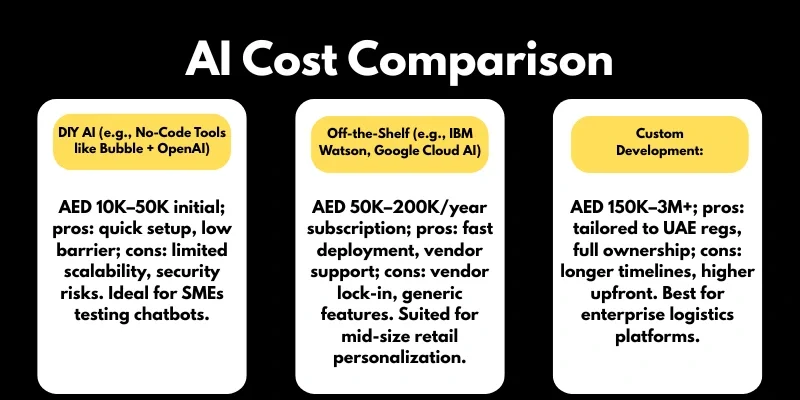
For example, basic AI applications such as chatbots or recommendation engines may require a smaller budget and shorter development timeline. However, advanced systems involving machine learning models, predictive analytics, or computer vision usually require more data processing, infrastructure, and development expertise. This is why the cost of AI software development Dubai projects often increases as the project scope expands.
Typical AI development cost estimates in Dubai include the following:
| AI Solution | Estimated Cost (AED) | Timeline |
|---|---|---|
| AI Chatbots | 40,000 – 150,000 | 3–8 weeks |
| Predictive Analytics Systems | 180,000 – 500,000 | 3–5 months |
| Computer Vision Platforms | 350,000 – 1.8M | 4–8 months |
| NLP / Voice AI | 300,000 – 950,000 | 4–9 months |
| Enterprise AI Platforms | 600,000 – 3M+ | 6–12 months |
These numbers represent general market estimates for AI software development Dubai projects. The actual investment required will depend on the business objectives, the sophistication of the AI model, and the technical infrastructure needed to deploy and maintain the solution.
Several important factors influence the cost of Dubai artificial intelligence services:
Project Complexity: Advanced AI systems involving deep learning, predictive modeling, or computer vision require more research, development time, and engineering expertise.
Training Data Requirements: AI systems depend heavily on high-quality datasets. Collecting, cleaning, and labeling training data can significantly affect development costs.
Integration with Existing Systems: Many organizations need AI tools to connect with CRM systems, enterprise databases, or cloud platforms, which increases development time and complexity.
AI Infrastructure and Cloud Resources: Machine learning models require powerful computing resources such as GPUs and scalable cloud infrastructure for training and deployment.
Team Expertise: Working with experienced AI software experts in the UAE ensures reliable, compliant, and scalable solutions, though premium expertise may increase upfront investment
Quick Questn: How long does it typically take to build and deploy an AI solution in Dubai?
Timelines vary significantly by solution type. A basic AI chatbot development Dubai project can go live in three to eight weeks. Predictive analytics platforms typically take three to five months to design, train, and deploy. More complex solutions like computer vision systems or NLP development UAE projects can span four to nine months.
Hidden Costs Most Businesses Miss in AI Projects
One of the most significant gaps in AI budget planning in the UAE is the underestimation of hidden costs. Many businesses receive a development quote, assume that covers the full investment, and are then blindsided by additional expenses that emerge as the project progresses. Understanding these costs upfront is not just good financial planning — it is the difference between an AI project that delivers ROI and one that stalls or gets abandoned midway.
The most common hidden cost in AI development is data labeling and annotation. For supervised machine learning models — which are used in everything from fraud detection to image classification — human annotators must manually label thousands or even millions of data points before the model can begin training. This work is time-intensive and, depending on the domain, may require expert annotators rather than generalist labelers. In practice, data labeling can add 20 to 30 percent to the stated development cost, particularly for computer vision development Dubai projects or NLP development UAE applications where labeled training datasets do not already exist.
Cloud infrastructure costs are another frequently underestimated line item. Training large AI models requires significant GPU compute time on cloud platforms such as AWS, Microsoft Azure, or Google Cloud. While pay-as-you-go pricing sounds economical, the compute hours required to train a production-grade model can accumulate quickly — sometimes running into tens of thousands of dirhams per training cycle. Businesses that plan to retrain their models regularly on new data need to factor in ongoing cloud infrastructure expenses as a recurring operational cost.
API and third-party service fees represent a third category of hidden costs. Many AI solutions in Dubai rely on external APIs for capabilities such as natural language processing, translation services, speech recognition, or geospatial data processing. These services are often billed on a usage basis, meaning costs scale with the volume of transactions processed. A company deploying an AI chatbot at scale, for example, may find that monthly API fees exceed the original development cost within twelve to eighteen months of operation.
Compliance and regulatory alignment are another cost driver that UAE businesses need to factor into their AI budget. The UAE has clear data protection regulations, including the Personal Data Protection Law (PDPL), and sectors like finance and healthcare have additional regulatory requirements around how AI systems process and store sensitive data. Ensuring compliance — through legal review, audit logs, data residency controls, and explainability features — adds real costs to any AI implementation in Dubai. Working with AI partners in Dubai who have prior experience navigating UAE regulatory requirements is the most efficient way to manage this risk.
Finally, employee training and change management are costs that rarely appear in an AI development proposal but have a direct impact on how quickly your organization realizes value from the investment. Staff need to understand how to interpret AI outputs, when to trust model recommendations, and how to escalate edge cases. Organizations that invest in structured training programs see significantly faster adoption and fewer operational errors in the months following deployment.
Tips to Reduce AI Development Costs in Dubai
Reducing AI costs does not mean cutting corners — it is about smart planning. Dubai businesses can optimize budgets while getting maximum ROI from AI software development Dubai projects.
Start with an MVP: Focus on core features first to validate ROI before scaling.
Use Open-Source Frameworks: TensorFlow, PyTorch, or Hugging Face cut licensing costs.
Go Cloud-Native: Pay-as-you-go cloud solutions save on infrastructure.
Partner Wisely: Work with a custom software development company or software company in UAE for expertise and milestone-based billing.
Reuse Modular Components: Microservices reduce redundant development by 20–25%.
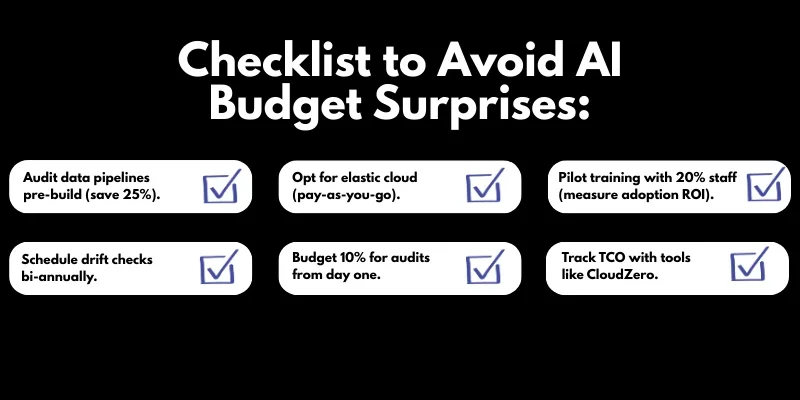
Plan Maintenance Early: Allocate budget for model updates, hosting, and audits to avoid surprises.
Following these strategies can reduce AI development costs by 25–40%, speed up deployment, and ensure scalable results.
Also Read—How to Build a Minimum Viable Product (MVP) That Gets Funding
A common question from businesses at this stage is whether to build AI capabilities in-house or work with an external AI development company in Dubai. The honest answer depends on your organization's existing technical capabilities and the strategic importance of AI to your long-term business model. For most UAE businesses — especially those in their first one to three years of AI adoption — partnering with an experienced external team is significantly more cost-effective than building internal AI teams from scratch. A good external partner brings pre-built frameworks, domain expertise, access to MLOps services in the UAE, and the ability to scale resources up or down depending on the project phase, all of which reduce both cost and time to deployment.
Another cost-reduction lever that many businesses overlook is the strategic use of pre-trained foundation models. Rather than training a large language model or vision model from scratch—which can cost hundreds of thousands of dirhams in compute alone—businesses can fine-tune existing open-source or commercially licensed foundation models on their own domain-specific data. This approach can reduce model development costs by 50 to 70 percent in many NLP and generative AI use cases, while still achieving performance levels that meet business requirements.
Quick Question: What is the difference between an AI chatbot and an AI agent, and does it affect the cost?
Yes, the distinction matters significantly for budgeting. A traditional AI chatbot development Dubai project involves a conversational interface that responds to user inputs based on pre-defined intents or a fine-tuned language model.Understanding the nuances between AI agents vs. AI chatbots is important: agents require significantly more architecture design, safety testing, and orchestration logic, which increases development cost.
Why Businesses Are Increasing Dubai AI Investment
Dubai has quickly become a global hub for artificial intelligence, with companies and government initiatives driving significant Dubai AI investment in 2026. The UAE continues to support AI adoption through strategic programs, funding, and collaborations with international tech hubs, making it easier for businesses to scale and innovate.
Organizations investing in AI-powered software development in the UAE are seeing clear benefits:
Boosting Efficiency: Automating repetitive tasks and optimizing workflows reduces errors and saves time across sectors like logistics, fintech, retail, and healthcare.
Smarter Decision-Making: Predictive analytics in the UAE and AI-driven insights help businesses respond faster to market changes.
Better Customer Experiences: Personalized recommendations and AI-assisted support improve engagement and loyalty.
Cost Savings: AI helps streamline operations and reduce unnecessary expenses over time.
Staying Competitive: Early adopters gain an edge in Dubai's fast-paced business environment.
Many companies rely on a reliable custom software development company or a reputable software company in the UAE to implement these AI solutions. Working with experienced partners ensures projects are compliant with UAE regulations, scalable, and aligned with business goals.
The UAE artificial intelligence investment landscape is also being shaped by macro-level government commitments. The National AI Strategy 2031 sets ambitious targets for AI's contribution to GDP, aiming for AI to account for $96 billion in economic output by 2031. This creates a powerful pull effect for private sector investment, as companies that adopt AI today are positioning themselves to benefit from government-procurement opportunities, smart city contracts, and cross-sector digital transformation programs. Businesses in sectors from construction to education are beginning to evaluate AI not just as a productivity tool but as a prerequisite for winning public and private contracts in a market that increasingly values data-driven operational capability.
With the rising AI software demand in Dubai in 2026, AI is no longer just a tech upgrade—it is a strategic investment. Collaborating with skilled AI software experts in UAE helps businesses unlock measurable results and long-term growth.
ROI Benchmarks: What Should You Expect From Your AI Investment?
When business leaders evaluate the cost of AI development in the UAE, the question they should be asking alongside the investment figure is: what return should I realistically expect, and over what time horizon? ROI benchmarks help frame the budget conversation in a way that aligns with business outcomes rather than technology deliverables, and they are a critical part of responsible AI budget planning in the UAE.
The ROI from AI investments in Dubai varies widely by solution type, implementation quality, and industry context, but several consistent patterns have emerged from enterprise deployments across the region.
In UAE financial services and fintech AI development, AI-powered fraud detection systems have demonstrated one of the strongest ROI profiles. Banks and payment platforms that deploy machine learning-based anomaly detection typically see fraud losses reduced by 30 to 60 percent within twelve months of deployment. When measured against development and operational costs, these systems often achieve full ROI within six to nine months — one of the fastest payback periods across any AI use case in the region.
For retail and e-commerce companies investing in AI-powered recommendation engines and demand forecasting, the typical ROI timeline is twelve to eighteen months. Revenue uplift from personalized product recommendations averages between 10 and 20 percent, and inventory carrying costs typically drop by 15 to 25 percent as demand forecasting accuracy improves. These may seem like moderate gains at first glance, but for large retailers processing hundreds of millions of dirhams in annual transactions, the absolute value of these efficiency improvements is substantial.
Logistics AI solutions in Dubai have generated a particularly compelling ROI in route optimization and predictive fleet maintenance. Companies deploying AI-driven route planning report fuel savings of 10 to 18 percent, while predictive maintenance systems reduce unplanned vehicle downtime by 20 to 35 percent. For logistics operators managing large fleets in the UAE's demanding climate, these efficiency gains translate directly into competitive pricing capacity and margin improvement.
Healthcare organizations investing in AI-assisted diagnostics and patient data management typically see ROI materialize over a longer horizon — eighteen to thirty-six months — due to the complexity of regulatory validation and the time required to integrate AI outputs into clinical workflows. However, the long-term value is significant: reduced diagnostic error rates, faster patient throughput, and lower administrative overhead create compound efficiency gains that continue to grow as the AI system is exposed to more data.
For enterprise AI platform development cost planning, the industry standard is to target a 3x to 5x return on AI investment over a three-year horizon, accounting for both direct cost savings and revenue impact attributable to AI-enabled capabilities. This target is achievable for businesses that invest in robust data infrastructure, choose the right use cases for initial deployment, and partner with experienced AI development teams who understand both the technical and operational dimensions of delivering AI at scale.
One important nuance for UAE businesses: ROI calculations should account for the competitive opportunity cost of delayed adoption. In a market where competitors are actively investing in AI innovations for Dubai companies, falling behind by two or three years in AI maturity creates a compounding disadvantage that becomes increasingly difficult to reverse. The cost of inaction is a real line item in the ROI model — even if it does not appear on a development invoice.
How to Choose the Right AI Software Development Partner in Dubai
Choosing the right partner can make or break your AI project. With Dubai's rapidly growing AI ecosystem, finding a team that combines expertise, experience, and compliance is essential to maximize ROI and avoid costly mistakes.
Proven Industry Experience: Work with a custom software development company or software company in the UAE that has successfully delivered AI solutions in your sector—finance, retail, healthcare, or logistics. Case studies and client testimonials reveal their practical capabilities and reliability.
End-to-End Capability: Companies that provide end-to-end software development services in Dubai can streamline the entire project lifecycle, from strategy and architecture planning to deployment, maintenance, and future scalability.
Technical Expertise: Ensure the team includes skilled AI software experts in the UAE proficient in machine learning, NLP, computer vision, and predictive analytics. They should be able to deliver AI-powered software development UAE that is scalable, efficient, and tailored to your business goals.
Compliance and Security: Verify adherence to UAE data protection laws, encryption standards, and ethical AI practices. Regulatory compliance ensures your AI solution is secure and risk-free.
Post-Launch Support and MLOps: AI systems require ongoing monitoring, model retraining, and performance audits. Partners offering MLOps services in the UAE and continuous support help maintain uptime and long-term ROI.
Transparent Pricing: Opt for vendors with milestone-based billing and clear cost breakdowns to avoid hidden charges. Compare packages for AI software development in Dubai, including infrastructure, data labeling, and integrations.
Working with the right software development company in the UAE transforms your AI investment into measurable business growth, ensures compliance, and sets you up for long-term success.

Beyond these core criteria, there are a few additional considerations that UAE businesses often overlook in the partner selection process. First, ask potential partners about their experience with enterprise AI development specifically—not just general software development. Enterprise AI involves unique challenges around model governance, explainability, bias detection, and integration with large-scale legacy systems that smaller or less specialized firms may not have encountered. Partners with genuine enterprise AI experience will be able to speak concretely about how they have handled these challenges in previous engagements.
Second, evaluate the partner's data strategy capabilities. Many AI development companies in Dubai are strong on model development but weaker on the data engineering and data governance work that makes models perform reliably in production. A partner that treats data infrastructure as a first-class concern — not an afterthought — will save you significant cost and rework in the long run.
Third, consider geographic and regulatory alignment. AI consulting companies Dubai that are deeply familiar with the UAE's regulatory environment — including PDPL compliance, DIFC data governance requirements, and sector-specific regulations in healthcare and finance — are better positioned to build solutions that do not require costly retrofitting to achieve compliance after the fact.
Quick Question: How do I know if my business data is ready for AI development?
Data readiness is one of the most critical but underassessed factors in AI project planning. Before engaging an AI development company Dubai, businesses should evaluate four dimensions: volume, quality, accessibility, and labeling. Most AI partners in Dubai offer a data readiness assessment as part of their discovery process — if they do not, that is a red flag. Businesses with immature data infrastructure should budget for a data preparation phase before the main AI development engagement begins, which typically adds four to eight weeks and AED 30K to AED 100K to the overall project timeline and cost.
Sector-Specific AI Development Costs and Use Cases in Dubai
While the general cost ranges for AI development provide a useful starting point, businesses in different sectors face meaningfully different cost structures based on the complexity of their data environments, the regulatory requirements they must meet, and the specific AI capabilities that deliver the most value in their industry context. Here is a more granular look at AI implementation costs and use cases by sector in the Dubai and broader UAE market.
Fintech AI Development UAE: The financial services sector in Dubai has been one of the earliest and most aggressive adopters of AI. Key use cases include algorithmic credit scoring, real-time fraud detection, automated AML (anti-money laundering) monitoring, and AI-driven wealth management platforms. AI platform development costs in fintech typically start at AED 300K for focused solutions such as fraud detection and scale to AED 2M or more for comprehensive AI banking platforms that span multiple product lines. DIFC AI companies in particular are investing heavily in explainable AI capabilities, since regulatory requirements demand that AI-driven financial decisions be interpretable and auditable by both internal compliance teams and external regulators.
Logistics AI Solutions Dubai: The UAE's position as a global trade hub makes logistics one of the most AI-receptive sectors in the country. Common use cases include predictive shipment delay detection, dynamic route optimization, warehouse robotics integration, and AI-powered customs documentation processing. Custom AI development UAE in logistics typically ranges from AED 200K for focused route optimization tools to AED 1.5M or more for end-to-end supply chain intelligence platforms. Companies managing cross-border logistics face additional complexity around multilingual document processing and multi-jurisdictional compliance, which adds to development scope.
Retail AI Development UAE: Dubai's retail sector — spanning luxury, fashion, grocery, and electronics — is investing heavily in personalization engines, visual search capabilities, and demand forecasting platforms. Retail AI development UAE costs typically start at AED 150K for recommendation engines and rise to AED 800K or more for comprehensive AI platforms that integrate inventory management, pricing optimization, and customer lifetime value modeling. One emerging use case gaining traction among Dubai mall operators is computer vision development in Dubai for footfall analysis, shopper behavior tracking, and queue management—with development costs typically in the AED 350K to AED 900K range.
Healthcare AI Implementation Dubai: AI in healthcare is subject to the strictest regulatory oversight in the UAE, and this has a meaningful impact on development cost and timeline. Common use cases include AI-assisted radiology for image analysis, predictive readmission risk scoring, NLP-based clinical documentation automation, and AI-powered patient engagement chatbots. Healthcare AI development costs in Dubai typically start at AED 400K for focused diagnostic tools and can exceed AED 3M for comprehensive clinical AI platforms. The validation and compliance phase alone — which includes clinical testing, regulatory submission, and audit trail implementation — can add 20 to 40 percent to the base development cost.
Smart City AI Dubai: The UAE government's smart city initiatives, including Dubai's Smart City Strategy and Abu Dhabi's urban technology programs, are generating significant demand for AI solutions in public infrastructure management. Use cases include AI-powered traffic signal optimization, predictive utility maintenance, environmental monitoring, and AI-driven public safety systems. Smart city AI implementations are typically procured through government contracts or public-private partnership models, with contract values ranging from AED 1M to AED 20M or more for large-scale urban AI platforms. For private companies looking to position themselves as vendors or solution providers in the smart city AI Dubai ecosystem, developing reference implementations and demonstrating compliance with government technology standards is essential for winning contracts in this segment.
Future of AI Software Development in Dubai
Dubai is rapidly emerging as a global AI hub, and the future of AI software development is brighter than ever. As businesses embrace digital transformation, smart cities expand, and innovation accelerates, the demand for AI software development in Dubai is expected to grow exponentially in the coming years.
Businesses also partner with an experienced Android and iOS app development company in Dubai to integrate AI-driven features into mobile applications and deliver smarter digital experiences across multiple platforms.
The next wave of AI adoption will be driven by emerging technologies:
Generative AI: Advanced models that can create content, designs, and simulations will transform marketing, design, and product development. Generative AI Development Services are already seeing rapid adoption among Dubai businesses looking to accelerate content production, automate code generation, and build intelligent customer communication platforms. The cost of generative AI projects in Dubai currently ranges from AED 200K for focused content automation tools to AED 2M or more for enterprise-grade multimodal platforms.
Machine Learning Automation: Automated ML pipelines will speed up model deployment, reduce human error, and increase efficiency across industries.
Intelligent Data Platforms: AI-driven platforms will integrate analytics, predictive insights, and decision-making tools, empowering businesses to leverage data more effectively.
Dubai's government initiatives and smart city projects, including AI-powered traffic management, predictive utilities, and automated public services, will further fuel AI adoption. Companies partnering with a trusted custom software development company can capitalize on these opportunities, implementing scalable solutions that align with Dubai's innovation ecosystem.
Looking further ahead, agentic AI — where autonomous AI systems complete complex multi-step business workflows without human intervention — is expected to become mainstream among UAE enterprises by 2028. This represents both a significant opportunity and a new set of challenges around safety, governance, and accountability. Businesses that build strong AI governance frameworks today will be better positioned to deploy more autonomous AI systems responsibly as the technology matures.
The outlook is clear: AI-powered software development is not just a trend—it is becoming a business imperative. Organizations that invest today in AI technologies and partner with skilled AI software experts in the UAE will lead Dubai's next era of digital transformation, achieving operational efficiency, improved customer experiences, and sustainable growth.
Final Thoughts:
Investing in AI is no longer optional — it is a strategic necessity. For Dubai businesses, smart budgeting ensures maximum ROI from AI software development Dubai projects while avoiding costly surprises.
Budget Recommendations by Business Size:
SMEs (under 50 employees): AED 100K–500K for MVPs like chatbots, basic analytics, or AI-powered recommendation engines.
Mid-Size Companies (50–250 employees): AED 500K–1.5M for predictive analytics, NLP tools, or industry-specific AI applications.
Enterprises (250+ employees): AED 2M+ for enterprise platforms, computer vision systems, or large-scale AI-powered software development UAE projects.
Key Takeaways for Smart Budgeting:
Prioritize working with a custom software development company or software company in UAE experienced in Dubai's AI landscape.
Start with an MVP to validate ROI before scaling to complex solutions.
Factor in 10–15% for hidden costs such as data labeling, cloud hosting, and compliance audits.
Consider post-launch MLOps services UAE and ongoing support to sustain long-term performance.
Build a data readiness assessment into your pre-development planning—it is the single most impactful thing you can do to reduce project risk and timeline overruns.
Budget for change management and staff training alongside the technical development investment — adoption quality directly determines how quickly you realize ROI.
Engage AI consulting companies in Dubai early in the planning process, even before you have a fully defined project scope. The right advisor will help you frame the right problems for AI to solve, rather than reverse-engineering AI solutions into problems that may not be the best fit.
With the AI software demand in Dubai 2026 rising, businesses that plan carefully, select the right AI partners in Dubai, and invest strategically will see measurable gains — whether through cost reduction, operational efficiency, or improved customer experiences. The question is no longer whether to invest in AI. It is how to invest in AI in a way that builds compounding competitive advantage, rather than producing a one-off technical project that delivers limited long-term value.
The organizations winning with AI in Dubai today share a common approach: they treat AI as a business strategy, not a technology purchase. They invest in data infrastructure before they invest in models. They start narrow and scale broad. They choose partners with genuine domain expertise rather than generic development capability. And they measure success in business outcomes — revenue impact, cost savings, and customer satisfaction — not just technical performance metrics.
If your organization is ready to move from AI curiosity to AI execution, the 2026 market environment in Dubai offers an exceptional combination of ecosystem maturity, government support, technical talent, and competitive necessity. The businesses that begin their AI journey this year will be the ones defining their industries in 2028 and beyond.