
Dubai runs on movement. Every delivery van in Deira, every rental car crossing Sheikh Zayed Road, every construction truck rolling out of a Jebel Ali site — they're all part of an ecosystem that's grown faster than most operators' back-office systems can keep up with. Logistics companies, rental fleets, delivery businesses, construction outfits, corporate transportation providers, and oil & gas contractors are all expanding at once, and a lot of them are still running fleets the way they did a decade ago.
That's the gap. Manual tracking spreadsheets. Paper maintenance logs. Fuel numbers that don't add up until someone finally audits them. Compliance reports assembled the night before a deadline. None of it scales, and in a market moving as fast as Dubai's, that lag shows up directly on the bottom line.
The alternative is already running in the background at most large fleets: real-time GPS tracking, AI-driven analytics, automated compliance reporting, predictive maintenance, and cost dashboards that flag a problem before it becomes an expensive one. Businesses in Dubai aren't really asking whether they need fleet management software anymore. They're asking how fast they can get one built that actually fits their vehicles, their routes, and UAE's regulatory requirements.
Looking to build custom fleet management software in Dubai? SISGAIN helps logistics, transportation, and construction businesses develop scalable fleet platforms powered by AI, IoT, and cloud infrastructure — built around how your fleet actually operates, not a generic template.
Quick Answer: What Is Fleet Management Software?
Fleet management software is a digital platform that helps businesses monitor, manage, and optimize vehicle operations. It combines GPS tracking, IoT devices, driver behavior analytics, maintenance automation, and compliance management into one system, so fleet managers can see the status of every vehicle — and act on it — from a single dashboard.
What Is Fleet Management Software Development in Dubai?
Fleet management software development is the process of building a custom digital platform that lets a company manage its vehicles, drivers, routes, fuel usage, maintenance schedules, and compliance obligations — tailored to how that specific fleet operates, rather than adapted after the fact from a system built for another market.
Off-the-shelf platforms exist, and for some smaller fleets they're enough. But once a business hits a certain scale, or operates across sectors with different compliance obligations, a custom build starts to make more financial sense than paying for features it doesn't need and missing the ones it does.
Why Dubai Businesses Need Custom Fleet Software
- UAE-specific regulations. Generic fleet platforms are usually built around US or European compliance standards. They don't natively handle RTA reporting, Asateel requirements, ADNOC IVMS for oil and gas site access, or SIRA tracking for security transportation. A custom platform can be built with these baked in from day one.
- Complex transportation operations. A last-mile delivery fleet in Dubai operates nothing like a heavy transportation company hauling construction materials, and neither operates like a rental car business juggling hundreds of short-term contracts. Off-the-shelf software forces all three into the same workflow. Custom development doesn't.
- The need for real cost control. Fleet managers need visibility into fuel expenses, driver performance, vehicle downtime, and route efficiency — not as separate spreadsheets, but as one connected view they can act on the same day.
How Does Fleet Management Software Work?
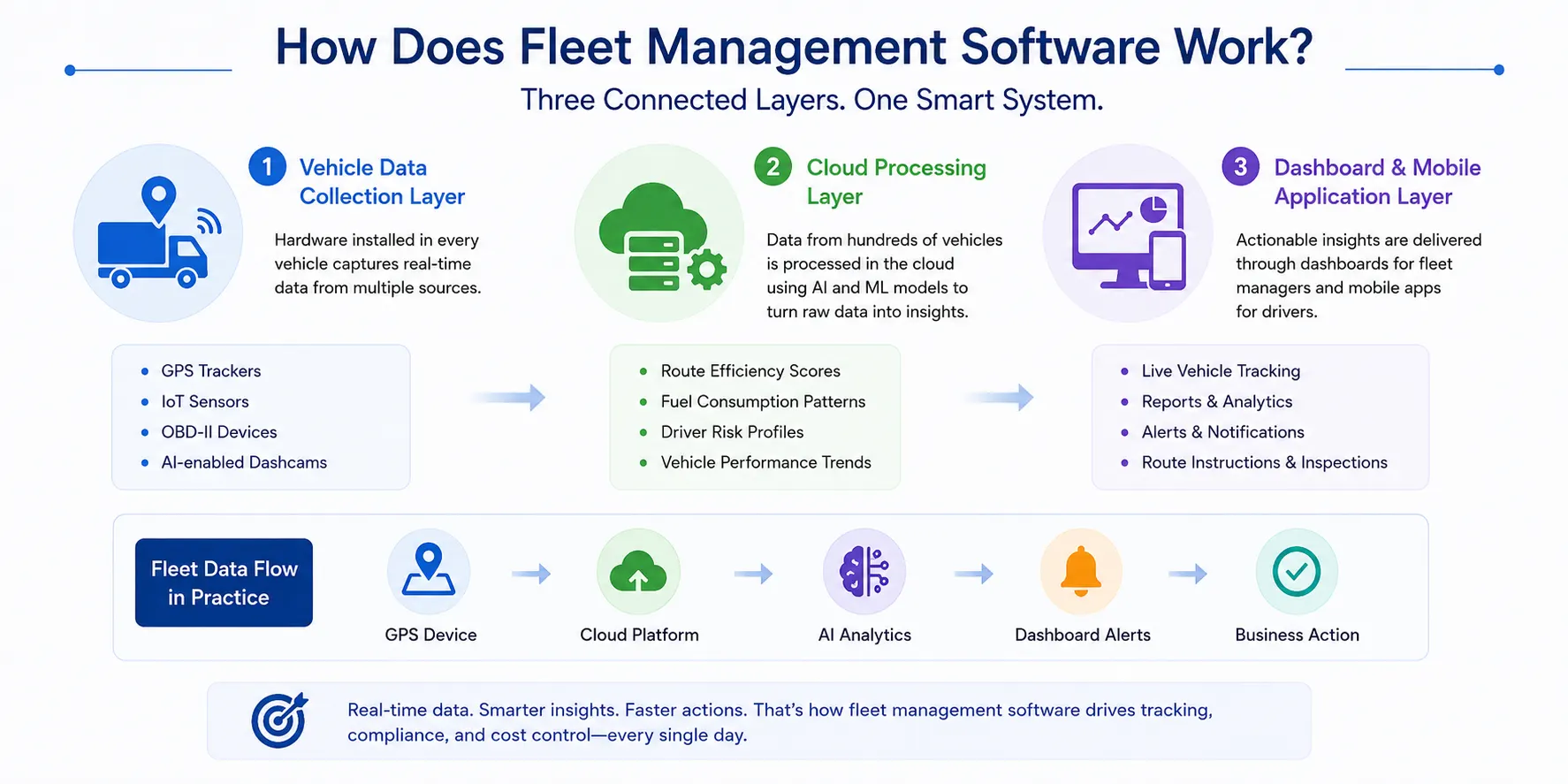
At a technical level, fleet management software runs on three connected layers: data collection, cloud processing, and the dashboard/app layer where humans actually make decisions.
1. Vehicle Data Collection Layer
Every vehicle in the fleet carries hardware that captures real-time data: location, speed, mileage, fuel consumption, engine diagnostics, and driver behavior. This comes from a mix of:
- GPS trackers
- IoT sensors
- OBD-II devices
- AI-enabled dashcams
2. Cloud Processing Layer
Raw data from hundreds of vehicles is useless on its own. It moves into a cloud platform — typically built on AWS, Azure, or Google Cloud — where AI and ML models process it into something usable: route efficiency scores, fuel consumption patterns, driver risk profiles, vehicle performance trends.
3. Dashboard & Mobile Application Layer
This is where the fleet manager and the driver actually interact with the system.
Fleet managers get a dashboard showing vehicle locations, reports, alerts, and analytics in one place. Drivers get a mobile app with route instructions, digital vehicle inspections, and real-time notifications.
Fleet data flow, in practice:
GPS Device → Cloud Platform → AI Analytics → Dashboard Alerts → Business Action
Here's what that looks like on the ground: a delivery vehicle exceeds the speed limit in Dubai Marina. The system flags it instantly, generates an alert, and the fleet manager gets a notification before the driver's even finished the route. That's the difference between finding out about a safety issue in a monthly report and catching it in real time.
Essential Fleet Management Software Features for Dubai Businesses
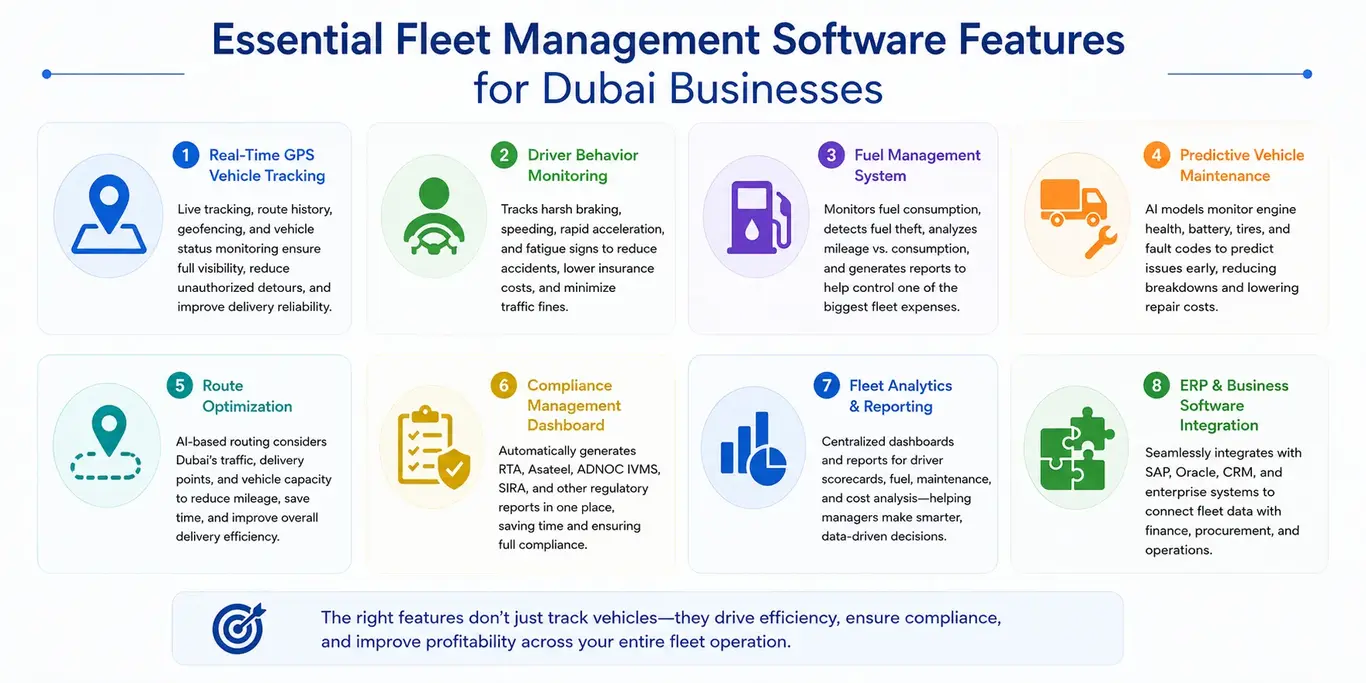
Not every fleet needs every feature below — but this is the full feature set worth evaluating when you're scoping a custom build.
Real-Time GPS Vehicle Tracking
Live location tracking, route history, geofencing, and vehicle status monitoring give fleet managers constant visibility. In practice, this means fewer unauthorized detours, faster response when something goes wrong, and delivery windows that actually hold up.
Driver Behavior Monitoring
The system tracks harsh braking, speeding, rapid acceleration, and signs of driver fatigue. Over time, this data translates into fewer accidents, lower insurance costs, and fewer traffic fines — the kind of savings that don't show up in a single report but add up over a fiscal year.
Fuel Management System
Fuel is usually one of the largest line items in a fleet budget, and it's also where the most money quietly disappears. A proper fuel management module tracks consumption, flags likely fuel theft, analyzes mileage against expected consumption, and generates reports fleet managers can actually use in a budget meeting.
Predictive Vehicle Maintenance
AI models monitor engine health, battery status, tire condition, and fault codes to flag problems before they cause a breakdown. The payoff is straightforward: less unplanned downtime and lower repair bills, because you're fixing small issues instead of replacing failed components on the side of the road.
Route Optimization
AI-based route planning factors in Dubai's traffic patterns, delivery locations, and vehicle capacity to cut wasted mileage. For fleets managing dozens of daily routes, this connects directly into a broader transportation management system that handles scheduling and dispatch alongside routing.
Compliance Management Dashboard
A single view for the regulatory reports Dubai and UAE authorities actually require — RTA reports, Asateel reports, ADNOC IVMS reports, and SIRA tracking documentation — generated automatically instead of assembled by hand.
Fleet Analytics & Reporting
Driver scorecards, fuel reports, maintenance reports, and cost analysis, all pulled from the same underlying data instead of reconciled from five different sources.
ERP and Business Software Integration
A fleet platform that can't talk to the rest of the business creates more work, not less. Integration with SAP, Oracle, CRM systems, and broader enterprise logistics software keeps fleet data connected to finance, procurement, and operations instead of sitting in its own silo.
Fleet Management System Compliance UAE: Regulations Businesses Must Know
Compliance isn't optional in the UAE, and the requirements vary by sector and emirate. Here's what actually applies, and to whom.
RTA Fleet Compliance (Dubai). Applies to rental cars, taxi operators, and school transportation providers operating within Dubai's jurisdiction.
Asateel Compliance (Abu Dhabi). Required for commercial vehicles and transportation companies operating in Abu Dhabi.
ADNOC IVMS Compliance. Mandatory for oil & gas contractors and any vehicle requiring site access on ADNOC-regulated locations.
SIRA Vehicle Tracking Compliance. Applies to security transportation operators, with specific tracking and reporting requirements.
Salik Integration. While not a compliance mandate in the same sense, integrating Salik toll data into the fleet platform automates toll tracking, simplifies expense reconciliation, and makes customer billing far less manual for fleets that bill clients per trip.
Trying to manage all of this manually across a fleet of any real size is where most compliance failures happen — not from bad intent, but from a report that got missed during a busy week.
Benefits of Fleet Management Software for Dubai Companies
Reduce Fuel Costs
Route optimization, idle-time monitoring, and driver behavior analysis together attack fuel spend from three different angles instead of relying on drivers to self-report efficient habits.
Improve Fleet Productivity
More deliveries per day, better vehicle utilization across the fleet, and less time wasted on empty runs or overlapping routes.
Reduce Maintenance Expenses
Predictive maintenance catches problems while they're still cheap fixes, instead of after they've turned into a breakdown on a highway shoulder and a tow bill.
Improve Compliance and Avoid Penalties
Automated reporting cuts regulatory risk and removes the manual paperwork that tends to slip when a team is stretched thin.
Improve Customer Experience
Customers get accurate delivery windows and more reliable service, because the fleet operating behind the scenes actually knows where every vehicle is at any given moment.
Custom Fleet Management Software Development Process in Dubai
Step 1: Fleet Requirement Analysis. Mapping vehicle types, existing business workflows, and the specific compliance obligations that apply to the fleet.
Step 2: UI/UX Design. Designing the fleet manager dashboard, the driver-facing mobile app, and the admin panel around how each user actually works — not a generic template stretched across three roles.
Step 3: Software Development. Built on a modern stack — Node.js, Python, or .NET on the backend; Flutter or React Native for mobile; AWS or Azure for cloud infrastructure.
Step 4: IoT Integration. Connecting the physical hardware — GPS devices, sensors, dashcams — to the software layer so data flows in without manual entry.
Step 5: Testing & Deployment. Security testing, performance testing under real load, and — critically — real-world driver testing before full rollout, because a system that works in a demo doesn't always survive a driver's actual daily routine.
Fleet Management Software Development Cost in Dubai
|
Software Type |
Estimated Cost |
Timeline |
|
Basic GPS Fleet System |
AED 70,000–150,000 |
3–5 months |
|
Mid-Level IoT Fleet Platform |
AED 150,000–350,000 |
5–8 months |
|
Enterprise AI Fleet Platform |
AED 350,000+ |
8–14 months |
Actual cost depends on a handful of variables: the number of vehicles in the fleet, how many third-party systems it needs to integrate with, how much AI capability is built in, whether a dedicated mobile app is required, and how many compliance frameworks the platform has to support at once. A rental fleet with 20 vehicles and no oil & gas site requirements is a very different build than a 300-vehicle construction fleet needing ADNOC IVMS compliance.
Why Choose SISGAIN for Fleet Management Software Development in Dubai?
Building fleet software isn't just a coding exercise — it requires understanding how Dubai's transportation and logistics sector actually operates, and building for the compliance frameworks that govern it.
SISGAIN brings enterprise software development experience, hands-on AI and IoT integration capability, and dedicated logistics software expertise to fleet projects across the UAE. That combination — technical depth plus real market understanding — is what separates a platform that fits a fleet's operations from one that just checks feature boxes on a proposal.
Businesses across Dubai rely on SISGAIN for innovative logistics software solutions built on scalable cloud architecture designed to grow with the fleet, not get replaced in three years.
Fleet Management Software Dubai: Final Overview
|
Requirement |
Solution |
|
Vehicle Tracking |
GPS + IoT Monitoring |
|
Compliance |
RTA, Asateel, ADNOC IVMS |
|
Cost Control |
Fuel & Maintenance Analytics |
|
Safety |
Driver Monitoring |
|
Growth |
AI & Cloud-Based Platforms |
Conclusion
Dubai businesses don't need more GPS dots on a map. They need a fleet platform that ties tracking, compliance, and cost control together into one system that actually reflects how their vehicles operate day to day.
Custom fleet management software gets there — better operational visibility, lower expenses, and transportation operations that run on real data instead of end-of-month guesswork.
Partner with SISGAIN to build custom fleet management software in Dubai designed for compliance, scalability, and measurable business growth.