
Dubai doesn't just move cargo. It moves the region's economy through it. Between Jebel Ali Port, Al Maktoum International, and a web of free zones built specifically for trade, the city has turned logistics into one of its core industries — and one of its most competitive.
But here's the catch: the busier Dubai's logistics network gets, the harder it becomes to run on old tools. Ports, airports, warehouses, customs desks, and road fleets all need to talk to each other in real time. Most freight companies still coordinate this through spreadsheets, WhatsApp messages, and email chains that were never built for the volume they're now handling.
That gap is exactly where freight management software comes in. It replaces scattered systems with one connected platform — one that gives forwarders, 3PLs, and shipping companies a single view of every shipment, every document, and every dollar in motion. This article breaks down why Dubai's logistics sector needs freight management software now, what a strong platform actually includes, and how the right build turns operational chaos into a scalable advantage.
Why Dubai's Logistics Industry Needs Smarter Freight Management Software Today
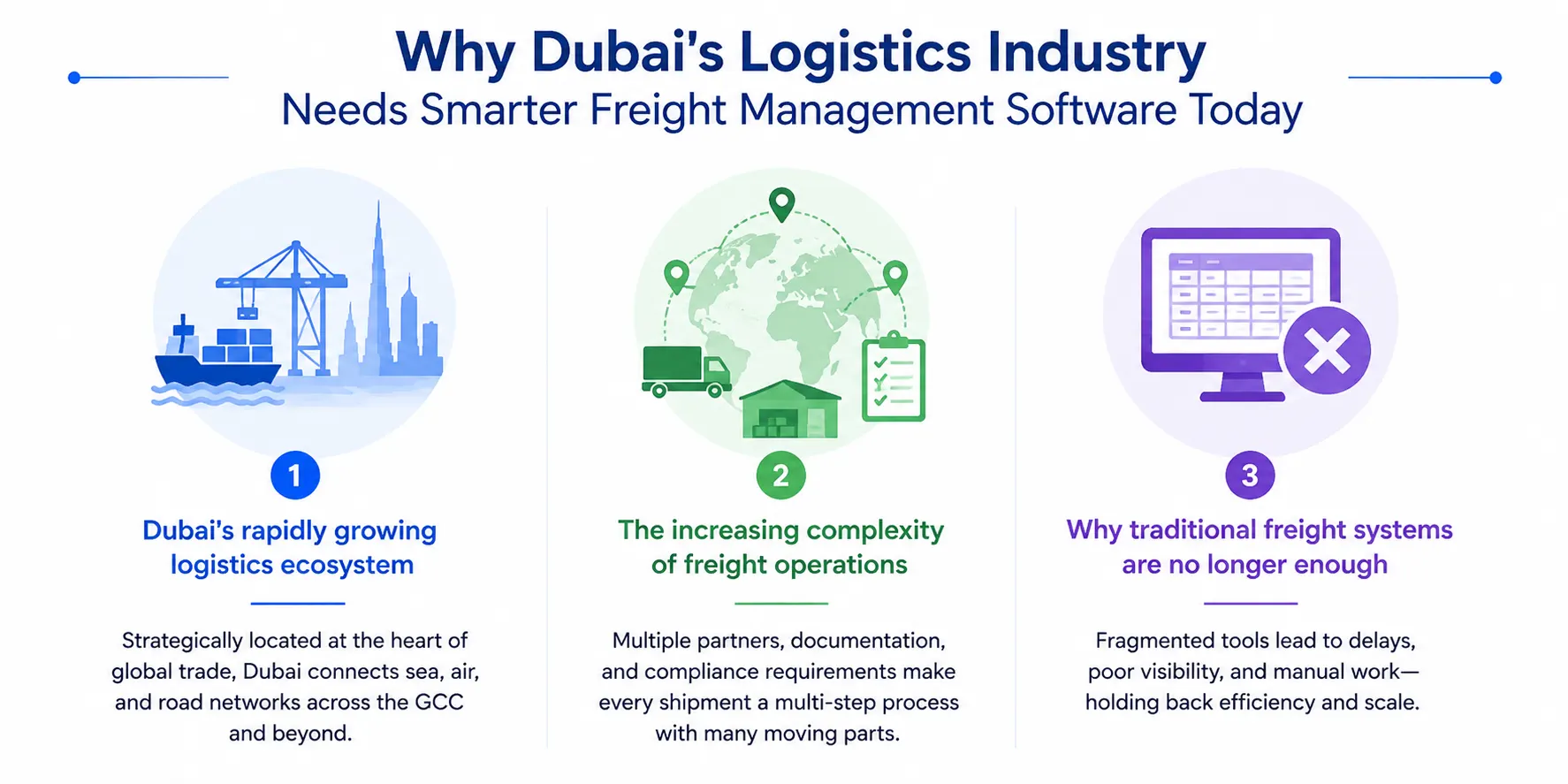
Dubai's rapidly growing logistics ecosystem
Jebel Ali is one of the largest man-made ports on the planet, and it sits at the center of a logistics ecosystem that includes Dubai South, JAFZA, and DAFZA free zones, a major air cargo hub at DXB and DWC, and road corridors that stretch across the GCC. Multimodal shipping — sea to air, air to road, road to warehouse — isn't an exception here. It's the default. Freight moving through Dubai typically touches three or four different modes and jurisdictions before it reaches a final customer, and every handoff is a place where things can go wrong without the right freight management software tracking it.
The increasing complexity of freight operations
A single shipment through Dubai can involve a forwarder, a customs broker, a warehouse operator, a trucking partner, and an overseas shipping line — sometimes all on the same day. Add cross-border documentation, HS code classification, certificates of origin, and Dubai Customs clearance, and you've got a process with dozens of moving parts. Freight management software exists precisely to hold all of that together in one place, instead of leaving it scattered across five different inboxes.
Why traditional freight systems are no longer enough
Fragmented software is the quiet killer of freight operations. One tool for quotes, another for tracking, a third for invoicing, and Excel holding the rest together — none of it talks to each other. That creates delayed communication between partners, poor shipment visibility for customers asking "where's my cargo," and hours of manual coordination that a properly built freight management software platform could handle automatically. Freight software Dubai companies are adopting today isn't a nice-to-have anymore. It's what separates operators who can scale from operators stuck firefighting.
The Biggest Challenges Logistics Companies Face Without Modern Freight Management Software
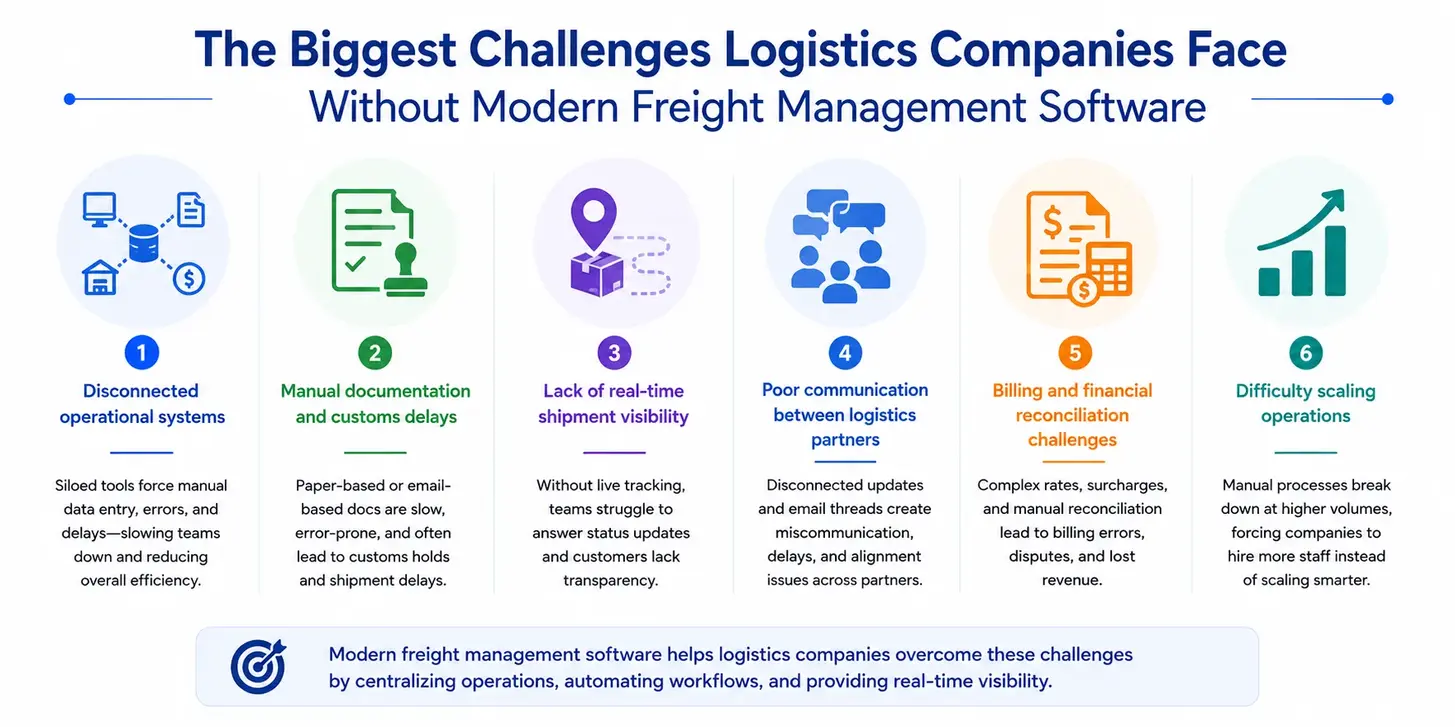
Disconnected operational systems
When booking, tracking, billing, and warehouse data live in separate tools, someone has to manually stitch them together. That someone is usually an ops team member re-entering the same shipment details three or four times a day. Freight management software removes the re-entry entirely by giving every department — sales, ops, finance — access to the same live record.
Manual documentation and customs delays
Bills of lading, packing lists, certificates of origin, customs declarations. Paper-based or email-based documentation is slow, easy to lose, and prone to the kind of small errors that trigger a customs hold. A freight forwarding software platform with document automation and OCR can extract data straight from uploaded files, flag mismatches before submission, and cut the back-and-forth with customs brokers dramatically.
Lack of real-time shipment visibility
Ask any shipper what frustrates them most, and "I don't know where my cargo is" comes up almost every time. Without live tracking built into the platform, teams are stuck calling carriers or checking third-party portals just to answer a basic status question. Freight management software solves this with milestone tracking that updates automatically as a shipment moves.
Poor communication between logistics partners
Forwarders, transporters, warehouse operators, and customers all need the same information — but rarely see it at the same time. A shared platform changes that. Instead of ten separate email threads, everyone works off the same shipment record, with permissions controlling who sees what.
Billing and financial reconciliation challenges
Freight billing is notoriously messy. Rates change by lane, surcharges get added mid-shipment, and reconciling invoices against actual costs eats up finance teams' time every month. Freight management software with automated rate management and billing closes that gap, matching charges to shipments as they happen rather than weeks later.
Difficulty scaling operations
Manual processes might work fine at 50 shipments a month. At 500, they collapse. Companies trying to grow without freight management software end up hiring more coordinators just to keep pace with the same workload a well-built platform could absorb. That's not scaling — that's adding headcount to cover a technology gap.
What Makes Smart Freight Management Software Different from Traditional Freight Systems?
Unified operations from booking to delivery
The core shift is simple: everything lives in one system. A quote becomes a booking, a booking becomes a shipment, and a shipment becomes an invoice — all inside the same platform, without data being copied between tools. That's the baseline difference between modern freight management software and the patchwork setups most companies are still running on.
AI-assisted freight management
This is where things get genuinely interesting. Modern platforms use AI-assisted freight management for ETA prediction, learning from historical transit times, port congestion, and weather patterns to flag delays before they happen. Exception alerts catch problems automatically — a container flagged for inspection, a missed connection — instead of waiting for someone to notice. OCR and document automation read uploaded shipping documents and populate fields instantly, cutting manual data entry to near zero. Businesses looking at ai-powered logistics software for enterprises in Dubai are essentially asking for this: intelligence layered on top of operations, not just digital paperwork.
Real-time shipment visibility
Customers and internal teams alike get a live view of where cargo sits, what's next, and whether anything needs attention — pulled directly from carrier feeds, GPS data, and milestone updates rather than manual check-ins.
Cloud-based scalability
A cloud-hosted freight management software platform scales with shipment volume instead of requiring new servers or infrastructure every time the business grows. It's also what makes multi-branch and remote access possible without duplicating systems at every location. This is the foundation good freight software development is built on today, and it's part of what separates a serious freight software Dubai build from a basic tracking tool.
Essential Features Every Freight Management Software Platform Should Include
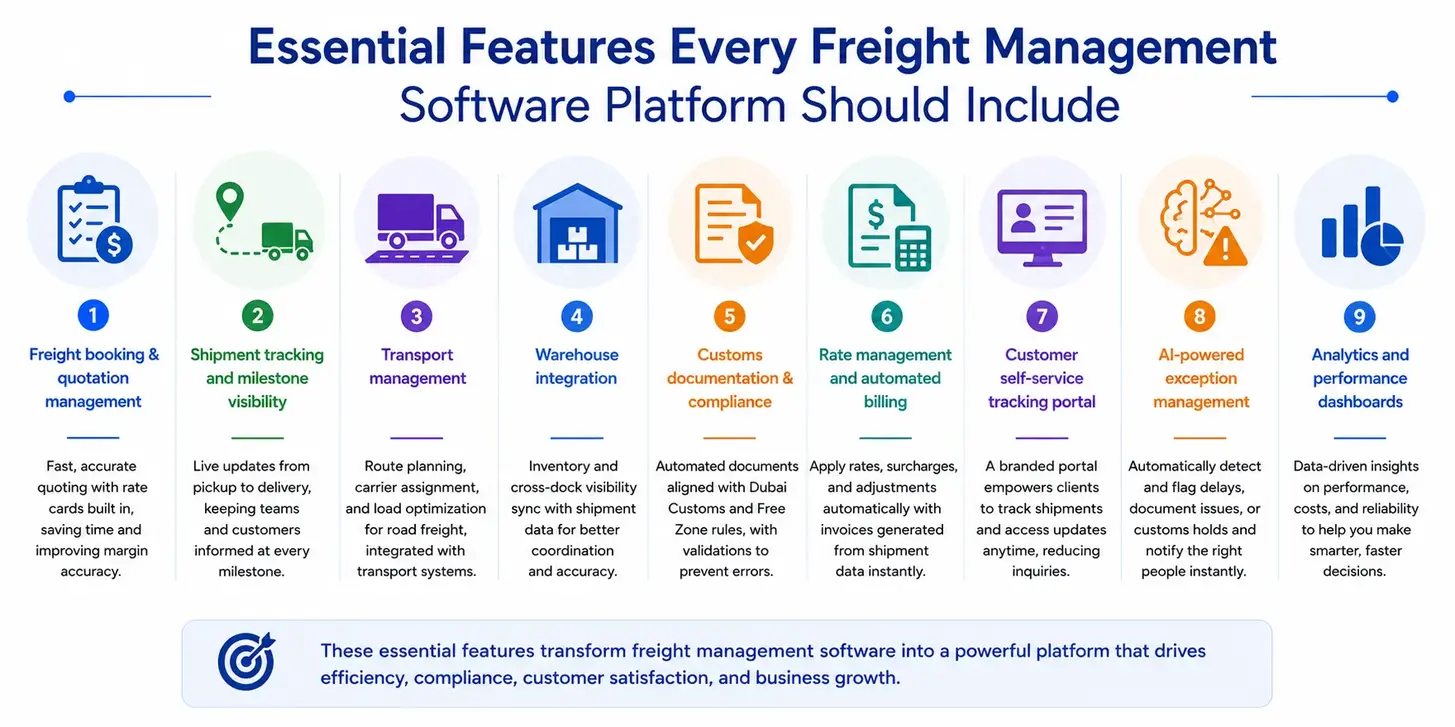
A platform is only as good as what it actually does day to day. Here's what belongs in a serious build:
Freight booking & quotation management — Fast, accurate quoting with rate cards built in, so sales teams aren't manually calculating margins on every request.
Shipment tracking and milestone visibility — Live status updates from pickup to final delivery, visible to both internal teams and customers.
Transport management — Route planning, carrier assignment, and load optimization for road freight, tying directly into broader transportation management system development so freight and inland transport aren't managed as separate silos.
Warehouse integration — Inventory and cross-dock visibility connected to shipment data, so warehouse teams aren't working from a different picture than the ops team.
Customs documentation & compliance — Automated document generation aligned to Dubai Customs and Free Zone requirements, with built-in checks that catch errors before submission.
Rate management and automated billing — Contract rates, surcharges, and fuel adjustments applied automatically, with invoices generated straight from shipment data.
Customer self-service tracking portal — A branded portal where clients check shipment status themselves instead of calling or emailing your ops team.
AI-powered exception management — Automatic flagging of delays, documentation issues, or customs holds, routed to the right person immediately.
Analytics and performance dashboards — Real numbers on on-time performance, cost per shipment, and carrier reliability, so decisions are based on data instead of gut feel.
Together, these features do more than digitize paperwork — they turn freight management software into the operational backbone of the business, and they're a big part of why customer experience and scalability improve at the same time once a company adopts one.
How Freight Management Software Helps Logistics Companies Scale Faster
Supports higher shipment volumes
Automated workflows mean a bigger book of business doesn't require a proportionally bigger ops team. Freight management software handles the repetitive parts — quoting, document generation, status updates — so headcount grows with strategy, not with paperwork.
Improves operational efficiency
Every manual handoff removed is time saved. Teams using a unified platform spend less time chasing information and more time solving actual shipment problems.
Enables better customer experience
Live tracking, self-service portals, and fewer errors add up to fewer "where's my shipment" calls and more trust in the relationship. Customers notice when a forwarder's systems are tight.
Simplifies multi-branch operations
Companies running offices across the UAE, or across the wider GCC, need one source of truth. Freight management software gives every branch the same data, the same rate cards, and the same visibility — no more reconciling five different spreadsheets at month-end.
Reduces operational costs
Fewer manual errors, faster billing cycles, and less time lost to coordination all show up directly on the bottom line. Over time, this is usually where freight management software pays for itself.
Why UAE Businesses Need Customized Freight Management Software Instead of Generic Global Solutions
Dubai Customs workflows
Off-the-shelf global platforms are usually built around US or European customs processes. They don't map cleanly onto Dubai Customs declaration types, Free Zone transfer rules, or UAE-specific documentation requirements. A platform built for freight software Dubai operations needs to handle these workflows natively, not as a workaround.
Free Zone operations
JAFZA, DAFZA, and Dubai South each run under their own regulatory framework, distinct from mainland UAE trade. Software that doesn't account for Free Zone-specific movement and reporting requirements creates manual work exactly where automation should be doing the job.
VAT and e-invoicing readiness
With UAE VAT compliance and the move toward mandatory e-invoicing, freight billing needs to generate compliant records automatically. Shipping software Dubai companies rely on has to build this in from day one rather than bolting it on later.
Arabic-English user experience
A genuinely usable platform for the UAE market supports both Arabic and English across the interface and generated documents — not just as a translation layer, but as a real design consideration for how teams and customers actually work.
Integration with existing ERP and logistics systems
Most logistics companies already run finance or ERP systems they're not willing to rip out. Freight management software needs to integrate with what's already there — accounting platforms, existing logistics software Dubai teams have invested in, and any partner-facing tools — rather than forcing a full system replacement.
Future Trends Shaping Freight Management Software in Dubai
AI-driven freight automation
Automated rate negotiation, dynamic routing, and predictive exception handling are moving from "nice future feature" to standard expectation in serious freight management software builds.
Predictive shipment visibility
Beyond live tracking, platforms are starting to predict delays before they happen — flagging a likely customs hold or port congestion issue days in advance instead of reporting it after the fact.
Multimodal logistics platforms
As Dubai's sea-air-road corridor grows busier, platforms that manage all three modes in one system — rather than treating them as separate products — are becoming the norm rather than the exception. On the road side specifically, this is pushing fleet management software development further into the same ecosystem, so truck routing, driver assignment, and vehicle maintenance data sit alongside shipment records instead of living in a separate silo.
Sustainability and carbon reporting
Shippers are increasingly asked to report carbon footprint per shipment. Freight management software with built-in emissions tracking is starting to become a competitive requirement, not just a compliance checkbox.
API-first logistics ecosystems
Modern platforms are built to connect — with carriers, customs systems, ERPs, and marketplaces — through open APIs rather than closed, standalone software. This is the direction the entire freight software development space is heading.
How SISGAIN Builds Smart Freight Management Software for Dubai Businesses
SISGAIN builds custom freight management software around how a specific logistics business actually operates, not a generic template stretched to fit. That starts with scalable cloud architecture designed to handle growth in shipment volume without a rebuild down the line, paired with AI-powered logistics solutions for ETA prediction, exception handling, and document automation.
Every build accounts for UAE-focused workflows — Dubai Customs, Free Zone documentation, VAT compliance — from the ground up, alongside API integrations that connect the platform to existing ERP, accounting, and carrier systems already in use. Mobile-first applications keep drivers, warehouse staff, and field teams connected to the same live data as the office.
For companies exploring Logistics Software Development Services in Dubai, the difference SISGAIN brings is end-to-end development support: discovery and workflow mapping, custom platform build, integration with existing tools, and ongoing support after launch — not a handoff the moment the software goes live.
Final Thoughts
Freight operations in Dubai aren't getting simpler. More stakeholders, more compliance requirements, and rising customer expectations around visibility are the new baseline, not a temporary phase. Businesses still running on spreadsheets and disconnected tools are absorbing that complexity manually, one shipment at a time.
Investing in freight management software isn't about chasing a trend. It's a competitive necessity at this point. The right platform gives a business real-time visibility, automated documentation, built-in compliance, and the ability to take on more volume without adding proportional headcount.
If your current systems are held together by manual workarounds, that's worth a hard look. A future-ready platform doesn't just fix today's bottlenecks — it's what lets a logistics business actually take on the growth Dubai's market keeps generating.