
Quick Answer: What Is AI in Revenue Cycle Management?
AI in Revenue Cycle Management (RCM) uses machine learning, natural language processing, document intelligence, predictive analytics, and automation to improve financial workflows across healthcare — from insurance eligibility and prior authorization to medical coding, claims validation, denial management, payment reconciliation, and revenue forecasting.
For UAE healthcare providers, AI-powered RCM can work as an intelligence layer across existing HIS, EMR/EHR, PMS, billing, payer, TPA, and health-information systems, helping organizations identify errors earlier, prioritize high-risk claims, automate repetitive tasks, and uncover potential revenue leakage.
A UAE hospital's revenue cycle doesn't begin when a claim is submitted. It starts the moment a patient registers, and it continues through eligibility verification, clinical documentation, coding, authorization, claims submission, payer adjudication, denial management, payment posting, reconciliation, and collections.
Introduction
At every one of those stages, data is generated — patient demographics, clinical notes, coding decisions, payer responses, remittance details. After 25 years in enterprise IT and healthcare technology, I can tell you the problem UAE providers face isn't a shortage of data. Most hospitals and clinics are drowning in it. The real problem is turning that data into timely, actionable intelligence before it turns into a denied claim, a delayed payment, or unbilled revenue that quietly disappears.
This is where artificial intelligence enters the picture — not as a replacement for RCM teams, but as an intelligence layer that can read, analyze, and flag information across the revenue cycle faster and more consistently than manual review alone.
The central thesis of this article is simple: the future of UAE RCM is moving from reactive revenue-cycle management toward predictive revenue-cycle intelligence.
In this guide, we'll cover what AI-powered RCM means, how the revenue cycle works in the UAE specifically, the local claims and health-data ecosystem, 15+ practical AI use cases, the benefits and real challenges, security and governance considerations, a recommended AI architecture, an implementation roadmap, the KPIs to track, cost factors, how to choose a development partner, and answers to the questions UAE healthcare leaders ask most.
What Is Revenue Cycle Management in Healthcare?
Revenue cycle management is the financial process healthcare providers use to track patient care from initial registration to final payment. It spans every administrative and clinical touchpoint that affects whether — and how quickly — a provider gets reimbursed for the care it delivers.
In the UAE, RCM carries an additional layer of complexity. Providers operate across multiple emirates, each with its own claims platform, payer landscape, and regulatory body, while also navigating a rapidly expanding digital health infrastructure. A UAE RCM strategy that works for a Dubai-based clinic may need real adjustments to work for a hospital group operating in Abu Dhabi.
What Does RCM Include?
- Patient registration
- Patient identification
- Insurance eligibility
- Benefits verification
- Clinical documentation
- Medical coding
- Prior authorization
- Charge capture
- Claim creation
- Claim validation
- Claim submission
- Payer adjudication
- Denial/rejection management
- Payment posting
- Reconciliation
- Collections
- Revenue analytics
Visual opportunity: A UAE Healthcare RCM Lifecycle diagram is a natural fit here, showing the flow: Patient → Eligibility → Clinical Documentation → Coding → Authorization → Claim → Payer → Denial → Payment → Reconciliation → Revenue Analytics.
Why Is AI Becoming Important for UAE Healthcare RCM?
Before selling the benefits of AI, it's worth understanding why the need is emerging now. UAE healthcare has digitized quickly — electronic claims, growing volumes of structured and unstructured patient data, increasingly complex payer rules, stricter documentation and coding requirements, and a health-data infrastructure that continues to expand.
Put simply: more digital healthcare leads to more data, more data leads to more complexity, and more complexity creates a genuine need for intelligent automation. RCM teams that once managed claims manually are now expected to manage the same workload at higher volume, with tighter turnaround expectations and less room for error — a gap that rules-based software alone often can't close.
How Does Revenue Cycle Management Work in the UAE?
UAE Healthcare RCM Workflow
- Patient registration
- Emirates ID / patient identification
- Insurance eligibility
- Benefits verification
- Clinical encounter
- Documentation
- Coding
- Prior authorization
- Charge capture
- Claim creation
- Claim validation
- Electronic submission
- Payer/TPA adjudication
- Denial/rejection
- Payment
- Reconciliation
- Collections
- Revenue analytics
AI can potentially introduce intelligence at almost every stage of this workflow — not as a single tool, but as a layer of analysis running alongside the systems providers already use. This is exactly why so many healthcare providers in Dubai need revenue cycle management built around the emirate's specific claims and payer rules rather than a generic, one-size-fits-all workflow.

UAE Healthcare Claims & Digital Health Ecosystem
The UAE is not one uniform claims environment. Dubai and Abu Dhabi operate different platforms, standards, and business rules, and a credible AI RCM strategy needs to account for each — which is why RCM intelligence works best when it sits on top of hospital information systems for smarter, connected healthcare rather than being bolted onto a disconnected billing tool.
Dubai eClaimLink
eClaimLink is Dubai's electronic claims platform, standardizing datasets, coding, payer information, denial codes, claims validation, and provider workflows across the emirate. The AI opportunity here is straightforward: AI-powered claims validation and denial prediction tuned specifically to Dubai's claims workflows and denial code patterns.
Abu Dhabi DoH and Shafafiya
Abu Dhabi's Department of Health, through the Shafafiya platform, governs claims standards, business rules, validation, clinical coding (ICD-10-CM), prior authorization, and claims reporting for the emirate. AI can help identify documentation gaps, coding inconsistencies, authorization issues, and potential claim errors before they reach the payer.
Malaffi
Malaffi is Abu Dhabi's health information exchange, connecting patient records across providers to create a more longitudinal view of care. More available, connected data creates stronger analytics opportunities for RCM — but it's important not to imply that RCM systems automatically receive unrestricted access to HIE data. Access is always governed by applicable permissions and regulatory requirements.
NABIDH
NABIDH plays a similar role for Dubai's health-information ecosystem, supporting interoperability between hospitals, clinics, and other care settings across the emirate.
Riayati and the National Unified Medical Record
Riayati represents the national push toward a unified medical record and broader interoperability across the UAE. As with Malaffi and NABIDH, it's important to be precise here: AI-powered RCM solutions may need to operate within the UAE's broader interoperability and healthcare-data ecosystem, subject to applicable access, integration, security, and regulatory requirements — not that AI tools connect automatically or unconditionally to these platforms.
Where Can AI Be Used in Healthcare Revenue Cycle Management?
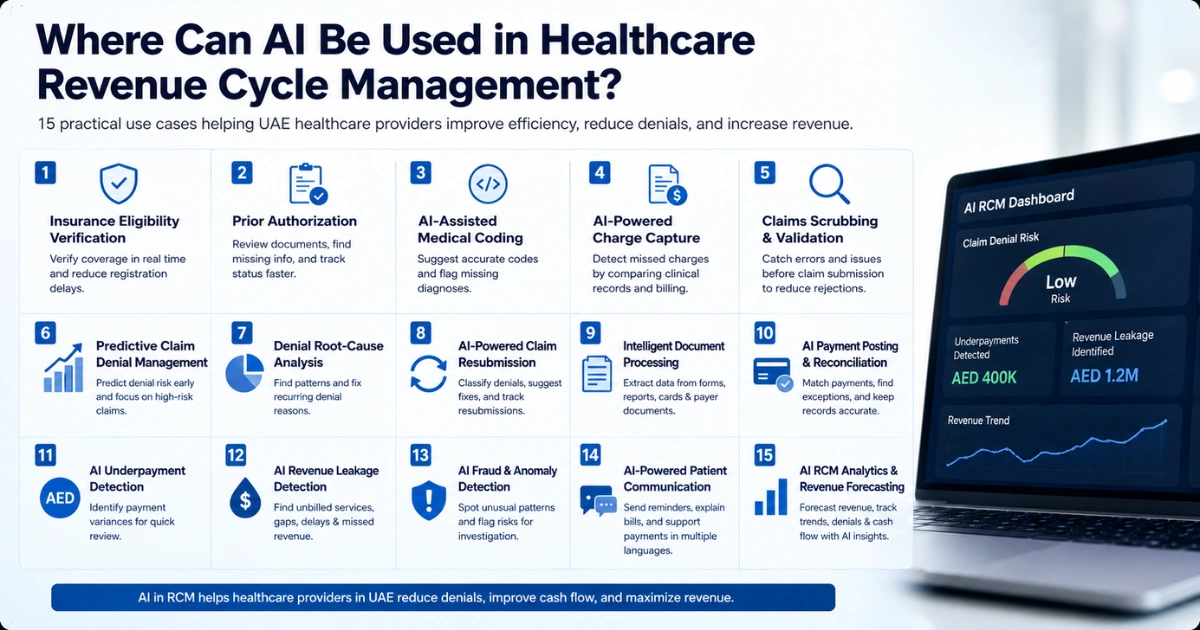
AI doesn't have to replace the existing RCM system. In many healthcare environments, it functions as an intelligence layer that analyzes information across existing clinical, billing, claims, payer, and financial systems. Below are 15 of the most practical, currently achievable use cases for UAE providers.
1. AI-Powered Insurance Eligibility Verification
AI can automate verification checks, extract insurance data from scanned cards and forms, confirm coverage in near real time, flag missing information, and route exceptions to staff for review — reducing the back-and-forth that slows down registration. A simplified flow looks like: Patient → Insurance → Coverage → Service → Provider network → Eligibility result.
2. AI for Prior Authorization
Prior authorization is one of the most time-consuming steps in UAE RCM, particularly under Abu Dhabi's claims and authorization environment. AI can review documentation, identify missing requirements, extract relevant clinical information, flag missing documents, monitor authorization status, and route items through the correct workflow — cutting down the manual chasing that authorization teams deal with daily.
3. AI-Assisted Medical Coding
Using NLP to analyze clinical documentation, AI can suggest ICD-10-CM and procedure codes, flag missing diagnoses, and support coding audits.
E-E-A-T note: AI should assist qualified coding professionals rather than independently make high-impact coding decisions without appropriate validation and oversight.
4. AI-Powered Charge Capture
By comparing clinical documentation, procedures, and orders against what's actually billed, AI can flag discrepancies — for example, a procedure that was documented but never charged, surfacing a potential missed-revenue event for review.
5. AI Claims Scrubbing and Validation
This is one of the strongest commercial use cases for UAE providers. AI can identify missing information, coding inconsistencies, duplicate services, authorization issues, demographic mismatches, payer-specific problems, and documentation gaps before a claim ever leaves the building. A typical flow: Claim → AI validation → Risk score → Error detection → Human review → Submission.
6. Predictive Claim Denial Management
Traditional RCM waits for a denial to arrive before responding. AI-powered RCM predicts the likelihood of denial before submission, often scoring claims across categories like Low, Medium, High, and Very High risk — so teams can intervene where it actually matters.
7. AI Denial Root-Cause Analysis
Analyzed across thousands of claims, patterns start to emerge that a single reviewer would rarely spot manually:
|
Pattern |
Possible Insight |
|
Payer A |
Authorization-related denials |
|
Payer B |
Coding-related denials |
|
Department C |
Documentation issues |
|
Provider Group D |
Recurring coding inconsistencies |
8. AI-Powered Claim Resubmission
AI can support denial classification, root-cause identification, documentation retrieval, corrective-action recommendations, and resubmission preparation, with status monitoring throughout. Human approval remains an essential part of this workflow.
9. Intelligent Healthcare Document Processing
Combining OCR and NLP, AI can process insurance cards, referrals, medical reports, discharge summaries, authorization documents, payer correspondence, remittance information, and invoices — turning unstructured documents into usable, structured data.
10. AI Payment Posting and Reconciliation
AI can match payments to claims, patients, invoices, and remittance data, and identify unmatched payments, duplicate payments, overpayments, underpayments, and other exceptions that need attention.
11. AI Underpayment Detection
Consider a simple example: expected reimbursement of AED 2,500 against an actual payment of AED 2,100 — a potential variance of AED 400. AI can flag that variance for review. It shouldn't automatically assume payer error; a human still needs to confirm the cause.
12. AI Revenue Leakage Detection
Revenue leakage happens quietly — unbilled services, missed charges, incorrect payer assignment, authorization gaps, unpaid claims, underpayments, documentation gaps, and delayed claims all chip away at revenue. This is the use case that tends to resonate most directly with CFOs, because it connects AI investment to a measurable financial number.
13. AI Fraud and Anomaly Detection
Rather than claiming AI automatically detects fraud, it's more accurate to describe this as anomaly detection and investigation support. Potential signals include duplicate claims, unusual billing frequency, abnormal provider patterns, suspicious claim combinations, and unusual payment patterns — all flagged for human investigation.
14. AI-Powered Patient Financial Communication
AI can support payment reminders, balance notifications, billing FAQs, insurance explanations, and payment-plan communication. Given the diversity of the UAE's patient population, multilingual digital communication is a genuinely valuable capability here, without needing to make unsupported quantitative claims about its impact. Many providers deliver this through mobile app development solutions for healthcare, putting billing notifications and payment options directly in patients' hands rather than relying solely on calls or emails.
15. AI RCM Analytics and Revenue Forecasting
AI-driven analytics can support expected collections, A/R forecasting, denial probability, payer performance tracking, revenue trends, claim turnaround analysis, revenue leakage identification, and cash-flow forecasting. The key distinction: traditional analytics tells you what happened; predictive AI estimates what's likely to happen; prescriptive intelligence suggests what to do next.
Benefits of AI-Powered RCM for UAE Healthcare Providers
- Reduce Avoidable Claim Errors — catching issues before submission rather than after denial.
- Accelerate Claims Processing — faster validation and routing shortens turnaround time.
- Reduce Repetitive Administrative Work — freeing RCM staff from manual, low-value tasks.
- Improve Coding Workflows — supporting coders with suggestions and audit checks.
- Prioritize High-Risk Claims — directing human attention where it's needed most.
- Identify Revenue Leakage — surfacing missed charges and underpayments earlier.
- Improve Payment Reconciliation — matching payments accurately and consistently.
- Improve Cash-Flow Visibility — giving finance teams a clearer forward view.
- Scale RCM Operations — handling growing claim volumes without proportional headcount growth.
- Improve RCM Team Productivity — shifting staff time toward exceptions and judgment calls, not data entry.
AI vs Traditional Revenue Cycle Management
|
Traditional RCM |
AI-Powered RCM |
|
Manual verification |
Intelligent verification |
|
Reactive denial management |
Predictive denial management |
|
Manual document review |
AI document extraction |
|
Rule-based reporting |
Predictive analytics |
|
Manual coding assistance |
AI-assisted coding |
|
Periodic reporting |
Near-real-time intelligence |
|
Manual reconciliation |
Intelligent payment matching |
|
Historical analysis |
Predictive forecasting |
|
Manual prioritization |
Risk-based prioritization |
AI-powered RCM does not necessarily eliminate traditional RCM processes. Instead, it can augment them with automation, prediction, pattern recognition, and decision support.
AI Technologies Used in Revenue Cycle Management
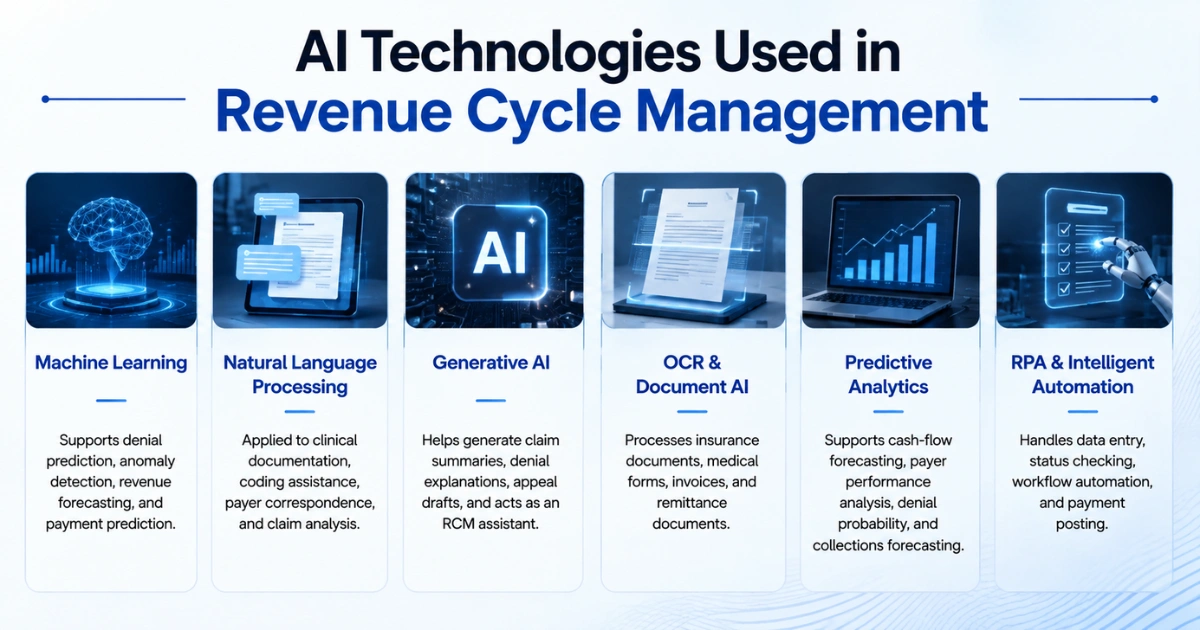
Machine Learning supports denial prediction, anomaly detection, revenue forecasting, and payment prediction.
Natural Language Processing is applied to clinical documentation, coding assistance, payer correspondence, and claim analysis.
Generative AI can help produce claim summaries, denial explanations, appeal drafts, and act as an assistant for RCM employees.
OCR and Document AI process insurance documents, medical forms, invoices, and remittance documents.
Predictive Analytics supports cash-flow forecasting, payer performance analysis, denial probability, and collections forecasting.
RPA and Intelligent Automation handle data entry, status checking, workflow automation, and payment posting.
Challenges of Implementing AI in UAE Healthcare RCM
Patient Data Privacy and Security
Any AI deployment touching patient or claims data raises questions about data processing, storage, encryption, access control, audit logs, data retention, third-party AI providers, and cross-border processing. This article isn't legal advice — organizations should seek qualified legal and compliance guidance specific to their setup before deploying AI systems that process health information.
AI Governance
Effective governance covers accountability, human oversight, model monitoring, auditability, access control, incident management, and ongoing validation of AI outputs.
Data Quality
Poor data in means unreliable AI recommendations out. Duplicate records, missing information, incorrect insurance data, coding inconsistencies, documentation gaps, and inconsistent terminology all undermine AI accuracy before a single model is even deployed.
Legacy System Integration
Most UAE providers run a mix of HIS, EMR/EHR, PMS, LIS, RIS, ERP, billing, and payer systems — often from different vendors and different eras. Integration depends on APIs, HL7, FHIR, middleware, data mapping, and identity matching, and this is frequently where AI RCM projects stall if it isn't planned for early.
Emirate-Specific Requirements
Dubai is not Abu Dhabi. An AI RCM platform needs configurable payer rules, coding rules, claims workflows, validation logic, and authorization workflows to operate correctly across emirates rather than treating the UAE as a single environment.
AI Hallucinations and Incorrect Recommendations
Healthcare RCM requires real safeguards against incorrect AI output. The safest pattern is: AI recommendation → validation → human review → action, never AI recommendation straight to action for anything financially or clinically significant.
Explainability
A system that simply says "high-risk claim" isn't useful on its own. A better system explains why — for example: missing authorization, coding inconsistency, documentation gap, historical payer pattern — giving staff something they can actually act on.
Workforce Adoption
AI should be positioned as an RCM assistant, not simply an RCM replacement. Adoption tends to succeed when staff see AI removing tedious work rather than threatening their role.
Implementation Cost and Integration Complexity
Real costs include integration, data engineering, cybersecurity, cloud infrastructure, APIs, testing, staff training, and ongoing maintenance and monitoring — not just the AI model itself.
Model Drift
Healthcare rules change, payer behavior shifts, and coding requirements get updated. AI models need continuous monitoring and periodic retraining to stay accurate over time.
AI RCM Compliance and Data Security Considerations in the UAE
Any serious AI RCM deployment needs a dedicated compliance conversation covering UAE healthcare data requirements, privacy, security, access controls, encryption, auditability, data governance, human oversight, vendor due diligence, and data-processing arrangements.
Healthcare organizations should verify current UAE federal and emirate-level requirements with qualified legal, compliance, and information-security professionals before deploying AI systems that process patient or health information.
How AI RCM Integrates With HIS, EMR, eClaims and HIE Platforms
A workable architecture generally looks like this:
HIS / EMR / PMS / Billing / ERP → Integration Layer → AI & ML Layer → RCM Intelligence → Human Review → Payer / Financial Workflow
This depends on APIs, HL7, FHIR, data normalization, secure interfaces, identity matching, and event-driven workflows where appropriate. Providers evaluating this kind of integration often turn to a partner offering healthcare software development Dubai services for medical organizations, since the regulatory and technical complexity here is significant enough that it rarely works as a bolt-on project.
Recommended AI RCM Architecture for UAE Healthcare
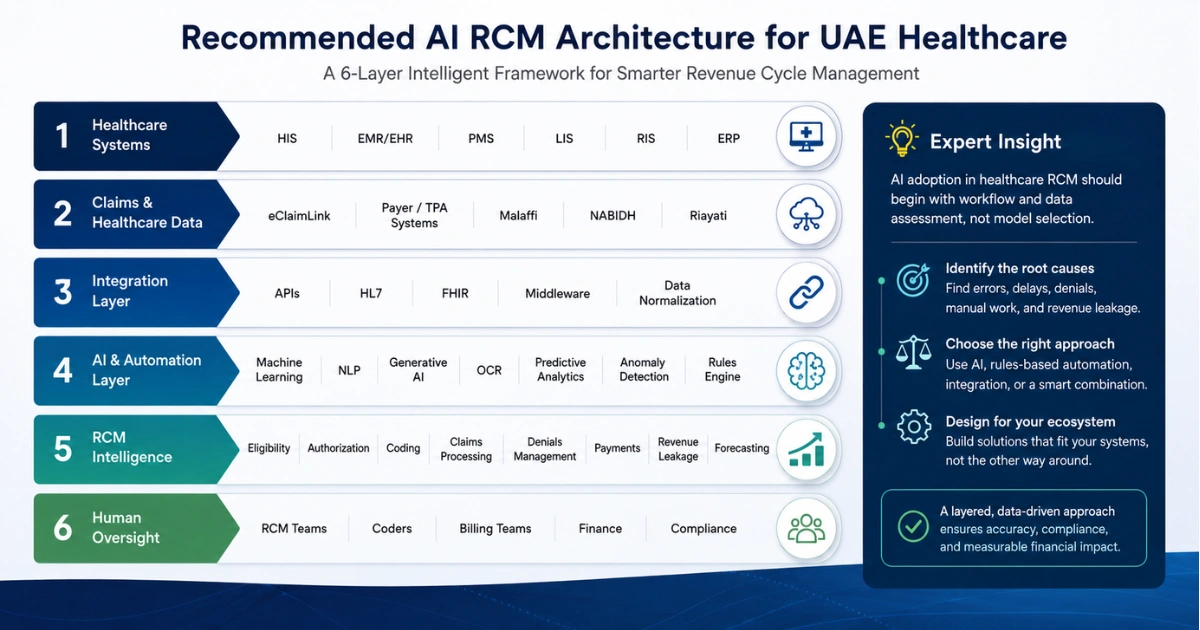
Layer 1 — Healthcare Systems: HIS, EMR/EHR, PMS, LIS, RIS, ERP
Layer 2 — Claims & Healthcare Data: eClaimLink, Payer/TPA systems, Malaffi, NABIDH, Riayati
Layer 3 — Integration: APIs, HL7, FHIR, Middleware, data normalization
Layer 4 — AI: Machine Learning, NLP, Generative AI, OCR, Predictive Analytics, Anomaly Detection, Rules Engine
Layer 5 — RCM Intelligence: Eligibility, Authorization, Coding, Claims, Denials, Payments, Revenue Leakage, Forecasting
Layer 6 — Human Oversight: RCM Teams, Coders, Billing Teams, Finance, Compliance
Expert Insight: AI adoption in healthcare RCM should begin with workflow and data assessment rather than model selection. Healthcare organizations should first identify where errors, delays, denials, manual work, and revenue leakage occur, then determine whether AI, rules-based automation, integration, or a combination of technologies is the appropriate solution.
Building this kind of layered architecture from scratch is rarely practical for an in-house team alone, which is why most providers pair it with custom healthcare software and mobile app development solutions designed specifically around their existing systems rather than forcing a generic platform to fit.
AI RCM Use Cases by Healthcare Organization
|
Organization |
High-Value AI RCM Applications |
|
Hospitals |
Claims scrubbing, coding, denial prediction, authorization, reconciliation |
|
Multi-specialty clinics |
Eligibility, billing, coding, claims automation |
|
Diagnostic centers |
Authorization, eligibility, charge capture, claims validation |
|
Medical groups |
Centralized analytics, payer intelligence, denial management |
|
Healthcare TPAs |
Claims classification, anomaly detection, document processing |
For hospitals in particular, this level of claims scrubbing and denial prediction usually depends on how well the underlying platform is built — which is where purpose-built hospital software development solutions make the difference between AI that's genuinely embedded in daily workflows and AI that sits as a disconnected add-on.
How to Implement AI in Healthcare RCM
- Map the Existing RCM Workflow — document every step as it actually happens today, not as it's supposed to happen.
- Identify Revenue-Cycle Bottlenecks — find where claims stall, denials cluster, or staff spend disproportionate time.
- Audit Data Quality — assess how clean and complete the underlying data really is.
- Identify Integration Requirements — map which systems the AI layer needs to connect to.
- Select High-ROI AI Use Cases — start where the financial or operational impact is clearest.
- Establish Security and Governance — define access, audit, and oversight rules before go-live.
- Build a Human-in-the-Loop Workflow — decide explicitly where AI recommends and where humans decide.
- Pilot the Solution — test on a limited scope before wider rollout.
- Measure Performance — track against a defined baseline, not assumptions.
- Scale and Continuously Monitor — expand deployment while watching for model drift and data changes.
AI RCM KPIs UAE Healthcare Organizations Should Track
Financial KPIs: Net Collection Rate, Gross Collection Rate, Days in A/R, A/R aging, revenue leakage, underpayment rate, outstanding receivables.
Claims KPIs: Clean claim rate, first-pass acceptance rate, claim rejection rate, denial rate, resubmission rate, claim turnaround time.
AI KPIs: Automation rate, prediction accuracy, human intervention rate, false-positive rate, false-negative rate, AI-assisted coding accuracy.
Operational KPIs: Cost per claim, claims processed per employee, processing time, documentation processing time.
Don't promise a universal percentage improvement. Instead, establish a baseline before implementation and measure improvement against the organization's own historical RCM performance.
What Should UAE Healthcare Providers Ask Before Buying AI RCM Software?
Integration: Does it integrate with our HIS/EMR? Can it connect with our billing platform? Does it support APIs? Can it accommodate HL7/FHIR requirements? Can it operate within our existing healthcare-data environment?
Claims: Can payer-specific rules be configured? Can Dubai workflows be supported? Can Abu Dhabi workflows be supported? Can denial patterns be analyzed?
AI: How is model accuracy evaluated? Can employees override recommendations? Are AI decisions explainable? Is there auditability? How is model drift monitored?
Security: Where is data processed? Where is it stored? How is access controlled? Is data encrypted? Are audit logs maintained?
ROI: What percentage of workflows can realistically be automated? What manual tasks will be reduced? Can the system identify revenue leakage? How will ROI be measured?
How Much Does AI RCM Software Cost in the UAE?
There's no honest, defined AED price range without a defined scope — anyone quoting one without understanding your environment is guessing. What actually drives cost is:
- Number of facilities
- Number of claims processed
- Existing HIS/EMR landscape
- Integration complexity
- AI functionality required
- Number of users
- Cloud/on-premise requirements
- Security requirements
- Custom workflows
- Payer integrations
- Analytics requirements
- Ongoing maintenance and monitoring
Understanding these factors is the first real step toward a meaningful conversation with a development partner about custom AI RCM development.
How to Choose an AI RCM Software Development Company in the UAE
Healthcare Experience: Has the company worked with hospitals, clinics, medical groups, healthcare billing, RCM, EHR/EMR, and healthcare integrations?
Technical Expertise: Do they have real depth in AI/ML, NLP, document AI, APIs, HL7/FHIR, cloud, cybersecurity, and data engineering?
UAE Understanding: Do they understand Dubai healthcare workflows, Abu Dhabi healthcare requirements, eClaims, HIE environments, and UAE data-security considerations?
Product Capability: Can they build claims engines, RCM dashboards, AI assistants, denial prediction models, coding assistance tools, and revenue analytics?
Building an AI-Powered RCM Solution for UAE Healthcare Providers
An experienced implementation partner can bring together AI claims processing, coding assistance, denial prediction, prior authorization automation, document intelligence, payment reconciliation, and revenue analytics — connected through HIS/EMR integration, secure APIs, role-based access, audit trails, and human-in-the-loop workflows.
Future of AI in UAE Healthcare Revenue Cycle Management
Traditional RCM has been reactive, manual, and historical. AI-powered RCM is shifting that toward predictive, intelligent, and continuous.
Looking ahead, the emerging possibilities include autonomous claim preparation, AI-powered coding copilots, predictive authorization, intelligent denial prevention, AI financial assistants, real-time revenue intelligence, payer behavior analytics, and agentic workflow automation. It's worth being clear-eyed about the distinction: some of these capabilities are already achievable today, while others — particularly fully autonomous claim preparation and agentic workflows — are still emerging and maturing.
Conclusion — From Reactive RCM to Predictive Revenue Intelligence
The future of healthcare RCM in the UAE isn't simply about automating billing tasks. It's about using connected healthcare data, predictive analytics, AI-assisted decision-making, and intelligent automation to identify problems before they become revenue-cycle problems.
AI shouldn't replace RCM expertise. Done well, it gives RCM teams better information, faster workflows, earlier warnings, and stronger visibility into revenue performance — which is ultimately what every UAE hospital, clinic, and medical group is trying to achieve.