
Build, modernize, or scale your digital banking platform with a partner who understands both the technology and the regulation behind it.
Banks don't fail at digital transformation because they lack ambition. They fail because digital banking software gets treated like a mobile app project instead of what it actually is — a system that has to move money correctly, verify identity under regulatory pressure, stay online under load, and connect to a core banking platform that was never designed for real-time channels.
We design and build digital banking software that does all of that. Whether you're modernizing channels around a legacy core, launching a neobank from scratch, or adding open banking APIs to an existing platform, our team handles the architecture, the integrations, and the compliance work that most vendors gloss over in a sales deck.
Talk to Our Banking Technology Team
What Is Digital Banking Software, and Why Does It Matter Now?
Digital banking software is the technology layer that lets a bank deliver its products — accounts, payments, cards, loans — through mobile apps, web portals, APIs, and digital onboarding flows, while staying connected to core banking, payment rails, fraud systems, and compliance infrastructure underneath.
It's not the same thing as a mobile banking app. A mobile app is one channel. Digital banking software is the platform that powers that channel, along with web banking, corporate portals, chatbots, and every API a fintech partner might plug into.
For banks in 2026, this distinction has real consequences. Customers expect instant onboarding, real-time payments, and personalized service. Regulators expect airtight identity verification and audit trails. Competitors — many of them fintechs with no legacy baggage — are shipping new products in weeks, not years. A bank running its digital experience on a rigid, tightly-coupled system can't keep pace with any of that.
That's the gap we build software to close.
Our Digital Banking Software Solutions
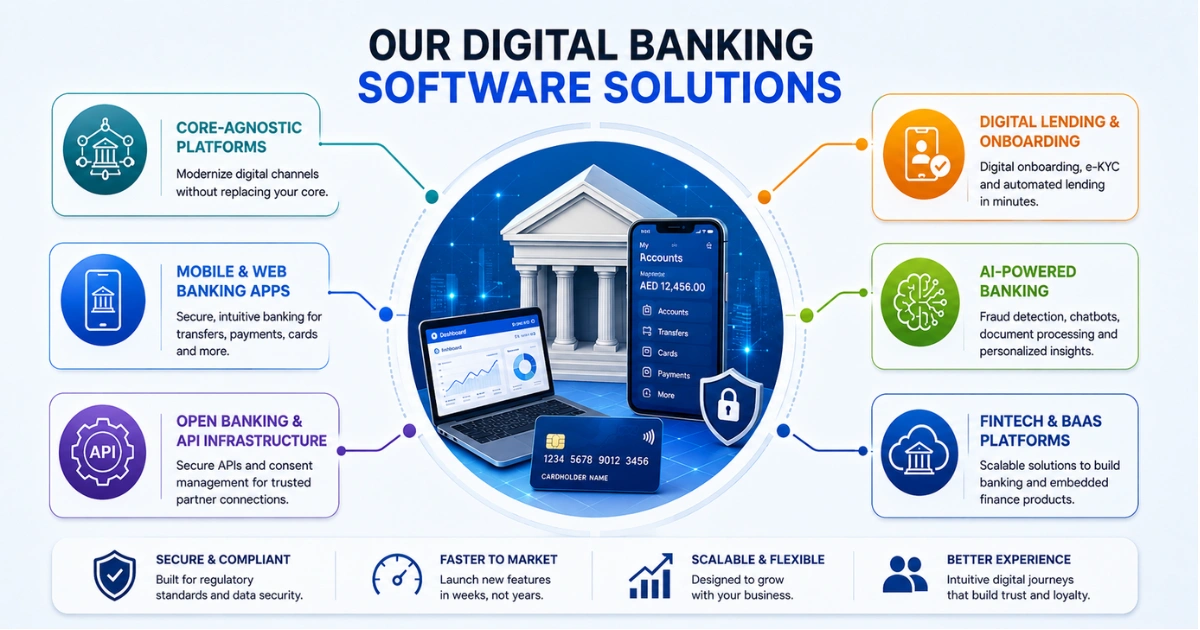
We don't sell a single rigid platform and force your bank to fit it. We build digital banking software around your existing infrastructure, your regulatory environment, and your growth plan. That typically falls into a few categories of work.
Core-Agnostic Digital Banking Platforms
If your core banking system works but your digital channels don't, you don't need to rip out the core. We build an integration and API layer that sits between your legacy core and your customer-facing apps, so you can modernize the experience your customers see without a multi-year core replacement project. This is one of the most common engagements we run, because it lets banks ship improvements in months instead of waiting on a full core migration.
Mobile and Web Banking Applications
Account balances, transfers, bill pay, card controls, statements, service requests — built as a connected experience rather than a static app bolted onto your core. If you're specifically building for the UAE market, this work often overlaps directly with our mobile banking apps in UAE practice, where local payment rails, Central Bank requirements, and Arabic-language UX are already baked into how we build.
Open Banking and API Infrastructure
An API gateway, consent management, authentication, and partner-facing APIs that let fintechs, aggregators, and third-party providers connect to your bank securely — without exposing more than they need. Open banking is no longer optional in most regulated markets, and retrofitting it onto a closed system is far more expensive than building it in from the start.
Digital Lending and Onboarding Systems
Digital account opening, e-KYC, document capture, credit scoring integration, and automated decisioning workflows that cut onboarding time from days to minutes, while still producing the audit trail your compliance team needs.
AI-Powered Banking Features
Fraud detection models, conversational banking assistants, document processing, and personalization engines. We build these as part of our broader AI apps development work, tailored specifically for the accuracy and explainability standards that banking demands — a chatbot hallucinating a wrong balance isn't an acceptable trade-off for a slicker UI.
Fintech and Banking-as-a-Service Platforms
For fintechs and challenger banks building banking products without a banking license of their own, we build the technology layer that plugs into a sponsor bank or BaaS provider. This work sits alongside our broader fintech app development solutions, which cover payments apps, lending platforms, and embedded finance products beyond traditional banking.
Who We Build Digital Banking Software For
Not every bank needs the same platform, and we scope engagements differently depending on where you're starting from.
Retail and commercial banks modernizing legacy channels. You have a working core, established customers, and a digital experience that's starting to look dated next to fintech competitors. We focus on the integration and API layer here, so you can ship a better experience without touching the core.
Neobanks and challenger banks building from zero. No legacy to work around, but no existing infrastructure either. We build the full stack — experience layer through core integration or partnership with a banking-as-a-service provider — sequenced so you can launch a limited product fast and expand from there.
Credit unions and community banks with limited internal engineering. Smaller teams, tighter budgets, but the same regulatory bar as larger institutions. We build platforms sized to your actual member base, without the enterprise overhead that larger banking software vendors tend to push regardless of fit.
Fintechs and BaaS platforms operating alongside a sponsor bank. You're building banking products without a banking license. We build the technology layer that sits on top of your sponsor bank relationship, handling the customer experience while staying inside the compliance boundaries your sponsor requires.
Corporate and business banking divisions. Your requirements — multi-user access, maker-checker approvals, treasury tools, bulk payments — are different enough from retail banking that they usually need dedicated design attention rather than a retail platform with extra permissions bolted on.
If your situation doesn't map cleanly onto any of these, that's normal. Most real projects are some mix of the above, and the first call is usually just us figuring out which parts of your platform need the most attention.
The Architecture Behind the Software
A lot of vendors will show you screenshots. We'll show you how the system actually holds together, because that's what determines whether your platform survives a core banking upgrade, a regulatory audit, or a 10x spike in transaction volume.
We build on a layered architecture:
- Experience layer — mobile apps, web banking, corporate portals, chatbots, and voice interfaces
- Engagement layer — dashboards, personalization, notifications, and customer journey orchestration
- API and integration layer — API gateway, authentication, event streaming, and open banking APIs
- Banking product layer — accounts, cards, loans, payments, pricing, and eligibility logic
- Core banking layer — the system of record for balances, transactions, and the general ledger
- Data and analytics layer — data warehousing, fraud analytics, and AI/ML pipelines
- Security and compliance layer — identity and access management, encryption, audit logging, and SIEM
Depending on your bank's scale and goals, we'll recommend one of a few architectural approaches: a layered architecture for straightforward modernization, microservices for large digital ecosystems that need independent scaling, a modular or composable approach for gradual rollouts, or an event-driven architecture for banks pushing into real-time payments. We'll walk you through the trade-offs of each rather than defaulting to whichever one is easiest for us to sell.
Features We Build Into Every Digital Banking Platform
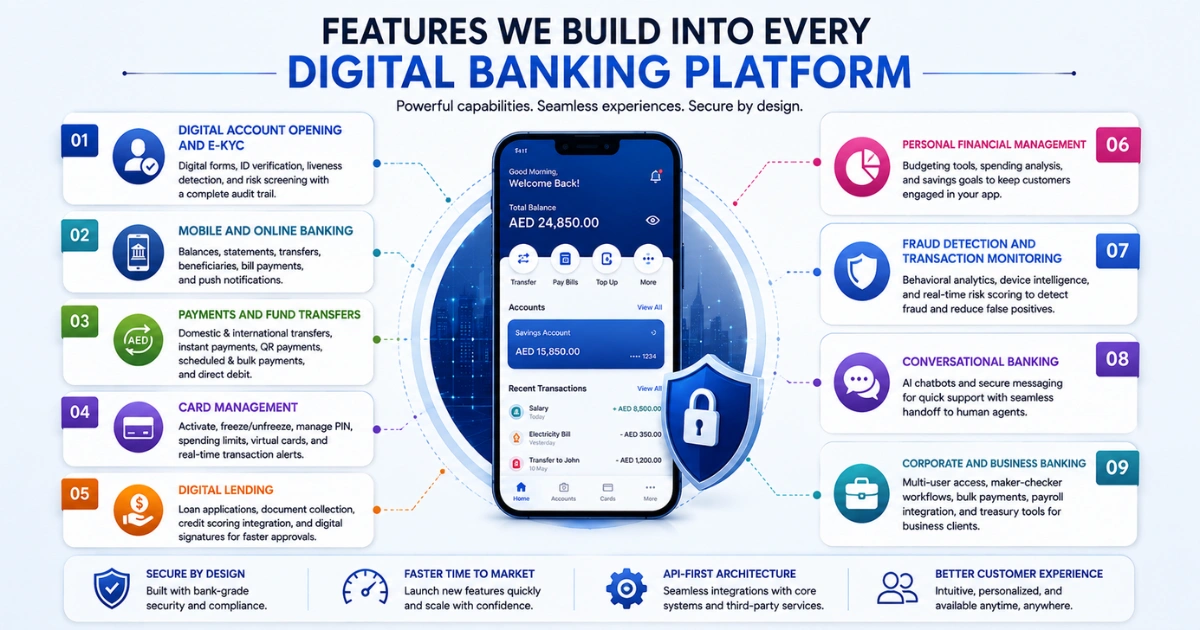
Every engagement is scoped to your specific product line, but these are the capabilities that show up in nearly every digital banking platform we deliver:
Digital account opening and e-KYC — digital forms, identity verification, liveness detection, sanctions and PEP screening, and risk classification, all producing a clean audit trail.
Mobile and online banking — balances, statements, transfers, beneficiary management, bill payments, and push notifications.
Payments and fund transfers — domestic and international transfers, instant payments, QR payments, scheduled and bulk payments, and direct debit.
Card management — activation, freeze/unfreeze, PIN management, spending limits, virtual card issuance, and real-time transaction alerts.
Digital lending — loan applications, automated document collection, credit scoring integration, and digital signatures, so a loan that used to take a week can close in a day.
Personal financial management — budgeting tools, spending analysis, and savings goals that keep customers inside your app instead of a third-party finance tool.
Fraud detection and transaction monitoring — behavioral analytics, device intelligence, and real-time risk scoring that catches anomalies without generating so many false positives that your fraud team drowns in alerts.
Conversational banking — AI chatbots and secure messaging for routine service requests, with a clean handoff to a human agent when a query needs one.
Corporate and business banking — multi-user access, maker-checker approval workflows, bulk payments, payroll integration, and treasury tools for your commercial clients.
If a feature on this list isn't relevant to your bank, we won't build it just to pad a scope document. If something you need isn't on this list, that's exactly the kind of conversation worth having with our team directly.
Security Isn't a Feature We Add at the End
For a bank, security has to be architectural, not decorative. We don't bolt authentication onto a finished product — it's part of the design from day one, and it shows up in every layer of the system:
- Identity and access management, with role-based and attribute-based controls
- Multi-factor authentication across customer and employee channels
- Encryption and key management, both in transit and at rest
- API security, including rate limiting, token validation, and abuse monitoring
- Application security testing, including regular penetration testing
- Fraud and account-takeover prevention built into the transaction pipeline, not layered on after
- Security monitoring, SIEM integration, and incident response planning
- Disaster recovery and business continuity planning that's actually tested, not just documented
- Full audit logging for every transaction and administrative action
- Ongoing vulnerability management, not a one-time assessment before launch
A digital banking platform shouldn't be judged by how many features it has. It should be judged by how those features behave when something goes wrong — a spike in fraud attempts, a regional outage, a regulator asking for six months of audit logs on short notice. That's the standard we build to.
Cloud-Based Digital Banking Software: What We Actually Recommend
Cloud infrastructure gives banks faster deployment, easier scaling, and better analytics than most on-premise setups can match. It also introduces real questions around data residency, vendor concentration risk, and third-party dependency — questions that matter a lot more in banking than in most other industries.
We work across public, private, and hybrid cloud models depending on what your regulator expects and what your risk appetite allows. Before recommending a cloud strategy, we look at:
- Data residency requirements in your operating jurisdiction
- How much control you need to retain over infrastructure versus how much you're comfortable outsourcing
- Your exit strategy if you ever need to move providers
- How the cloud environment integrates with your existing core and third-party systems
We'd rather walk you through the actual risks up front than sell you on "the cloud" as a one-line pitch.
AI in Digital Banking: Where It Actually Helps
AI gets pitched as a blanket solution to everything in banking right now. In practice, it earns its place in a handful of areas: fraud detection, credit risk scoring, document processing, customer service automation, and personalization based on transaction history.
Generative AI specifically is showing up in banking assistants, document summarization for compliance teams, and internal knowledge tools that help staff find policy answers faster. Used well, it speeds up decisions your team already makes. Used carelessly, it introduces hallucinations, bias, and explainability problems that a regulator will ask you to account for.
We build AI features with human oversight built into the workflow, not as an afterthought — because in banking, the goal of AI is to improve decisions, not to remove accountability for them. Our AI development on the banking side runs through the same AI apps practice we use across fintech, adapted for the accuracy and audit requirements this industry demands.
Digital Banking Software vs. Core Banking Software
We get this question constantly from banks evaluating a modernization project, so it's worth answering directly.
|
Factor |
Digital Banking Software |
Core Banking Software |
|
Primary purpose |
Digital customer experience |
Financial system of record |
|
Main users |
Customers, employees, partners |
Bank operations teams |
|
Examples |
Mobile banking, web banking, onboarding |
Accounts, deposits, loans, general ledger |
|
Customer interaction |
Direct |
Usually indirect |
|
Role of APIs |
High |
Increasingly important |
|
Modernization approach |
Can be built around legacy systems |
May require deeper modernization |
The short version: you can modernize your digital banking software without replacing your core. We build an integration layer between the two — legacy core, then an API and integration layer, then the digital banking platform, then your customer channels — so you get a modern experience without a multi-year, high-risk core replacement.
Build vs. Buy: Why Banks Choose to Build With Us
Off-the-shelf digital banking platforms are faster to deploy, but you inherit someone else's roadmap, someone else's limitations, and often a licensing structure that gets expensive as you scale. Building custom software gives you full control and a system shaped around your actual products, but it's a bigger upfront lift.
|
Factor |
Build |
Buy |
|
Customization |
High |
Medium to high |
|
Time to market |
Longer |
Faster |
|
Control |
Full |
Depends on vendor |
|
Maintenance |
Your responsibility (or ours, as your dev partner) |
Shared with vendor |
|
Integration |
Custom-fit |
Constrained by platform |
|
Cost predictability |
Lower upfront, more predictable long-term |
Higher upfront predictability, less long-term control |
Most banks we work with land somewhere in between: buying core infrastructure where it makes sense, and building custom digital banking software where differentiation actually matters — the parts of the experience customers notice and competitors can't easily copy. We'll tell you honestly which parts of your project fit which category instead of pushing a full custom build when a hybrid approach would serve you better.
What It Costs to Build Digital Banking Software
There's no honest single number here, and any vendor giving you a flat quote before understanding your requirements is guessing. What actually drives the cost:
- How many banking products the platform needs to support
- Number of channels (mobile, web, corporate portal)
- Complexity of your core banking integration
- Number and complexity of third-party integrations (payments, CRM, AML, fraud)
- Security and compliance requirements specific to your jurisdiction
- Cloud infrastructure and data migration scope
- How much customization and AI capability you need
- Geographic coverage and number of users at launch
If your project also involves a standalone mobile application, our breakdown of the cost to develop an app in 2026 is a useful starting point for scoping that piece specifically. For the full platform, we'll give you a real estimate after a scoping call — not a number pulled from a rate card that ignores your actual requirements.
CTA - Get a Project Estimate
How We Deliver: Our Implementation Approach
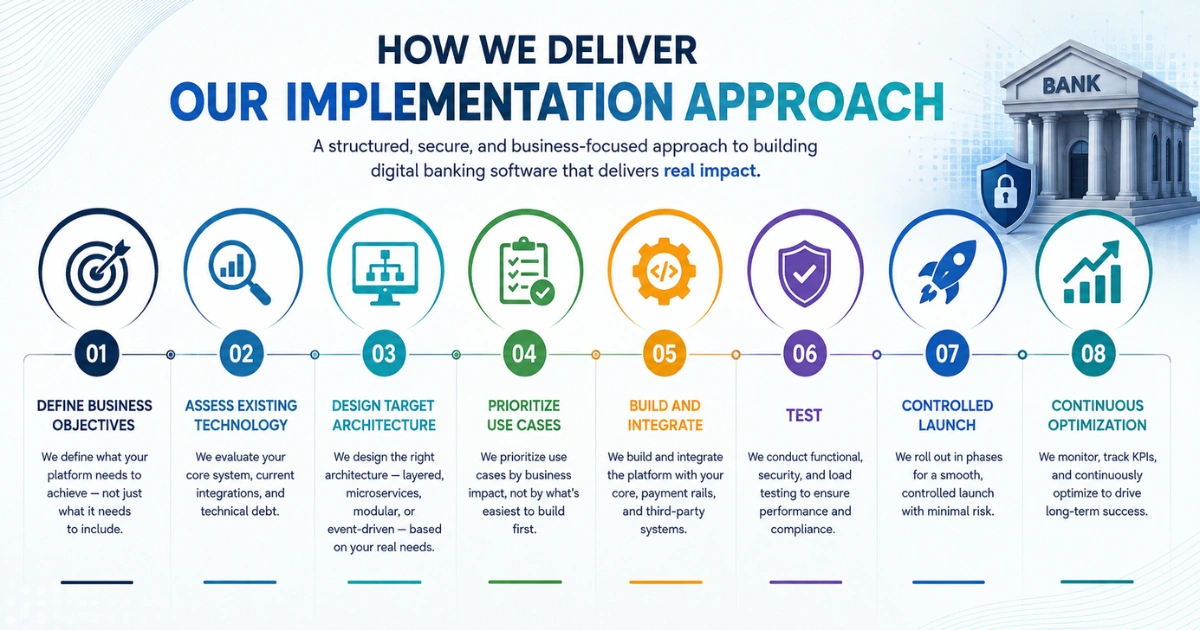
We run digital banking software projects through a structured process, because in banking, a missed integration or a skipped security review doesn't just delay launch — it creates real risk.
- Define business objectives — what the platform needs to achieve, not just what it needs to include
- Assess existing technology — your core system, current integrations, and technical debt
- Design target architecture — layered, microservices, modular, or event-driven, based on your actual needs
- Prioritize use cases — sequencing features by business impact, not by what's easiest to build first
- Build and integrate — development against your core, payment rails, and third-party systems
- Test — functional, security, and load testing before anything reaches production
- Controlled launch — phased rollout rather than a single high-risk go-live
- Continuous optimization — monitoring, KPI tracking, and iteration after launch
We stay involved past launch. A digital banking platform that isn't monitored and iterated on starts falling behind the moment it ships.
Digital Banking Software for the UAE Market
If you're operating in the UAE, your platform has to account for a specific set of expectations: Central Bank cybersecurity and data protection requirements, open finance and consent management standards, biometric authentication norms, cloud outsourcing rules, and business continuity requirements that go further than what many markets require.
|
Area |
What We Build For |
|
Security |
Identity and access management, encryption, fraud prevention aligned to local standards |
|
APIs |
Authentication, consent management, and monitoring for open finance |
|
Cloud |
Data residency, outsourcing compliance, and a clear exit plan |
|
AI |
Explainability and human oversight built into every model |
|
Open Finance |
Consent-based, third-party API access |
|
Resilience |
Disaster recovery and incident response tested against local expectations |
This is also where our mobile banking apps in UAE work connects directly to digital banking software: the mobile experience is only as good as the platform and compliance layer behind it, and we build both together rather than treating them as separate projects.
Blockchain and Emerging Technology in Digital Banking
Some banks and fintechs are exploring blockchain for cross-border payments, trade finance, and settlement infrastructure — areas where a shared, tamper-evident ledger solves a real coordination problem between institutions. It's not a fit for every use case, and we won't recommend it where a traditional database does the job better. Where it does make sense, our work on blockchain in fintech covers the specific applications worth evaluating for a banking environment.
How to Choose a Digital Banking Software Partner
Whether you work with us or someone else, evaluate any vendor against these criteria:
- Functional fit — does the platform actually match your product lineup, or does it force you to redesign your products around the software?
- Integration capability — can it connect cleanly to your specific core, payment rails, and third-party systems?
- Security and compliance — does the vendor understand your regulatory environment, or are they learning it on your project?
- Architecture — is the system built to scale with you, or will you outgrow it in two years?
- Implementation support — do they stay involved through launch and after, or hand off a system and disappear?
- Total cost of ownership — licensing, maintenance, and support costs beyond the initial build
- Vendor track record — have they actually shipped banking software, not just generic enterprise software
- Data portability and exit strategy — can you leave if the relationship doesn't work out, without losing your data or rebuilding from scratch?
We'll answer every one of these directly on a call — including the ones that don't favor us, if that's the honest answer for your specific project.
What Changes for Your Bank After Launch
It's worth being specific about what a well-built digital banking platform actually changes, because "digital transformation" as a phrase has been used so loosely it's stopped meaning much.
Customer acquisition gets faster. When onboarding drops from days to minutes, fewer applicants abandon the process halfway through. That's not a UX nicety — it's applicants you were losing before that you now keep.
Support volume shifts. Routine requests — balance checks, card freezes, transaction disputes — move to self-service and conversational banking, which frees your support team to handle the cases that actually need a person.
New products ship faster. A modular, API-first platform means launching a new card product or lending feature doesn't require touching the core system every time. Product and engineering teams stop waiting on each other.
Fraud losses become more manageable. Real-time risk scoring and behavioral analytics catch more fraud attempts earlier, and better tuning means your team isn't buried in false positives that make every genuine alert harder to spot.
Compliance reporting stops being a fire drill. With audit logging and monitoring built into the platform from the start, pulling records for a regulator becomes a query, not a weeks-long manual reconstruction.
None of that happens automatically just because you moved to "digital." It happens because the platform was architected to support those outcomes specifically — which is the part of this work that actually matters.
Let's Build Your Digital Banking Platform
Digital banking software isn't just a customer-facing app — it's the connective layer between your customers, your core systems, your compliance requirements, and every partner you'll ever plug into through open banking. Getting that layer right determines how fast you can launch new products, how well you handle a regulatory audit, and whether your platform can actually scale with your bank.
We've built that layer for banks and fintechs working through exactly these constraints — legacy integration, security requirements, and tight regulatory timelines. If you're evaluating a digital banking software project, the conversation costs nothing and tells you a lot about whether we're the right fit.