

What is aviation fleet & MRO software? It's a specialised platform that helps airlines and maintenance organisations manage aircraft records, maintenance planning, work orders, components, inventory, technical documentation, workforce authorisations, compliance and fleet performance from a connected system.
The UAE has built one of the busiest aviation ecosystems in the world, and that scale creates a maintenance problem most legacy tools were never designed to solve. As fleets grow, aircraft utilisation climbs, and regulatory expectations tighten, disconnected spreadsheets and standalone systems become harder to trust — and harder to defend in an audit.
Aviation fleet and MRO software is the digital layer that connects the moving parts of an operation:
Aircraft → Maintenance → Components → Inventory → People → Technical Records → Compliance → Operations
This guide walks through what that software actually does, why UAE operators are investing in it, which capabilities matter most, how GCAA requirements shape software selection, where AI genuinely helps, and how to evaluate a platform before you commit budget to one.
Why UAE Aviation Is Creating Greater Demand for MRO Software
UAE Aviation at a Glance
|
Indicator |
Latest reported figure |
Why it matters |
|
Passenger traffic |
147.8 million in 2024 |
Higher utilisation increases maintenance-planning requirements |
|
Air cargo |
4.36 million tonnes in 2024 |
Adds fleet and maintenance complexity |
|
Registered aircraft |
929 in 2024 |
Shows the breadth of the aviation ecosystem |
|
Registered air operators |
36 in 2024 |
Reflects diverse operator requirements |
|
Air traffic movements |
~1.03 million |
Increases pressure on aircraft availability |
|
Estimated UAE MRO market |
$3.67B in 2025* |
Indicates significant MRO activity |
This figure is a third-party market estimate, not an official government statistic — treat it as directional rather than definitive.
What These Numbers Mean for Airlines and MRO Providers
More passengers and more cargo mean more flight hours. More flight hours mean more maintenance events, more parts consumption, and more technical records to keep current. None of that is a problem in isolation — it becomes a problem when the systems tracking it can't keep pace with the fleet generating it. Airlines and MRO providers operating at this scale need real-time visibility into aircraft availability, not a weekly spreadsheet reconciliation.
What Is Aviation Fleet & MRO Software?
The term covers two related but distinct disciplines, often delivered through one connected platform.
Aviation Fleet Management Software
This side of the platform tracks the aircraft as an asset. It covers the aircraft portfolio, utilisation, flight hours, flight cycles, configuration, ownership and leasing status, operational status, lifecycle data and overall availability. Think of it as the system that answers: which aircraft do we have, where are they, and what condition are they in right now?
Aviation MRO Software
This side manages the work required to keep those aircraft airworthy. It covers maintenance programmes, work orders, inspections, repairs, components, parts, labour, technical records, defects and compliance workflows. It answers a different question: what needs to happen to this aircraft, when, and who's authorised to do it?
How Fleet and MRO Software Work Together
The two disciplines are only useful together. A simplified version of the workflow looks like this:
Flight Operations → Aircraft Utilisation → Maintenance Due → Parts & Labour → Work Order → Inspection → Certification → Return to Service
An aircraft accrues flight hours and cycles, which trigger maintenance requirements. Those requirements pull parts and labour into a work order, which gets inspected, certified and returned to service — and the cycle starts again. When fleet data and maintenance data live in separate systems, someone has to manually bridge that gap. That's where delays creep in.
Aviation Fleet Management Software vs MRO Software: What's the Difference?
|
Area |
Fleet Management Software |
MRO Software |
|
Primary purpose |
Manage aircraft assets and utilisation |
Manage maintenance |
|
Main users |
Fleet, operations, finance, leasing |
Engineering, maintenance, quality, stores |
|
Core data |
Aircraft, utilisation, ownership, cycles |
Tasks, components, parts, labour, records |
|
Main outcome |
Aircraft availability and asset utilisation |
Safe, compliant and efficient maintenance |
|
Typical integrations |
Operations, finance, leasing |
ERP, inventory, technical records, reliability |
Do Airlines Need Both?
For complex UAE airlines and large MRO organisations, yes — an integrated approach is usually worth more than two isolated systems bolted together after the fact. A standalone fleet tool can tell you an aircraft is available. It can't tell you why a maintenance check is about to eat into that availability window. Only a connected system can do both.
Why Do UAE Airlines Need Aviation MRO Software?
1. High Aircraft Utilisation
When aircraft fly more hours per day, the margin for maintenance error shrinks. A delayed check or a missed parts order doesn't just affect one flight — it ripples through the day's entire schedule.
2. Large and Technically Diverse Fleets
UAE operators run wide-body aircraft, narrow-body aircraft, freighters, business jets and helicopters, often side by side, each with different engine and APU configurations and different maintenance programmes. A system designed for one aircraft type won't scale cleanly across that mix.
3. GCAA Compliance and Audit Readiness
Software can support the processes that regulators expect to see documented — but it doesn't create compliance on its own. That distinction matters, and we'll come back to it in detail below.
4. UAE Climate and Operating Conditions
Heat, dust, sand and humidity are a fact of operating in the region. They demand disciplined maintenance scheduling and record-keeping, though the extent of any specific component impact varies by aircraft type, engine and operating environment.
5. Growing Third-Party MRO Activity
Independent MRO providers in the region increasingly need multi-customer support, coverage across multiple aircraft types, workscope management, customer portals, contract and billing tracking, component exchange, and technical records delivery — capabilities a single-operator system usually can't provide.
Essential Features of Aviation Fleet & MRO Software
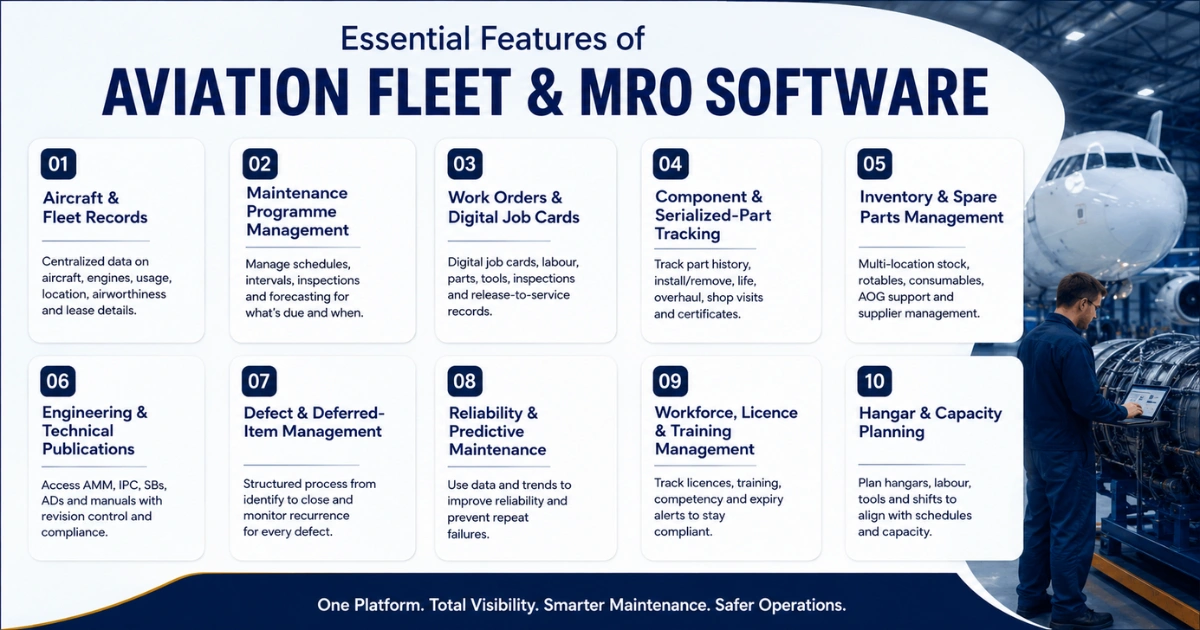
1. Aircraft & Fleet Records
Registration, serial number, aircraft type, configuration, ownership, operator, engine/APU, flight hours, flight cycles, location, airworthiness status and lease conditions all need a single source of truth.
2. Maintenance Programme Management
Covers calendar-based maintenance, flight-hour intervals, flight-cycle intervals, multiple-parameter thresholds, tolerance windows, repetitive inspections, deferred maintenance and forecasting — the logic that decides what's due, and when.
3. Work Orders & Digital Job Cards
Workscope definitions, job cards, labour assignments, required skills, parts, tools, inspections, non-routine findings, digital signatures and release-to-service records — the paper trail (now digital) that proves the work was done correctly.
4. Component & Serialized-Part Tracking
Serialised component traceability isn't optional in this industry — it's how an organisation proves a part's full history. That means tracking part number, serial number, installation and removal history, time since new, time since overhaul, remaining life, shop visits, warranty status and certificates.
5. Aviation Inventory & Spare Parts Management
Multi-location inventory, airport and station stock, rotables, consumables, quarantine status, shelf life, minimum and maximum stock thresholds, AOG procurement and supplier management all sit here. Good inventory management is one of the biggest levers an operator has against unplanned aircraft-on-ground events — a point worth its own deep dive.
6. Engineering & Technical Publications
AMM, IPC, SRM, wiring diagrams, CMM, service bulletins, airworthiness directives, engineering orders, MEL and internal procedures all need to live somewhere engineers can trust. Revision control matters here more than almost anywhere else in the system — an engineer working from an outdated manual page is a real risk, not a paperwork issue.
7. Defect & Deferred-Item Management
A structured path from discovery to resolution:
Identify → Assess → Classify → Plan → Rectify → Approve → Close → Monitor Recurrence.
Skipping steps, or losing visibility between them, is how minor defects turn into repeat problems.
8. Reliability & Predictive Maintenance
Technical delays, repetitive defects, component removals, MTBF, MTTR, dispatch reliability, AOG events and failure trends all feed into a reliability programme that should be shaping maintenance planning, not just reporting on it after the fact.
9. Workforce, Licence & Training Management
Qualifications, aircraft type ratings, CAR-66 licences, company authorisations, training records, competency tracking, expiry alerts and scope of approval — the system should flag an expiring licence before it becomes a certification gap, not after.
10. Hangar & Capacity Planning
Hangar bays, maintenance stations, aircraft induction, release dates, labour capacity, tools, equipment, shift planning and outsourced work all need to be balanced against each other, ideally in the same view as the maintenance schedule driving them.

Benefits of Aviation MRO Software for UAE Airlines and MRO Providers
Improve Aircraft Availability
Availability comes from four things working together: maintenance planning, parts availability, a qualified workforce and clear work-order visibility. Weakness in any one of them drags the others down.
Reduce AOG and Maintenance Disruption Risk
Better visibility into upcoming maintenance, parts stock and component life gives engineering teams a chance to act before a problem becomes a grounded aircraft, rather than reacting once it already is one.
Improve Compliance & Audit Readiness
Audit trails, digital records, electronic approvals, document control and fast record retrieval all shorten the time between an auditor's question and a defensible answer.
Reduce Maintenance Costs
Parts forecasting, labour optimisation, warranty recovery, less emergency expediting and tighter inventory control all chip away at cost — not through one dramatic change, but through the accumulation of smaller, avoidable losses being closed off.
Improve Maintenance Decision-Making
Dashboards that surface fleet availability, maintenance cost, AOG frequency, reliability trends, parts stock, labour utilisation and overdue maintenance turn maintenance planning from a reactive exercise into a genuinely proactive one.
UAE Aviation MRO Software Compliance: What Should You Look For?
GCAA CAR-145
Software can support the areas CAR-145 covers — personnel, facilities, equipment, maintenance data, production planning, certification, records, occurrence reporting, quality systems and audit management — by making them traceable and consistent.
Continuing Airworthiness
This includes support for maintenance programmes, ADs, service bulletins, life-limited components, aircraft records, defect control and maintenance forecasting — the ongoing evidence that an aircraft remains fit to fly.
CAR-66 and Personnel Authorisation
The system should be able to verify licence validity, aircraft type qualification, training status, company authorisation and scope of approval before someone signs off on a task — not after.
Important Compliance Disclaimer
Software can support regulatory compliance, but software alone does not make an airline or MRO organisation compliant. Compliance depends on approved procedures, qualified personnel, facilities, records, governance and implementation.
Any vendor claiming their platform makes you "CAR-145 compliant" out of the box is oversimplifying what compliance actually requires.
How AI Is Changing Aviation Fleet & MRO Software in 2026
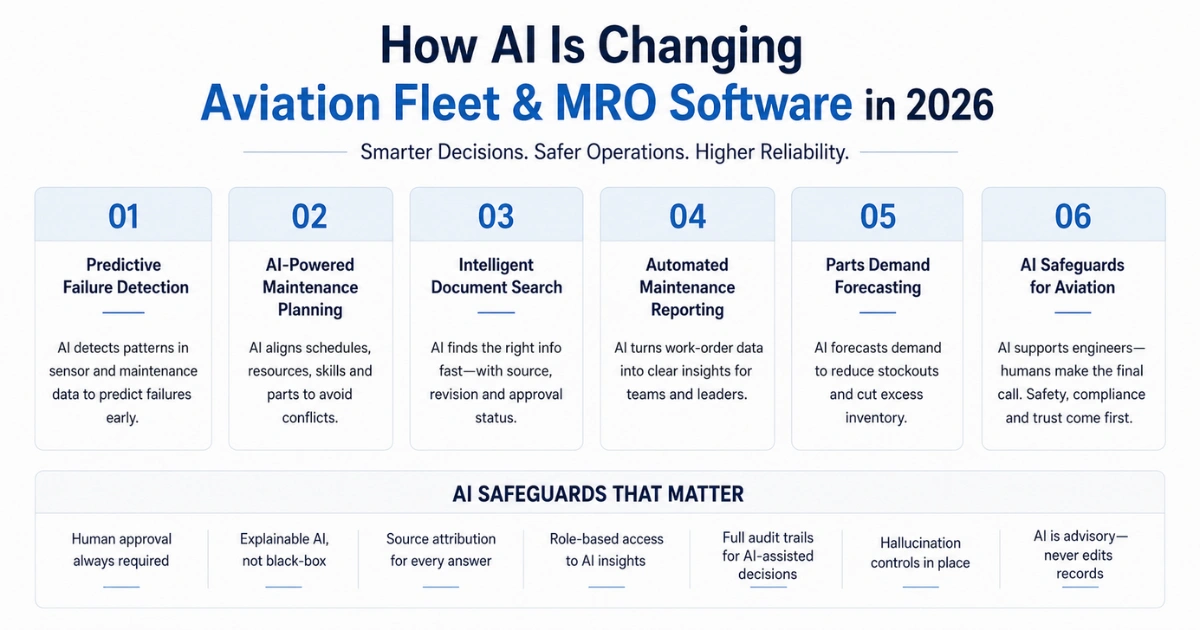
Predictive Failure Detection
AI models can identify patterns across sensor data, flight data, maintenance history, component removals and defect history that would take a human analyst far longer to surface manually.
AI-Powered Maintenance Planning
AI can compare maintenance due dates against aircraft schedules, hangar capacity, technician skills, parts availability and expected task duration, surfacing conflicts before they become scheduling emergencies.
Intelligent Technical Document Search
LLM-powered search can help engineers find relevant approved information faster than manually paging through manuals. The critical safeguard here: the AI's response needs to show the source document, its revision, and its approval status — an answer without provenance isn't usable in this environment.
Automated Maintenance Reporting
AI can summarise structured maintenance data for supervisors, engineering managers, quality teams and executives, turning raw work-order data into something a non-technical reader can act on quickly.
Parts Demand Forecasting
Historical consumption, component removal rates, utilisation trends and supplier lead times can all feed a forecasting model that reduces both stockouts and excess inventory.
AI Safeguards for Aviation
AI should assist engineering decisions — not independently authorise maintenance. That means:
- Human approval remains mandatory for maintenance decisions.
- AI outputs need to be explainable, not black-box.
- Every AI-sourced answer needs source attribution.
- Role-based access controls who can see and act on AI outputs.
- Full audit trails cover AI-assisted decisions, not just human ones.
- Hallucination controls prevent fabricated technical guidance from reaching an engineer.
- Advisory AI stays clearly separated from approved technical data.
- No AI system modifies maintenance records without human authorisation.
How to Choose the Right Aviation MRO Software in the UAE
Step 1 — Define Your Operating Model
Are you an airline, an independent MRO, a cargo operator, a business aviation operator, a helicopter operator, a government or military operator, or an aircraft lessor? Each has a different priority list.
Step 2 — Map Existing Maintenance Processes
Walk through aircraft induction, maintenance planning, defect management, parts requisition, work-order completion, certification, technical records, AOG response and audit preparation as they actually happen today — not as they're documented to happen.
Step 3 — Validate Regulatory Fit
Ask vendors to demonstrate actual workflows against your requirements rather than accepting "aviation compliant" as a marketing line. If they can't show you the screen, be skeptical of the claim.
Step 4 — Test Integrations
Check compatibility with flight operations, ERP, finance, HR, procurement, warehouse, aircraft health monitoring, OEM systems, BI tools and identity management. A platform that can't talk to your existing systems creates a new silo instead of removing one.
Step 5 — Run a Realistic Proof of Concept
Test the platform against scenarios that actually happen, not idealised demo data:
- An AOG event at an international station.
- A part shortage before scheduled maintenance.
- An expiring certifying staff authorisation.
- A repetitive defect.
- An unplanned engine removal.
- A lease-return records request.
- An audit evidence retrieval request.
Step 6 — Calculate Total Cost of Ownership
Look beyond the licence fee to implementation, integration, data migration, training, customisation, support, security, storage, upgrades and business continuity costs. The sticker price is rarely the real number.
Aviation MRO Software Checklist for UAE Airlines
- Multi-aircraft support
- Multi-operator support
- Aircraft/engine/APU configuration control
- Flight-hour and flight-cycle tracking
- Maintenance programme management
- Digital work orders
- Digital job cards
- Defect management
- Deferred-item management
- Serialised component tracking
- Spare-parts inventory
- Supplier management
- Mobile maintenance access
- Electronic signatures
- Audit trails
- Technical publication control
- Licence and training management
- Reliability analytics
- AOG workflows
- Hangar planning
- Customer portals
- API support
- Role-based security
- Backup and disaster recovery
- Cloud/private deployment options
- Arabic/English capability where required
- Configurable dashboards
KPIs to Measure After Implementing Aviation MRO Software
|
KPI |
What it tells you |
|
Fleet availability |
How much of the fleet is operationally available |
|
Dispatch reliability |
Maintenance-related operational reliability |
|
Maintenance schedule compliance |
Whether planned work is completed on time |
|
AOG frequency |
Frequency of aircraft-grounding events |
|
Mean time to repair |
Maintenance restoration speed |
|
Parts fill rate |
Availability of required inventory |
|
Inventory turnover |
Efficiency of inventory investment |
|
Labour utilisation |
Workforce productivity |
|
Repeat defects |
Recurring technical problems |
|
On-time release |
Maintenance planning effectiveness |
|
Record retrieval time |
Audit/customer responsiveness |
|
Maintenance cost per flight hour |
Cost efficiency |
Establish baseline figures for these KPIs before implementation, then compare them at 30, 90, 180 and 365 days. Without a baseline, you have no way of knowing whether the new system actually moved the needle — only that it's running.
The Future of Aviation Fleet & MRO Software in the UAE
Expect continued fleet expansion, rising aircraft utilisation, growing third-party MRO activity, wider adoption of predictive maintenance, more AI-assisted engineering work, fully digital technical records, connected aircraft data feeding directly into maintenance planning, greater automation, more attention to cybersecurity, workforce planning around skills shortages, multi-location maintenance operations, and increasingly demanding integration requirements.
MRO software should increasingly be treated as operational infrastructure rather than an isolated back-office application. Airlines that still think of it as a records system are leaving the platform's actual value on the table.
Should UAE Airlines Buy or Build Aviation MRO Software?
Buy an Existing Platform When
- Requirements are relatively standard.
- Fast deployment matters more than deep customisation.
- Regulatory workflows already exist within the platform.
- The organisation wants proven aviation functionality rather than a first build.
Consider Custom Development When
- Existing systems can't support specialised workflows.
- Multiple legacy systems need to be unified into one view.
- The organisation needs a unique customer portal experience.
- Advanced AI capabilities are required beyond what off-the-shelf vendors offer.
- The operator has specialised UAE workflows that generic platforms don't handle well.
- Current software is creating excessive manual workarounds just to function day to day.
Hybrid Approach
Many operators land somewhere in between — an established MRO core paired with custom integrations, analytics, mobile applications and AI layers built around it. For organisations weighing this path, aviation software development services in Dubai can bridge the gap between an off-the-shelf platform's limits and what a specific operation actually needs.
Final Takeaway
For UAE airlines and MRO organisations, aviation fleet and MRO software is no longer simply a maintenance-record system. It's becoming the operational layer connecting aircraft, engineering, maintenance, inventory, people, technical data, compliance and decision-making.
Five priorities matter most when selecting a platform:
- Regulatory and audit readiness
- Aircraft/component traceability
- Integrated maintenance and inventory planning
- Reliable integrations and secure data
- AI and analytics with human engineering oversight
Planning to modernise your airline or MRO operation? Start by evaluating your current maintenance workflows, integrations and data architecture before selecting a platform.