
The Middle East aviation sector is approaching a structural transformation that will redefine how airspace is managed, monetized, and regulated. By 2026, commercial operations of electric vertical takeoff and landing (eVTOL) aircraft and urban air taxi systems are expected to begin in cities such as Dubai and uae, with parallel mobility initiatives accelerating in saudi arabia. What makes this transition significant is not merely the introduction of new aircraft types, but the emergence of an entirely new digital aviation layer operating below traditional airspace corridors.
Advanced Air Mobility (AAM) is fundamentally software-driven. While aircraft manufacturers capture headlines, the true operational backbone lies in low-altitude traffic orchestration systems, vertiport management platforms, autonomous navigation software, safety intelligence systems, and real-time operations control centers. Without these systems functioning in perfect coordination, commercial viability is impossible.
The Middle East holds a strategic advantage. Unlike legacy aviation markets constrained by decades-old air traffic infrastructure, GCC countries possess centralized regulatory frameworks, modern airport ecosystems, and government-backed smart mobility strategies. Aviation authorities are already working within structured regulatory environments to define certification pathways and digital governance standards for urban air mobility.
For aviation companies operating in this region, 2026 is not a distant milestone—it is an execution deadline. Software architecture decisions made today will determine regulatory approval timelines, operational scalability, cybersecurity resilience, and long-term profitability.
The competitive edge in Advanced Air Mobility will not be mechanical superiority. It will be digital maturity. Aviation leaders who invest early in robust, certifiable Advanced Air Mobility software infrastructure will shape the future of regional airspace. Those who delay risk entering a market where digital ecosystems are already locked in by first movers.
The Rise of Advanced Air Mobility in the Middle East
A. Government Vision and Policy Backing
Advanced Air Mobility (AAM) in the Middle East is not emerging in isolation. It is being engineered as part of long-term national transformation agendas.
In the UAE, the UAE Net Zero 2050 initiative is accelerating investment in sustainable transportation systems, including electric aviation and smart mobility corridors. Urban air taxis and eVTOL systems directly align with decarbonization goals by reducing ground congestion and lowering carbon emissions per passenger kilometer. Similarly, under Saudi Vision 2030, Saudi Arabia is reimagining its infrastructure ecosystems—integrating aviation, logistics, tourism, and smart city mobility into a unified digital framework.
What distinguishes the region is the proactive involvement of aviation regulators. The General Civil Aviation Authority (GCAA) and the Dubai Civil Aviation Authority (DCAA) are already working on regulatory frameworks that support low-altitude airspace integration, unmanned traffic management (UTM), and certification pathways for eVTOL platforms.
Rather than waiting for global regulatory consensus, these authorities are deploying structured experimentation models, including:
-
Regulatory sandboxes for testing flight management software
-
Controlled low-altitude testing corridors within designated urban zones
-
Public-private aviation partnerships between regulators, aircraft manufacturers, and technology providers
This policy-backed acceleration reduces bureaucratic uncertainty and allows aviation companies to begin building compliant software ecosystems today.
B. Why the Middle East Is Uniquely Positioned
The Middle East offers structural advantages that few global markets can replicate.
First, airspace governance is highly centralized. Unlike fragmented Western jurisdictions, GCC aviation authorities maintain streamlined approval hierarchies, enabling faster certification cycles for new air mobility systems.
Second, infrastructure investment capacity remains exceptionally strong. Airports across the region were built or modernized in the last two decades, meaning digital integration layers can be embedded without dismantling outdated systems.
Third, regional carriers and operators are technologically progressive. Airlines and aviation groups in the GCC already rely on advanced operations control centers, predictive maintenance systems, and integrated safety management frameworks. This digital maturity creates a foundation for low-altitude fleet orchestration platforms.
Most importantly, Middle Eastern aviation ecosystems are not burdened by legacy urban air traffic congestion models. They can deploy vertically integrated digital frameworks—from vertiport scheduling systems to autonomous air traffic management—starting from a clean architectural baseline.
Unlike legacy Western markets, where regulatory fragmentation and infrastructure inertia slow adoption, the Middle East can build Advanced Air Mobility as a native, software-first aviation layer from day one.
What Is Advanced Air Mobility (AAM) — And Why It Is Software-Driven
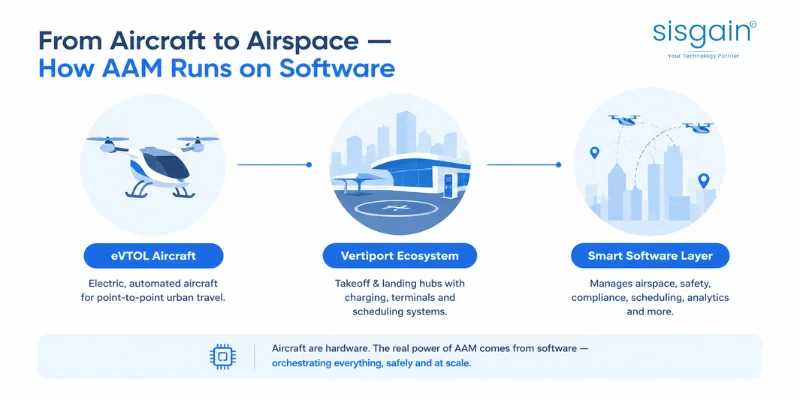
Advanced Air Mobility (AAM) refers to a next-generation aviation ecosystem built around electric, highly automated aircraft operating primarily in low-altitude urban and regional environments. While often associated with futuristic aircraft concepts, AAM is fundamentally a digital infrastructure challenge.
At the hardware level, AAM revolves around eVTOL systems (electric vertical takeoff and landing aircraft). These vehicles are designed to operate without traditional runways, enabling point-to-point urban transport. Within this framework, Urban Air Mobility (UAM) represents the passenger and cargo operations conducted within metropolitan airspaces.
However, aircraft alone do not create a mobility system. Supporting infrastructure includes:
-
Vertiport ecosystems — designated takeoff and landing hubs integrated with charging systems, passenger terminals, and digital scheduling platforms
-
Low-altitude traffic corridors — structured airspace pathways below traditional commercial flight routes, requiring real-time coordination
The core reality is this: aircraft are hardware assets. Airspace coordination, scheduling, regulatory compliance, safety enforcement, billing systems, and predictive analytics are software systems. Without intelligent software orchestration, AAM cannot scale safely or profitably.
Advanced Air Mobility relies on:
-
Autonomous navigation platforms capable of sensor fusion and obstacle detection
-
AI-driven flight coordination to prevent airspace congestion
-
Digital twin simulations that model urban airspace scenarios before live deployment
-
Real-time risk analytics for weather, air traffic density, and system health monitoring
From an aviation compliance perspective, these systems must operate within aviation-grade redundancy models. That means multi-layer failover protocols, deterministic system behavior, auditable telemetry logs, and strict alignment with certification frameworks such as DO-178C for airborne software. Unlike consumer mobility platforms, AAM software must meet aviation safety integrity levels comparable to commercial airline systems.
In essence, Advanced Air Mobility is not an aviation add-on. It is a software-first aviation architecture built on regulatory precision, digital reliability, and AI-enabled operational control.
The Software Infrastructure Required for Advanced Air Mobility
The success of Advanced Air Mobility depends on a tightly integrated software stack. Each layer must communicate seamlessly while meeting aviation-grade safety and compliance standards.
1. Vertiport Management Systems
Vertiports will function as the airports of low-altitude aviation. Their management systems must handle:
-
Dynamic slot allocation based on real-time traffic density
-
Charging cycle management for electric fleets
-
Passenger flow orchestration and identity verification
-
Integration with airport management systems for multimodal connectivity
These platforms must also integrate safety reporting, compliance logging, and operational audits—similar in rigor to existing Aviation Safety Management Software used in traditional aviation environments. The difference is scale and speed: vertiports will operate with higher frequency cycles and shorter turnaround windows.
Vertiport software must also integrate payment processing, fleet dispatch coordination, and predictive maintenance alerts into a unified digital dashboard.
2. Low-Altitude Air Traffic Management (UTM Systems)
Urban air mobility requires a new category of traffic orchestration often referred to as Unmanned Traffic Management (UTM).
Key capabilities include:
-
Integration with traditional Air Traffic Control (ATC) systems
-
AI-based conflict detection to prevent mid-air convergence
-
Dynamic geo-fencing for restricted or sensitive zones
-
Automated emergency rerouting protocols
These systems must align with global standards set by bodies such as the International Civil Aviation Organization while also adhering to national civil aviation authority frameworks. Interoperability between UTM and existing ATC infrastructure is one of the most complex integration challenges in AAM software development.
3. Autonomous Flight & Navigation Software
Autonomous flight control requires deterministic, certifiable algorithms capable of operating under variable environmental conditions.
Core components include:
-
Sensor fusion algorithms combining LiDAR, radar, GPS, and visual navigation data
-
Fail-safe redundancy layers ensuring continued operation in case of subsystem failure
-
Predictive weather risk modeling integrated with live meteorological feeds
-
Real-time fleet diagnostics transmitted to ground control centers
Certification remains a critical barrier. Software used in airborne systems must comply with DO-178C standards, which define strict development assurance levels (DAL A–E) depending on safety criticality. Achieving certification demands traceability documentation, verification testing, and configuration management protocols far beyond standard enterprise development practices.
4. Operations Control Centers for AAM
Just as UAE Airlines Rely on Operations Control Centers, future AAM operators will require next-generation digital command hubs.
These centers will include:
-
AI-powered dispatch systems that optimize route allocation
-
Fleet-level visibility dashboards displaying aircraft health, battery levels, and traffic congestion
-
Predictive maintenance integration that reduces unscheduled downtime
Unlike traditional airline OCCs, AAM control centers must operate with higher frequency cycles and urban density complexity. Micro-delays in data processing can translate into airspace conflicts, making system latency and redundancy critical design considerations.
5. Cybersecurity & Data Sovereignty
AAM software will manage flight telemetry, passenger data, geospatial coordinates, and infrastructure control systems. This makes cybersecurity non-negotiable.
Requirements include:
-
Aviation-grade cybersecurity frameworks
-
End-to-end encrypted communication channels
-
Secure API gateways between aircraft and ground systems
-
Compliance with GCC data localization and sovereignty regulations
Aviation software cannot be treated like standard enterprise SaaS. Breaches in consumer platforms create reputational risk; breaches in aviation systems create safety risk. Therefore, penetration testing, intrusion detection systems, and zero-trust architecture must be embedded from the design phase.
In summary, Advanced Air Mobility software demands a multi-layered, certifiable, and regionally compliant digital ecosystem. Companies that underestimate this complexity risk operational delays and regulatory rejection.
Why Aviation Companies Cannot Afford to Delay Investment
A. First-Mover Advantage in Regulated Markets
Aviation markets are licensing-driven. Early compliance often translates into long-term operating dominance. Organizations that align their software architecture with regulatory frameworks today are more likely to secure early route approvals and vertiport partnerships.
Integration timelines for aviation-grade systems range between 18 and 36 months when factoring in development, testing, certification, and regulator approvals. Waiting until commercial launch announcements are finalized may leave insufficient time to deploy certifiable systems.
B. Infrastructure Lock-In Effect
Once Advanced Air Mobility ecosystems are deployed, they create technological lock-in. Vertiport management systems, traffic coordination platforms, and fleet analytics tools are deeply integrated. Replacing them after deployment can be operationally disruptive and financially prohibitive.
Early adopters can shape standards and ecosystem interoperability, influencing vendor relationships and long-term data governance structures.
C. Strategic Technology Partnerships
Aviation leaders must now evaluate whether to:
-
Build internal aviation-grade software teams
-
Or collaborate with specialized aviation software development solutions providers
Given the certification complexity, regulatory coordination, and cybersecurity requirements involved, partnering with experienced aviation software development solutions firms often accelerates compliance readiness while reducing integration risk.
The decision is not simply technological—it is strategic. Aviation companies that treat Advanced Air Mobility software as a secondary consideration may find themselves competing in a digitally defined market without the necessary digital backbone.
Build vs Partner: Strategic Technology Decisions for Aviation Leaders
As Advanced Air Mobility moves from pilot programs to commercial deployment, aviation executives face a defining question: should they build their AAM software infrastructure internally or collaborate with a specialized technology partner?
Option 1: In-House Development
Building internally offers control, but it comes with substantial risk.
First, the capital expenditure is significant. Aviation-grade software requires specialized engineering teams, certification consultants, cybersecurity architects, systems engineers, and compliance auditors. Unlike conventional enterprise platforms, AAM systems must meet deterministic reliability and safety integrity requirements.
Second, there is the certification knowledge gap. DO-178C processes, safety case documentation, configuration management traceability, and regulator-facing audits demand experience that most airline IT teams do not possess internally.
Third, approval cycles are long. Even well-resourced aviation organizations often underestimate the time required for validation, authority review, and integration testing. What appears as a 12-month development roadmap can easily extend to 24–36 months when compliance layers are factored in.
Option 2: Strategic Software Partner
Partnering with experienced providers—particularly established custom software development companies in UAE—can significantly reduce these risks.
Regional partners bring:
-
Familiarity with GCC civil aviation regulatory frameworks
-
Understanding of data sovereignty and hosting requirements
-
Experience coordinating with aviation authorities during validation cycles
-
Structured development processes aligned with certification standards
Most importantly, a specialized partner can design a Minimum Viable Product (MVP) architecture that is certification-aware from the outset, shortening regulatory review cycles and reducing rework costs.
For aviation leaders, this decision is not about outsourcing development—it is about accelerating compliance readiness and minimizing systemic risk. The right technology partner functions as an extension of the aviation organization’s governance framework, not merely as a software vendor.
Regulatory & Certification Complexity in the Middle East
Advanced Air Mobility cannot operate without deep regulatory alignment. In the Middle East, aviation authorities maintain strict oversight frameworks, and software systems must satisfy multiple layers of validation before commercial approval.
Airworthiness certification for AAM platforms includes software validation processes that assess reliability, fault tolerance, and deterministic system behavior. Systems controlling navigation, flight stabilization, and traffic coordination must meet clearly defined safety assurance levels.
National civil aviation authority approval layers typically involve:
-
Software design review
-
Operational safety case evaluation
-
Cybersecurity assessment
-
Integration testing with air traffic infrastructure
-
Ongoing compliance monitoring
In Saudi Arabia, oversight from the Saudi General Authority of Civil Aviation introduces structured evaluation procedures that cover operational safety, technical documentation, and risk management frameworks. Similar multi-stage validation models apply across the GCC.
Data hosting compliance is another critical dimension. Flight telemetry data, passenger records, and geospatial mapping systems must often remain within national boundaries, requiring localized cloud infrastructure or sovereign hosting arrangements.
Additionally, flight telemetry archiving requirements demand secure, tamper-proof storage of operational data for audit and investigation purposes. These archives must support traceability and replay capabilities, often for extended retention periods.
Understanding this ecosystem requires more than general software expertise. It requires familiarity with aviation governance, authority engagement processes, documentation standards, and audit preparation cycles. Companies entering AAM without regulatory fluency risk delays that can stall commercial launch timelines indefinitely.
The Future: 2026–2035 Advanced Air Mobility Outlook
The commercialization phase beginning in 2026 represents only the first chapter of a broader transformation.
Between 2026 and 2035, the Middle East is expected to expand Advanced Air Mobility beyond passenger air taxis into diversified operational domains.
AI-piloted cargo drones will support logistics corridors connecting airports, ports, and inland distribution hubs. These systems will rely on autonomous fleet coordination software capable of real-time route optimization and predictive load balancing.
Cross-border low-altitude corridors may emerge between neighboring GCC states, requiring interoperable traffic management systems and harmonized regulatory frameworks.
Integrated airport–vertiport ecosystems will connect commercial aviation terminals with urban air mobility hubs, enabling seamless multimodal passenger transfers. Software platforms will synchronize ticketing, scheduling, and baggage logistics across both layers.
Smart city mobility integration will further embed AAM into digital urban planning systems. Traffic congestion analytics, weather modeling, and emergency response networks will feed into centralized airspace coordination platforms.
Carbon credit tracking through blockchain-based registries may also become standard, enabling transparent emissions accounting and sustainability reporting tied directly to flight telemetry data.
From a regulatory perspective, autonomous certification models will evolve. Authorities may introduce AI-assisted compliance audits and continuous system validation frameworks, reducing manual review cycles while increasing real-time oversight.
AI-driven predictive airspace analytics will help authorities and operators anticipate congestion patterns before they occur. Subscription-based AAM software platforms may replace traditional license models, enabling scalable infrastructure adoption across smaller operators.
The Middle East is positioned to function as a global testing ground for these systems. Centralized governance, infrastructure funding capacity, and smart city ambitions create an environment where next-generation aviation software can mature rapidly.
Conclusion: Aviation’s Next Competitive Edge Is Digital, Not Mechanical
Aircraft will capture public attention. Sleek eVTOL designs and futuristic vertiports will dominate media coverage. But beneath that visibility lies a less visible, more decisive factor: software.
Software determines whether aircraft can safely coordinate in dense urban airspace. Software ensures compliance, manages fleet health, orchestrates charging cycles, protects data, and optimizes profitability. Software will ultimately dictate whether Advanced Air Mobility becomes scalable infrastructure or remains a limited pilot initiative.
For aviation companies in the Middle East, 2026 is not the starting point. It is the execution phase. The groundwork—architecture design, compliance mapping, regulator engagement, cybersecurity structuring—must begin now.
Forward-looking aviation organizations should initiate:
-
Feasibility assessments aligned with regulatory frameworks
-
Infrastructure mapping for vertiport and UTM integration
-
Regulatory alignment workshops with civil aviation authorities
-
Certification-aware software architecture planning
Organizations exploring advanced aviation software infrastructure should align with experienced aviation software development partners who understand compliance ecosystems, scalability requirements, and Middle East aviation governance structures.
In the coming decade, competitive advantage in aviation will not be defined by mechanical engineering alone. It will be defined by digital precision, regulatory intelligence, and the ability to build software systems that can safely scale across the skies of the Middle East.