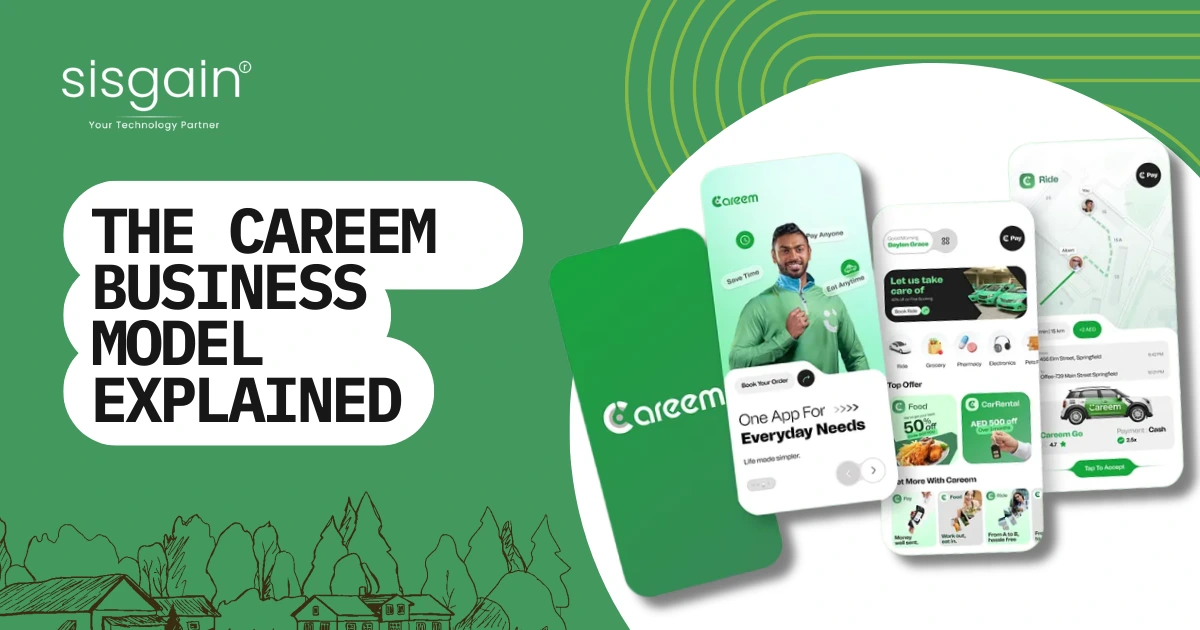

Careem didn’t just become a taxi app—it transformed into the Middle East’s most popular super app, serving millions of users across 100+ cities. Its journey from a simple ride-hailing service in 2012 to a multi-service platform today is nothing short of remarkable.
But how did Careem scale so fast, expand into food delivery, digital payments, and logistics, and generate millions in revenue?
In this article, we break down Careem’s business model, operating strategy, and revenue streams, and show how you can leverage these insights to build your own taxi or super app with the help of expert Mobile App development in UAE services.
By the end, you’ll understand what makes a super app like Careem successful, and how startups and enterprises can replicate this model in their markets.
What is the Careem Super App?
Careem started as a simple ride-hailing company in the UAE in 2012, aiming to solve a basic transportation problem: getting from point A to point B efficiently. However, its founders quickly realized that the market demanded more than just a taxi service. Users wanted convenience, speed, and reliability in one seamless platform—something that could simplify daily life rather than add complexity. This insight laid the foundation for what would eventually become the Careem Super App, a platform designed to meet multiple everyday needs under a single interface.
Today, Careem has evolved far beyond ride-hailing. It has successfully transformed into a multi-service digital ecosystem, catering to millions of users across the Middle East, Africa, and South Asia. The app is organized around three core verticals, each targeting a distinct aspect of user life:
1. Mobility of People
At its core, Careem remains a mobility platform for people. This includes:
-
Car and Bike Ride-Hailing: Users can book cars or bikes through the app for instant rides or scheduled trips. Options include economy, business, and luxury vehicles to meet different customer preferences.
-
Shuttle Services & Mass Transit: Careem has introduced Commut, a tech-driven bus shuttle service that allows users to book shared rides on fixed routes, making commuting more affordable and efficient.
-
Corporate Transport: The platform also serves businesses, offering seamless fleet management and corporate bookings for employees.
By focusing on speed, reliability, and safety, Careem ensures that users trust the platform for their daily travel needs, whether commuting to work, running errands, or attending events.
Pro Tip: For entrepreneurs, this vertical highlights the importance of starting with a core service that solves a real pain point before expanding into other domains.
2. Mobility of Things
Careem’s second vertical is mobility of things, transforming the app into a one-stop solution for daily deliveries. This includes:
-
Food Delivery: Through Careem Eats, users can order from restaurants across multiple cities. Over the years, Careem has also adapted to health-conscious trends, offering options for nutritious meals alongside traditional fast food.
-
Grocery & Essentials Delivery: Careem Quik allows customers to get groceries, fresh produce, and essential items delivered directly to their doorstep, often within minutes.
-
B2B Logistics & Corporate Deliveries: The platform handles bulk deliveries for businesses, including restaurants, retailers, and corporate offices. This includes items like office supplies, promotional materials, and even meals for employees.
-
Parcel Delivery: Careem users can send packages and personal items efficiently, ensuring reliable same-day or next-day delivery.
This vertical demonstrates Careem’s ability to understand and adapt to changing consumer needs, especially in urban areas where convenience and speed are highly valued.
Insight: If you are planning to build a super app, the mobility of things vertically is crucial for diversifying revenue streams and increasing daily user engagement.
3. Mobility of Money
The third vertical, mobility of money, is Careem’s foray into the fintech space, creating a secure and seamless financial ecosystem for users. Services include:
-
Digital Wallet & Payments: Careem Pay allows users to top up their wallets, pay bills, transfer money, and manage everyday financial transactions directly from the app.
-
Mobile Recharge & Top-Ups: Users can recharge prepaid mobile plans instantly through the app.
-
Peer-to-Peer Transfers: The app enables safe, fast, and convenient money transfers between friends and family.
-
Loyalty & Rewards Integration: Careem’s wallet integrates with its rewards program, allowing users to earn and redeem points for rides, deliveries, and other services.
By combining transport, logistics, and finance under a single platform, Careem has successfully created a daily-use ecosystem, ensuring users return to the app repeatedly.
Lesson for Startups: The mobility of money vertical not only enhances convenience but also builds user trust and retention. When integrated thoughtfully, it can become a powerful monetization channel.
Why Careem’s Three-Pronged Approach Works
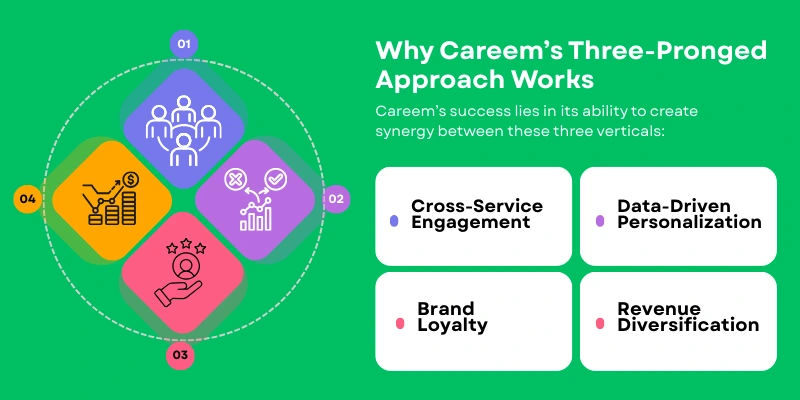
Careem’s success lies in its ability to create synergy between these three verticals:
-
Cross-Service Engagement: Users who book rides are more likely to order food or make payments within the same app, increasing daily engagement.
-
Data-Driven Personalization: Integrating multiple services allows Careem to collect behavioral data, enabling personalized recommendations and targeted promotions.
-
Brand Loyalty: Offering multiple services under one brand builds trust, reduces friction, and strengthens user loyalty.
-
Revenue Diversification: By combining rides, deliveries, and payments, Careem ensures multiple streams of revenue, reducing dependence on any single service.
This approach has allowed Careem to transition from a ride-hailing company into a super app, becoming an indispensable part of users’ daily lives in the Middle East.
Key Takeaways for Super App Developers
-
Start with a core problem (e.g., ride-hailing) and expand gradually.
-
Design the app as a platform rather than a single service, enabling future verticals to integrate seamlessly.
-
Include both B2C and B2B services to capture multiple revenue streams.
-
Integrate digital payments early to increase stickiness and open fintech opportunities.
-
Focus on local market adaptation, including language, payment habits, and cultural nuances.
By studying Careem’s model, startups and IT companies can understand how to build scalable, multi-service platforms that engage users daily and generate multiple revenue streams.
How the Careem Business Model Works
At its core, Careem’s business model revolves around a technology-driven platform consisting of three main components:
-
Passenger App
-
Captain App
-
Admin Dashboard
Let’s explore each.
Passenger App
The Passenger App is designed for ease of use and reliability:
-
Real-time GPS tracking for accurate pickup and drop-off.
-
Ride options: Users can choose ‘Now’ or ‘Later’.
-
Payment flexibility: Cash, credit/debit cards, or Careem Wallet.
-
Ratings & feedback: Customers can rate drivers and provide service feedback.
The app ensures a seamless experience that keeps customers engaged and loyal.
Captain App
The Captain App is tailored for drivers, offering:
-
Onboarding & training: Drivers must complete a training program before starting.
-
Trip management: Accept or reject rides, track earnings, and view ride history.
-
Cash management: Handles B2C cash bookings and B2B invoicing.
-
Notifications: Real-time updates about bookings, schedules, and promotions.
This app ensures drivers can maximize earnings while maintaining service quality.
Admin Dashboard
The Admin Dashboard is the operational control center:
-
Track rides and deliveries in real-time
-
Manage drivers and captains
-
Monitor cash flows and transactions
-
Set fares, discounts, and promotion codes
-
Analyze performance metrics
The Admin Dashboard is crucial to scaling operations across multiple cities while ensuring consistency and quality.
Careem’s Revenue Model Explained
Careem generates revenue through multiple channels, which is key to its success as a super app.
|
Revenue Stream |
Description |
Example |
|
Ride-Hailing |
Commission per trip |
20–25% per ride fare |
|
Food Delivery |
Service fee + delivery charges |
Careem Eats |
|
Grocery & Essentials |
Delivery fee + markup |
Careem Quik |
|
B2B Logistics |
Contracted deliveries |
Burger deliveries, corporate shipments |
|
Payments & Wallet |
Transaction fees |
Careem Pay |
|
Premium Rewards |
Subscription & loyalty program |
Careem Gold |
This multi-stream approach allows Careem to remain profitable and diversify its income sources.
Operating Model That Powers Growth
The operating model is how Careem executes its business model efficiently:
-
Location Database: Google Maps often fails in the Middle East due to rapid urban development. Careem built its own location database for precise pickups.
-
Call Centers: Careem operates call centers for both drivers and customers to overcome language and tech barriers.
-
Cash Handling: With low credit card penetration in the region, most rides are paid in cash. Careem’s model accommodates this seamlessly.
-
Booking for Others: Users can book rides for family, clients, or employees—a feature that boosted adoption.
-
Mass Transportation: Through Commut, Careem expanded into shuttle services for urban commuters.
This customer-focused operational model allows Careem to scale rapidly in diverse markets.
Key Statistics & Market Impact
-
97 million rides in 2022, covering 1.2 billion kilometers
-
Saudi Arabia accounted for the highest trips: 26.8 million
-
Food delivery growth: Healthy meal orders increased by 47%
-
Grocery delivery growth: Monthly orders on Careem Quik rose 26x in 2022
-
Wallet top-ups: $50 million
-
CSR contributions: $778,162 raised for humanitarian, educational, and economic initiatives
These numbers highlight Careem’s dominance and influence in the region.
Lessons for Taxi & Super App Development
Careem’s journey provides actionable insights for startups and IT companies looking to build super apps:
-
Start Small, Expand Gradually
Launch with one core service (rides), then expand into related verticals like food delivery and payments. -
Understand Local Needs
Cash is king in the Middle East, so digital payment options must complement traditional cash payments. -
Invest in Technology
A strong tech stack with passenger, driver, and admin apps is essential for smooth operations. -
Leverage Data
User behavior, location analytics, and rewards program data drive engagement and profitability. -
Diversify Revenue Streams
Super apps thrive by monetizing multiple services simultaneously—rides, deliveries, payments, subscriptions. -
Prioritize Trust & Safety
Features like driver call centers and restricted contact info enhance security and customer confidence.
Why Careem Succeeded vs Competitors
Careem’s remarkable rise from a simple taxi-hailing app to a dominant super app in the Middle East is not just luck—it is the result of strategic planning, local market understanding, and technological innovation. Let’s break down the key factors that set Careem apart from competitors in the region.
1. Local Adaptation: Tailored Solutions for Middle East Cities
Unlike global competitors who often deploy a “one-size-fits-all” approach, Careem focused on understanding the nuances of the local market. This included:
-
Cash Payments: Credit card penetration is relatively low in many Middle Eastern countries, so Careem’s system accommodates cash-based transactions, which accounted for over 90% of rides in certain regions.
-
Local Language Support: Careem’s apps and call centers support multiple languages, including Arabic, English, and Urdu, ensuring accessibility for both locals and expatriates.
-
Accurate Navigation: Google Maps often underperforms in rapidly developing cities due to road construction and urban changes. Careem built its own location database to ensure precise pickups and drop-offs.
-
Cultural Sensitivity: Features like booking rides for others—parents booking rides for children or assistants booking for executives—cater specifically to local customs and practical needs.
By adapting to regional realities, Careem gained a competitive edge over global ride-hailing services that didn’t localize effectively.
2. Customer-Centric Approach: Putting Users First
Careem’s success is rooted in a customer-first philosophy, which permeates its products and services:
-
Call Centers: Unlike many ride-hailing apps that rely solely on digital support, Careem provides dedicated call centers for both drivers and passengers. This ensures real-time assistance, even for users who are not tech-savvy.
-
Mobile-First Design: The app is intuitive, fast, and visually simple, which keeps users engaged and reduces friction.
-
Loyalty Programs: Careem’s reward system, including Careem Gold, incentivizes frequent usage and builds brand loyalty. Users earn points for rides, deliveries, and wallet top-ups, which can be redeemed for free services, discounts, or donations.
-
Safety Measures: Driver verification, ride tracking, and in-app support make users feel secure—a critical differentiator in regions where safety concerns are significant.
By prioritizing user experience, Careem ensured high retention rates, repeat usage, and positive word-of-mouth growth, which competitors struggled to achieve.
3. Strong Technology Foundation: Scalable & Flexible Architecture
Careem’s technology stack is built for rapid expansion and multiple verticals, which gives it an edge over competitors limited to single-service apps. Key features include:
-
Passenger & Driver Apps: Real-time GPS tracking, automated receipts, feedback systems, and flexible payment options.
-
Admin Dashboard: Centralized control for monitoring rides, finances, promotions, and driver performance.
-
Data Analytics & AI: Predictive analytics for ride demand, delivery optimization, and personalized promotions.
-
Scalable Architecture: Designed to handle high volumes of traffic across multiple cities without downtime.
This robust technical infrastructure allowed Careem to launch new services quickly, maintain high reliability, and scale to new regions efficiently—a challenge for competitors with rigid systems.
4. Strategic Acquisitions & Partnerships
Careem didn’t grow organically alone—it leveraged acquisitions and partnerships to expand services and enhance its ecosystem:
-
RoundMenu Acquisition: Integrated restaurant listings and food delivery across the Arab region.
-
Bike-Sharing Startup: Expanded urban mobility options with eco-friendly transport solutions.
-
Fintech Partnerships: Launched Careem Pay, enabling digital payments, wallet top-ups, and secure transactions.
-
Commut Shuttle Service: Partnered with local operators to create a tech-driven mass transportation solution.
These strategic moves allowed Careem to diversify its offerings, reach new customer segments, and stay ahead of competitors in an increasingly crowded market.
5. Brand Loyalty: Building a Daily-Use Ecosystem
Careem’s ultimate success lies in creating a platform that users rely on every day, rather than just for occasional rides:
-
Super App Convenience: By integrating rides, deliveries, and payments in one app, users interact with Careem multiple times daily.
-
Rewards & Premium Memberships: Careem Gold and in-app reward points encourage loyalty, increase engagement, and foster a sense of belonging.
-
Trust & Safety: Transparent pricing, verified drivers, and secure payment options give users confidence in the platform.
-
Social Responsibility: Community initiatives, charity programs, and educational support reinforce a positive brand image.
This combination of convenience, trust, and rewards has cemented Careem as a household name in the Middle East, making it extremely difficult for competitors to lure users away.
6. Lessons for Aspiring Taxi & Super App Developers
By analyzing Careem’s success, startups and IT companies can extract actionable insights:
-
Localize Your Solution: Adapt features to suit regional behaviors, culture, and payment preferences.
-
Prioritize Customer Experience: Invest in UX, loyalty programs, safety features, and accessible support.
-
Build Scalable Tech Infrastructure: Ensure your app can handle high traffic, multiple services, and rapid expansion.
-
Leverage Strategic Partnerships: Acquire complementary businesses or partner with local service providers to diversify offerings.
-
Create Daily-Use Value: Offer multiple verticals so users engage with the app frequently, increasing retention and monetization.
For startups and enterprises in the Middle East looking to launch a taxi or super app, partnering with expert Mobile App development in UAE companies ensures the right combination of tech, design, and strategy.
How to Build a Taxi or Super App in 2026
If you’re planning to launch a super app in the Middle East, consider these steps:
-
Market Research: Analyze local customer needs, competitor offerings, and regulations.
-
Tech Stack: Develop Passenger, Driver, and Admin apps using scalable technology.
-
Payment Integration: Offer cash, card, and digital wallets.
-
Multi-Service Approach: Add delivery, e-commerce, or financial services.
-
Rewards & Loyalty: Implement gamified rewards and premium subscriptions.
-
Compliance: Ensure the app meets local regulations, safety standards, and financial compliance.
-
Partner with Experts: Work with professional Mobile App development in UAE companies for faster deployment and support.
SISGAIN Advantage: Your Partner for Super App Development
SISGAIN is one of the leading IT Companies in Dubai specializing in:
-
Ride-hailing & taxi apps
-
Super app development (multi-service platforms)
-
Scalable Admin dashboards
We focus on custom solutions, ensuring your app is robust, secure, and market-ready.
Conclusion
Careem’s journey proves that market understanding, scalable technology, and multi-service integration are key to building a super app that dominates its region.
If you want to launch a taxi or super app like Careem, partnering with an experienced company like SISGAIN, one of the top IT Companies in Dubai, ensures you have the right expertise, technology, and market insight to succeed.
Book a Free Consultation with SISGAIN Today and transform your super app idea into a reality.