
Most ERP conversations in Dubai start the same way. A finance manager is closing the month from the fourth spreadsheet of the week, the warehouse quotes one stock number while sales quotes another, and someone in the leadership meeting finally says, “We need an ERP.”
That sentence is the easy part. What decides whether you end up with a system your team trusts or an expensive piece of shelfware is everything after it: packaged or custom, who connects it to your POS and your bank, and how you cut over without losing a month of data.
There is now a hard deadline on top of that. UAE e-invoicing goes live for large businesses in January 2027 and for everyone else in July 2027. That moves ERP software for businesses in Dubai out of the “growth project” bucket and into the “compliance dependency” bucket.
I run delivery at SISGAIN, and across 19 years in IT I have watched ERP programmes succeed and fail. They rarely fail because of the software. They fail on scoping, data quality and integration. This guide is what I would hand a Dubai owner or CFO before their first vendor call. If you want the business case for ERP, we have covered how ERP cuts costs and lifts productivity for UAE businesses separately. Here, we assume you are past “why” and need to get “which” and “how” right.
1. What ERP Software for Businesses in Dubai Has to Do in 2026
Enterprise Resource Planning software runs your core operations from one shared data model: finance, inventory, purchasing, sales, HR and projects. A purchase order raised by procurement updates stock, accounts payable and cash forecasts without anyone retyping it.
The Dubai version of that has extra obligations. Your system must handle 5% VAT across mainland, free zone and designated zone transactions, track corporate tax, generate WPS salary files, report Emiratisation, run in Arabic and English, and now issue structured e-invoices. A generic global package with a translated interface does not cover that. It is the single most common mismatch I see in first-time buyers.
It also helps to be clear about what ERP is not:
| Accounting software | CRM | ERP |
Core job | Books, invoices, VAT returns | Leads, pipeline, customer history | One data model across finance, stock, purchasing, HR and projects |
Works well while | One entity, simple stock | Sales is the only complexity | Several departments depend on the same numbers |
Starts to break when | You add warehouses, branches or complex payroll | Sales promises what operations cannot deliver | Processes are unmapped or master data is dirty |
From the delivery desk: The trigger I hear most is not “we want to grow.” It is “we cannot trust our numbers on the 5th of the month.” [Vivek to supply: one real, anonymised example of the moment a client realised spreadsheets had stopped working.]
2. The Dubai Compliance Layer: What Any ERP Must Pass Before You Shortlist It
Before comparing features, run every candidate through the compliance test. It removes more vendors than any demo does.
UAE e-invoicing: the deadline that changes the buying decision
The UAE’s e-invoicing system is built on the Peppol PINT AE standard and uses a five-corner model. Instead of emailing a PDF, your ERP sends a structured invoice through an Accredited Service Provider, which validates it and reports to the tax authority. It applies to business transactions in the UAE regardless of VAT registration status, with specific exclusions, and the initial scope is B2B and B2G.
The current timeline, as of November 2026:
Business group | Appoint an ASP by | Mandatory go-live |
Revenue of AED 50 million or more | 30 October 2026 (extended from 31 July; now passed) | 1 January 2027 |
Revenue below AED 50 million | 31 March 2027 | 1 July 2027 |
Government entities | 31 March 2027 | 1 October 2027 |
If you are in the first group and have not appointed an ASP, you are already behind the schedule, and penalties for non-compliance have been published. Check the current position with the Ministry of Finance and the FTA before you act, because this area has been amended more than once this year.
What this means for ERP buying: ask every vendor how their system connects to an ASP, which PINT AE fields it populates, and what happens to invoices that fail validation. “It’s on our roadmap” is not an answer in 2026. For a practical view of the workflow side, read how e-invoicing connects ERP, inventory and finance workflows.
VAT and corporate tax
VAT at 5% sounds simple until you trade between mainland, free zone and designated zone entities, each with different treatment. Corporate tax at 9% adds another layer, particularly for groups with Qualifying Free Zone entities where the books have to separate qualifying and non-qualifying income. Your ERP should do that separation by configuration, not by an accountant’s spreadsheet at year-end.
WPS, MOHRE and Emiratisation
Payroll in the UAE means Wage Protection System files, end-of-service gratuity that changes with tenure, visa and labour card tracking, and Emiratisation reporting tied to your headcount and sector. If payroll lives outside the ERP, someone is re-keying data every month. For the reporting side, see Emiratisation reporting in HR software.
Language, currency and data residency
Arabic and English should work across screens, documents and reports, not only on invoice templates. Multi-currency should handle live rates and consolidation. And for hosting, you need a clear answer on where data physically sits and how it aligns with the UAE Personal Data Protection Law (Federal Decree-Law No. 45 of 2021). Our guide to data residency and PDPL requirements for cloud goes into the detail.
The Dubai ERP readiness scorecard
Requirement | What good looks like | Red flag |
E-invoicing (PINT AE) | Named ASP integrations, tested validation and error handling | “Roadmap item” or a manual export step |
VAT treatment | Mainland, free zone and designated zone handled by rules | One tax setup for all entities |
Corporate tax | Separate tracking for qualifying free zone income | Handled outside the system |
WPS and MOHRE | Native WPS file generation and Emiratisation reports | Payroll built for another country’s labour law |
Arabic and English | Full bilingual UI, documents and reports | Arabic on invoices only |
Multi-currency | Automatic rates and consolidated reporting | Manual exchange-rate entry |
Data hosting | Clear, documented region and residency answer | Vendor cannot say where data sits |
Audit trail | Every edit logged with user and timestamp | Editable records without history |
3. ERP Software Solutions in Dubai: The Four Options on the Table
When buyers search for ERP software solutions in Dubai, they usually find four distinct categories, and most confusion comes from comparing across them as though they were the same thing.
Option | Best for | Strength | Watch out for |
Global enterprise suites (SAP or Oracle class) | Large groups with complex, multi-country operations | Depth, ecosystem, long track record | Cost, implementation length, partner dependence |
Mid-market cloud platforms (Business Central, Odoo or Zoho class) | Growing SMEs and mid-sized companies | Speed to deploy, modular pricing | Localisation depth varies; customisation ceilings |
Regional and locally built packages | Businesses wanting local compliance out of the box | UAE VAT, WPS and Arabic usually built in | Product roadmap, integration openness, vendor size |
Custom-built ERP | Businesses whose workflow does not fit a template | Fits your process, no per-user licence creep | Needs strong discovery and a disciplined delivery partner |
No category is “best.” I have seen a packaged mid-market system serve a trading company perfectly for years, and I have seen the same system strangled by customisation for a manufacturer with an unusual production sequence. The right choice depends on how standard your processes are, how many systems it must talk to, and how fast you expect to change.
One piece of advice from the delivery side: shortlist two options from different categories, not five from the same one. It forces a real conversation about trade-offs.
4. Custom ERP Software in Dubai: When It Is Worth It and When It Is Not
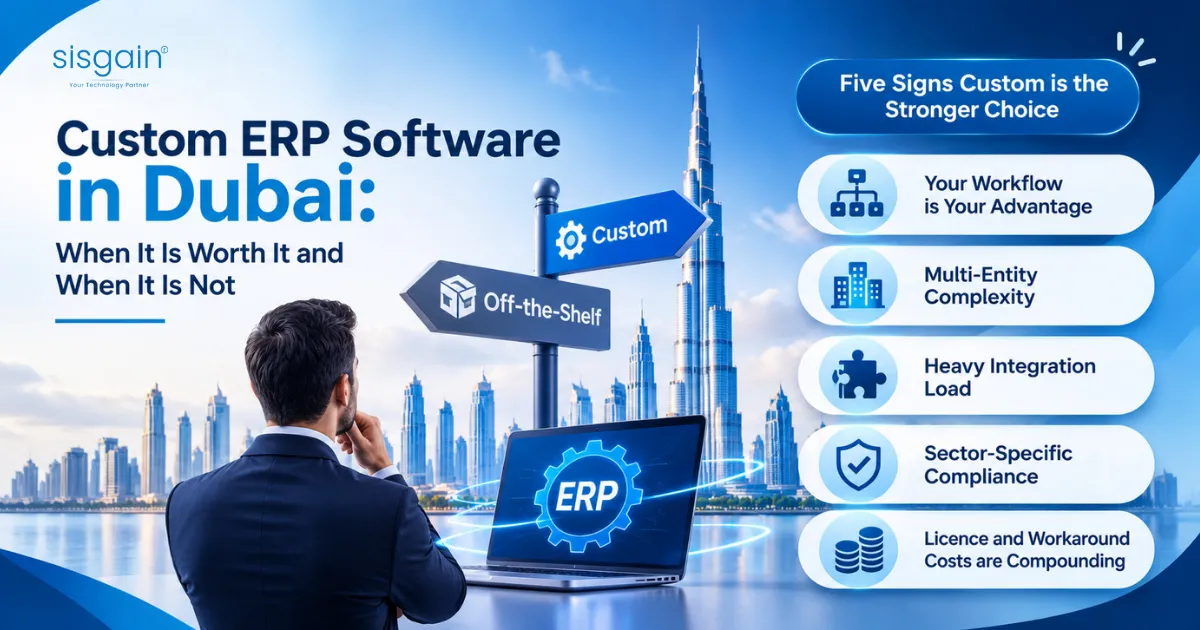
Custom ERP software in Dubai makes sense in fewer situations than vendors like me would sometimes prefer to admit. Here is when I think it genuinely wins.
Five signs custom is the stronger choice
- Your workflow is your advantage. Unique production sequencing, project-based billing, or non-standard routing rules that a template would flatten.
- Multi-entity complexity. A group with mainland, free zone and offshore entities, each needing different treatment and a consolidated view.
- Heavy integration load. If the ERP must talk to eight or more systems, a purpose-built architecture can be simpler than bending a packaged tool.
- Sector-specific compliance. Healthcare, aviation and regulated industries often need tracking that no standard module carries.
- Licence and workaround costs are compounding. When per-user fees and paid customisations keep growing every year.
Thinking about three-year cost, not first-year cost. A packaged system looks cheaper at signing. Over three years, add licences as headcount grows, paid customisation requests, integration connectors and the productivity lost to workarounds. Custom has a higher entry cost but flatter growth. Do the comparison on that horizon, using your own numbers.
The middle path. Some businesses are better served by a packaged core with custom modules, or by a low-code layer for edge workflows. Low-code vs no-code trade-offs are worth understanding before you commit either way.
When custom is the right call, the quality of the build partner decides the outcome. Our custom ERP software development work starts with discovery, not code, for exactly that reason.
From the delivery desk: I am as comfortable telling a client to buy a packaged system as to build one. [Vivek to supply: a real case where a client chose off-the-shelf and it was the right decision.]
5. ERP Software Development in Dubai: How a Custom Build Actually Runs
If you go the build route, here is what ERP software development in Dubai looks like when it is done properly.
Discovery and process mapping. We document how work actually happens, not how the org chart says it does. This is where most of the risk is removed. A week of honest discovery regularly saves two months of rework.
Architecture. The decisions that matter most:
Decision | Options | How I think about it |
Application structure | Modular monolith or microservices | Start with a modular monolith for most mid-sized businesses. Split services out only when scale demands it. |
Deployment | Cloud, hybrid or on-premise | Cloud suits most. Hybrid fits regulated data or legacy dependencies. On-premise needs a clear reason. |
Data model | Single shared model or domain-separated | One shared model for finance, stock and purchasing. Separate only where regulation requires. |
For deployment planning and moving existing workloads, our cloud migration services team works through hosting, security and cutover together.
Module order. Build finance and inventory first, because everything else depends on them. Then HR and payroll, then CRM and project modules, then analytics. Trying to launch everything at once is the classic way to ship six half-finished modules.
Security as a baseline. Role-based access, encryption, audit trails and tested backups belong in the first sprint, not the last. A junior accountant should never be able to approve their own expense claim, and the system should make that impossible rather than discouraged.
6. ERP Integration in Dubai: The Part Most Projects Underestimate
In my experience, ERP integration in Dubai is where schedules slip. The ERP is rarely the only system. It sits among point-of-sale terminals, e-commerce platforms, banks, payroll providers and legacy tools nobody wants to retire. If those connections are an afterthought, you get double entry, mismatched numbers and an ERP people quietly work around.
System | What flows | Typical pattern | Dubai-specific note |
POS and e-commerce | Sales, stock, returns, promotions | API or event-driven sync | Peak seasons like Ramadan and DSF stress this hardest |
CRM | Customers, quotes, order status | API, shared customer master | Avoid a second customer database |
WMS and TMS | Stock movements, shipments | Middleware or direct API | Free zone and multi-warehouse flows need care |
Banks and WPS | Payments, salary files, statements | File exchange or bank APIs | Bank formats vary by institution |
Payroll and HR | Employees, attendance, gratuity | Native module or API | Emiratisation reporting depends on clean headcount data |
ASP (e-invoicing) | Structured invoices, validation status | API to the provider | New for every business in 2026–27 |
BI and analytics | Consolidated operational data | Warehouse or reporting layer | Define metrics before building dashboards |
The silent killer is master data. Customer, supplier and item records that are duplicated, misspelled or inconsistent across systems will break integrations no matter how good the code is. Clean them first.
Legacy systems you cannot switch off yet. Many businesses cannot replace an old system on day one. The pragmatic route is to integrate now and retire it in phases, using legacy application modernization to remove the dependency over time.
When scoping, I put integration in its own workstream with its own estimate, owner and test plan. For teams that need a partner for the connection work, our software integration services in Dubai cover API design through monitoring.
From the delivery desk: Integrations almost never break in testing. They break on the first real month-end. [Vivek to supply: a real go-live where an integration issue surfaced late, and what changed afterwards.]
7. ERP Implementation in Dubai: Five Gates, Not a Calendar
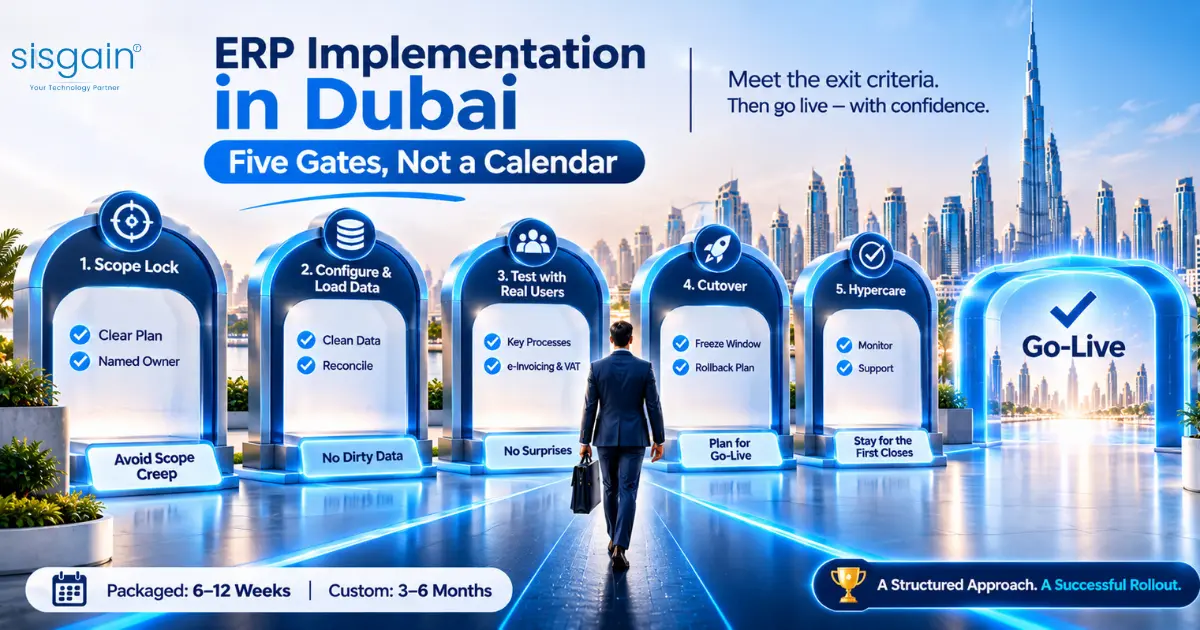
A packaged system typically goes live in 6–12 weeks. A custom build takes 3–6 months, depending on modules and integrations. But I do not run ERP implementation in Dubai by the calendar. I run it by gates. You do not pass a gate because the date arrived. You pass it because the exit criteria are met.
Gate | Exit criteria | Where it usually goes wrong |
1. Scope lock | Signed process maps, in-scope modules, a named owner per department, a full integration list, an e-invoicing approach | Scope is “agreed” verbally and grows every week |
2. Configure or build, plus data | Chart of accounts, tax rules, items and employees loaded; two trial migrations reconcile to the dirham | Dirty legacy data is migrated as-is |
3. Test with real users | Month-end close, VAT return, WPS file, returns and a failed e-invoice all run end to end | Testing is done by IT, not by the people who will use it |
4. Cutover | Freeze window agreed, parallel run complete, rollback plan tested | Go-live lands in the worst week of the year |
5. Hypercare | Daily issue triage through the first two or three month-end closes | The project team disbands on go-live day |
On testing. The most valuable test is the one nobody wants to schedule: a real month-end close by the finance team, on real data. It finds what scripted tests miss. Structured QA and testing services help, but the business users still have to sit in the chair.
On cutover timing. Avoid VAT filing windows, financial year-end and your own peak trading season. In Dubai, that often means steering clear of Ramadan and the shopping festival period if you are in retail or hospitality. A two-week delay is cheaper than a failed month-end.
Why ERP implementations fail
Having seen both outcomes, these are the six causes I would put money on:
- Nobody owns scope. Without one accountable business owner, every department adds “just one thing.”
- Bad data goes in. An ERP is a mirror. It will faithfully show you every duplicate and typo you migrate.
- Integrations are scoped last. And e-invoicing gets bolted on in the final month instead of designed in at the start.
- IT runs it alone. The system works technically and fails operationally, because the users were never in the room.
- Training is one session. People learn an ERP by using it, with support, over weeks.
- The team is released too early. Real problems appear in the first real close, and nobody is left to fix them.
From the delivery desk: If I could change one habit across the industry, it would be treating go-live as the finish line. [Vivek to supply: a real example of what hypercare caught in the first month after go-live.]
8. ERP by Industry: What Changes in Dubai
The core stays the same. The gotchas do not.
- Retail. The critical link is ERP, POS and stock across stores and online, with promotion and returns logic that holds up in peak season. Start with our guide to retail POS and inventory software. Gotcha: price and stock mismatches between channels.
- Logistics and trading. Multi-warehouse stock, shipment tracking, customs and free zone documentation tied to the books. If shipments and finance live apart, margins become guesswork. See our logistics software development capabilities. Gotcha: landed-cost accuracy.
- Healthcare. Billing, insurance claims, pharmacy and supply stock with expiry control, alongside clinical systems. We cover this in healthcare ERP for UAE hospitals. Gotcha: integrating with clinical and claims systems.
- Construction and real estate. Project costing, subcontractor payments and milestone billing. Gotcha: retention and variation handling.
- Hospitality. Multi-property finance, F&B procurement and seasonal workforce planning. Gotcha: PMS and POS integration.
- Manufacturing. Production planning, bill of materials and quality control tied to cost accounting. Gotcha: shop-floor data capture.
9. What Does ERP Cost in Dubai? An Honest Breakdown
Anyone who quotes a single ERP price without seeing your processes is guessing. What I can give you is the structure, so you can ask better questions.
What drives cost: the number of users, the modules in scope, how many integrations you need, how much is custom, how much data you migrate, and how much training and support you want after go-live.
Costs that surprise people:
- Per-user licences that grow as headcount grows
- ASP fees for e-invoicing, which are new for most businesses
- Data cleansing before migration
- Paid customisation requests after go-live
- Change management and training, often left out of the first quote
Approach | What you pay for | Typical range (AED) |
Packaged cloud ERP | Per-user subscription plus configuration | AED 5,000–30,000/year |
Packaged ERP with implementation partner | Licences, setup, migration and training | AED 25,000–100,000 |
Custom ERP, core modules | Discovery, development, testing and deployment | AED 100,000–300,000 |
Integration workstream | APIs, middleware, monitoring and data synchronisation | AED 10,000–50,000 |
Judge return on four numbers, measured before and after: days to close the month, stock-holding days, hours spent on VAT preparation and hours spent on payroll processing. If those do not move, the system is not paying for itself, regardless of the invoice total. For wider budgeting context, see software development costs in 2026.
10. How to Choose an ERP Development Company in Dubai
Picking an ERP development company in Dubai is a bigger decision than picking the software. A good partner fixes a mediocre product choice. A weak one wrecks a good one.
What I would check:
- References from your sector, in the UAE, that you can actually call
- A clear, tested approach to e-invoicing and ASP integration
- Native Arabic and English support, not a plug-in
- A named delivery lead who stays on your project
- A written data migration method, including reconciliation
- Integration experience with your specific systems
- Clear IP and code ownership terms
- Post-go-live support with defined response times
- Willingness to say “you do not need custom for this”
- A realistic plan, not the shortest one
Questions that expose the weak ones:
Ask this | A good answer | A worrying answer |
“Who runs my project day to day?” | A named person with relevant experience | “Our team will be assigned” |
“How will you migrate and reconcile data?” | A method with trial loads and sign-off | “We’ll import it at go-live” |
“What happens if an e-invoice fails validation?” | A defined error and retry flow | Silence, or “the ASP handles that” |
“What would you not build?” | Specific modules better bought | “We can build anything” |
At SISGAIN, we have delivered 500+ projects since 2009, and every ERP engagement has a senior delivery lead accountable from discovery to hypercare. If you are weighing options, you can see how we approach it as an ERP development company in Dubai. Compare us against the checklist above, as you should with everyone else.
11. Where ERP Is Heading: AI-Assisted and Real-Time Compliant
Two shifts are worth planning for, and I will separate what is ready from what is hype.
Ready now: AI-assisted invoice matching, anomaly detection in finance, demand forecasting for stock, and natural-language reporting. These work when your data is clean, which brings us back to master data.
Arriving: real-time tax reporting becoming the default as e-invoicing matures, and Arabic-capable assistants embedded in everyday ERP tasks.
Still mostly hype: fully autonomous ERP that “runs itself.” Human sign-off on money and compliance is not going anywhere.
If you want to explore what is practical for your processes, our AI automation services team can help you separate the useful from the noisy.
12. Your 90-Day Starting Plan
You do not need to decide everything this week. You do need to start in the right order.
- Days 1–30: Understand. Map your processes, list every system the ERP must touch, clean your master data, and decide your e-invoicing route. Set a clear owner.
- Days 31–60: Compare. Run two options from different categories through the compliance scorecard in section 2. Request references. Ask the hard questions from section 10.
- Days 61–90: Commit and scope. Choose a partner, lock scope with exit criteria for each gate, and plan the cutover window around your calendar, not the vendor’s.

If you would rather pressure-test your plan with someone who has delivered these projects, you can book a free ERP scoping call. Bring your process list and your integration list, and we will tell you honestly whether you need custom, packaged or a mix.