

Introduction
If you run a contracting business in the UAE, you already know the gap between the site and the head office. Quantity surveyors measure work in one file, storekeepers log deliveries in another, and accountants rebuild the picture at month-end from both. That gap was manageable when the main risk was a late invoice. It is much harder to manage now that electronic invoicing is about to become a legal obligation.
The timing matters. Under the phased rollout set by the Ministry of Finance, the first group of businesses goes live on 1 January 2027, only weeks from now. At the same time, the market is large but competitive. Turner & Townsend reports that the UAE construction market grew 4.2% in 2025, with a project pipeline of roughly US772billion.YettotalUAEcontractawardsfell14.5%yearonyeartoUS88.2 billion in 2025, according to Enterprise. More work in the pipeline and tighter awards mean contractors cannot afford cost overruns they discover too late.
This guide explains what a construction ERP must do in the UAE, which modules to prioritise, how to compare platforms, and how to implement without disrupting live projects. If you are also weighing a tailored build against an off-the-shelf package, our construction software solutions show how we approach site-to-office systems.
Quick Answer: What Is a Construction ERP?
A construction ERP is a single system that connects estimating, project costing, procurement, subcontractors, inventory, equipment, payroll and finance. In the UAE, it must also handle VAT on interim payment certificates (IPCs), e-invoicing through an accredited provider, project-wise profitability for corporate tax, WPS salary files and English–Arabic reporting.
Why Generic ERPs Fail UAE Contractors
Many contractors begin with a general-purpose ERP built for trading or manufacturing, and discover the mismatch within the first project cycle. There are three common failure points.
Revenue and billing logic. Retail and distribution systems assume one invoice per delivery. A contractor bills against certified progress: measured work, approved variations, advance payment recovery and retention. Multi-year projects also need cost-to-complete forecasting, which most generic packages do not provide out of the box.
The site-to-office disconnect. Without a shared system, the same quantity gets typed three times: in the QS file, the purchase order and the accounting entry. Each re-entry is a chance for error, and none of it is visible until someone reconciles. Approvals for material requests, variation orders and subcontractor certificates stall in email.
Missing localisation. VAT on certified IPCs, WPS file formats, Arabic documentation and e-invoicing connectivity are not features you can bolt on cheaply after go-live. When they are missing, finance teams fall back on spreadsheets, which defeats the purpose of buying an ERP.
We cover the broader advantages of integrated systems in our post on the benefits of ERP software for UAE businesses. Below, we focus on what is specific to construction.
Essential UAE Regulatory Features
Generic global ERPs often fail in the UAE unless they are localised for regional contracting practice. Check that your shortlisted platform supports each of the following natively or through a proven add-on.
UAE VAT and Progress Billing
UAE VAT is charged at 5%, and construction billing adds several layers on top of it. Your ERP should calculate VAT on certified IPCs, apply advance payment deductions, and track retention held and released. Retention is typically a percentage of each certificate, often in the 5–10% range depending on the contract, so the system needs to hold it as a separate receivable or payable and release it at the right milestones.
The VAT treatment of retention amounts depends on tax point rules, so confirm the configuration with your tax adviser. The practical test is simple: can the system produce a correct tax invoice, credit note and statement for every certificate without manual adjustment?
E-Invoicing Readiness
This is the most time-sensitive requirement. The Ministry of Finance issued Ministerial Decisions 243 and 244 of 2025, which set up the national e-invoicing system and its phased implementation. The system is based on the Peppol network, using a decentralised model with five parties: the supplier, the supplier’s accredited provider, the buyer’s accredited provider, the buyer and the tax authorities.
Two points are often misunderstood. First, invoices do not go from your ERP directly to the FTA. They pass through your ASP, which validates them and reports to the Ministry of Finance and the FTA. Second, the mandate covers nearly all domestic business-to-business and business-to-government transactions, including zero-rated and exempt supplies. Business-to-consumer transactions remain excluded until further notice.
Business group | Appoint an ASP by | Go live by |
Annual revenue of AED 50 million or more | 30 October 2026 | 1 January 2027 |
Annual revenue below AED 50 million | 31 March 2027 | 1 July 2027 |
In-scope government entities | 31 March 2027 | 1 October 2027 |
The FTA has stated an administrative penalty of AED 5,000 for each month, or part of a month, of delay in implementing the system, including failure to appoint an ASP on time. Ministerial Decision 197 of 2026, effective 1 October 2026, also eased several rules: transactions between members of the same tax group are excluded for 24 months from 1 January 2027, e-invoice data may now be stored outside the UAE, and the two-business-day system-failure notification was removed. Retention rules still apply, so records must remain available to the FTA on request.
For a closer look at how this affects your finance stack, read our guide on how e-invoicing affects ERP systems in the UAE. When you evaluate an ERP, ask the vendor which ASPs it has already integrated with, whether it supports the Peppol PINT-AE data format, and who is responsible for testing.
Quick Answer: Is e-invoicing mandatory for construction companies in the UAE? Yes. Construction companies that carry out B2B or B2G transactions fall within the mandate. Contractors with annual revenue of AED 50 million or more go live on 1 January 2027, and smaller contractors follow on 1 July 2027.
UAE Corporate Tax
The federal corporate tax regime applies a 9% rate to taxable income above AED 375,000, with different treatment for certain qualifying free zone businesses. For a contractor, the ERP’s job is to make the annual filing easier, not to replace a tax adviser.
That means tracking profitability project by project, recording related-party transactions between group companies, and keeping a clean audit trail from the ledger back to source documents. If you work with a joint venture or several legal entities, the ERP should handle inter-company eliminations without manual journals.
Wages Protection System (WPS)
Payroll is a significant cost and compliance area for contractors with large site workforces. The Wages Protection System requires salaries to be paid through approved channels and reported to the Ministry of Human Resources and Emiratisation (MoHRE). Your ERP should pull attendance from biometric devices or site timesheets, apply overtime and deduction rules, and generate the salary information file (SIF) that your bank or exchange house submits.
Also check how the system stores visa, labour card and contract data, since expiries drive both compliance and site availability. Employers subject to Emiratisation targets will want reporting on their workforce mix. Our article on Emiratisation compliance and HR software explains what HR systems should track.
Bilingual Reporting
Government submissions, client reports and contract documents often need Arabic as well as English. Confirm that the interface, printed documents and statutory reports support both languages, including right-to-left layouts, rather than relying on translated templates added afterwards.
Core Construction Modules
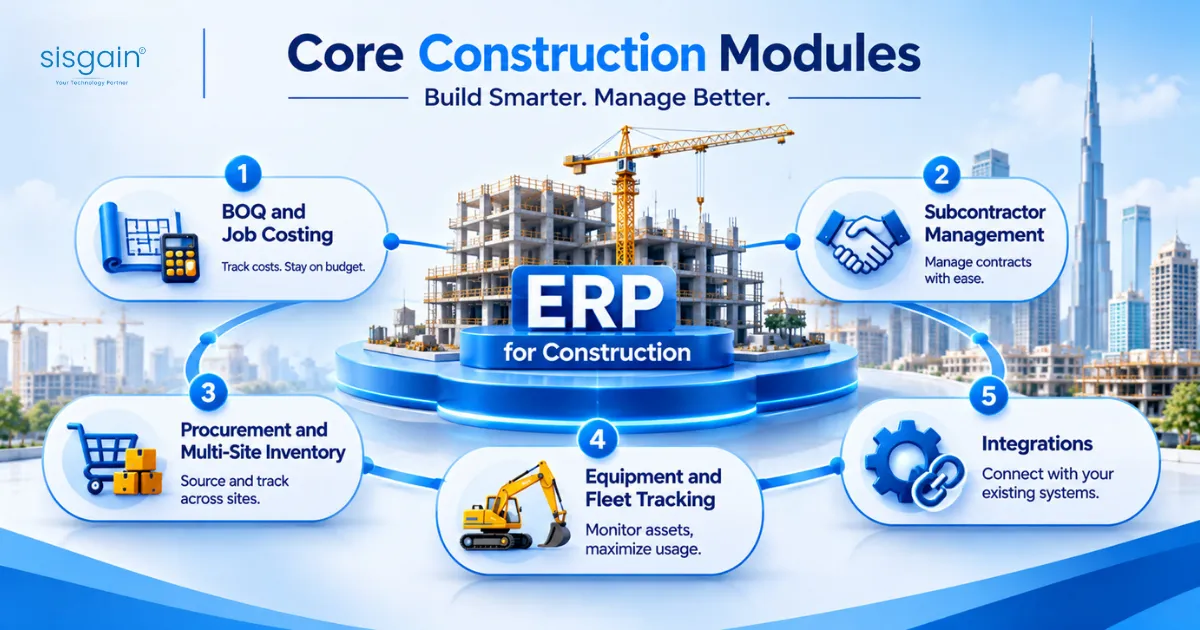
To eliminate disconnected spreadsheets between the head office and site engineers, prioritise these modules.
BOQ and Job Costing
The Bill of Quantities (BOQ) is the backbone of most contracts. A good ERP imports the BOQ from the tender, creates a baseline budget, and then tracks committed cost (purchase orders and subcontracts) against actual spend in real time. The value is early warning. When a cost code trends over budget in week six, you can act. When you only learn about it from the month-end report, you can only explain it.
Look for cost-to-complete forecasting, budget revisions linked to approved variations, and the ability to compare certified revenue against cost for each project.
Quick Answer: What is job costing in construction ERP? Job costing assigns every cost, from materials and labour to subcontractors and equipment, to a specific project and cost code. It lets you compare actual and committed cost against the BOQ budget and see each project’s margin as work progresses.
Subcontractor Management
Subcontracting is where many margins leak. The ERP should manage back-to-back contracts, work-done valuations, variation orders and retention holdbacks, with approvals that reflect your authority matrix. Linking subcontractor certificates to the main contractor’s IPCs shows whether you are over-certifying relative to what the client has approved.
Procurement and Multi-Site Inventory
The procurement flow should run from site material requisition to request for quotation (RFQ), comparison, local purchase order (LPO) approval and goods receipt. Inventory needs to span central warehouses and project sites, with transfers between them recorded and costed correctly. Without this, materials are bought twice, sit idle at one site while another waits, or disappear from the books.
Equipment and Fleet Tracking
Heavy equipment is both an asset and a cost driver. The ERP should log machine utilisation hours, fuel consumption and preventive maintenance schedules across active sites, and charge equipment cost back to projects. If you operate a mixed fleet, a dedicated tool can complement the ERP; our overview of fleet management software explains the options.
Integrations
An ERP is only as useful as the data it receives. Typical connections include biometric attendance devices, your ASP for e-invoicing, bank files for WPS and payments, and estimating or planning tools. Plan these early rather than treating them as post-go-live extras. Our software integration services team builds and tests exactly these connections.
ERP Options by Company Size
The right platform depends on scale, complexity and budget. The table below groups common options by tier. It describes fit, not rankings, and you should validate localisation in a live demo for your own project types.
Tier | Examples | Best suited for |
Enterprise and large contractors | SAP S/4HANA, Microsoft Dynamics 365 | Tier-1 main contractors and multi-entity GCC groups needing deep customisation and high scalability |
Mid-market contractors | Dynamics 365 Business Central, Oracle NetSuite, Sage X3, Acumatica | Growing civil, MEP and fit-out contractors wanting strong financial control and cloud access |
UAE-localised and niche | FirstBit ERP, FactsERP, Nexa One | Small to mid-sized contractors wanting local VAT, WPS and BOQ workflows with faster setup |
A Practical Shortlist Checklist
Whatever the tier, ask each vendor to show, not describe, the following:
- IPC billing with VAT, advance recovery and retention
- Integration with at least one accredited e-invoicing provider
- WPS-ready payroll with SIF file generation
- BOQ import and job costing with cost-to-complete
- English and Arabic documents
- References from UAE contractors of similar size and specialty
- Local support hours and a named implementation team
Off-the-Shelf or Custom?
Packaged systems get you live faster, but contractors with unusual approval chains, joint ventures or specialised workflows sometimes end up customising heavily. In those cases a tailored build can be more economical over time. If that sounds like your situation, explore our custom ERP software development services in Dubai.
Step-by-Step Implementation Roadmap
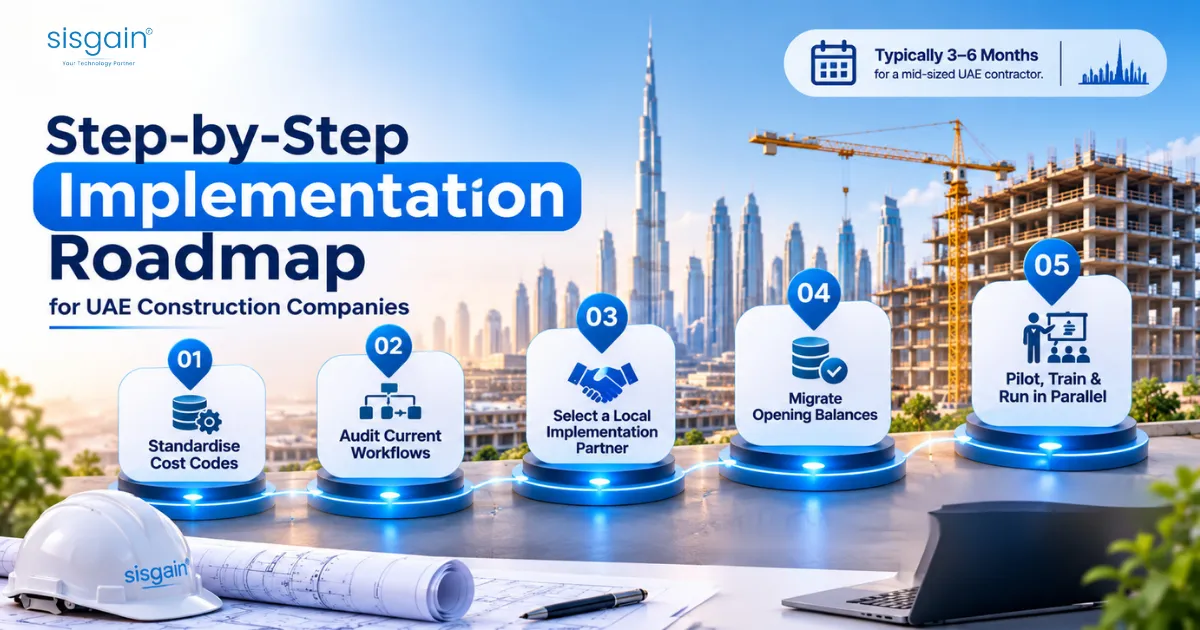
For a mid-sized UAE contractor, implementation typically takes three to six months, although multi-entity or heavily customised projects take longer. That range is a common implementer estimate, not a guarantee, so agree your own timeline with the partner.
- Standardise cost codes. Unify your Work Breakdown Structure (WBS) and cost codes across estimating, procurement and finance before migrating any data. If estimating and accounting use different codes, the ERP will reproduce the mismatch.
- Audit current workflows. Map how variation orders, site material requests and subcontractor certificates are approved today. Decide which steps the ERP should enforce and which are historical habits.
- Select a local implementation partner. Choose a vendor or partner with references from UAE contracting firms, rather than generic retail or trading consultants. Ask to speak to a contractor who has gone through e-invoicing and WPS setup with them.
- Migrate opening balances. Clean up active project budgets, open LPOs, unpaid retention balances and employee visa and WPS records. Migrate only what you need, and reconcile every balance to the ledger before sign-off.
- Pilot, train and run in parallel. Give hands-on training to quantity surveyors, site storekeepers and accountants, then run the new system alongside the old one for one billing cycle before full cutover. The parallel run is where you find the gaps that no demo reveals.
Cloud or On-Premise?
Cloud deployment gives site teams access without VPN complexity and reduces the infrastructure burden on a small IT team. The recent change allowing e-invoice data to be stored outside the UAE gives you more freedom, but you still need to keep records available to the FTA and protect access to sensitive project data. For guidance on planning the move, see our overview of secure cloud migration in the UAE.
Quick Answer: How long does ERP implementation take for a construction company? Most mid-sized UAE contractors need roughly three to six months, covering cost-code cleanup, configuration, data migration, training and a parallel billing cycle. Larger or multi-entity groups should plan for longer.
Common Pitfalls and How to Measure ROI
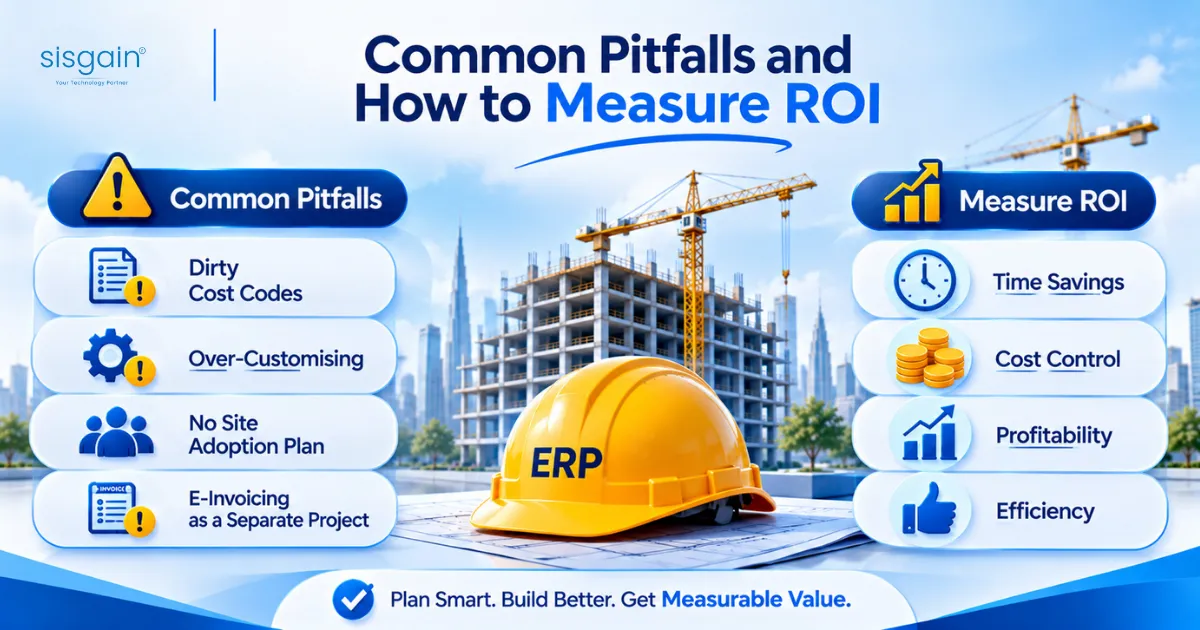
The same mistakes appear across projects:
- Skipping cost-code cleanup. Dirty codes produce unreliable reports from day one.
- Over-customising. Every custom feature adds cost at upgrade time. Configure first, customise only where the workflow is truly unique.
- No site adoption plan. If storekeepers and site engineers find the system slow, they will keep their spreadsheets. Involve them in design and training.
- Treating e-invoicing as a separate project. It touches customer master data, tax settings and invoice templates, so plan it with the ERP rollout.
To judge success, track a handful of measures before and after go-live: the time from certified work to issued IPC, the accuracy of cost-to-complete forecasts, retention recovered on time, stock write-offs and the hours finance spends on month-end close.
Conclusion
A construction ERP in the UAE is a compliance system as much as a management one. The three priorities are clear: meet the e-invoicing, VAT, corporate tax and WPS requirements; connect BOQ costing, subcontractors, procurement and equipment in one place; and plan adoption so that site teams actually use it.
With the first e-invoicing deadline arriving on 1 January 2027, contractors who have not yet chosen a provider and an ERP path should treat this as urgent. If you want a second opinion on your shortlist, your integration plan or a custom build, talk to our ERP consultants.
Regulatory dates and rules change. Check the Ministry of Finance, the FTA and MoHRE websites before acting, and confirm tax treatment with a qualified adviser.