
If you’re weighing up LMS vs off-the-shelf LMS platforms, you’ve probably noticed that nearly every vendor calls their product “fully customisable”. So how do you tell a configurable platform from one that’s genuinely built around your institution? That’s the question this guide answers, with a UAE lens throughout: Arabic–English requirements, integrations, data protection and the real cost of ownership.
A quick clarification first, because it trips up a lot of buyers. “LMS” is the category, and “off-the-shelf” is just one way of getting one. The real choice is between three models: a ready-made platform, an open-source platform such as Moodle, or a custom-built system. If you’re at the stage of speaking to an education software development company in Dubai, this guide will help you walk into that conversation with sharper questions.
Quick answer: Off-the-shelf LMS platforms launch in days or weeks and suit standard training needs. A custom LMS takes months to build but fits complex workflows, Arabic-first design, deep integrations and long-term differentiation. Many UAE organisations start with an off-the-shelf platform and extend or replace it later.
What Is an LMS?
A learning management system is the software that delivers and manages learning. At its core it handles course delivery, learner and user management, assessments, progress tracking, reporting and communication. Beyond that, the feature list depends on who’s using it: a school needs gradebooks and parent communication, a corporate team needs compliance tracking and certifications, and a training business needs payments and subscriptions.
If you want a deeper look at what to prioritise, our guide to LMS features schools should look for covers it in detail. For this article, what matters is how the platform is delivered.
What Are Off-the-Shelf LMS Platforms?
Off-the-shelf LMS platforms are pre-built products, usually sold as software-as-a-service. You subscribe, configure the platform to your needs, add your branding and users, and start teaching. Familiar examples include hosted Moodle services, Canvas, TalentLMS and Docebo, though the right choice depends entirely on your requirements, and no single vendor is best for everyone.
Where they shine
- Speed: you can often launch in days or weeks.
- Lower year-one cost: licensing, hosting, updates and core support are usually bundled into the subscription.
- Vendor-managed upkeep: security patches and feature updates happen without your IT team lifting a finger.
- Proven basics: course delivery, assessments and reporting are mature and tested.
Where they can pinch
- You’re limited to platform settings, plugins and the vendor’s roadmap.
- Branding may be template-based or only partly white-labelled.
- Integration depth varies, so connecting to your student information system (SIS), HR system or finance tools can get awkward.
- Pricing often scales with user numbers, so costs can climb as you grow.
Open-source platforms like Moodle sit in between. They can be self-hosted and extended, which means Moodle can be a standard off-the-shelf deployment in one organisation and a heavily customised system in another.
What Is a Custom Learning Management System?
A custom LMS is built around how your organisation actually works. Instead of adapting your curriculum, approvals and reporting to fit a product, the product is designed around them. That typically means tailored learner journeys, fully branded experiences for learners, teachers, parents and administrators, native integrations with your other systems, and full ownership of the roadmap.
The trade-off is time and upfront investment. A custom build usually moves through discovery, UX/UI design, development, testing and launch, which takes months rather than weeks. You can read more about that process in our overview of how LMS development works.
Who tends to benefit most?
- Schools and universities with curriculum variation, SIS integration, attendance, gradebooks and parent portals.
- Corporate L&D and training providers whose training is tied to proprietary products, workflows or regulated processes.
- Coaching and EdTech businesses with a distinctive model, such as marketplaces, subscriptions or community features, that standard tools constrain.
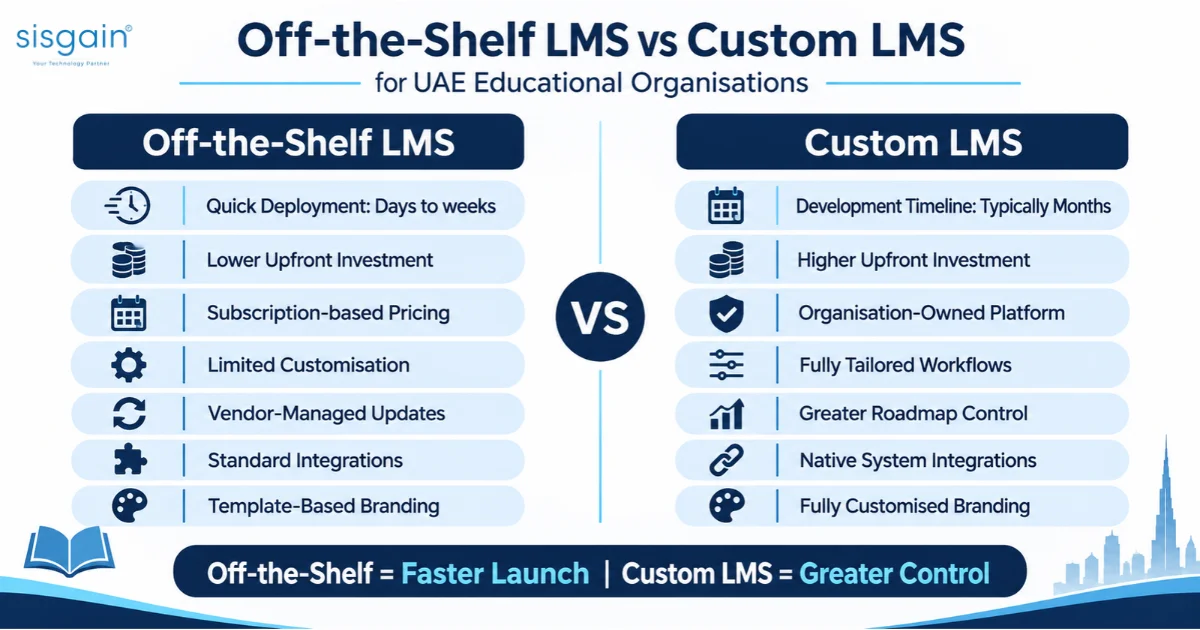
LMS vs Off-the-Shelf LMS Platforms: Key Differences at a Glance
|
Factor |
Off-the-shelf LMS |
Custom LMS |
|
Time to launch |
Days to weeks, configuration-led |
Typically months: discovery, design, build, testing |
|
Upfront cost |
Lower, usually subscription-based |
Higher initial investment |
|
Ongoing cost |
Subscriptions, user tiers, add-ons, premium support |
Hosting, maintenance, security, support, product development |
|
Flexibility |
Platform settings, plugins, vendor roadmap |
Built around your exact workflows |
|
Branding |
Template-based or partly white-labelled |
Fully branded across every user type |
|
Integrations |
Vendor connectors and APIs; depth varies |
Native integration with SIS, HR, CRM, finance, identity |
|
Arabic / RTL |
Varies widely; translation may not mean true RTL |
Can be designed Arabic-first or bilingual |
|
Data control |
Vendor-hosted; depends on the contract |
Greater control over architecture, hosting and access |
|
Scalability |
Easy to scale, but licensing may rise with headcount |
Scales by design; needs infrastructure planning |
|
Best for |
Standard training, rapid rollout, small IT teams |
Complex institutions, deep integrations, long-term platforms |
Key takeaways
- Off-the-shelf wins on speed and year-one cost.
- Custom wins on workflow fit, integration depth and brand control.
- For UAE buyers, Arabic quality and integration needs are usually what tips the decision.
UAE-Specific Requirements That Change the Decision
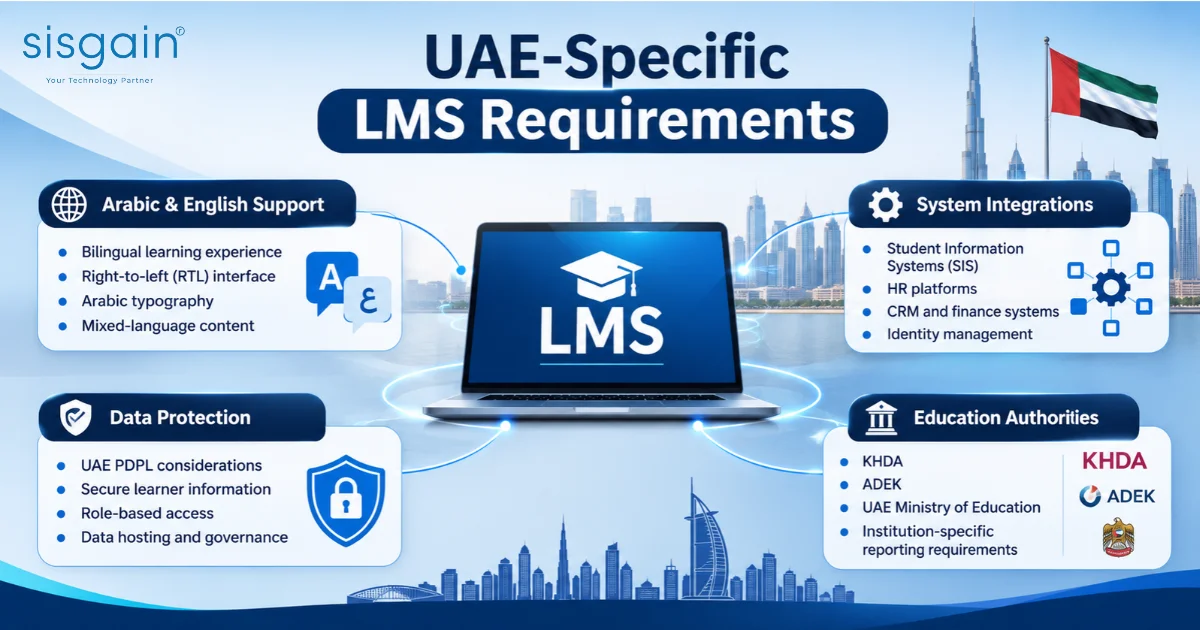
This is where generic comparison articles fall short. An LMS that works well in one market can feel clumsy in the UAE, and these are the areas worth testing early.
Arabic–English bilingual experience
A UAE-ready LMS should work in both languages across navigation, courses, assessments, notifications, certificates and parent communication. That means proper right-to-left (RTL) layout, correct Arabic typography, smooth handling of mixed Arabic–English content, and culturally appropriate date and number formats. Translated labels alone aren’t enough. When you demo any platform, ask to see a full Arabic course, an Arabic assessment and an Arabic certificate, not just a translated menu.
Integrations with the systems you already run
Most institutions don’t buy an LMS into a vacuum. Schools usually need it to talk to their SIS for enrolment, attendance and grades. Corporate teams need HR and identity systems connected for onboarding and role-based training. Vendor connectors cover many common cases, but if your workflow depends on deeper or unusual connections, it’s worth speaking to a team that offers software integration services in Dubai early, before you commit to a platform.
Data protection and the PDPL
The UAE’s Personal Data Protection Law, Federal Decree-Law No. 45 of 2021, is a good reason to look closely at how an LMS collects, stores, processes and shares learner data. Questions worth taking to your legal and IT teams include:
- Where is learner data hosted, and who can access it?
- How are consent and role-based access handled?
- What do the vendor agreement and data-processing terms say?
- What is the breach-response process?
Requirements vary by organisation and sector, so each institution should assess its own obligations rather than assume a platform covers them. For a broader view, see our note on PDPL considerations for apps.
Education authorities and scale
Schools operate under different oversight depending on location: KHDA in Dubai, ADEK in Abu Dhabi, and the federal Ministry of Education. Reporting, curriculum, attendance and parent-engagement expectations can differ, and requirements vary by emirate and institution. Scale matters too: Dubai’s private-school sector alone had 387,441 students, 27,284 teachers and 227 schools in 2024–25, which shows how much complexity digital learning platforms are asked to handle.
Cost and Total Cost of Ownership
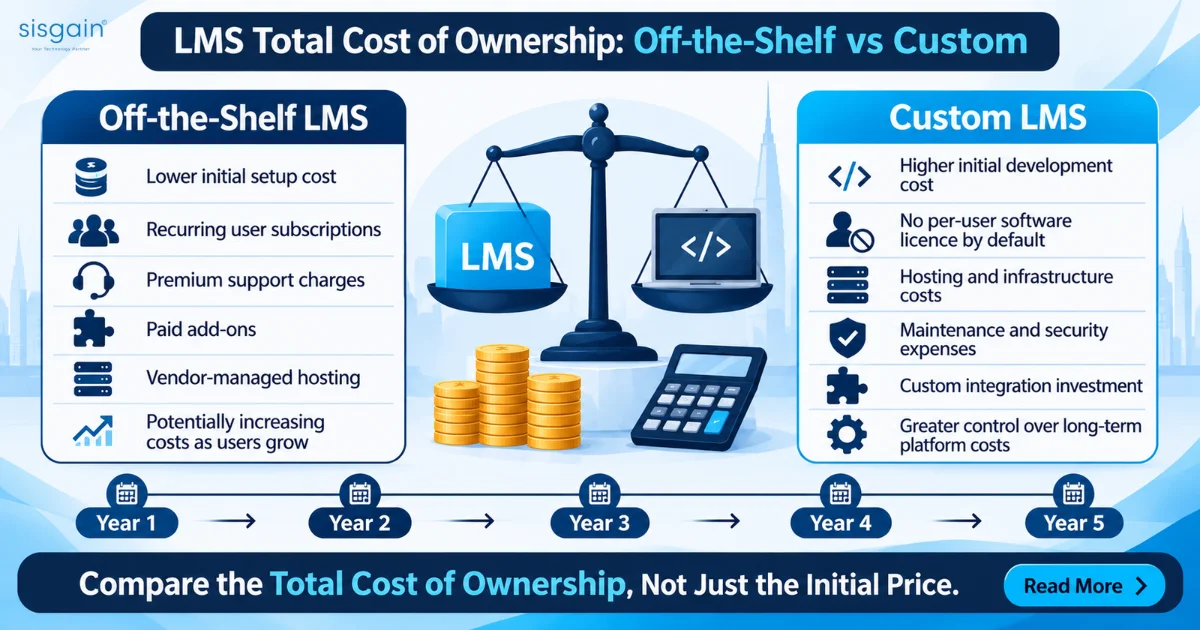
Comparing only the price tag is the most common mistake I see. A better question is: what will this cost us over three to five years?
|
Cost area |
Off-the-shelf LMS |
Custom LMS |
|
Setup |
Low; configuration and onboarding |
Higher; discovery, design, development, testing |
|
Licences |
Recurring subscription, often per user |
No per-user licence, but you own the build cost |
|
Hosting and updates |
Usually bundled |
Your responsibility (or your partner’s) |
|
Integrations |
Connectors; extra work for non-standard systems |
Built to your specification |
|
Support |
Tiered; premium support may cost extra |
Maintenance and support agreement |
|
Growth |
Costs can rise with headcount |
Infrastructure planning needed, but cost isn’t tied to user count |
|
Changing direction |
Limited by vendor roadmap; migration may be costly |
Flexible, but changes need development time |
Off-the-shelf platforms usually have the lower first-year cost. Custom costs are concentrated upfront, in discovery, design, development, QA and integration work. Over three or more years, a custom platform can become cost-effective if it removes manual administration, replaces several separate tools, avoids restrictive per-user pricing or enables revenue-generating features. But that’s conditional, not automatic. It depends on your scale, workflow complexity and what the platform replaces.
We’ve deliberately left AED figures out of this guide, because real costs depend on scope, integrations, languages and user numbers. For a deeper look at what moves the numbers, read our guide on what drives software development costs.
When Off-the-Shelf Is the Better Choice
Let’s be honest: off-the-shelf is often the smarter first move. Choose it if:
- You need to launch quickly.
- Your programmes follow a standard course structure.
- You have limited internal technical resources.
- You want the vendor to handle hosting, updates and support.
- Your needs fit existing integrations and reporting tools.
If that sounds like you, a well-configured platform will probably serve you well, and spending months on a custom build would be hard to justify.
When a Custom LMS Makes More Sense
A custom LMS earns its place when the platform itself is part of your strategy. Consider it if:
- Your learning model can’t be squeezed into standard course structures.
- You need deep integration with SIS, HR, finance, CRM, identity or reporting systems.
- Arabic-first design, parent engagement or specialised assessment is central to the experience.
- You need full brand control across web and mobile.
- You expect the platform to support a long-term, differentiated strategy.
For example, a school group might need a parent portal and gradebook synced with its SIS in two languages. A corporate training team might need modules tied to proprietary workflows. An EdTech start-up might need subscriptions and a marketplace without platform fees getting in the way. Those are the situations where custom LMS development tends to pay off.
Not sure whether an off-the-shelf platform or a custom LMS is right for your institution? Explore our LMS development services to see how a purpose-built learning platform can support your curriculum, learners and operational requirements.
The Hybrid Route: Start Configurable, Extend Later
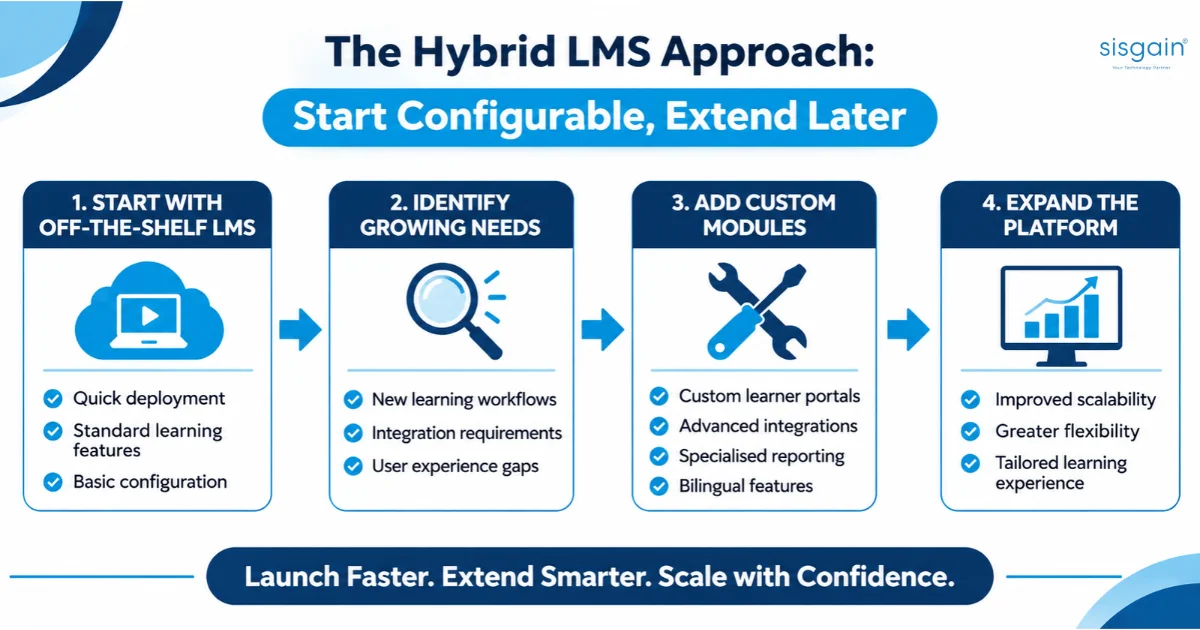
It doesn’t have to be either/or. Many organisations launch quickly on a configurable platform, then add custom modules as needs become clear. Others keep their existing administrative tools and build a custom learner-facing experience on top. Open-source platforms like Moodle work well for this path. If you’re also weighing build-versus-configure trade-offs more broadly, our explainer on low-code vs no-code platforms is a useful companion read.
LMS Decision Checklist: 10 Questions to Ask Internally
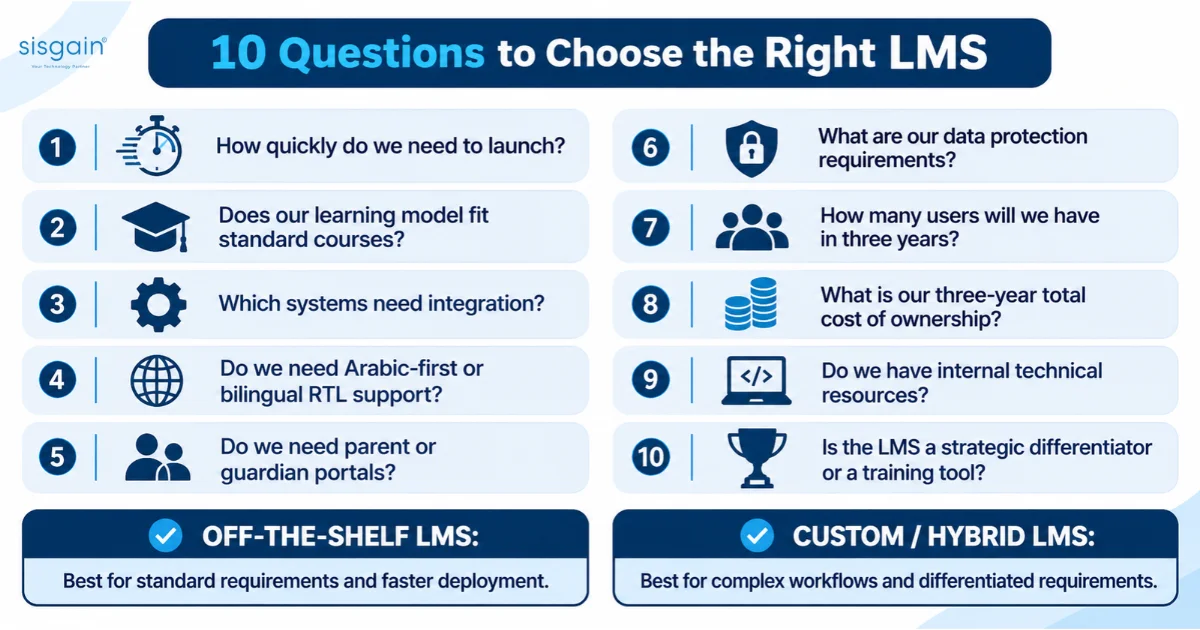
Gather your academic, IT, HR and legal stakeholders and work through these together:
- How quickly do we need to launch?
- Does our learning model fit standard course structures?
- Which systems must the LMS integrate with (SIS, HR, CRM, finance, identity)?
- Do we need Arabic-first or fully bilingual RTL experiences?
- Do we need parent or guardian portals?
- What data-protection and hosting obligations should we assess?
- How many users do we have now, and how many in three years?
- What does three-year total cost of ownership look like under each model?
- Do we have the internal technical resources to manage a platform?
- Is the platform meant to differentiate us, or simply to deliver training?
If most of your answers point to “standard”, start off-the-shelf. If several point to “complex” or “differentiated”, a custom or hybrid route deserves a serious look.
READ MORE - How to Choose the Right Learning Management System for Your Business: A Step-by-Step Framework
Conclusion and Next Step
There’s no universally right answer in the LMS vs off-the-shelf LMS platforms debate, only the right fit for your learners, systems and long-term goals. Off-the-shelf gets you moving fast. Custom gives you control and room to grow. A hybrid path can give you both.
My suggestion before you shortlist anything: run a requirements audit. List your must-haves, your integrations and your language needs, then test them against real demos. If you’d like help, our team offers LMS development services and can walk through your requirements with you. For more comparisons like this one, browse our education technology comparison hub.