
If you are asking how much an LMS costs in the UAE, the honest answer is: it depends on what you need it to do. A staff-training portal for 150 employees and a bilingual academy with payments, live classes, assessments, certificates and HR integration are very different projects, and their price tags reflect that.
This guide breaks down LMS cost in UAE terms: AED ranges, the factors that move a quote, the hidden fees that catch buyers out, and three budget examples. Whether you run a school, a training academy, a corporate L&D team or an EdTech start-up, you should leave with a realistic planning range.
One point up front: the licence fee is rarely the full budget. Implementation, content, integrations, support and running costs all count. If you are considering a build, our team offers LMS development services in the UAE and can scope it with you. If you would rather read first, the guide below gives you the numbers to plan with, and you can get a custom LMS cost estimate whenever you are ready.
What Is an LMS and Why Does Pricing Vary?
A learning management system (LMS) is a platform for delivering, tracking and managing training or courses. Learners enrol, study, take assessments and earn certificates, while administrators manage content, users and reporting. If you are new to the category, our learning management system guide for UAE schools covers the fundamentals.
Pricing varies because five things change from one organisation to the next:
- Learner volume: 200 learners and 20,000 learners need very different infrastructure and support.
- Feature depth: A quiz-and-certificate portal costs less than a platform with live classes, ecommerce and AI recommendations.
- Deployment model: SaaS, open source and custom development each have a different cost shape.
- Integrations: Connecting HR, payments, video and reporting tools adds build and maintenance effort.
- Support level: Business-hours email support is cheaper than a 24/7 service-level agreement.
LMS Pricing Models Explained
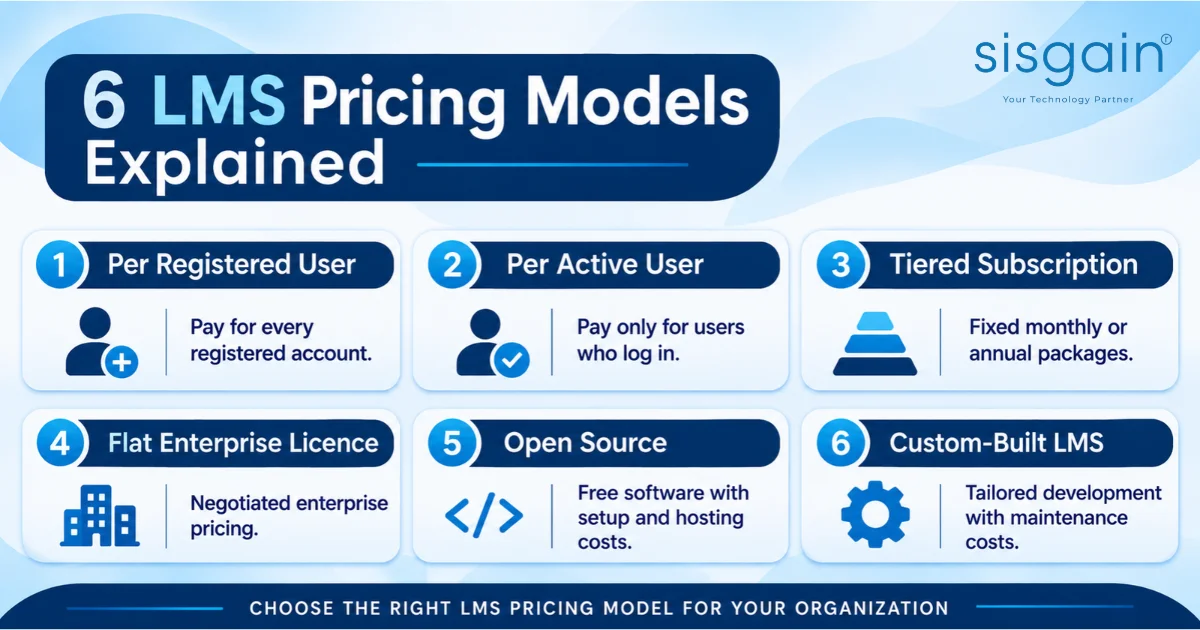
Before comparing quotes, understand how vendors charge. Globally, LMS pricing usually follows one of six models:
|
Pricing model |
How it works |
Best suited to |
Cost consideration |
|
Per registered user |
You pay for every account, active or not |
Schools and companies with stable headcounts |
Gets expensive if many users rarely log in |
|
Per active user |
You pay only for users who log in during a billing period |
Large workforces with irregular training |
Better for seasonal or low-engagement audiences |
|
Tiered subscription |
Fixed monthly or annual package with user and feature limits |
SMEs, academies and growing teams |
Predictable, but may need upgrades as you grow |
|
Flat enterprise licence |
Negotiated annual licence, often with implementation and support |
Enterprises, government-linked entities, large institutes |
Higher upfront commitment; needs clear scope |
|
Open source |
Software may be free; you pay for hosting, setup and development |
Organisations wanting control and customisation |
Lower software cost, higher technical ownership |
|
Custom-built LMS |
One-time or phased development plus ongoing maintenance |
Organisations with unique workflows or ownership needs |
Higher initial investment, long-term flexibility |
For context, corporate per-user pricing is often reported at around USD 2–20 per user per month globally, which is roughly AED 7–73. Tiered plans commonly begin around USD 100–500+ per month (about AED 370–1,850+), depending on features and user caps. These are global benchmarks, so treat them as a starting point rather than UAE quotes.
How Much Does an LMS Cost in the UAE in 2026?
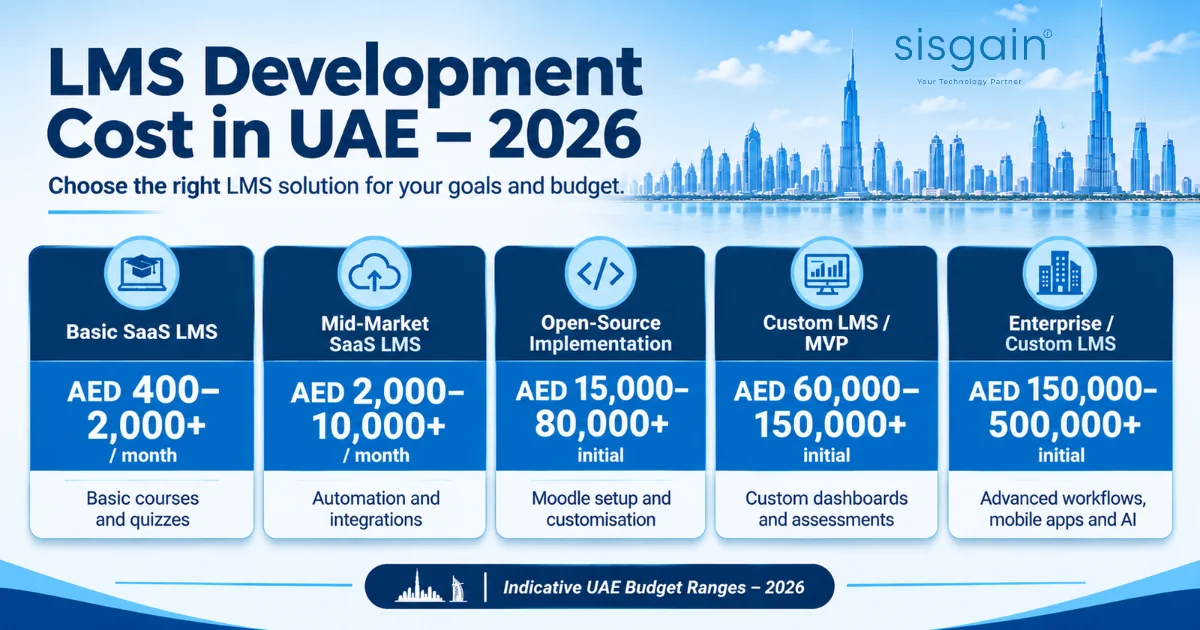
Here are indicative AED ranges for LMS pricing UAE buyers are likely to encounter in 2026. Real quotes depend on scope and vendor.
|
LMS type |
Typical UAE budget range |
What it usually includes |
Best for |
|
Basic SaaS LMS |
AED 400–2,000+ per month |
Core courses, quizzes, user management, basic reporting |
Small training providers and SMEs |
|
Mid-market SaaS LMS |
AED 2,000–10,000+ per month |
Automation, integrations, advanced reporting, larger user volumes |
Growing academies and mid-size companies |
|
Open-source implementation |
AED 15,000–80,000+ initial; hosting and support extra |
Moodle-based setup, theme, basic customisation, hosting, migration |
Schools and institutes needing flexibility |
|
Custom LMS / MVP |
AED 60,000–150,000+ initial |
Custom UI/UX, learner and admin dashboards, assessments, certificates, core integrations |
EdTech start-ups and training businesses |
|
Enterprise / custom LMS |
AED 150,000–500,000+ initial; ongoing support extra |
Advanced workflows, mobile apps, AI features, SSO, analytics, ERP/HR integration |
Large corporates, universities, government-linked entities |
Independent UAE benchmarks point the same way. One 2026 estimate puts a full LMS with live classes, recorded content, quizzes, assessments, certificates and dashboards from around AED 60,000. Broader Dubai estimates for custom LMS and EdTech platforms range from USD 40,000 to USD 250,000+, depending on complexity.
A caution: these are planning ranges. The final quote depends on scope, integrations, content migration, mobile requirements, compliance needs and the development partner you choose. For wider context on how software projects are priced, see our breakdown of software development costs in 2026.
Sisgain expert insight: [Add a short technical-expert comment here on why two LMS quotes for the same brief can differ. Include an anonymised budget range only if approved.]
Key Factors That Affect LMS Cost in the UAE
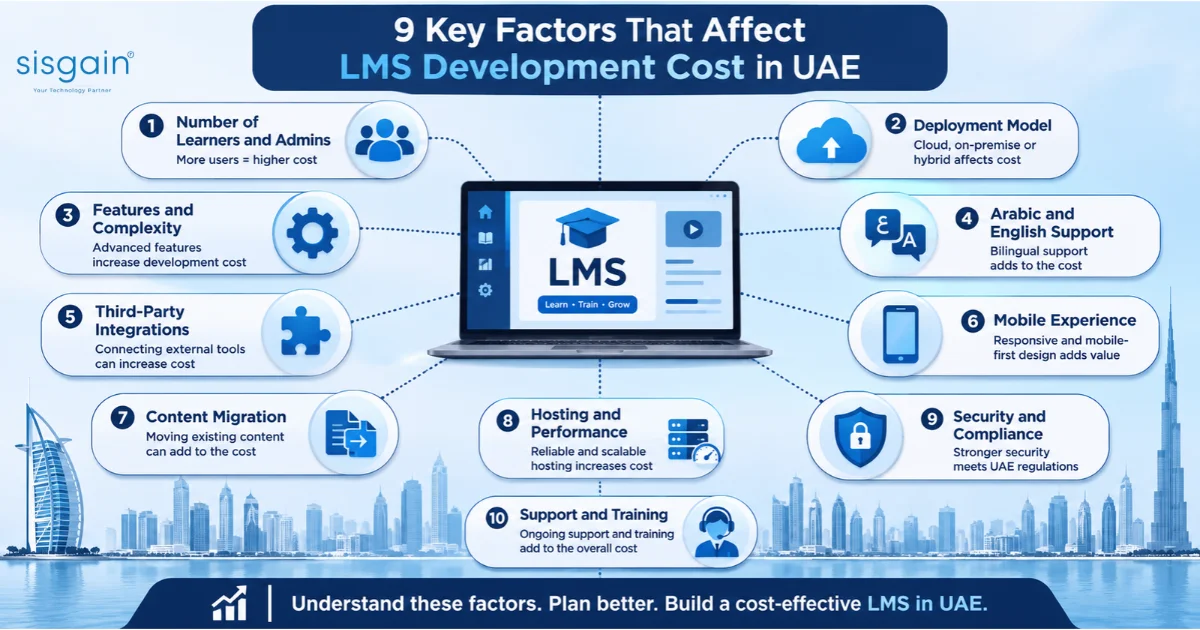
Number of learners and admins. More users usually mean higher licence fees, storage, support load and infrastructure cost. Decide your year-one and year-three numbers before you compare quotes.
Deployment model. SaaS gives predictable recurring fees. Custom development costs more upfront but gives greater ownership and flexibility.
Features and complexity. Live classes, SCORM/xAPI support, ecommerce, certification, gamification, AI recommendations, offline access and advanced analytics all add cost. Each feature should earn its place. Our guide to LMS features schools need in 2026 helps you separate must-haves from nice-to-haves.
Arabic and English support. A genuinely bilingual LMS needs right-to-left (RTL) layouts, Arabic typography, translated interfaces and notifications, and sometimes separate content workflows. This is design work, not just translation, which is why experienced UI/UX design services in Dubai matter for Arabic-first platforms.
Integrations. HR systems, payment gateways, Zoom or Teams, CRM, ERP, identity providers, WhatsApp and BI tools each add development and maintenance cost. Budget for these early, ideally with a partner offering software integration services in Dubai.
Mobile experience. A responsive web platform costs far less than native iOS and Android apps. If you are weighing the two, our comparison of native vs cross-platform app development explains the trade-offs.
Content migration. Moving existing courses, learner records, certificates and completion history can be a significant one-time cost, especially from spreadsheets or a legacy system.
Hosting and performance. High-definition video, concurrent live classes, large assessments and peak enrolment periods all need stronger infrastructure.
Security and compliance. Review data protection, access controls, backups, audit logs and cross-border data-transfer arrangements before you sign.
Support and training. Admin onboarding, instructor training, SLAs, bug fixes and feature updates should be budgeted from day one, not discovered in month six.
SaaS vs Open Source vs Custom LMS
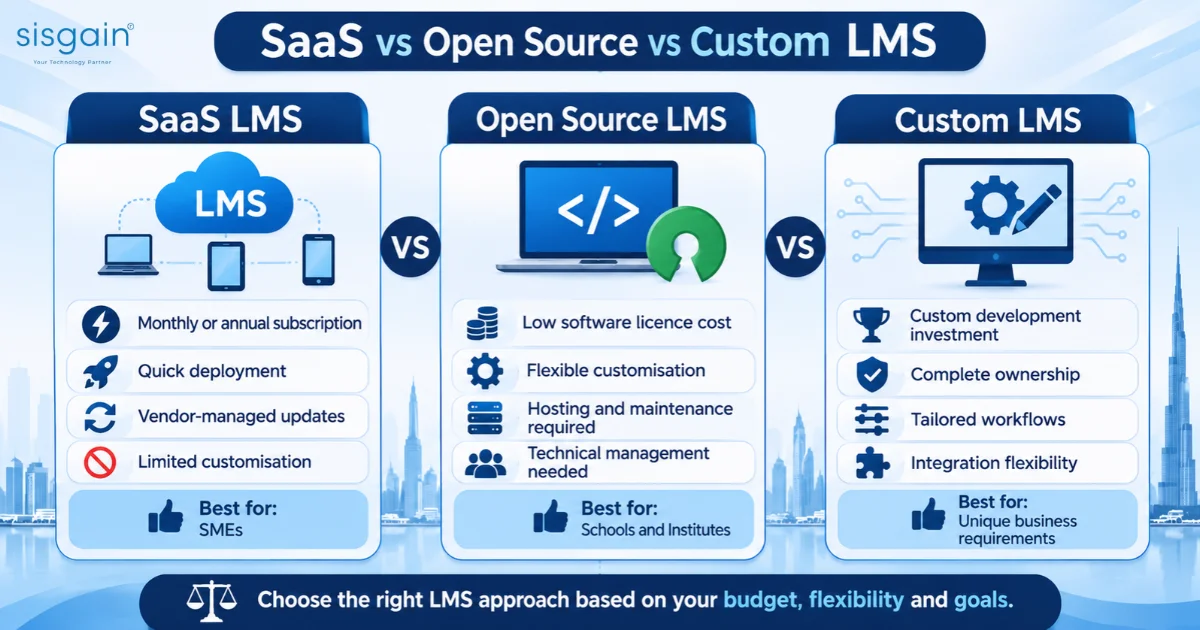
The biggest single decision is the model. Each fits a different organisation.
|
Option |
Typical cost structure |
Advantages |
Limitations |
Best for |
|
SaaS LMS |
Monthly or annual subscription |
Fast launch, lower technical burden, vendor-managed updates |
Less customisation, recurring fees, possible user limits |
SMEs needing quick deployment |
|
Open-source LMS |
Low licence cost; hosting and customisation paid separately |
Flexibility, large ecosystem, no per-seat lock-in with core Moodle |
Needs technical management, security upkeep and custom development |
Schools and institutes with IT capacity |
|
Custom LMS |
Development project plus maintenance |
Full ownership, tailored workflows, brand control, integration freedom |
Higher upfront investment, longer delivery |
Organisations with unique learning models or scale ambitions |
Moodle is free to download, but the real cost comes from hosting, implementation, customisation, integrations, maintenance and support.
Custom development is the right choice when you need ownership, bespoke workflows, Arabic-first UX, deep integrations, strict branding control or specialised reporting. It is not the right choice for every buyer. A small team that needs to launch in weeks is usually better served by SaaS. For a deeper look, read our comparison of custom LMS vs off-the-shelf LMS in the UAE.
Hidden LMS Costs UAE Buyers Should Budget For
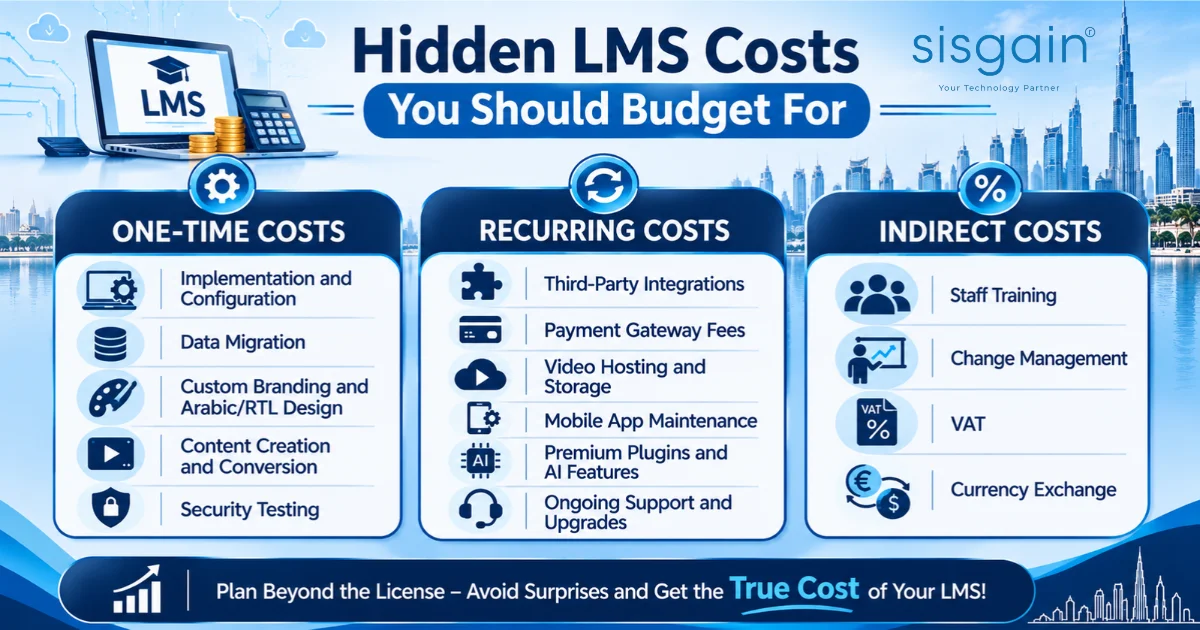
Vendors often price implementation, migration and onboarding separately from the recurring platform fee. Here are the items that most often surprise buyers.
One-time costs
- Implementation and configuration fees: Setup, roles, workflows and branding.
- Data migration: Moving learners, courses and history from spreadsheets, legacy systems or another LMS. Our application migration services in Dubai cover this kind of work.
- Custom branding and Arabic/RTL design: Often quoted as separate UX work.
- Content creation and conversion: Course conversion and SCORM packaging.
- Security testing and disaster recovery setup.
Recurring costs
- Third-party integrations and API development.
- Payment gateway setup and transaction fees.
- Video hosting, bandwidth and storage.
- Mobile app development and app-store maintenance.
- Premium plugins, AI features and third-party licences.
- Ongoing support, SLA coverage and version upgrades.
Indirect costs
- Staff training and change management: A platform nobody uses delivers no return.
- VAT and currency-exchange considerations: Particularly with international vendors billing in USD or EUR.
UAE-Specific Cost Considerations
A generic global pricing article will miss several points that affect your budget locally.
VAT. Software subscriptions and many digital or e-learning services supplied to UAE customers are generally subject to 5% VAT. Recognised educational institutions delivering government-recognised curricula may be treated differently. Always ask whether a quote is VAT-exclusive, and confirm your own position with a tax adviser or the Federal Tax Authority.
Data protection. The UAE’s federal Personal Data Protection Law governs lawful processing, security and cross-border transfers of personal data. Ask every vendor where production data, backups, logs and support data are stored. Our guide to PDPL compliance for mobile apps explains the practical implications. Free zones such as DIFC and ADGM have their own data protection regimes, so check which applies to you.
UAE hosting and data residency. Regulated sectors, government-linked entities and some enterprises may require UAE hosting or stricter contractual controls. Confirm cloud regions, backup locations and subprocessors, and consider whether cloud security services in Dubai should form part of the plan.
Arabic-first learning. Budget for RTL layout, Arabic typography, bilingual navigation, translated notifications and Arabic course-content support.
Local payment methods. Consider card payments, Apple Pay, Google Pay, bank-transfer workflows and, where relevant, regional payment providers.
Support hours. Confirm whether support covers UAE business hours, Arabic-language assistance and critical-incident response.
Schools should also check any requirements from their regulator, such as KHDA in Dubai or ADEK in Abu Dhabi, before finalising platform choices.
LMS Budget Examples for UAE Organisations
These three scenarios show how LMS cost in UAE projects can look in practice. All figures are indicative.
Example 1: Small training academy
- 100–300 learners
- Course catalogue, quizzes, certificates, basic reporting
- English and Arabic interface, with a payment gateway
- SaaS or a lightweight custom MVP
Indicative first-year budget: AED 25,000–80,000.
Main cost drivers: subscription, branding, payment integration, content setup and support.
Example 2: Corporate L&D programme
- 500–2,000 employees
- Compliance training, learning paths, manager dashboards
- HR and SSO integration, with leadership reporting
- Arabic and English content
Indicative first-year budget: AED 80,000–250,000.
Main cost drivers: user volume, integrations, reporting, migration and ongoing support.
Example 3: University, school group or EdTech platform
- Thousands of learners
- Live classes, assessments, certification, ecommerce, mobile apps, analytics
- Custom learner journeys and a multi-tenant or multi-campus structure
Indicative initial build: AED 150,000–500,000+.
Ongoing budget: hosting, maintenance, support, content operations and a feature roadmap. Platforms of this kind often follow a multi-tenant model, which is a specialism of any SaaS development company in Dubai.
For reference, one UAE market estimate places a full LMS with live classes, recorded libraries, assessments, certificates and dashboards from approximately AED 60,000, and more complex platforms cost substantially more.
Want a figure tailored to your learner numbers and features?
How to Reduce LMS Costs Without Compromising Quality
Saving money on an LMS is about sequencing, not cutting corners.
- Start with an MVP. Launch core courses, enrolment, assessments and reporting first. Our guide on how to build a minimum viable product shows how to scope it.
- Use responsive web before native apps. Add mobile app development once learner demand proves the need.
- Prioritise integrations that matter. Focus on enrolment, HR, payments and reporting first.
- Reuse existing content. Convert what you have instead of rebuilding every course.
- Choose active-user pricing if many registered users train infrequently.
- Phase the roadmap. Launch, optimise, then add AI, advanced analytics or apps. If AI is on your list, understand the AI software development cost in Dubai before committing.
- Insist on total cost of ownership, not just the headline subscription price.
LMS Cost Checklist Before You Request a Quote
Copy these questions into your brief. Clear answers lead to quotes you can actually compare.
- How many learners, instructors and administrators do we need in year one?
- Do we need Arabic, English or both?
- Do we need live classes, recorded video, assessments, certificates or ecommerce?
- Which systems must integrate with the LMS?
- Do we need SSO, HR integration, CRM integration or BI reporting?
- Do we need mobile apps, or is responsive web enough?
- What existing content and learner data must be migrated?
- Where will learner data, backups and logs be stored?
- What are the implementation, migration, training and support costs?
- What is included in the annual renewal price?
- Who owns the source code, content, data and customisations?
- What are the costs for future users, storage, features and support?
If you expect heavy traffic at enrolment time, also ask how the platform is tested for peak load. Performance testing services can validate this before launch.
How to Choose the Right LMS Partner in the UAE
A low quote with a vague scope usually becomes an expensive project. Ask every shortlisted partner for a detailed proposal that includes:
- A fixed-scope MVP versus a phased development plan
- Itemised development, hosting, integration and support costs
- Timeline and milestones
- Examples of Arabic/RTL capability
- Data-security and hosting approach
- A content-migration plan
- Post-launch support and maintenance terms
- Ownership of code, designs, content and data
Our guide on how to choose a development company in the UAE offers a useful scorecard. If your project sits in the education sector, an education software development company in Dubai with relevant experience will understand the context faster.
Conclusion: Budget for the Whole LMS, Not Just the Licence
LMS pricing UAE buyers see ranges from a few hundred AED a month for a simple SaaS plan to AED 500,000+ for an enterprise build. What separates a good budget from a bad one is completeness: implementation, migration, Arabic support, integrations, hosting, support and training all belong in the number.
Start with a clear scope, ask for itemised quotes, and choose the model, SaaS, open source or custom, that fits how your organisation actually learns and grows.
Need a realistic LMS budget for your UAE organisation? Request a custom LMS development estimate and our team will respond with a tailored plan.