
How can blockchain improve cross-border payments in 2026? Blockchain can simplify cross-border payment workflows by creating a shared transaction infrastructure, enabling programmable settlement, and reducing reliance on multiple reconciliation layers. However, the actual speed, cost, and compliance benefits depend heavily on the blockchain network, the payment assets used, the jurisdiction involved, and the integration architecture.
Cross-border payments today still pass through multiple intermediaries — correspondent banks, clearing networks, and currency conversion desks — before funds finally reach the recipient. Each hop adds settlement delay, reconciliation overhead, and compliance friction. For businesses operating internationally, this translates into slower supplier payments, unpredictable transaction costs, and limited visibility into where a payment actually sits at any given moment.
At the same time, expectations have shifted. Businesses now expect international transactions to behave more like domestic ones: fast, transparent, and programmable. Blockchain networks can offer shared transaction infrastructure and near-real-time settlement, depending on how the underlying architecture is designed.
2026 marks a noticeable shift in how this technology is discussed. The conversation has moved away from cryptocurrency speculation and toward practical blockchain payment solutions — tokenized money, regulated stablecoins, and enterprise-grade blockchain fintech solutions built for compliance and scale rather than trading.
The UAE has emerged as one of the more significant markets in this shift. With a fast-growing FinTech ecosystem, high volumes of international trade, and a regulator actively defining rules for digital payment infrastructure, the region offers a useful lens for understanding how blockchain-based payments are actually being adopted rather than just discussed.
This article covers the underlying technology, real-world use cases, how blockchain-based payments actually work step by step, the benefits and risks involved, what building such a system looks like, what it costs, and specific considerations for UAE businesses evaluating this shift.
What Is Blockchain for Cross-Border Payments?
Blockchain in the Context of International Payments
In the context of international payments, blockchain functions as a shared, tamper-resistant transaction ledger that multiple parties — banks, payment providers, or businesses — can reference without relying on a single centralized intermediary to verify every step. Instead of each institution keeping its own separate record that later needs to be reconciled against everyone else's, participants can work off a shared source of transaction truth.
Traditional Cross-Border Payment Flow vs. Blockchain-Based Flow
| Traditional Payments | Blockchain-Based Payments |
|---|---|
| Multiple intermediaries | Shared distributed infrastructure |
| Longer settlement cycles | Potentially faster settlement |
| Reconciliation between systems | Shared transaction record |
| Higher intermediary dependency | Programmable settlement |
| Limited transparency across parties | Greater transaction visibility |
Blockchain vs Cryptocurrency
This distinction matters, and it's one that's often blurred in casual coverage of the space. Blockchain is the underlying technology — a method for recording and validating transactions across a distributed network. Cryptocurrency is only one possible asset that can move across that infrastructure.
Enterprise blockchain payment development does not require building or relying on a speculative cryptocurrency ecosystem at all. A bank or payment provider can use blockchain purely as settlement infrastructure while transacting in regulated, fiat-backed instruments such as tokenized deposits or licensed stablecoins. Conflating "blockchain" with "crypto trading" is one of the more common misunderstandings enterprises need to move past before evaluating this technology seriously.
Why Blockchain for Cross-Border Payments Matters in 2026
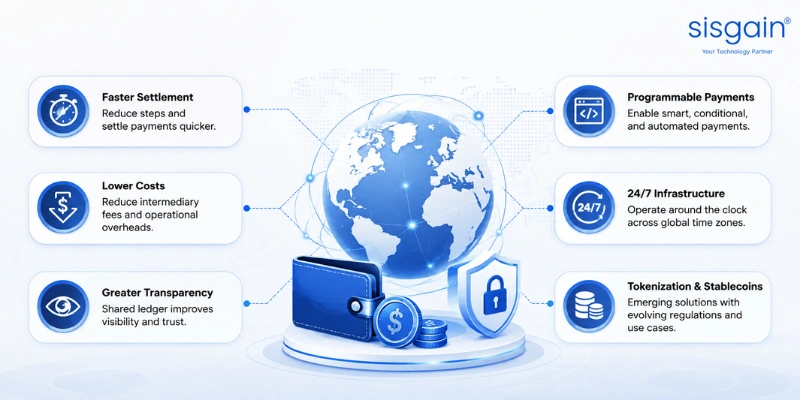
Faster Settlement
Traditional cross-border payments often move through several settlement layers, each adding processing time. Blockchain networks can reduce the number of intermediary steps required to confirm a transaction, which can shorten settlement windows — though the actual speed still depends on the specific network and how it's architected.
Lower Operational and Intermediary Costs
Correspondent banking relationships, manual reconciliation, intermediary fees, and currency conversion markups all add cost to cross-border transactions. Shared ledger infrastructure can reduce some of this operational overhead by cutting down on duplicate processing and manual reconciliation work. That said, blockchain does not automatically make every transaction cheaper — network fees, compliance infrastructure, and integration costs still apply, and savings depend on transaction volume and use case.
Greater Payment Transparency
Because transactions are recorded on a shared ledger, participating parties can gain better visibility into transaction status and history compared to fragmented, siloed banking systems where each party only sees its own leg of the transaction.
Programmable Payments
Smart contracts allow payment logic to be embedded directly into the transaction itself. This enables:
- Conditional payments
- Automated settlements
- Milestone-based payments
- Escrow arrangements
- Recurring transactions
Rather than payments being a single manual action, they can become part of automated business workflows.
24/7 Payment Infrastructure
Traditional banking rails often operate within specific business hours and settlement windows, particularly across time zones. Blockchain infrastructure can, in principle, operate continuously, which matters for businesses transacting across multiple regions simultaneously.
Tokenization and Stablecoins
This is arguably the defining discussion point of 2026. Stablecoins and tokenized deposits are increasingly being explored as settlement instruments by both private institutions and central banks. However, these instruments carry meaningfully different regulatory, operational, and risk profiles from one another. Current industry debate also centers heavily on interoperability between networks, compliance obligations, governance of issuing entities, and broader monetary-system implications — these are not settled questions, and enterprises should treat this as an evolving regulatory landscape rather than a finished framework.
How Blockchain-Based Cross-Border Payments Work
How does blockchain make cross-border payments faster? Blockchain-based payments can reduce settlement time by replacing sequential intermediary handoffs with a shared validation process, though the full payment lifecycle still involves several distinct steps outlined below.
- Payment Initiation — A customer or business initiates an international payment through a platform or application.
- Identity and Compliance Verification — KYC (Know Your Customer), KYB (Know Your Business), AML (Anti-Money Laundering), and sanctions screening checks are performed before the transaction proceeds.
- Asset or Payment Token Conversion — Depending on the architecture, fiat currency may be converted into a payment token, or the transaction may use tokenized money mechanisms directly.
- Blockchain Transaction — The transaction is submitted to the selected blockchain network for processing.
- Validation and Consensus — Network participants validate the transaction according to the network's consensus mechanism before it is confirmed.
- Cross-Border Settlement — The recipient receives the corresponding asset or value on their end of the network.
- Fiat Conversion — If required, the digital value is converted back into local currency for the recipient.
- Reconciliation and Reporting — Transaction data is recorded and reconciled against enterprise financial systems for accounting and audit purposes.
This eight-step structure applies broadly across most blockchain-based payment architectures, though the specific implementation of each step varies depending on the network, regulatory jurisdiction, and whether the solution is built on a public, private, or permissioned blockchain.
Key Blockchain Technologies Powering Cross-Border Payments
Distributed Ledger Technology
The foundational layer that maintains a shared, synchronized transaction record across all participating nodes, reducing the need for separate reconciliation between parties.
Smart Contracts
Self-executing code that automates payment rules and settlement conditions — for example, releasing funds automatically once predefined conditions, such as delivery confirmation, are met.
Stablecoins and Tokenized Money
Digital assets designed to maintain price stability, typically pegged to a fiat currency. Their usefulness for payments depends on the issuer's regulatory standing, reserve backing, and jurisdictional acceptance — not all stablecoins are interchangeable or equally reliable.
APIs and Payment Gateways
The connective layer that allows blockchain payment infrastructure to interact with existing banking systems, payment processors, and enterprise software — without APIs, blockchain infrastructure remains isolated from the systems businesses already run on.
Cross-Chain Interoperability
Different blockchain networks often operate independently of one another. Cross-chain interoperability protocols allow value and data to move between these networks, which becomes increasingly important as more institutions adopt different blockchain platforms.
Identity and Compliance Infrastructure
KYC/KYB verification, ongoing AML monitoring, transaction screening, and auditability tools that ensure blockchain payment activity meets regulatory obligations.
Oracles
When smart contracts need external, real-world data — such as exchange rates, shipment tracking status, or verification of an external event — oracles supply that data to the blockchain in a verifiable way.
Enterprises building this technology stack typically require blockchain payment development expertise across each of these layers rather than a single point solution.
Top Use Cases of Blockchain for Cross-Border Payments in 2026
International B2B Payments — Businesses paying suppliers, vendors, and partners across borders benefit from faster settlement and reduced reconciliation overhead compared to traditional wire transfers.
Global Payroll and Contractor Payments — Companies with distributed international teams can use blockchain rails to pay employees and contractors across multiple countries with fewer intermediary delays.
Remittances — Blockchain-based rails have the potential to reduce friction and cost in personal international money transfers, though actual savings vary by corridor and provider.
Trade Finance — Payments tied to invoices, purchase orders, shipping documents, and letters of credit can be automated through smart contracts, reducing manual document reconciliation.
International Treasury Management — Corporate treasury teams managing liquidity across multiple currencies and jurisdictions can use blockchain infrastructure for more efficient fund movement and visibility.
Cross-Border E-Commerce — International merchants can settle payments from global customers more efficiently, particularly when dealing with multiple currencies and payment methods.
FinTech Payment Platforms — Companies building blockchain fintech solutions for their own customer base use this infrastructure as the backbone of new payment products.
Bank-to-Bank Settlement — Financial institutions are exploring blockchain rails for institutional settlement and tokenized financial infrastructure between one another.
Automated Escrow — Smart-contract-based escrow arrangements release funds automatically once agreed-upon conditions are verified, reducing reliance on third-party escrow agents.
Across these use cases, the common thread is that blockchain for fintech works best when applied to a specific operational bottleneck — like reconciliation delay or manual document processing — rather than deployed as a generic replacement for existing payment rails.
Blockchain Payment Solutions for UAE Businesses
Why the UAE Is Relevant to Blockchain Payments
The UAE, and Dubai in particular, has positioned itself as a significant hub for FinTech innovation. High volumes of international trade, a large base of businesses with cross-border operations, and sustained government investment in digital payment infrastructure make the region a genuinely active market for blockchain payment adoption rather than a purely theoretical one.
UAE Regulatory Considerations
It would be inaccurate to suggest that cryptocurrency or blockchain-based payments are simply "fully legal" in the UAE without qualification. The reality is more specific: the Central Bank of the UAE's Payment Token Services Regulation governs payment-token issuance, conversion, custody, and transfer, and requires businesses conducting these activities to be appropriately licensed or registered. The regulation also places restrictions on certain token types and activities, meaning not every digital asset or payment structure is treated the same way under UAE law.
What UAE Businesses Should Evaluate
Before adopting blockchain payment infrastructure, UAE businesses should assess:
- Licensing requirements under applicable regulations
- KYC/KYB verification processes
- AML controls and sanctions screening
- Data security standards
- Custody arrangements for digital assets
- Transaction monitoring capabilities
- Fiat on/off ramps for currency conversion
- Banking integrations
- Audit trail requirements
Businesses evaluating blockchain payment infrastructure can work with a blockchain development company in UAE to design solutions around their operational, technical, and regulatory requirements. Given the specificity of the CBUAE's payment-token framework, working with a team that understands both the technology and the local regulatory environment is generally more practical than adapting a generic international solution after the fact.
For businesses that need this payment layer connected to broader accounting, treasury, or core banking systems, this is typically where dedicated Financial Software Development Dubai expertise becomes relevant — since compliant payment infrastructure rarely works in isolation from the rest of a company's financial technology stack.
Benefits of Blockchain Payment Solutions for Enterprises
Faster Settlement — Reduced settlement friction compared to multi-stage traditional processing.
Improved Transparency — Better visibility into transaction status across all participating parties.
Automated Reconciliation — Smart contracts and shared transaction records can reduce the manual reconciliation work finance teams currently handle.
Programmable Payments — Payment conditions can be embedded directly into business logic rather than handled manually after the fact.
Reduced Operational Complexity — Potential reduction in duplicate processes and unnecessary intermediary layers.
Improved Traceability — Transactions can be tracked through auditable, time-stamped records.
Scalable Financial Infrastructure — A well-architected enterprise blockchain network can be extended to support additional financial workflows beyond payments alone, which is a key consideration in enterprise blockchain development planning.
Challenges and Risks of Blockchain Cross-Border Payments
No serious evaluation of this technology should skip its limitations.
Regulatory Uncertainty — Rules governing blockchain-based payments differ significantly by jurisdiction, and frameworks are still evolving in many markets.
Interoperability — Different blockchain networks, and the traditional financial systems they need to connect with, don't always communicate seamlessly, which can create integration overhead.
Scalability — Network throughput limitations and congestion can affect transaction speed and cost during periods of high demand.
Smart Contract Vulnerabilities — Poorly audited smart contract code can introduce security vulnerabilities that lead to financial losses.
Stablecoin and Digital Asset Risks — Reserve backing quality, de-pegging risk, regulatory uncertainty, liquidity constraints, and issuer dependency all vary significantly between different stablecoin providers.
AML/KYC Requirements — Blockchain's inherent transparency does not automatically satisfy regulatory compliance obligations; dedicated compliance infrastructure is still required.
Fiat Conversion — Businesses still depend on reliable banking relationships and fiat settlement infrastructure at the points where digital value needs to convert back to local currency.
Privacy — Public blockchains, by design, expose transaction data broadly, which can create challenges for businesses that need to keep sensitive financial information confidential.
A balanced view of these trade-offs is what separates a genuinely useful evaluation from purely promotional messaging.
How to Build a Blockchain Payment Solution
- Define the Payment Use Case — B2B payments, remittances, treasury management, or merchant settlement each require different architectural decisions.
- Identify Regulatory Requirements — Compliance obligations vary by jurisdiction and must be mapped before development begins.
- Select Blockchain Architecture — Public, private, permissioned, or hybrid networks each offer different trade-offs around transparency, control, and performance.
- Design Payment and Settlement Architecture — This includes the payment gateway, wallet/custody solution, token layer, smart contracts, APIs, and banking integrations.
- Implement Security and Compliance — KYC/KYB, AML monitoring, access control, encryption, and independent smart-contract audits.
- Integrate Existing Financial Systems — Connect with ERP, accounting, banking, and reporting systems already in use.
- Test and Audit — Functional testing, security testing, and dedicated smart-contract testing before launch.
- Deploy and Monitor — Real-time monitoring, analytics, alerting, and ongoing compliance tracking post-launch.
This process reflects why blockchain payment development is rarely a one-off engineering task — it requires sustained collaboration between compliance, security, and engineering teams, ideally guided by a blockchain development company with direct FinTech experience.
How Much Does Blockchain Payment Development Cost in 2026?
There is no single fixed cost for building a blockchain payment solution — pricing depends heavily on architecture choices, compliance scope, and integration complexity.
| Factor | Impact on Cost |
|---|---|
| Blockchain architecture | High |
| Smart contract complexity | Medium–High |
| Payment gateway | Medium |
| Wallet/custody | High |
| Banking integrations | High |
| KYC/AML infrastructure | Medium–High |
| Security audits | Medium–High |
| Admin dashboard | Medium |
| Mobile/web applications | Medium |
| Maintenance | Ongoing |
For a broader breakdown of development budgets, see our guide to Software Development Costs in 2026.
Blockchain Payment Development vs. Traditional Payment Infrastructure
| Factor | Traditional Infrastructure | Blockchain-Based Infrastructure |
|---|---|---|
| Settlement | Often multi-stage | Can be near real-time depending on network |
| Intermediaries | Multiple | Can reduce intermediary layers |
| Transparency | Fragmented | Shared ledger |
| Automation | Limited | Smart contracts |
| Availability | Banking-dependent | Potentially 24/7 |
| Programmability | Limited | High |
| Compliance | Established frameworks | Requires architecture-specific controls |
It's worth being direct here: blockchain-based infrastructure is not universally superior to traditional systems. Traditional infrastructure benefits from decades of established regulatory frameworks and institutional trust, while blockchain infrastructure requires that trust and compliance to be built into the architecture from the ground up.
Why Enterprises Need Custom Blockchain Development
Off-the-shelf blockchain payment products rarely fit enterprise requirements out of the box. Enterprises typically need:
- Custom business logic tailored to their specific payment workflows
- Deep integrations with existing enterprise systems
- Permissioned access controls
- Jurisdiction-specific compliance requirements
- Enterprise-grade security controls
- Scalability planning for transaction growth
- Multi-currency support
- Custom reporting dashboards
- Well-documented APIs
- ERP/CRM integration
Enterprises exploring blockchain infrastructure can also learn more about Blockchain App Development for enterprises, which covers how these systems extend beyond payments into broader operational workflows.
Enterprise blockchain development is fundamentally about designing infrastructure around a specific organization's operational reality — not adapting that organization to fit a generic blockchain product.
Blockchain for FinTech: What Comes Next?
Looking toward 2026–2030, several trends are shaping the next phase of blockchain for fintech:
Tokenized Financial Assets — The conversation is moving beyond simple crypto transactions toward tokenizing a broader range of financial instruments.
Stablecoin-Based Settlement — Institutional interest continues to grow, though this comes with ongoing regulatory and infrastructure considerations that vary by market.
Tokenized Deposits — An important distinction from stablecoins — tokenized deposits represent claims on regulated bank deposits, offering an alternative path that doesn't require treating every blockchain payment as a stablecoin transaction.
AI + Blockchain — Artificial intelligence is increasingly layered onto blockchain payment infrastructure for fraud detection, transaction monitoring, compliance automation, and risk scoring. Businesses building this layer often pair blockchain development with specialized AI Consulting Services Dubai to design the fraud-detection and compliance-scoring models that sit on top of the payment infrastructure itself.
Cross-Chain Payments — As more networks gain adoption, interoperability between them becomes increasingly critical rather than optional.
Programmable Finance — Payments are becoming embedded directly into broader business workflows rather than functioning as standalone transactions.
CBDCs and Institutional Digital Money — Central bank discussions increasingly focus on tokenized money and interoperable distributed-ledger infrastructure, rather than simply replacing existing financial systems with cryptocurrencies outright.
How to Choose a Blockchain Development Company for Payment Projects
When evaluating a development partner for a payment-focused blockchain project, consider whether they demonstrate:
- Blockchain architecture expertise across public, private, and permissioned networks
- Direct FinTech industry experience
- Payment integration experience with existing banking and gateway systems
- Smart-contract development capability
- Independent security auditing practices
- API development experience
- KYC/AML integration expertise
- Cloud infrastructure and scalability experience
- UAE regulatory awareness, where relevant
- Post-launch maintenance and support capacity
Businesses based in the region, or planning to operate there, often benefit from working with a blockchain development company in UAE that understands both the technical requirements and the specific regulatory environment set by the Central Bank of the UAE. In many cases, this evaluation overlaps with a broader search for custom software development in dubai partners, since payment infrastructure is rarely built as a standalone project — it usually connects to wider enterprise systems, dashboards, and reporting tools that need the same level of technical and regulatory diligence.
Conclusion
Blockchain can meaningfully improve cross-border payment infrastructure — but its value isn't limited to, or dependent on, cryptocurrency. In 2026, the more relevant conversation is about tokenization, programmable settlement, network interoperability, and regulated digital payment infrastructure built for enterprise use.
Before implementation, businesses need to carefully evaluate compliance obligations, security requirements, scalability needs, and integration complexity with existing financial systems. There is no single "correct" architecture — the right approach depends entirely on the specific payment use case, the jurisdictions involved, and the level of regulatory oversight required.
The practical next step for most businesses is a focused evaluation: map your actual transaction corridors, compliance obligations, and existing financial systems, then assess whether a blockchain-based payment solution genuinely solves a bottleneck you have today — rather than adopting it because it's the current trend. Getting that evaluation right matters more than the technology choice itself.