
Quick answer: A learning management system (LMS) is a digital platform that connects teachers, students, parents, and administrators in one place — managing everything from lesson delivery and assessments to attendance, analytics, and AI-powered personalised learning. For UAE schools juggling multiple curricula, diverse student populations, and evolving Ministry of Education mandates, a well-built LMS is the operational backbone that holds it all together.
Think about what a school actually manages on any given day. Teachers are preparing lessons across 17 different curricula. Parents are sending messages in three languages. Administrators are chasing attendance reports. Students are sitting mock exams — some in the classroom, some at home. And somewhere in the middle of all that, an IT manager is trying to make sure none of it falls through the cracks.
That's the reality for UAE school leaders right now. Dubai's private school sector alone served 387,441 students across 227 schools in 2024–25, taught by 27,284 teachers representing 185 nationalities. The complexity is extraordinary — and spreadsheets, paper registers, and disconnected apps simply can't handle it anymore.
That's where a learning management system becomes less of a "nice to have" and more of a non-negotiable. But here's the thing: most people still think of an LMS as a place to upload PDFs. The schools that are getting real value out of their platforms know it's much more than that. A modern LMS is a full digital ecosystem — connecting teaching, learning, operations, communication, data security, and AI-driven personalisation in one coherent system.
This guide is written for UAE school owners, principals, IT managers, academic coordinators, curriculum heads, and education group investors who want to understand what a school LMS actually does, what to look for when evaluating one, and how to roll one out successfully. By the end, you'll know exactly what questions to ask, what features to prioritise, and how to measure whether your LMS is actually working.
What Is a Learning Management System?
A learning management system is software that manages the full cycle of teaching and learning — from planning and content delivery to assessment, feedback, reporting, and communication — all within a single digital environment.
Think of it like the operating system for your school. Just as your phone's OS quietly runs everything in the background while you focus on the app you're using, an LMS runs your academic infrastructure while teachers focus on teaching.
Different users experience the LMS through role-based dashboards:
- Teachers see their class rosters, lesson plans, assignment submissions, and student progress data
- Students access course materials, submit work, take quizzes, and track their own progress
- Parents receive updates, view grades, communicate with teachers, and monitor attendance
- Administrators manage timetables, generate compliance reports, and oversee school-wide analytics
- IT managers handle integrations, user access, security controls, and system health
The right LMS doesn't just centralise these functions — it connects them. When a student's attendance drops, the LMS can flag it for the class teacher and trigger a parent notification automatically. That's the difference between a tool and an ecosystem.
Why UAE Schools Need an LMS
Managing multiple curricula without losing your mind
UAE schools are, frankly, some of the most curriculum-diverse in the world. Dubai private schools alone operate across 17 curricula — British, American, IB, Indian CBSE, Pakistani, French, and more. Each has its own grading scales, term structures, assessment formats, and reporting requirements.
A well-designed LMS lets you configure all of this within one platform. Teachers can build curriculum-aligned lessons without working across five different tools, and administrators can generate reports that map to the right framework automatically.
Supporting blended and online learning at scale
The shift toward blended learning — mixing in-classroom and online instruction — accelerated sharply after 2020 and hasn't reversed. The UAE Ministry of Education's 2023–2026 strategic objectives explicitly prioritise digital transformation in education, with blended and hybrid learning models forming a core pillar. Schools without a capable LMS are essentially trying to run a hybrid model without the infrastructure to support it.
Keeping parents informed and engaged
Parent engagement is one of the strongest predictors of student outcomes — and it's also one of the most consistent pain points for schools operating across language and cultural barriers. A good LMS gives parents a clear, real-time window into their child's progress, assignments, attendance, and communications, reducing the number of "what's going on with my child?" emails that land in teacher inboxes every Monday morning.
Preparing students for an AI-integrated future
Starting from the 2025–2026 academic year, the UAE Ministry of Education rolled out a formal AI curriculum across K–12 grades. Schools are now expected to teach foundational AI literacy as part of their standard offering. An AI-ready LMS doesn't just deliver that content — it models good AI practice by using adaptive learning, intelligent recommendations, and automated feedback in the daily student experience. Students don't just learn about AI. They learn through it.
Core LMS Features for Schools
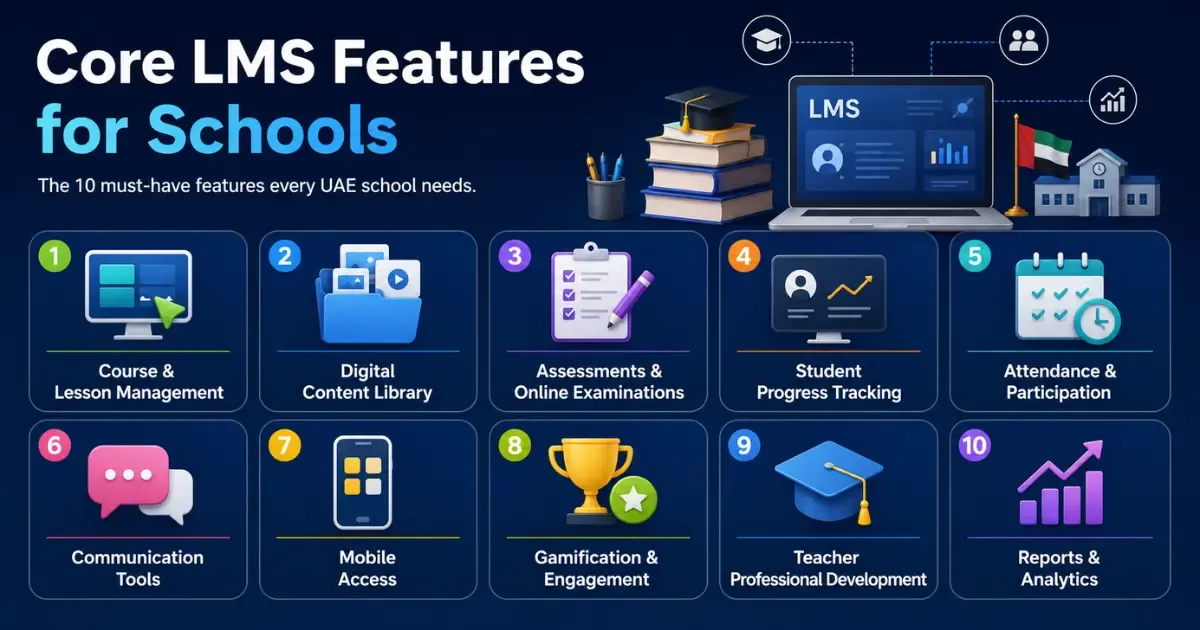
Not all platforms are built the same. Here are the ten features that matter most for UAE schools specifically.
1. Course and lesson management
Teachers need to build, sequence, and publish lessons without needing a developer's help. Look for drag-and-drop course builders, lesson templates, and curriculum tagging so content maps cleanly to learning objectives.
2. Digital content library
A central repository where teachers can store, share, and reuse resources — videos, PDFs, interactive activities, assessments — saves enormous amounts of time. The best libraries allow filtering by subject, year group, and curriculum.
3. Assessments and online examinations
From formative quizzes to high-stakes mock exams, your LMS should handle the full range. Look for auto-grading, question banks, anti-cheating controls (like browser lockdown and randomised questions), and rubric-based manual marking.
4. Student progress tracking
Dashboards that show each student's performance at a glance — across subjects, over time, against learning objectives — give teachers the information they need to intervene early rather than react late.
5. Attendance and participation
Automated attendance recording, linked to timetables and synced with student information systems (SIS), reduces administrative load and creates accurate records for compliance reporting.
6. Communication tools
Built-in messaging, announcements, parent portals, and notification systems reduce dependence on external email and WhatsApp threads. Multilingual support is essential in UAE schools — your LMS should ideally handle Arabic and English as a baseline.
7. Mobile access
In a country where smartphone penetration is among the highest in the world, mobile-first design isn't optional. Students, teachers, and parents should get a full-featured experience on any device.
8. Gamification and engagement
Badges, leaderboards, streaks, and reward systems improve student motivation — particularly for younger age groups. The evidence base here is solid: structured gamification can improve course completion rates and daily active use significantly.
9. Teacher professional development
Your LMS can double as a CPD platform for staff. Teachers can complete training modules, track their own professional learning hours, and access resources curated by curriculum heads — all within the same system.
10. Reports and analytics
From individual student reports to school-wide performance dashboards, the analytics layer is where your LMS pays for itself. Governors, principals, and curriculum coordinators need clean, exportable data — not raw numbers they have to format manually.
UAE LMS Compliance and Data Protection
If your school collects student data — and it does — you need to understand Federal Decree-Law No. 45 of 2021, the UAE's Personal Data Protection Law (PDPL). This legislation sets clear obligations around how personal data is collected, stored, processed, and shared.
For school LMS platforms, this translates into several practical requirements:
- Data residency: Understand where your LMS data is stored. Some cloud platforms host data outside the UAE, which can create compliance exposure.
- Consent and access control: Role-based access controls should limit who can see what. Student records should not be visible to unauthorised users.
- Data minimisation: Only collect data that serves a legitimate educational purpose. Your LMS configuration should reflect this.
- Breach notification: If a data breach occurs, the PDPL requires prompt notification. Your LMS provider should have incident response protocols in place.
- Vendor due diligence: If you're using a third-party LMS provider, they are a data processor under UAE law. You need a data processing agreement (DPA) in place.
Pro tip: When evaluating LMS vendors, ask them directly: "Where is our data stored, and what are your PDPL compliance controls?" A reputable provider will have a clear, documented answer.
AI-Ready LMS Capabilities
AI features in education software have moved from marketing language to measurable value. Here's what actually matters:
Personalised learning paths: An AI-powered LMS analyses each student's performance and learning patterns, then recommends the next piece of content, adjusts difficulty, or flags a topic for revision — automatically. This is adaptive learning in practice, and it's particularly powerful in diverse classrooms where students come in with very different knowledge baselines.
Adaptive quizzes: Rather than serving the same quiz to every student, adaptive assessment tools adjust question difficulty in real time based on how a student is performing. The result is more accurate measurement and less student frustration.
Automated feedback: AI can provide instant, detailed feedback on written assignments — not replacing the teacher's judgement, but giving students a faster first response that they can act on before the teacher's review arrives.
Early intervention alerts: Machine learning models can identify students at risk of falling behind based on attendance patterns, submission rates, quiz scores, and engagement data — giving teachers a chance to step in before a problem becomes a crisis.
AI governance: This matters. Any AI feature in your LMS should be transparent about how it makes recommendations, free from discriminatory bias, and subject to teacher override. Ask your LMS provider about their AI governance framework before signing anything.
For schools building their own platforms, our AI-Powered EdTech Solutions and Machine Learning Solutions pages cover what's technically possible in school LMS environments today.
LMS Integrations for UAE Schools
A standalone LMS that doesn't talk to anything else creates data silos — and data silos create extra work. Your LMS should integrate cleanly with:
|
Integration |
Purpose |
|
Student Information System (SIS) |
Sync enrolments, grades, and student records automatically |
|
ERP / Finance System |
Connect fee payments, resource allocation, and budgeting |
|
Single Sign-On (SSO) |
One login for all school platforms — critical for teacher and student adoption |
|
Video Conferencing (Zoom, MS Teams) |
Embed live sessions directly into lesson pages |
|
Google Workspace / Microsoft 365 |
Allow content creation and collaboration within familiar tools |
|
Library Management Systems |
Link reading resources and digital books to course content |
|
Assessment Platforms |
Pull in external test data for a unified progress view |
|
Parent Communication Tools |
Sync notifications and messages with the school's parent engagement channels |
The key question to ask any vendor: "What does your API documentation look like, and who manages integrations on your side?" The answer tells you a lot about how seriously they take interoperability.
How to Select an LMS for a UAE School
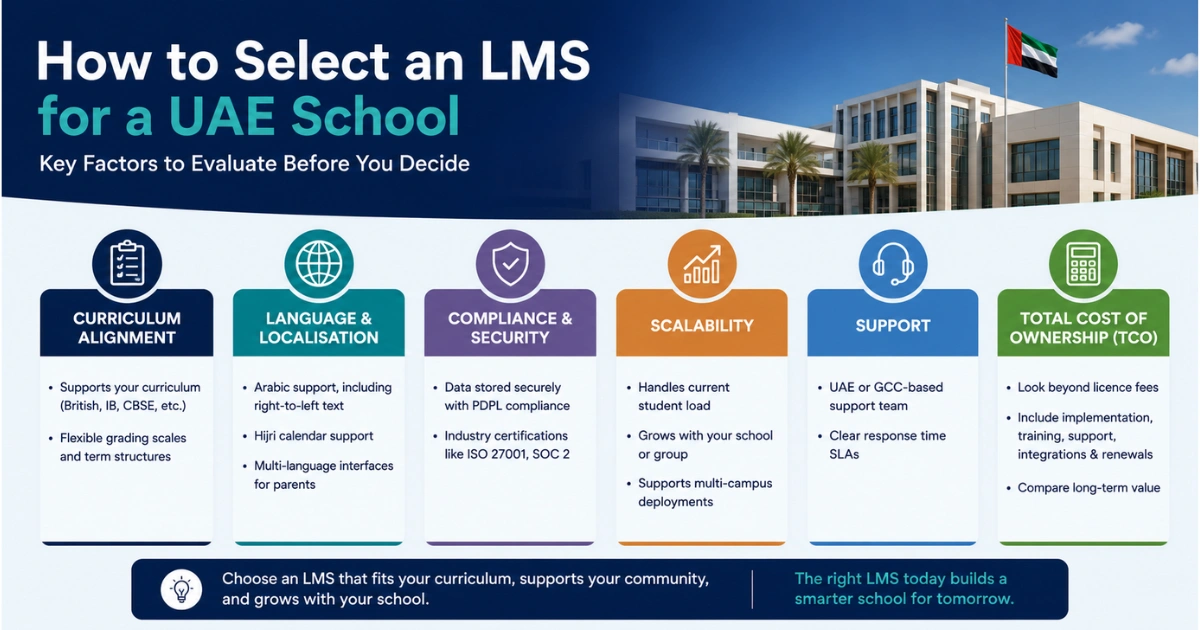
Picking an LMS is a bit like choosing a school building. You can't just go by the brochure — you need to walk through it, check the foundations, and make sure it fits the students and staff who'll actually be using it.
Here are the evaluation questions that matter most:
Curriculum alignment
- Does the platform support your specific curriculum frameworks (British, IB, CBSE, etc.)?
- Can grading scales and term structures be configured per curriculum?
Language and localisation
- Does the platform support Arabic, right-to-left text, and the Hijri calendar?
- Are parent-facing interfaces available in multiple languages?
Compliance and security
- Where is data stored, and how does the vendor address PDPL requirements?
- What security certifications does the platform hold (ISO 27001, SOC 2, etc.)?
Scalability
- Can the platform handle your current student body and grow with you — including multi-campus or group-level deployments?
Support
- Is there a UAE-based or GCC-based support team? What are the response time SLAs?
Total cost of ownership (TCO)
Beyond the licence fee, account for: implementation costs, training, ongoing support, integration development, and annual renewal increases. A platform that looks affordable at year one can become expensive by year three.
Build or Buy an LMS?
This is the question every school group eventually faces. Here's an honest comparison:
|
Factor |
Ready-Made LMS |
Custom-Built LMS |
Hybrid (Configured Ready-Made + Custom Modules) |
|
Time to deploy |
4–12 weeks |
6–18 months |
3–9 months |
|
Upfront cost |
Low–Medium |
High |
Medium |
|
Ongoing cost |
Recurring licence fees |
Internal/vendor maintenance |
Mixed |
|
Curriculum fit |
Generic; requires configuration |
Built to your exact spec |
High configurability |
|
UAE compliance |
Varies by vendor |
Fully controlled |
Controlled with vendor oversight |
|
Scalability |
Vendor-dependent |
Fully controlled |
Flexible |
|
AI capabilities |
Depends on vendor roadmap |
Custom-built to requirements |
Selectively integrated |
|
Best for |
Single schools or small groups needing fast deployment |
Large groups with unique requirements and internal IT capacity |
Groups that want control without building from scratch |
The honest answer? Most UAE school groups end up in the hybrid camp. They start with a configurable ready-made platform and build custom modules — for AI features, custom reporting, or integrations with local systems — on top of it.
If you're considering a custom or hybrid build, explore our App Development services and Enterprise Generative AI Development options to understand what's involved.
LMS Implementation Roadmap
Rolling out an LMS to a school is a project, not a purchase. Here's the six-stage roadmap that experienced teams follow:
Stage 1: Discovery (Weeks 1–3)
Map your current tools, workflows, and pain points. Interview teachers, admin staff, and IT. Define the requirements the LMS needs to meet before anything else happens.
Stage 2: Planning (Weeks 4–6)
Select your platform, finalise the project scope, assign internal owners, and set a realistic timeline. Define your data migration plan and integration requirements.
Stage 3: Pilot (Weeks 7–10)
Run the LMS with one year group or department. Collect feedback systematically. Fix what doesn't work before rolling out school-wide.
Stage 4: Training (Weeks 11–13)
Train teachers, administrators, and IT staff. Don't skip parent onboarding — a confusing parent portal is one of the fastest ways to kill LMS adoption. Create short video guides and FAQs in multiple languages.
Stage 5: Rollout (Weeks 14–18)
Launch school-wide. Keep a helpdesk active for the first four weeks. Monitor adoption metrics daily and address resistance quickly — the first month sets the culture.
Stage 6: Continuous Improvement (Ongoing)
Review usage data quarterly. Add features based on actual user feedback. Keep the platform aligned with Ministry of Education updates, curriculum changes, and AI developments.
Pro tip: Appoint an internal LMS champion — a teacher or coordinator who is enthusiastic about the platform and can support colleagues peer-to-peer. This is consistently one of the highest-impact factors in long-term adoption success.
Measuring LMS Success
How do you know if your LMS is actually working? Not by gut feel — by tracking the right metrics. Here's a KPI framework designed for UAE school contexts:
|
Category |
KPI |
Target Benchmark |
|
Adoption |
Monthly active users (teachers + students) |
>90% within 6 months |
|
Adoption |
Parent portal login rate |
>70% of registered parents monthly |
|
Learning Activity |
Average lessons completed per student/week |
Baseline + 20% within one term |
|
Learning Activity |
Assignment submission rate |
>95% on-time submission |
|
Academic Support |
Early intervention alerts triggered and acted on |
>80% of flagged students receive follow-up within 48 hours |
|
Operations |
Attendance recording time per class |
Reduced by >50% vs. manual process |
|
Operations |
Report generation time |
<30 minutes for standard compliance reports |
|
Engagement |
Gamification participation rate |
>60% of eligible students active monthly |
|
Experience |
Teacher satisfaction score (NPS or survey) |
>7/10 |
|
Security |
Data access audit completion |
100% quarterly |
Review these metrics at the end of each term. Share the results with your leadership team and use them to drive your platform roadmap — not just to report progress, but to identify where the LMS isn't delivering value and act on it.
Ready to Build or Upgrade Your School's LMS?
A great learning management system doesn't just digitise what you're already doing — it changes what's possible. Teachers get more time to teach. Students get a more personalised learning experience. Parents stay connected and informed. Administrators get the data they need without spending hours pulling reports together. And your school is positioned to meet every Ministry of Education mandate that comes next.
If you're evaluating your options — whether that's configuring an existing platform, building a custom solution, or creating a hybrid — the right technical partner makes all the difference.
We work with school groups, education investors, and academic institutions across the UAE to design, build, and deploy LMS platforms built for real-world school complexity — multi-curriculum, multilingual, AI-ready, and PDPL-compliant.
You can also explore our broader capabilities in AI-Powered EdTech Solutions, AI Apps, AI Chatbot Solutions, and Enterprise Generative AI Development to see how AI can extend what your LMS does for students and staff alike.