
Freight forwarding runs on thin margins and even thinner patience. Shippers want real-time visibility. Carriers want fast tenders. Finance wants clean invoices. And somewhere in the middle, your ops team is juggling all three across spreadsheets, WhatsApp threads, and phone calls that never quite stop ringing.
That gap — between what the market demands and what manual processes can realistically deliver — is exactly where transportation management software steps in. A modern TMS pulls planning, execution, tracking, billing, and analytics into a single system, so a rate error doesn't quietly turn into a missed pickup, and a missed pickup doesn't turn into a lost account.
This guide covers what a freight forwarder actually needs to know: what a TMS is, the features that matter, the real ROI behind the investment, how implementation plays out in practice, and how to choose the right platform for your operation — not a generic enterprise shipper's operation.
The timing matters too. The global transportation management system market was valued at roughly USD 18.7 billion in 2025 and is projected to climb past USD 21 billion in 2026, on its way toward the mid-40-billion range by the early 2030s. That growth isn't abstract — it reflects thousands of forwarders making the same decision you're weighing right now: stay manual, or move to a system built for how freight actually moves.
What Is Transportation Management Software?
A Simple Definition for Freight Forwarders
Think of a TMS as a control tower for everything that moves. It's a platform that plans routes, books and tenders loads to carriers, tracks shipments in transit, audits freight bills against contracted rates, and reports on performance — all from one dashboard instead of five disconnected tools.
For a freight forwarder specifically, that means one system handling multi-carrier bookings across road, air, ocean, and rail, instead of a different login and a different spreadsheet for every mode you operate.
TMS vs. Generic Logistics Software or ERP
Not all logistics software solves the same problem. A TMS is built specifically for transportation operations — moving freight from point A to point B as efficiently and predictably as possible. An ERP or WMS, by contrast, is built around orders, inventory, and warehouse floor operations, and treats transportation almost as an afterthought.
Freight forwarders get outsized value from a dedicated TMS because their work is inherently more complex than a typical shipper's: multiple carriers per shipment, multiple transport modes, cross-border documentation, and customer-specific rate agreements that a generic system was never designed to handle. This is one reason many forwarders end up working with teams that specialise in Transportation Management Software Development in Dubai, since off-the-shelf platforms rarely map cleanly onto GCC trade corridors, free-zone documentation, and the mix of regional and international carriers a Dubai-based forwarder deals with daily.
Why Freight Forwarders Actually Need a TMS
The Real Cost of Running Without One
Most forwarders don't wake up one day and decide they need software. They arrive there because the cracks start showing:
- Shipment data lives across email, spreadsheets, WhatsApp, and phone calls — nobody has the full picture.
- Rate errors and duplicate data entry quietly eat into margin every single month.
- Clients call asking "where's my shipment?" because there's no self-service visibility to check.
- Booking, tendering, and documentation eat hours that should go toward growing the business instead.
Freight forwarding software has become common enough that this isn't a niche problem anymore. Industry data shows over 71% of freight companies have already implemented some form of software platform to automate bookings, invoicing, and customs clearance — which means forwarders still running on Excel are increasingly the exception, not the norm.
How a TMS Actually Fixes This
A TMS replaces the fragmented workflow with a single shipment lifecycle: booking, routing, tracking, proof of delivery, and billing all happen inside one system. Load planning, carrier tendering, and reminder workflows run automatically instead of relying on someone remembering to follow up manually. Customers get their own tracking portal instead of a phone call they have to make just to get a status update.
Picture a UAE-based forwarder moving 200+ shipments a day across three modes. Without a TMS, that's three full-time ops staff dedicated purely to status updates. With one, the same visibility runs through a customer portal — freeing that headcount for actual problem-solving instead of repetitive status-chasing.
Key Features of Transportation Management Software for Logistics
Core Operational Features
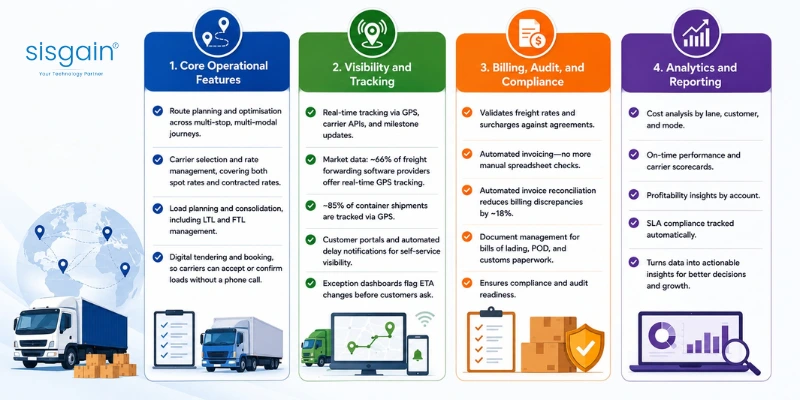
- Route planning and optimisation across multi-stop, multi-modal journeys.
- Carrier selection and rate management, covering both spot rates and contracted rates.
- Load planning and consolidation, including LTL and FTL management.
- Digital tendering and booking, so carriers can accept or confirm loads without a phone call.
None of these features work in isolation. A route optimisation engine is only as good as the rate data feeding it, and a tendering workflow is only as fast as the carrier network connected to it. This is exactly why forwarders evaluating a TMS should look at how well these core modules talk to each other, not just whether each one exists somewhere on a feature list.
Visibility and Tracking
Real-time tracking — via GPS, carrier APIs, and milestone updates — is no longer a differentiator; it's table stakes. Market research puts real-time GPS tracking coverage at roughly 66% of freight forwarding software providers, extending to around 85% of container shipments tracked this way. Customer-facing portals and automated delay notifications turn "where's my shipment?" from a support ticket into a self-service answer, backed by exception dashboards that flag ETA changes before the client even has to ask.
Billing, Audit, and Compliance
A TMS validates freight rates and surcharges against what was actually agreed upon, then generates invoices automatically instead of someone manually cross-checking a spreadsheet line by line. This matters more than it sounds: automated invoice reconciliation has been shown to cut billing discrepancies by around 18% for forwarders that adopt it. Document management for bills of lading, proof of delivery, and customs paperwork rounds out the compliance side of the platform.
Analytics and Reporting
Cost per lane, per customer, and per mode. On-time performance and carrier scorecards. Profitability broken down by account, with SLA compliance tracked automatically — this is the layer that turns a TMS from an operations tool into a genuine decision-making tool for the business.
Benefits of Transportation Management Software for Freight Forwarders
This isn't software for software's sake — it's a lever for margin, efficiency, and growth.
Cost Savings and Margin Improvement
Better routing cuts fuel and transit time. Load consolidation improves truck utilisation. Fewer manual errors mean fewer claims and write-offs eating into what you actually keep at the end of the month.
Operational Efficiency
Booking, tracking, and documentation that used to take hours now take minutes. Processes get standardised across branches, so performance no longer depends on which employee happens to be handling a particular shipment that day.
A Better Customer Experience
Self-service portals, transparent pricing, and live tracking change the entire client relationship. Faster, more accurate communication on ETAs and delays becomes a real competitive edge in a market where most competitors are still working off email.
Strategic Decision-Making
Once your data lives in one place, pricing and lane decisions stop being guesswork. You can spot low-margin customers and routes early, and plan capacity with carriers using actual historical patterns instead of gut feel.
Types of Transportation Management Software: Deployment and Use Cases
Cloud TMS vs. On-Premise
Cloud-based TMS runs on a subscription model with faster deployment, lower upfront cost, and automatic updates — no IT team required to keep it running. On-premise systems offer deeper customisation and control but come with higher capital expense and ongoing IT overhead.
The market has already made its preference clear. Cloud-based deployments now account for roughly 58% of new freight forwarding software installs, up from 47% just a few years earlier — and close to 68% of small and mid-sized forwarders now run on cloud platforms specifically for the 24/7 access and operational continuity it provides.
SMB TMS vs. Enterprise TMS
Small and mid-sized forwarders generally need ease of use, essential features, and a manageable price tag more than they need a hundred configuration options they'll never touch. Enterprise forwarders — multi-country, high shipment volume — need advanced optimisation, deeper integrations, and increasingly, AI-driven modules for dynamic rate and route decisions.
Mode-Specific vs. Multi-Modal TMS
A road-only TMS works fine if that's genuinely all you move. But freight forwarders rarely stay in one lane for long. Roughly 68% of global freight forwarders now manage multimodal shipments spanning at least three transport modes, which is exactly why multi-modal support isn't optional for most forwarders — it's the whole point of the software. Forwarders looking to understand how road-side operations specifically fit into that broader picture often start with a dedicated fleet management software development dubai guide, since fleet visibility and TMS-level routing decisions are closely linked but solve slightly different problems.
How Transportation Management Software Works: Step by Step
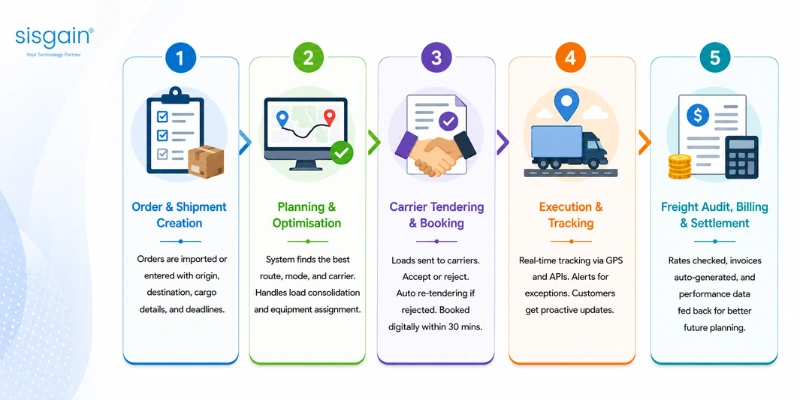
Step 1 — Order and Shipment Creation
Orders come in either imported from an ERP/WMS or entered manually, with origin, destination, cargo details, and deadlines defined upfront.
Step 2 — Planning and Optimisation
The system suggests the best route, mode, and carrier based on rules and current rates, then handles load consolidation and equipment assignment automatically.
Step 3 — Carrier Tendering and Booking
Loads go out to preferred carriers digitally. Carriers accept or reject, and if a load gets rejected, automatic re-tendering kicks in instead of someone manually calling the next carrier on the list. Nearly half of global freight bookings are now confirmed digitally within 30 minutes using workflows like this.
Step 4 — Execution and Tracking
Tracking runs through GPS, carrier APIs, and milestone updates. Exception alerts fire automatically, and customers get proactive updates instead of finding out about a delay only when they call to ask.
Step 5 — Freight Audit, Billing, and Settlement
The system checks agreed rates against actual charges, generates invoices automatically, and feeds performance data back into the analytics layer — closing the loop for the next shipment's planning.
Transportation Management Software vs. Other Tools
TMS vs. WMS
A WMS manages what happens inside the four walls of a warehouse. A TMS manages what happens the moment freight leaves those walls — the actual movement between points, carriers, and modes.
TMS vs. ERP
An ERP handles financials, orders, HR, and procurement at the company level. A TMS is the specialised layer for planning and executing transportation specifically — the two are complementary, not competing, and the strongest setups have them talking to each other constantly. Forwarders mapping out where a TMS fits alongside their broader systems often find it useful to reference a supply chain software development guide dubai teams put together for exactly this kind of system-landscape planning.
Why Excel and Email Fall Short at Scale
Spreadsheets don't flag exceptions. Email doesn't give a customer live status. Neither leaves a reliable audit trail when a rate dispute comes up six months later. Once shipment volume grows past a certain point, the risk of errors compounds faster than any team can manually catch them.
How to Choose the Right Transportation Management Software: A Buying Guide
Step 1 — Define Your Logistics Needs
Start with the basics: shipment volume, geographic coverage, and the modes you actually run — road, air, ocean, or all three. Factor in complexity like multi-leg shipments, customs handling, and whether you're serving B2B, B2C, e-commerce, or enterprise clients.
Step 2 — Identify Must-Have Features
For a freight forwarder, the non-negotiables usually come down to:
- Multi-carrier and multi-modal support
- Strong documentation and compliance handling
- Customer portals, ideally with white-label options
- Integration with ERP, WMS, load boards, and accounting systems
For forwarders weighing custom builds against off-the-shelf platforms, a well-scoped freight management software dubai guide can be a useful starting point for comparing what's realistically achievable within a given budget and timeline before signing with any vendor.
Step 3 — Check Integration and Scalability
Look at API and EDI support for connecting with your existing systems, and be honest about whether the platform can handle 2–3x your current shipment volume without breaking. If you operate across multiple emirates or across the wider GCC, confirm the system actually supports that structure — not just in a sales demo.
If your requirements are specific enough that off-the-shelf platforms fall short — unusual trade lanes, regional compliance rules, or deep integration with existing systems — it's worth bringing in a specialised software development company dubai businesses trust for building or customising freight-tech platforms, rather than forcing your operation to adapt around a rigid, generic product.
Step 4 — Evaluate UX, Support, and Training
A powerful TMS that your ops team refuses to use is worse than no TMS at all. Check how much onboarding and training support the vendor actually provides, and whether bilingual Arabic-English support matters for your team — a real consideration for forwarders operating across the UAE's diverse, multinational workforce.
Step 5 — Calculate Total Cost of Ownership and ROI
Add up license or subscription fees plus implementation cost — but don't stop there. Integration work, customisation, training, and future upgrades are where hidden costs usually show up. Ask the vendor for a realistic ROI timeline in months, not just a feature list on a brochure.
Implementation: How Freight Forwarders Can Successfully Adopt a TMS
Preparation and Process Mapping
Before touching any software, document your current workflows, pain points, and where your data actually lives today. This is also where you separate quick wins from longer-term improvements.
Roll Out in Phases
Start with a pilot branch or region rather than switching your entire operation overnight. Activate features gradually — tracking first, then planning, then billing — so your team isn't relearning everything at once.
Manage the Change, Not Just the Software
Bring the ops team in early. Resistance to new software is almost always about workflow disruption, not the tool itself. Set clear KPIs from day one — on-time delivery rate, shipments handled per FTE, error rate — so success isn't a vague feeling, it's a number you can point to.
Measure What Actually Changed
Compare before-and-after metrics: cost per shipment, error rate, on-time percentage. Track customer satisfaction and retention too — that's often where a TMS pays for itself fastest, even before the cost savings show up on paper.
The Future of Transportation Management Software in Logistics
AI and Automation
Dynamic route optimisation based on live conditions, predictive ETAs, and delay-risk scoring are moving from "nice to have" to standard. Industry data already shows 57% of logistics firms running AI-powered rate management systems that process rates across 100+ carriers simultaneously — a scale no manual process could realistically match.
Real-Time Visibility and Collaboration
Control tower dashboards are extending beyond a single company to entire partner networks — carriers, shippers, and customs brokers collaborating on one platform instead of five disconnected ones. This shift is already happening at the industry infrastructure level: in mid-2026, Lufthansa Cargo, WiseTech Global, and IBS Software completed a live production rollout of IATA's ONE Record standard for end-to-end air cargo data exchange, a clear signal of where data interoperability across the freight industry is heading — a development with direct relevance for a hub economy like the UAE's, where air cargo through Dubai and Abu Dhabi feeds global trade lanes.
Sustainability and Green Logistics
Route planning increasingly factors in emissions, not just cost and speed. Carbon tracking per shipment is moving from a niche add-on to a standard reporting requirement, particularly as clients face their own sustainability disclosure pressure. Around 45% of freight forwarding companies already integrate carbon emission calculators aligned with international standards — a number that keeps climbing as regulation tightens, a pressure UAE forwarders increasingly feel too as the country's own net-zero 2050 commitments and green logistics initiatives push sustainability reporting further up the vendor-selection checklist.
For freight forwarders, this isn't just a future trend to watch — it's already becoming a factor in which vendors win enterprise contracts today.
Is Transportation Management Software Right for Your Freight Forwarding Business?
Who Should Seriously Consider a TMS
- You're handling 50+ shipments a day
- Your operation spans multiple carriers, modes, or regions
- Your customers are asking for real-time visibility and performance reporting you can't currently deliver
A Quick Self-Assessment
Ask yourself honestly:
- Do we struggle to give clients real-time shipment visibility?
- Are we still relying on Excel and email for critical, day-to-day operations?
- Are error-related costs — claims, write-offs, rework — creeping up quarter over quarter?
- Is our ops team overloaded with manual, repetitive tasks that software could handle instead?
If you answered yes to two or more of these, the case for a TMS isn't theoretical anymore — it's operational.
Conclusion
Manual processes worked when shipment volumes were low and client expectations were lower still. Neither of those is true anymore. Between rising shipment volumes, multi-modal complexity, and clients who expect the same real-time visibility they get from a courier app, freight forwarders running on spreadsheets and phone calls are absorbing costs their competitors have already automated away.
A transportation management software platform isn't a replacement for good operations — it's what lets good operations scale without breaking. The forwarders pulling ahead right now aren't necessarily the ones with the biggest fleets or the oldest client relationships. They're the ones who can quote faster, track more accurately, bill without disputes, and show a client exactly where a shipment is at 2 a.m. without anyone picking up a phone.