
Real estate software development in the UAE typically costs between AED 55,000 and AED 1,500,000+, depending on platform complexity, number of integrations, and whether you build an MVP, a mid-level platform, or an enterprise PropTech system. A basic listing app sits at the low end; an AI-powered, multi-portal enterprise platform sits at the high end.
Why Real Estate Software Costs Vary So Much in the UAE
Two companies asking "how much does real estate software cost" can get quotes that differ by 10x — and both quotes can be correct. The variance comes from measurable inputs, not vendor inconsistency:
- How many platforms you need (web only vs. web + iOS + Android)
- Whether listings are entered manually or synced through bulk imports and feeds
- How much of the CRM and lead-routing logic is custom vs. templated
- Whether AI, AR/VR, or advanced geospatial search are in scope
- How many third-party systems the platform must talk to (payment gateways, SMS/WhatsApp, mapping, analytics)
- Whether the team is a UAE-based agency, an offshore team, or a hybrid delivery model
A property listing directory with a contact form is a fundamentally different engineering project than a broker CRM with automated lead distribution, or an enterprise portfolio management system used by a developer's finance and leasing teams. The cost table below reflects that spread.
Real Estate Software Development Cost Table (2026 UAE Estimates)
|
Real Estate Software Type |
Estimated Cost (AED) |
Development Time |
Suitable For |
|
Basic property listing MVP |
55,000 – 120,000 |
6–8 weeks |
Solo agents, small brokerages validating an idea |
|
Real estate mobile app (single platform) |
90,000 – 200,000 |
8–12 weeks |
Agencies wanting a branded listing/search app |
|
Agent/broker CRM |
120,000 – 280,000 |
10–14 weeks |
Brokerages managing leads and follow-ups |
|
Property management software |
180,000 – 450,000 |
3–6 months |
Property managers, landlords, facility teams |
|
Mid-complexity platform (web + mobile + CRM) |
200,000 – 450,000 |
3–5 months |
Growing agencies, regional brokerages |
|
Marketplace platform (multi-vendor listings) |
350,000 – 750,000 |
5–8 months |
Portals connecting buyers, sellers, agents |
|
AI-powered platform (smart search, recommendations, chatbot) |
400,000 – 800,000 |
5–8 months |
Agencies differentiating on technology |
|
Enterprise PropTech platform (multi-portal, ERP-integrated) |
800,000 – 1,500,000+ |
8–14 months |
Developers, large brokerages, investment firms |
These are estimated 2026 UAE development ranges based on typical team compositions (UAE and hybrid delivery), not quotations. Actual pricing depends on your requirements document, chosen vendor, and team location.
What Each Cost Level Actually Includes
Basic MVP
Who needs it: Individual agents, small agencies, or founders validating a PropTech idea before raising investment or committing to a full build.
Typical features: property listing pages, basic search and filters, contact/lead capture forms, an admin panel to add and edit listings, and basic user accounts.
What it excludes: CRM automation, AI, payment processing, multi-language support, and advanced maps. An MVP proves the core concept works — it is not meant to run a full brokerage.
Approximate cost and timeline: AED 55,000–150,000, 6–10 weeks.
Mid-Level Platform
Who needs it: Agencies and property management companies past the validation stage, with defined workflows and a growing team of agents or property managers.
Typical features: everything in the MVP, plus a functioning CRM (lead assignment, follow-up reminders, pipeline stages), map-based search, agent profiles, saved searches, push notifications, basic analytics dashboards, and integration with at least one payment gateway or lead-generation channel (e.g., WhatsApp Business API or an SMS gateway).
Approximate cost and timeline: AED 150,000–450,000, 3–6 months.
Advanced / AI-Powered Platform
Who needs it: Businesses that want technology as a competitive differentiator — faster lead qualification, better search relevance, or automated content generation for listings.
Typical features: AI-driven property recommendations based on user behavior, natural-language or conversational search, an AI chatbot for initial lead qualification, predictive lead scoring, automated listing description generation, and (optionally) virtual tour or AR/VR integration.
A critical distinction: "AI-powered" does not require building a custom large language model. Most UAE real estate platforms in this tier integrate existing LLM APIs (for chat and content generation) and build a recommendation layer on top of their own listing and behavioral data. This is materially cheaper and faster than training proprietary models, and it is the approach most vendors — including an AI-Powered Real Estate App Development Company in Dubai — would recommend for a first AI implementation.
Approximate cost and timeline: AED 400,000–800,000, 5–8 months.
Enterprise PropTech Platform
Who needs it: Property developers, large multi-branch brokerages, and real estate investment firms that need the platform to function as core operating infrastructure — not just a marketing or lead-capture tool.
Typical features: multi-portal architecture (separate experiences for buyers, agents, developers, and internal staff), integration with accounting/ERP systems, advanced role-based security, audit logging, custom reporting and BI dashboards, API access for partners, high-availability cloud architecture, and support for large transaction and document volumes (contracts, off-plan payment plans, title documents).
Approximate cost and timeline: AED 800,000–1,500,000+, 8–14 months. Highly complex, multi-country, or multi-entity platforms can exceed this range.
Detailed Cost Breakdown: Where the Budget Goes
|
Development Component |
Estimated Cost Contribution |
|
Discovery, requirements, business analysis |
5–8% |
|
UI/UX design |
10–15% |
|
Frontend development (web) |
15–20% |
|
Mobile application development (iOS/Android) |
20–30% |
|
Backend development and architecture |
20–25% |
|
Admin dashboard and CMS |
8–10% |
|
API integrations (maps, payments, CRM, SMS) |
8–15% |
|
QA and testing |
10–12% |
|
DevOps, cloud setup, and deployment |
5–8% |
|
Project management |
8–10% |
|
Post-launch support (first month) |
3–5% |
These percentages are indicative and will shift depending on scope — a mobile-heavy project spends proportionally more on iOS/Android work, while an integration-heavy enterprise platform spends more on APIs and backend architecture.
Why each component affects cost:
- Discovery and business analysis determines everything downstream. Skipping this to "save money" is the single most common cause of expensive mid-project scope changes.
- UI/UX design is not decorative — for a property platform, poor search UX and cluttered listing pages directly reduce lead conversion. This is a revenue decision disguised as a design decision.
- Backend architecture decisions (how listings, users, and leads are modeled) determine how expensive future features will be. Under-investing here creates technical debt that costs more to fix later than to build correctly the first time.
- QA and testing cost scales with the number of user roles and integrations. A platform with agent, buyer, admin, and developer roles needs meaningfully more test coverage than a single-role listing app.
- API integrations are priced per integration, not as a flat fee — each third-party system (payment gateway, SMS provider, mapping service) adds its own authentication, error-handling, and testing overhead.
Major Cost Drivers Explained
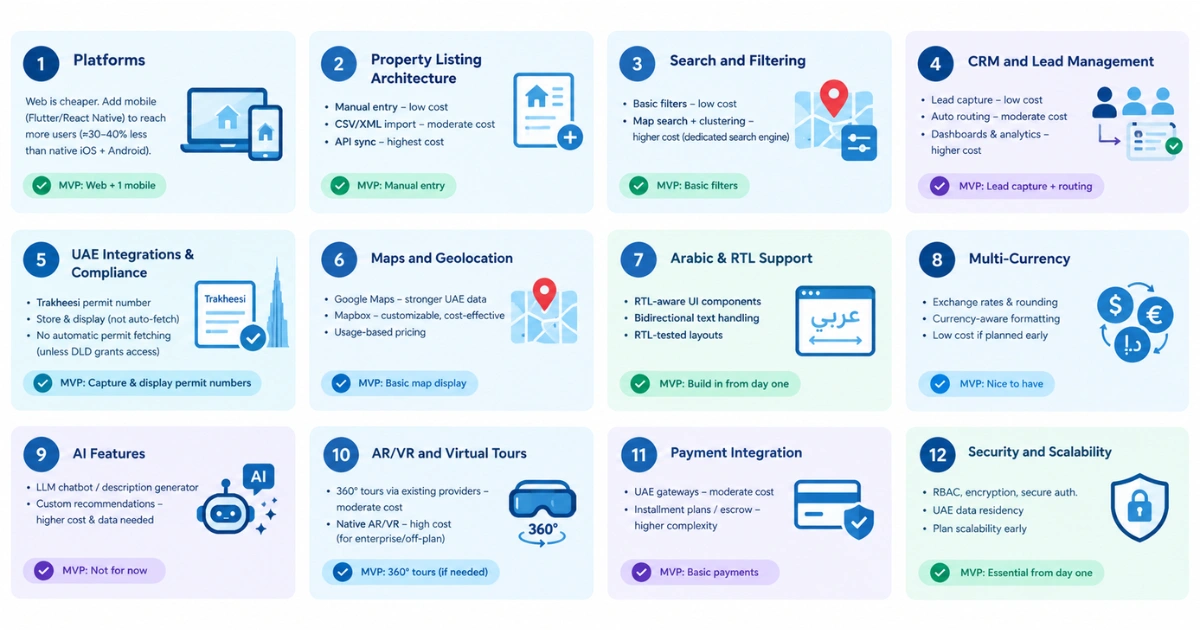
1. Number of Platforms
Building for web only is cheaper than web + iOS + Android. Cross-platform frameworks like Flutter or React Native can cover both mobile OSes from a largely shared codebase, cutting mobile development cost by roughly 30–40% compared to fully native iOS and Android builds — at the cost of some platform-specific performance and UI nuance.
MVP priority: Start with web (fastest to market, easiest to iterate) plus one mobile platform if your user base is mobile-first, which UAE consumers generally are.
2. Property Listing Architecture
Feature → Why it costs more → Impact → MVP priority
- Manual listing entry → simplest to build → low cost → yes, MVP-appropriate
- Bulk CSV/XML import → requires parsing, validation, deduplication logic → moderate cost → useful once listing volume grows
- Live API sync with portals or CRMs → requires ongoing integration maintenance as external APIs change → highest cost → post-MVP, once volume justifies it
3. Search and Filtering
Basic filters (price, bedrooms, location) are inexpensive. Map-based search with clustering, radius search, and sub-second performance on large datasets typically requires a dedicated search engine (Elasticsearch, Algolia, or Meilisearch) rather than relying on standard database queries. This is a meaningful cost increase but pays off directly in user experience and conversion once listing volume exceeds a few thousand properties.
MVP priority: Basic filters at launch; dedicated search infrastructure once listing volume or traffic justifies it.
4. CRM and Lead Management
Feature → Why it costs more → Impact → MVP priority
- Lead capture forms → low complexity → low cost → yes
- Automated lead routing to agents → requires business logic and notification systems → moderate cost → recommended early, even in a lean form
- Broker performance dashboards and analytics → requires data pipeline work → moderate-to-high cost → post-MVP
Lead management is consistently one of the highest-ROI investments in a real estate platform. A platform that captures leads but has no routing or follow-up logic loses a measurable share of those leads to slow response times.
5. UAE Integrations and Compliance
This is the area most often misrepresented in generic cost guides. Here is what is actually verifiable:
- Trakheesi is the Dubai Land Department's online permit system, regulated by RERA, through which licensed brokers and developers obtain an advertising permit before publishing any property advertisement in Dubai — online, on portals, on social media, or via WhatsApp. Major portals (Property Finder, Bayut, Dubizzle) require a valid Trakheesi permit number before accepting a listing.
- Trakheesi is not a public developer API that your software calls directly to "verify" or "sync" listings automatically. It is a compliance workflow: your brokerage or agents obtain permits through their own DLD/RERA business account, and your software should be designed to store and display the Trakheesi permit number against each listing, not to programmatically fetch or issue permits itself, unless DLD has granted your organization specific system access.
- Advertising without a valid permit is a RERA violation, with reported enforcement including listing removal and fines. Software teams should treat "does our platform correctly capture and display permit numbers" as a real product requirement, and "does our platform obtain permits automatically" as something to verify directly with DLD rather than assume.
Disclaimer: Regulatory requirements around real estate advertising, licensing, and data handling should be confirmed directly with the Dubai Land Department, RERA, or your legal/compliance advisor. This guide describes common product-design implications, not legal advice.
6. Maps and Geolocation
Google Maps Platform and Mapbox are the two realistic options for UAE property search. Google Maps offers stronger local UAE address and points-of-interest data; Mapbox offers more customizable styling and can be more cost-effective at high query volumes. Both are metered APIs — cost scales with usage, which matters for the ongoing cost section below.
MVP priority: Basic map display is low-cost and worth including from day one; advanced features like drive-time isochrones or heatmaps are post-MVP.
7. Arabic and RTL Support
Arabic-language and right-to-left (RTL) interface support is not just translation — it requires RTL-aware UI components, bidirectional text handling, and RTL-tested layouts across every screen. Retrofitting RTL after a platform is built in LTR-only can cost nearly as much as building it in from the start.
MVP priority: If a meaningful share of your target users are Arabic-speaking, build RTL support into the architecture from day one rather than adding it later.
8. Multi-Currency
For platforms serving international investors (common in Dubai's off-plan market), multi-currency display adds moderate complexity: exchange rate sourcing, rounding rules, and currency-aware formatting. This is a relatively low-cost addition if planned early.
9. AI Features
AI features range widely in cost depending on approach. Integrating an existing LLM API for a chatbot or listing-description generator is a moderate addition. Building a custom recommendation engine trained on your own listing and user-behavior data is more expensive and requires sufficient historical data to be effective — which is why AI recommendation features are rarely appropriate for a true MVP.
MVP priority: No, unless AI is the core product differentiator itself (e.g., an AI-first valuation tool).
10. AR/VR and Virtual Tours
360° virtual tours (using existing tour-hosting platforms embedded via API) are moderate cost. Native AR/VR experiences built in-house are significantly more expensive and are typically reserved for enterprise developer platforms marketing off-plan projects, where the tour itself is a sales tool for high-value units.
11. Payment Integration
UAE payment gateway integration (for booking fees, subscription payments, or transaction processing) is a well-established, moderate-cost addition. Complexity increases if the platform needs to support installment plans, escrow-style holding, or multiple payment gateways for redundancy.
12. Security and Scalability
Security cannot be scoped as "add later." Role-based access control, encrypted data storage, secure authentication, and UAE data-residency considerations should be part of the base architecture regardless of budget tier. Scalability (the ability to handle growth in listings, users, and traffic without a rebuild) is a design decision made early — over-engineering it for an MVP wastes budget, but ignoring it entirely creates expensive rework later.
What Makes Real Estate Software Development in the UAE Different?
The UAE real estate market has structural characteristics that affect product decisions more than in many other markets:
- A regulated advertising environment. In Dubai, property advertising is regulated by RERA and administered through DLD's Trakheesi system. Your software should be designed around correctly capturing and displaying permit information, not around bypassing or automating regulatory steps.
- Heavy reliance on WhatsApp for buyer-agent communication. UAE real estate buyers commonly expect to reach an agent via WhatsApp, not just email or in-app messaging. Integrating WhatsApp Business API (a paid, metered service) is a practical, high-adoption feature rather than a "nice to have."
- A large expatriate and international investor base. This drives demand for multi-currency display, Arabic/English bilingual support, and off-plan payment plan visibility — features less central in fully domestic markets.
- Off-plan property dominance in Dubai. A significant share of Dubai transactions involve off-plan (pre-construction) units, which changes what a "listing" needs to display: payment milestones, handover dates, and developer information, not just a finished property's specs.
- Broker-centric workflows. Much of the UAE market runs through licensed brokerages and individual RERA-registered agents rather than direct owner listings, which makes CRM and lead-routing functionality more central to product-market fit than in owner-direct markets.
- Data hosting and privacy expectations. UAE businesses increasingly expect cloud infrastructure choices (AWS Middle East/UAE region, Azure UAE regions, or Google Cloud) that keep data within or near the region, both for latency and for client comfort with data residency — though specific legal data-residency obligations depend on your business type, free zone, and sector, and should be confirmed with legal counsel.
Regulatory requirement vs. recommended product feature: Obtaining a Trakheesi permit before advertising a Dubai property is a regulatory requirement administered by DLD/RERA. Building WhatsApp integration, Arabic/RTL support, or multi-currency display are recommended product features based on user expectations — not legal mandates. Treat this distinction carefully when scoping compliance-related work, and confirm current requirements directly with DLD, RERA, or a UAE legal advisor before finalizing product decisions that touch licensing or advertising rules.
Feature-Based Cost Analysis
|
Feature |
Complexity |
Approximate Cost Impact |
MVP Priority |
|
Property listings (manual) |
Low |
Low |
Yes |
|
Advanced search & filters |
Medium |
Medium |
Partial (basic filters yes) |
|
Map integration |
Medium |
Medium |
Yes (basic) |
|
Agent profiles |
Low |
Low |
Yes |
|
Lead capture forms |
Low |
Low |
Yes |
|
WhatsApp integration |
Medium |
Medium |
Recommended early |
|
CRM (lead routing) |
Medium–High |
Medium–High |
Recommended early |
|
Admin dashboard |
Medium |
Medium |
Yes |
|
Mortgage calculator |
Low |
Low |
Optional |
|
Property comparison tool |
Low–Medium |
Low–Medium |
No |
|
Push notifications |
Low–Medium |
Low–Medium |
No |
|
In-app chat |
Medium |
Medium |
No |
|
Payment gateway |
Medium |
Medium |
Only if transacting online |
|
Analytics dashboard |
Medium |
Medium |
No |
|
AI recommendations |
High |
High |
No |
|
AI chatbot |
Medium–High |
Medium–High |
No |
|
Virtual tours (embedded) |
Medium |
Medium |
Optional |
|
AR/VR (native) |
Very High |
Very High |
No |
|
Arabic/RTL support |
Medium |
Medium |
Yes, if targeting Arabic speakers |
|
Multi-currency |
Low–Medium |
Low–Medium |
Optional |
|
Trakheesi permit display/workflow |
Low–Medium |
Low–Medium |
Yes, for Dubai-facing listing platforms |
Technology Stack for UAE Real Estate Platforms
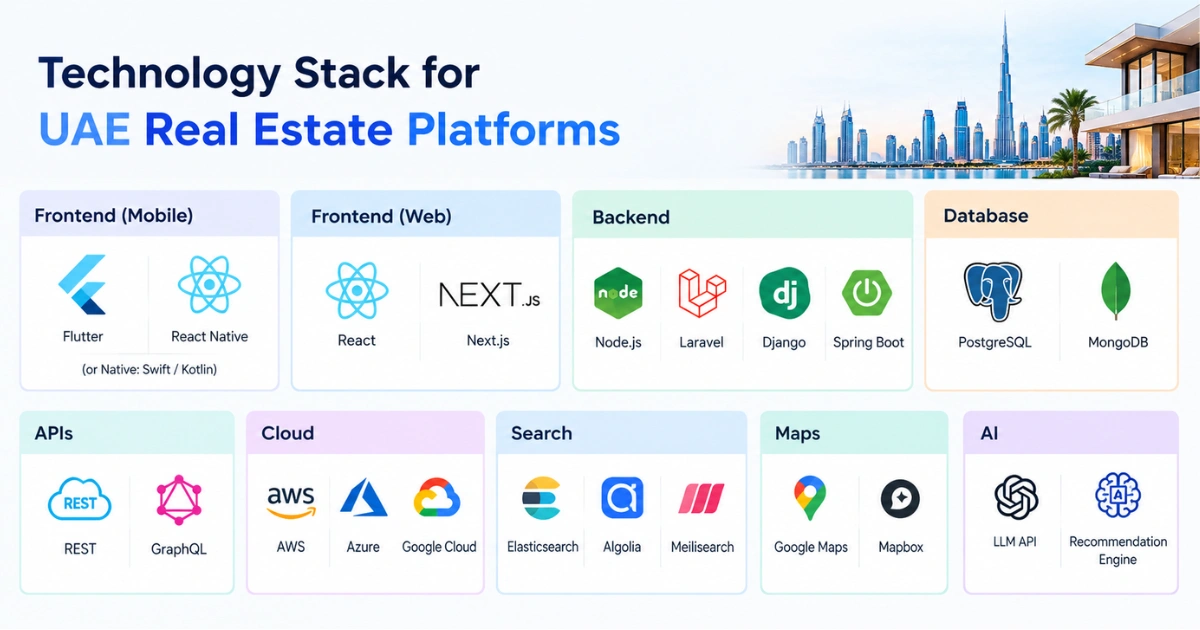
There is no single "correct" stack — the right choice depends on team size, timeline, and scalability needs.
Frontend (mobile): Flutter or React Native are the practical choices for most UAE real estate apps, since they let one codebase serve both iOS and Android, reducing cost and time-to-market. Fully native development (Swift/Kotlin) is worth the extra cost only when the app depends heavily on device-specific performance (e.g., AR features) or platform-exclusive capabilities.
Frontend (web): Modern frameworks such as React or Next.js are standard choices for responsive, SEO-friendly real estate web platforms, since public listing pages need to be indexable by search engines.
Backend: Node.js is a common choice for real-time features (chat, notifications) and teams wanting JavaScript across the stack. Laravel (PHP) remains widely used in the region for CRM-heavy, admin-dashboard-driven platforms with strong developer availability. Django (Python) suits teams planning to build data science or AI features in-house. Spring Boot (Java) is more common in enterprise platforms with strict transactional or banking-grade integration requirements.
Database: PostgreSQL is a strong default for relational data (listings, users, transactions) with reliable geospatial support via PostGIS for location-based search. MongoDB suits platforms with highly variable listing attributes or rapidly evolving data models.
APIs: REST remains the standard for most integrations. GraphQL is worth considering for platforms with complex, nested data (e.g., a listing with agent, developer, amenities, and payment-plan data) queried by multiple client types that each need different subsets of that data.
Cloud: AWS, Microsoft Azure, and Google Cloud all offer UAE-based or nearby regions suitable for a real estate platform's latency and data-hosting preferences. The right choice usually comes down to existing team expertise and which platform's managed services best match your feature roadmap, rather than one provider being objectively "best" for real estate specifically.
Search: Elasticsearch is a strong open-source option for teams wanting full control over infrastructure. Algolia is faster to implement and well-suited to teams prioritizing time-to-market over infrastructure ownership, at a higher ongoing cost per search volume. Meilisearch is a lighter-weight, cost-effective option for platforms with moderate listing volumes.
Maps: Google Maps Platform for stronger UAE local data coverage; Mapbox for design flexibility and potentially lower cost at high query volumes.
AI: For most UAE real estate platforms, integrating an existing LLM API (for chat, content generation, or summarization) is more practical and cost-effective than building proprietary models. Recommendation engines are typically built as a custom layer on top of your own listing and behavioral data, using established machine learning approaches rather than novel research.
Realistic Development Timeline
|
Project Type |
Timeline |
|
Basic MVP |
6–10 weeks |
|
Mid-level platform |
3–6 months |
|
AI-powered/advanced platform |
5–8 months |
|
Enterprise PropTech platform |
8–14 months |
A typical project timeline breaks down roughly as:
- Discovery and requirements: 1–3 weeks
- UI/UX design: 2–5 weeks (can partially overlap with backend architecture work)
- Core development: the majority of the timeline, varying by scope
- Third-party integrations: 1–4 weeks per major integration, often run in parallel with core development
- QA and bug fixing: 2–4 weeks, scaling with the number of user roles and integrations
- User acceptance testing (UAT): 1–2 weeks with your actual team using real workflows
- Deployment and go-live: several days to 1–2 weeks depending on infrastructure complexity
What causes delays: scope changes mid-build (the single most common cause), late discovery of a required integration that wasn't identified upfront, insufficient stakeholder availability for UAT feedback, and underestimating QA time for platforms with multiple user roles.
Ongoing Costs After Launch
Development cost is the starting investment, not the full technology budget. Plan for recurring costs across:
- Cloud hosting, database, and storage: scales with traffic and data volume
- Maps API usage: metered per request/load, scales with search volume
- Search infrastructure: metered (Algolia) or server-based (self-hosted Elasticsearch/Meilisearch)
- SMS, email, and WhatsApp Business API: metered per message sent
- Payment processing fees: typically a percentage per transaction, set by the payment gateway
- Monitoring and security tooling
- Ongoing maintenance and bug fixes
- Feature enhancements and iteration
As a rough planning guide, a mid-level platform's combined monthly infrastructure and third-party service costs commonly fall somewhere in the AED 3,000–15,000 range, with enterprise platforms running higher depending on traffic and integration volume — these are estimates that should be validated against your actual expected usage, not treated as fixed figures.
Annual maintenance is commonly estimated industry-wide at roughly 15–20% of the original development cost per year, covering bug fixes, security patches, minor enhancements, and platform updates. This is a widely used industry rule of thumb, not a guaranteed figure, and actual maintenance cost depends heavily on code quality, architecture, and how much the product evolves post-launch.
App store costs are small but worth budgeting accurately: the Apple Developer Program costs US $99 per year (or US $299/year for the Enterprise Program), and Google Play charges a one-time US $25 registration fee with no recurring annual charge. These are official, current figures from Apple and Google, not estimates.
How to Reduce Development Cost Without Compromising Quality
Do this:
- Start with a true MVP and validate demand before building advanced features
- Prioritize features with direct ROI: lead capture, lead routing, and search — not AI or AR/VR — for a first release
- Use cross-platform mobile development (Flutter/React Native) unless you have a specific native-only requirement
- Delay AI investment until you have enough real usage data for it to be effective
- Handle listing management manually or via simple bulk import before building expensive live-sync integrations
- Build in phases, with each phase tied to a measurable business outcome
- Design a modular architecture so features can be added later without rebuilding the core system
- Plan for scale in your architecture decisions, but don't build enterprise-grade infrastructure for a product with no users yet
Do not cut these, regardless of budget pressure:
- Security fundamentals (authentication, access control, encrypted storage)
- Data protection and backup systems
- QA and testing time
- Core architecture decisions (rushing these creates expensive rework later)
- Monitoring and error tracking
- Any workflow tied to regulatory compliance, such as correctly capturing and displaying Trakheesi permit information
MVP vs. Full-Scale Platform: How to Decide
|
MVP |
Full-Scale Platform |
|
Core listings |
Advanced marketplace with multi-vendor support |
|
Basic search and filters |
AI-powered search and recommendations |
|
Lead capture forms |
Automated lead routing and scoring |
|
Basic admin panel |
Enterprise dashboard with role-based access |
|
Basic map display |
Advanced geospatial search and clustering |
|
Basic usage analytics |
BI dashboards and predictive analytics |
|
Manual listing/data workflows |
Automated integrations and live data sync |
Choose an MVP if you are validating a new business model, entering the market for the first time, working with a constrained initial budget, or need to demonstrate traction to investors before committing further capital.
Choose a full-scale platform if you already have proven demand, an existing customer/agent base ready to migrate, or are replacing an outgrown legacy system where a phased MVP approach would create operational disruption.
Many UAE businesses take a middle path: launch a lean mid-level platform, then expand based on real usage data — often the most capital-efficient route for an established agency or developer that isn't validating a brand-new business model but also doesn't yet need enterprise architecture.
Revenue Models for Real Estate Software Platforms
A real estate platform's cost only matters relative to how it generates return. Common revenue models include:
- Broker/agent subscriptions — recurring fee for platform access and lead volume
- Featured listing fees — agents or developers pay for premium placement
- Lead generation fees — charging per qualified lead delivered to agents
- Advertising revenue — third-party ads on a high-traffic listing portal
- Transaction commissions — a percentage of completed deals facilitated through the platform
- SaaS subscriptions — for property management or CRM software sold to agencies
- Property management subscriptions — recurring fees from landlords or asset owners
- Premium analytics — charging for advanced market data or performance dashboards
- Enterprise licensing — for large developers or investment firms deploying the platform internally
The revenue model you intend to pursue should directly shape which features belong in your MVP — a lead-fee model needs strong lead-routing early; a SaaS-subscription model needs strong onboarding and admin tooling early.
Common Mistakes UAE Businesses Make When Building Real Estate Software
- Starting development before validating the business model. Building a full feature set before confirming anyone will pay for the product wastes the majority of a real estate software budget. Validate with a lean MVP first.
- Building too many features into version one. Feature-heavy V1 launches take longer, cost more, and delay the market feedback that should be shaping the roadmap.
- Ignoring broker and agent workflows. Platforms designed around consumer search but not around how agents actually manage leads and listings see poor adoption from the people who generate revenue.
- Allowing poor listing data quality. Inconsistent, incomplete, or duplicate listings undermine user trust faster than almost any other product flaw.
- Underinvesting in search. Weak search and filtering is one of the fastest ways to lose users on a listing platform.
- Launching without lead-routing logic. Capturing leads with no automated routing or follow-up system means leads go cold, directly undermining ROI.
- Treating Arabic/RTL as a post-launch add-on. Retrofitting RTL support after launch is significantly more expensive than building it into the architecture from day one.
- Treating compliance as an afterthought. Waiting until near launch to consider how Trakheesi permit numbers or licensing information should be reflected in the product creates rework a discovery-phase conversation would have avoided.
- Building AI before establishing clean, sufficient data. AI recommendation and search features perform poorly without adequate historical data — build the data foundation first.
- Underestimating post-launch maintenance. Budgeting only for development, not the ongoing 15–20% annual maintenance estimate plus infrastructure costs, leads to under-resourced platforms within a year.
- Choosing a vendor purely on lowest price. The cheapest quote often reflects reduced QA, weaker architecture, or unclear code ownership — costs that resurface later as redevelopment expense.
How to Choose a Real Estate Software Development Company in UAE
A structured evaluation reduces the risk of costly mid-project surprises. Look for:
- Relevant PropTech or real estate domain experience — not just general app development
- UAE market understanding — familiarity with local user behavior, WhatsApp-centric communication, and broker workflows
- Integration experience — payment gateways, mapping, SMS/WhatsApp, and CRM systems relevant to your use case
- Documented security practices — authentication, data encryption, and access control
- UI/UX design capability, not just development — real estate conversion depends heavily on search and listing UX
- Cloud and DevOps expertise — can they design for the scale you'll actually need
- A defined QA process — ask what percentage of the timeline is allocated to testing
- Post-launch support terms — what's included after go-live, and for how long
- Transparent, itemized pricing — vague, single-line quotes are a red flag
- Clear source code and IP ownership terms — confirm in writing that you own the codebase
- Technical documentation practices — undocumented code becomes expensive to maintain or hand off
- A track record of scalable platforms, evidenced by portfolio examples relevant to your project size
Questions to Ask Before Signing a Contract
- Can you share examples of real estate or PropTech platforms you've built, and can I speak with a past client?
- How do you structure pricing — fixed scope, time and materials, or milestone-based?
- Who owns the source code and IP after the project is delivered?
- What percentage of the project timeline is allocated to QA and testing?
- How do you handle scope changes mid-project, and how are they priced?
- What does your post-launch support package include, and for how long is it covered?
- What is your approach to security — authentication, data encryption, and access control?
- How do you handle third-party integrations that change or deprecate their APIs after launch?
- Will you provide technical documentation and architecture diagrams as part of delivery?
- What is your team composition — in-house, offshore, or hybrid — and who will actually work on the project?
- How do you approach Arabic/RTL support and UAE-specific compliance considerations like Trakheesi permit workflows?
- What is your typical timeline for a project of this scope, and what are the biggest risks to that timeline?
Evaluating ROI, Not Just Development Cost
The cheapest software is not necessarily the lowest-total-cost solution if it produces weak conversion, poor performance, or requires expensive redevelopment within a year. Evaluate a platform's return using metrics such as:
- Lead response time — how quickly a new lead is contacted
- Lead-to-viewing conversion rate
- Viewing-to-deal conversion rate
- Broker/agent productivity — leads or deals handled per agent per month
- Listing management time — hours spent per listing on data entry and updates
- Customer acquisition cost (CAC)
- Cost per lead
- Revenue per broker or agent
- Subscription revenue (for SaaS-model platforms)
- Operational savings from automation
A platform that costs 30% more upfront but meaningfully improves lead-to-viewing conversion, or cuts agent administrative time, typically pays that difference back within its first year of operation. Framing the decision purely around "which quote is cheapest" misses the metric that actually matters: the return the software generates.
Planning Your Real Estate Software Budget
Development cost is one input into a larger decision: what technology infrastructure will actually move your business forward, and at what pace it makes sense to invest. The right approach — MVP, mid-level platform, or enterprise build — depends on where your business is today, not on matching a competitor's feature list.
If you're evaluating real estate software development cost in UAE for your own business, working through requirements, MVP scope, and architecture decisions — the IT technologies, integrations, and data workflows a platform will depend on — with an experienced technology partner before committing budget tends to prevent the most expensive mistakes: scope creep, weak search, and retrofitted compliance workflows chief among them. The same discipline applies whether you're scoping Real Estate Software Systems for a brokerage or evaluating AI apps as part of a longer-term roadmap, and it's worth understanding general app development cost in 2026 benchmarks alongside real estate-specific figures.
SISGAIN Technologies works with UAE real estate businesses on requirements definition, MVP scoping, architecture design, application development, API integrations, and AI implementation for PropTech platforms. If you're weighing your options — from a lean MVP to a full Real Estate Management Software build — a project consultation can help translate your specific requirements into a realistic cost estimate and delivery timeline before you commit to a vendor or a budget.