
The Shift from Tools to Intelligent Platforms
Real estate is no longer paper-driven — it’s data-driven.
Over the past 25 years in PropTech, I’ve witnessed the industry evolve from desktop-based property management software installed on office computers to fully integrated, cloud-native ecosystems operating across continents. What once functioned as simple rent collection and ledger tools has transformed into intelligent, API-first platforms capable of managing entire real estate portfolios in real time.
Today, portfolio managers are no longer just managing properties — they are managing digital ecosystems. Leasing workflows, tenant communication, accounting, compliance, maintenance, investor reporting, and analytics are expected to operate within one connected environment. This shift is being fueled by accelerated cloud adoption, artificial intelligence integration, and the rise of tenant experience platforms.
Market momentum reinforces this transformation. Global PropTech investment continues to grow, and SaaS adoption in property management is accelerating as firms demand scalable, subscription-based models instead of rigid on-premise systems. The industry is moving decisively toward integrated ecosystems where accounting, CRM, analytics, IoT devices, and transaction management operate seamlessly through open APIs.
2026 marks a turning point. The conversation is no longer about digitization — it is about intelligent optimization. Real estate software systems are becoming operational infrastructure, enabling predictive vacancy management, automated compliance, data-backed asset valuation, and real-time decision-making at scale.
The firms that embrace this transition will not simply modernize operations — they will build sustainable competitive advantage.
Why Traditional Property Management Systems Are Failing
Traditional property management systems were built for administration. Modern real estate demands intelligence.
Many legacy platforms still operate in silos. Accounting functions remain disconnected from leasing operations. CRM modules lack real-time synchronization with tenant data. Financial reporting requires manual exports. These fragmented workflows increase errors, slow decision-making, and limit portfolio visibility.
Manual leasing processes remain a major bottleneck. Paper-based contracts, spreadsheet-driven rent escalations, and disconnected approval chains create inefficiencies that are costly at scale. In large portfolios, even small delays in lease processing can translate into significant revenue impact.
Another critical weakness is the absence of predictive analytics. Most legacy systems report historical data but fail to provide forward-looking insights. There is no vacancy forecasting, no dynamic rent optimization, and no AI-assisted maintenance prediction. In an increasingly competitive market, reactive management is no longer sufficient.
Tenant engagement is also underpowered. Modern renters expect mobile-first portals, instant communication, self-service maintenance requests, and digital payment options. Older systems struggle to deliver this experience, weakening retention and satisfaction rates.
The fundamental issue is this: traditional property management systems were built as administrative tools. In 2026, real estate software systems must function as digital infrastructure — intelligent, integrated, and scalable platforms that power the entire asset lifecycle.
The gap between admin software and operational intelligence is widening. And only modern platforms are equipped to close it.
What Defines a Modern Real Estate Software System in 2026
A modern real estate software system in 2026 is no longer a back-office utility — it is the operational backbone of the entire portfolio. The difference lies in architecture, intelligence, and ecosystem integration.
1. Cloud-Native Architecture
Modern platforms are built as multi-tenant SaaS environments, not retrofitted desktop tools moved to the cloud. This architecture ensures:
-
Real-time syncing across accounting, leasing, and operations
-
Automatic updates without downtime
-
Remote accessibility across devices and regions
-
Scalable infrastructure that grows with portfolio expansion
An API-first design is equally critical. Open APIs allow seamless integration with CRMs, ERP systems, banking gateways, marketing tools, and third-party compliance systems. Without API maturity, software becomes another silo.
2. AI & Predictive Intelligence
The biggest competitive advantage today is intelligence. Modern platforms leverage AI to move from reactive management to predictive optimization.
Key capabilities include:
-
Lease optimization based on market demand
-
Vacancy forecasting using historical and behavioral data
-
Dynamic rent pricing algorithms
-
Predictive maintenance alerts
-
Tenant churn risk modeling
This level of automation transforms asset management from operational to strategic.
3. Integrated Real Estate Transaction Tools
Transaction workflows must be embedded directly within the platform — not handled via disconnected systems. Modern real estate software integrates advanced real estate transaction tools that enable:
-
Digital contracts
-
Secure e-signatures
-
Online payment gateways
-
Automated compliance documentation
-
Escrow and reconciliation tracking
This reduces friction, accelerates leasing cycles, and improves audit readiness.
4. Tenant Experience Platforms
Tenant expectations have shifted dramatically. Mobile-first dashboards are now standard. Features such as:
-
Maintenance tracking
-
Real-time communication
-
Community announcements
-
Digital payment portals
are critical for retention and satisfaction. Tenant experience directly influences occupancy rates.
5. Smart Building & IoT Integration
Forward-looking systems connect to smart infrastructure, including:
-
Access control systems
-
Energy monitoring platforms
-
ESG performance dashboards
-
IoT-enabled maintenance sensors
As ESG reporting and operational transparency become mandatory in many markets, integration with building intelligence is no longer optional.
A true 2026-ready platform operates as a unified digital ecosystem — not just property management software.
Deep Comparative Analysis: Top Real Estate Software Platforms
Choosing the right platform depends heavily on portfolio size, geographic scope, and operational complexity. Below is a strategic breakdown of leading providers.
Buildium
Best for: Small to mid-sized residential portfolios
Strength: User-friendly interface and strong accounting functionality
Limitation: Limited enterprise-grade AI and customization
Buildium performs well for landlords and growing property managers. However, for institutional-scale portfolios, its integration depth and predictive capabilities may feel limited.
AppFolio
Best for: Mid-sized residential and mixed portfolios
Strength: Strong automation workflows and marketing integrations
Limitation: Less flexible for highly customized enterprise requirements
AppFolio offers intuitive design and workflow automation, but large REITs may find customization constraints restrictive.
Yardi
Best for: Enterprise-level residential and commercial portfolios
Strength: Extensive integration ecosystem and global presence
Limitation: Complex implementation and higher cost
Yardi remains a dominant enterprise solution with mature integration capabilities. However, onboarding complexity and cost may not suit smaller operators.
RealPage
Best for: Multifamily and data-driven operators
Strength: Advanced analytics and revenue management tools
Limitation: Premium pricing structure
RealPage excels in AI-driven rent optimization and market analytics, making it attractive for operators prioritizing revenue intelligence.
ResMan
Best for: Growing multifamily portfolios
Strength: Balanced accounting and leasing modules
Limitation: Limited global adaptability
ResMan works well for regional operators but may lack the international compliance depth needed for cross-border portfolios.
Rentec Direct
Best for: Independent landlords and small property managers
Strength: Affordable and simple setup
Limitation: Minimal AI and scalability features
Rentec Direct is cost-effective but not designed for institutional growth.
Comparative Overview
| Platform | Best For | Scalability | AI Capability | Weakness | Ideal Portfolio Size |
|---|---|---|---|---|---|
| Buildium | Small–Mid Residential | Moderate | Basic | Limited enterprise features | 50–5,000 units |
| AppFolio | Mid-Sized Operators | Moderate–High | Moderate | Customization limits | 200–10,000 units |
| Yardi | Enterprise & Global | Very High | Advanced | Complex setup | 5,000+ units |
| RealPage | Multifamily Revenue Focus | High | Strong revenue AI | Premium pricing | 1,000+ units |
| ResMan | Regional Multifamily | Moderate | Basic–Moderate | Limited global depth | 500–5,000 units |
| Rentec Direct | Small Landlords | Low–Moderate | Minimal | Limited scalability | Under 500 units |
Strategic Insight: When NOT to Use These Systems
Even the best platforms are not universal solutions.
-
If you operate across multiple countries with unique compliance needs, off-the-shelf SaaS may require heavy customization.
-
If your business model includes co-living, hybrid hospitality, or tokenized real estate assets, standard systems may not align.
-
If tenant experience and branded digital engagement are central to your strategy, custom-built ecosystems may offer stronger differentiation.
The key is alignment. Technology must serve your operational model — not force you to adapt to its limitations.
In 2026, the decision is no longer about choosing software. It’s about choosing infrastructure that supports long-term strategic growth.
Cloud-Based Integration: What Decision Makers Must Evaluate

Cloud adoption is no longer the strategic question — integration maturity is.
For decision-makers evaluating real estate software systems, the true value of a cloud-based platform lies in how seamlessly it connects with the broader operational ecosystem. A system may appear feature-rich, but without strong integration capabilities, it becomes another silo.
Data residency compliance is a critical starting point. With increasing regulatory oversight across regions, organizations must ensure their data is hosted in compliant jurisdictions. For firms operating across borders, understanding where tenant and financial data is stored — and under which legal framework — is non-negotiable.
Next is SOC 2 and GDPR readiness. Security certifications and privacy compliance demonstrate operational maturity. Institutional investors and enterprise stakeholders now expect platforms to meet stringent cybersecurity standards.
Integration depth matters equally. A modern real estate platform must connect smoothly with:
-
ERP systems for financial consolidation
-
CRM platforms for lead management and lifecycle tracking
-
Banking and payment gateways
-
Marketing automation tools
-
Smart building infrastructure
An open API architecture determines how adaptable the platform will be over time. Closed systems increase dependency on vendors and limit innovation flexibility.
This leads to one of the most overlooked risks: vendor lock-in. Some SaaS providers restrict data portability, making migration complex and expensive. Decision-makers must evaluate data export policies, customization rights, and integration flexibility before committing long term.
This is where partnering with an experienced software development company becomes strategically valuable. Rather than forcing workflows into rigid SaaS structures, tailored integrations can unify ERP, CRM, IoT, and analytics layers — creating a cohesive digital ecosystem aligned with your operational model.
Cloud is no longer just about access. It’s about architectural freedom.
Custom vs Off-the-Shelf: When to Build Your Own Platform
Off-the-shelf SaaS solutions work well — until they don’t.
For small to mid-sized operators, standardized platforms can streamline accounting, leasing, and tenant communication efficiently. However, SaaS begins to break down when portfolio complexity, geographic expansion, or strategic differentiation becomes a priority.
REITs, institutional investors, and enterprise-level asset managers often require:
-
Multi-entity financial consolidation
-
Cross-border compliance management
-
Advanced investor reporting dashboards
-
AI-driven portfolio analytics
-
Custom tenant engagement ecosystems
Standard platforms are built for broad market adoption — not unique business models. If your organization operates hybrid assets (co-living, mixed-use, hospitality-integrated residential), tokenized property investments, or region-specific regulatory structures, customization becomes essential.
This is especially evident in rapidly digitizing markets like the UAE. Government-backed smart city initiatives, digital contract mandates, and regulatory modernization have accelerated demand for tailored platforms. Businesses investing in real estate software development in UAE are increasingly moving toward custom-built ecosystems that align with local compliance frameworks and smart infrastructure standards.
Partnering with a specialized mobile app development company or a real estate mobile app development company enables firms to build branded tenant platforms, investor dashboards, and operational intelligence systems tailored to their growth strategy.
Custom development provides:
Competitive moat: Proprietary systems create differentiation competitors cannot replicate.
Operational flexibility: Workflows are designed around your processes — not software limitations.
Data ownership: Full control over analytics, reporting, and integration pipelines.
AI customization: Predictive models trained on your portfolio’s unique data patterns.
While SaaS offers convenience, custom platforms offer strategic leverage.
The real question is not “build or buy?”
It is: How critical is technology to your long-term competitive advantage?
Cost Breakdown: What Real Estate Software Actually Costs
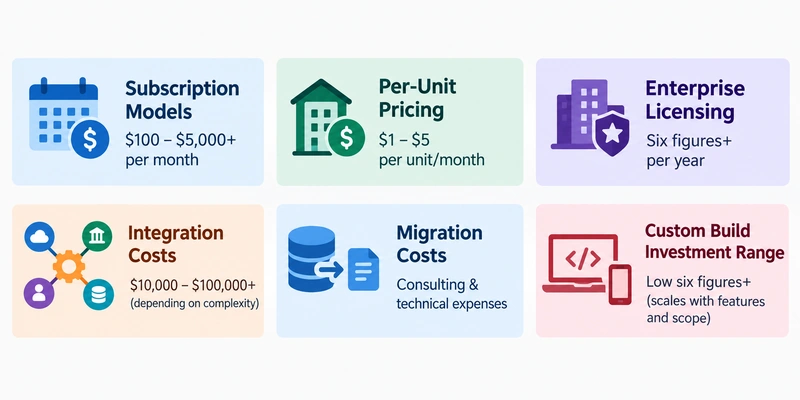
One of the biggest misconceptions in PropTech is that software pricing is simple. It isn’t. The real cost goes far beyond the advertised monthly subscription.
Subscription Models:
Most SaaS platforms operate on monthly or annual subscription pricing. For small portfolios, this can range from a few hundred to a few thousand dollars per month, depending on feature access and support tiers.
Per-Unit Pricing:
Many providers charge per unit (e.g., per apartment or property). Typical pricing can range from $1–$5 per unit monthly. For a 5,000-unit portfolio, even a $2 difference significantly impacts annual operating expenses.
Enterprise Licensing:
Enterprise-grade platforms often use custom licensing structures. Pricing may include base platform fees, module add-ons (accounting, CRM, analytics), and advanced AI features. Costs can reach six figures annually for large portfolios.
Integration Costs:
API integrations with ERP systems, banking gateways, CRMs, and smart building technologies often require additional development fees. These may range from $10,000 to $100,000+, depending on complexity.
Migration Costs:
Data migration from legacy systems is frequently underestimated. Cleaning historical data, restructuring accounting records, and onboarding teams can involve consulting and technical expenses.
Custom Build Investment Range:
For enterprise firms, custom platform development typically begins in the low six-figure range and scales depending on scope, AI functionality, mobile apps, and multi-region compliance features.
Transparent cost evaluation builds trust — and prevents unpleasant surprises during implementation.
How to Choose the Right System (Strategic Framework)
Selecting the right real estate software system requires strategic alignment — not feature comparison alone. Below is a practical decision matrix used by experienced portfolio operators.
1. Portfolio Size
-
Under 500 units → SaaS platforms may suffice.
-
500–5,000 units → Scalable SaaS with integration capability.
-
5,000+ units → Enterprise or custom solutions likely required.
2. Geographic Reach
-
Single-country portfolio → Standard compliance modules may work.
-
Multi-country operations → Evaluate data residency, tax frameworks, and regulatory adaptability.
3. Compliance Requirements
-
Does your jurisdiction require digital contracts?
-
ESG reporting?
-
Data protection mandates?
Ensure the system aligns with local regulations.
4. Tenant Demographics
-
Are tenants digitally native?
-
Do they expect mobile-first communication?
-
Is community engagement central to your brand?
Tenant expectations directly influence platform requirements.
5. Data Strategy
-
Are you using data for predictive decision-making?
-
Do you require AI-driven forecasting?
-
Is investor reporting automated?
If data is strategic, choose platforms with advanced analytics.
6. Long-Term Scalability
-
Can the system scale 3–5 years ahead?
-
Are APIs open and flexible?
-
Is data export possible if you need to pivot?
Practical Checklist Before Final Decision:
- Confirm total cost of ownership
- Validate API documentation and integration limits
- Assess compliance certifications
- Request data portability guarantees
- Evaluate implementation support
- Test user experience for both staff and tenants
- Technology should not merely support growth — it should accelerate it.
Strategic Conclusion
Real estate companies that treat software as infrastructure will outperform those who treat it as an expense.
Over the past two decades, we’ve seen a clear pattern: firms that invest strategically in digital architecture consistently achieve higher occupancy rates, stronger tenant retention, improved operational margins, and better investor confidence. Technology is no longer a support function — it is the operating system of modern real estate.
Digital transformation is not about adopting more tools. It’s about building intelligent integration across leasing, accounting, analytics, tenant engagement, compliance, and asset performance. When systems communicate seamlessly, decision-makers gain real-time visibility, predictive insights, and operational control at scale.
For some organizations, this means selecting a powerful SaaS platform with strong API capabilities. For others — particularly enterprise portfolios, multi-country operators, or innovation-driven developers — it may require customization beyond off-the-shelf limitations.
This is where collaboration with an experienced mobile app development company and a forward-thinking software development company becomes strategic. The right technology partner helps architect scalable PropTech ecosystems, integrate AI capabilities, ensure compliance readiness, and future-proof your portfolio operations.
In 2026 and beyond, the competitive advantage will belong to those who build digital foundations — not just digital workflows.