
Quick Answer: AI Chatbot Cost in UAE
The cost to build an AI chatbot in the UAE typically ranges from AED 150,000 to AED 1,470,000 (approximately $40,000 to $400,000), depending on the level of intelligence, integrations, and deployment scale.
A basic rule-based chatbot sits at the lower end, while advanced AI-powered systems using LLMs and real-time integrations fall at the higher end. The final cost is primarily influenced by factors such as chatbot complexity, backend system integrations, multilingual capabilities, and the type of AI model used.
Why UAE Businesses Are Investing in AI Chatbots
Across the UAE, businesses are not adopting AI chatbots as a trend—they are responding to a fundamental shift in how customers expect to interact with brands. From Dubai’s fast-paced retail ecosystem to Abu Dhabi’s government services, the demand for instant, intelligent communication has redefined customer experience standards.
Rising Customer Expectations
Customers in the UAE expect immediate responses, regardless of time or channel. Delayed replies often result in lost opportunities, especially in competitive sectors like real estate, e-commerce, and hospitality. AI chatbots address this gap by delivering real-time responses, ensuring that businesses remain accessible 24/7 without delays.
Multilingual Demand (Arabic and English)
The UAE’s diverse population makes bilingual communication essential rather than optional. Businesses must serve both Arabic and English-speaking audiences seamlessly. However, Arabic language processing introduces technical complexity due to dialect variations and linguistic structure. AI chatbots equipped with advanced natural language processing can handle these nuances, making them a strategic investment for companies operating in the region.
WhatsApp and Omnichannel Communication
Platforms like WhatsApp, mobile apps, and websites have become primary communication channels for customers. Businesses are expected to maintain consistent conversations across all these touchpoints. AI chatbots enable unified communication by integrating with multiple platforms, allowing users to start a conversation on one channel and continue it on another without disruption.
This omnichannel capability is a key reason why organizations are increasingly exploring advanced ai applications to streamline customer engagement and operational workflows.
Cost Efficiency Compared to Human Support
Scaling human support teams comes with linear costs—more queries require more agents, more infrastructure, and more management. In contrast, AI chatbots scale efficiently. Once deployed, they can handle thousands of conversations simultaneously without a proportional increase in cost.
For many UAE businesses, this shift is not just about automation but about optimizing operational efficiency. By reducing dependency on large support teams, companies can reallocate resources toward higher-value tasks such as customer relationship management and business growth.
AI Chatbot Cost Breakdown (With Pricing Table)
Understanding the cost of an AI chatbot in the UAE requires more than just a price range. The real difference lies in the type of chatbot architecture, its intelligence level, and how deeply it integrates with business systems.
Below is a clear breakdown to help you evaluate where your requirement fits.
|
Chatbot Type |
Cost (AED) |
Best For |
|
Rule-Based Chatbot |
AED 150,000 – 275,000 |
FAQs, basic customer support, simple workflows |
|
NLP-Based AI Chatbot |
AED 275,000 – 735,000 |
Customer service automation, CRM integration, multilingual support |
|
LLM + RAG Chatbot |
AED 735,000 – 1,470,000 |
Enterprise automation, real-time data access, complex workflows |
Rule-Based Chatbots
These are the most basic form of chatbots, operating on predefined decision trees and keyword-based responses. They are suitable for handling repetitive queries such as FAQs or basic navigation support.
However, they lack contextual understanding and cannot handle dynamic conversations. This makes them cost-effective but limited in scalability and user experience.
NLP-Based AI Chatbots
Natural Language Processing (NLP) chatbots introduce intelligence into conversations. They can understand user intent, extract relevant information, and maintain context across multiple interactions.
These systems are commonly used in industries like e-commerce, healthcare, and real estate, where conversations go beyond simple queries. Integration with CRM or ERP systems adds further value but also increases development cost.
LLM + RAG Chatbots (Enterprise-Grade)
This is the most advanced category, leveraging Large Language Models (LLMs) combined with Retrieval-Augmented Generation (RAG). These chatbots can generate human-like responses, access enterprise knowledge bases in real time, and handle complex workflows.
They are designed for high-scale environments such as banking, telecom, and government platforms. While the upfront investment is higher, they deliver significantly better performance, automation depth, and long-term ROI.
The key takeaway is that chatbot pricing is not driven by the interface users see. It is defined by the backend intelligence, system integrations, and scalability requirements.
AI Chatbot Cost Calculator (Estimate Your Budget)
One of the most common questions businesses ask is not just “how much does it cost,” but “how much will it cost for my specific use case.”
To answer that, you need a structured way to estimate your investment.
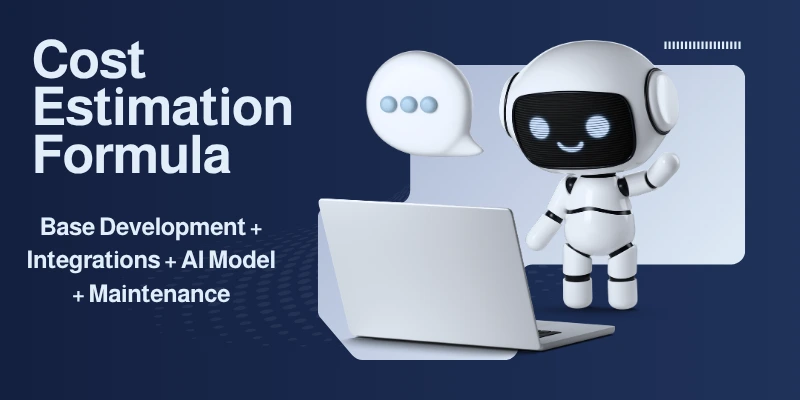
Cost Estimation Formula
Estimated Cost =
Base Development + Integrations + AI Model + Maintenance
Each component contributes differently depending on the scale and complexity of your project.
1. Base Development
This includes core chatbot design, conversation flow creation, UI/UX, and initial deployment.
- Basic chatbot: AED 80,000 – 150,000
- AI chatbot: AED 150,000 – 300,000
- Enterprise chatbot: AED 300,000+
2. Integrations
This is where costs can increase significantly. Integrating with CRM, ERP, payment gateways, or internal systems requires secure APIs and data orchestration.
- Minimal integrations: AED 20,000 – 80,000
- Moderate integrations: AED 80,000 – 250,000
- Complex enterprise integrations: AED 250,000+
3. AI Model Costs
The choice of AI model directly impacts both development and operational costs.
- Rule-based logic: Low cost
- NLP models: Moderate cost (training + tuning)
- LLM integration (API or custom): High cost (usage + infrastructure)
4. Maintenance and Scaling
Post-deployment costs include hosting, updates, monitoring, and performance optimization.
- Monthly maintenance: AED 5,000 – 25,000+
- Scaling costs increase with traffic and usage
Budget Estimation by Business Size
Small Business (Basic Automation)
- Use case: FAQs, lead capture
- Estimated cost: AED 150,000 – 300,000
- Focus: Simple workflows with minimal integrations
Mid-Level Business (Operational Automation)
- Use case: Customer support, CRM integration
- Estimated cost: AED 300,000 – 800,000
- Focus: NLP-based chatbot with multilingual support
Enterprise (Advanced AI Systems)
- Use case: End-to-end automation, real-time workflows
- Estimated cost: AED 800,000 – 1,470,000+
- Focus: LLM + RAG architecture with deep integrations
This calculator framework gives you a practical way to evaluate your chatbot investment before starting development. Instead of relying on generic estimates, businesses can align their budget with actual operational needs, ensuring better cost control and long-term scalability.
8 Key Factors That Affect AI Chatbot Cost
The cost of building an AI chatbot in the UAE is not determined by a single variable. Two chatbots may look identical on the front end but differ significantly in cost due to backend architecture, intelligence level, and compliance requirements.
Below are the core factors that directly influence pricing, along with real-world implications.
Chatbot Type (Rule-based vs AI vs LLM)
The type of chatbot sets the foundation for cost.
A rule-based chatbot follows predefined flows and works well for simple FAQs. It is affordable but limited in handling real conversations. An NLP-based chatbot introduces intent recognition and context handling, increasing both capability and cost.
LLM-powered chatbots go a step further by enabling dynamic responses, reasoning, and real-time knowledge retrieval. These systems require advanced infrastructure and significantly higher investment.
Cost impact example:
A real estate firm using a rule-based chatbot for lead capture may spend under AED 250,000. However, if they upgrade to an LLM-powered chatbot that qualifies leads and integrates with CRM systems, the cost can exceed AED 800,000.
AI Model Selection (API vs Custom)
Choosing between API-based models and custom-built AI models has long-term cost implications.
API-based models (such as third-party LLM APIs) reduce development time and upfront costs but introduce ongoing usage charges. Custom models require higher initial investment due to training and infrastructure but offer better control and cost stability at scale.
Cost impact example:
A startup may initially spend less using API-based AI, but as user interactions grow, token usage costs can surpass the cost of maintaining a custom model.
Integration Complexity
Chatbots rarely operate in isolation. Their value increases when connected to business systems like CRM, ERP, payment gateways, or booking engines.
The more systems involved, the higher the complexity and cost due to API development, data mapping, authentication, and real-time synchronization.
Cost impact example:
An e-commerce chatbot integrated only with a website may cost under AED 300,000. The same chatbot integrated with inventory systems, payment gateways, and logistics APIs can double the cost.
Multilingual Support (Arabic NLP)
In the UAE, supporting both Arabic and English is often essential. Arabic NLP is significantly more complex due to dialect variations, grammar structure, and right-to-left formatting.
This requires additional dataset preparation, model training, and testing cycles.
Cost impact example:
Adding Arabic support to an existing chatbot can increase development cost by 20% to 40%, depending on the depth of language processing required.
Deployment Channels
The number of platforms where the chatbot operates also affects cost.
A chatbot deployed only on a website is relatively simple. However, adding channels like WhatsApp, mobile apps, Facebook Messenger, or IVR systems introduces additional development and integration layers.
Cost impact example:
A single-channel chatbot may cost AED 200,000, while a fully omnichannel solution can exceed AED 600,000 due to platform-specific requirements.
UI/UX and Conversational Design
A chatbot’s success depends heavily on how conversations are structured. Poor conversational design leads to user frustration, lower engagement, and higher retraining costs.
Designing effective flows, fallback mechanisms, and human handover systems requires expertise and time.
Cost impact example:
Investing an additional AED 50,000 to AED 100,000 in conversational design can significantly reduce long-term maintenance and improve conversion rates.
Data Training and Optimization
AI chatbots rely on high-quality training data. This includes collecting, cleaning, labeling, and structuring datasets to improve accuracy.
Post-deployment, continuous optimization is required to maintain performance as user behavior evolves.
Cost impact example:
Initial data preparation and training can add AED 50,000 to AED 200,000 to the project, with ongoing optimization costs over time.
Security and UAE Compliance
In the UAE, compliance with data protection regulations and hosting requirements is critical, especially in sectors like banking, healthcare, and government.
Security measures such as encryption, access control, audit logging, and local cloud hosting increase both development and infrastructure costs.
Cost impact example:
Deploying a chatbot with UAE-based cloud hosting and compliance layers can increase total cost by 15% to 30% compared to a standard deployment.
Hidden Costs of AI Chatbot Development
While most businesses focus on initial development costs, the total cost of ownership extends far beyond launch. Understanding hidden costs helps prevent budget overruns and ensures long-term sustainability.
API Token Costs
For chatbots powered by LLM APIs, every interaction consumes tokens. As user volume increases, these costs can grow rapidly.
How to reduce this cost:
Optimize prompts, limit unnecessary responses, and implement caching for repeated queries.
Cloud Hosting (UAE Region)
Hosting in UAE-based cloud regions is often required for compliance. However, it comes with higher infrastructure costs, including compute, storage, and bandwidth.
How to reduce this cost:
Use auto-scaling efficiently, optimize database queries, and avoid over-provisioning resources.
Maintenance and Updates
Chatbots require continuous updates to remain effective. Changes in business processes, user behavior, and system integrations demand regular maintenance.
How to reduce this cost:
Build modular architecture and automate monitoring to minimize manual intervention.
Scaling Costs
As chatbot usage grows, infrastructure and API usage costs increase. High-traffic applications, especially in retail or fintech, can see significant scaling expenses.
How to reduce this cost:
Design scalable architecture from the beginning and use hybrid AI models to balance performance and cost.
Industry-Wise AI Chatbot Cost in UAE
The cost of AI chatbot development varies significantly across industries, not because of the industry itself, but because of the level of integration, data sensitivity, and workflow complexity involved.
|
Industry |
Cost Range (AED) |
Complexity |
|
Healthcare |
AED 700,000 – 1,470,000 |
High (EMR integration, compliance, patient data security) |
|
Fintech |
AED 600,000 – 1,300,000 |
High (secure transactions, identity verification) |
|
E-commerce |
AED 300,000 – 800,000 |
Medium (order tracking, payment integration) |
|
Real Estate |
AED 250,000 – 600,000 |
Medium (lead management, CRM integration) |
|
Retail |
AED 250,000 – 650,000 |
Medium (POS systems, customer engagement) |
Real-World Context
In healthcare, chatbots must integrate with electronic medical records and comply with strict data privacy standards, making them more expensive. Fintech solutions require secure APIs and fraud detection mechanisms, adding to complexity.
On the other hand, e-commerce and retail chatbots focus more on customer interaction, order tracking, and scalability during high traffic periods. Real estate chatbots are often optimized for lead generation and CRM synchronization, making them relatively less complex but still integration-heavy.
The key takeaway is that cost is driven by what the chatbot needs to do behind the scenes, not just the industry it serves.
ROI of AI Chatbots: Is It Worth the Investment?
For most UAE businesses, the real question is not the development cost—it is whether the investment delivers measurable returns. In practice, AI chatbots generate ROI through a combination of cost reduction, revenue growth, and operational efficiency.
Cost Savings
Customer support is one of the largest operational expenses for growing businesses. A significant portion of support queries are repetitive—order status, booking confirmations, account access, and general inquiries.
AI chatbots automate these interactions, reducing the workload on human agents.
Impact:
- Reduced dependency on large support teams
- Lower hiring and training costs
- Faster resolution times
In high-volume industries like e-commerce and hospitality, businesses often reduce support costs by 30% to 50% within the first year.
Conversion Increase
Speed plays a critical role in conversions. When a potential customer makes an inquiry, the likelihood of conversion decreases with every minute of delay.
AI chatbots respond instantly, qualify leads, and guide users through decision-making.
Impact:
- Higher lead engagement
- Reduced drop-offs
- Improved sales conversion rates
For example, real estate and service-based businesses in the UAE often see a 20% to 40% increase in qualified leads when chatbots handle initial interactions.
24/7 Availability Without Linear Costs
Unlike human teams, chatbots operate continuously without requiring shifts, overtime, or additional staffing.
This is especially valuable in the UAE, where businesses serve both local and international customers across time zones.
Impact:
- Continuous customer engagement
- No missed opportunities outside business hours
- Scalable support without proportional cost increase
Payback Timeline
In most practical deployments, AI chatbot investments begin to show measurable returns within 6 to 12 months.
- High-traffic businesses (retail, e-commerce): Faster ROI (6–9 months)
- Mid-volume businesses: Moderate ROI (9–12 months)
- Low-volume or niche use cases: Longer ROI cycle
The speed of return depends on how deeply the chatbot integrates into business workflows.
ROI Formula
To evaluate the financial impact, businesses can use a simple ROI calculation:
ROI (%) = [(Total Benefits – Total Investment) / Total Investment] × 100
Where:
- Total Benefits include cost savings, additional revenue from conversions, and productivity gains
- Total Investment includes development cost, infrastructure, and maintenance
This structured approach helps decision-makers move beyond assumptions and evaluate chatbot investments based on measurable outcomes.
Real-World Use Case (Case Study Section)
To understand how these benefits translate into real results, consider a typical UAE-based service business that implemented an AI chatbot to optimize customer engagement.
Problem
The company was facing multiple operational challenges:
- High volume of repetitive customer inquiries
- Delayed response times leading to lost leads
- Increasing support team costs
- Inconsistent customer experience across channels
Despite investing in human support, the business struggled to scale efficiently.
Solution
The company implemented an AI-powered chatbot with the following capabilities:
- Automated handling of frequently asked questions
- Real-time lead qualification and routing
- Integration with CRM for customer data access
- Multilingual support (Arabic and English)
- Deployment across website and WhatsApp
The chatbot was designed not just as a support tool, but as a core part of the customer engagement process.
Results
Within the first 6 to 9 months, the business observed measurable improvements:
- Reduced support costs by 35%
- Increased qualified leads by 28%
- Improved response time from hours to seconds
- Achieved consistent 24/7 customer engagement
- Enhanced customer satisfaction due to faster resolutions
This demonstrates that when implemented correctly, AI chatbots do not just reduce costs—they directly contribute to revenue growth and operational efficiency.
Build vs Buy: SaaS vs Custom Chatbots
One of the most important decisions businesses face is whether to build a custom chatbot or use a SaaS-based platform. The right choice depends on your business goals, complexity, and long-term strategy.
|
Factor |
SaaS Chatbot |
Custom Chatbot |
|
Initial Cost |
Low |
High |
|
Deployment Time |
Fast |
Moderate |
|
Customization |
Limited |
Fully customizable |
|
Integration Capability |
Basic connectors |
Deep system integration |
|
AI Flexibility |
Vendor-defined |
Full control |
|
Scalability |
Cost increases with usage |
Built for scale |
|
Compliance (UAE) |
Limited control |
Fully compliant architecture |
|
Long-Term Cost |
Recurring subscription |
Lower at scale |
When to Choose SaaS Chatbots
SaaS platforms are suitable for:
- Small businesses with limited budgets
- Basic use cases such as FAQs or lead capture
- Minimal integration requirements
- Quick deployment needs
They offer a faster and more affordable entry point but come with limitations in customization and scalability.
When to Choose Custom Chatbots
Custom development is the better option when:
- The chatbot is central to business operations
- Deep integration with CRM, ERP, or payment systems is required
- Compliance and data control are critical
- Multilingual and advanced AI capabilities are needed
Custom chatbots provide long-term flexibility, better performance, and cost efficiency at scale.
Cost Comparison Over Time
While SaaS chatbots appear cost-effective initially, their subscription-based pricing increases with usage. Over time, especially in high-volume environments, these recurring costs can exceed the one-time investment of a custom solution.
Custom chatbots require higher upfront investment but offer:
- Lower per-interaction cost at scale
- Greater control over infrastructure and data
- Long-term cost predictability
For UAE enterprises and growing businesses, the decision often shifts toward custom development once chatbot usage becomes a core part of operations.
How to Reduce AI Chatbot Development Cost
AI chatbot development in the UAE can be a significant investment, but it does not have to be unnecessarily expensive. The key is making the right architectural and strategic decisions early in the process. Businesses that approach development with a clear roadmap often achieve better results at a lower cost.
Start with an MVP (Minimum Viable Product)
One of the most effective ways to control cost is to begin with a focused MVP. Instead of building a fully featured enterprise chatbot from day one, start with core functionalities such as FAQ automation or lead capture.
This approach allows you to:
- Validate real user behavior
- Identify high-impact use cases
- Avoid unnecessary development overhead
Once the chatbot proves its value, you can gradually expand its capabilities based on actual business needs rather than assumptions.
Use Hybrid AI Models
Not every interaction requires advanced AI. A hybrid approach combines rule-based logic with AI-driven responses, ensuring efficiency without overusing expensive AI models.
For example:
- Use rule-based flows for repetitive queries
- Use AI models for complex or open-ended conversations
This reduces dependency on high-cost LLM processing while maintaining a strong user experience.
Optimize Integrations
Integrations are often one of the largest cost drivers in chatbot development. Instead of connecting every system at once, prioritize integrations that directly impact business outcomes.
Focus on:
- CRM systems for lead management
- Payment or booking systems for transactions
- Essential APIs only
Avoid over-engineering by integrating non-critical systems in later phases.
Choose Scalable Architecture
A poorly designed system can become expensive to maintain and scale. Investing in a scalable architecture from the beginning helps control long-term costs.
Key considerations:
- Modular design for easy updates
- Cloud-based infrastructure with auto-scaling
- Efficient API management
This ensures that as your business grows, your chatbot scales without requiring major redevelopment.
Plan for Long-Term Cost Efficiency
Many businesses focus only on initial development cost and overlook long-term expenses. A well-planned strategy balances upfront investment with operational efficiency.
For a broader perspective on managing development budgets and future scalability, it is useful to understand trends in ai development cost in 2026, especially as AI technologies continue to evolve.
How to Choose the Right Development Partner

Selecting the right development partner is as important as defining the chatbot itself. A strong partner does not just build the system—they shape its architecture, scalability, and long-term performance.
Experience in AI and Real-World Deployments
A credible partner should have proven experience in building AI-driven systems, not just basic chatbots. This includes working with NLP models, LLM integrations, and real-world deployments.
Experience reduces risk and ensures that the solution is built with practical, production-level considerations.
Understanding of UAE Compliance and Data Regulations
In the UAE, compliance is not optional. Data residency, encryption standards, and access control requirements must be addressed from the beginning.
A reliable partner understands:
- Local data protection requirements
- Cloud hosting within UAE regions
- Security architecture for sensitive industries
Ignoring these factors can lead to increased costs and delays later.
Strong Integration Capability
The real value of a chatbot lies in its ability to connect with existing systems. Whether it is CRM, ERP, or payment gateways, seamless integration is critical.
An experienced partner will:
- Analyze your current tech stack
- Design secure API integrations
- Ensure real-time data synchronization
This prevents integration issues that often arise during later stages of development.
Deep AI Expertise
Not all development companies specialize in AI. Choosing a partner with strong AI expertise ensures that the chatbot is built using the right models, tools, and frameworks.
They should be able to:
- Recommend the right AI architecture
- Balance cost and performance
- Optimize models for accuracy and efficiency
Businesses evaluating options often compare multiple software development companies in uae, but the key differentiator is not just development capability—it is AI maturity.
Why Choose SISGAIN for AI Chatbot Development
When it comes to building AI chatbots that deliver real business value, SISGAIN focuses on more than just development. The approach is centered on creating scalable, intelligent systems that integrate seamlessly into business operations.
Proven Experience in AI Development
SISGAIN has extensive experience in building AI-driven solutions across industries. From intelligent automation to advanced conversational systems, the focus is on delivering production-ready solutions rather than experimental projects.
Strong Industry Expertise
Different industries require different approaches. SISGAIN understands the unique challenges of sectors such as healthcare, retail, fintech, and on-demand services.
This industry-specific knowledge ensures that each chatbot is aligned with real business workflows and user expectations.
Custom-Built Solutions
Every business has unique requirements, and SISGAIN builds chatbots accordingly. Instead of relying on generic templates, solutions are designed from the ground up to match specific operational needs.
This includes:
- Custom AI model selection
- Tailored integrations
- Scalable architecture
UAE-Focused Approach
Operating in the UAE requires a clear understanding of regional expectations. SISGAIN designs solutions with:
- Multilingual support (Arabic and English)
- Compliance with local data regulations
- Deployment on UAE-based cloud infrastructure
For businesses looking to implement scalable and future-ready solutions, exploring ai software development in uae provides a strong foundation for long-term success.
This approach ensures that the chatbot is not just a tool, but a strategic asset that drives efficiency, engagement, and growth.
Final Thoughts
AI chatbots are no longer a luxury—they are a strategic investment for businesses in the UAE aiming to scale efficiently, improve customer engagement, and reduce operational costs. Whether you are a startup looking to automate basic interactions or an enterprise aiming for advanced AI-driven conversations, the key lies in making informed decisions about technology, architecture, and development approach.
Understanding the cost structure, hidden expenses, and ROI potential allows you to build a solution that is not just functional, but profitable. From choosing the right chatbot type to selecting a reliable development partner, every decision directly impacts long-term success.
The businesses that succeed with AI are not the ones that spend the most—but the ones that invest smartly, start lean, and scale strategically.