
Enterprises across the UAE and global markets are moving beyond blockchain experiments and into full-scale production systems. Banks are tokenizing assets. Logistics firms are tracking cargo on-chain. Real estate developers are fractionalizing property. Governments are piloting digital identity platforms.
What once felt speculative is now operational.
For C-suite leaders and innovation heads, the conversation has shifted from “Should we explore blockchain?” to:
How do we build secure, compliant, revenue-generating blockchain systems that integrate with our enterprise stack?
That is where blockchain app development becomes a strategic capability—not a side project.
At SISGAIN, we work with organizations that want more than prototypes. They come to us to build production-grade platforms, navigate regulatory realities, and extract real ROI from distributed ledger systems.
This guide is written for enterprise decision-makers who are evaluating or already building blockchain applications at scale. You’ll learn:
-
Why corporations are investing in blockchain now
-
Which industries are gaining the most value
-
How to develop blockchain applications the right way
-
Cost, ROI, and governance models
-
UAE and global regulatory considerations
-
Mobile-first blockchain strategies
-
How to select a long-term technology partner
Why Enterprises Are Investing in Blockchain Applications
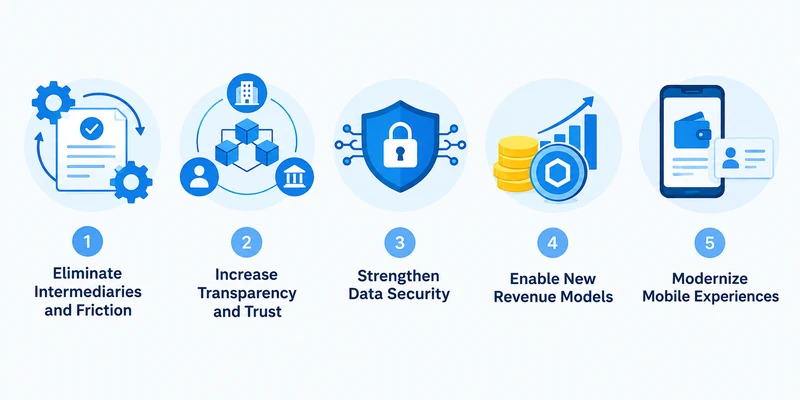
Enterprise adoption is driven by practical business outcomes—not hype.
Organizations pursuing blockchain applications development typically aim to:
1. Eliminate Intermediaries and Friction
Smart contracts automate settlements, approvals, escrow, and reconciliation. Processes that once took days can complete in minutes.
2. Increase Transparency and Trust
Shared ledgers give multiple parties—suppliers, banks, regulators—real-time access to the same immutable data.
3. Strengthen Data Security
Cryptographic signatures and distributed validation dramatically reduce tampering, fraud, and single-point failures.
4. Enable New Revenue Models
Tokenization, decentralized finance platforms, digital marketplaces, and NFT-based licensing open revenue streams that didn’t previously exist.
5. Modernize Mobile Experiences
Enterprises increasingly embed blockchain into consumer and workforce apps through blockchain in mobile app development, powering wallets, loyalty systems, digital IDs, and payments.
When executed correctly, developing blockchain software becomes a competitive differentiator—not just a technical upgrade.
When Blockchain Is (and Isn’t) the Right Choice
Not every system benefits from decentralization. A credible blockchain application development company should say so upfront.
Blockchain is usually justified when:
-
Multiple organizations need a shared system of record
-
Trust between participants is limited
-
Auditability is mandatory
-
Digital assets or tokens are involved
-
Automated settlement is valuable
-
Regulatory reporting is complex
It may not be ideal when:
-
Only one party controls all data
-
Transaction volume is extremely high and latency must be minimal
-
Data privacy rules prohibit replication
-
A traditional database can solve the problem cheaper
Enterprises in the UAE often favor hybrid architectures—combining permissioned blockchains with off-chain systems—to meet data residency and compliance requirements.
Enterprise Blockchain Adoption in UAE & Global Markets
The Middle East is emerging as a blockchain innovation hub.
In the UAE, regulatory sandboxes in DIFC and ADGM allow companies to test tokenization, digital asset custody, and payment systems under structured oversight. Saudi Arabia’s Vision 2030 programs similarly promote distributed ledger adoption across trade, logistics, and energy.
Globally:
-
EU: MiCA regulations govern crypto assets and service providers
-
US: evolving SEC and FinCEN guidance affects token issuance and DeFi
-
Asia: Singapore and Hong Kong lead enterprise pilots
For multinational organizations, building blockchain applications means designing governance, hosting, and identity frameworks that satisfy multiple jurisdictions simultaneously.
Types of Blockchain Applications Enterprises Are Building
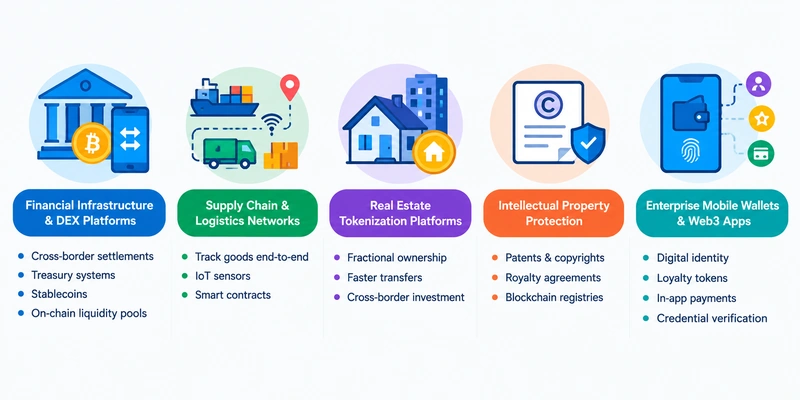
Financial Infrastructure & DEX Platforms
Banks and fintech firms deploy blockchain for cross-border settlements, treasury systems, stablecoins, and on-chain liquidity pools.
Many explore decentralized trading environments through Decentralized Exchange (DEX) platforms—often in partnership with regulated Fintech Software Makers and advisors focused on blockchain for fintech.
Supply Chain & Logistics Networks
Manufacturers and logistics groups track goods from factory to shelf using immutable ledgers, IoT sensors, and smart contracts.
This is a fast-growing area for enterprises working with Logistics and transportation application development companies to create tamper-proof provenance systems.
Real Estate Tokenization Platforms
Property developers tokenize commercial assets to enable fractional ownership, faster transfers, and cross-border investment—often supported by specialist Real Estate App Development teams.
Intellectual Property Protection
Media houses and R&D firms secure patents, copyrights, and royalty agreements using blockchain-based registries and licensing systems—an expanding category within Blockchain in Intellectual Property solutions.
Enterprise Mobile Wallets & Web3 Apps
Organizations increasingly create a blockchain app for:
-
digital identity
-
loyalty tokens
-
in-app payments
-
credential verification
This drives demand for secure blockchain mobile app development programs with biometric authentication, MPC key custody, and offline signing.
Why Enterprises Are Investing in Blockchain Applications
Enterprise adoption of blockchain is no longer driven by experimentation or speculative use cases. Today’s investments are rooted in measurable business outcomes—operational efficiency, regulatory resilience, new revenue generation, and ecosystem-level collaboration.
Across banking, logistics, energy, healthcare, and real estate, executive teams are funding blockchain applications development because traditional centralized systems are struggling to keep up with increasingly complex global operations, regulatory scrutiny, and digital-first customer expectations.
Organizations pursuing blockchain initiatives typically focus on five core value drivers:
1. Eliminating Intermediaries and Operational Friction
In many industries, transactions still rely on clearing houses, escrow agents, auditors, reconciliation teams, and manual approval chains. Each layer adds:
-
processing delays
-
operational costs
-
data inconsistencies
-
counterparty risk
By embedding business logic directly into smart contracts, enterprises can automate settlement, verification, royalty distribution, customs clearance, and compliance reporting.
For example:
-
a logistics consortium can release payments automatically once IoT sensors confirm delivery conditions
-
a real-estate platform can transfer ownership the moment escrow terms are met
-
a bank can settle cross-border trades without multiple correspondent institutions
What previously took days—or even weeks—can often be compressed into minutes or hours, freeing working capital and improving cash flow forecasting at scale.
2. Increasing Transparency, Auditability, and Partner Trust
Modern enterprises operate inside multi-party ecosystems involving suppliers, distributors, insurers, regulators, and financial institutions. Maintaining a single source of truth across these stakeholders is notoriously difficult.
Blockchain replaces fragmented databases with shared, immutable ledgers that record:
-
asset ownership
-
transaction histories
-
compliance events
-
document timestamps
-
supply-chain movements
This transparency reduces disputes, simplifies audits, and strengthens regulatory reporting—particularly valuable in jurisdictions like the UAE where financial services, logistics, and real estate operate under strict governance frameworks.
For executive teams, this translates into:
-
fewer reconciliation cycles
-
lower audit fees
-
faster regulatory approvals
-
improved investor confidence
Trust becomes embedded in infrastructure rather than enforced through paperwork.
3. Strengthening Security and Reducing Systemic Risk
Cybersecurity threats, insider fraud, data manipulation, and infrastructure outages cost enterprises billions annually. Traditional centralized systems remain vulnerable to single-point failures and unauthorized database access.
Blockchain-based systems distribute validation across multiple nodes and secure records through cryptographic signatures, making unauthorized alterations extraordinarily difficult.
When designed properly, enterprise blockchain architectures can:
-
prevent retroactive data tampering
-
detect anomalies instantly
-
limit insider access through role-based permissions
-
create immutable forensic trails for investigations
-
improve disaster recovery through distributed hosting
This is one of the primary reasons regulated sectors—banking, healthcare, energy, government—are increasingly prioritizing developing blockchain software within mission-critical workflows rather than limiting it to innovation labs.
4. Enabling New Digital Revenue Streams
Beyond efficiency, blockchain is unlocking entirely new business models.
Enterprises are monetizing digital infrastructure through:
-
asset tokenization for fractional investment
-
decentralized trading platforms
-
blockchain-based loyalty ecosystems
-
NFT licensing for intellectual property
-
programmable subscription models
-
digital escrow and settlement services
Real-estate groups are converting properties into liquid investment instruments. Media firms are automating royalty flows. Logistics providers are selling verified provenance data to insurers and retailers. Banks are launching tokenized funds and settlement rails.
These initiatives shift blockchain from a cost-center to a growth engine, which is why boards increasingly view blockchain investments through strategic-expansion lenses rather than purely IT budgets.
5. Modernizing Mobile-First Enterprise Experiences
As enterprises digitize frontline operations and customer engagement, mobile platforms have become the primary interface for blockchain systems.
Through blockchain in mobile app development, organizations deploy:
-
corporate digital wallets
-
on-site logistics scanning apps
-
biometric identity platforms
-
field-service verification tools
-
token-based loyalty programs
-
decentralized authentication systems
These mobile experiences allow employees, partners, and customers to interact with blockchain networks securely—without needing technical knowledge of wallets, nodes, or cryptography.
When paired with intuitive UX, offline signing capabilities, and enterprise authentication systems, blockchain mobile app development transforms distributed ledgers from back-office infrastructure into everyday operational tools.
From Experimental Technology to Strategic Advantage
When approached with governance, compliance, and long-term architecture in mind, developing blockchain software is no longer about chasing innovation headlines.
It becomes about:
-
shortening financial cycles
-
reducing compliance overhead
-
protecting digital assets
-
monetizing data
-
future-proofing platforms
-
building cross-industry ecosystems
For enterprises operating in competitive, regulation-heavy markets like the UAE, blockchain adoption is increasingly a board-level decision tied directly to growth strategy, digital transformation roadmaps, and shareholder value creation—not simply a technical upgrade.
Blockchain Architecture for Enterprise Systems
Modern enterprises do not run mission-critical operations entirely on public blockchains. Corporate IT environments are built around decades of ERP platforms, CRM systems, regulatory controls, and data-governance frameworks. As a result, most successful enterprise blockchain implementations follow layered, hybrid architectures that integrate decentralized networks with existing enterprise infrastructure.
Rather than replacing legacy systems, blockchain platforms typically act as a trusted coordination layer—synchronizing transactions, enforcing shared rules through smart contracts, and providing immutable audit trails across multiple organizations.
These enterprise-grade architectures are designed around five interconnected layers:
Public Networks for Settlement, Liquidity, and Token Issuance
Public blockchains are often used for functions that benefit from global accessibility and liquidity, such as:
-
asset tokenization
-
cross-border settlements
-
stablecoin payments
-
decentralized trading rails
-
NFT licensing
-
public auditability for regulators and investors
Because public chains provide strong security guarantees through large validator networks, enterprises frequently anchor final transaction states—or cryptographic proofs—on these networks while keeping sensitive business logic elsewhere.
This approach delivers transparency and settlement finality without exposing proprietary operational data.
Private and Consortium Chains for Confidential Operations
For workflows involving sensitive pricing models, supplier contracts, or regulated data, enterprises deploy permissioned blockchain networks operated by a known set of participants—such as banks, shipping companies, or government agencies.
These networks enable:
-
confidential transaction channels
-
role-based data visibility
-
faster throughput
-
predictable transaction costs
-
regulatory oversight nodes
-
governance voting frameworks
Consortium models are particularly effective in industries like trade finance, healthcare, energy trading, and real estate registries, where multiple organizations must collaborate without surrendering control to a single intermediary.
Off-Chain Data Stores for Scale, Privacy, and Compliance
Not all enterprise data belongs on a blockchain.
High-volume records, personal information, medical files, engineering drawings, and internal financial reports typically remain in traditional databases or encrypted storage systems. Blockchain is then used to store:
-
cryptographic hashes of documents
-
timestamp proofs
-
ownership references
-
transaction metadata
-
access logs
This design keeps systems compliant with data-residency laws and privacy regulations while ensuring that off-chain records cannot be altered without detection—an essential requirement for regulated jurisdictions.
Middleware and Integration Layers for Enterprise Platforms
A blockchain system delivers real value only when it connects seamlessly to core corporate software.
Middleware APIs and event-driven integration layers allow blockchain networks to communicate with:
-
SAP and Oracle ERP modules
-
Salesforce and CRM systems
-
supply-chain management platforms
-
payment gateways
-
banking rails
-
customs and compliance portals
These connectors translate blockchain events into enterprise workflows—triggering invoice creation, inventory updates, compliance checks, or settlement postings inside systems finance and operations teams already use daily.
This integration-first mindset is what transforms blockchain from an isolated innovation project into a production-grade enterprise platform.
Identity, Access Control, and Regulatory Governance Layers
Identity is central to enterprise adoption.
Blockchain architectures increasingly include decentralized identity frameworks, enterprise key-management systems, hardware security modules, and compliance engines that enforce:
-
Know-Your-Customer (KYC) and AML checks
-
role-based permissions
-
audit trails for regulators
-
revocable credentials
-
multi-signature transaction approvals
-
corporate wallet custody policies
These identity layers ensure that blockchain networks meet internal security standards while aligning with regulatory requirements across jurisdictions such as the UAE, Europe, and Asia-Pacific.
Why Hybrid Architectures Dominate Enterprise Deployments
Hybrid blockchain models—combining public, private, and off-chain components—have become the default choice for enterprises because they balance three competing demands:
-
decentralization and trust
-
data privacy and compliance
-
performance and cost control
They allow organizations to operate within regional regulations, protect proprietary information, and still benefit from distributed verification and shared infrastructure.
When architected correctly, these systems support scalability, governance, disaster recovery, and cross-border interoperability—making blockchain a sustainable long-term foundation rather than a siloed experiment.
Blockchain Mobile App Development for Enterprise Users
Mobile has become the primary interaction layer for enterprise blockchain platforms. Executives approve transactions on phones, field workers scan shipments in ports, brokers verify property deeds on tablets, and customers manage digital assets through secure wallets.
As a result, blockchain mobile app development is no longer consumer-centric experimentation—it is mission-critical enterprise infrastructure.
For global corporations and UAE-based organizations alike, blockchain in mobile app development enables real-time decision-making at the edge of operations while maintaining cryptographic security and regulatory oversight.
Where Enterprises Deploy Blockchain-Powered Mobile Apps
In large organizations, mobile blockchain interfaces are increasingly embedded into core workflows:
Digital Wallets and Treasury Tools
Corporate wallets allow finance teams to manage tokenized assets, stablecoins, escrow accounts, and settlement rails. Advanced implementations include multi-signature approvals, daily spending limits, and automated reconciliation with ERP systems.
Employee Identity and Credential Systems
Mobile apps store verifiable credentials for access control, certifications, visas, and training records—reducing paperwork while enabling instant compliance checks at physical and digital entry points.
Logistics and Field Operations Apps
Drivers, inspectors, and warehouse teams scan QR codes or IoT sensors that write shipment milestones to a blockchain ledger. This creates tamper-proof delivery records, reduces disputes, and accelerates insurance claims.
Property and Asset Dashboards
In real estate and infrastructure projects, mobile dashboards show tokenized ownership stakes, construction milestones, lease agreements, and regulatory filings—allowing stakeholders to track high-value assets from anywhere.
Loyalty and Customer Engagement Platforms
Retailers and airlines are adopting tokenized reward systems managed through mobile apps, where customers can earn, trade, or redeem points across partner ecosystems with transparent settlement logic.
What Makes Enterprise Blockchain Mobile Apps Different
Building consumer wallets is not the same as building blockchain applications for enterprise environments.
Enterprise-grade mobile platforms must satisfy security teams, compliance officers, auditors, and regulators—often simultaneously across multiple jurisdictions.
At SISGAIN-level delivery standards, developing blockchain applications for mobile requires rigorous engineering across several layers:
Advanced Authentication and Biometric Security
Enterprise apps rely heavily on:
-
fingerprint and facial recognition
-
device-level secure enclaves
-
trusted execution environments
-
multi-factor authentication
-
conditional access policies based on location or role
Private keys are never exposed to the application layer, and signing operations are isolated inside hardware-backed security modules wherever possible.
Key Management Through MPC and Hardware Wallets
Rather than storing keys on devices, enterprises increasingly deploy:
-
multi-party computation (MPC) custody systems
-
hardware wallets for executives and treasury staff
-
enterprise key-rotation policies
-
disaster-recovery signing shards
-
approval hierarchies for high-value transactions
These models reduce insider risk while meeting institutional custody requirements for regulated financial operations.
Transaction Governance and Approval Workflows
Enterprise mobile apps embed configurable approval chains:
-
dual or triple sign-off for payments
-
compliance review stages
-
spending thresholds
-
real-time risk scoring
-
automated sanctions screening
Smart contracts enforce these workflows before transactions are broadcast—ensuring governance is coded directly into operational processes.
Offline Signing and Intermittent Connectivity
In logistics yards, construction sites, and maritime ports, connectivity cannot be assumed.
Enterprise blockchain mobile apps therefore support:
-
offline transaction signing
-
queued broadcasts
-
cryptographic timestamping
-
sync-on-reconnect models
-
tamper-resistant event logs
This enables field teams to continue operations even in low-connectivity environments while preserving data integrity.
Audit Trails, Monitoring, and Regulatory Reporting
Every action performed inside an enterprise mobile app—logins, approvals, document signatures, wallet transfers—is logged immutably.
Integrated analytics layers generate:
-
regulatory compliance reports
-
SOC and ISO audit packages
-
transaction provenance records
-
dispute-resolution evidence
-
AML and KYC dashboards
For UAE enterprises operating under evolving digital-asset frameworks, these built-in controls are essential for production deployment rather than pilot projects.
Why Enterprises Partner with Specialist Mobile Development Firms
Because of the complexity involved, most organizations collaborate with experienced Mobile Application development companies that understand both cryptography and enterprise UX.
Successful blockchain mobile platforms demand:
-
secure mobile SDKs
-
hardened API gateways
-
penetration-tested architectures
-
accessibility-compliant interfaces
-
performance optimization for cryptographic workloads
-
regulatory-aware user flows
The difference between a prototype and a globally scalable product lies in disciplined mobile engineering, governance-first design, and continuous security validation.
Security, Governance & Compliance Framework
Security is not optional—it is existential.
Production-ready blockchain programs require:
-
formal smart-contract audits
-
penetration testing
-
SOC 2 and ISO alignment
-
encryption at rest and in transit
-
role-based access
-
AML/KYC integrations
-
node monitoring
-
disaster recovery
In regulated sectors, governance councils and legal oversight become just as important as technical architecture.
Cost of Blockchain App Development for Enterprises
Enterprise blockchain initiatives vary dramatically in scope—from internal pilots validating process automation to multi-country production platforms involving banks, regulators, mobile workforces, and consumer applications.
While proof-of-concept systems may be delivered for tens of thousands of dollars, enterprise-scale deployments that include multi-party networks, security audits, compliance tooling, and mobile interfaces frequently exceed six-figure budgets and can grow further as ecosystems expand.
For procurement teams and CTOs, the key is understanding where investment is concentrated and how costs evolve from experimentation to full production rollout.
Primary Cost Drivers in Enterprise Blockchain Programs
Smart Contract Complexity and Formal Verification
Advanced logic for escrow, asset tokenization, automated settlements, or regulatory enforcement requires specialized engineering, simulation environments, and formal audits—significantly increasing development timelines and budgets.
Network Selection and Governance Models
Public blockchains involve gas-optimization engineering and treasury planning, while private or consortium networks require infrastructure provisioning, validator coordination, governance tooling, and disaster-recovery setups.
Mobile and Front-End Integration
Enterprise-grade mobile applications—especially those supporting wallets, biometrics, offline signing, and approval chains—often represent a major portion of overall spend, particularly when supporting both iOS and Android with hardened security layers.
Third-Party Systems and API Connectivity
Integration with banking rails, KYC providers, ERP platforms, IoT devices, payment gateways, and compliance engines adds both licensing costs and engineering effort.
Security Audits and Regulatory Certifications
Penetration testing, smart-contract audits, SOC 2 readiness, ISO compliance, and regional regulatory reviews are essential for production deployment and must be budgeted as recurring—not one-time—expenses.
Cloud Hosting and Node Operations
Running validator nodes, monitoring systems, backup infrastructure, log aggregation, and analytics pipelines across multiple geographies generates ongoing operational costs that increase with transaction volume.
Why Enterprises Treat Blockchain as a Strategic Program
Organizations pursuing long-term adoption rarely frame blockchain as a single IT project.
Instead, developing blockchain software becomes part of a broader digital-transformation roadmap—similar to ERP rollouts or cloud migration initiatives. These programs typically involve:
-
multi-year funding horizons
-
phased rollouts across departments
-
ecosystem onboarding strategies
-
governance councils and steering committees
-
vendor-management frameworks
-
internal capability development
This strategic framing allows enterprises to scale responsibly while aligning innovation with regulatory readiness and business priorities.
ROI Modeling: How Enterprises Measure Blockchain Success
The most successful blockchain initiatives begin with financial and operational KPIs defined before development starts.
CFOs and strategy teams increasingly require quantified business cases that demonstrate how building blockchain applications improves margins, reduces risk, or unlocks new revenue streams.
Operational Efficiency Metrics
Enterprises track improvements such as:
-
reduction in settlement and reconciliation cycles
-
faster invoice processing
-
automated compliance workflows
-
lower manual intervention rates
-
reduced cross-border payment delays
-
improved data-sharing between partners
Risk Mitigation and Fraud Prevention
Distributed ledgers and cryptographic verification are measured against:
-
fraud losses prevented
-
duplicate payment elimination
-
counterfeit-goods detection
-
dispute-resolution time reductions
-
insurance claim accuracy
-
cybersecurity incident frequency
Compliance and Audit Cost Savings
In regulated sectors, blockchain platforms can materially reduce audit overhead by providing immutable transaction trails and real-time reporting.
Typical metrics include:
-
external audit hours reduced
-
regulatory reporting cycle compression
-
compliance staffing efficiencies
-
documentation retrieval time
-
fines and penalty avoidance
Supply Chain and Asset Utilization Improvements
Logistics, manufacturing, and real-estate enterprises monitor:
-
inventory turnover ratios
-
shrinkage reduction
-
port dwell-time improvements
-
asset-tracking accuracy
-
equipment utilization rates
-
faster ownership transfers
Digital Revenue and Platform Growth
Forward-looking organizations also track new commercial outcomes:
-
transaction-fee revenue from marketplaces
-
tokenized-asset trading volumes
-
loyalty-platform engagement
-
secondary-market participation
-
new partner onboarding rates
-
customer lifetime value
Trust and Brand Metrics
Because blockchain impacts ecosystem confidence, enterprises increasingly measure:
-
customer trust scores
-
partner satisfaction indices
-
regulator feedback cycles
-
dispute frequency
-
onboarding friction reduction
Executive Dashboards and Data-Driven Governance
Leading enterprises consolidate these KPIs into executive dashboards that correlate blockchain adoption directly with business performance.
These dashboards typically integrate:
-
on-chain analytics
-
ERP financial reports
-
compliance systems
-
operational telemetry
-
customer engagement platforms
This data-driven governance approach ensures blockchain programs remain accountable, scalable, and aligned with corporate strategy—rather than remaining isolated innovation labs.
Technology Stack Powering Modern Blockchain Systems
Blockchain becomes exponentially more valuable when integrated with:
-
AI for fraud detection and forecasting
-
IoT for supply-chain sensors
-
Cloud platforms for scalability
-
Big data analytics for insights
-
5G for real-time logistics
-
Edge computing for factory systems
These convergences are redefining what enterprises can achieve with distributed systems.
Common Enterprise Pitfalls—and How SISGAIN Avoids Them
Many early blockchain programs failed because of:
-
unclear governance
-
regulatory blind spots
-
vendor lock-in
-
scalability limits
-
poor mobile UX
-
under-audited contracts
As an experienced IT Software development company, SISGAIN emphasizes long-term maintainability, compliance-first design, and modular architectures that grow with your business.
Organizations evaluating any blockhain application development company should look for these qualities.
How to Choose the Right Blockchain Partner
Enterprise buyers should assess:
-
regulated-industry experience
-
security certifications
-
regional compliance knowledge
-
mobile development maturity
-
scalability references
-
post-launch support
Many global firms work with multiple Mobile Application development companies and Fintech Software Makers, but long-term success usually comes from consolidating around a strategic partner who understands both technology and business transformation.
The SISGAIN Perspective: Building Production-Grade Blockchain
At SISGAIN, we don’t just code distributed ledgers—we help enterprises design future-ready digital ecosystems.
Our teams work across finance, logistics, real estate, healthcare, and public-sector transformation to build blockchain applications that integrate seamlessly with enterprise systems, comply with regional regulations, and scale globally.
If your organization is exploring blockchain applications development, planning to build a blockchain app, or preparing to modernize operations through decentralized systems, our consultants are ready to help you turn strategy into execution.