
Dubai’s extraordinary mobile penetration (228 devices per 100 people) and a 92% expatriate populace create fertile ground for on-demand services. The emirate’s tech-savvy market – home to over 13,000 restaurants (~60% of UAE’s eateries) – has fueled rapid growth in delivery apps. Leading platforms like Talabat (handling roughly 75% of orders) and global players such as Deliveroo and Careem underscore the region’s appetite for digital food services. In this dynamic environment, businesses hire specialized Dubai-based developers to stay competitive and compliant. Businesses looking to launch scalable delivery platforms often work with a Mobile App Development Company in Dubai that understands regional compliance, multilingual experiences, and high-volume transaction architectures. For example, Dubai’s Food Apps ecosystem demands Arabic/English UX and local payment integration.
Dubai’s On-Demand Boom: The UAE’s online food delivery market is booming – projected to reach about $3.9 billion by 2030. High smartphone use means over 70% of orders are placed via mobile. As a result, dozens of Mobile App Development Companies in Dubai have carved niches helping restaurants and startups tap into this growth. Our guide compares the top 12 such companies, detailing expertise, pricing, and why each stands out.
Why Choosing the Right Food Delivery App Development Company Matters
In Dubai's competitive digital economy, Mobile App Development Matters in Dubai because customer expectations around speed, personalization, and user experience continue to rise across every on-demand sector. Before you pick a vendor, it’s crucial to understand the unique challenges of the Dubai market. First, scalability is non-negotiable: delivery volumes spike during Ramadan and peak summer, with platforms seeing nearly 30% sales jumps in those months. Only robust systems (backend servers, cloud infrastructure) can handle those surges without downtime.
Second, UAE compliance and localization are essential. The UAE enforces strict digital content and data regulations (e.g. via TDRA) – non-compliant apps risk being blocked. Leading developers ensure apps support right-to-left Arabic text, dual-language interfaces, and local payment gateways (e.g. Etisalat, Mashreq Pay). For instance, apps like Careem and Talabat invested heavily in Arabic UX and regional payment integration to win user trust. Choosing a Dubai-based firm means they already build these localizations in by default (learn more at App development company in UAE).
Long-term maintenance and updates are another critical factor. Mobile apps require ongoing support: without updates and bug fixes, even a great app can falter within months. Your development partner should offer regular version upgrades (for new iOS/Android releases) and security patches to keep the app reliable.
Finally, modern food apps increasingly rely on AI and analytics. Integrating machine learning for inventory forecasting, dynamic pricing, or fraud detection gives a competitive edge. Industry experts predict deeper adoption of AI-driven tools in food delivery: e.g. predictive analytics for stock and pricing. A qualified development company will not only build your app but also integrate these smart features from day one.
Choosing a seasoned Dubai food app developer ensures they handle all these aspects: scalable architecture, local regs, multi-language UX, plus advanced tech and support.These requirements highlight why selecting the right mobile app development partner is often more important than focusing solely on development costs.
Key Features Every Successful Food Delivery App Must Have in 2026
A top-tier food delivery platform has four parts (user app, restaurant portal, delivery app, and admin console). Each must be feature-rich to delight users and partners. Below are must-have features in 2026:
User App (Customer) Features
-
Restaurant Discovery & Smart Filters: Users can search nearby restaurants by location, cuisine, price range, or ratings. Advanced filters (geolocation, dietary options, popularity) help them find meals faster.
-
Real-Time Order Tracking: Once an order is placed, customers track it live on a map. The UI shows driver location and estimated arrival time, ensuring transparency.
-
Multiple Payment Options: Integrated payment gateways allow credit/debit cards, mobile wallets (Apple Pay, Google Pay) and cash-on-delivery, all within the app. Secure and varied payment methods reduce drop-offs.
-
Ratings & Reviews: Customers can rate restaurants, menu items and drivers, and read reviews from others. This social proof builds trust and helps improve service quality.
-
AI-Based Recommendations: Personalized dish and restaurant suggestions based on user order history and preferences. Modern apps use AI engines to surface relevant items, boosting upsell. (Research shows ~80% of users expect such personalized choices.)
Restaurant Portal Features
-
Menu & Pricing Management: Restaurants easily update menus, pricing, and item availability in real time. Bulk-edit tools let them add promotions or new dishes without code.
-
Order & Kitchen Workflow: Incoming orders are managed efficiently – the portal shows live order queues, and enables acceptance/fulfillment with one tap. Automated alerts help kitchen staff prepare efficiently.
-
Analytics Dashboard: Sales reports, order trends and peak-time analytics help restaurants make data-driven decisions. Real-time insights (e.g. top-selling items, busiest hours) guide staffing and menu updates.
-
Rating & Feedback: Restaurants see customer feedback and ratings on each order, allowing them to address issues and improve service over time.
Delivery Partner App Features
-
Smart Order Allocation: Orders are auto-assigned to drivers using algorithms (considering proximity, current workload and driver ratings). This optimizes delivery times and driver utilization.
-
Live GPS Navigation: Integrated maps (Google Maps, Waze) guide drivers turn-by-turn. Real-time traffic data is used to optimize routes, ensuring meals arrive hot and on time.
-
Earnings & Incentives Dashboard: Delivery staff can track their earnings, tips, and bonuses in-app. Gamification elements (badges for completing rides or earning high ratings) and clear pay breakdowns keep drivers motivated.
Admin Panel Features
-
Commission & Pricing Management: Admins set and adjust commission rates (per order or subscription), manage fees, and handle billing reports.
-
AI Fraud Detection: Advanced systems monitor for fake or fraudulent orders. ML algorithms flag unusual behavior (e.g. repeated cancellations or coupon abuse) to protect revenue.
-
Marketing & Promo Tools: The admin console lets the business create promo codes, flash deals and targeted campaigns. Segmentation (first-time users, high-value customers) enables efficient user acquisition and retention.
Each feature above ensures a seamless, secure and engaging experience. Together, they form a future-ready food delivery app that can thrive in Dubai’s competitive market.
Technology Stack Used by Top Food Delivery App Developers
Building modern food delivery platforms requires more than coding expertise. Businesses increasingly seek AI-Powered Mobile App Development capabilities to integrate recommendation engines, route optimization, demand forecasting, and intelligent customer engagement features from the initial development phase. Leading Dubai developers use proven, scalable tech to build delivery apps. The typical stack looks like this:
-
Frontend (Mobile/Web): For cross-platform mobile apps, frameworks like React Native or Flutter are popular (allowing a single codebase for iOS and Android). Some teams still use native (Swift/Kotlin) for maximum performance. Web portals often use React or Angular.
-
Backend: Server-side development in Node.js, Java, Go or .NET handles app logic and APIs. Common databases include PostgreSQL or MySQL for relational data, and MongoDB (or similar NoSQL) for flexible order data. Cloud-hosted microservices and REST/GraphQL APIs power the platform.
-
Cloud Infrastructure: Top providers AWS, Azure and Google Cloud are used for hosting servers, databases and storage. For example, AWS offers scalable EC2 instances and managed databases, while GCP or Azure deliver strong analytics services. Using cloud services ensures the app can grow elastically with demand.
-
Third-Party Integrations: Robust third-party tools are integrated: payment gateways (Stripe, local UAE gateways), push notification services (Firebase Cloud Messaging, OneSignal), and mapping APIs (Google Maps, Mapbox). Proper integration ensures reliability and localization.
-
AI/ML Integrations: Advanced apps include AI libraries for recommendations, predictive analytics and computer vision (for menu OCR). They may use ML models for demand forecasting or route optimization. Chatbots powered by NLP (AI Apps) handle basic customer inquiries.
-
Security & Compliance: Data encryption, secure authentication (OAuth2, JWT) and GDPR/UAE-compliant privacy measures are non-negotiable. Developers implement secure payment modules and apply local data-protection guidelines (as emphasized by UAE authorities).
In short, reliable technologies (React Native/Flutter, Node.js or Laravel/Django backends, MongoDB/PostgreSQL, AWS/Azure) combined with AI tools and strong security practices form the foundation of any top food delivery platform. This stack ensures your app is performant, extensible and compliant with UAE standards.
Cost to Build a Food Delivery App in Dubai (2026 Pricing)
The final budget often depends on the scope of Mobile App Development Solutions, integrations, scalability requirements, and long-term maintenance expectations. Understanding cost is vital. Industry data shows wide ranges depending on scope. A recent analysis finds: a basic MVP (single-restaurant app with core features) typically costs $20K–$40K. A mid-level app (multi-restaurant aggregator with tracking, reviews, promo codes) runs about $40K–$100K. An advanced platform (UberEats/Talabat-style, with separate delivery driver apps, personalized AI features and analytics) can exceed $80K–$250K+ globally.
Dubai-specific guides echo this scale in local currency. One Dubai consultancy notes that simple apps start around AED 25K–35K (~$7–10K), while enterprise-grade apps often exceed AED 80K (>$20K). In practice, expect full-featured food delivery platforms in Dubai to begin near AED 150K–250K (~$40K–$70K), depending on complexity. The exact price hinges on several factors:
-
Feature Set: Each feature adds to cost. Basic menu/payment/order features are cheap, but advanced ones (live GPS tracking, loyalty programs, AI recommendations) drive the price up. For example, integrating AI-based menu suggestions or route optimizers requires additional ML development.
-
Platforms: Developing native iOS and Android versions separately costs 20–30% more than a cross-platform Flutter/React app. Many clients start with one platform or use a cross-platform approach to save budget.
-
Backend & Integrations: Complex backend logic (real-time updates, third-party APIs like maps, SMS, local payment gateways) increases development hours. Cloud hosting and database costs scale with usage.
-
Design & UX: Custom animations, premium UX/UI design and branding can raise costs. A simple UI is cheaper, but rich, tailored interfaces demand more design time.
-
Maintenance & Support: Don’t forget post-launch costs. Ongoing server fees, bug fixes and feature updates typically run 5-20% of the initial budget per year.
MVP Strategy: Many businesses mitigate cost by launching an MVP app first – a stripped-down version to test the concept. This approach can cut initial spending and de-risk investment. User feedback from the MVP then guides which premium features to add next.
In summary, build estimates are: Basic MVP ($20–40K), Mid-tier ($40–100K), Full Enterprise ($80–250K+). Dubai’s costs follow similarly (AED 25K–80K+).
For detailed breakdowns, see our Cost to Develop an App in 2026 guide.
How We Ranked the Top Food Delivery App Companies in Dubai
We based our rankings on transparent criteria to ensure trust. Industry best practices advise checking experience and portfolio first. We prioritized companies with a proven history (typically 5+ years) in on-demand or restaurant app development. We closely examined each firm’s portfolio – successful past projects and case studies – to ensure they can deliver high-quality, similar solutions.
We also evaluated client reviews and testimonials. Positive feedback and high ratings on Clutch or Google Reviews indicate reliability. As Netguru notes, testimonials are “invaluable” for gauging a company’s track record. Firms with overwhelmingly satisfied clients scored higher.
Technical expertise was another key factor. We checked whether teams know the latest food-tech stack (React Native/Flutter, Node.js, cloud hosting) and advanced tools (AI/ML integration). Familiarity with the UAE market – including language, payment systems and local regulations – earned extra points. Finally, we looked for firms offering post-launch support and maintenance as standard; ongoing partnership potential is a must for long-term success.
By combining years of experience, portfolio strength, client satisfaction, technical mastery and local knowledge – in line with expert advice – we arrived at our list of the top Dubai food delivery app development companies.
List of 12 Food Delivery App Development Companies in Dubai
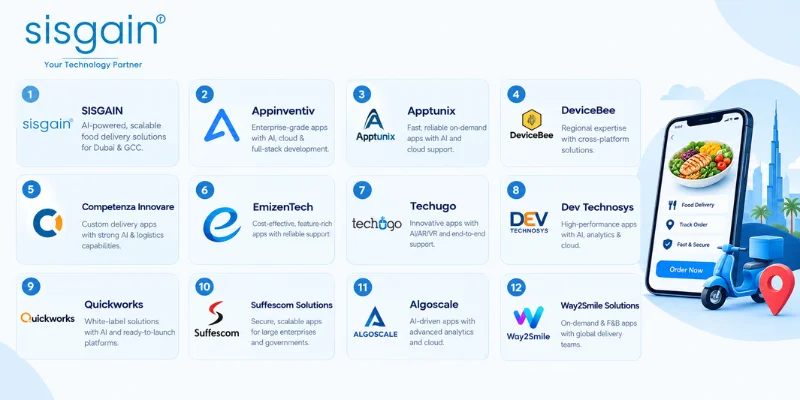
1. SISGAIN – Leading Food Delivery App Development Company in Dubai
Focus: Enterprise-grade food delivery solutions, AI-driven logistics, cloud-native architectures, and full-stack development. SISGAIN specializes in custom on-demand apps with advanced features like smart routing, dynamic menus and real-time analytics.
Services: End-to-end App development (iOS, Android, web), UI/UX design, AI/ML integration, QA/testing, and DevOps. They also handle app store deployment, localization (Arabic/English), and payment gateway setup.
Strengths: Deep domain expertise with a focus on Gulf markets. SISGAIN’s Dubai team prides itself on rapid delivery and scalable architecture. They leverage AI algorithms for route optimization and fraud prevention. Their developers have built Talabat-like aggregators, ensuring Talabat-class reliability. Known for transparent pricing and agile turnaround, they also offer robust post-launch support.
Best For: Large restaurants, delivery startups aiming for rapid scale, or enterprises needing a Talabat-style platform. SISGAIN is especially suited for clients that want cutting-edge AI features and full regulatory compliance.
Ready to get started? SISGAIN offers a free consultation and custom quote to kickstart your project.
2. Appinventiv (USA, Dubai & Global)
Appinventiv is a leading enterprise mobile app developer with a strong Middle East focus. Headquartered in New York with offices in Dubai and India, the firm excels in custom iOS/Android apps, cloud services, AI/AR integration and full-stack solutions. Its team has worked with major brands; notably, as part of the Americana Group, Appinventiv built and launched seven custom KFC food-delivery apps across the Middle East (UAE, KSA, Kuwait, Egypt, Qatar, Bahrain and Oman) within a year. They emphasize UX design, agile processes and mobile-first innovation. Key strengths include enterprise-grade scalability, a large in-house engineering team, and experience with high-traffic solutions. Appinventiv’s portfolio spans 3,000+ projects for clients like IKEA, Adidas and Edamama. Best for mid-size to large enterprises in retail, restaurant chains or on-demand services seeking full-featured, scalable food delivery apps. Their solutions often incorporate advanced features like order tracking, digital wallets and AI-driven recommendations. Website: appinventiv.com.
3. Apptunix (USA, Dubai)
Apptunix is a rapid-development specialist with a global footprint (headquartered in New York and UAE). It has a Dubai office at One Central Tower, DWTC and offers end-to-end mobile app development with AI, cloud and backend integration. The company emphasizes turnkey on-demand solutions and white-label platforms. For example, Apptunix built Expo City Eats, a food-delivery app tailored to Dubai’s Expo City, complete with real-time tracking and multi-restaurant ordering. They also developed India’s McDonald’s delivery app (boosting orders ~40%). Apptunix’s strengths are quick deployment, extensive library of pre-built modules, and deep experience in restaurant apps. The firm supports startups through enterprises with services from UI/UX design to cloud orchestration. Best suited for businesses seeking a fast, proven solution: from single restaurants to large chains, especially those wanting AI features (e.g. recommendation engines) and scalable AWS/GCP infrastructure. Website: apptunix.com.
4. DeviceBee (UAE, UK, Australia, Spain)
DeviceBee is a Dubai-based on-demand app boutique known for regional expertise. With headquarters in Dubai Outsource City and offices in Birmingham, Sydney and Madrid, they develop cross-platform mobile apps (React Native/Flutter) for restaurants, delivery and hyperlocal services. DeviceBee’s portfolio highlights include the ClickFood app (food & grocery delivery for UAE/Lebanon) and SaveMe (a food-delivery platform). They also created Sofra, a home-cooked meal ordering app in Dubai. Key differentiators are local market know-how, bilingual support, and a strong focus on end-to-end design (front-end, back-end, admin dashboards). They often build AI-driven features like route optimization and user personalization. Clients span startups to midsize chains in the GCC. DeviceBee is ideal for companies seeking Middle East specialists with on-demand delivery expertise, particularly SMEs that need cost-effective yet polished iOS/Android apps. Website: devicebee.com.
5. Competenza Innovare (UAE, India, Australia)
Competenza is a Dubai-headquartered technology firm (office at Dubai Digital Park) offering mobile and web development, cloud engineering and AI/ML solutions. The company serves a broad range of clients, claiming “1000+ enterprises and growing startups” in the GCC. Its on-demand delivery practice includes custom food-delivery and multi-vendor platforms. Competenza emphasizes high-performance apps tailored to Middle Eastern markets, with expertise in logistics, CRM integration and payment systems. They have worked on unified commerce projects (e.g., partnership with retail platform Fynd) and restaurant chain apps. Differentiators include full-stack development, strong machine-learning capabilities, and compliance with regional regulations (payment, invoicing). Competenza is suited for both startups and large enterprises looking for local presence and robust solutions. Its clients praise its technical expertise and project management. Website: competenza.ae.
6. EmizenTech (India, UAE)
Emizen Technologies has 12+ years’ experience building on-demand apps. With offices in Jaipur (India) and Ajman (UAE), EmizenTech delivers mobile solutions across food delivery, e-commerce and logistics. Its strengths lie in full-cycle development with competitive pricing. EmizenTech’s Clutch profile (4.9/5 rating) highlights its responsiveness and cost-effectiveness. The company offers Android, iOS and hybrid apps, plus backend APIs and cloud deployment. In the food sector, EmizenTech builds apps with restaurant panels, delivery-tracking and payment integration (cash, e-wallets, cards). They focus on stable, feature-rich products (menus, orders, push notifications, chat, etc.). EmizenTech is a good fit for small-to-mid-size businesses and restaurants looking for budget-friendly custom apps with solid support. Clients appreciate their proactive communication and on-time delivery. Website: emizentech.ae.
7. Techugo (India, UAE)
Techugo is an award-winning mobile app studio with a strong Middle East track record. Founded in 2015, the firm is CMMI Level 3-certified and has offices in Noida (India) and Dubai (Emaar Square). Khaleej Times hailed Techugo as a “game changer for startups in the Middle East,” with 750+ apps delivered across Saudi Arabia, UAE, USA and India. They specialize in advanced technologies: AI/AR/VR, IoT, blockchain and enterprise mobility. Notably, Techugo built MilkBun (a food delivery app for top restaurants) and CanCan (AI-driven e-commerce). The company emphasizes user-centric design, robust architecture and end-to-end development (from concept to App Store). Core strengths include strong UI/UX, agile teams and post-launch support. Techugo suits mid-to-large clients and startups aiming to scale; they have experience taking ventures to unicorn scale and support custom AI features. Website: techugo.com.
8. Dev Technosys (India, UAE)
Dev Technosys is a full-stack development company with offices in Jaipur (India) and Dubai (UAE). Founded in 2010, it has delivered 950+ software solutions globally. Specializing in high-growth ventures, Dev Technosys offers mobile (Android/iOS) and web development, AI/analytics, cloud and e-commerce. A third-party profile notes their portfolio includes on-demand apps like Honestbee (grocery/food delivery). Client testimonials praise Dev Technosys for high-performance food-delivery platforms: “their team took time to understand our needs… the app’s performance is fast, and the backend is seamless — it handles high traffic without a hiccup”. They are known for creating Zomato/Doordash-style apps with features like live tracking and AI-based recommendations. Ideal for mid-size businesses, Dev Technosys is often chosen by growing chains or startups needing robust apps at moderate budgets. Website: devtechnosys.com.
9. Quickworks (Dubai, Global)
Quickworks is an on-demand app development platform (an Apptunix spin-off) based in Dubai (DWT Office, +971 contact). It offers white-label app solutions for delivery businesses (food, grocery, taxi, etc.). The firm’s pre-built product suite (Quick Delivery, Quick Orders, Quick Rides) lets clients launch MVPs rapidly. Quickworks touts “1000+ businesses” and presence in 25+ countries. Their solutions are AI-enabled (e.g. scheduling, chatbots) and fully customizable. Key strengths: plug-and-play architecture, AI enhancements, and full admin/driver/customer dashboards. This makes it well-suited for startups and SMBs on a budget who want to avoid ground-up development. Clients get end-to-end functionality (apps + web dashboards) out of the box, with options to integrate cloud services like AWS or Firebase. Website: quick-works.com.
10. Suffescom Solutions (USA, India, Dubai)
Suffescom is a global IT consultancy (HQ in California, India) with a Dubai branch, providing enterprise app development, AI/ML, Web3 and blockchain services. It is a “leading mobile app development company in Dubai” with a “proven track record” of projects for government bodies and Fortune 500 firms. Suffescom’s team (300+ people) delivers full-cycle projects: custom iOS/Android apps, IoT platforms, and complex backend systems. They highlight strong capabilities in AI integration and cloud-native solutions. Strengths include enterprise focus, adherence to security standards, and broad technology stack (AR, VR, blockchain). While not a pure-play food-delivery shop, Suffescom has relevant on-demand experience and emphasizes quality. They are best for large enterprises or governments wanting highly scalable, secure solutions (with ongoing support and customization). Website: suffescom.com.
11. Algoscale (USA, Dubai)
Algoscale is a data-driven mobile app and AI development firm. With offices in New York, India and Dubai (presence in UAE tech hub), they focus on combining mobile apps with AI/ML and scalable cloud infrastructure. Their core services include custom iOS/Android apps, cross-platform (React/Flutter), AI/ML integration, and cloud deployment (AWS/Azure). Algoscale is known for blending technology and analytics: their blog claims they help scale apps “from 1,000 to 100,000+ users without compromising performance”. They serve both startups and Fortune 500 clients in industries like fintech and logistics. Key differentiators are agile processes, extensive tech expertise (AI, APIs) and transparent pricing. Algoscale suits companies that need sophisticated AI-driven features (smart recommendations, data analytics) and robust backends. Website: algoscale.com.
12. Way2Smile Solutions (UAE, India, USA, Europe)
Way2Smile is a Dubai-based technology firm (with development centers in India, USA and Europe) specializing in mobile and AI solutions. They emphasize on-demand and F&B apps – the company’s own materials highlight a “strong background in mobile app development, especially in the food & beverages and on-demand sectors”. With 150+ employees worldwide, Way2Smile has built over 100 mobile apps. Their services cover iOS/Android development, cloud integration and analytics. Strengths include cross-border teams, end-to-end project management, and AI features (e.g., personalized recommendations and real-time analytics). Suitable for mid-market to large food businesses and logistics companies, Way2Smile can scale from restaurant chains to startups. They stress clear communication and post-launch support as differentiators. Website: way2smile.ae
Comparison Table: Top Food Delivery App Development Companies in Dubai
| Company | Headquarters / Presence | Core Focus | Key Strengths | Best For | Notable Projects / Highlights |
|---|---|---|---|---|---|
| SISGAIN | Dubai, UAE | Enterprise-grade food delivery platforms | AI-driven logistics, smart routing, Talabat-like architecture, Gulf compliance, transparent pricing | Enterprises, aggregators, fast-scaling startups | Talabat-style multi-vendor apps, AI fraud prevention, real-time analytics |
| Appinventiv | USA, Dubai, India | Enterprise mobile app development | Large engineering team, UX excellence, high-traffic scalability | Large restaurant chains & enterprises | Built 7 KFC delivery apps across Middle East |
| Apptunix | USA, Dubai | Rapid on-demand app development | Fast deployment, white-label solutions, AI recommendations | Startups & chains needing quick launch | Expo City Eats, McDonald’s delivery app |
| DeviceBee | UAE, UK, Australia, Spain | On-demand & hyperlocal apps | Local UAE expertise, bilingual apps, cost-effective builds | SMEs & regional startups | ClickFood, Sofra, SaveMe |
| Competenza Innovare | UAE, India, Australia | Custom delivery & commerce platforms | Full-stack development, ML expertise, regional compliance | Startups to enterprises | Unified commerce & restaurant chain apps |
| EmizenTech | India, UAE | Budget-friendly on-demand apps | Competitive pricing, reliable delivery, strong support | Small & mid-sized restaurants | Multi-restaurant delivery apps with tracking |
| Techugo | India, UAE | Advanced tech-driven mobile apps | AI/AR/VR, CMMI Level 3, premium UX | Scaling startups & unicorn-ready apps | MilkBun, CanCan |
| Dev Technosys | India, UAE | High-performance food delivery systems | Robust backend, AI recommendations, traffic handling | Growing chains & mid-size businesses | Honestbee-style platforms |
| Quickworks | Dubai, Global | White-label delivery platforms | Plug-and-play MVPs, low cost, fast rollout | Startups & SMBs | Quick Delivery, Quick Orders |
| Suffescom Solutions | USA, India, Dubai | Enterprise & government-grade apps | Security-first, AI, blockchain, scalability | Enterprises & government projects | Fortune 500 & public sector apps |
| Algoscale | USA, Dubai, India | AI-first mobile & cloud apps | Data analytics, scalable backends, transparent pricing | AI-driven startups & enterprises | Apps scaled from 1K to 100K+ users |
| Way2Smile Solutions | UAE, India, USA, Europe | F&B & on-demand solutions | Cross-border teams, analytics, strong PM | Mid-market to large food businesses | 100+ apps in food & logistics |
Common Mistakes to Avoid When Hiring
-
Focusing on Price Only: Choosing the cheapest vendor can backfire. Low bids often cut corners on quality or leave out crucial features. Remember the old adage: “You get what you pay for.” Opt for value and expertise over rock-bottom rates.
-
Ignoring Scalability: A common error is not planning for growth. If your app is only built for today’s order volumes, it may crash or lag once it’s popular. Always ask about load testing and how the system scales (especially for Ramadan peaks).
-
No Post-Launch Support Plan: Some hire a developer to launch the app, then never think about updates. That’s risky. Make sure your contract includes ongoing maintenance, security patches and upgrades; without that, your app could become outdated in months.
-
Skipping the AI Roadmap: In 2026, features like AI recommendations and dynamic routing are no longer optional. Don’t ignore a technology plan – even a basic AI integration down the road can vastly improve efficiency and user engagement.
-
Weak UX/UI: A clunky or confusing interface kills adoption. Avoid developers who don’t prioritize design. In food apps, ease-of-use (one-click reordering, clear buttons, quick checkout) is crucial – poor UX will frustrate customers and lead to uninstalls.
Avoiding these pitfalls sets you up for success. Partner with a vendor who balances cost with quality, plans for scale, commits to long-term support, has an AI strategy, and delivers a polished user experience.
Why SISGAIN Is the Best Food Delivery App Development Company in Dubai
SISGAIN stands out for many reasons: as a Dubai-based expert, we speak the local language and regulations fluently. Our AI-driven solutions and cloud-native architectures mean your app isn’t just built – it’s future-proofed. We seamlessly integrate Arabic UX and UAE-compliant payment systems into every project. For example, all our apps include right-to-left support and local gateway options out of the box (meeting UAE digital guidelines).
Our team specializes in scalable, enterprise-ready platforms. We’ve built multiple Talabat-like systems with dedicated driver apps and restaurant dashboards. Every line of code is optimized for performance under load. We also incorporate advanced security: ML-based fraud detection to block fake orders, and full encryption to protect user data.
We believe in transparent pricing – no hidden fees. Our development process is fully agile: you see demos each sprint and we pivot based on your feedback. Post-launch, our dedicated support team handles updates, analytics, and new feature rollouts (think AI-enhancements or expansion to new cities). Many of our clients sign yearly contracts so we become a true partner, not a one-off vendor.
Future Trends in Food Delivery App Development (2026–2028)
As emerging technologies reshape customer expectations, businesses increasingly rely on experienced Mobile App Development teams to implement AI, automation, real-time analytics, and intelligent logistics systems. The food delivery space keeps evolving. Key trends to watch:
-
AI-Powered Demand Forecasting: Next-gen apps use machine learning to predict order volumes and optimize inventory. For example, predictive analytics can forecast peak times and popular dishes, reducing waste and ensuring restaurants prepare adequately.
-
Voice Ordering: Consumers will increasingly order via voice assistants. By 2026+, apps that support voice commands (e.g. “Hey app, order my usual lunch”) gain an edge. This hands-free convenience speeds ordering and boosts accessibility.
-
Drone & Robotic Delivery: UAVs and delivery robots are advancing fast. Many cities are piloting drone deliveries to bypass traffic; these drones can drop off orders autonomously at customers’ locations. Meanwhile, ground robots on sidewalks will handle short-range runs, making couriers faster and reducing costs.
-
Hyper-Local “Quick Commerce”: Ultra-fast delivery models will grow. Companies are building micro-warehouses or “dark stores” in neighborhoods so groceries and meals can arrive in ~10–15 minutes. This hyper-local approach is driven by consumer demand for instant gratification.
-
Sustainability & Eco Features: Green tech is a must-have. Apps are adding features like carbon-neutral delivery options and green loyalty points. Customers will expect environmentally friendly practices – for example, offering biodegradable packaging and incentivizing low-emission deliveries. Companies using electric bikes or offsetting carbon will stand out.
In short, think AI and automation, new delivery modes (voice/drone), ultra-fast hyperlocal logistics, and a push for sustainability. Forward-looking food delivery apps will embrace these trends to lead the market.