
Why iGaming Software Costs Are Rising in 2026
The iGaming industry in 2026 looks nothing like it did even five years ago. What once revolved around simple browser-based games and basic random number generators has evolved into a highly regulated, technology-intensive digital ecosystem. Today’s platforms are expected to handle real-money transactions, operate across jurisdictions, support thousands of concurrent users, and meet strict compliance standards—all without compromising performance or user experience. This evolution is the primary reason why igaming software cost has increased steadily and why outdated estimates no longer reflect reality.
Many cost discussions still rely on figures from an era when iGaming software development focused mainly on gameplay mechanics and visual design. Those numbers ignore today’s operational requirements: secure wallets, fraud prevention systems, regulatory reporting, data protection frameworks, and scalable cloud infrastructure. As a result, businesses relying on old benchmarks often underestimate both timelines and budgets.
There is also a fundamental difference between building software and operating a compliant iGaming business. Writing code is only one part of the equation. Running an iGaming platform means maintaining legal compliance, safeguarding player funds, managing risk, and ensuring uninterrupted service in a high-stakes environment. Each of these responsibilities directly impacts development and operational costs.
This guide is written to clarify those realities. Instead of marketing figures or oversimplified price ranges, it focuses on the real factors that influence igaming software development costs in 2026—helping decision-makers plan with accuracy, not assumptions.
What iGaming Software Development Really Includes Today
Modern iGaming projects are often underestimated because the scope of work is misunderstood. Terms like iGaming software solutions, iGaming platform development, and iGaming backend systems are frequently used interchangeably, but they represent very different levels of technical and operational responsibility.
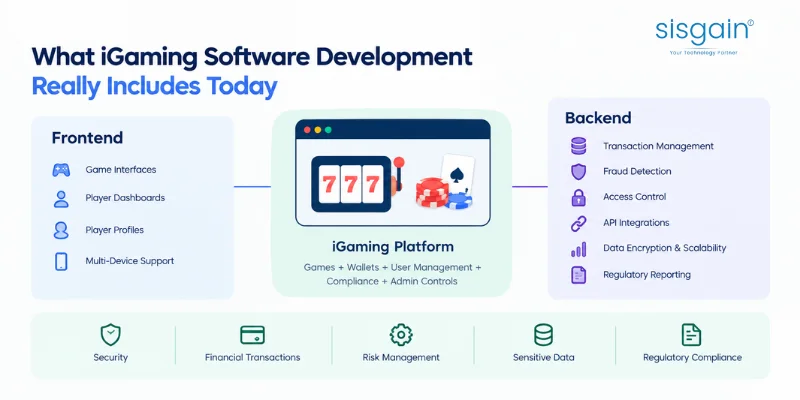
iGaming software solutions typically refer to individual components—such as game engines, payment modules, or reporting tools—that solve specific problems within a platform. In contrast, iGaming platform development involves designing and integrating the entire ecosystem: games, wallets, user management, compliance layers, and administrative controls. At the core of this ecosystem sits the iGaming backend system, which manages transactions, player data, security rules, analytics, and regulatory reporting.
From a technical perspective, frontend development focuses on user-facing elements—game interfaces, dashboards, player profiles, and responsiveness across devices. Backend development carries far greater complexity. It includes wallet segregation, fraud detection, access control, API integrations, data encryption, and system scalability. In real-money environments, backend architecture is not optional infrastructure; it is the foundation of trust and compliance.
This is why modern iGaming platforms resemble fintech and SaaS systems more than traditional games. They process financial transactions, manage risk, store sensitive data, and operate under regulatory oversight. Understanding this scope is essential for accurately evaluating igaming software cost—and for setting realistic expectations before development begins.
Key Components That Drive iGaming Software Cost
Understanding igaming software cost starts with understanding where the complexity truly lies. Modern platforms are not priced by the number of games alone, but by the robustness of the systems supporting fairness, security, and scalability. The most significant cost drivers fall into three core areas.
1. Game Engine & Core Logic
The game engine is more than visual interaction—it governs fairness, accuracy, and real-time behavior. One of the first cost drivers is RNG certification, which ensures that game outcomes are statistically fair and tamper-proof. Certified RNG implementation requires compliant algorithms, audit-ready documentation, and integration with testing authorities, all of which increase development effort.
Multiplayer logic adds another layer of complexity. Real-time synchronization, latency handling, and state management must work flawlessly across thousands of users. Unlike single-player games, multiplayer environments require continuous server validation to prevent exploits or desynchronization.
For betting platforms, odds calculation systems are critical. These engines must process large volumes of data, update odds dynamically, and ensure accuracy across markets. Even small errors can result in financial exposure, making this one of the most sensitive and resource-intensive components.
2. iGaming Backend System (Critical Cost Driver)
The igaming backend system is the most influential factor in overall platform cost. It acts as the operational core where money, data, and risk converge.
A secure wallet architecture must isolate player funds, manage deposits and withdrawals, and support multiple payment methods without exposing financial vulnerabilities. Closely tied to this is player account management, which handles identity verification, access control, transaction history, and responsible gaming limits.
Fraud detection systems significantly impact cost as well. These include behavior analysis, transaction monitoring, geo-validation, and rule-based alerts—often operating in real time. Finally, admin and reporting dashboards enable operators to monitor performance, manage users, generate compliance reports, and make data-driven decisions. Together, these backend elements often account for a substantial portion of development investment.
3. Platform Infrastructure & Scalability
Infrastructure decisions shape long-term cost efficiency. Cloud hosting enables elasticity but requires careful architecture planning to avoid unnecessary overhead. Platforms must also handle peak concurrency, especially during live events or promotions, without degrading performance.
Load balancing and uptime SLAs are not optional in real-money environments. High availability, redundancy, and disaster recovery mechanisms directly influence development time and operational expenses. This is why scalable infrastructure is a defining factor in enterprise-grade igaming software solutions.
4. iGaming Software Development Cost Breakdown (Realistic View)
One of the most common mistakes businesses make is treating igaming software development as a single-line expense. In reality, costs are layered, interconnected, and influenced by regulatory and technical decisions made early in the project.
Initial Development Cost
This includes core architecture design, frontend and backend development, game integrations, and internal testing. Costs vary significantly based on whether the platform is an MVP or a production-ready system. MVPs focus on essential functionality, while full-scale platforms include redundancy, automation, and advanced security from day one.
Compliance & Licensing Cost
Compliance is a structural requirement, not an add-on. Licensing fees, KYC/AML modules, audit preparation, and jurisdiction-specific rules can substantially affect budgets. Regulated markets require deeper integration and ongoing updates, while offshore deployments reduce upfront compliance costs but introduce operational risks.
Infrastructure & Scaling Cost
Infrastructure expenses grow with user volume. Server provisioning, database optimization, real-time data processing, and global content delivery all contribute to long-term igaming platform development costs. Poor infrastructure planning often results in higher expenses after launch.
Ongoing Maintenance & Operations
Post-launch costs are frequently underestimated. These include security updates, feature enhancements, compliance changes, payment gateway adjustments, and customer support systems. Maintenance is not optional—it is essential for platform stability and regulatory continuity.
Why Cost Ranges Vary
There is no universal pricing because requirements differ. An MVP costs less than a production-ready platform. Regulated deployments cost more than offshore ones. White-label solutions reduce initial investment but limit flexibility, while custom architecture demands higher upfront cost but offers long-term control.
Understanding these layers provides a realistic view of igaming software cost—and helps businesses plan for sustainability rather than short-term savings.
Cost Comparison: MVP vs Enterprise iGaming Platforms
When evaluating iGaming software cost, one of the most critical decisions is whether to launch with a startup-focused MVP platform or invest upfront in an enterprise-grade iGaming system. The cost difference between the two is not just financial—it directly impacts scalability, compliance readiness, and long-term technical debt.
Startup / MVP iGaming Platforms
MVP platforms are designed for speed and validation. They typically include:
- A limited selection of games
- A basic wallet and payment flow
- Essential player account management
- Minimal compliance tooling
From an iGaming software development perspective, MVPs offer a faster go-to-market and lower initial investment, making them suitable for startups testing demand or entering less complex markets. However, this approach comes with trade-offs. MVP architectures are often tightly coupled, meaning that as user volumes grow or regulatory requirements increase, the platform may need partial or complete redevelopment.
While the upfront iGaming software cost is lower, businesses should be aware of the future rebuild risk—especially if the MVP was not designed with scalability in mind.
Enterprise-Grade iGaming Platforms
Enterprise platforms are built for longevity and scale. They typically feature:
- Modular, service-based architecture
- Advanced compliance and reporting systems
- Robust iGaming backend systems
- Multi-region and multi-currency scalability
Although enterprise iGaming platform development requires a higher initial investment, it significantly reduces long-term operational risk. These platforms are easier to expand, integrate with third-party services, and adapt to regulatory changes without disrupting live operations.
Not every business should start with an enterprise platform. For early-stage operators, an MVP can be the right strategic move—provided it is built with a clear roadmap for evolution. The key is aligning platform scope with realistic business goals, not overbuilding or underplanning.
Custom vs White-Label iGaming Software: Cost vs Control
Another major factor influencing iGaming software development cost is the choice between white-label solutions and custom iGaming software development. Each approach serves different business priorities, and neither is universally “better.”
White-Label iGaming Software
White-label platforms are pre-built systems that can be branded and launched quickly. They offer:
- Faster deployment timelines
- Lower upfront development costs
- Built-in games, wallets, and basic compliance features
For businesses focused on speed, white-label iGaming software solutions can be an effective entry point. However, these platforms come with limitations. Customization is restricted, ownership of core technology is limited, and differentiation in competitive markets can be challenging. Over time, dependency on the provider may also increase operational costs.
Custom iGaming Software Development
Custom development involves building a platform tailored to specific business, regulatory, and scalability requirements. While the initial iGaming software cost is higher, the benefits include:
- Full intellectual property ownership
- Greater brand and feature flexibility
- Easier long-term scaling and integration
Many businesses choose custom software development solutions when scalability and ownership matter more than speed. From an EEAT standpoint, custom platforms are often better suited for regulated markets and long-term operators, as they offer stronger control over compliance, data security, and platform evolution.
Bottom line:
White-label solutions prioritize speed and lower entry cost, while custom development prioritizes control, longevity, and return on investment. The right choice depends on business maturity, target markets, and long-term vision—not just budget.
How Geography Impacts iGaming Software Development Cost
Geography plays a far bigger role in iGaming software cost than many businesses initially expect. The region where your platform is developed, hosted, and deployed directly affects compliance requirements, infrastructure decisions, and long-term operational stability.
Cost Differences by Deployment Region
iGaming platform development for regulated markets such as Europe, the UK, and parts of the Middle East typically costs more than offshore or lightly regulated jurisdictions. The reason is simple: regulated regions demand higher standards across security, data protection, auditing, and player safety.
For example, platforms built by experienced software development companies in uae often include stronger compliance workflows, enterprise-grade backend architecture, and secure payment frameworks by default. While this increases upfront development cost, it significantly reduces regulatory risk and rework later.
Compliance Complexity by Market
Each market introduces its own regulatory obligations—KYC, AML, responsible gaming controls, reporting, and audit trails. Building an iGaming backend system that satisfies multiple jurisdictions requires additional engineering effort, legal coordination, and ongoing updates.
This is why Software Companies in Dubai and other regulated hubs may charge more: they design iGaming software solutions with compliance-ready architecture rather than shortcuts. That expertise protects operators from fines, forced shutdowns, or rushed platform rebuilds.
Hosting & Data Residency Implications
Hosting location also impacts cost. Many regions mandate local data residency, requiring region-specific cloud infrastructure, redundancy planning, and disaster recovery setups. These factors increase operational expenses but ensure legal compliance and platform reliability.
Why Regulated Hubs Cost More—but Deliver Stability
Companies operating in regulated hubs aren’t just building software; they’re building long-term operational platforms. Higher costs reflect deeper regulatory knowledge, stronger security practices, and infrastructure designed for scale—critical factors for sustainable iGaming software development.
Technology Stack Choices & Their Cost Impact
Technology stack decisions directly influence both the initial iGaming software development cost and the platform’s ability to scale reliably over time. Choosing the right stack is less about trends and more about aligning technology with business goals.
Traditional Stacks vs. Modern Scalable Stacks
Traditional stacks—such as PHP with MySQL—can reduce early development costs and work well for MVPs or limited-feature platforms. However, they often struggle with high concurrency, real-time processing, and long-term scalability.
Modern stacks using Node.js, React, microservices, and cloud-native databases are more expensive to implement initially but provide flexibility, performance, and resilience. For serious iGaming platform development, this approach lowers technical debt and supports future expansion.
Real-Time Data Handling
iGaming platforms rely heavily on real-time data: live bets, wallet balances, game outcomes, and fraud monitoring. Supporting this requires event-driven architectures, message queues, and scalable backend services. These components increase development effort but are essential for user trust and platform stability.
Blockchain & AI: When They Make Sense
Blockchain and AI can raise iGaming software cost significantly—and they are not always necessary. Blockchain is valuable for transparent transaction records or crypto-centric platforms, but adds complexity and regulatory considerations.
AI is most effective when applied to fraud detection, player behavior analysis, and risk management—not basic gameplay. Implementing advanced tech without a clear use case often leads to unnecessary expenses.
Experienced software development companies in uae providers recommend advanced technologies only when they solve real operational problems. Smart tech decisions prioritize reliability and compliance over hype—saving cost without compromising quality.
Choosing the Right iGaming Software Development Provider
Selecting the right iGaming software development provider is less about who offers the lowest quote and more about who understands the operational reality of running a real-money gaming platform. The wrong partner can reduce upfront costs—but multiply long-term risk.
Regulatory Experience
A credible provider must demonstrate hands-on experience working within regulated and semi-regulated markets. This includes familiarity with KYC, AML workflows, player data protection, and jurisdiction-specific compliance requirements. Providers offering iGaming software development services without proven regulatory exposure often underestimate timelines, approval cycles, and rework costs—issues that surface only after launch.
Backend Security Expertise
The iGaming backend system is the foundation of trust. Evaluate how the provider designs wallet isolation, transaction integrity, fraud detection, and access controls. Security cannot be an afterthought or a third-party add-on. Experienced teams build security into architecture decisions from day one, especially for platforms handling high transaction volumes and real-time betting activity.
Post-Launch Support Capability
iGaming platforms are living systems. Ask how updates, scalability, monitoring, and incident response are handled post-launch. Reliable iGaming software development services include SLA-backed support, performance optimization, and ongoing compliance updates—not just delivery of source code.
Transparency in Pricing
A serious provider explains what is included and what is not. Transparent pricing clearly separates development, infrastructure, third-party tools, and long-term maintenance. This is especially important when working with teams that also operate as a mobile gaming app development company, where cross-platform expertise can reduce duplication costs across web and mobile ecosystems.
Hidden Costs Most iGaming Businesses Miss
One of the most common reasons iGaming projects exceed budget is not poor development—it’s unaccounted operational costs that surface after launch. These hidden expenses are rarely mentioned in surface-level pricing discussions.
Payment Gateway Fees & Chargebacks
Beyond integration costs, payment providers charge transaction fees, rolling reserves, and chargeback penalties. For high-volume platforms, these recurring costs significantly impact profitability. Poorly designed payment flows can also increase dispute rates, compounding losses.
Third-Party API Dependencies
Odds feeds, sports data, live dealer streaming, identity verification, and analytics tools often operate on usage-based pricing models. As user activity grows, so does API spend. Many platforms underestimate this scaling cost when calculating initial iGaming software cost.
Ongoing Compliance Audits
Compliance is not a one-time milestone. Regular audits, security assessments, and regulatory updates are mandatory in many jurisdictions. These require both internal resources and external certification bodies, adding predictable—but often ignored—annual expenses.
Feature Creep Costs
Post-launch feature expansion is inevitable. Loyalty programs, additional payment methods, regional customization, or new game modules all require backend and frontend changes. Without a modular architecture, each new feature becomes expensive and time-consuming to deploy.
The reality is that sustainable iGaming platform development requires financial planning beyond build costs. Businesses that account for these hidden factors early avoid operational stress later—and gain a clearer picture of true long-term ROI.
IGaming Software Cost Trends to Watch Beyond 2026
The iGaming software cost landscape is evolving rapidly, and post-2026 platforms will be shaped more by operational intelligence and architectural efficiency than raw feature volume. Businesses planning long-term growth must account for these emerging cost drivers early in their iGaming software development strategy.
AI-driven risk management is becoming a core requirement rather than a premium feature. Modern platforms are embedding AI models to detect fraud, abnormal betting behavior, bonus abuse, and payment anomalies in real time. While this adds to upfront iGaming platform development costs, it significantly reduces long-term losses and compliance penalties.
Automation in regulatory compliance is another major shift. Manual KYC, AML, and reporting workflows are being replaced by automated verification systems and rule-based compliance engines. This reduces human dependency, lowers operational overhead, and improves audit readiness—especially for multi-jurisdiction platforms.
On the infrastructure side, server cost optimization is gaining priority. Instead of over-provisioned hosting, scalable cloud architectures with dynamic load balancing are helping platforms control infrastructure spend during traffic spikes. This directly impacts the total iGaming software cost over time.
Finally, modular platform growth is redefining how iGaming software solutions are built. Modular architectures allow operators to launch faster and add features without reengineering the entire iGaming backend system, making platforms more adaptable and cost-efficient.
For a broader perspective on how technology trends influence budgets, this aligns closely with overall Software Development Cost in 2026 planning.
Final Thoughts: Building Smart, Not Cheap
When evaluating iGaming software development, the biggest mistake businesses make is treating cost as a one-time expense rather than a long-term investment. The true iGaming software cost is not defined by how little you spend upfront, but by how efficiently your platform performs, scales, and complies over time.
A well-designed architecture—supported by a secure iGaming backend system, scalable infrastructure, and modular components—reduces future redevelopment, minimizes downtime, and lowers operational risk. These factors often save far more money than choosing the cheapest initial build.
Equally important is selecting the right iGaming software development provider. Experienced iGaming software development services teams understand regulatory realities, platform longevity, and post-launch challenges. They design systems that grow with your business rather than forcing costly rebuilds later.
The smartest iGaming operators don’t ask, “What’s the cheapest option?”
They ask, “What architecture and partner will still make sense three years from now?”
If your goal is sustainable growth, the right decisions at the development stage will always outperform short-term cost savings.