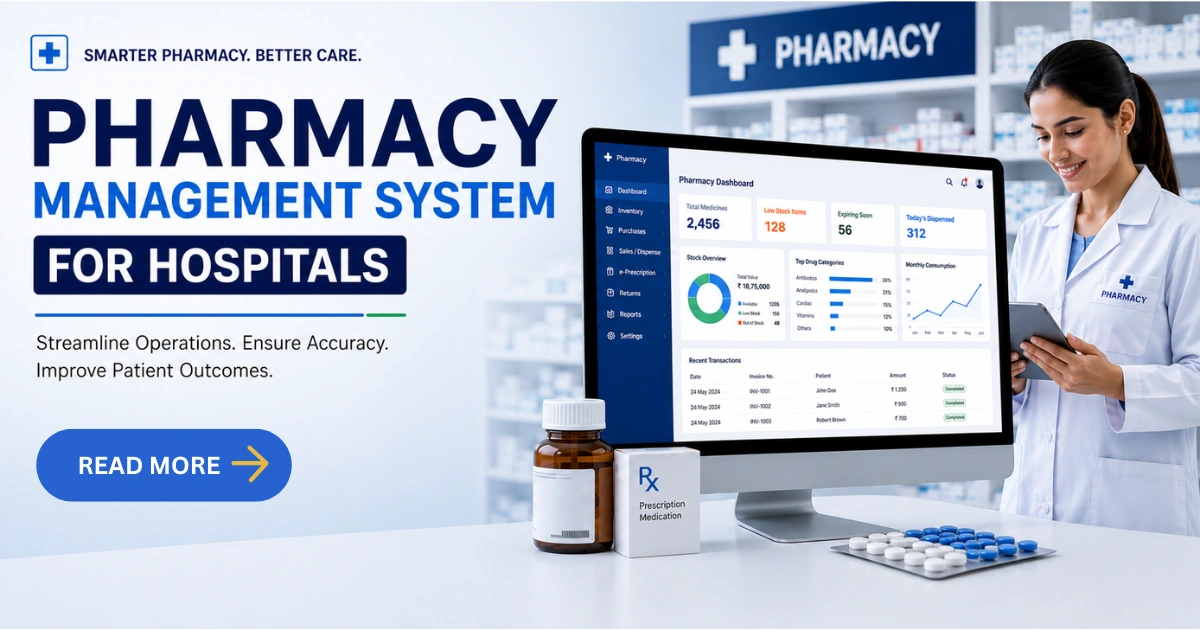

Walk into a hospital pharmacy on a busy Tuesday and you'll see the problem before anyone explains it to you: a pharmacist juggling three phone calls, a stack of paper prescriptions, and a shelf of medicines that may or may not match what the system says is in stock. Multiply that across a 500-bed hospital with an OPD counter, an IPD store, an emergency window, and ward-level stock rooms, and "manage the pharmacy" stops being a software problem and starts being an operations problem.
That's what a pharmacy management system is actually built to solve.
Hospitals aren't just tracking pills anymore. They're managing patient safety, regulatory compliance, inventory accuracy, billing integrity, and real-time coordination between doctors, pharmacists, and finance — often across multiple locations at once. A few things tend to break down first:
- Manual workflows that cause dispensing errors
- Expired medicine written off as pure loss, because nobody caught the expiry in time
- Billing entries that get missed, which means revenue that simply evaporates
- A gap between when a prescription is written and when the medicine actually reaches the patient
- Pharmacy, HIS, and EMR systems that don't talk to each other
A pharmacy management system isn't inventory software with a nicer interface. Done right, it's a connected layer of the hospital's technology stack — one that touches medication safety, day-to-day efficiency, and the bottom line all at once.
What Is a Pharmacy Management System?
A pharmacy management system is healthcare software built to automate and run pharmacy operations end to end: medicine inventory, prescription processing, drug dispensing, purchasing, billing, compliance reporting, and stock monitoring.
The difference between that and the pharmacy software hospitals used a decade ago is bigger than a feature list:
|
Traditional Pharmacy Software |
Hospital Pharmacy Management System |
|
Basic billing |
Integrated clinical workflows |
|
Manual inventory updates |
Real-time stock tracking |
|
Limited reporting |
Advanced analytics |
|
Standalone operation |
HIS/EMR connectivity |
The old model treated the pharmacy as its own island — a till and a stockroom. The modern model treats it as one node in a hospital-wide data flow, which is exactly why most hospitals now fold pharmacy into a broader hospital software development plan rather than buying it as a one-off tool, especially as part of a wider push toward healthcare IT solutions in the UAE.
Why Hospital Pharmacy Is More Complex Than Retail Pharmacy
It's tempting to assume pharmacy software is pharmacy software. It isn't — hospitals carry a level of complexity retail pharmacies simply don't deal with.
Multiple pharmacy locations. A hospital typically runs a main pharmacy store, OPD and IPD pharmacies, an emergency medicine counter, and stock sitting in individual wards. Without a centralized system, nobody has a single accurate picture of what's actually on the shelves across all of them.
Zero tolerance for stockouts on critical drugs. A retail pharmacy running low on cough syrup is an inconvenience. A hospital running low on ICU drugs, surgical medications, or emergency supplies is a patient safety incident waiting to happen.
Compliance that doesn't bend. Hospitals need drug traceability, controlled substance tracking, clean audit records, and regulatory reporting that holds up when someone comes asking questions.
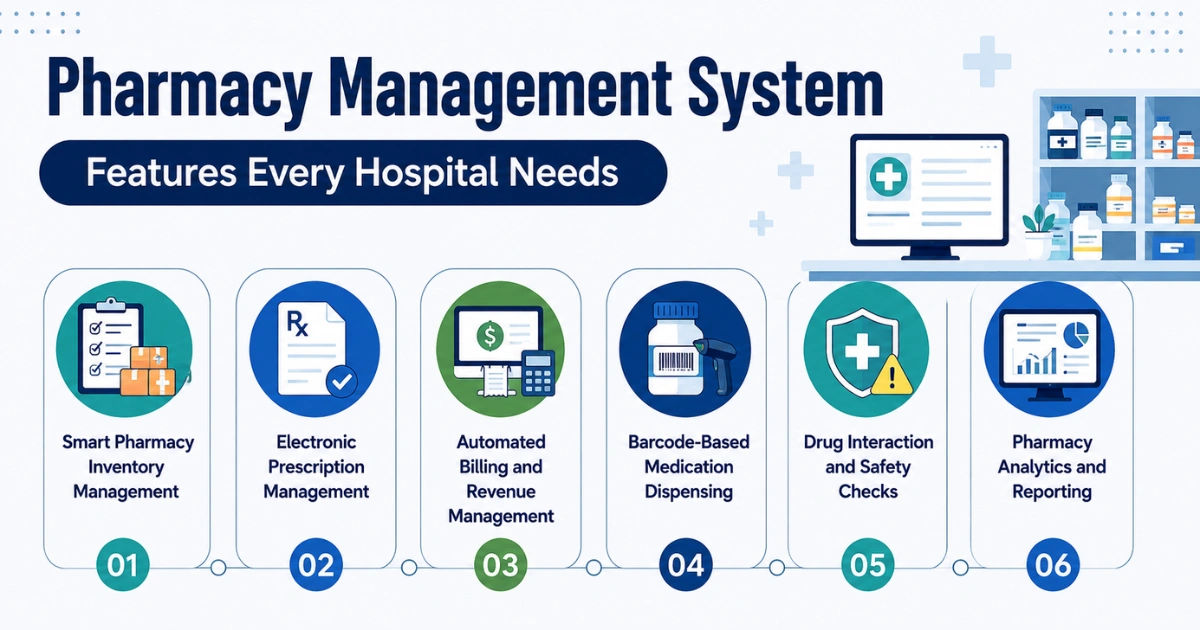
Pharmacy Management System Features Every Hospital Needs
The value of a hospital pharmacy system comes down to one thing: how well it connects clinical workflows, inventory operations, and financial processes. A system that's strong on inventory but blind to billing just moves the problem somewhere else.
1. Smart Pharmacy Inventory Management
This is the backbone. Real-time stock tracking, batch number management, expiry date monitoring, FEFO (first-expiry-first-out) logic, minimum stock alerts, and purchase forecasting all live here.
Business impact: fewer medicines expiring unused, and far fewer moments where a critical drug simply isn't there when it's needed.
2. Electronic Prescription Management
Digital prescriptions replace the doctor-to-pharmacy handoff that used to run on handwriting and hope. Errors drop, and dispensing speeds up — particularly when the pharmacy system is built by an eRx software development company that understands how to wire that handoff directly into EMR data, rather than bolting it on after the fact.
3. Automated Billing and Revenue Management
Every time a medicine is dispensed, that action should flow straight into hospital billing — no separate entry, no manual reconciliation later. That connection is where automatic charge capture, fewer billing gaps, accurate patient invoices, and smoother insurance claims come from.
4. Barcode-Based Medication Dispensing
Scan the barcode, verify the medicine, confirm it against the patient record. It sounds simple, and that's exactly the point — this single step catches a meaningful share of dispensing errors before they ever reach a patient.
5. Drug Interaction and Safety Checks
Allergy alerts, interaction warnings, dosage verification, and clinical decision support sit at the intersection of pharmacy and patient safety. This is the feature set that turns a pharmacy system from "inventory tool" into "safety net."
6. Pharmacy Analytics and Reporting
Consumption reports, purchase analysis, expiry tracking, revenue analytics, and department-wise usage give pharmacy leadership something they rarely had before: visibility they can act on instead of react to.
How Does a Hospital Pharmacy Management System Work?
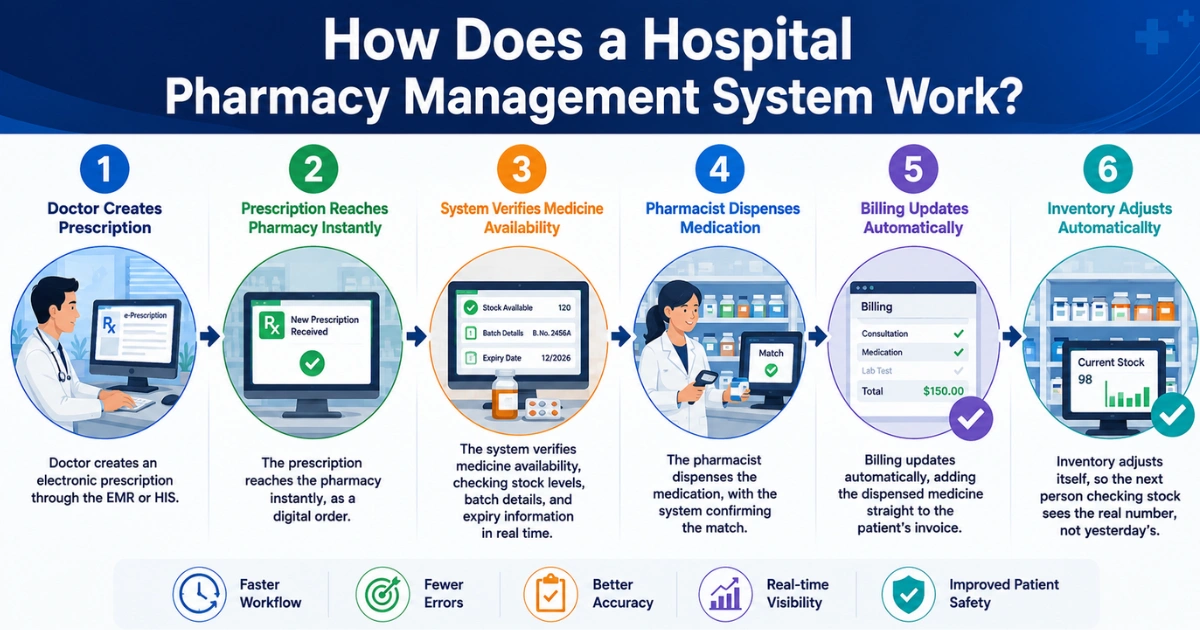
Strip away the software and the workflow is straightforward:
- A doctor creates an electronic prescription through the EMR or HIS.
- The prescription reaches the pharmacy instantly, as a digital order — no runner, no paper.
- The system verifies medicine availability, checking stock levels, batch details, and expiry information in real time.
- The pharmacist dispenses the medication, with the system confirming the match.
- Billing updates automatically, adding the dispensed medicine straight to the patient's invoice.
- Inventory adjusts itself, so the next person checking stock sees the real number, not yesterday's.
Six steps, and every one of them used to involve a human double-checking something manually. That's the actual efficiency gain — not "digitization" as a buzzword, but six fewer places where delay and error used to creep in.

Pharmacy Management System Integration with HIS and EMR
Integration isn't a nice-to-have bolted onto a pharmacy system. It's the foundation the rest of it stands on.
Integration with the Hospital Information System (HIS)
A pharmacy system tied into HIS gives the hospital centralized patient information, billing workflows that don't require separate reconciliation, and department-level coordination that actually holds together across shifts — a natural extension of the broader evolution of HIS hospitals have been going through over the past decade.
Integration with Electronic Medical Records (EMR)
EMR integration means prescriptions transfer directly, pharmacists can see a patient's medication history without asking, and clinical decisions get made with more complete information. Fewer prescription errors follow almost automatically.
Other Integrations Worth Building For
- Laboratory Information System (LIS) — connects medication decisions with diagnostic results, so a drug order can account for a lab value instead of ignoring it.
- RIS system (Radiology Information System) — rounds out the broader hospital data ecosystem pharmacy sits inside.
- ERP implementation in healthcare — links pharmacy procurement directly to hospital finance.
Benefits of a Pharmacy Management System in Hospitals
Fewer medication errors. Automation cuts down wrong dispensing, manual prescription mistakes, and the documentation gaps that come from doing everything by hand.
Tighter inventory control. Fewer medicines expire on the shelf, purchasing gets smarter over time, and stock visibility stops being a guessing game.
Better revenue management. Billing accuracy goes up, leakage goes down, and insurance processing moves faster because the data is already there.
Faster pharmacy operations. Shorter wait times, quicker prescription processing, and a noticeably better experience for patients standing at the counter.
Regulatory compliance that's actually auditable. Clean audit trails, controlled drug monitoring, and data security that holds up under scrutiny — not just paperwork assembled after the fact.
ROI of Implementing a Hospital Pharmacy Management System
For hospital leadership, the pharmacy system conversation eventually comes down to one question: does this pay for itself? It usually does, across three categories.
Cost savings — less medicine wasted to expiry, less manual workload for pharmacy staff, and procurement decisions backed by actual consumption data instead of guesswork.
Revenue improvements — billing that's accurate the first time, fewer missed charges slipping through the cracks, and pharmacy revenue that's tracked instead of estimated.
Risk reduction — better medication safety, stronger compliance posture, and tighter operational control across every pharmacy location.
|
ROI Area |
Business Impact |
|
Inventory Optimization |
Lower medicine wastage |
|
Automation |
Reduced operational cost |
|
Billing Integration |
Revenue recovery |
|
Safety Controls |
Lower clinical risk |
Pharmacy Management System for UAE Hospitals: Why Integration Matters
UAE hospitals are moving fast on hospital digital transformation, and that shift is reshaping what "good enough" pharmacy software looks like. Regulatory requirements are tightening, healthcare ecosystems are getting more connected, and hospitals increasingly need pharmacy systems that plug into the healthcare IT solutions infrastructure they've already invested in — not standalone tools that create yet another data silo. That same demand is showing up across the broader push for healthcare app development in Dubai, where interoperability, not just features, has become the deciding factor.
Build vs. Buy: Choosing the Right Pharmacy Management Solution
|
Ready-Made Software |
Custom Pharmacy Management System |
|
Faster deployment |
Business-specific workflows |
|
Limited customization |
Scalable architecture |
|
Standard features |
HIS/EMR integrations |
Off-the-shelf software wins when a hospital needs something running quickly and its workflows are fairly standard. Custom development makes more sense once you're dealing with multi-location hospitals, enterprise healthcare groups, complex clinical workflows, or integrations that off-the-shelf tools simply don't support out of the box.
Where Pharmacy Management Systems Are Headed
A few trends are already shaping what these systems look like next: AI-based demand forecasting that predicts stockouts before they happen, predictive inventory management, automation in physical dispensing, cloud-based platforms that don't tie hospitals to on-premise servers, mobile apps for pharmacy staff on the move, and AI-driven medication safety checks that catch what a tired human eye might miss. All of it points the same direction pharmacy has been heading for a while now — toward the same hospital digital transformation reshaping every other department.
Bringing It All Together
The shift here isn't subtle: hospitals are moving from manual medicine management toward pharmacy operations that are intelligent, connected, and accountable by design. A pharmacy management system is the piece that makes that shift possible — provided it's actually built to talk to HIS, EMR, and billing, instead of sitting off to the side as one more disconnected tool.
Partner with an experienced healthcare software development company to build a scalable pharmacy management solution integrated with HIS, EMR, billing, and hospital workflows.