
Introduction
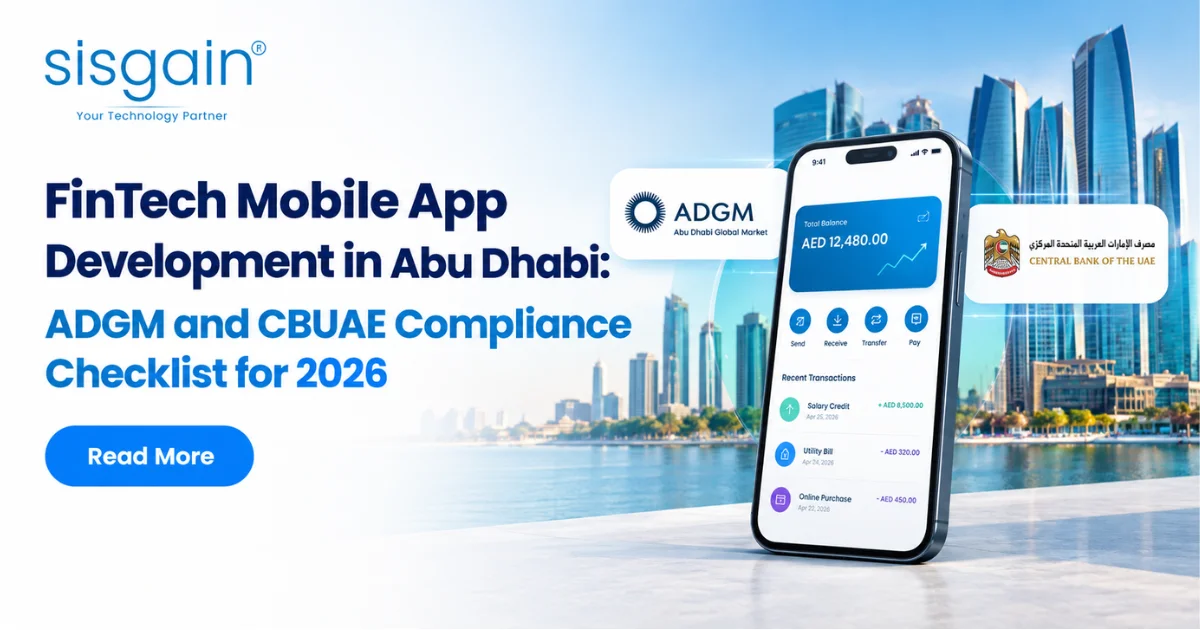
Abu Dhabi has become one of the more serious places in the region to build financial technology. Digital payments, mobile banking and digital wallets are growing quickly, and customers expect onboarding that takes minutes. Regulators expect the opposite of shortcuts.
If you are planning a product here, you need to think about ADGM compliant app development from the start, along with the CBUAE mobile banking app requirements that apply to your model. This checklist explains the main regulatory bodies, which features trigger which obligations and what your development plan should include. It is written for founders, product leads and CTOs. It is not legal advice. Use it to ask better questions of your lawyers and your development partner.
1. Understanding the FinTech Regulatory Landscape in Abu Dhabi
Why Abu Dhabi is an emerging fintech development hub
Abu Dhabi combines a sophisticated financial sector, government support for digital finance and a regulatory environment built around innovation. That mix attracts startups and established institutions alike, which also makes customer trust a competitive issue. Teams that build for mobile app development services in Abu Dhabi often find that compliance is the main differentiator.
The role of ADGM and the Financial Services Regulatory Authority (FSRA)
Abu Dhabi Global Market (ADGM) is a common-law financial free zone with its own legal framework. The Financial Services Regulatory Authority (FSRA) regulates financial services conducted within ADGM. Firms that carry on regulated activities there need FSRA authorisation for those activities. The FSRA also runs a Regulatory Laboratory (RegLab), a sandbox for testing innovative products under supervision.
The role of the Central Bank of the UAE (CBUAE)
The Central Bank of the UAE supervises licensed financial institutions and payment services across the UAE, including onshore activity. Its retail payment and stored-value frameworks are the ones most fintech apps meet first.
ADGM-regulated businesses vs. UAE mainland fintech operations
An ADGM-regulated business is authorised by the FSRA and operates under ADGM rules. A mainland business is generally supervised by the CBUAE and other federal or emirate-level authorities. These are separate regimes. Being in one does not make you compliant with the other.
How regulatory jurisdiction affects fintech app development
Jurisdiction shapes the product. It determines which entity can hold customer funds, which data protection rules apply, which KYC standards you must meet and who your customers can be. Settle those answers before the first wireframe.
Content asset: ADGM vs. CBUAE at a glance
| Area | ADGM / FSRA | CBUAE (mainland) |
|---|---|---|
| Typical scope | Financial services carried on within ADGM | Licensed financial institutions and payment services across the UAE |
| Regulated activities | Depend on the FSRA permissions the firm holds | Depend on the CBUAE licence category, such as retail payments or stored value |
| App implications | Entity structure, FSRA permissions and ADGM data rules shape the build | Payment flows, wallet features and bank integrations shape the build |
2. ADGM vs. CBUAE: Which Regulatory Framework Applies to Your FinTech App?
The applicable framework depends on the activity, the entity and the permissions involved. The app’s location is only one input.
When an ADGM/FSRA regulatory assessment may be required
If your company is based in ADGM, or plans to operate there, an FSRA assessment is likely needed before you launch any regulated activity. This holds even if the first version of the product is small.
When CBUAE payment or stored-value requirements may apply
If your app moves money, stores value for users or facilitates payments onshore, CBUAE requirements may apply. Whether they do depends on what the app actually does with funds.
Can a fintech company operating in ADGM serve mainland UAE customers?
This is a question for specialist advisers. Serving mainland customers can involve separate permissions or licences. Do not assume ADGM authorisation extends to mainland activity.
How business models, customer locations and money flows affect regulatory obligations
Three questions drive most of the analysis: who the customer is, where the customer is and where the money goes. A wallet that holds balances is treated differently from an app that only displays account data.
When to obtain specialist regulatory advice before development
Get advice before you commit to architecture, vendors or a launch date. A regulatory review costs far less than rebuilding a product that was scoped without one.
Decision tree: which assessment do you need?
- Is the legal entity operating the app based in ADGM, or planning to operate there? If yes, start with an FSRA assessment.
- Does the app hold, store, move or control customer funds? If yes, review CBUAE payment and stored-value requirements.
- Does the app only display information, or initiate payments through a licensed partner? If yes, confirm that partner’s responsibilities and whether your role is still regulated.
- Will the app serve customers in more than one jurisdiction? If yes, get advice on each separately.
3. FinTech App Licensing Checklist: Identify Regulatory Triggers Before Development
Each product category carries different triggers. These are starting points, not a complete list of licences.
Digital wallet and stored-value functionality
Wallets that hold balances are the most common trigger for stored-value rules. Even a small balance can bring obligations. If you are building a digital wallet app development UAE project, this is the first question to answer.
Payment gateway, payment initiation and payment processing
An app that initiates or processes payments may be a regulated payment service, or it may rely on a licensed provider. The answer depends on how the flow is built.
Remittance and international money transfer applications
Cross-border transfers add anti-money laundering checks, sanctions screening and often stricter licensing.
Digital banking and account management apps
Apps that give customers access to bank accounts are usually a front end to a licensed bank. Your responsibilities depend on what the app does beyond displaying data.
Buy Now, Pay Later (BNPL) and digital lending platforms
Lending and credit features are regulated activities. Check lending permissions before you design repayment flows.
WealthTech, investment and robo-advisory apps
Investment advice and portfolio management are regulated. A robo-advisor that recommends products needs its own assessment.
Digital asset and virtual asset platforms
Virtual asset activity has specific requirements in the UAE. Treat it as a separate question, not an extension of your payments product.
Open finance and account-information services
Apps that aggregate account data from several banks need consent management and clear rules on data access.
Checklist: items to cover before development starts
- Identify the legal entity operating the application.
- Map the product’s funds flow and customer journey.
- Determine whether the app holds, stores or controls customer funds.
- Review applicable licence categories and exemptions with qualified advisers.
- Confirm third-party bank, PSP and regulated-provider responsibilities.
4. CBUAE Stored Value Facility and Digital Wallet Compliance Considerations
Digital wallets are where many fintech apps get their regulatory surprises. Meeting CBUAE mobile banking app requirements starts with understanding how your wallet actually handles money.
What distinguishes a payment interface from a stored-value wallet?
A payment interface lets a user pay through a licensed provider without holding a balance. A stored-value wallet holds funds on the user’s behalf. That difference determines which rules apply.
When wallet balances may trigger stored-value regulatory considerations
Balances, top-ups and the ability to spend or transfer stored value are the main triggers. Review the design before launch, because a feature added late can change the classification.
Customer funds safeguarding and reconciliation requirements
Where customer funds are held, you need to show they are safeguarded and reconciled to the ledger at all times. Build reconciliation in from day one.
Wallet top-ups, transfers, refunds and chargebacks
Each money movement needs a clear record, a clear owner and a clear exception path. Refunds and chargebacks are where many wallet ledgers break down.
Transaction limits and customer balance management
Limits manage risk and can be part of regulatory expectations. Make them configurable so you can change them without a new release.
Integrating licensed payment providers into the app
Many apps rely on a licensed provider for the regulated part of the flow. Your contract and technical integration should make clear who does what.
What to confirm before launching a digital wallet in the UAE
Confirm the licence position, safeguarding model, reconciliation process, limits, complaints process and partner responsibilities in writing.
Content asset: feature-to-regulatory-trigger mapping
| Feature | Possible trigger | What to confirm |
|---|---|---|
| Stored balance | Stored-value considerations | Licence category and safeguarding |
| Peer-to-peer transfer | Payment service rules | Who processes the transfer |
| Card top-up | Partner provider obligations | Provider licence and settlement flow |
| Bill payment | Payment initiation | Whether the app initiates or only displays |
Not every wallet or payment app needs the same licence. This table shows which questions to ask, not which answers apply to you.
5. KYC and AML Compliance Checklist for FinTech Mobile Apps
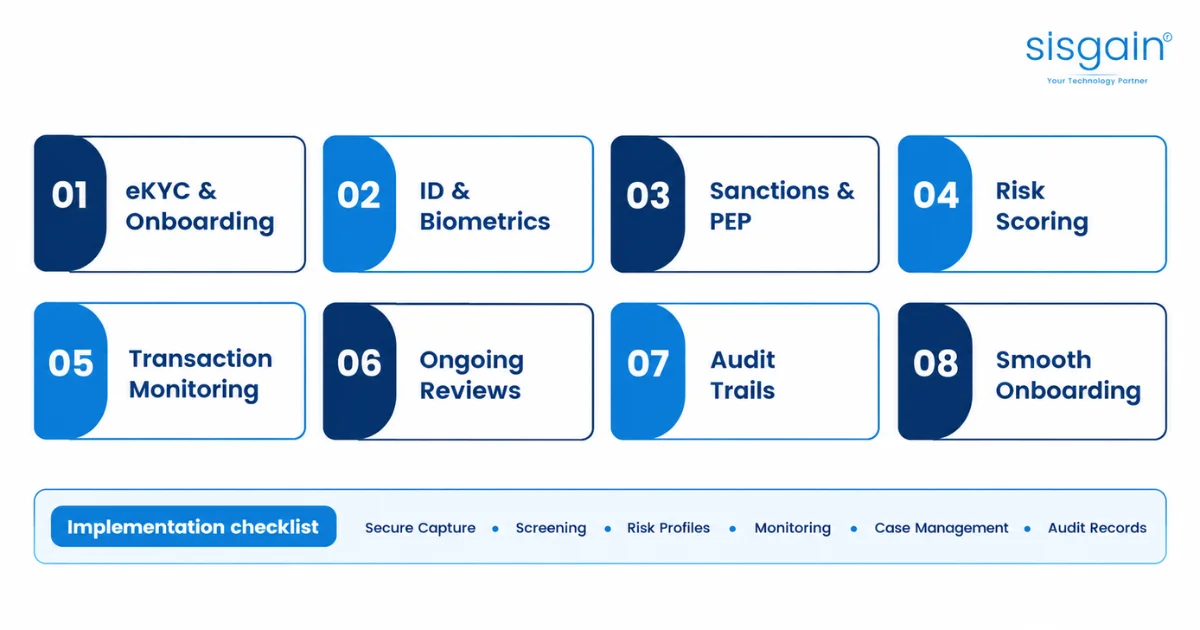
A good KYC integration mobile app is a product problem as much as a compliance one. Customers abandon onboarding that feels slow or confusing, and regulators expect the checks to be real.
Electronic Know Your Customer (eKYC) and digital onboarding
Digital onboarding usually combines identity capture, document checks and verification against trusted sources. The design should make the process clear and recoverable if something fails.
Identity document verification and biometric checks
Document capture needs to work on common phones in ordinary lighting. Biometric checks should run with consent and with a fallback path.
Sanctions screening and Politically Exposed Person (PEP) checks
Screen customers at onboarding and on an ongoing basis against sanctions lists and PEP databases. Keep records of what was checked and when.
Customer risk scoring and risk-based due diligence
Not every customer carries the same risk. A risk score lets you apply enhanced checks where they’re needed and lighter checks elsewhere.
Transaction monitoring and suspicious activity escalation
Monitoring rules should flag unusual activity, and every alert needs a clear review path. Escalations to a compliance officer should be recorded.
Ongoing customer due diligence and periodic reviews
Onboarding is not the end of KYC. Customer information needs refreshing, and risk ratings should be reviewed when circumstances change.
Audit trails, compliance records and reporting workflows
Every decision should be explainable later. Who approved what, when and on what evidence should be retrievable without a manual search through logs.
Reducing onboarding friction without weakening compliance
Good onboarding does not skip checks. It orders them well, explains them clearly and avoids asking for the same information twice.
Implementation checklist for a KYC integration mobile app
- Secure identity-document capture and verification
- Screening integrations and review queues
- Configurable customer risk profiles
- Transaction monitoring rules
- Alerts, case management and escalation
- Retention controls and audit-ready records
6. Mobile Banking and FinTech App Security Requirements for 2026
Security in a regulated app is a set of controls that must work together. A strong login screen does not help if the API behind it is weak. Teams working on enterprise mobile app development Abu Dhabi projects usually find that security reviews decide the timeline.
Multi-factor authentication (MFA) and risk-based authentication
Use MFA for sign-in and sensitive actions. Risk-based checks ask for extra verification when the context looks unusual, such as a new device or location.
Biometric login and step-up authentication for sensitive actions
Biometrics make daily use easier. For high-value actions, require a step-up check even if the user is already signed in.
Encryption of data in transit and at rest
All traffic should use current transport encryption. Stored data, including backups, should be encrypted with keys managed separately from the data.
Secure API architecture and payment processing
APIs carry most of the risk in a fintech app. Enforce authentication, authorisation, rate limits and input validation on every endpoint.
Tokenization and cryptographic key management
Replace sensitive values such as card numbers with tokens wherever possible. Keys need rotation, access control and a documented recovery process.
Device fingerprinting and fraud detection
Device signals help spot account takeover and fraud. Use them as one input among several, and be transparent with users about why you collect them.
Role-based access controls and privileged-access management
Staff access should follow least privilege. Privileged access needs approval, logging and regular review.
Secure software development lifecycle (SSDLC)
Security reviews, dependency checks and code scanning should run inside the development process, not at the end of it.
Penetration testing, vulnerability management and incident response
Test before launch and on a schedule after. Have an incident response plan that names owners and contacts before you need it.
Content asset: security checklist
- Authentication: MFA, risk-based checks, step-up for sensitive actions
- Application security: secure coding, input validation, SSDLC
- Infrastructure security: encryption, key management, network controls
- Operational monitoring: fraud signals, logging, incident response drills
7. UAE Data Protection, Privacy and Data Residency Checklist
Customer data is the most sensitive asset in a fintech app. For any mobile app security UAE PDPL compliance Abu Dhabi plan, the data rules need to be designed in early.
UAE Personal Data Protection Law (PDPL): applicability and key considerations
The UAE’s Personal Data Protection Law, Federal Decree-Law No. 45 of 2021, sets out how personal data should be collected, processed and protected. Check its current implementation status and how it interacts with sector rules.
Consent management and lawful processing
Every processing purpose needs a lawful basis. Where consent is the basis, it must be specific, recorded and easy to withdraw.
Data minimization during onboarding and transactions
Collect only what you need for the purpose. Onboarding forms that ask for everything “just in case” create risk and friction.
Collection of biometric, location and device data
These data types are sensitive in practice. Collect them only when there’s a clear reason, and say so in the app.
Data retention, deletion and access-request workflows
Set retention periods for each data category and automate deletion where you can. Users should be able to request access to their data, and you need a process to answer.
Cross-border data transfers and third-party processors
Map every vendor that touches personal data, including analytics, messaging and cloud providers. Check where each stores and accesses data.
Cloud hosting, data residency and regional architecture
Data residency requirements depend on the sector and the regulator. Confirm them before choosing a hosting region, because moving regions after launch is slow and costly.
Privacy impact assessments and privacy-by-design practices
For high-risk processing, run a privacy impact assessment before you start. Privacy by design means the default settings protect users without them changing anything.
Checklist: data protection and residency
-
Document data categories and processing purposes.
-
Establish applicable lawful bases for processing.
-
Define data retention periods and deletion procedures.
-
Assess cross-border data transfers and vendor access.
-
Confirm whether additional ADGM-specific data protection rules apply.
8. Building a Compliance-Ready FinTech App Architecture
Compliance is easier to maintain when it lives in clearly separated services rather than scattered through the screens.
Modular architecture for regulated fintech products
Separate the customer-facing app from the core services that handle identity, money and records. Each module should have a clear owner and audit trail.
KYC and AML integration layer
Put KYC and AML logic behind one integration layer. You can then change providers or rules without rewriting the app.
Payment gateway and banking API integration
Payment and banking connections should go through a controlled gateway with logging, retries and reconciliation hooks.
Transaction ledger and reconciliation services
The ledger is the source of truth for balances and movements. Reconciliation services compare it against partner records and flag differences.
Fraud detection and transaction rules engine
Keep rules configurable. Fraud patterns change, and a new check should not require a full release.
Audit logging and regulatory reporting
Log every significant action in a tamper-resistant way. Reporting should draw from the same records, not from manual exports.
Encryption, identity management and secrets management
Centralise identity and secrets. Hard-coded credentials are one of the most common causes of breaches.
Data governance and compliance monitoring layer
Track data lineage, access and policy exceptions. A compliance dashboard helps you spot problems before a regulator does.
Third-party integrations and vendor risk management
Every vendor adds risk. Review security posture, data handling and exit terms before you connect them.
Content asset: reference architecture
The mobile app talks to an API gateway. The gateway routes requests to identity verification, compliance services (KYC, AML, screening), the ledger, the payments layer, the fraud engine and the audit layer. Every service writes to the audit layer, which feeds reporting. Use this as a starting diagram and adapt it to your product.
9. FinTech App Development Roadmap: From Regulatory Assessment to Launch
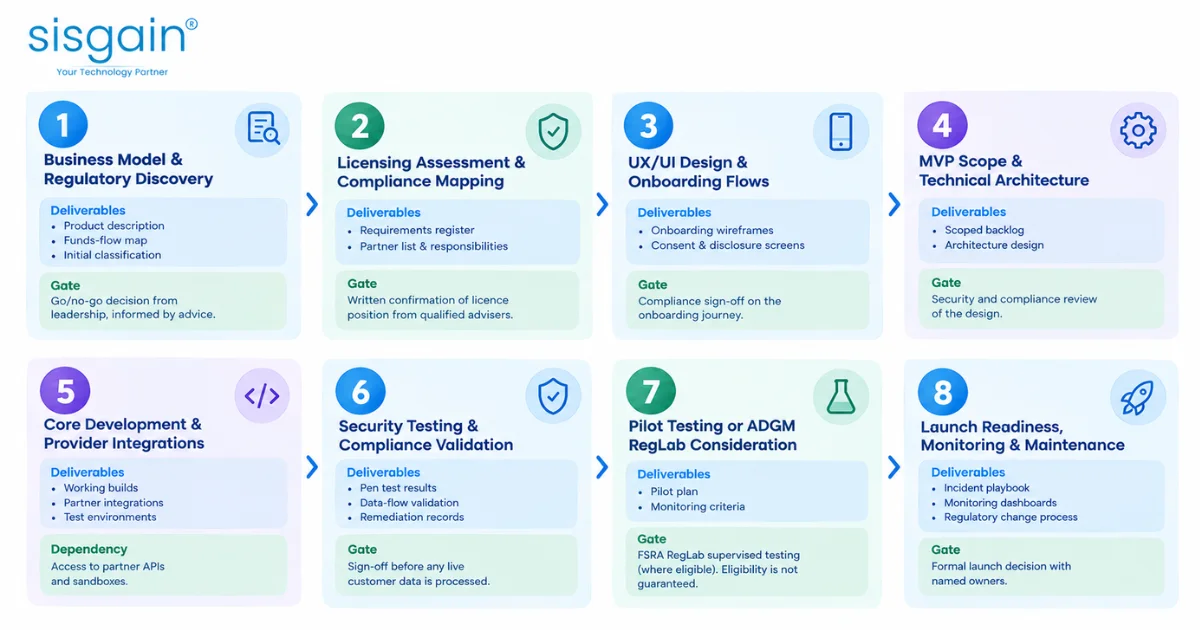
A compliant fintech app follows a sequence. Skipping a step usually means returning to it later at higher cost.
Step 1: Business model and regulatory discovery. Deliverables include a product description, a funds-flow map and an initial classification. The approval gate is a go or no-go decision from leadership, informed by advice.
Step 2: Licensing assessment and compliance requirements mapping. Deliverables include a requirements register and a list of partners with their responsibilities. The gate is written confirmation of the licence position from qualified advisers.
Step 3: UX/UI design and compliant onboarding flows. Deliverables include onboarding wireframes and consent and disclosure screens. The gate is compliance sign-off on the onboarding journey.
Step 4: MVP scope and technical architecture. Deliverables include a scoped backlog and the architecture described above. The gate is a security and compliance review of the design.
Step 5: Core app development and regulated-provider integrations. Deliverables include working builds, partner integrations and test environments. The dependency is access to partner APIs and sandboxes.
Step 6: Security testing and compliance validation. Deliverables include penetration test results, data-flow validation and remediation records. The gate is sign-off before any live customer data is processed.
Step 7: Pilot testing or ADGM RegLab consideration, where eligible. Deliverables include a pilot plan and monitoring criteria. Where the product qualifies, the FSRA RegLab can offer supervised testing. Eligibility is not guaranteed.
Step 8: Launch readiness, monitoring and ongoing maintenance. Deliverables include an incident playbook, monitoring dashboards and a regulatory change process. The gate is a formal launch decision with named owners.
10. FinTech Mobile App Development Cost and Timeline in Abu Dhabi
Cost and timeline depend on the product, the regulatory position and the partners involved. We have not published fixed price ranges because they would mislead without a scoped brief. Ask any vendor for an estimate built on a specific feature list and funds-flow map. Searches like Mobile App Development Cost 2026 or App Development Cost in Dubai 2026 return generic figures, and those rarely reflect a regulated build.
Factors affecting fintech app development costs
Scope, the number of integrations, the regulatory classification and security requirements drive cost most. Design quality and the number of platforms matter too.
Standard fintech MVP vs. compliance-intensive application
A basic app that displays information costs far less than one that holds funds, lends money or processes cross-border payments. The second type needs more testing, documentation and partner work.
Cost impact of eKYC, AML, payment and banking integrations
Each integration adds build time, testing effort and ongoing fees. Identity and screening vendor pricing varies, so budget for it separately.
Security testing, compliance documentation and ongoing maintenance
These are often underestimated. Penetration testing, documentation and regular updates should be in the budget from the start.
Factors affecting development timelines and launch readiness
Software delivery is only part of the picture. Regulatory approval, partner onboarding and security review can take longer than the build. Plan them as separate tracks.
How to prioritize compliance features within an MVP
Start with what the regulator requires to launch: KYC, core security, audit logging and funds controls. Then add convenience features. Compliance is not something you can defer to version two.
11. Common Compliance Mistakes to Avoid Before Launch
These mistakes come up repeatedly. Most are avoidable with a classification exercise at the start.
Starting development without regulatory classification
Building before you know what is regulated is the most expensive mistake. It usually forces a redesign of the funds flow.
Assuming ADGM authorisation automatically covers mainland activities
It does not. Mainland activity needs its own analysis and often its own permissions.
Adding wallet functionality without reviewing licensing implications
A balance feature can change the whole regulatory picture. Review every new money feature before it ships.
Treating KYC and AML as third-party integrations only
A vendor can verify identity, but you remain responsible for how decisions are made, recorded and escalated.
Overlooking audit logs and transaction traceability
If you cannot reconstruct a transaction later, you have a compliance gap, even if nothing has gone wrong yet.
Ignoring data transfers and vendor access
Analytics and support tools often receive more personal data than teams realise. Map them.
Launching without fraud monitoring or incident-response procedures
Fraud will happen. What matters is how fast you detect it and how well you respond.
Failing to plan for ongoing regulatory and security changes
Rules change. Assign an owner for regulatory monitoring and schedule regular reviews.
Red-flag checklist: Do not launch until these gaps have been assessed and resolved.
12. How to Choose a FinTech App Development Company in Abu Dhabi
Choosing a development partner is one of the most important decisions in the project. The right partner turns compliance requirements into technical controls. The wrong one builds fast and leaves you to fix the gaps later. If you are comparing options, you may also look at FinTech companies in Dubai or a Custom FinTech App Development Services in Dubai provider, but judge every candidate on the same criteria.
Experience with fintech and mobile banking architecture
Ask for examples of regulated products they have built and how they handled the compliance design.
Knowledge of ADGM/FSRA and CBUAE-related technical requirements
A good partner understands how these requirements show up in code, data and infrastructure. They also tell you when a question belongs with a lawyer.
Experience with KYC, AML and payment-provider integrations
Ask how they have integrated identity and screening providers, and what they did when a provider changed its API.
Security engineering, auditability and data protection capabilities
Look for secure development practices, audit-ready logging and clear data handling policies.
Third-party vendor and API integration experience
Integrations are where most delays happen. Ask about sandbox access, failure handling and vendor management.
Post-launch monitoring, maintenance and compliance updates
Launch is the start of operations. Confirm who will monitor the app, apply updates and respond when rules change.
Questions to ask before selecting a development partner
- Which regulated products have you built, and what did you learn from them?
- How do you turn a regulatory requirement into a technical control?
- How do you handle audit logs, retention and deletion?
- What is your process for security testing before launch?
- Who supports the product after launch, and how?
A development company builds the product. It does not grant regulatory authorisation. Make sure your partner is clear about that boundary, and involve your legal and regulatory advisers from the start.
Conclusion
Regulatory classification, KYC and AML, security and data protection are not separate projects. They shape the same product, and they are far cheaper to get right at the start than to fix after launch.
Translate each requirement into a technical control and a development milestone. Make the classification decision before committing to architecture, and make sure your partners know where their responsibilities end and yours begin.
If you are planning a fintech app in Abu Dhabi, start with an honest look at your regulatory and technical position. Book a consultation with our team to review your product, funds flow and compliance requirements before development begins.