
A radiology department in Sharjah recently finished installing a brand-new PACS system. On paper, it was a win — faster image retrieval, better storage, a slicker viewer. Three weeks later, the same department was manually retyping patient IDs between the new PACS and the hospital's existing RIS because the two systems couldn't talk to each other cleanly. What was sold as an upgrade had quietly become a second job for the radiographers.
This is the story behind most failed radiology IT purchases in the UAE. It's rarely the software itself that fails. It's the integration—the handshake between RIS, PACS, HIS, EMR, and increasingly, AI diagnostic tools—that gets treated as an afterthought instead of a procurement requirement.
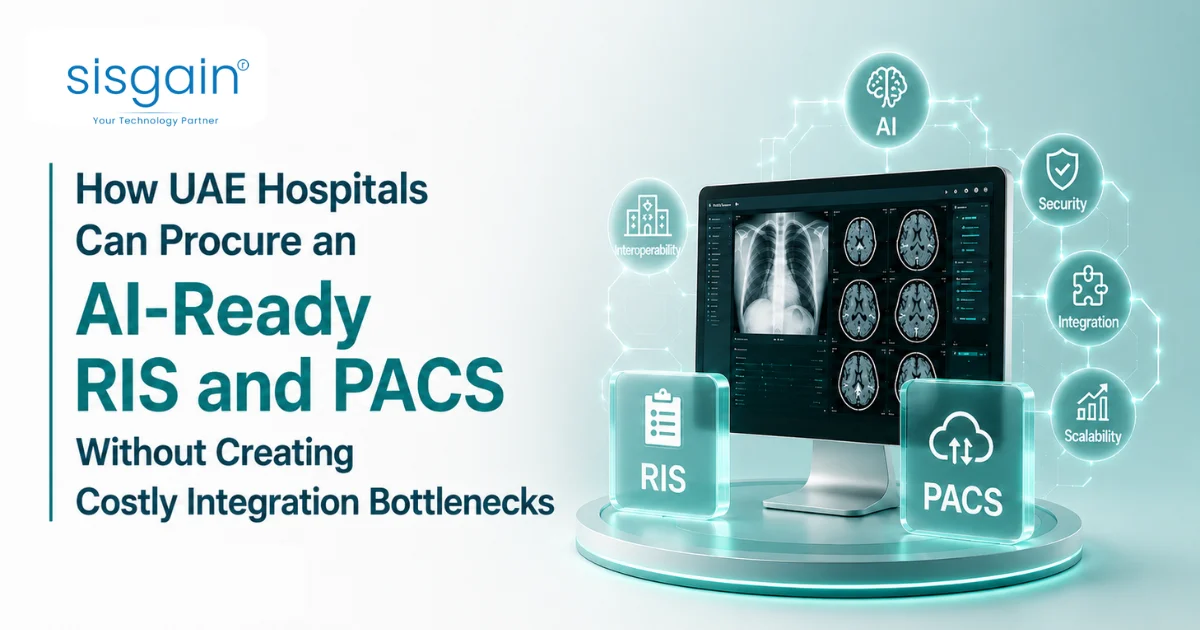
If you're evaluating a Radiology Information System (RIS) or PACS system for a UAE hospital, imaging center, or multi-facility group in 2026, this guide is built for you. It covers what these systems actually do, what they cost, what UAE regulators expect, and — most importantly — exactly where integration bottlenecks come from and how to avoid paying for them twice.
What Is a RIS and PACS System?
Before comparing vendors or costs, it helps to be precise about what these two systems actually do, because hospital buyers frequently conflate them.
A radiology information system is the administrative and clinical backbone of a radiology department. It manages patient scheduling, exam ordering, radiologist worklists, report generation, billing codes, and referral tracking. Think of it as the system that answers, "Who is being scanned, when, why, and who's reporting on it?"
A PACS system—Picture Archiving and Communication System—is the imaging counterpart. It stores, retrieves, and displays medical images (X-rays, CT, MRI, and ultrasound) using the DICOM standard, and it lets radiologists view and annotate scans from a workstation instead of hunting through physical film. A modern PACS software platform doesn't just archive images; it routes them, compresses them for fast transfer, and increasingly runs AI algorithms against them for anomaly detection.
Here's the part that trips up a lot of hospital buying committees: RIS and PACS are not competing products. They're complementary layers of the same imaging workflow, and a poorly integrated pair causes exactly the kind of manual re-entry problem described at the start of this guide. When people search for "RIS and PACS" as a single term, they're usually looking for a combined, interoperable solution — not two separate purchases bolted together after the fact.
For UAE facilities that already run a broader digital backbone, RIS and PACS need to sit cleanly inside that ecosystem. If your radiology department reports into a wider hospital information systems in UAE deployment, the RIS/PACS layer has to exchange data with that system continuously, not through nightly batch exports.
It's also worth being precise about what an individual RIS system covers versus what buyers sometimes expect it to cover. A RIS is not a general hospital scheduling tool, and it's not a billing platform on its own—it's purpose-built for the radiology workflow specifically: exam orders, modality worklists, radiologist assignment, report status, and referral tracking for imaging studies. Hospitals that try to stretch a generic scheduling module into RIS duties usually end up missing fields radiologists actually need, like prior study comparison flags or contrast allergy alerts tied to a specific exam type. That's one more reason a purpose-built RIS system, properly integrated with PACS, tends to outperform a general-purpose module retrofitted for radiology.
Why UAE Hospitals Need an AI-Ready RIS and PACS Now
The UAE's radiology departments are processing more studies, with more complexity, across more locations than they were even two years ago. A few forces are driving this:
Medical tourism keeps growing, and imaging-heavy specialties—orthopedics, oncology, and cardiology—are a big part of that draw. Dubai and Abu Dhabi hospital groups are also expanding across emirates, which means radiology data needs to move between facilities, not stay locked in one building's server room. On top of that, national digital health mandates from DoH Abu Dhabi and DHA Dubai are pushing every clinical system, including radiology, toward structured interoperability and electronic health information exchange.
Then there's AI. Radiologists in the UAE are under the same reporting-volume pressure as their counterparts everywhere else, and AI-assisted triage—flagging a likely fracture, a suspicious nodule, or a stroke indicator—is no longer an experimental add-on. It's becoming a baseline expectation from hospital boards trying to protect radiologist time and catch urgent findings faster.
Here's the catch: none of that works if the underlying radiology information system UAE hospitals rely on wasn't built with open integration in mind. An AI algorithm can't triage a scan it never receives in a structured, timely format. This is exactly why "AI-ready" needs to be a procurement requirement, not a marketing checkbox.
How RIS and PACS Work Together
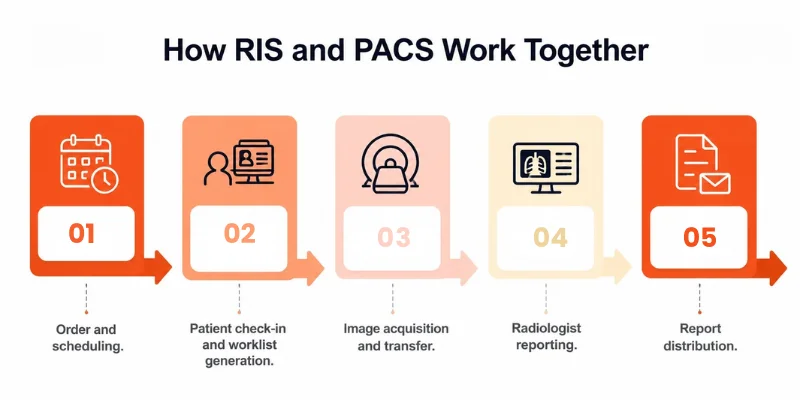
Understanding the workflow makes it obvious why integration quality determines whether these systems actually save time or create more of it.
Order and scheduling. A referring physician orders an imaging study, usually from the hospital's EMR or HIS. The RIS receives that order, checks insurance and referral details, and schedules the patient.
Patient check-in and worklist generation. On the day of the scan, the RIS generates a worklist that's pushed to the imaging modality (the CT or MRI machine itself), so the technologist doesn't have to manually type patient demographics into the scanner.
Image acquisition and transfer. The modality captures the images and sends them, via the DICOM PACS network, into the PACS software for storage and immediate viewing.
Radiologist reporting. The radiologist pulls up the study in the PACS viewer, and — critically — the RIS pulls up the matching worklist entry so the report gets tied to the correct patient record and billing code automatically.
Report distribution. The finalized report flows back out to the referring physician, the EMR, and often the patient portal, closing the loop.
Every one of those five steps depends on RIS and PACS exchanging data in real time using standard protocols—DICOM for images and HL7 or FHIR for the administrative and clinical messaging. When a hospital buys a RIS and PACS from two different vendors without confirming this handshake works out of the box, the radiographer at the start of this article is what happens next.
The Business Case: What a Well-Integrated RIS and PACS Actually Saves You
Hospital administrators evaluating a RIS and PACS purchase are usually asked to justify it in operational terms, not just clinical ones. It helps to be specific about where the return actually shows up.
Radiologist time. When a RIS pushes a clean worklist directly into the PACS viewer, radiologists stop losing minutes per study by manually matching patient records to images. Across a department reading several hundred studies a week, that adds up to meaningful reporting capacity without hiring additional radiologists.
Reduced repeat imaging. A properly archived, vendor-neutral PACS makes prior studies easy to retrieve, which cuts down on unnecessary repeat scans ordered simply because an earlier image couldn't be located in time. Repeat imaging isn't just a cost issue — it's an unnecessary radiation exposure issue for CT and X-ray patients.
Faster turnaround, shorter length of stay. Emergency and inpatient cases depend on fast imaging turnaround to move treatment decisions forward. A radiology workflow management system that automatically prioritizes STAT cases ahead of routine ones directly affects how quickly a trauma or stroke patient gets to the next stage of care.
Lower IT maintenance overhead. Cloud and hybrid PACS software reduces the burden of maintaining on-premise storage hardware, which frees IT staff for higher-value work instead of babysitting server capacity and backup jobs.
Fewer compliance incidents. Automated audit trails and role-based access reduce the manual auditing burden during regulatory inspections, and they reduce the risk of a costly compliance finding tied to inadequate access logging.
None of these gains materialize automatically just because a hospital purchased modern software. They depend entirely on the RIS and PACS being properly integrated with each other and with the rest of the hospital's systems—which circles back to why integration planning deserves as much attention in procurement as the feature list.
Core Features Checklist for a Modern RIS and PACS
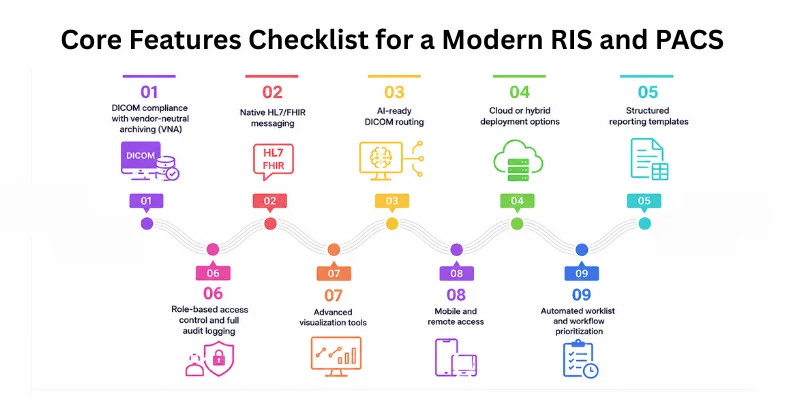
Not every platform marketed as "next-generation" actually qualifies. Here's what genuinely AI-ready medical imaging software should include, based on what UAE hospitals are procuring in 2026:
- DICOM compliance with vendor-neutral archiving (VNA), so images from any modality or previous system can be stored and retrieved without a proprietary lock-in format.
- Native HL7/FHIR messaging, so the RIS can exchange orders, results, and patient demographics with HIS, EMR, and lab systems without custom middleware for every connection.
- AI-ready DICOM routing, meaning images can be automatically sent to third-party AI algorithms for triage (stroke, fracture, and nodule detection) as part of the normal workflow, not a manual export step.
- Cloud or hybrid deployment options, supporting multi-facility groups that need centralized image access across emirates.
- Structured reporting templates, so radiologist output is standardized and machine-readable, not free-text paragraphs that are hard to search or mine for analytics.
- Role-based access control and full audit logging, covering every view, edit, and export action on a patient's imaging record.
- Advanced visualization tools — 3D reconstruction, multi-planar reformatting, and image fusion — built into the viewer rather than requiring a separate application.
- Mobile and remote access, letting radiologists review urgent studies securely from outside the hospital, with the same access controls as on-site.
- Automated worklist and workflow prioritization, so STAT and urgent cases surface ahead of routine studies without manual triage by staff.
- Analytics dashboards covering turnaround time, radiologist productivity, and modality utilization, since hospital administrators increasingly need this data for both operations and compliance reporting.
If a vendor can't clearly demonstrate the first two items — DICOM/VNA compliance and native HL7/FHIR support — everything else on this list is largely irrelevant, because the system won't integrate cleanly with anything else in the hospital regardless of how good its viewer looks in a demo.
A quick word on why vendor-neutral archiving specifically deserves more attention than buyers usually give it. Many legacy PACS platforms store images in a proprietary format, which sounds harmless until a hospital tries to switch vendors five years later and discovers that migrating a decade of imaging history is a six-figure project in itself. A vendor-neutral archive stores images in standard DICOM format regardless of which PACS software is layered on top, which means the hospital owns its imaging data independently of any single vendor relationship. For a multi-facility group planning to grow, this single design choice can be the difference between a smooth future vendor transition and being effectively locked in indefinitely.
Structured reporting deserves the same scrutiny. A radiologist dictating free-text findings produces a report a human can read, but not one a system can easily search, aggregate, or feed into an AI model for quality benchmarking. Structured templates — with discrete fields for findings, measurements, and impressions — make radiology data usable for analytics and research down the line, not just for the single patient encounter it was written for.
Cost Guide: What RIS and PACS Really Cost in the UAE
Pricing for a RIS and PACS deployment in the UAE varies widely based on facility size, number of modalities, deployment model, and how much custom integration work is needed. The table below gives a realistic planning range for 2026, based on typical mid-sized to large UAE hospital deployments.
|
Cost Component |
Small Facility (1–2 modalities) |
Mid-Size Hospital (Multi-modality, single site) |
Multi-Facility Hospital Group |
|
RIS/PACS software licensing (annual) |
AED 60,000 – 150,000 |
AED 200,000 – 450,000 |
AED 500,000 – 1.2M+ |
|
Implementation & configuration |
AED 40,000 – 90,000 |
AED 120,000 – 300,000 |
AED 350,000 – 800,000 |
|
HL7/FHIR & HIS/EMR integration |
AED 30,000 – 70,000 |
AED 100,000 – 250,000 |
AED 300,000 – 700,000 |
|
Data migration (legacy image archive) |
AED 20,000 – 50,000 |
AED 80,000 – 180,000 |
AED 200,000 – 500,000 |
|
Staff training & change management |
AED 10,000 – 25,000 |
AED 30,000 – 70,000 |
AED 80,000 – 150,000 |
|
Ongoing support & maintenance (annual) |
AED 15,000 – 40,000 |
AED 50,000 – 120,000 |
AED 150,000 – 350,000 |
These figures are directional planning ranges, not fixed quotes—actual pricing depends on your existing infrastructure, the number of integration points, cloud vs. on-premise storage needs, and whether AI diagnostic modules are bundled in. What consistently surprises first-time buyers is that integration and migration, not the software license, are usually where costs balloon if they weren't scoped properly upfront. A hospital that budgets AED 200,000 for licensing but skips proper integration scoping often ends up spending more later fixing a system that technically works but doesn't talk to anything else.
A few cost factors worth flagging separately, since they rarely show up on a vendor's initial quote:
Storage costs scale with imaging volume in ways that are easy to underestimate. A single CT study can run into the hundreds of megabytes, and a busy imaging center generating thousands of studies a month needs a realistic multi-year storage projection, not just a snapshot of current usage. Cloud PACS pricing models that charge per gigabyte can look attractive in year one and become a significant recurring cost by year three if volume growth wasn't modeled properly.
AI module licensing is often quoted separately from the core RIS/PACS platform, and per-study or per-algorithm pricing can add up quickly across a busy department. Ask vendors for a clear, itemized breakdown of AI licensing costs at your actual study volume, not a generic per-seat estimate.
Finally, downtime cost is rarely part of a procurement conversation but should be. A radiology department that goes offline during a botched migration isn't just an IT inconvenience — it's a clinical operations problem, with scans potentially rescheduled and referring physicians left waiting on reports. Building a realistic cutover plan, including a fallback period where the old and new systems run in parallel, is worth the extra cost relative to the risk of a hard cutover failure.
Comparison Guide: Traditional PACS vs. AI-Ready Cloud PACS
|
Feature |
Traditional On-Premise PACS |
AI-Ready Cloud PACS |
|
Image storage |
Local servers, limited scalability |
Cloud/hybrid, scales with volume |
|
Multi-facility access |
Difficult, requires VPN/replication |
Native, centralized access |
|
AI algorithm integration |
Manual export/import, slow |
Built-in routing, near real-time |
|
Disaster recovery |
Manual backup processes |
Automated, geo-redundant |
|
Upgrade cycle |
Hardware refresh every 3–5 years |
Continuous software updates |
|
Remote radiologist access |
Limited, often VPN-dependent |
Secure mobile and web access |
|
Interoperability with RIS/HIS/EMR |
Often custom-built, fragile |
Standards-based (HL7/FHIR/DICOM) |
|
Total cost pattern |
Lower upfront, higher hidden maintenance |
Predictable subscription, lower hardware overhead |
The direction of travel across UAE hospital groups is clear: cloud and hybrid PACS deployments are becoming the default, not the exception, especially for any organization operating more than one site. On-premise still has a place for hospitals with strict data residency preferences or existing infrastructure investments they don't want to abandon, but it comes with a maintenance burden that cloud platforms are specifically designed to remove.
UAE Legal, Security & Compliance Requirements for RIS and PACS
Radiology data is patient health information, and in the UAE it sits under the same regulatory scrutiny as any other clinical record — arguably more, given how sensitive imaging data (oncology scans, prenatal imaging, trauma cases) tends to be.
Hospitals evaluating a RIS and PACS need to confirm the platform can demonstrably support the following:
- Data residency and sovereignty requirements. Depending on facility type and emirate, patient imaging data may need to stay within UAE borders or specific approved data center regions. Confirm this with your relevant health authority before signing a cloud PACS contract.
- DoH Abu Dhabi and DHA Dubai health IT standards, which govern how clinical systems must be designed, secured, and reported to regulators. MOHAP sets parallel requirements for facilities under federal jurisdiction.
- Full audit trails covering every access, edit, and export of a patient's imaging record, with timestamps and user identification—not optional, but a base requirement for any regulatory inspection.
- Encryption at rest and in transit for all DICOM images and associated patient metadata.
- Role-based access control, so radiographers, radiologists, referring physicians, and administrative staff each see only what their role requires.
- Data retention policies aligned with UAE record-keeping rules, which can require imaging and reports to be retrievable for years, not months.
- Incident response and breach notification procedures, since a PACS breach involving patient imaging is treated with the same seriousness as any other health data breach under UAE data protection frameworks.
- Software validation documentation, proving the RIS/PACS platform itself has been tested for accuracy and safety before clinical deployment.
Because regulations are enforced somewhat differently across emirates and facility types, compliance should be built into the system's daily configuration—access logs running continuously, retention rules applied automatically—rather than treated as a one-time certification exercise done during go-live and then forgotten.
There's also a legal dimension that hospitals sometimes overlook until a vendor contract is already signed: liability for a data breach or system outage should be explicitly addressed in the procurement agreement, not left to a generic service-level clause. Ask directly who bears responsibility if patient imaging data is exposed due to a vendor-side security failure, and confirm the vendor carries appropriate cyber liability coverage for a healthcare deployment of your scale. For any facility handling patients across multiple emirates, it's also worth confirming with legal counsel whether cross-emirate data transfer between facilities triggers any additional reporting obligations under current health data protection rules, since this can vary by patient consent model and facility licensing.
Where Integration Bottlenecks Actually Come From
This is the section most RIS/PACS buying guides skip, and it's the one that determines whether your procurement succeeds or turns into the re-typing scenario from the intro.
Bottleneck #1: Buying RIS and PACS from separate vendors without a documented interface. Some hospitals choose a "best of breed" RIS from one vendor and a PACS from another, assuming standard protocols will handle the rest. HL7 and DICOM are standards, not guarantees—different vendors implement them with enough variation that a live integration test, not a spec sheet, is the only real proof they'll work together.
Bottleneck #2: Underestimating HIS/EMR integration scope. RIS and PACS rarely live in isolation. They need to exchange orders and results with the hospital's core hospital management system software, and every additional connection point is a place where data can silently fail to sync if it wasn't scoped and tested before go-live.
Bottleneck #3: Legacy data migration treated as an afterthought. Years of archived imaging studies need to migrate into the new PACS in a usable, DICOM-compliant format. Rushed migrations frequently leave gaps—studies that technically transferred but lost associated metadata, making them nearly impossible to find later.
Bottleneck #4: No single point of accountability for integration. When a RIS vendor, a PACS vendor, and the hospital's internal IT team all own a piece of the integration and something breaks, the finger-pointing alone can stall a fix for weeks. One vendor or systems integrator needs to own the end-to-end interoperability outcome.
Bottleneck #5: AI modules bolted on after deployment. Retrofitting AI triage tools onto a RIS/PACS that wasn't architected for structured DICOM routing from day one is far more expensive than building it in from the start—and it often requires re-touching integrations that were already considered "done."
Bottleneck #6: Staff workflow not redesigned alongside the new system. Even a technically flawless RIS/PACS integration can underperform if radiographers and radiologists keep using old manual workarounds out of habit. A go-live plan needs department-specific workflow retraining, not just a generic software walkthrough, or staff will quietly route around the very automation the new system was bought to provide.
The common thread across all six is the same: integration is an engineering deliverable that needs to be scoped, tested, and contractually owned before a single license fee gets paid — not something assumed to work because the vendor's brochure says "fully interoperable." A useful gut check during vendor negotiations: ask exactly which party is financially responsible if the RIS/PACS integration fails its acceptance test after go-live. If nobody has a clear answer, that's the bottleneck waiting to happen.
A 7-Step Procurement Roadmap to Avoid Integration Bottlenecks
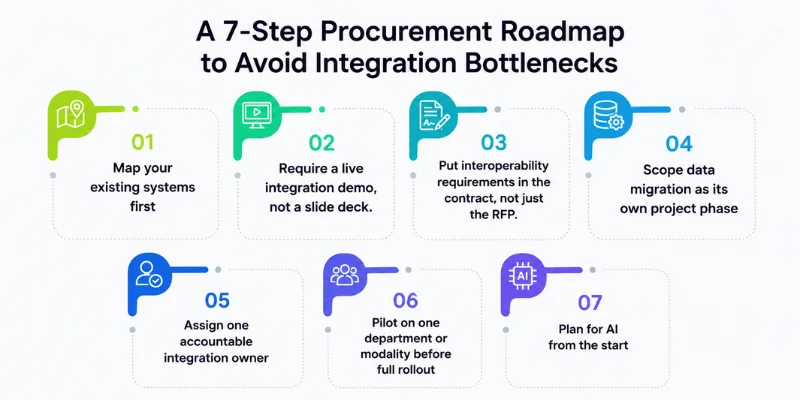
- Map your existing systems first. Document every system your RIS/PACS will need to talk to — HIS, EMR, lab systems, billing, and any AI diagnostic tools already in use or planned.
- Require a live integration demo, not a slide deck. Ask vendors to demonstrate an actual HL7 order flowing from a test HIS into their RIS and a DICOM image flowing into their PACS during the sales process.
- Put interoperability requirements in the contract, not just the RFP. Specific HL7/FHIR versions, DICOM conformance statements, and API documentation should be contractual deliverables with defined acceptance criteria.
- Scope data migration as its own project phase, with a dedicated budget and timeline, rather than folding it into "implementation" as a vague line item.
- Assign one accountable integration owner — either the primary vendor or an independent systems integrator — who is contractually responsible for the end-to-end data flow working correctly.
- Pilot one department or modality before full rollout. A single-modality pilot surfaces integration issues at a manageable scale before they affect the whole radiology department.
- Plan for AI from the start, even if you're not deploying an AI algorithm on day one. Confirm the PACS can route DICOM studies to a third-party AI engine without future re-architecture.
Change Management: Getting Radiology Staff to Actually Use the New System
Procurement teams tend to focus almost entirely on the technical evaluation—DICOM conformance, HL7 versions, uptime guarantees—and treat staff adoption as a training checklist item near the end of the project. That ordering is backwards, and it's a quiet contributor to the same integration bottlenecks discussed earlier, because a system that works perfectly on paper but gets bypassed by frustrated staff produces the same operational failure as a broken interface.
A few practical steps make a measurable difference:
Involve radiographers and radiologists in the vendor demo stage, not just IT and administration. The people who will use the RIS and PACS daily notice usability friction that a procurement committee often misses entirely—an extra click to pull up a prior study or a worklist that doesn't sort the way their department actually triages cases.
Run training in the actual clinical environment, on real (anonymized) workflows, rather than a generic vendor training deck. Staff retain far more from a session built around their department's specific exam types and referral patterns than from a one-size-fits-all product walkthrough.
Keep a visible support channel open for the first several weeks post-go-live specifically for workflow questions, separate from general IT helpdesk tickets. Radiology staff under reporting-volume pressure will often revert to a manual workaround rather than wait in a generic support queue, and every one of those workarounds erodes the value of the new radiology workflow management investment.
Finally, track adoption the same way you'd track a clinical KPI—worklist usage rates, manual override frequency, and time-to-report—for the first quarter after go-live, and treat a stalled adoption curve as a project risk that needs active management, not just a training gap that will resolve itself over time.
Industry Data: Radiology Workflow and Imaging Volume Trends in the UAE
UAE hospitals are managing rising imaging volumes driven by population growth, an expanding medical tourism sector, and preventive screening programs that push more patients through CT, MRI, and mammography pipelines than a decade ago. Multi-Emirate hospital groups are increasingly consolidating radiology operations under a single platform rather than running separate systems per site, largely because centralized reporting and staffing flexibility become nearly impossible otherwise.
Radiologist reporting turnaround time has become a board-level metric in many UAE hospital groups, not just a departmental one, because delayed imaging reports directly affect length-of-stay and downstream treatment decisions. This is part of why radiology workflow management tools with built-in analytics—turnaround time dashboards and modality utilization tracking—have moved from "nice to have" to a standard procurement requirement.
At the same time, UAE hospitals are folding radiology procurement into broader digital transformation and resource-planning conversations. A healthcare ERP for UAE hospitals initiative, for example, increasingly needs to account for radiology equipment utilization, staffing, and consumables alongside the rest of hospital operations rather than treating imaging as a siloed department with its own separate budget conversation.
Staffing is another pressure point worth naming directly. The UAE, like most of the region, has a limited pool of subspecialty radiologists—neuroradiology, musculoskeletal imaging, and breast imaging—relative to demand. A well-integrated RIS and PACS with secure remote access lets a hospital group route a complex case to the right subspecialist regardless of which physical site the patient was scanned at, effectively pooling scarce radiologist expertise across a network instead of limiting it to whoever happens to be on-site that day. This kind of workload distribution is only possible when the underlying radiology information system UAE hospitals run supports secure, low-latency remote viewing—another reason integration architecture matters more than any single feature on a spec sheet.
Imaging equipment utilization data is also becoming a budgeting input in its own right. Hospital finance teams are increasingly asking radiology leadership to justify capital equipment purchases—an additional CT scanner, a new MRI suite—using actual utilization and turnaround time data pulled from the RIS/PACS analytics layer, rather than anecdotal capacity complaints. Departments running a modern RIS and PACS with built-in reporting dashboards are simply better positioned to make that case with hard numbers.
RIS/PACS and the Wider Hospital Tech Stack
A RIS and PACS deployment doesn't exist in isolation, and hospitals that treat it as a standalone radiology project tend to run into exactly the bottlenecks described earlier. The imaging layer needs to sit inside a coherent digital ecosystem:
It exchanges orders and results with the hospital's core HIS and EMR continuously. It shares patient identifiers and billing codes with revenue cycle systems. And in facilities running connected diagnostic services, radiology data increasingly needs to align with lab workflows too — a patient's imaging and lab results often inform the same clinical decision, and disconnected systems make that correlation harder than it needs to be. If your facility already runs a Laboratory Information System UAE platform, confirming that RIS/PACS and LIS can share a common patient record is worth raising directly with both vendors during procurement.
Vendors that build healthcare software in Dubai with genuine UAE regulatory experience tend to understand this interconnected reality better than international vendors parachuting in a global product with a UAE compliance patch bolted on. This is worth probing directly in vendor conversations: ask how many UAE-based hospital integrations they've actually delivered, not just sold.
Future Trends: AI, Interoperability & Intelligent Imaging Ecosystems
Radiology is one of the clearest examples of where AI is moving from pilot project to standard infrastructure across UAE healthcare. A few trends are shaping procurement decisions heading into the next few years:
AI-assisted triage is becoming table stakes rather than a premium add-on, particularly for stroke, fracture, and pulmonary nodule detection, where speed directly affects patient outcomes. Cloud-native PACS architectures are increasingly the default for any multi-site deployment, since retrofitting cloud capability onto an on-premise system later is far costlier than building it in from the start. Radiologists are also starting to work across facilities more fluidly, supported by secure remote access, which changes how hospital groups think about staffing and coverage models entirely.
More broadly, radiology is being pulled into the same conversation as the rest of the hospital's digital roadmap. UAE hospital groups building intelligent healthcare ecosystems UAE initiatives are treating RIS/PACS interoperability as one thread in a much larger fabric that includes HIS, LIS, pharmacy, and patient engagement platforms — not a department-level IT purchase anymore.
Digital pathology integration, predictive analytics for imaging demand, and generative AI support for structured reporting are all moving from research conversations into actual UAE hospital procurement discussions in 2026. Hospitals that build an open, standards-based RIS/PACS foundation now are the ones positioned to adopt each of these without another expensive re-architecture down the line.
How to Choose the Right RIS/PACS Vendor — Buyer's Checklist
Use this as a working checklist during vendor evaluation, not just a reference list:
- Can the vendor demonstrate live HL7/FHIR and DICOM integration during the sales process, not just describe it?
- Does the platform support vendor-neutral archiving, so you're not locked into proprietary image formats?
- Is there a documented, testable path for routing DICOM studies to third-party AI diagnostic tools?
- What UAE-specific compliance certifications or deployments can they point to, specifically in Abu Dhabi, Dubai, or federal MOHAP facilities?
- Who owns integration accountability contractually — the vendor, a systems integrator, or your internal IT team?
- What does the data migration process look like for your existing archived studies, and what's the realistic timeline?
- Is deployment cloud, on-premise, or hybrid, and does that match your data residency requirements?
- What's the actual support model for critical issues—response time, escalation path, on-ground UAE presence?
- How does the vendor handle future upgrades and evolving UAE compliance requirements without a full re-implementation?
- What's the total cost of ownership over five years, not just the first-year licensing fee?
Treat this checklist as the backbone of your RFP evaluation criteria, not a set of questions to ask casually in a sales call. Vendors who answer confidently and specifically—with named UAE facility examples, actual conformance documentation, and a clear integration ownership model—are giving you very different signals than vendors who respond with general reassurances about being "fully compliant" or "seamlessly interoperable" without backing it up.
It's also worth running at least two vendors through the same reference-check process: ask for a UAE hospital reference of a similar size and modality mix to yours, and actually call them. Ask that reference specifically about their integration experience—not just whether they're happy with the software, but how long the RIS/PACS integration took to stabilize after go-live and what unexpected costs came up along the way. This single step surfaces more real information than almost anything in the sales process itself.
Conclusion
The technology behind a modern RIS and PACS isn't the hard part anymore—DICOM, HL7, and FHIR are mature, well-understood standards, and most credible vendors can deliver a capable viewer and a solid worklist. What separates a successful deployment from a costly, frustrating one is whether integration was treated as a core procurement requirement from the very first vendor conversation or as an assumption that got tested for the first time during go-live week.
UAE hospitals that get this right end up with a radiology department that runs faster, reports more accurately, and is genuinely ready to adopt AI triage tools as they mature—without another disruptive system overhaul in two years. The ones that don't end up with radiographers manually re-typing patient IDs between two systems that were each individually excellent and collectively broken.
If your hospital or diagnostic group is planning a RIS and PACS procurement and wants a second set of eyes on the integration architecture before you sign anything, SISGAIN's healthcare technology team has worked through exactly these scenarios across UAE hospital deployments. A conversation now costs nothing and can save months of rework later—reach out to discuss your radiology infrastructure roadmap.