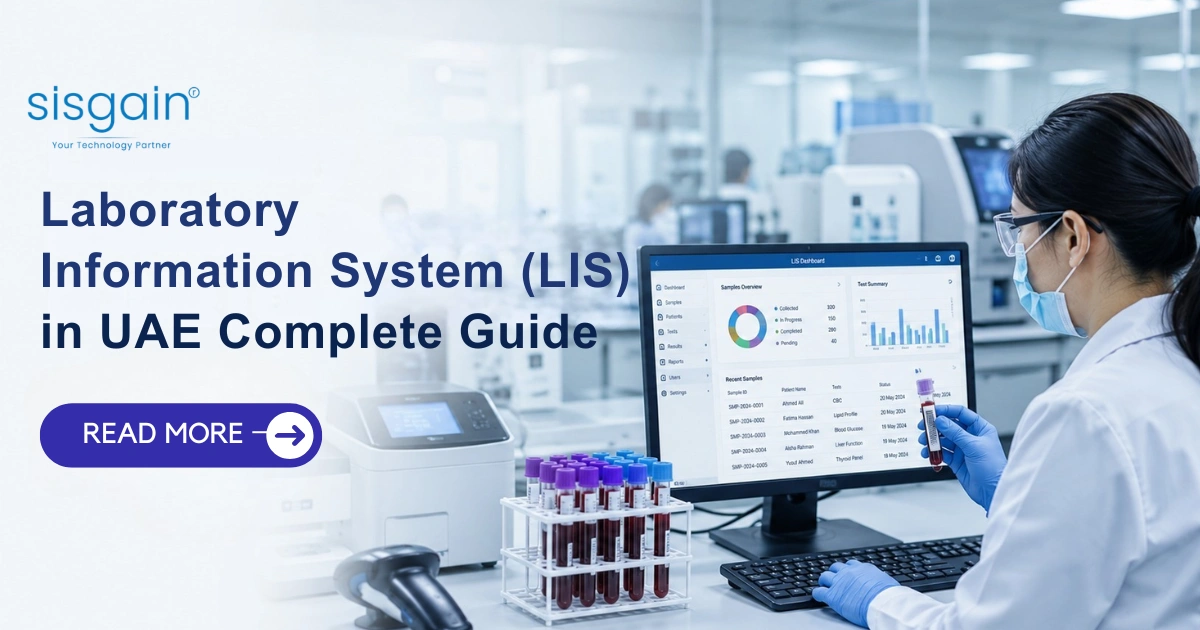

The UAE's healthcare sector is moving through one of the fastest digital transformations in the region, and diagnostic laboratories sit right at the center of that shift. Federal health authorities, private hospital groups, and independent diagnostic chains are all under pressure to process higher testing volumes, meet stricter regulatory expectations, and share results instantly across care teams — often across multiple emirates and facilities at once.
Manual, paper-based lab workflows simply cannot keep pace with this. Rising patient volumes, tighter data protection rules, and the UAE's push toward interoperable, connected healthcare systems have made the Laboratory Information System (LIS) a foundational piece of infrastructure rather than a "nice-to-have" upgrade.
Today, laboratories operating in the UAE are expected to deliver:
- Faster diagnosis and shorter turnaround times
- Higher accuracy with fewer manual errors
- Secure, auditable patient records
- Seamless interoperability with smart hospitals, clinics, and government health platforms
- Continuous regulatory compliance, not a one-time certification
This guide walks through what a Laboratory Information System is, how it works, why UAE laboratories need one, the compliance landscape it operates in, and how to choose the right platform for a growing healthcare organization.
What is a Laboratory Information System (LIS)?
A Laboratory Information System (LIS) is a specialized software platform built to manage every stage of laboratory operations digitally — sample intake, test ordering, analyzer communication, result validation, reporting, and long-term data storage.
In a traditional, manual lab environment, technicians rely on paper requisitions, handwritten logs, and manual data entry between the analyzer and the report. This approach is slow, error-prone, and nearly impossible to audit at scale. An LIS replaces these manual touchpoints with an automated, end-to-end digital workflow, so every specimen is tracked by a unique identifier from the moment it enters the lab until the final report is signed off.
Beyond automation, an LIS acts as a centralized information hub. It consolidates patient data, test history, quality control records, and audit logs in one system, and it connects that information outward — to hospital systems, referring clinicians, and national health data exchanges — enabling true healthcare interoperability rather than isolated, department-level record-keeping.
(Illustration placeholder: end-to-end laboratory lifecycle — sample registration → test ordering → analyzer integration → result validation → report generation → record storage.)
Why Laboratory Information Systems Matter in UAE Healthcare
The UAE's healthcare system has moved rapidly toward digital hospitals, unified electronic health records, and connected diagnostic networks. Laboratories that still rely on manual processes are increasingly the weak link in an otherwise digital care journey.
Several forces are driving LIS adoption across the country:
- Healthcare modernization — UAE hospitals and clinics are digitizing records, imaging, and diagnostics as standard practice, not as pilot projects.
- Growing diagnostic demand — population growth, medical tourism, and expanded preventive screening programs are pushing lab volumes higher every year.
- Multi-location laboratory networks — many diagnostic groups now operate across several emirates, requiring centralized visibility rather than siloed, per-branch systems.
- Government digital health initiatives — national programs promoting electronic health records and health information exchange are effectively making digital lab data a baseline expectation.
- Patient safety expectations — regulators and patients alike now expect traceable, error-resistant diagnostic processes.
- Standardized workflows — an LIS enforces consistent protocols across shifts, staff, and locations, reducing variation in quality.
As a result, laboratories are shifting from being a back-office support function to becoming a strategic, revenue-generating, and compliance-critical part of the healthcare organization.
How a Laboratory Information System Works
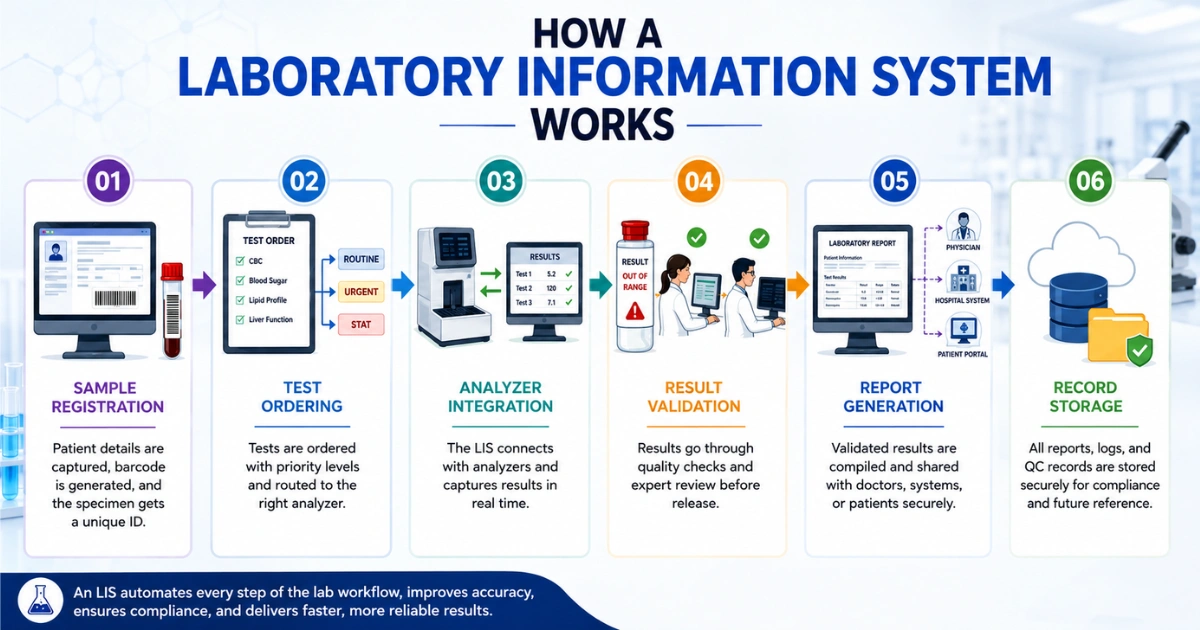
An LIS manages the laboratory workflow as a connected sequence of stages. Understanding each stage helps clarify exactly where automation removes manual risk.
Sample Registration
Every specimen begins with digital registration: patient demographics are captured or pulled from the hospital system, a barcode is generated, and the specimen is accessioned with a unique identifier that follows it through every subsequent step.
Test Ordering
Once registered, tests are ordered based on department requests. The LIS applies priority levels (routine, urgent, STAT) and can apply rule-based routing to send samples automatically to the correct workstation or analyzer.
Analyzer Integration
The LIS communicates directly with laboratory analyzers, capturing results in real time as tests are completed. This bidirectional integration removes manual transcription between machine and record, which is one of the largest sources of lab error.
Result Validation
Before a result is released, it passes through quality checks, technologist review, and — where required — pathologist approval. Auto-verification rules can flag abnormal or out-of-range values for mandatory human review.
Report Generation
Once validated, results are compiled into structured digital reports that can be shared electronically with referring physicians, hospital systems, or directly with patients through secure portals.
Record Storage
Every report, audit log, and quality control record is retained for the compliance period required by UAE health regulations, creating a complete, searchable historical archive for future reference or audit.
Core Features of a Modern Laboratory Information System
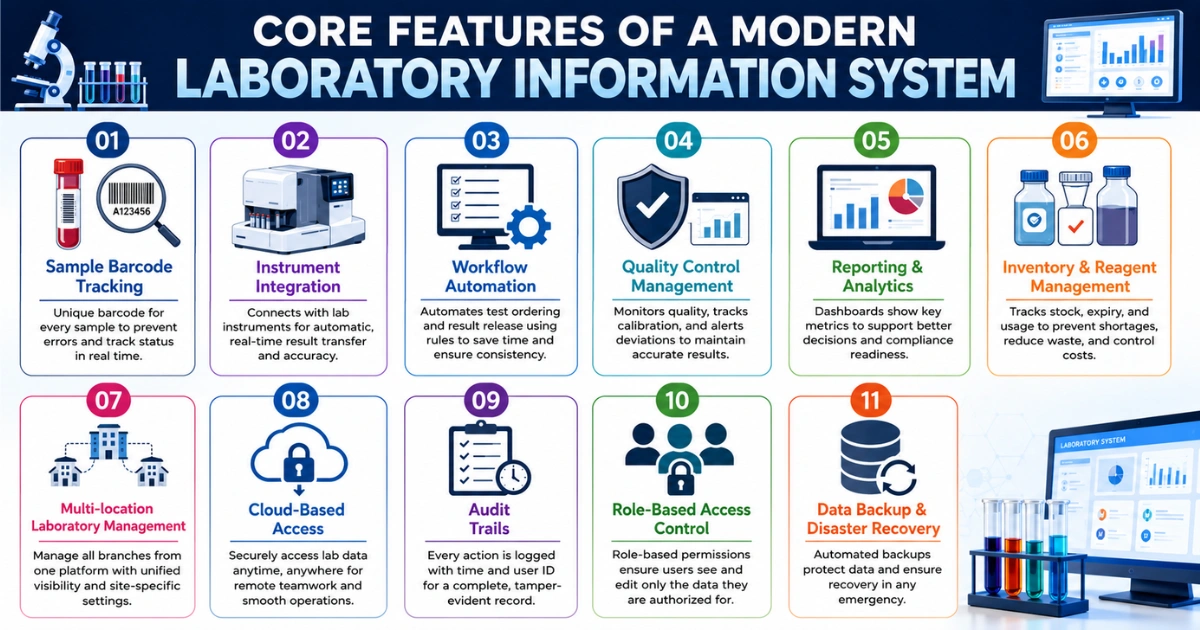
Sample Barcode Tracking
Barcode-based tracking assigns a unique identifier to every specimen at the point of collection. This eliminates manual labeling errors, prevents specimen mix-ups, and allows staff to trace a sample's exact location and status at any point in the workflow — a fundamental requirement for both efficiency and patient safety.
Instrument Integration
Modern LIS platforms connect directly with laboratory analyzers and diagnostic equipment, enabling automatic, real-time transfer of results. This reduces manual data entry, shortens turnaround time, and minimizes the risk of transcription errors that can affect diagnostic accuracy.
Workflow Automation
From test ordering to result release, an LIS automates repetitive administrative steps using configurable rules. This frees lab staff to focus on quality control and complex cases rather than manual paperwork, while ensuring every sample follows a consistent, standardized process.
Quality Control Management
Built-in quality control modules track calibration schedules, control ranges, and analyzer performance over time. Automated alerts flag deviations before they affect patient results, supporting the continuous quality assurance that UAE laboratory accreditation standards require.
Reporting & Analytics
Dashboards and analytics tools give lab managers visibility into turnaround times, staff productivity, test volumes, and error rates. This data supports operational decision-making and provides the documentation needed for compliance and accreditation reviews.
Inventory & Reagent Management
An LIS tracks reagent stock levels, expiry dates, and consumption patterns, automatically flagging low stock or expired materials. This reduces waste, prevents testing delays caused by stockouts, and improves budget planning for lab consumables.
Multi-location Laboratory Management
For diagnostic groups operating across multiple emirates or facilities, a centralized LIS provides unified visibility into all branches from a single platform, standardizing protocols while still allowing site-specific configuration where needed.
Cloud-Based Access
Cloud-deployed LIS platforms allow authorized staff, referring physicians, and administrators to securely access lab data from any location, supporting remote consultation, multi-site operations, and business continuity.
Audit Trails
Every action within the system — from sample registration to result modification — is logged with a timestamp and user ID. This creates a complete, tamper-evident audit trail that is essential for regulatory inspections and internal quality reviews.
Role-Based Access Control
Access permissions are assigned based on staff role, ensuring technicians, pathologists, and administrators only see and modify the data relevant to their responsibilities. This protects patient confidentiality and supports compliance with data protection requirements.
Data Backup & Disaster Recovery
Automated backup and disaster recovery protocols protect laboratory data against loss from hardware failure, cyberattacks, or system outages, ensuring continuity of critical diagnostic records at all times.
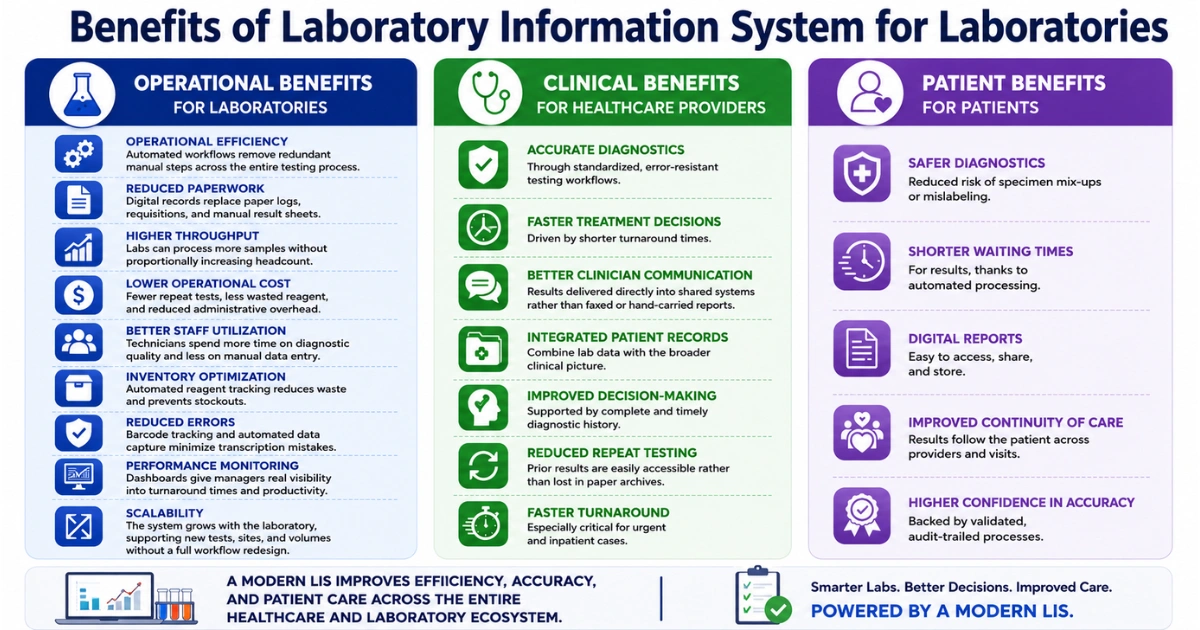
Benefits of Laboratory Information System for Laboratories
A well-implemented LIS delivers measurable operational gains:
- Operational efficiency — automated workflows remove redundant manual steps across the entire testing process.
- Reduced paperwork — digital records replace paper logs, requisitions, and manual result sheets.
- Higher throughput — labs can process more samples without proportionally increasing headcount.
- Lower operational cost — fewer repeat tests, less wasted reagent, and reduced administrative overhead.
- Better staff utilization — technicians spend more time on diagnostic quality and less on manual data entry.
- Inventory optimization — automated reagent tracking reduces waste and prevents stockouts.
- Reduced errors — barcode tracking and automated data capture minimize transcription mistakes.
- Performance monitoring — dashboards give managers real visibility into turnaround times and productivity.
- Scalability — the system grows with the laboratory, supporting new tests, sites, and volumes without a full workflow redesign.
Clinical Benefits for Healthcare Providers
For physicians and clinical teams, a connected LIS translates into better patient care:
- Accurate diagnostics through standardized, error-resistant testing workflows.
- Faster treatment decisions driven by shorter turnaround times.
- Better clinician communication, with results delivered directly into shared systems rather than faxed or hand-carried reports.
- Integrated patient records that combine lab data with the broader clinical picture.
- Improved decision-making, supported by complete and timely diagnostic history.
- Reduced repeat testing, since prior results are easily accessible rather than lost in paper archives.
- Faster turnaround, which is especially critical for urgent and inpatient cases.
Patient Benefits
Patients experience the impact of a modern LIS directly, even if they never see the software itself:
- Safer diagnostics, with reduced risk of specimen mix-ups or mislabeling.
- Shorter waiting times for results, thanks to automated processing.
- Digital reports that are easy to access, share, and store.
- Improved continuity of care, as results follow the patient across providers and visits.
- Higher confidence in test accuracy, backed by validated, audit-trailed processes.
UAE Compliance Requirements for Laboratory Information Systems
Laboratories operating in the UAE must align their LIS with a layered set of regulatory expectations rather than a single fixed checklist. Broadly, these requirements span:
- Federal healthcare ICT regulations governing how health information systems must be designed, secured, and operated.
- Patient data protection rules requiring strict controls over how personal health information is stored, accessed, and shared.
- Health information exchange requirements that increasingly expect laboratories to connect with national and emirate-level health data platforms.
- Laboratory quality standards, often aligned with international accreditation frameworks, that govern testing accuracy and process consistency.
- Data retention rules specifying how long lab records, reports, and audit logs must be securely stored.
- Confidentiality obligations covering patient identity and clinical information at every stage of the workflow.
- Audit documentation requirements that demand a traceable record of who accessed or modified any piece of data, and when.
- Software validation expectations, ensuring the LIS itself has been tested and verified for accuracy before clinical use.
- Emirate-level healthcare governance, since individual emirates may layer additional requirements on top of federal rules.
Because regulations evolve and are enforced differently across sectors and emirates, LIS compliance should be treated as a continuous operational process — built into daily workflows and system configuration — rather than a one-time implementation milestone.
Essential Compliance Features Every UAE LIS Should Include
When evaluating an LIS for regulatory readiness, laboratories should look for:
- Role-based permissions to restrict data access by job function
- Encryption for data at rest and in transit
- Audit logs covering every system action, user, and timestamp
- Electronic signatures for result approval and sign-off
- Data retention controls aligned with UAE record-keeping requirements
- Backup systems with tested disaster recovery procedures
- Result traceability from sample collection through final report
- Critical value notifications to ensure urgent results reach clinicians immediately
- Incident management workflows for tracking and resolving data or process issues
- Standardized coding (such as LOINC) for consistent, interoperable test naming
- Secure APIs for safe data exchange with other health systems
- Multi-language reporting to support the UAE's diverse patient population
Integrating LIS with Other Healthcare Systems
An LIS delivers its full value only when it's connected to the broader healthcare technology ecosystem rather than operating as an isolated department tool. Key integration points include:
- Hospital Information System — synchronizing lab orders and results with the hospital's core operational platform.
- Hospital Software — connecting lab workflows with broader digital hospital operations.
- EHR/EMR Software — feeding lab results directly into the patient's electronic health record for a complete clinical picture.
- Health Information Exchange (HIE) — enabling secure data sharing across providers, facilities, and government health platforms.
- HL7 & FHIR Integration Services — using standardized healthcare data exchange protocols so systems from different vendors can communicate reliably.
- PACS/RIS — coordinating diagnostic imaging data alongside laboratory results for a unified diagnostic view.
- Pharmacy systems — supporting medication management decisions informed by lab data.
- Billing systems — automating charge capture based on completed tests.
- ERP System in Healthcare — linking lab operations with broader resource planning and inventory management.
- Government healthcare exchanges — supporting compliance with national digital health reporting requirements.
Seamless integration across these systems eliminates data silos, reduces duplicate data entry, and enables genuinely coordinated care — where every provider involved in a patient's treatment has access to the same accurate, up-to-date diagnostic information.
Common Challenges Without an LIS
Laboratories still relying on manual or fragmented systems typically face:
- Manual paperwork that slows every stage of the testing process
- Lost specimens due to inconsistent labeling and tracking
- Duplicate testing caused by inaccessible or incomplete historical records
- Long turnaround times from manual data entry and result compilation
- Compliance risks from incomplete audit trails and inconsistent documentation
- Inventory waste from untracked reagent stock and expiry dates
- Human errors in transcription between analyzers, logs, and reports
- Limited visibility into lab performance, bottlenecks, and staff productivity
- Poor reporting capabilities that make trend analysis and quality reviews difficult
- Scalability issues as test volume or facility count grows beyond what manual processes can support
Future Trends in Laboratory Information Systems
Laboratory technology continues to evolve quickly, and UAE healthcare organizations are well-positioned to adopt these trends early:
- Artificial Intelligence for anomaly detection and result interpretation support
- Predictive analytics to forecast test volumes and staffing needs
- Cloud-native laboratories built for scalability and remote access from the ground up
- Automation extending further into pre- and post-analytical workflow stages
- IoT-enabled analyzers that communicate continuously with the LIS in real time
- Digital pathology integrating imaging-based diagnostics into the same digital workflow
- Interoperability expanding further across regional and national health data networks
- Cybersecurity becoming a core design requirement, not an add-on feature
- Remote laboratory management enabling oversight of multi-site operations from a single dashboard
- Business intelligence dashboards turning raw lab data into actionable operational insight
- Generative AI for reporting, assisting with structured, clear report drafting
- Digital twins for laboratory operations, allowing simulation-based process optimization before changes are deployed
How to Choose the Right Laboratory Information System
Selecting an LIS is a long-term infrastructure decision. Use this checklist when evaluating vendors:
- Scalability — can it grow with test volume, staff, and additional locations?
- Compliance readiness — does it support UAE-specific audit, retention, and data protection requirements?
- Integration capabilities — does it connect cleanly with HIS, EHR/EMR, HL7/FHIR, and billing systems?
- Cloud deployment — does it offer secure, reliable remote access?
- Vendor experience — has the vendor deployed LIS platforms in similar healthcare environments before?
- Support services — what are the response times and support model for critical issues?
- Customization — can workflows be configured to match your lab's specific protocols?
- Cybersecurity — what encryption, access control, and monitoring capabilities are built in?
- Implementation methodology — is there a clear, staged rollout plan to minimize disruption?
- Training — what onboarding and ongoing training resources are provided for staff?
- Future upgrades — how does the vendor handle updates, new features, and evolving compliance needs?
- Total cost of ownership — beyond licensing, what are the implementation, integration, and maintenance costs? For context on planning technology investments, see this overview of software development cost in 2026.
Traditional Lab vs. Modern LIS: At a Glance
|
Feature |
Traditional Lab |
Modern LIS |
|
Sample Tracking |
Manual |
Automated |
|
Reporting |
Paper-Based |
Digital |
|
Compliance |
Difficult |
Simplified |
|
Audit Trails |
Limited |
Complete |
|
Analyzer Integration |
None |
Real-Time |
|
Turnaround Time |
Longer |
Faster |
|
Errors |
Higher |
Significantly Lower |
|
Multi-site Management |
Difficult |
Centralized |
Conclusion
UAE laboratories are becoming digital-first by necessity, not by trend. Rising diagnostic volumes, multi-site operations, and a healthcare system that is rapidly moving toward full interoperability all point in the same direction: manual, paper-based lab workflows are no longer sustainable.
A modern Laboratory Information System addresses this directly — driving operational excellence, strengthening compliance, improving patient safety, and connecting laboratories seamlessly with the hospitals, clinics, and health information networks they serve. It transforms the laboratory from a back-office function into a strategic, future-ready part of the healthcare organization.
For healthcare organizations planning their next stage of growth, adopting a compliance-ready, fully interoperable LIS isn't just an operational upgrade — it's a foundational investment in long-term regulatory confidence and patient trust. If your laboratory is ready to move toward a modern, compliant, and connected LIS, now is the time to start planning that transition.