
A payments fintech signs a corporate customer on a Tuesday. The identity documents pass, the sanctions screen is clear, and the account is live by Wednesday. Three months later the customer's payment pattern looks nothing like the profile captured at onboarding: more counterparties, faster movement of funds, new jurisdictions. The analyst reviewing the alert can see the transactions, but the KYC file sits in another system, the beneficial-ownership evidence is a scanned PDF, and nobody can say whether this customer was ever rated high-risk.
That is an illustrative scenario, not a client case. It is also the most common shape of AML weakness in fast-growing fintechs: every control works on its own, and the gaps sit between them.
This is why fintech AML compliance in Dubai is a product, operations and governance problem before it is a regulatory formality. The law sets the outcomes: a documented risk assessment, due diligence, ongoing monitoring, suspicious-transaction reporting and retrievable records. Whether you can deliver them at scale depends on how onboarding, screening, monitoring, case handling and reporting are designed and connected. Those decisions are cheapest to get right before the build, which is why they belong in the same conversation as fintech application development rather than being bolted on afterwards.
This guide covers the current UAE framework, what good KYC and monitoring look like, how goAML reporting works, and how to scope and buy the technology. It reflects the position on 28 October 2026. It is general information, not legal advice.
Quick Answers: Fintech AML Compliance in Dubai
Which regulator oversees fintech AML in Dubai? It depends on your licence and location. The Central Bank of the UAE (CBUAE) supervises licensed financial institutions in its perimeter, the Dubai Financial Services Authority (DFSA) supervises firms in the DIFC, and the Virtual Assets Regulatory Authority (VARA) supervises virtual-asset firms in Dubai outside the DIFC. Most fintechs answer to one of them, not all three.
What is the current AML law? Federal Decree-Law No. 10 of 2025, in force since 14 October 2025, replaced the 2018 law. Its executive regulations are Cabinet Resolution No. 134 of 2025. The DFSA aligned its AML Module with this framework from 2 March 2026.
Does KYC end at onboarding? No. The executive regulations require ongoing scrutiny of transactions against what you know about the customer, and keeping due-diligence records up to date, with particular attention to high-risk customers.
When must a firm file a suspicious transaction report? When it suspects, or has reasonable grounds to suspect, that a transaction, an attempted transaction or funds relate to a crime, regardless of value. The report goes to the UAE FIU immediately and without delay. An internal alert is not automatically a report.
Is AI better than rules for transaction monitoring? Not automatically. A well-governed rules engine can beat an opaque model. The right choice depends on risk, data quality, volumes and how well you can explain decisions.
How long must records be kept? Under Cabinet Resolution No. 134, not less than five years, with start dates that vary by record type. VARA's rulebooks set their own longer period in the provisions reviewed for this article. Check the rule that applies to your licence.
Understanding the AML Regulatory Landscape in Dubai
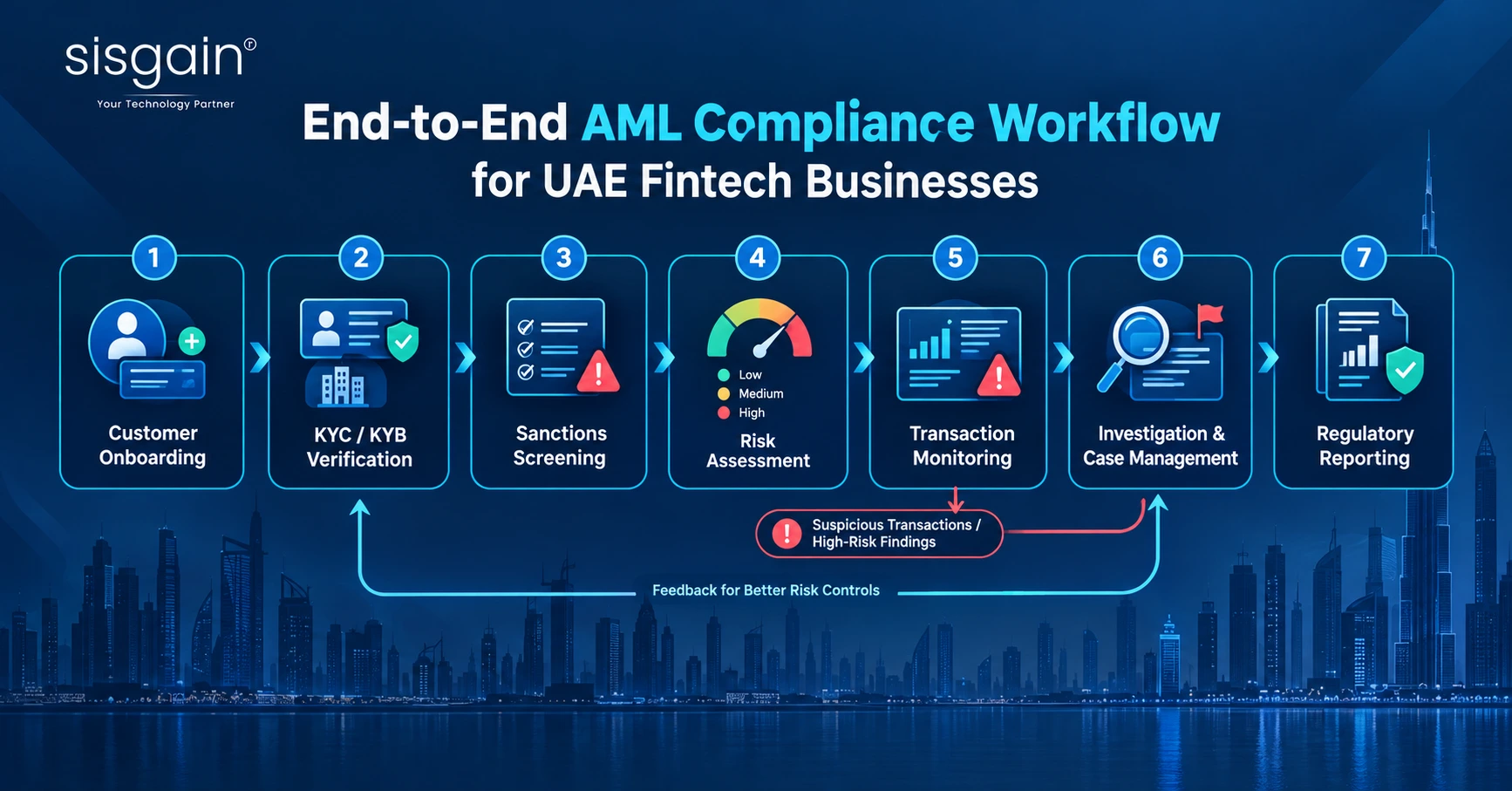
Start with the legal baseline, because it moved recently. Federal Decree-Law No. 10 of 2025, on anti-money laundering and combating the financing of terrorism and proliferation financing, repealed Federal Decree-Law No. 20 of 2018. The CBUAE Rulebook now lists the 2018 law as repealed. The detailed rules sit in Cabinet Resolution No. 134 of 2025, which replaced the 2019 executive regulations. Any guide still treating the 2018 law or the 2019 regulations as current is out of date.
Federal law sets the baseline for financial institutions, designated non-financial businesses and professions, and virtual-asset service providers. Individual regulators then add their own rules. That layering is why the first question is always who supervises you.
CBUAE and regulated financial activities
The executive regulations define financial institutions by activity. The list includes money or value transfer services and the issuance and management of means of payment, such as cards and electronic money (Article 2). A fintech carrying out those activities under a CBUAE licence is supervised by the CBUAE for AML purposes. Wire-transfer rules apply too: originator and beneficiary information must travel with transfers, and the regulations set specific thresholds, including AED 3,500 for wire-transfer verification and due-diligence triggers.
DFSA and DIFC fintechs
Firms licensed in the DIFC follow the DFSA Rulebook's AML Module. The DFSA's updated AML and Glossary Modules came into force on 2 March 2026 to align with the federal legislation, and the DFSA published FAQs covering governance, risk assessments, digital onboarding, outsourcing and internal audit. A further rule-making instrument, No. 432 of 2026, took effect on 1 April 2026, so work from the current consolidated module rather than a March snapshot.
VARA and virtual-asset businesses
VARA's jurisdiction covers virtual-asset activity across Dubai, including free zones, but excluding the DIFC. Its Compliance and Risk Management Rulebook covers AML/CFT, customer due diligence, record keeping and transaction monitoring. The federal regulations add virtual-asset specifics, including requirements to obtain and transmit originator and beneficiary information, such as wallet addresses, with transfers (Article 36). Retention is where VARA differs visibly: its rulebook provisions I reviewed set an eight-year period for books and records, longer than the federal five-year floor.
The UAE FIU and goAML
The UAE Financial Intelligence Unit is the national centre for receiving suspicious transaction reports, analysing them and passing results to law enforcement (Article 44). Keep the two roles separate. Your supervisor examines whether your controls are adequate. The FIU receives your reports. A firm can have a clean supervisory record and still file poor-quality reports, and the FIU can send quality concerns to supervisors.
How to establish your regulatory perimeter
Before designing anything, write down four facts: the exact licence or registration you hold, the regulated activities it covers, where you are licensed (DIFC, Dubai outside the DIFC, or elsewhere in the UAE), and whether you sit inside a group with its own AML programme. Then confirm with qualified counsel which rulebooks apply. Abu Dhabi's ADGM has its own regulator and rules; SISGAIN's guide to ADGM and CBUAE compliance for fintech apps in Abu Dhabi covers that side.
If you want to turn this into a working document, the perimeter facts above plus Articles 5, 21 and 22 of Cabinet Resolution No. 134 (risk assessment, internal policies, compliance officer) make a sound requirements checklist for any software scoping exercise.
KYC Automation in the UAE: Beyond Identity Verification
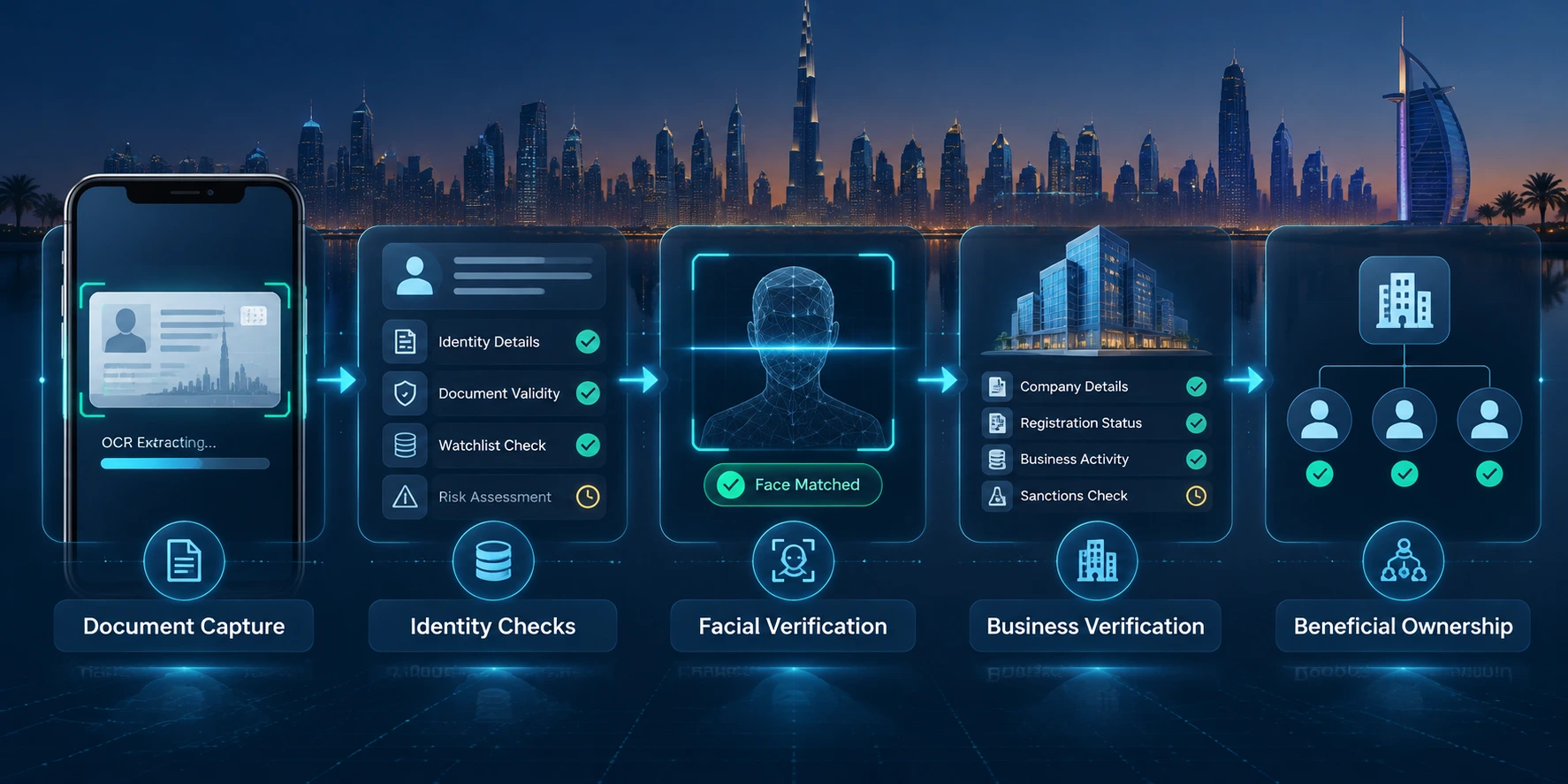
KYC is a customer-lifecycle process. Collecting a passport and a selfie is one step in it. The regulations treat due diligence as something you apply at the start of a relationship, when you suspect a crime, when you doubt earlier data, and continuously afterwards (Articles 7 and 8). Software that only handles the first screen automates the easy part.
Digital identity verification
For individuals, the regulations require identity details such as name as shown on the identity document, nationality, address and date and place of birth, verified from a reliable and independent source (Article 9). Verification must happen before or during the establishment of the relationship. Deferral is allowed only for low-risk cases, as soon as possible, where it is necessary not to disrupt normal business and with effective risk controls (Article 6). In product terms, a let-them-in-now, verify-later funnel is defensible for a narrow low-risk segment, not as a default.
Typical automation here includes document capture and data extraction, authenticity checks, and, where appropriate, face matching and liveness detection. None of it removes the need for a review path for low-confidence results. SISGAIN's digital identity verification and KYC workflow work is built around that principle: clear cases move forward, exceptions go to people.
Business verification and KYB
For companies, the regulations ask for legal form, constitutional documents, registered address, tax registration where relevant and the names of senior management. You must also verify that the person acting for the company is authorised, and understand the customer's business and its ownership and control structure (Article 9). KYB tooling can pull registry data, but the workflow still needs places for analysts to resolve mismatches.
UBO identification and verification
For legal persons, you identify the natural person holding 25% or more. Where there is doubt, or no one holds that much, you identify whoever exercises control by other means. If still none, you identify the relevant senior manager (Article 10). The regulations define accurate information as information verified against reliable, independent sources, so a customer's own declaration is a starting point, not proof. Design the data model to hold the ownership chain, the evidence for each link and the date it was verified.
Sanctions, PEP and adverse-media screening
The regulations require systems to determine whether a customer or beneficial owner is a politically exposed person, with senior-management approval, source-of-funds and source-of-wealth checks and enhanced monitoring for foreign PEPs (Article 16). Targeted financial sanctions follow instructions from the competent authorities. Screening should run at onboarding, on list updates and when customer data changes. Adverse-media screening is a common risk-based addition, but it generates judgement calls, not binary results.
Risk scoring and enhanced due diligence
Risk assessment must weigh customer, geography, product, service, transaction and delivery-channel factors (Article 5). Enhanced due diligence can include extra information on identity and the purpose of the relationship, more frequent updates, source-of-funds checks, more intense monitoring and senior-management approval. A scoring model helps, but it must be explainable, and higher-risk decisions need a human owner.
Periodic reviews and ongoing KYC
Records must stay current, with particular emphasis on high-risk categories (Article 8). A calendar-driven review is the floor. Better designs add event triggers: a change in ownership, a new jurisdiction in payment flows, a jump in volume, a sanctions-list change.
Illustrative scenario: document collection versus lifecycle KYC. Fintech A stores onboarding documents and a risk rating, then never looks at them again. Fintech B writes the risk rating, ownership evidence and expected activity profile into structured fields that its monitoring engine reads. When a customer's flows diverge from that profile, an alert reaches an analyst with the KYC context attached, and the outcome updates the rating. The two firms may have identical onboarding screens. Only one can show a supervisor that due diligence is continuing.
Transaction Monitoring Software for UAE Fintechs
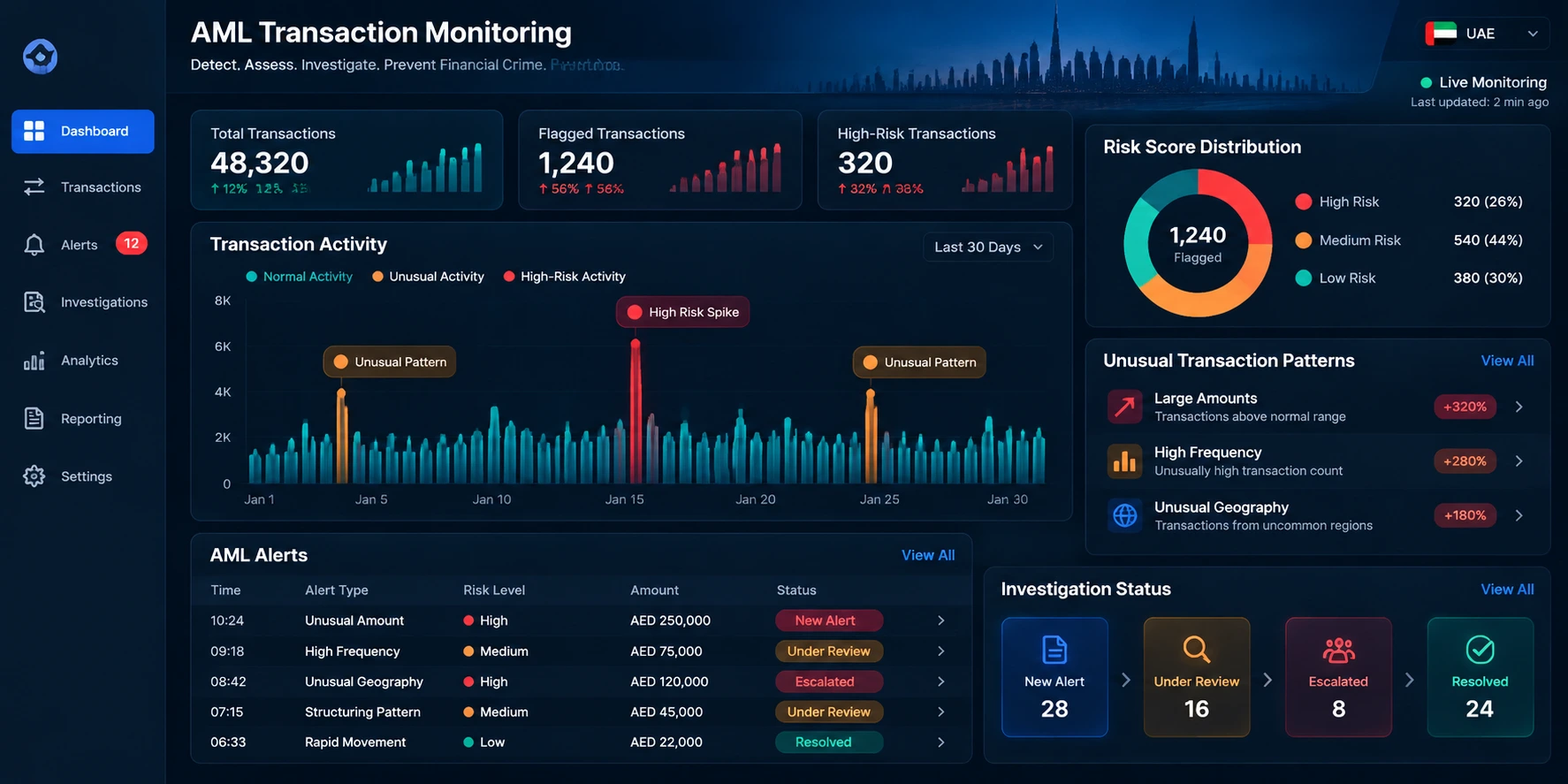
Buying a monitoring engine is the easy part. Making it produce useful alerts, and making your people able to act on them, is where programmes succeed or stall. The executive regulations require scrutiny of transactions throughout the relationship to check they are consistent with what you know about the customer, their business and the risk they represent (Article 8).
Suspicious behaviour and transaction patterns
Common patterns include structuring, where amounts are kept below an internal control point; rapid in-and-out movement of funds; sudden changes in velocity; accounts that behave like mules, receiving from many unrelated sources and forwarding quickly; exposure to sanctioned or high-risk geographies; dormant accounts that suddenly reactivate; activity that departs from the customer profile; links through shared counterparties, devices or addresses; and, for crypto businesses, wallet exposure that fiat monitoring never sees. Note that the UAE's reporting duty applies regardless of value (Article 18). A threshold can be a useful internal scenario trigger, but it is not the legal test for suspicion.
How an alert moves through investigation
- Detection. A rule, model or screening hit creates an alert with the data that triggered it.
- Triage. The alert is scored and routed by risk, so the riskiest cases are not waiting behind noise.
- Enrichment. The analyst sees KYC data, risk rating, previous alerts, counterparties and linked accounts in one place.
- Investigation. The analyst tests explanations against evidence and records the reasoning.
- Decision. The compliance officer decides whether to notify the FIU or retain the matter, with reasons recorded (Article 22).
- Outcome and feedback. The case is closed or reported, the customer's risk rating is revisited and the result feeds back into rule tuning.
Rules-based monitoring versus AI
|
Approach |
Detects well |
Main limits |
Governance needs |
Typical fit |
|---|---|---|---|---|
|
Rules-based |
Known typologies, clear thresholds |
Blind to novel patterns, noisy if poorly tuned |
Documented scenarios, threshold testing, change control |
Early-stage or lower-volume firms; explainability-sensitive cases |
|
Behavioural analytics |
Departures from a customer's own or peer-group norm |
Needs clean history and sensible segmentation |
Peer-group definition, drift monitoring |
Growing portfolios with stable customer segments |
|
Network analytics |
Hidden links, mule rings, shared devices or counterparties |
Needs linked data across accounts and entities |
Data lineage, link-confidence rules |
Payments, wallets and marketplaces |
|
Machine learning |
Complex, non-linear patterns |
Explainability, training-data bias, validation burden |
Model validation, performance monitoring, human review |
High volumes with strong data quality and model-risk skills |
|
Hybrid |
Combines rules for known risk with models for ranking and discovery |
Most complex to build and operate |
All of the above, plus clear ownership of each layer |
Most scaling fintechs in practice |
The honest guidance is to start from risk, data quality, volume, explainability needs and governance capacity, not from the technology.
False-positive reduction
High alert volumes are usually a design problem. Segment customers so one threshold does not serve everyone. Test thresholds above and below the line before changing them. Enrich alerts so analysts stop re-keying context. Prioritise by risk. Feed investigation outcomes back into tuning. One caution: fewer alerts is not the same as less risk. Every tuning decision should be documented with its rationale and tested so that you can show you did not tune away genuine detection.
Case management and audit trails
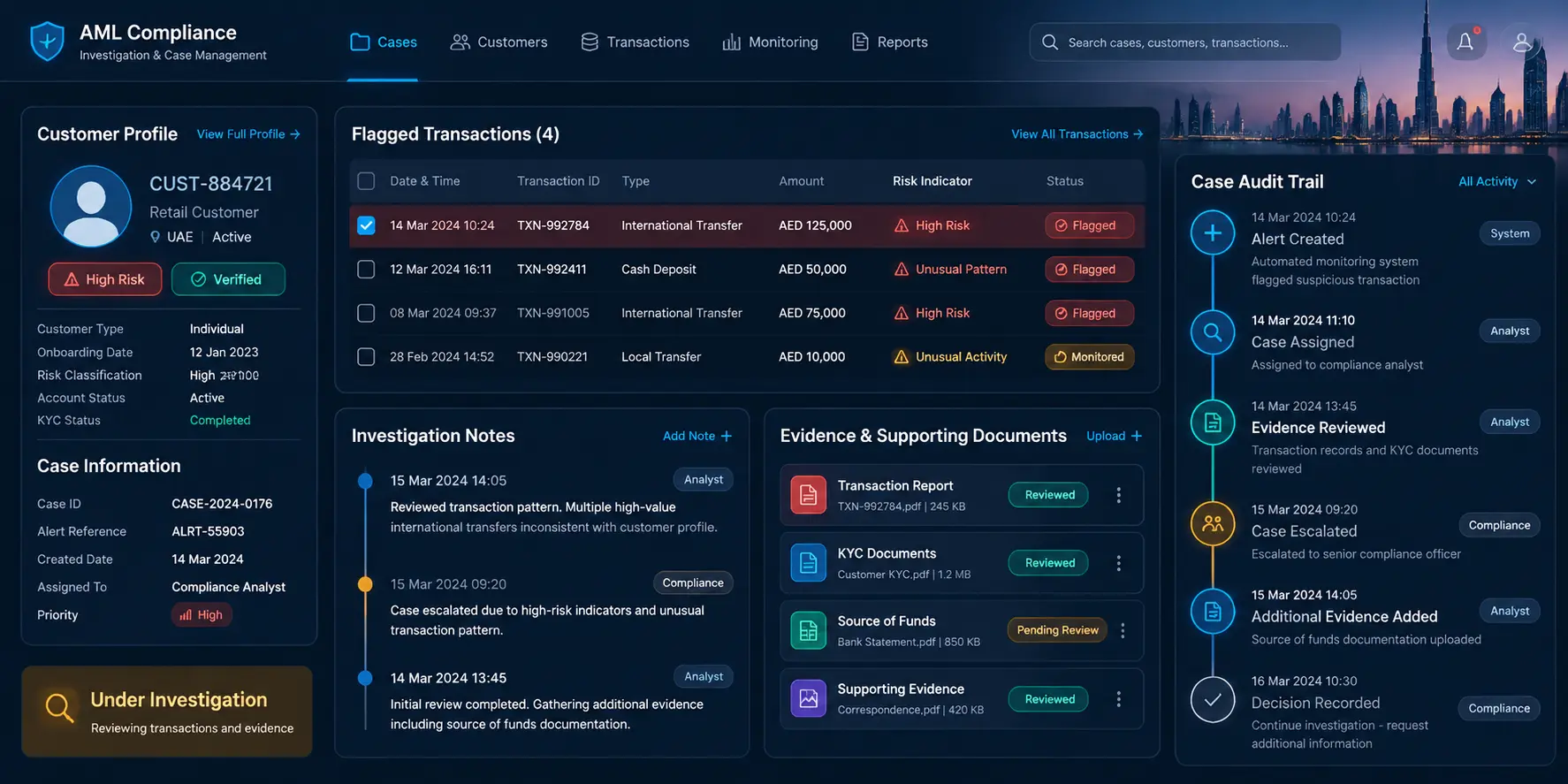
Records must be organised so individual transactions can be reconstructed and traced (Article 25). In practice that means an append-only audit trail of who did what and when, structured decision reasons rather than free-text-only notes, links from each case to the KYC record, and role-based access. A case tool that cannot show why an alert was closed will fail a supervisory review however good its detection engine is.
goAML Reporting in the UAE
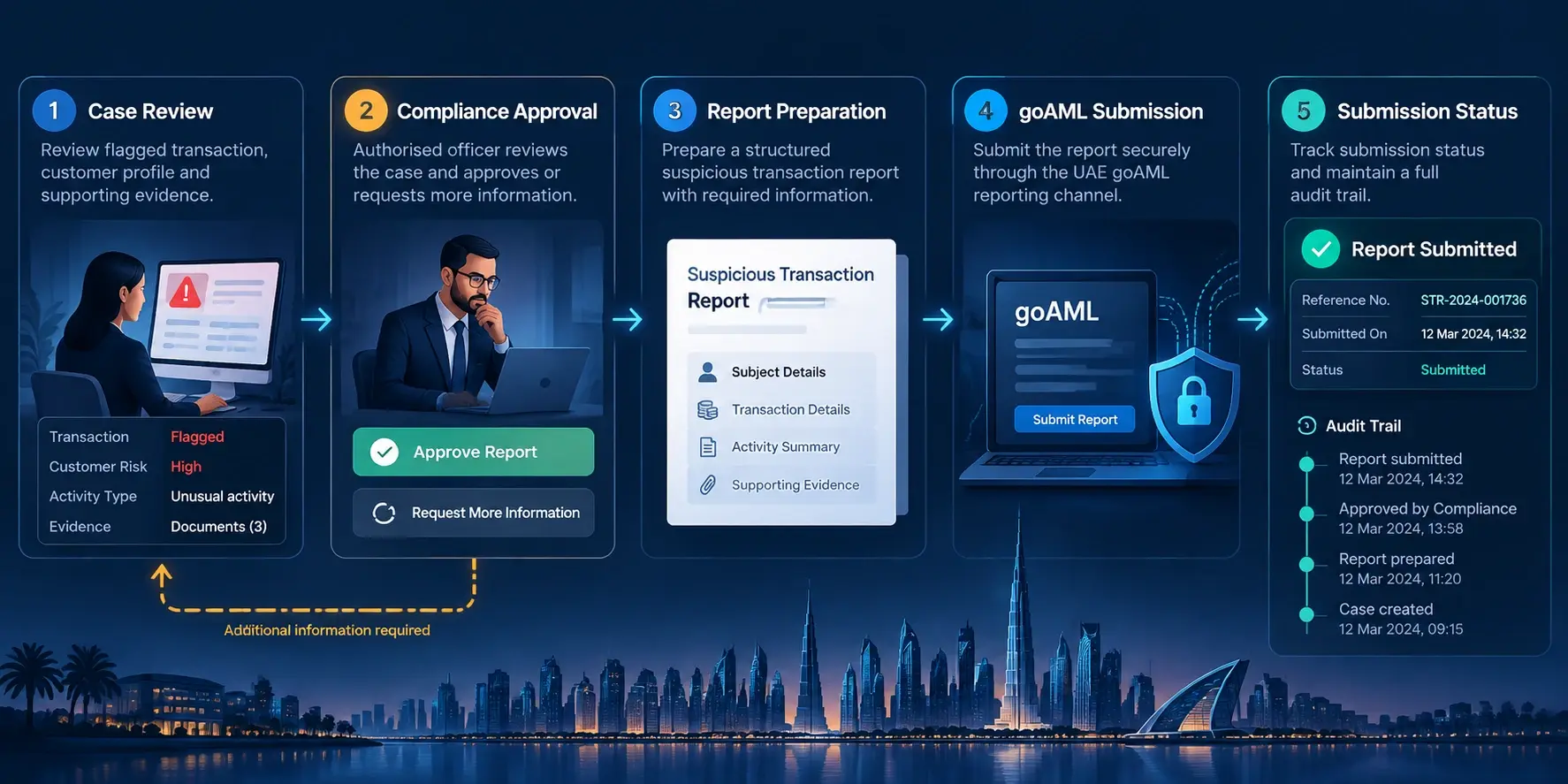
goAML is the reporting system the UAE FIU uses to receive reports from regulated entities. CBUAE guidance describes it as the mechanism for filing suspicious transaction and suspicious activity reports, and its report types include STR, SAR and several information-request and follow-up types. Understanding the process matters for product teams because the quality of a report depends on the quality of the case file behind it.
STRs, SARs and reporting triggers
The duty sits in Article 18 of Cabinet Resolution No. 134. If you suspect, or have reasonable grounds to suspect, that a transaction, an attempted transaction or funds are proceeds of, or linked to, a crime, you notify the FIU immediately and without delay, with all available data, and respond promptly to the FIU's requests for more information. The duty applies regardless of value, and it covers attempted transactions.
Two points are often missed. First, suspicion is not proof: you do not need to establish that a crime occurred. Second, unusual is not the same as suspicious. Firms must set indicators of suspicion and keep them updated (Article 17), and the compliance officer decides whether to notify or retain the matter, giving reasons (Article 22). CBUAE guidance for licensed institutions has also discouraged defensive filings; that guidance predates the 2025 framework, so confirm current expectations with your supervisor.
In the FIU's terminology, an STR generally involves a transaction, while a SAR concerns suspicious activity without one, for example a customer who refuses to provide information during onboarding. If a firm cannot complete due diligence, it must not establish or continue the relationship or execute the transaction, and it should consider an STR (Article 14).
What makes an investigation file defensible?
A reviewer should be able to read the file cold and understand the decision. That usually means: what triggered the case; the customer's profile and risk rating; expected activity versus actual activity; the evidence reviewed; the alternative explanations tested and what came of them; related parties and accounts; the decision, who made it, when, and why; and, if reported, what was submitted and when, or, if not, why not. Timestamps matter, because they show when suspicion arose and how quickly the firm acted on it. Anything that cannot be explained in plain language will be hard to defend later.
Reporting workflows and confidentiality
Reporting runs through named, authorised users registered with the FIU, with the compliance officer or MLRO at the centre. Tipping off is prohibited: firms and their staff must not disclose to the customer or anyone else that a report has been or is about to be submitted, or that an investigation is under way (Article 19). A firm that suspects a crime may even refrain from completing due-diligence steps if they would alert the customer, and must then file an STR explaining why (Article 14). For software teams this has practical consequences. Customer-facing tools, support dashboards and anything a customer can see must never expose STR status, and case workspaces need tight, logged access.
On integration, be careful. CBUAE's rulebook describes goAML as having a web interface and an XML schema for filing batches of reports, and the FIU publishes registration and web-submission guides. This article does not claim a public goAML API or an approved connector for any product. If a vendor says its case tool can file directly, ask for the supporting FIU documentation and validate against the current schema before relying on it.
The FIU also has powers that touch system design. Its chief can order a transaction suspended for up to ten working days and funds frozen for 30 days (Article 51). Your platform needs a fast, reliable way to place and lift holds.
Recordkeeping and audit readiness
Article 25 requires transaction records to be kept for not less than five years from completion of the transaction or termination of the relationship. For due-diligence files, monitoring records, account files, correspondence, identity copies, STRs and analysis results, the five years run from the most recent of several events, including relationship termination, account closure, completion of an inspection, completion of an investigation or a final court judgment. Records must be organised so transactions can be reconstructed and traced, and produced promptly on request. A single created-on-date retention rule will not meet that. Model retention around multiple triggers, support holds, and apply the longer VARA period where it governs.
DIFC, Mainland and Virtual-Asset Compliance Differences
Licence, not postcode, decides which rules apply. The table summarises the common cases at a high level.
Regulatory Aspect | DIFC Firms (DFSA) | CBUAE-Licensed Institutions | Virtual-Asset Firms (VARA) |
|---|---|---|---|
Who | Firms licensed by the DFSA in the DIFC | Banks, payment and money-transfer providers, and other institutions licensed by the CBUAE | VASPs licensed by VARA in Dubai, including free zones, excluding the DIFC |
Main Rules | Federal AML law and regulations, plus the DFSA AML Module | Federal AML law and regulations, plus CBUAE guidance and requirements | Federal AML law and regulations, plus VARA's Compliance and Risk Management Rulebook and activity rulebooks |
Recent Change | AML and Glossary Modules amended on 2 March 2026, with a further amendment on 1 April 2026 | Executive regulations replaced in late 2025 | Federal regulations add virtual-asset-specific transfer-data rules |
Record Retention | Check the current DFSA module against the federal minimum | Not less than five years under Article 25, with varying start points | Eight years under the VARA provisions reviewed |
Key Compliance Design Priorities | Digital onboarding, outsourcing, and governance expectations in DFSA FAQs | Wire-transfer data and money or value transfer services (MVTS) agent oversight | Wallet and blockchain analytics, transfer-data exchange, and crypto-to-fiat linkage |
Groups with several licensed entities, for example a DIFC firm and a VARA-licensed crypto arm, should map obligations entity by entity before choosing a shared platform.
Designing a Practical AML Operating Model
It helps to organise the programme into five layers and give each an owner.
1. Governance and accountability. Policies are approved by senior management, a compliance officer at management level has independence in decision-making, and an independent audit function tests the controls (Articles 21 and 22). Include compliance in product changes: new products, delivery channels and technologies must be risk-assessed before launch (Article 24).
2. Customer and business risk assessment. A documented enterprise-wide assessment that weighs customer, geography, product, transaction and channel risk, kept current and available to authorities (Article 5).
3. Onboarding and due diligence. Risk-based identity, KYB, UBO, PEP and sanctions checks, with enhanced steps for higher-risk cases.
4. Ongoing monitoring and investigation. Scenarios, alert triage, case work, quality assurance and tuning.
5. Reporting, recordkeeping and audit readiness. FIU reporting, confidentiality controls, retention and evidence that the programme works.
Technology serves these layers. It does not replace them. A tool with no named owner, no tuning process and no escalation path is shelfware with a licence fee.
The AML Technology Stack for Modern Fintechs
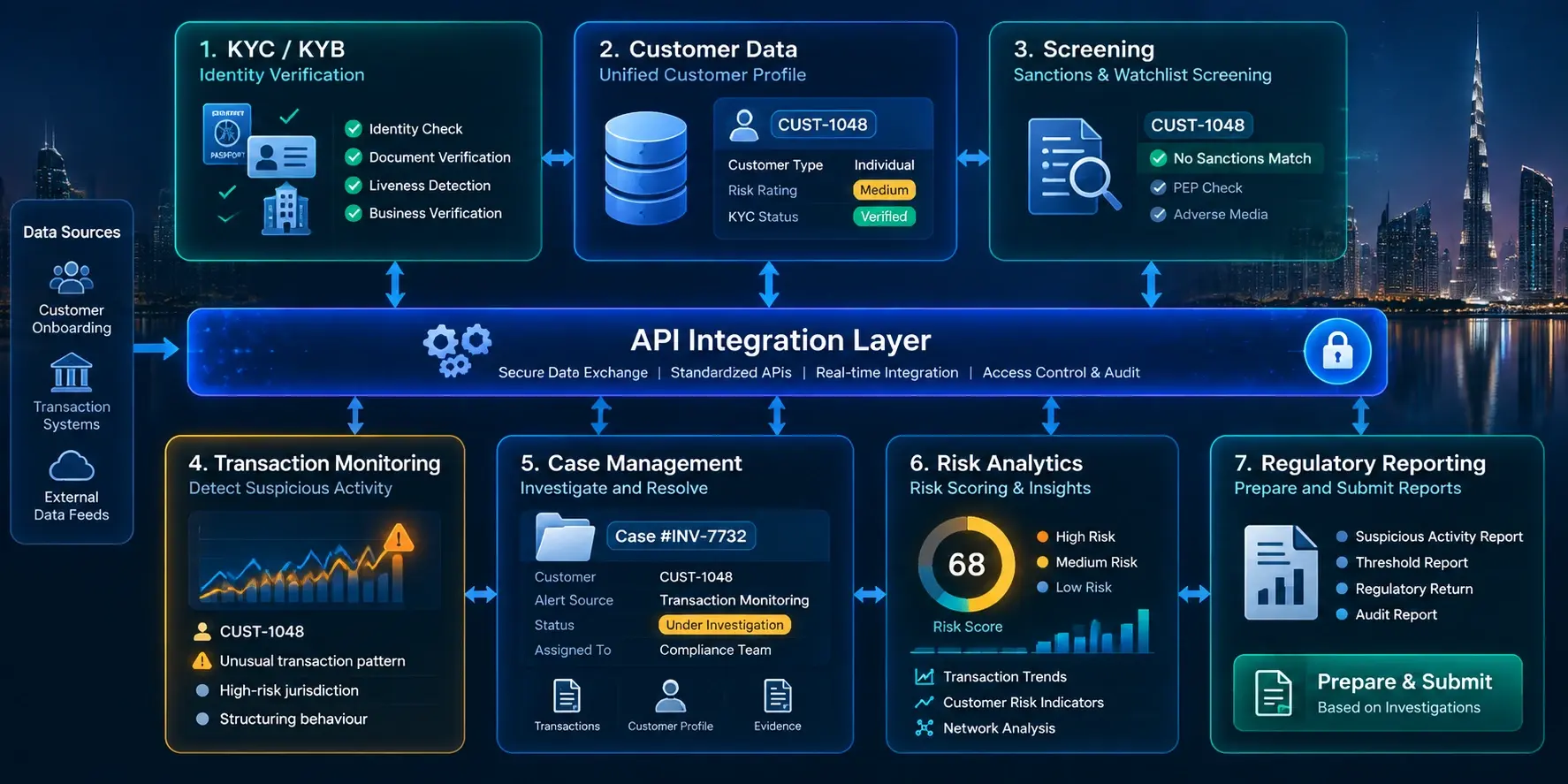
A modern stack usually combines identity verification and document-fraud detection, KYB and UBO data, screening providers, a transaction-monitoring engine, case management, blockchain analytics where virtual assets are involved, a customer data layer, rule and model governance, reporting workflows, audit logs and access controls, and the security and integration infrastructure that holds them together. Few firms build all of it. Most integrate several components and build the workflow that joins them.
Integrating KYC, screening and transaction monitoring
The decisive design question is data linkage. Alerts become useful when an analyst can see, in one view, the customer's identity and risk rating, accounts, devices, transactions, counterparties, earlier alerts, KYC evidence and previous investigations. That does not require one giant database. Tools can stay separate if they share a canonical customer identifier, agreed data contracts, event feeds or APIs, and lineage that shows where each data point came from. The common failure is the same customer carrying three identifiers across three systems.
Illustrative scenario: a crypto platform. Its wallet-risk tool scores deposits but does not know the customer's fiat payment history or KYC tier, and its fiat monitoring cannot see wallet exposure. Each system produces alerts the other would have explained. Linking them through a shared customer key, and passing wallet-risk results into the case view, is an integration project, not a new engine.
If you are planning a financial application or compliance workflow, a short scoping discussion on systems, data flows and integration points usually saves more than it costs. SISGAIN's software integration team can talk through that scope with you.
Real-time monitoring and batch processing
Some controls must act before funds move: sanctions screening at payment and hold or release decisions. Others work better over time, such as behavioural baselines, peer-group comparison, network analysis and periodic reviews. Most firms run both, and the architecture should make clear which control runs in which mode and what happens when a real-time check is unavailable.
Cloud, data governance and security
Identity data, biometric data and STR information are among the most sensitive records a fintech holds. Plan for UAE personal data protection requirements and, in the DIFC, its own data-protection regime, along with any hosting or outsourcing expectations from your regulator. The DFSA's FAQs address outsourcing directly. Under the federal regulations you may use outsourced providers for due diligence under your own policies and control, but you stay responsible for the result (Article 20). Practical controls include encryption, role-based access, a segregated workspace for sensitive cases, and complete access logging.
AI governance and human oversight
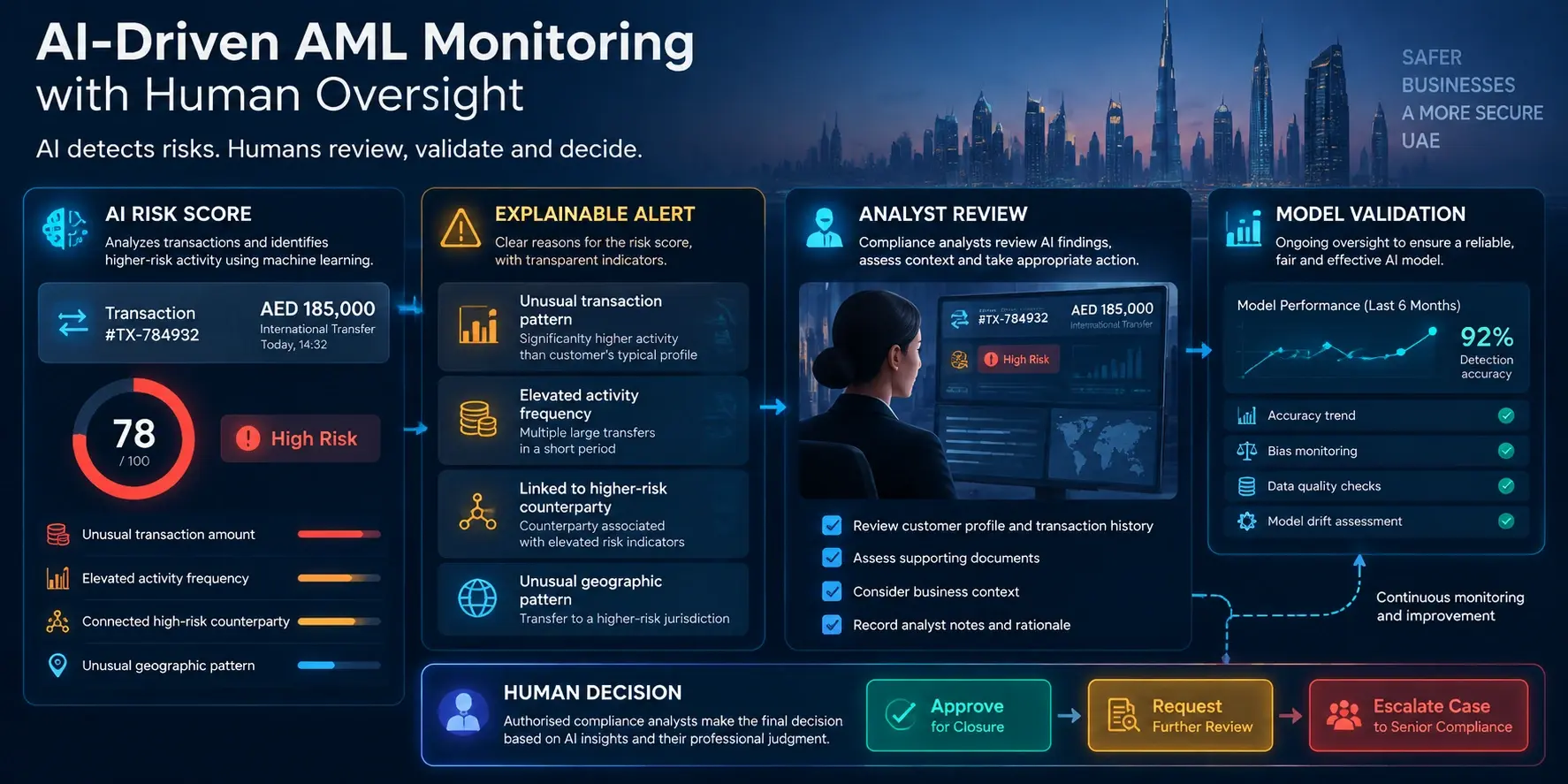
Treat model changes as change events. Before using a new model, assess the money-laundering and terrorism-financing risks it introduces (Article 24), validate it on your data, compare it with a simpler baseline, monitor for drift, and record why it was approved. Keep a human decision-maker for higher-risk outcomes and make sure every automated decision can be explained to an analyst, an auditor and a supervisor.
Common AML Compliance Failures and How to Prevent Them
|
Failure |
Why it happens |
Prevention |
|---|---|---|
|
KYC not refreshed |
Reviews are calendar-only and manual |
Risk-based schedules plus event triggers; track completion |
|
Rules copied from another business model |
Vendor defaults go live untested |
Map scenarios to your own risk assessment; test before launch |
|
Poorly calibrated thresholds |
No segmentation or below-the-line testing |
Segment customers; test and document every change |
|
Excess false positives |
Noisy rules, thin context |
Enrichment, prioritisation and feedback loops |
|
Alerts closed without explanation |
Free-text notes, time pressure |
Structured reasons and quality-assurance sampling |
|
Unverified UBO data |
Self-declaration accepted as proof |
Verify against independent sources; store evidence |
|
Crypto and fiat monitored separately |
Separate tools and teams |
Shared customer key and combined case view |
|
Weak investigation records |
No case template |
Standard file structure with decision and timestamps |
|
Unclear MLRO accountability |
Roles shared informally |
Written authority, reporting line and escalation rights |
|
Vendor tools deployed without validation |
Trust in the brochure |
Independent validation, UAT with your own data |
|
Compliance excluded from product changes |
Releases outrun governance |
Compliance sign-off in the release process |
How Much Does Fintech AML Software Cost in the UAE?
There is no honest single number. Published estimates from vendors and agencies vary widely because scope varies widely, they are rarely comparable, and none of them are SISGAIN prices. This article does not quote a range for that reason. The more useful question is what drives cost.
The main drivers are software licensing; usage-based charges for identity verification and screening; data subscriptions; integration and engineering work; custom monitoring scenarios; case management; blockchain analytics where relevant; security testing; governance and model validation; and ongoing maintenance and tuning. Total cost of ownership is rarely dominated by the licence. Usage pricing grows with your customer base, and tuning and validation never stop.
Before asking anyone for a price, write a scoping brief covering your licence and regulated activities, products and expected volumes, customer types and countries, existing systems, build-versus-integrate preference, data residency needs, who will investigate alerts, reporting requirements and languages, including Arabic where relevant. When proposals arrive, compare them on identical assumptions: what is excluded, how usage charges behave at double your volume, how change requests are priced, and what third-party data is passed through at cost. For general budgeting context on custom builds, SISGAIN's software development cost guide for 2026 is a starting point, though it is not AML-specific pricing.
How to Choose a Fintech AML Technology Partner
Use these questions to test any vendor or development partner.
|
Question |
What good looks like |
|---|---|
|
Do they ask about your licence and activities first? |
Requirements start from your regulatory perimeter, not a feature list |
|
Can they explain why an alert fired? |
Scenario logic and data inputs are visible to analysts |
|
Who controls tuning? |
Your team can change rules under change control without a vendor ticket |
|
What does the audit trail show? |
Append-only, exportable record of actions, decisions and reasons |
|
Where does data live and who owns it? |
Clear residency, ownership and deletion terms |
|
How do they handle goAML? |
Honest about what is supported, with evidence from FIU documentation |
|
How is the system tested? |
UAT on your data, threshold testing, independent validation |
|
How is security handled? |
Penetration testing, role-based access, segregated sensitive workspaces |
|
Who maintains integrations? |
Defined ownership, documentation and support terms |
|
Can you leave? |
Data portability and a workable exit plan |
Be cautious of anyone who promises to make you compliant. Software supports obligations that stay with your firm, your compliance officer and your advisers. SISGAIN's role is as a software development and integration partner: building and connecting the workflows, while regulatory judgement, legal advice and STR decisions remain yours. If you have a defined scope and want a view on feasibility and effort, SISGAIN's fintech software consulting team can work from that brief to prepare an estimate.
A Practical AML Implementation Roadmap
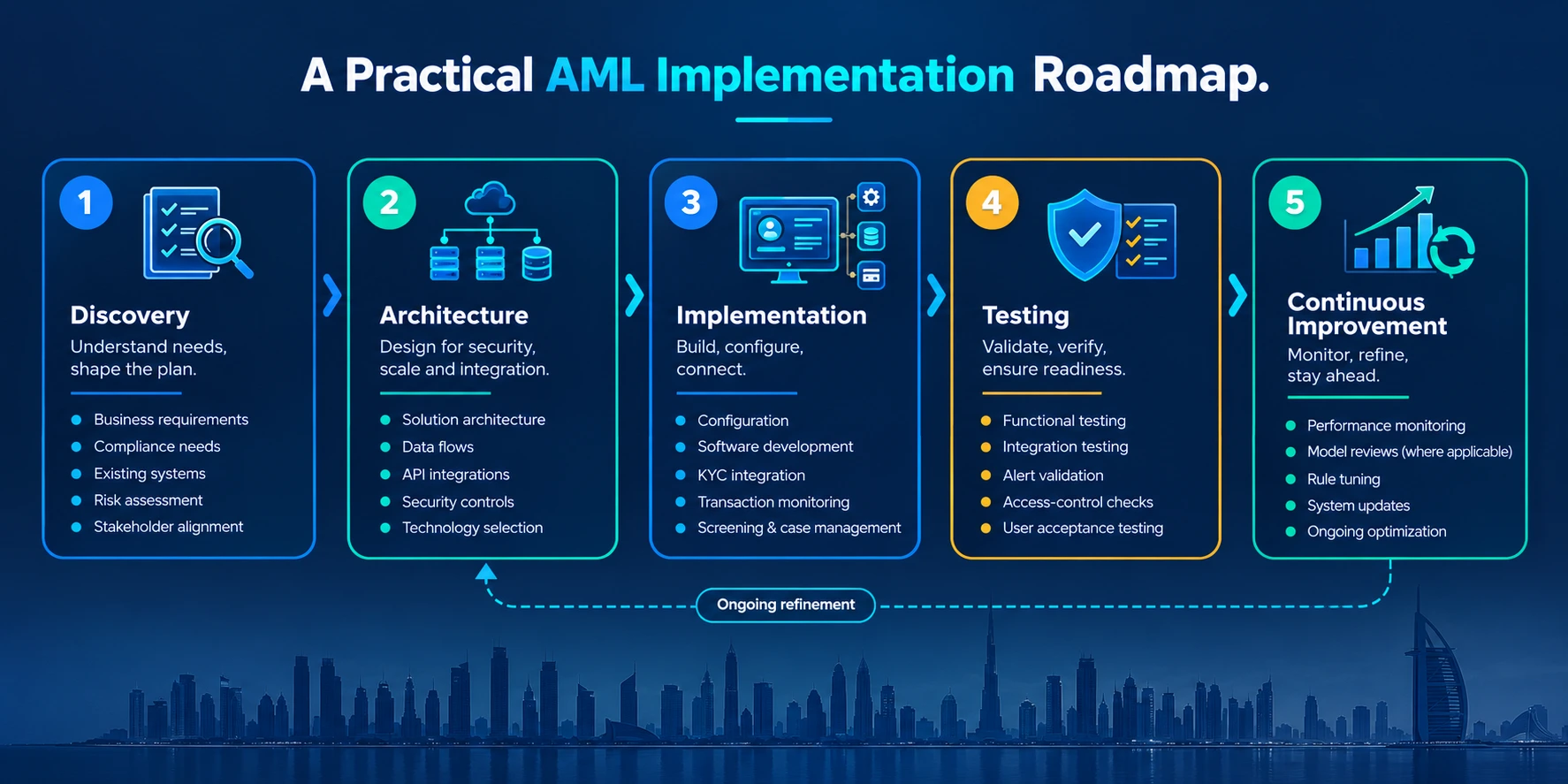
- Discovery. Confirm the regulatory perimeter, risk assessment, current processes, data sources, pain points and the target operating model.
- Architecture. Decide what to buy, build and integrate; define the customer identifier, data contracts, real-time and batch flows, retention rules and access model.
- Implementation. Build and configure onboarding workflows, screening, monitoring scenarios, case management and reporting preparation, in priority order.
- Testing and validation. Test functions, integrations and security, run threshold and scenario testing with realistic data, and have compliance sign off before go-live.
- Continuous improvement. Track metrics, tune scenarios, review models, refresh KYC logic and revisit the risk assessment as products and regulation change.
How to Measure AML Programme Effectiveness
|
Metric |
What it tells you |
Limit |
|---|---|---|
|
KYC refresh completion |
Whether reviews are keeping pace |
Completed is not the same as good quality |
|
Customer risk-rating coverage |
Whether every customer has a current rating |
A current rating can still be a wrong one |
|
Alert volume by scenario |
Which rules generate work |
High volume may be noise or genuine risk |
|
Alert-to-case conversion |
How often alerts merit investigation |
Depends on how alerts are defined |
|
False-positive rate |
Efficiency of detection |
Lower is not safer if detection weakened |
|
Average investigation time and overdue cases |
Capacity and timeliness |
Speed can hide shallow reviews |
|
Reporting timeliness |
Whether decisions reach the FIU promptly |
Needs defined start and end points |
|
Repeat-alert rate |
Whether closures resolve or recycle issues |
Can reflect real repeat behaviour |
|
Data-quality issues |
Reliability of inputs |
Often under-reported |
|
QA findings and model performance |
Quality of decisions and detection |
Sample sizes and methods matter |
No single metric proves effectiveness. Read them together and with qualitative review, such as quality-assurance sampling and independent audit.
Conclusion
Effective AML technology is a connected system. KYC feeds the risk rating, the rating shapes monitoring, monitoring produces cases, cases produce decisions and reports, and all of it leaves records that survive scrutiny. The 2025 federal framework and the regulator-specific rules that followed it raise the bar on documentation and governance, which makes data linkage and explainability product requirements rather than afterthoughts.
If you are scoping a fintech platform or a compliance-workflow project, talk to SISGAIN about the systems, integrations and workflows involved.
Disclaimer: this article provides general information as of 28 October 2026 and is not legal or regulatory advice. SISGAIN is a software development company and does not provide legal advice, certify regulatory compliance or make STR decisions. Confirm obligations with qualified counsel and your supervisor.