
TL;DR: UAE government agencies are shifting from standalone AI tools and traditional business intelligence to Decision Intelligence (DI) platforms—systems that unify data, apply predictive and prescriptive analytics, and automate complex decisions in real time. For entities managing national security, policing, customs, and public services, DI closes the gap between raw data and confident, compliant action.
The Gap Between Having Data and Making Decisions
The UAE has built one of the world's most forward-looking government AI frameworks. The UAE AI Strategy 2031, launched in 2017 with the world's first AI minister, His Excellency Omar Sultan Al Olama, set an ambitious course: position the Emirates as a global leader in AI-driven governance by the end of this decade. Progress has been measurable. The Dubai Paperless Strategy eliminated over 336 million paper transactions and saved more than 1.3 billion sheets of paper, making Dubai the first paperless government in the world by 2021. The UAE Pass now gives residents and citizens access to more than 6,000 government and private sector services through a single digital identity.
Yet, across ministries, police departments, national security agencies, and smart city authorities, a fundamental challenge remains. Government entities are generating more data than ever—from IoT sensors, digital transactions, surveillance systems, immigration checkpoints, and citizen service portals. Most can report on what happened last quarter. Far fewer can tell you what is about to happen, why it matters, and what the optimal response should be.
That is the gap Decision Intelligence closes.
This post explains what Decision Intelligence is, why traditional AI and business intelligence tools are insufficient for modern government operations, and how UAE agencies—from Dubai Police to federal customs and immigration—can deploy Decision Intelligence platforms to transform raw data into confident, automated, and auditable decisions. It also outlines the step-by-step implementation path, the technology stack involved, and what the next phase of UAE government AI looks like.
What Is Decision Intelligence?
Decision Intelligence (DI) is a discipline that combines artificial intelligence, machine learning, behavioral science, and data engineering to improve, automate, and scale decision-making across complex organizations.
The term was formally defined by Gartner as "a practical discipline for improving decision making" by modeling decisions as discrete, manageable processes—complete with inputs, outcomes, feedback loops, and measurable performance indicators.
To understand what makes Decision Intelligence distinctive, it helps to compare it directly with the tools that came before it.
AI vs Business Intelligence vs Decision Intelligence: A Comparison
|
Dimension |
Business Intelligence (BI) |
Artificial Intelligence (AI) |
Decision Intelligence (DI) |
|
Primary function |
Report on historical data |
Detect patterns and predict outcomes |
Automate and optimize the full decision cycle |
|
Time orientation |
Backward-looking |
Present and forward-looking |
Real-time + forward-looking + prescriptive |
|
Data scope |
Samples and subsets |
Large datasets, specific domains |
All available data, cross-domain |
|
Decision output |
Static dashboards |
Predictions and classifications |
Actionable recommendations + automated decisions |
|
Human role |
Interprets reports manually |
Reviews model outputs |
Oversees automated workflows; intervenes at escalation points |
|
Feedback loops |
Manual updates |
Model retraining cycles |
Continuous, automated learning and optimization |
|
Government use case |
KPI tracking, annual reporting |
Fraud pattern detection, facial recognition |
National threat scoring, border risk profiling, real-time resource dispatch |
|
Compliance and explainability |
Audit trails for reports |
Model-level explainability varies |
Built-in explainable AI with human-in-the-loop governance |
Business intelligence tells a government ministry how many services were processed last month. AI models tell it which transactions look suspicious. Decision Intelligence tells it which cases to escalate, which officer to assign, and what the optimal resolution pathway is—automatically, in real time, with a documented rationale.
Why UAE Government Agencies Need More Than Traditional AI
The UAE government has invested significantly in AI deployments across sectors. The UAE Digital Government Strategy 2024 allocated AED 2 billion for technology upgrades, with a goal of digitizing 80% of government services. Yet despite this investment, many agencies still face operational friction that AI tools alone have not resolved.
Here is why traditional AI implementations fall short at the enterprise government level.
Data Silos Across Ministries and Agencies
Government data is inherently distributed. An immigration case may touch the Federal Authority for Identity, Citizenship, Customs and Port Security; the Ministry of Interior; the Ministry of Foreign Affairs; and relevant emirate-level departments. When each operates a separate data environment, AI models trained on one agency's data will consistently miss patterns that only become visible when datasets are merged and cross-referenced.
Decision Intelligence platforms address this structurally through unified data integration layers—not just by connecting APIs, but by resolving entity identities across systems so that the same individual, company, or asset is recognized consistently regardless of which database contains the record.
Legacy Infrastructure Limits Real-Time Response
According to Ken Research (2025), approximately 60% of UAE government departments face significant challenges integrating new AI technologies with legacy IT infrastructure. Deploying AI models on top of aging systems often produces delayed, incomplete outputs—precisely the opposite of what high-stakes decisions require. Decision Intelligence architectures are designed to ingest, normalize, and analyze data from legacy systems, modern cloud platforms, and real-time streams simultaneously, without requiring wholesale system replacement.
Manual Decision Bottlenecks at Scale
Many government agencies still rely on case officers and analysts to manually review AI-generated outputs and decide on actions. At scale, this creates a decision bottleneck. A customs authority processing 50,000 shipments per day cannot manually review every risk score. A national security agency monitoring digital communications across millions of endpoints cannot rely on analyst review alone. Decision Intelligence automates routine decisions within defined policy parameters and routes only genuinely complex or high-risk cases to human decision makers—dramatically increasing throughput without reducing oversight.
Disconnected Agencies Create Investigative Blind Spots
Criminal networks, financial fraud, and national security threats rarely respect departmental boundaries. A financial crime investigation that begins in a central bank's fraud unit may connect to an immigration case, a customs alert, and a cybersecurity incident across three different emirates. Without a unified analytical layer, these connections remain invisible. Decision Intelligence platforms built on knowledge graph technology map relationships across entities and datasets, surfacing connections that no single-agency system would detect.
Slow Investigation Cycles Miss Time-Sensitive Threats
Traditional investigative workflows—manual data requests, physical document review, sequential analyst assessments—are incompatible with the speed at which modern threats evolve. Decision Intelligence compresses investigation timelines by automating data collection, entity matching, network mapping, and risk scoring in parallel, reducing what once took days or weeks to hours or minutes.
Key Features of Decision Intelligence for Government Agencies
Selecting a Decision Intelligence platform for a government environment is not the same as procuring standard enterprise software. The platform must meet sovereignty requirements, support Arabic-language data, integrate with UAE government identity infrastructure like the UAE Pass, and comply with UAE data protection regulations.
The following are the core capabilities that define a government-grade Decision Intelligence platform.
Entity Resolution
Entity resolution is the process of identifying when multiple records across different systems refer to the same real-world entity—a person, organization, address, vehicle, or device. In government data environments, the same individual may appear under different name transliterations, Emirates ID numbers, passport numbers, or phone numbers across a dozen different databases. Without entity resolution, AI models generate fragmented views. With it, the platform builds a unified, deduplicated identity profile that supports accurate analysis.
Knowledge Graphs
A knowledge graph maps entities and the relationships between them. For law enforcement and national security, this means visualizing how a suspect connects to a financial network, a set of properties, a communications cluster, and a travel itinerary—simultaneously. Knowledge graphs transform isolated data points into relational intelligence, making it possible to identify organized networks that tabular data analysis would never surface.
Predictive Analytics
Predictive analytics applies machine learning models to historical and real-time data to forecast future events or behaviors. For a government agency, this might mean predicting which visa applicants present elevated overstay risks, which supply chains are likely targets for smuggling, or which municipal infrastructure assets require maintenance before failure occurs.
Real-Time Intelligence
Government operations increasingly require decisions made within seconds, not hours. Real-time intelligence capabilities ingest streaming data—from CCTV systems, financial transaction feeds, border sensor networks, or social media monitoring platforms—and trigger automated alerts or decision workflows the moment defined thresholds are crossed.
Data Integration and Normalization
A government Decision Intelligence platform must connect to heterogeneous data sources: SQL and NoSQL databases, legacy ERP systems, cloud data warehouses, open government datasets, and external feeds from national and international agencies. Robust data integration layers ensure that the analytical layer always works from a complete, current, and consistent picture.
Decision Automation
Decision automation allows government agencies to encode policy rules and risk thresholds into automated workflows. A customs platform can automatically release low-risk shipments, flag medium-risk consignments for inspection, and escalate high-risk cases to senior officers—all without manual input for the first two tiers. This dramatically increases processing capacity while maintaining regulatory compliance.
Explainable AI (XAI)
For governments, auditability is non-negotiable. Every automated decision that affects a citizen, a business, or a case must have a documented rationale that can withstand legal scrutiny. Explainable AI ensures that every output from the platform—every risk score, every recommendation, every automated action—is accompanied by a transparent explanation of the factors that drove it.
Risk Scoring
Risk scoring aggregates signals across multiple data dimensions into a single, actionable score. For border security, a traveler's risk score might combine passport data, travel history, financial behavior, biometric match quality, and watchlist status into a single indicator that a border officer can act on within seconds.
Multi-Agency Collaboration
Decision Intelligence platforms built for government must support secure, permissioned data sharing across agencies. A federated architecture allows each agency to retain sovereign control over its own data while participating in cross-agency analytical workflows—ensuring that collaboration does not compromise data governance.
Cloud Integration
Modern government Decision Intelligence deployments leverage hybrid and multi-cloud architectures. In the UAE context, this includes private government clouds aligned with the UAE Government Cloud (G-Cloud) initiative, as well as integrations with Azure, AWS GovCloud, and Google Cloud—each configured to meet UAE data residency requirements.
Feature Comparison: Traditional Government Analytics vs Decision Intelligence
|
Capability |
Traditional Gov Analytics |
Decision Intelligence Platform |
|
Data unification |
Partial, manual ETL |
Automated, real-time across all sources |
|
Entity resolution |
None or basic matching |
Advanced, probabilistic, cross-database |
|
Predictive analytics |
Limited, batch-mode |
Continuous, real-time ML models |
|
Decision automation |
Manual rule engines |
AI-driven, adaptive, policy-encoded |
|
Explainability |
Minimal |
Full audit trail with XAI |
|
Multi-agency access |
Bilateral agreements, manual |
Federated, permissioned, real-time |
|
Investigation support |
Separate case tools |
Integrated, graph-based investigation |
|
Arabic language support |
Varies |
Native NLP support required |
How Decision Intelligence Platforms Work: A Government Workflow
Understanding Decision Intelligence at a conceptual level is useful. Seeing how it operates in practice is more valuable for government leaders evaluating adoption.
Below is a simplified seven-stage workflow that illustrates how a Decision Intelligence platform processes a government use case—from data ingestion to automated action.
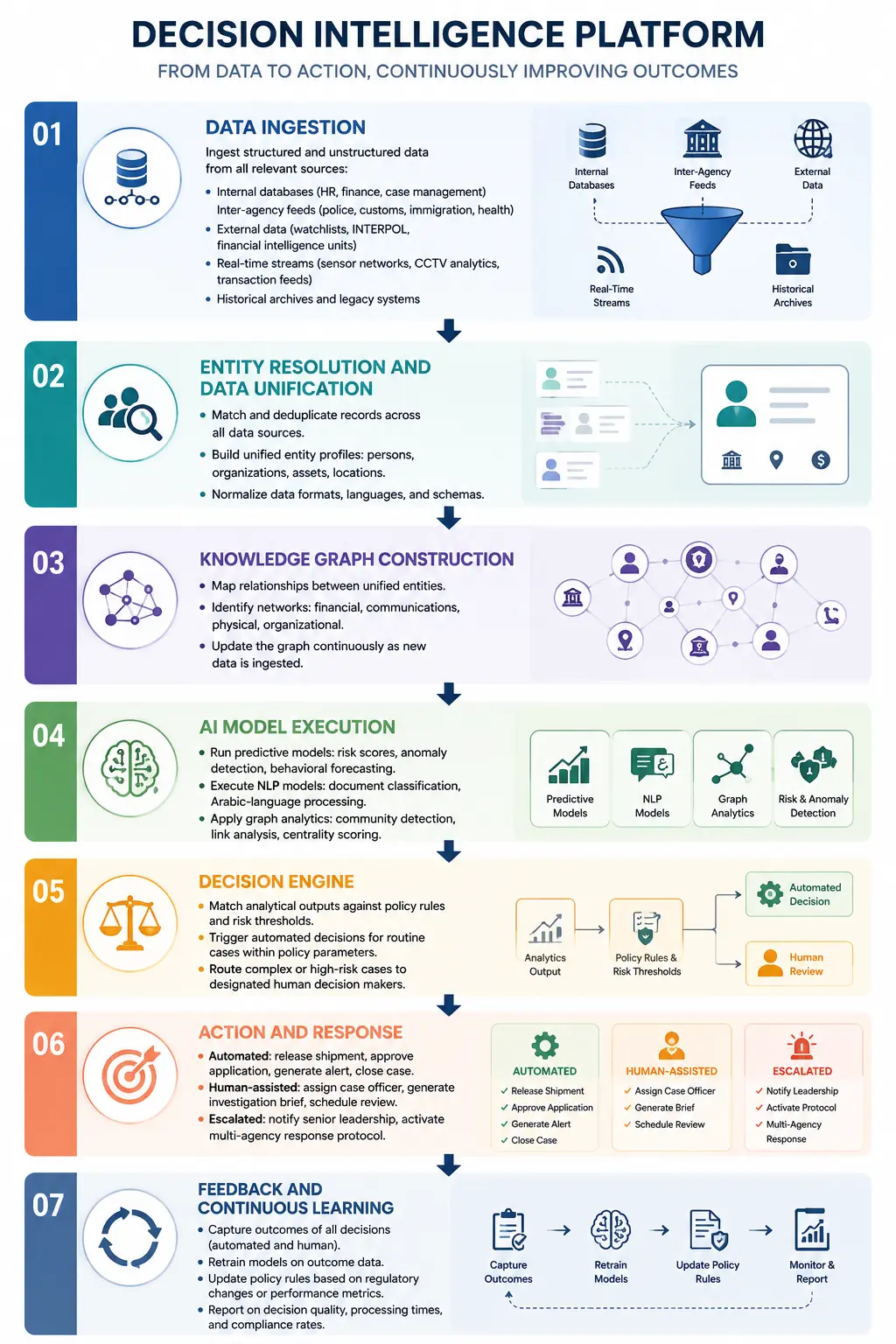
This workflow is not a one-time process. It runs continuously, updating as new data arrives and refining its outputs as outcomes are observed. For government agencies managing real-time operations, this continuous cycle is the defining difference from static analytics tools.
Why Use Decision Intelligence Platforms for Police Investigations
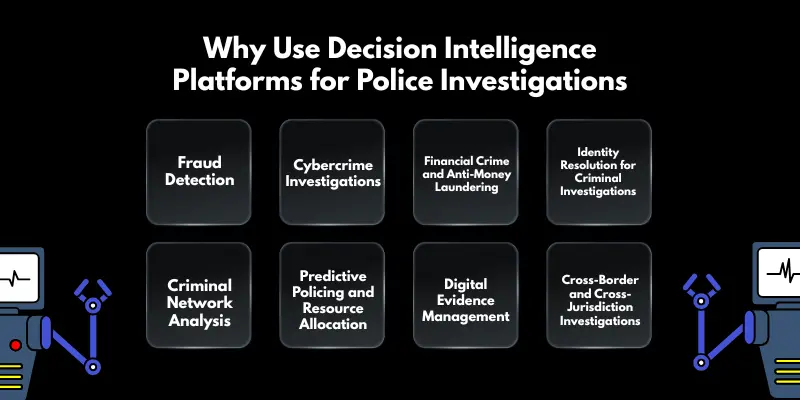
Law enforcement agencies operate in one of the most data-intensive, time-critical environments in government. Investigations generate vast quantities of unstructured data—witness statements, call records, financial transactions, digital evidence, surveillance footage, social media activity—across multiple jurisdictions and systems.
Traditional investigative tools are largely siloed: a case management system here, a financial intelligence platform there, a separate database for vehicle records, another for communications intercepts. Analysts must manually cross-reference these sources, a process that introduces delays, errors, and missed connections.
Decision Intelligence platforms designed for law enforcement address each of these limitations directly.
Fraud Detection
Financial fraud investigations require the ability to trace transaction flows across multiple accounts, institutions, and jurisdictions in real time. A Decision Intelligence platform integrates transaction data, beneficial ownership registries, watch lists, and behavioral baselines into a single analytical environment. It can automatically flag transaction clusters that match known fraud typologies, score cases by urgency, and generate evidence packages ready for prosecution.
Cybercrime Investigations
Cybercrime evidence is inherently distributed—across IP addresses, device identifiers, cloud storage accounts, dark web forums, and cryptocurrency wallets. Decision Intelligence platforms with graph analytics capabilities can map digital infrastructure networks, identify the relationships between malicious actors and their technical assets, and trace financial flows from ransomware payments or illicit transactions back to identifiable entities.
Financial Crime and Anti-Money Laundering
Connecting the dots between shell companies, nominee directors, cross-border wire transfers, and real estate transactions requires the kind of relational analysis that BI tools simply cannot perform. Knowledge graph technology, combined with entity resolution, allows financial crime investigators to visualize layered corporate structures and identify the ultimate beneficial owners behind complex financial arrangements—a task that previously required months of manual research.
Identity Resolution for Criminal Investigations
Suspects frequently use multiple identities, aliases, and fraudulent documents. An entity resolution layer built into the investigative platform automatically consolidates fragmented identity records into unified profiles, surfacing biometric links, document history, and behavioral patterns that confirm true identity even when an individual has attempted to obscure it.
Criminal Network Analysis
Organized crime, terrorism financing, and human trafficking networks share a common structural characteristic: they depend on relationships between individuals, organizations, accounts, and assets that span multiple databases and jurisdictions. Graph-based Decision Intelligence enables investigators to map these networks visually, calculate the centrality of specific actors within the network, identify the nodes whose removal would be most disruptive, and generate defensible evidence of network membership.
Predictive Policing and Resource Allocation
Decision Intelligence platforms can apply machine learning to historical crime data, socioeconomic indicators, event calendars, and environmental factors to predict where and when specific types of incidents are likely to occur. This allows police departments to allocate patrol resources proactively rather than reactively—improving both prevention rates and officer utilization. Dubai Police is already integrating AI-driven systems, including autonomous patrol units with 360-degree vision, into its smart policing ecosystem, reflecting the broader direction of UAE law enforcement.
Digital Evidence Management
Modern investigations generate enormous volumes of digital evidence. Decision Intelligence platforms with AI-powered evidence management capabilities can automatically classify, tag, and index digital files—extracting entities, relationships, and timelines from unstructured content, including Arabic-language documents and audio recordings, making them immediately searchable and analytically actionable.
Cross-Border and Cross-Jurisdiction Investigations
For the UAE—a major international hub for trade, finance, and travel—cross-border investigations are routine. A Decision Intelligence platform built on a federated architecture allows UAE agencies to collaborate with international counterparts through permissioned data sharing, joint investigation workspaces, and standardized intelligence formats, accelerating cross-border case resolution while maintaining national data sovereignty.
Practical Investigation Scenario: A financial intelligence unit flags an unusual pattern of structured deposits across five UAE banks. The Decision Intelligence platform automatically runs entity resolution against the account holders, surfacing that three of the five individuals share an address, a company registration, and a travel history to the same three jurisdictions within the past 18 months. The system constructs a network graph connecting these individuals to 11 additional entities—including two shell companies and a property portfolio. A risk score of 94 out of 100 is assigned, an investigation brief is auto-generated, and the case is escalated to the financial crimes unit—all within 90 seconds of the initial flag.
How to Use a Decision Intelligence Platform for National Security
National security applications represent the most demanding operating environment for any analytical platform. The stakes are absolute, the data volumes are extreme, the threat landscape is continuously evolving, and the consequences of analytical errors—whether false positives or missed threats—can be severe.
Decision Intelligence platforms built for national security applications must meet requirements beyond those of any commercial deployment: air-gap compatibility, classified data handling, sovereign cloud hosting, Arabic-language NLP, multi-level security classification, and real-time performance at national scale.
Border Security and Traveler Risk Assessment
Every day, UAE airports and land borders process hundreds of thousands of travelers. Manual inspection of every individual is neither feasible nor effective. A Decision Intelligence platform aggregates biometric data, travel history, visa application records, financial transactions, criminal intelligence, and international watchlists into a unified risk model that scores every traveler in real time—before they reach the border officer. Low-risk travelers are processed automatically. Elevated-risk travelers are flagged for targeted screening. This is a direct application of predictive analytics for government at national scale.
Immigration Risk Management
Beyond border entry, immigration risk management covers the full lifecycle of a visa holder's presence in the UAE: visa overstay risk scoring, employment verification, financial solvency monitoring, and compliance with residency conditions. Decision Intelligence platforms enable immigration authorities to monitor these parameters continuously, triggering automated notifications or case reviews when risk indicators change—rather than discovering violations retrospectively.
Critical Infrastructure Protection
UAE critical infrastructure—energy networks, water systems, financial systems, telecommunications—faces persistent threats from cyberattacks, physical intrusion, and insider threats. A Decision Intelligence platform integrating operational technology (OT) data, cybersecurity telemetry, personnel access logs, and threat intelligence feeds can detect anomalous patterns across these domains and trigger protective responses before damage occurs.
Defense Intelligence
Defense Intelligence requires the integration of signals intelligence, human intelligence, open-source intelligence, and geospatial data into unified operational pictures. Decision Intelligence platforms built on knowledge graph architectures allow defense analysts to maintain persistent entity profiles on adversarial actors, track capability development, and model potential threat scenarios—supporting both strategic planning and tactical response.
Cybersecurity and Threat Intelligence
National cybersecurity operations centers (SOCs) generate millions of alerts per day. Most are false positives or low-priority events. Decision Intelligence platforms dramatically reduce analyst alert fatigue by automatically triaging, scoring, and correlating security events—surfacing only those combinations of signals that represent genuine, high-priority threats. Integration with threat intelligence feeds, vulnerability databases, and behavioral baselines allows the platform to contextualize alerts in real time.
Emergency Management and Disaster Response
Decision Intelligence platforms support emergency management agencies by integrating weather data, population movement data, infrastructure status, resource inventories, and historical incident data into a unified operational dashboard. During a crisis, the platform provides prescriptive recommendations for resource deployment, evacuation routing, and inter-agency coordination—accelerating response time and reducing coordination errors.
Counter-Terrorism and Extremism Monitoring
Counter-terrorism applications require the ability to monitor communications patterns, financial flows, travel behavior, and network activity for signals that indicate radicalization pathways or operational planning. Decision Intelligence platforms with graph analytics and behavioral AI can identify emerging networks and flag behavioral changes that warrant investigation—before a threat becomes kinetic.
Threat Intelligence and Strategic Warning
At the strategic level, Decision Intelligence platforms aggregate open-source intelligence, diplomatic reporting, economic indicators, and historical conflict data to build predictive models of regional instability and emerging threats. These platforms support the kind of long-range strategic warning capability that national security leadership requires for proactive policy formation.
Practical Workflow Example: A national security operations center detects an anomalous pattern—a cluster of new SIM card registrations in a specific geographic zone, combined with unusual access attempts on a government portal and a set of financial transactions that partially match a known hawala network typology. Individually, none of these signals triggers a threshold. Together, they score 89 out of 100 on the platform's threat model. The platform automatically correlates the entities involved, generates a structured intelligence brief with relationship maps and evidence citations, and routes the case to the relevant security directorate with a recommended response protocol—within four minutes of the first anomalous signal.
SISGAIN's Enterprise AI and Government Technology Expertise
Government entities exploring Decision Intelligence adoption require more than a software vendor. They need a technology partner who understands the complexity of government data environments, the regulatory requirements of UAE public sector deployments, and the strategic context of digital transformation mandates at both federal and emirate levels.
SISGAIN is a global enterprise AI and digital transformation company with offices in Dubai, Canada, and India, serving clients across 40+ countries with a team of 200+ expert developers and engineers. With over 1,000 projects delivered and a 98% client satisfaction rate, SISGAIN has a proven track record across government technology, AI software development, machine learning, NLP, computer vision, cloud architecture, and cybersecurity.
For UAE government entities, SISGAIN delivers end-to-end Decision Intelligence capabilities—from initial architecture design and data integration to AI model development, knowledge graph construction, and production deployment. Solutions are configured to align with the UAE Government Cloud (G-Cloud) framework, UAE data protection legislation, and smart government digital transformation strategies at both the federal and emirate levels.
SISGAIN's government technology engagements encompass Dubai Government AI Initiatives, UAE Government AI Solutions, Smart Citizen Engagement Platforms, and predictive analytics for government—supporting agencies from smart city authorities and municipal services to police departments and national security agencies.
Every SISGAIN engagement begins with a free 60-minute strategy consultation, includes an NDA before any discussion, delivers a detailed project roadmap and cost estimate within 48 hours, and provides three months of post-deployment support.
Contact SISGAIN UAE: +971 56-848-5757 | [email protected]
UAE Government Decision Intelligence Use Cases by Sector
The following sections illustrate how Decision Intelligence platforms create measurable value across the UAE government's diverse institutional landscape. These use cases reflect the breadth of Public Sector IT Solutions in Dubai and across UAE federal entities.
Police and Law Enforcement
Dubai Police and Abu Dhabi Police can deploy Decision Intelligence to accelerate criminal investigations, support evidence-based prosecution, optimize patrol deployment, and monitor organized crime networks in real time. Integration with CCTV analytics, financial intelligence feeds, and international law enforcement databases creates an unprecedented investigative capability.
Healthcare and Public Health
UAE health authorities can use Decision Intelligence to predict disease outbreak vectors, optimize hospital resource allocation, detect healthcare fraud in insurance claims, and personalize preventive care interventions for specific population segments—supporting the UAE's broader vision for a data-driven public health system.
Municipalities and Urban Services
Smart city authorities managing urban services—waste management, road maintenance, public facilities—can use Decision Intelligence to predict infrastructure failure before it occurs, optimize service routes in real time, and detect inefficiencies in contract performance that manual audits would miss.
Transportation and Logistics
The UAE's Roads and Transport Authority and logistics regulators can deploy Decision Intelligence for real-time traffic management, predictive maintenance of transport infrastructure, freight risk scoring, and the optimization of public transit schedules based on dynamic demand modeling.
Education
Education authorities can use Decision Intelligence to identify students at risk of dropout, optimize teacher deployment, detect anomalies in examination data, and model the long-term outcomes of curriculum policy changes before implementation.
Customs and Trade Facilitation
UAE Customs authorities processing millions of declarations annually can use Decision Intelligence to score every shipment for risk automatically—releasing low-risk consignments without intervention, triggering targeted inspection for elevated-risk cargo, and building longitudinal risk profiles for importers and exporters that refine over time.
Immigration and Residency
The Federal Authority for Identity, Citizenship, Customs and Port Security can deploy Decision Intelligence to automate residency compliance monitoring, predict visa overstay risk, identify fraudulent application patterns, and support the rapid processing of legitimate applications through automated eligibility verification.
Tax and Revenue
The Federal Tax Authority can use Decision Intelligence for automated tax gap analysis, VAT refund fraud detection, audit targeting based on behavioral risk scoring, and real-time monitoring of large taxpayer compliance—maximizing revenue collection while minimizing compliance burden on legitimate businesses.
Utilities and Energy
The UAE's utility regulators and operators can deploy Decision Intelligence for predictive grid management, smart meter fraud detection, demand forecasting aligned with renewable energy integration, and the optimization of maintenance schedules for critical infrastructure assets.
Regulatory Authorities
Sector regulators—financial services, telecommunications, healthcare, real estate—can use Decision Intelligence to automate regulatory reporting analysis, detect compliance anomalies in real time, conduct market surveillance, and support enforcement case preparation with automated evidence assembly.
Benefits Across Government Departments
The following table summarizes the operational transformation that Decision Intelligence delivers across key UAE government functions.
|
Department |
Primary Challenge |
Decision Intelligence Solution |
Expected Outcome |
|
Police / Law Enforcement |
Fragmented investigation data, slow case resolution |
Knowledge graph investigation platform, entity resolution, predictive policing |
40–60% reduction in investigation cycle times |
|
National Security |
Real-time threat detection across vast data volumes |
Multi-source threat intelligence, behavioral AI, automated alerting |
Near-real-time threat detection and response |
|
Customs |
Manual risk scoring unable to scale to shipment volumes |
Automated risk scoring, anomaly detection, trader profiling |
80%+ of shipments processed without manual intervention |
|
Immigration |
Retrospective compliance monitoring |
Predictive overstay risk models, automated compliance triggers |
Proactive enforcement and improved compliance rates |
|
Municipalities |
Reactive infrastructure maintenance |
Predictive asset failure models, IoT data integration |
30–50% reduction in unplanned infrastructure failures |
|
Tax Authority |
Manual audit selection, fraud detection gaps |
Behavioral risk scoring, automated audit targeting |
Higher revenue yield per audit, reduced compliance burden |
|
Healthcare |
Fragmented patient data, reactive resource planning |
Unified patient intelligence, demand forecasting |
Improved outcomes and optimized resource utilization |
|
Regulatory Bodies |
Volume of filings exceeds manual review capacity |
Automated compliance analytics, anomaly flagging |
Faster enforcement action, higher deterrence effect |
Decision Intelligence vs Traditional Government Analytics
This comparison illustrates the structural differences that determine why UAE government entities are moving from conventional analytics deployments to Decision Intelligence platforms.
|
Dimension |
Traditional Analytics |
Decision Intelligence |
|
Data scope |
Departmental silos |
Cross-agency, unified |
|
Update frequency |
Batch, daily or weekly |
Real-time, continuous |
|
Decision type |
Descriptive (what happened) |
Prescriptive (what to do) |
|
Automation |
None to minimal |
High, policy-encoded |
|
Entity resolution |
Manual, inconsistent |
Automated, probabilistic |
|
Network analysis |
Not available |
Native graph analytics |
|
Investigation support |
Separate case tools |
Integrated platform |
|
Explainability |
Dashboard-level |
Per-decision audit trail |
|
Scalability |
Limited by analyst capacity |
Unlimited within compute parameters |
|
Feedback and learning |
Manual model updates |
Continuous, outcome-driven |
|
Arabic NLP |
Limited |
Native capability required |
|
Compliance alignment |
Retrospective audit |
Real-time compliance monitoring |
|
Integration with UAE Pass |
Typically absent |
Designed for UAE identity infrastructure |
Challenges Government Agencies Face Without Decision Intelligence
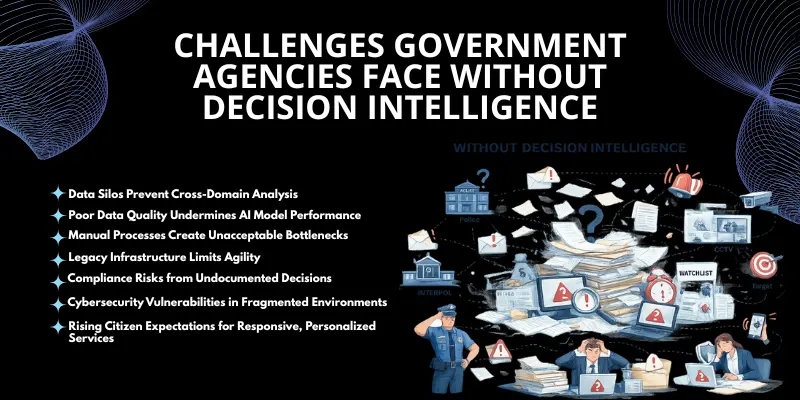
Understanding the cost of inaction is as important as understanding the benefits of adoption. Agencies operating without Decision Intelligence face specific, measurable operational challenges.
Data Silos Prevent Cross-Domain Analysis
When agency data stays within departmental boundaries, cross-domain patterns remain invisible. Financial crimes with immigration connections, cybersecurity incidents linked to organized crime networks, or public health signals embedded in social services data—none of these become visible until the data is unified. Silos do not just slow analysis; they prevent certain categories of insight from ever being generated.
Poor Data Quality Undermines AI Model Performance
AI models are only as reliable as the data they are trained on. Government datasets frequently contain duplicate records, outdated entries, inconsistent formats, and missing values—particularly when data originates from legacy systems that were not designed for interoperability. Without a data quality layer, AI models trained on this data produce unreliable outputs that erode decision-maker confidence.
Manual Processes Create Unacceptable Bottlenecks
At the scale of UAE government operations—millions of transactions, applications, and interactions daily—manual decision processes are not just inefficient. They are operationally unsustainable. The volume of data generated by UAE smart government infrastructure has grown faster than the analytical workforce capacity to process it. Automation is not optional; it is a structural necessity.
Legacy Infrastructure Limits Agility
Legacy government IT systems were designed for a different era of service delivery. They support batch processing, not real-time analytics. They are difficult to integrate with modern AI platforms. They create technical debt that grows with every new system added on top of them. Agencies that cannot modernize their data infrastructure are constrained in their ability to deploy effective Decision Intelligence—but the right platform architecture can work around legacy systems rather than requiring their replacement.
Compliance Risks from Undocumented Decisions
Every automated decision that affects a citizen or a legal entity must be auditable under UAE law and international best practice standards. Agencies deploying AI models without explainability layers, audit trails, or governance frameworks expose themselves to legal challenge, regulatory censure, and reputational risk. Decision Intelligence platforms designed for government include these governance capabilities by default, not as optional add-ons.
Cybersecurity Vulnerabilities in Fragmented Environments
Fragmented data environments—multiple disconnected systems with varying security standards—create larger attack surfaces. Consolidating data and decision-making into a unified, security-by-design platform reduces the number of entry points an adversary can exploit and enables centralized monitoring for anomalous access patterns.
Rising Citizen Expectations for Responsive, Personalized Services
UAE residents expect government services to be fast, personalized, and available digitally at any hour. Generative AI for government and AI-powered citizen service platforms are raising the bar on responsiveness. Agencies that cannot move at the speed of citizen expectation risk falling behind in the quality metrics that the UAE government uses to measure entity performance.
Step-by-Step Decision Intelligence Implementation Roadmap
For government technology leaders considering a Decision Intelligence deployment, the following roadmap provides a structured progression from initial assessment to operational optimization.
Phase 1: Assessment and Discovery (Weeks 1–4)
Map existing data sources, systems, and analytical capabilities. Identify priority use cases based on strategic value and implementation feasibility. Assess data quality, governance frameworks, and integration requirements. Define success metrics and compliance requirements.
Phase 2: Data Integration Architecture (Weeks 5–10)
Design the unified data integration layer. Establish connections to priority data sources. Implement data quality and normalization pipelines. Configure data governance controls and access permissions aligned with agency classification requirements.
Phase 3: Entity Resolution and Knowledge Graph Construction (Weeks 11–16)
Deploy entity resolution across unified datasets. Build initial knowledge graph covering priority entity types—persons, organizations, assets, locations. Validate entity matching accuracy against known test cases.
Phase 4: AI Model Development and Configuration (Weeks 17–24)
Train or configure predictive and prescriptive AI models for priority use cases. Develop risk scoring frameworks aligned with agency policy. Implement explainable AI layers for audit compliance. Validate model performance against historical case data.
Phase 5: Decision Engine Configuration (Weeks 25–28)
Encode agency policy rules into the decision automation layer. Define escalation pathways and human-in-the-loop intervention points. Configure alerts, notifications, and case assignment workflows.
Phase 6: Pilot Deployment and Validation (Weeks 29–36)
Deploy in a controlled operational environment with selected use cases. Monitor decision quality, processing times, and compliance metrics. Gather feedback from operational users and decision makers. Refine models, rules, and workflows based on observed performance.
Phase 7: Full Deployment and Optimization (Week 37 onward)
Scale deployment across all priority use cases and data sources. Establish continuous monitoring and model retraining cycles. Implement cross-agency collaboration capabilities. Integrate with digital transformation services and solutions for connected government operations.
Technology Stack Behind Government Decision Intelligence Platforms
A government-grade Decision Intelligence platform draws on a sophisticated combination of technologies. Each layer serves a specific analytical or operational function.
Data Infrastructure
- Apache Kafka for real-time data streaming
- Apache Spark for distributed large-scale data processing
- Data lakes and lakehouses for unified storage of structured and unstructured data
- Vector databases (e.g., Pinecone, Weaviate) for semantic search and retrieval
AI and Machine Learning
- Machine learning frameworks (TensorFlow, PyTorch, scikit-learn) for predictive model development
- Large Language Models (LLMs) for Arabic and English document analysis, report generation, and natural language querying
- Retrieval-Augmented Generation (RAG) for grounding LLM outputs in verified government data
- Generative AI for automated briefing generation, investigation summaries, and citizen communication
Knowledge and Graph Technologies
- Graph databases (Neo4j, Amazon Neptune, TigerGraph) for relationship storage and querying
- Graph analytics engines for link analysis, community detection, and centrality scoring
- Entity resolution platforms for cross-database identity matching
Cloud and Infrastructure
- Azure Government Cloud, AWS GovCloud, Google Cloud for scalable compute
- Hybrid and private cloud deployments for sovereign data requirements
- Kubernetes and containerization for scalable, resilient deployment
Visualization and Decision Support
- Power BI, Tableau, or custom dashboards for operational intelligence displays
- Interactive graph visualization tools for investigator workstations
- Digital twins for infrastructure simulation and scenario planning
Security and Governance
- Zero Trust Security architecture for data access control
- Identity and Access Management (IAM) aligned with UAE Pass integration
- Automated compliance monitoring and audit trail management
- AI Agents for orchestrating multi-step decision workflows autonomously
The Future of Decision Intelligence in UAE Government
The current phase of UAE government AI adoption—deploying AI tools within individual departments to improve specific functions—is the precursor to a more transformative stage: autonomous, interconnected government intelligence at national scale.
Several emerging capabilities will define the next phase of Decision Intelligence in the UAE context.
Agentic AI and Autonomous Government Operations
Agentic AI systems—AI agents that can independently plan, execute, and adapt multi-step workflows—will extend Decision Intelligence from decision support to decision execution. A government AI agent will not just recommend the optimal response to a regulatory violation; it will initiate the enforcement workflow, generate the official notice, and schedule the follow-up review—all within policy-defined parameters and with complete audit documentation.
Cross-Ministry Intelligence Networks
The current siloed nature of government data will be progressively replaced by federated intelligence networks that allow permissioned data sharing and joint analytical workflows across ministries, agencies, and emirate-level authorities—creating a true national intelligence fabric that supports coordinated policy and operations.
Digital Twins for Government Infrastructure
Digital twin technology—creating real-time virtual replicas of physical infrastructure—will enable government authorities to simulate the impact of policy changes, natural events, or security threats on physical and social systems before committing to real-world interventions. Transportation authorities will model new road network configurations. Emergency management agencies will simulate evacuation scenarios. Utilities will stress-test grid configurations against demand projections.
Hyperautomation of Government Services
Hyperautomation—the systematic automation of every government process that can be automated, using combinations of AI, robotic process automation, and Decision Intelligence—will transform government service delivery. Citizen applications that currently take days will resolve in minutes. Compliance monitoring that currently requires analyst teams will run continuously and autonomously. Procurement analysis that currently requires months of manual review will produce ranked recommendations within hours.
Predictive Government and Anticipatory Policy
The ultimate application of Decision Intelligence in government is the transition from reactive governance—responding to problems after they occur—to anticipatory governance—identifying and addressing problems before they materialize. UAE government entities deploying advanced Decision Intelligence platforms will be able to model the likely consequences of policy choices, predict the emergence of social or economic challenges, and intervene at the earliest possible stage—fulfilling the vision embedded in the UAE AI Strategy 2031.
Why SISGAIN Is the Right Technology Partner for UAE Government Decision Intelligence
UAE government agencies considering a Decision Intelligence deployment need more than a capable platform. They need a technology partner with a track record in enterprise AI, a physical presence in the UAE, an understanding of local regulatory requirements, and the engineering depth to deliver complex integrations at government scale.
SISGAIN combines all of these. With operations based at DUQE Freezone, Dubai—and a global delivery capability across 40+ countries—SISGAIN serves as both a strategic advisor and a technical delivery partner for government AI transformation. SISGAIN's service portfolio covers every element of a Decision Intelligence deployment: AI software development, machine learning, NLP, computer vision, knowledge graph construction, RAG solutions, cloud architecture, cybersecurity, and digital transformation.
For UAE government entities operating under the UAE Digital Government Strategy 2024 and the UAE AI Strategy 2031, SISGAIN's alignment with government digital transformation mandates and its experience with Public Sector IT Solutions in Dubai positions it uniquely to support both federal and emirate-level Decision Intelligence initiatives.