
The UAE's food delivery industry is experiencing unprecedented growth, driven by increasing smartphone adoption, changing consumer lifestyles, and the rising demand for on-demand convenience. From busy professionals in Dubai to families in Abu Dhabi, customers now expect fast, seamless, and personalized food delivery experiences. As a result, the market presents a significant opportunity for startups, restaurant chains, cloud kitchens, and entrepreneurs looking to launch their own food delivery platforms.
However, entering this competitive market is not as simple as building an app and acquiring users. Many businesses invest heavily in development, marketing, and operations only to discover that high download numbers do not automatically translate into profitability. The most successful food delivery businesses focus on sustainable revenue generation, operational efficiency, customer retention, and scalable technology rather than vanity metrics alone.
One of the biggest challenges for startups is controlling development costs without compromising user experience or future scalability. Businesses often overspend by building unnecessary features, selecting the wrong technology stack, overlooking long-term maintenance costs, or partnering with inexperienced development teams. These mistakes can significantly impact profitability and delay return on investment.
The good news is that building a profitable food delivery app in the UAE does not always require a massive budget. With the right development strategy, feature prioritization, AI-driven automation, and business model, companies can launch a competitive platform while keeping costs under control.
In this guide, you'll learn how to approach Food Delivery App Development in UAE strategically, reduce unnecessary expenses, identify the features that truly drive revenue, leverage emerging technologies such as AI, and create a scalable business model that supports long-term growth. Whether you're a startup founder, restaurant owner, cloud kitchen operator, or investor, this article will provide practical insights to help you build a profitable food delivery app without overspending.
Understanding the UAE Food Delivery Market in 2026
The UAE food delivery industry continues to evolve rapidly, creating new opportunities for businesses that can deliver convenience, speed, and personalized customer experiences. With one of the highest smartphone penetration rates in the world and a digitally connected population, the demand for online food ordering is expected to remain strong throughout 2026 and beyond.
For startups, restaurant owners, and investors, understanding market dynamics is essential before investing in Food Delivery App Development UAE. Success is no longer determined by simply launching an app; it depends on identifying market trends, consumer expectations, and emerging business models that can generate sustainable revenue.
Why the UAE Continues to Be a High-Growth Food Delivery Market
Several factors contribute to the continued growth of the UAE food delivery ecosystem. A busy urban lifestyle, increasing reliance on digital services, and growing demand for convenience have transformed food delivery from a luxury into an everyday necessity. Cities such as Dubai and Abu Dhabi have become innovation hubs where consumers actively embrace mobile-first services.
Additionally, government support for digital transformation, expanding cloud kitchen networks, and increasing investment in technology startups continue to strengthen the market. These factors make Food Delivery App Development in UAE an attractive opportunity for businesses seeking long-term growth.
Consumer Behavior Trends Driving Food Delivery Demand
Modern UAE consumers expect more than just food delivery. They look for convenience, personalization, real-time tracking, multiple payment options, loyalty rewards, and fast delivery times. Mobile users increasingly prefer platforms that provide seamless ordering experiences and tailored recommendations based on their preferences.
The rise of AI-powered personalization, subscription-based delivery programs, and contactless ordering has also influenced customer expectations. Businesses that understand these evolving behaviors can create stronger customer relationships and improve retention rates while reducing customer acquisition costs.
Opportunities for Restaurants, Startups, and Cloud Kitchens
The UAE market offers opportunities for businesses of all sizes. Traditional restaurants can expand their customer reach beyond physical locations, while startups can introduce niche delivery concepts targeting specific customer segments. Cloud kitchens, which operate exclusively through delivery channels, can significantly reduce operational costs while serving multiple brands from a single facility.
By leveraging Cost-Effective Food Delivery App Development strategies, businesses can enter the market with lower risk and scale gradually based on customer demand. The combination of digital adoption, consumer convenience, and technological innovation creates a favorable environment for sustainable growth.
What Makes a Food Delivery App Profitable?
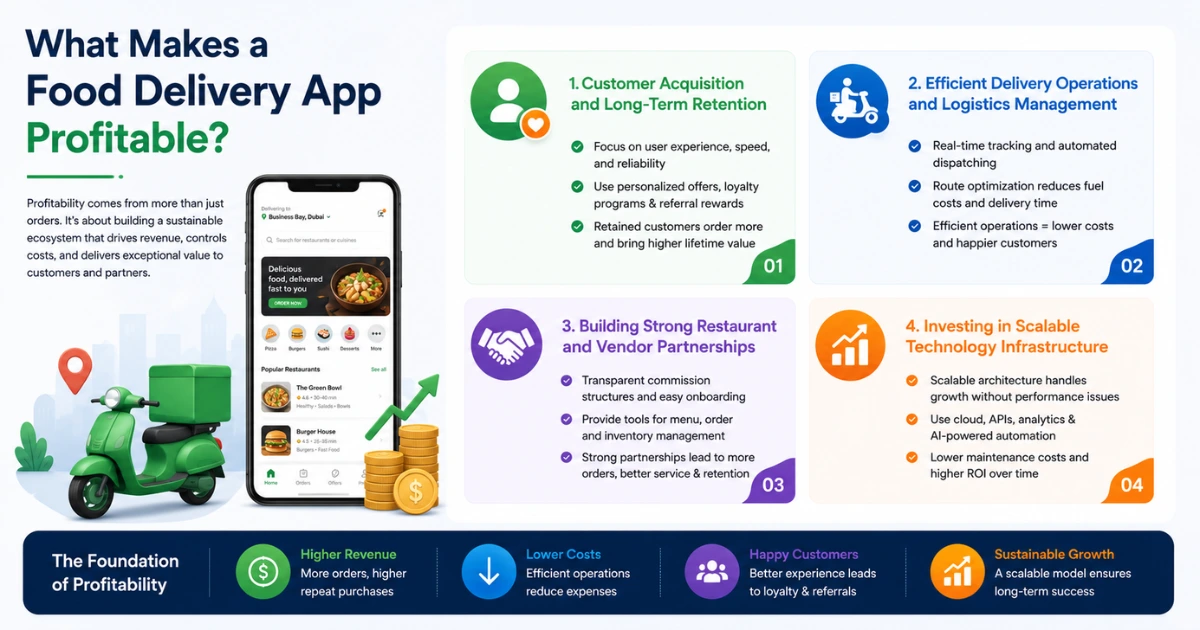
Many food delivery businesses focus heavily on acquiring users but overlook the factors that drive long-term profitability. A profitable food delivery platform is built on operational efficiency, customer loyalty, strong restaurant partnerships, and scalable technology. The goal is not simply to generate downloads but to create a sustainable ecosystem that consistently generates revenue while controlling operational expenses.
Customer Acquisition and Long-Term Retention
Acquiring customers is important, but retaining them is where profitability begins. Businesses that continuously spend on advertising without improving customer loyalty often experience rising acquisition costs and shrinking profit margins.
Successful food delivery apps focus on user experience, personalized recommendations, loyalty programs, referral incentives, and consistent service quality. Retained customers place more frequent orders, generate higher lifetime value, and contribute to sustainable business growth.
Efficient Delivery Operations and Logistics Management
Delivery efficiency directly impacts profitability. Delayed deliveries, poor route planning, and inefficient fleet management increase operational costs while reducing customer satisfaction.
Modern On-Demand Food Delivery App Development UAE solutions use real-time tracking, automated dispatching, route optimization, and AI-driven logistics management to improve delivery performance. Efficient operations help reduce fuel costs, improve driver productivity, and enhance customer experiences.
Building Strong Restaurant and Vendor Partnerships
Restaurants are the backbone of any food delivery ecosystem. Strong partnerships help businesses expand menu options, improve service quality, and increase order volume. Transparent commission structures, easy onboarding processes, and integrated restaurant management tools can strengthen vendor relationships and improve retention.
A successful platform creates value for both customers and restaurant partners, resulting in a healthier and more profitable marketplace.
Investing in Scalable Technology Infrastructure
Scalability plays a critical role in long-term profitability. As order volumes grow, businesses need technology capable of handling increased traffic, transactions, and customer interactions without performance issues.
A reliable Food Delivery App Development Company in UAE will focus on building scalable architecture that supports future growth while minimizing maintenance costs. Cloud infrastructure, API integrations, data analytics, and AI-powered automation can help businesses scale efficiently without requiring major redevelopment investments later.
Common Reasons Food Delivery Startups Overspend
Launching a food delivery app in the UAE can be highly rewarding, but many startups struggle with budget overruns that reduce profitability before the business even gains traction. While competition often pushes founders to build feature-rich platforms, overspending usually results from poor planning rather than market demands.
Understanding where development budgets are commonly wasted can help businesses make smarter decisions and maximize their return on investment. By avoiding these costly mistakes, startups can focus their resources on growth, customer acquisition, and operational efficiency instead of unnecessary development expenses.
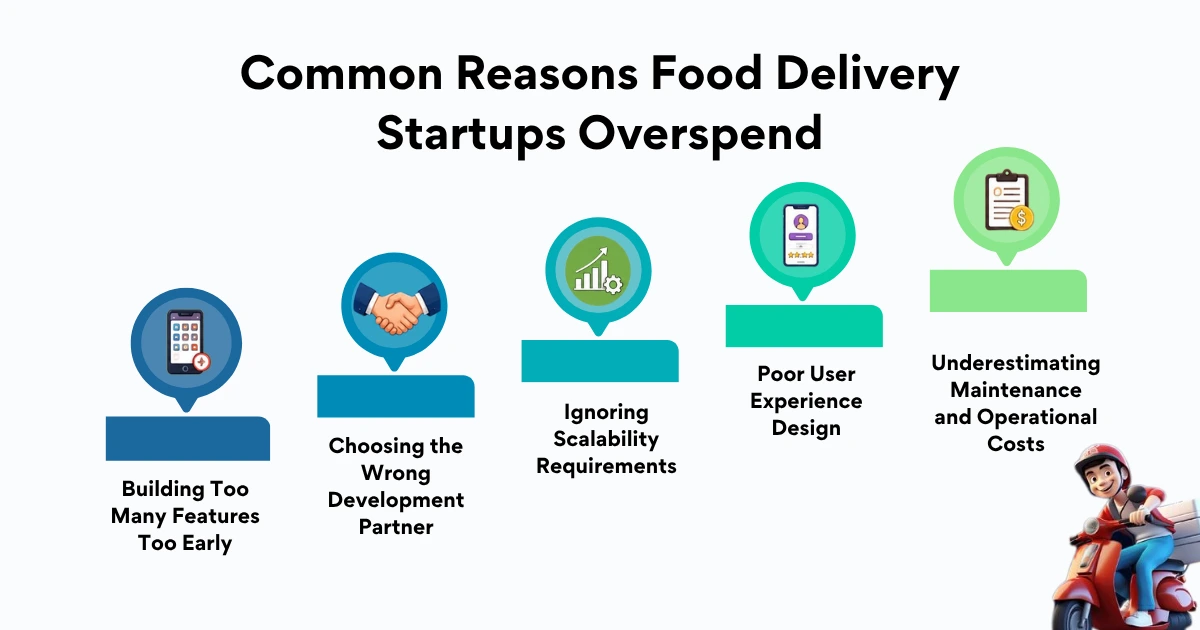
Building Too Many Features Too Early
One of the most common mistakes startups make is attempting to replicate every feature offered by established platforms from day one. Businesses often believe that adding more features will automatically attract more users, but this approach usually leads to increased development costs, longer launch timelines, and unnecessary complexity.
Features such as advanced loyalty systems, AI-powered recommendations, multiple subscription models, social networking capabilities, and complex analytics dashboards may not be essential during the initial launch phase. Instead, startups should focus on solving a specific customer problem and validating market demand before investing in advanced functionality.
A streamlined launch strategy allows businesses to gather real user feedback and invest in features that genuinely improve customer experience and revenue generation.
Choosing the Wrong Development Partner
Selecting a development partner based solely on the lowest price can become an expensive mistake. Many businesses underestimate the importance of industry expertise, technical capabilities, and post-launch support when choosing a Food Delivery App Development Company in UAE.
An inexperienced development team may deliver an application that suffers from poor performance, security vulnerabilities, scalability limitations, or frequent technical issues. Fixing these problems after launch often costs significantly more than building the platform correctly from the beginning.
Businesses should evaluate development partners based on their portfolio, experience with on-demand applications, technical expertise, scalability approach, communication process, and long-term support capabilities rather than focusing only on upfront pricing.
Ignoring Scalability Requirements
Many startups build applications designed only for current needs without considering future growth. While this may reduce initial development costs, it often creates major challenges when customer demand increases.
An application that performs well with a few hundred users may struggle when handling thousands of concurrent orders, resulting in slow performance, downtime, and customer dissatisfaction. Businesses are then forced to invest in expensive redevelopment projects that could have been avoided through proper planning.
Scalable architecture, cloud infrastructure, and modular development practices ensure that the platform can grow alongside the business without requiring major structural changes.
Poor User Experience Design
Even the most feature-rich food delivery application can fail if users find it difficult to navigate. Complicated ordering processes, confusing interfaces, slow loading times, and inconsistent design elements often lead to abandoned orders and lower customer retention rates.
Poor user experience increases customer acquisition costs because businesses must spend more on marketing to replace users who leave the platform after a negative experience.
Investing in intuitive navigation, seamless checkout experiences, personalized user journeys, and responsive design helps improve customer satisfaction while reducing long-term marketing expenses.
Underestimating Maintenance and Operational Costs
Many startups focus exclusively on initial development costs and overlook the ongoing expenses required to operate a successful platform. However, maintenance costs continue throughout the application's lifecycle and can significantly impact profitability if not planned properly.
Regular software updates, security enhancements, cloud hosting fees, payment gateway charges, technical support, performance optimization, and compliance requirements all contribute to long-term operational expenses.
A comprehensive budget should account for both development and post-launch costs to ensure sustainable business growth and financial stability.
Cost-Effective Food Delivery App Development Strategies
Building a profitable food delivery app does not necessarily require a massive investment. Businesses that prioritize strategic planning, scalable technology, and customer-focused development can significantly reduce costs while maintaining a competitive market position.
The following strategies help startups launch faster, minimize unnecessary expenses, and improve long-term profitability without compromising quality.
Start with a Minimum Viable Product (MVP)
An MVP is one of the most effective ways to control development costs while validating business ideas. Instead of building a fully featured platform immediately, businesses can launch with a core set of functionalities that address primary user needs.
Essential MVP features typically include:
-
User registration and authentication
-
Restaurant listings
-
Menu management
-
Cart functionality
-
Secure payment processing
-
Order tracking
-
Delivery management
-
Customer support
Launching with an MVP allows businesses to gather market feedback, identify customer preferences, and make data-driven investment decisions before expanding the platform.
Prioritize Revenue-Generating Features
Every feature should contribute directly or indirectly to revenue growth, customer retention, or operational efficiency. Startups often waste resources developing features that have little impact on business performance.
Revenue-focused features may include:
-
Loyalty and rewards programs
-
Subscription memberships
-
Real-time order tracking
-
Personalized recommendations
-
Promotional campaigns
-
Restaurant advertising opportunities
-
Customer referral systems
Prioritizing these capabilities helps businesses improve monetization while keeping development budgets under control.
Use Scalable Cloud Infrastructure
Modern cloud infrastructure provides flexibility, reliability, and cost efficiency compared to traditional hosting environments. Instead of investing heavily in physical infrastructure, businesses can scale resources based on actual demand.
Benefits include:
-
Reduced infrastructure costs
-
Improved application performance
-
Faster deployment cycles
-
Enhanced security
-
Automatic scalability
-
Better disaster recovery capabilities
Cloud-based solutions are particularly valuable for businesses expecting seasonal demand fluctuations or rapid growth.
Leverage Existing APIs and Integrations
Developing every system from scratch can dramatically increase both development costs and project timelines. Businesses can accelerate development by integrating proven third-party solutions for common functionalities.
Examples include:
-
Payment gateway integrations
-
SMS notification services
-
Real-time mapping solutions
-
Location tracking services
-
Customer communication platforms
-
Analytics and reporting tools
Using established APIs reduces development complexity while providing access to reliable and tested functionality.
Adopt Agile Development Practices
Traditional development approaches often involve lengthy planning cycles and delayed feedback. Agile development focuses on iterative releases, continuous testing, and rapid improvements based on real-world insights.
Benefits of Agile development include:
-
Faster time-to-market
-
Better budget control
-
Reduced project risks
-
Improved stakeholder collaboration
-
Greater flexibility for feature enhancements
-
Continuous performance optimization
For businesses pursuing Cost-Effective Food Delivery App Development, Agile methodologies help ensure that investments are aligned with actual customer needs rather than assumptions.
By combining MVP development, scalable infrastructure, strategic feature prioritization, API integrations, and Agile execution, startups can significantly reduce costs while building a platform capable of supporting sustainable growth in the competitive UAE food delivery market.
Essential Features Every Food Delivery App Needs
The success of a food delivery platform depends heavily on the features it offers to customers, restaurants, delivery partners, and administrators. While attractive design and marketing play an important role, long-term growth is driven by functionality that simplifies operations and improves user experience. Businesses investing in Food Delivery App Development in UAE should focus on building a feature-rich yet user-friendly platform that supports seamless ordering, efficient delivery management, and data-driven decision-making. Each stakeholder within the ecosystem has unique requirements, and meeting those expectations is essential for increasing customer satisfaction, improving retention rates, and maximizing profitability. The following features form the foundation of a successful and scalable food delivery application.
Customer Application Features
The customer application is the core component of any food delivery platform because it directly influences user experience, customer satisfaction, and retention. A well-designed customer app should make it easy for users to discover restaurants, browse menus, place orders, make secure payments, and track deliveries in real time. Modern consumers expect convenience, speed, and personalization throughout the ordering process. Features such as smart search, personalized recommendations, multiple payment options, live order tracking, and loyalty programs help create a seamless experience that encourages repeat purchases. For businesses investing in Food Delivery App Development in UAE, prioritizing customer-focused features is essential for increasing engagement, improving retention rates, and maximizing long-term profitability.
Registration and Login
The registration and login process serves as the first interaction between users and the application. A smooth onboarding experience can significantly influence customer retention and conversion rates. Modern food delivery apps should support multiple login methods, including email registration, mobile number verification, social media sign-ins, and biometric authentication. Features such as one-time password (OTP) verification and password recovery options help improve security while minimizing friction during account creation.
A well-designed registration system also enables businesses to collect valuable customer information that can later be used for personalization, loyalty programs, targeted promotions, and customer segmentation. The easier it is for users to create and access their accounts, the more likely they are to complete orders and continue using the platform regularly.
Smart Search
Smart search functionality is one of the most important features for enhancing customer convenience. Users should be able to find restaurants, dishes, cuisines, special offers, and nearby food options within seconds. Advanced filtering options such as price range, dietary preferences, ratings, delivery time, cuisine type, and location help customers narrow down their choices quickly.
Modern food delivery platforms are increasingly using artificial intelligence to improve search experiences. AI-powered search recommendations can analyze customer preferences and order history to display highly relevant suggestions. This not only improves user satisfaction but also increases order values and conversion rates by helping customers discover products they are likely to purchase.
Real-Time Tracking
Customers today expect complete transparency regarding their orders. Real-time tracking allows users to monitor every stage of the delivery process, from order confirmation and food preparation to dispatch and final delivery. Live map integration enables customers to track delivery partners in real time and receive accurate estimated arrival times.
This feature significantly improves customer confidence and reduces uncertainty. It also decreases the number of customer support inquiries related to delivery status. For businesses, real-time tracking contributes to better operational efficiency while improving overall customer satisfaction and trust in the platform.
Secure Payments
A secure and reliable payment system is critical for the success of any food delivery application. Customers expect flexible payment options that accommodate different preferences and purchasing behaviors. Popular payment methods include credit cards, debit cards, digital wallets, mobile banking solutions, and cash-on-delivery services.
Security should remain a top priority throughout the payment process. Advanced encryption protocols, fraud detection systems, secure payment gateways, and compliance with international payment standards help protect sensitive customer information. A secure payment environment encourages repeat purchases and strengthens customer trust in the platform.
Ratings and Reviews
Ratings and reviews play a significant role in influencing customer purchasing decisions. This feature allows users to share their experiences regarding food quality, restaurant service, delivery speed, and overall satisfaction. Honest customer feedback helps new users make informed choices when selecting restaurants or dishes.
For restaurant partners and platform administrators, ratings and reviews provide valuable insights into performance and service quality. Businesses can use this feedback to identify operational issues, improve customer experiences, and strengthen relationships with both customers and restaurant partners. A transparent review system also increases credibility and trust across the platform.
Restaurant Partner Features
Restaurant partners are a critical part of the food delivery ecosystem, making it essential to provide them with tools that simplify operations and improve efficiency. A dedicated restaurant management panel should allow vendors to manage menus, update pricing, monitor inventory, process orders, track performance, and communicate with customers when necessary. These features help restaurants handle high order volumes efficiently while maintaining service quality. Real-time order management and inventory synchronization can reduce operational errors and improve customer satisfaction. By empowering restaurant partners with the right technology, businesses can strengthen vendor relationships, improve service consistency, and create a more scalable and profitable food delivery platform.
Menu Management
Restaurant partners require an efficient and flexible menu management system to maintain accurate and up-to-date listings. Through a centralized dashboard, restaurants should be able to add new menu items, update prices, manage promotions, modify descriptions, and upload food images whenever necessary.
Real-time menu management ensures customers always have access to accurate information regarding available dishes and pricing. This reduces order errors, improves operational efficiency, and enhances the customer experience. For businesses managing multiple outlets, centralized menu controls can simplify operations and reduce administrative workload.
Order Processing
Order processing functionality helps restaurants manage incoming orders efficiently and accurately. Once an order is placed, restaurants should receive instant notifications allowing staff to accept, prepare, and update order statuses in real time. Automated workflows reduce manual intervention and minimize delays.
Efficient order processing contributes directly to customer satisfaction by ensuring timely food preparation and accurate delivery schedules. It also improves communication between restaurants, customers, and delivery agents, creating a smoother experience for all stakeholders involved.
Inventory Monitoring
Inventory monitoring helps restaurants maintain accurate stock levels and avoid operational disruptions. By tracking ingredient availability in real time, restaurants can prevent customers from ordering unavailable menu items. Automatic inventory synchronization updates menu availability instantly whenever stock levels change.
This feature reduces order cancellations, improves customer trust, and supports more effective inventory planning. For restaurants handling large order volumes, inventory monitoring can significantly improve operational efficiency while minimizing food waste and unnecessary expenses.
Delivery Agent Features
Delivery partners play a vital role in ensuring a smooth and reliable customer experience. A dedicated delivery agent application should provide access to order details, route optimization tools, navigation support, delivery status updates, and earnings information. Real-time communication between restaurants, customers, and delivery agents helps minimize delays and improve delivery accuracy. Features such as intelligent route planning and automated dispatch systems can significantly increase operational efficiency while reducing delivery times. A well-equipped delivery partner app not only improves productivity but also enhances driver satisfaction and retention, which are crucial for maintaining a dependable delivery network.
Route Optimization
Route optimization technology is essential for improving delivery efficiency and reducing operational costs. The system analyzes multiple factors, including traffic conditions, delivery locations, road closures, and order priority levels, to determine the most efficient route for each delivery.
Optimized routes enable delivery partners to complete more deliveries within shorter timeframes while reducing fuel consumption and transportation expenses. Faster deliveries also improve customer satisfaction and increase the likelihood of repeat orders, making route optimization a key profitability driver.
Order Updates
Real-time order updates help delivery partners stay informed throughout the delivery process. Delivery agents receive notifications regarding new assignments, pickup instructions, customer preferences, and route changes. These updates ensure smooth coordination between restaurants, customers, and delivery personnel.
Providing accurate and timely information minimizes communication errors, reduces delays, and helps delivery agents perform their responsibilities more effectively. Enhanced communication ultimately contributes to a better customer experience and stronger platform reliability.
Earnings Dashboard
An earnings dashboard provides delivery agents with complete visibility into their income and performance metrics. Delivery partners can track completed deliveries, daily earnings, incentives, bonuses, customer ratings, and payout schedules from a single interface.
Transparency regarding earnings improves trust and motivation among delivery personnel. It also helps agents identify performance trends and optimize their working schedules. For platform operators, a well-designed earnings dashboard can improve delivery partner retention and operational stability.
Admin Panel Features
The admin panel acts as the operational control center of the entire food delivery platform. It provides administrators with complete visibility into business performance, customer activity, restaurant operations, delivery management, and revenue generation. Through a centralized dashboard, administrators can monitor orders, manage users, configure commission structures, analyze business metrics, and resolve operational issues. Advanced reporting and analytics capabilities help businesses make informed decisions based on real-time data. A robust admin panel enables better resource management, improves operational efficiency, and supports long-term scalability, making it an essential component of successful Food Delivery App Development UAE projects.
Analytics Dashboard
The analytics dashboard serves as the command center for managing and monitoring platform performance. Administrators can access detailed insights related to customer behavior, restaurant performance, order volumes, delivery efficiency, revenue generation, and marketing campaign effectiveness.
Advanced analytics support data-driven decision-making by helping businesses identify trends, customer preferences, operational bottlenecks, and growth opportunities. These insights play a crucial role in optimizing profitability and long-term business strategy.
User Management
User management functionality enables administrators to oversee all platform participants, including customers, restaurant partners, and delivery agents. Administrators can verify accounts, manage permissions, monitor user activity, resolve disputes, and address operational issues from a centralized interface.
Effective user management helps maintain platform security, improve operational efficiency, and ensure compliance with business policies. It also supports a more organized and scalable ecosystem as the platform continues to grow.
Commission Tracking
Commission tracking is a critical feature for monitoring revenue generated through restaurant partnerships and service fees. Administrators can configure commission structures, generate financial reports, track transactions, and analyze vendor profitability through automated dashboards.
Accurate commission management improves financial transparency and simplifies revenue monitoring. It also helps businesses evaluate vendor performance, identify high-performing restaurant partners, and optimize pricing strategies to maximize profitability while maintaining strong business relationships.
Also Read :- AI Development Cost in Dubai: 2026 Business Guide
Advanced Features That Increase Profitability
Launching a food delivery app with essential features is only the first step toward success. To achieve long-term profitability in the highly competitive UAE market, businesses must go beyond basic functionality and invest in advanced technologies that improve customer engagement, streamline operations, and maximize revenue opportunities. Modern consumers expect personalized experiences, faster service, and intelligent recommendations that simplify their ordering journey. At the same time, businesses need tools that help them optimize resources, reduce operational costs, and make data-driven decisions.
This is where advanced features become a competitive advantage. Technologies such as artificial intelligence, predictive analytics, automation, and personalized marketing can significantly improve customer retention while increasing operational efficiency. As AI apps continue to gain popularity across industries, food delivery businesses are increasingly leveraging these solutions to automate processes, enhance customer experiences, and improve profitability. The following advanced features can help transform a standard food delivery application into a scalable and revenue-generating platform.
AI-Powered Recommendations
Artificial intelligence has transformed how businesses engage with customers by delivering highly personalized experiences. AI-powered recommendation engines analyze customer behavior, order history, search patterns, preferred cuisines, spending habits, and browsing activity to suggest relevant restaurants and menu items.
Instead of displaying generic recommendations, the system presents personalized suggestions that align with individual preferences. For example, a customer who frequently orders healthy meals may receive recommendations for salads, protein-rich dishes, or health-focused restaurants. Similarly, users who often order during specific times may receive targeted recommendations based on their habits.
These intelligent recommendations improve customer satisfaction by reducing decision fatigue and helping users discover relevant options more quickly. For businesses, AI-powered recommendations can increase average order value, boost conversion rates, encourage repeat purchases, and improve customer retention. As AI apps continue to evolve, recommendation engines are becoming one of the most effective tools for driving revenue growth in food delivery platforms.
Dynamic Pricing Models
Dynamic pricing enables businesses to adjust pricing strategies based on real-time market conditions, customer demand, restaurant capacity, delivery availability, and external factors such as weather or peak ordering periods. Rather than relying on fixed pricing structures, food delivery platforms can use intelligent algorithms to optimize pricing and maximize profitability.
For example, during periods of high demand, delivery fees may increase slightly to balance order volumes and ensure efficient service. Conversely, during slower periods, businesses can offer discounts or promotional pricing to encourage additional orders and maintain consistent revenue flow.
Dynamic pricing also benefits restaurant partners by helping them manage demand more effectively while reducing operational bottlenecks. When implemented strategically, this feature improves resource utilization, increases profit margins, and creates a more balanced marketplace for customers, restaurants, and delivery partners.
Predictive Demand Forecasting
Predictive demand forecasting uses artificial intelligence and data analytics to anticipate future customer demand based on historical ordering patterns, seasonal trends, holidays, local events, weather conditions, and market behavior. This advanced capability allows businesses to make proactive decisions rather than reacting to operational challenges after they occur.
By accurately forecasting demand, food delivery platforms can optimize staffing requirements, improve inventory planning, allocate delivery resources more effectively, and support restaurant partners during peak ordering periods. Restaurants can prepare for increased demand while minimizing food waste and inventory shortages.
For platform operators, predictive analytics reduces operational inefficiencies and helps maintain service quality during high-volume periods. Businesses that leverage predictive demand forecasting can improve profitability by reducing unnecessary costs and ensuring resources are allocated where they generate the greatest value.
Automated Customer Support
Customer support plays a critical role in maintaining customer satisfaction, but managing support requests manually can become expensive and time-consuming as order volumes increase. Automated customer support solutions powered by artificial intelligence help businesses provide instant assistance while reducing operational costs.
AI-driven chatbots and virtual assistants can handle common customer inquiries such as order status updates, payment issues, refund requests, restaurant information, and delivery tracking. These systems operate around the clock, ensuring customers receive timely support regardless of business hours.
Automation not only improves response times but also allows human support teams to focus on more complex issues that require personalized assistance. As AI apps become increasingly sophisticated, automated customer support is helping food delivery businesses improve customer experiences, reduce support costs, and scale operations more efficiently.
Personalized Promotions
Personalized promotions enable businesses to deliver highly targeted marketing campaigns based on customer preferences, purchase history, location, spending behavior, and engagement patterns. Rather than sending generic offers to all users, the platform can create customized promotions designed to increase the likelihood of conversion.
For example, a customer who frequently orders pizza may receive exclusive discounts from nearby pizza restaurants, while another user who often places family-sized orders may receive bundle offers tailored to their purchasing habits. Personalized promotions can also be triggered based on customer inactivity, birthdays, special occasions, or loyalty milestones.
This data-driven approach improves marketing effectiveness while reducing unnecessary promotional spending. Customers are more likely to engage with offers that match their interests, leading to higher conversion rates, increased order frequency, stronger customer loyalty, and improved profitability. When combined with artificial intelligence and customer analytics, personalized promotions become a powerful tool for driving sustainable business growth.
How AI Is Transforming Food Delivery App Development in UAE
Artificial intelligence is rapidly reshaping the food delivery industry, enabling businesses to operate more efficiently while delivering highly personalized customer experiences. As customer expectations continue to evolve, food delivery platforms are increasingly adopting AI-powered technologies to automate operations, improve decision-making, and create competitive advantages. From personalized recommendations and intelligent logistics to fraud prevention and customer support automation, AI is helping businesses address some of the most significant challenges in the food delivery ecosystem.
For companies investing in Food Delivery App Development in UAE, artificial intelligence is no longer a future consideration—it has become a strategic necessity. The UAE's digitally connected population, growing adoption of smart technologies, and demand for convenient services make AI integration particularly valuable for food delivery businesses. Modern AI apps can analyze large volumes of data in real time, enabling platforms to make smarter decisions, improve customer satisfaction, reduce operational costs, and increase profitability. The following AI-powered capabilities are transforming how food delivery applications are built and managed across the UAE.
AI-Driven Customer Personalization
Customer expectations have shifted from generic experiences to highly personalized interactions. AI-driven personalization enables food delivery platforms to understand customer preferences, purchasing behavior, browsing patterns, dietary choices, and order history. Using this information, the system can deliver customized recommendations that are highly relevant to each user.
For example, customers who frequently order healthy meals may receive recommendations for health-focused restaurants, while users who regularly order family-sized meals may see special group dining offers. AI can also personalize home screens, promotional campaigns, loyalty rewards, and search results based on individual preferences.
This level of personalization creates a more engaging user experience and helps customers discover relevant options faster. As a result, businesses often experience higher conversion rates, increased average order values, stronger customer loyalty, and improved retention. In an increasingly competitive market, personalized experiences can become a key differentiator for food delivery platforms.
Intelligent Route Optimization
Delivery speed is one of the most important factors influencing customer satisfaction in the food delivery industry. AI-powered route optimization helps delivery partners identify the fastest and most efficient routes by analyzing real-time traffic conditions, road closures, weather patterns, delivery schedules, and order priorities.
Traditional routing methods often rely on static maps, which may not account for changing traffic conditions or unexpected delays. Artificial intelligence continuously evaluates multiple variables and automatically adjusts routes to improve delivery efficiency. This enables delivery partners to complete more orders in less time while reducing fuel consumption and transportation costs.
For businesses, intelligent route optimization contributes to lower operational expenses and improved resource utilization. Customers benefit from faster deliveries and more accurate estimated arrival times, while delivery agents experience smoother workflows and increased productivity. These combined benefits make route optimization one of the most valuable AI-driven features in modern food delivery platforms.
Demand Prediction and Inventory Planning
Accurately predicting customer demand is essential for maintaining operational efficiency and minimizing waste. AI-powered demand forecasting systems analyze historical order data, customer behavior, seasonal trends, holidays, weather conditions, local events, and market patterns to anticipate future demand with remarkable accuracy.
By understanding when and where demand is likely to increase, restaurants can prepare inventory, staffing, and kitchen operations accordingly. This reduces the risk of stock shortages during peak periods while minimizing unnecessary inventory costs during slower periods.
Food delivery platforms can also use predictive analytics to allocate delivery resources more effectively and optimize operational planning. Better forecasting improves service quality, reduces food waste, enhances customer satisfaction, and supports more profitable business operations. As AI technologies continue to advance, demand prediction is becoming an essential tool for sustainable growth in the UAE food delivery market.
Fraud Detection and Payment Security
As online transactions continue to grow, payment security has become a top priority for food delivery businesses. Fraudulent activities such as payment fraud, account takeovers, fake orders, and suspicious transaction behavior can result in significant financial losses and damage customer trust.
Artificial intelligence enhances payment security by continuously monitoring transactions and identifying unusual patterns that may indicate fraudulent activity. Machine learning algorithms can analyze customer behavior, transaction history, device information, location data, and purchasing patterns to detect potential threats in real time.
When suspicious activity is identified, the system can automatically trigger additional verification processes, flag transactions for review, or temporarily restrict access until the issue is resolved. AI-driven fraud prevention not only protects businesses from financial losses but also helps maintain customer confidence by ensuring secure and reliable payment experiences.
AI-Powered Chatbots and Virtual Assistants
Providing fast and effective customer support is critical for maintaining customer satisfaction, especially as order volumes increase. AI-powered chatbots and virtual assistants enable food delivery platforms to deliver instant support while reducing the workload on customer service teams.
These intelligent systems can handle a wide range of inquiries, including order tracking, delivery updates, payment issues, refund requests, restaurant information, and frequently asked questions. Unlike traditional support channels, AI-powered assistants are available 24/7 and can respond to customer requests within seconds.
Modern AI chatbot continue to learn from interactions, allowing them to provide increasingly accurate and relevant responses over time. This improves customer experiences while reducing support costs and response times. For businesses seeking scalable customer service solutions, AI-powered virtual assistants have become an essential component of successful Food Delivery App Development UAE strategies.
As artificial intelligence continues to evolve, its impact on food delivery platforms will only increase. Businesses that embrace AI-driven innovation today will be better positioned to improve efficiency, enhance customer experiences, and achieve long-term profitability in the rapidly growing UAE food delivery market.
Choosing the Right Food Delivery App Development Company in UAE
Selecting the right development partner is one of the most important decisions when building a food delivery platform. Even the most innovative business idea can struggle if the application is poorly designed, lacks scalability, or fails to meet customer expectations. A reliable Food Delivery App Development Company in UAE brings not only technical expertise but also industry knowledge, strategic guidance, and long-term support that can significantly impact the success of your project.
Many businesses focus primarily on development costs when evaluating potential partners. However, choosing a provider based solely on price can lead to performance issues, delayed launches, security vulnerabilities, and expensive redevelopment efforts in the future. The ideal development partner should understand the unique challenges of the UAE food delivery market and possess the technical capabilities required to build a scalable, secure, and profitable platform.
Whether you are a startup, restaurant chain, cloud kitchen operator, or enterprise business, evaluating a development company's experience, technical skills, scalability approach, support services, and pricing transparency is essential for making an informed decision. The following factors should be carefully considered before selecting a development partner.
Industry Experience and Portfolio
Industry experience is one of the strongest indicators of a development company's ability to deliver successful food delivery solutions. Companies that have previously worked on on-demand delivery platforms, restaurant applications, marketplace solutions, and logistics systems are more likely to understand industry-specific requirements and challenges.
Before making a decision, review the company's portfolio to evaluate the quality and functionality of their previous projects. Look for applications that demonstrate strong user experiences, modern interfaces, seamless integrations, and scalable architecture. Case studies and client testimonials can provide valuable insights into the company's problem-solving capabilities and project outcomes.
An experienced mobile app development company in UAE will have a proven track record of delivering applications that meet both business objectives and user expectations. Their industry knowledge can help identify potential challenges early in the development process, reducing risks and improving project efficiency.
Technical Expertise
Food delivery applications require a complex technology ecosystem that supports multiple user roles, real-time tracking, payment processing, restaurant management, analytics, and cloud infrastructure. As a result, technical expertise should be a key consideration when selecting a development partner.
A qualified development team should be proficient in modern mobile technologies, backend development frameworks, cloud services, API integrations, security standards, and emerging technologies such as artificial intelligence and machine learning. They should also have experience building applications for both Android and iOS platforms while ensuring consistent performance across devices.
Technical expertise becomes even more important when integrating advanced capabilities such as AI-powered recommendations, route optimization, predictive analytics, and automated customer support. Businesses should look for development teams that stay updated with evolving technologies and industry best practices.
Scalability Capabilities
Scalability is often overlooked during the early stages of development, yet it plays a crucial role in long-term business success. A food delivery platform that performs well with a few hundred users may struggle when handling thousands of daily orders if scalability is not considered from the beginning.
The right development partner should design the application using scalable architecture, cloud-based infrastructure, modular development practices, and efficient database management systems. This ensures that the platform can accommodate increasing user traffic, restaurant partnerships, and delivery operations without compromising performance.
An experienced Mobile app company in Dubai will understand the importance of future-proofing the application and implementing technologies that support business growth. Investing in scalability early can help avoid costly redevelopment projects and operational disruptions later.
Post-Launch Support
Launching a food delivery application is only the beginning of the business journey. Ongoing maintenance, performance optimization, security updates, feature enhancements, and technical support are essential for maintaining a reliable and competitive platform.
A dependable development company should offer comprehensive post-launch services that include application monitoring, bug fixes, software updates, infrastructure management, and user support. These services help ensure that the platform continues to perform effectively as customer expectations and market conditions evolve.
Businesses should also assess the company's response times, support processes, and long-term maintenance capabilities before signing a contract. Reliable post-launch support can significantly reduce operational risks and improve overall platform stability.
Transparent Pricing Models
Development costs are a major consideration for businesses investing in Food Delivery App Development UAE projects. However, transparency is often more important than simply finding the lowest price. Hidden costs, unclear deliverables, and poorly defined project scopes can lead to budget overruns and unexpected expenses.
A trustworthy development company should provide a detailed project proposal outlining development costs, feature specifications, third-party integration expenses, maintenance fees, and future enhancement costs. Clear communication regarding pricing helps businesses plan budgets effectively and avoid financial surprises during the development process.
Transparent pricing also reflects professionalism and builds trust between clients and development partners. Businesses should seek providers that offer clear estimates, realistic timelines, and well-defined project milestones to ensure a smooth and predictable development experience.
Choosing the right Food Delivery App Development Company in UAE requires careful evaluation of experience, technical capabilities, scalability planning, support services, and pricing transparency. By partnering with a skilled and reliable development team, businesses can reduce development risks, accelerate time-to-market, and build a scalable food delivery platform that supports long-term profitability and growth.
Revenue Models That Improve Profitability
Building a successful food delivery app is not just about acquiring users and processing orders—it is about creating sustainable revenue streams that support long-term growth and profitability. Many startups focus heavily on customer acquisition while overlooking the importance of a well-defined monetization strategy. As competition continues to increase in the UAE food delivery market, relying on a single source of income can limit growth potential and expose businesses to financial risks.
The most successful food delivery platforms generate revenue through multiple channels, creating a balanced business model that maximizes earnings while maintaining customer satisfaction. A diversified revenue strategy also helps businesses remain profitable during seasonal fluctuations, changing customer behavior, and market shifts. Companies investing in Food Delivery App Development in UAE should carefully evaluate different monetization methods and select those that align with their target audience, operational model, and growth objectives.
The following revenue models are commonly used by leading food delivery platforms to improve profitability and create sustainable business growth.
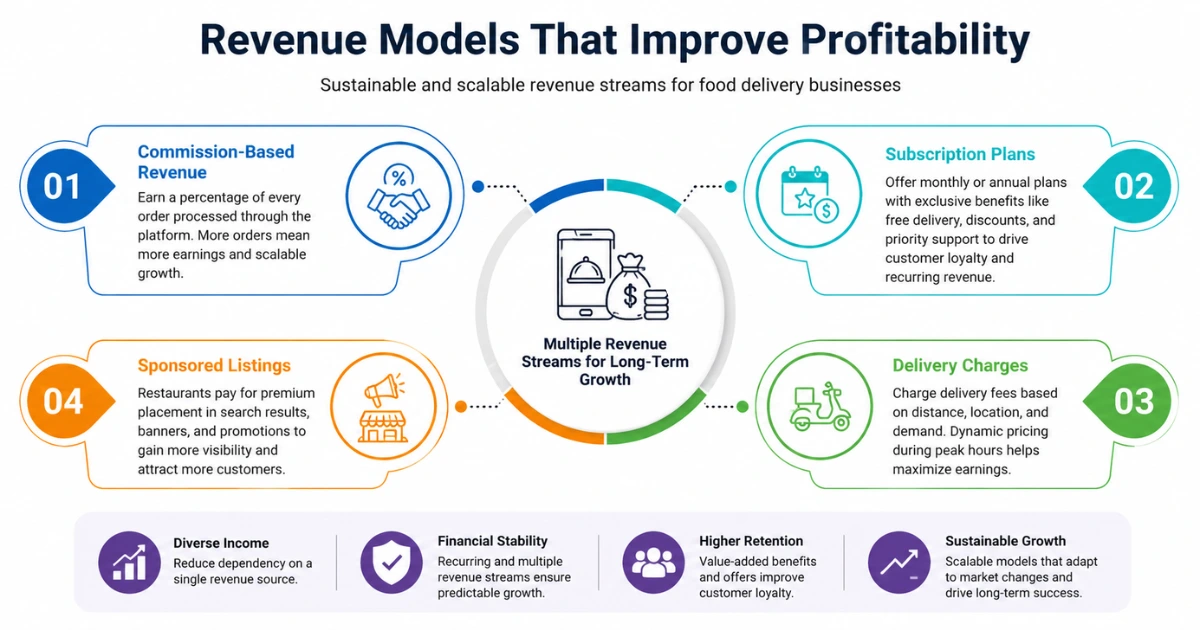
Commission-Based Revenue
Commission-based revenue is one of the most widely adopted monetization models in the food delivery industry. Under this model, the platform earns a percentage of every order processed through the application. Restaurants pay a commission fee in exchange for gaining access to a larger customer base, delivery infrastructure, and digital ordering capabilities.
The commission percentage may vary depending on the restaurant category, order volume, partnership agreements, and additional services provided by the platform. This model creates a mutually beneficial relationship where the platform generates revenue as restaurants receive more orders and increased visibility.
One of the primary advantages of commission-based revenue is scalability. As order volumes grow, platform earnings increase without requiring significant changes to the business model. This makes commission-based monetization a reliable and sustainable source of revenue for food delivery businesses.
Subscription Plans
Subscription plans provide businesses with a recurring revenue stream that improves financial predictability and customer retention. Under this model, users pay a monthly or annual fee in exchange for exclusive benefits such as free delivery, priority order processing, special discounts, cashback rewards, and access to premium restaurant partners.
Subscription programs encourage customers to place orders more frequently because they want to maximize the value of their membership. As a result, businesses often experience higher customer retention rates and increased lifetime customer value.
For food delivery platforms, recurring subscription revenue helps reduce dependence on individual order commissions while creating a more stable and predictable income source. This model has become increasingly popular among leading delivery platforms seeking long-term customer loyalty and sustainable profitability.
Delivery Charges
Delivery charges remain one of the most direct and effective revenue sources for food delivery businesses. Customers are charged a delivery fee based on factors such as distance, order value, delivery location, traffic conditions, and service type.
Many platforms implement flexible delivery pricing models that adjust fees according to demand and operational requirements. For example, delivery charges may increase during peak hours or adverse weather conditions when demand exceeds available delivery capacity.
While delivery fees generate immediate revenue, businesses must strike a balance between profitability and customer satisfaction. Excessive delivery charges can discourage orders, whereas competitive pricing can improve order frequency and customer loyalty. When managed strategically, delivery charges can contribute significantly to overall platform revenue.
Sponsored Listings
Sponsored listings allow restaurant partners to pay for premium placement within the application. Restaurants that choose this option receive greater visibility in search results, category listings, homepage banners, and promotional sections, helping them attract more customers and increase order volumes.
This advertising-based revenue model benefits both the platform and restaurant partners. Restaurants gain enhanced exposure in a competitive marketplace, while the platform generates additional revenue without affecting the customer experience.
Sponsored listings are particularly valuable for newly launched restaurants seeking brand awareness or established businesses looking to promote specific products and offers. As the number of restaurant partners grows, sponsored placements can become a highly profitable monetization channel.
In-App Advertising
In-app advertising provides another effective opportunity to generate revenue beyond food orders and delivery services. Businesses can display targeted advertisements from restaurants, food brands, beverage companies, grocery providers, and related service providers directly within the application.
Advanced analytics and customer data allow platforms to deliver highly relevant advertisements based on user preferences, order history, location, and browsing behavior. Personalized advertising increases engagement and improves campaign performance while creating additional value for advertisers.
Unlike traditional revenue models tied directly to orders, in-app advertising enables platforms to monetize user engagement and application traffic. As customer activity increases, advertising opportunities expand, creating an additional source of scalable revenue.
Premium Membership Programs
Premium membership programs are designed to reward loyal customers while creating an additional recurring revenue stream. Unlike standard subscription plans, premium memberships often include exclusive benefits such as priority customer support, VIP restaurant access, early access to promotions, exclusive discounts, faster delivery options, and personalized rewards.
These programs create a sense of exclusivity that encourages customers to remain engaged with the platform. Premium members typically place more frequent orders and demonstrate higher lifetime value compared to non-members.
For businesses, premium membership programs improve customer retention, increase recurring revenue, and strengthen brand loyalty. When combined with subscription plans and personalized experiences, premium memberships can become a powerful tool for driving long-term profitability.
Choosing the Right Revenue Mix for Long-Term Growth
No single monetization model is sufficient to maximize profitability in today's competitive food delivery industry. The most successful platforms combine multiple revenue streams to create a balanced and resilient business model. Commission-based earnings, subscription plans, delivery charges, sponsored listings, in-app advertising, and premium memberships each contribute unique benefits that support sustainable growth.
For businesses pursuing Food Delivery App Development UAE, selecting the right revenue mix should be based on target audience behavior, market positioning, operational capabilities, and long-term business goals. A diversified monetization strategy not only increases profitability but also reduces financial risk and creates a stronger foundation for future expansion.
Technology Stack Recommendations for Cost-Efficient Development
Choosing the right technology stack is one of the most important decisions in Food Delivery App Development in UAE. The technologies used to build the platform directly impact development costs, application performance, scalability, maintenance requirements, and long-term profitability. Many startups overspend by selecting overly complex technologies that exceed their current business needs, while others choose low-cost solutions that struggle to support future growth.
A well-planned technology stack should balance performance, security, scalability, and cost efficiency. It should also provide flexibility for future feature enhancements, third-party integrations, and increasing user demand. Businesses looking for Cost-Effective Food Delivery App Development should prioritize proven technologies that reduce development time, simplify maintenance, and support seamless user experiences across all devices.
The following technology stack recommendations can help businesses build a scalable and profitable food delivery platform while maintaining development efficiency and controlling long-term operational costs.
Front-End Technologies
The front end is responsible for everything users see and interact with within the application. A responsive and user-friendly interface plays a critical role in customer satisfaction, engagement, and retention. Since food delivery platforms serve multiple user groups, including customers, restaurant partners, delivery agents, and administrators, the front-end framework must deliver consistent performance across all devices and operating systems.
Cross-platform technologies such as Flutter and React Native have become popular choices for food delivery applications because they allow developers to build Android and iOS applications using a single codebase. This significantly reduces development time, lowers costs, and simplifies future maintenance compared to building separate native applications for each platform.
These frameworks also support faster updates, smoother user experiences, and scalable development practices. For startups aiming to launch quickly without compromising quality, modern cross-platform solutions provide an excellent balance between performance and affordability.
Backend Technologies
The backend serves as the foundation of a food delivery application, managing business logic, databases, APIs, user authentication, order processing, and real-time communication between different stakeholders. A reliable backend ensures that the platform can handle thousands of users, transactions, and orders simultaneously without performance issues.
Popular backend technologies such as Node.js, Python, Laravel, Java Spring Boot, and .NET are widely used for developing scalable food delivery applications. The choice of backend framework should depend on business requirements, expected traffic volume, development resources, and long-term scalability goals.
A strong backend architecture helps businesses support real-time order tracking, secure transactions, restaurant management, delivery operations, and analytics capabilities while maintaining system reliability. Investing in scalable backend infrastructure from the beginning can help avoid costly redevelopment efforts as the platform grows.
Cloud Infrastructure
Cloud infrastructure has become the preferred deployment model for modern food delivery applications due to its flexibility, scalability, and cost efficiency. Instead of investing in expensive physical servers and infrastructure management, businesses can leverage cloud services to scale resources based on actual demand.
Leading cloud providers such as Amazon Web Services (AWS), Microsoft Azure, and Google Cloud Platform offer solutions that support high application availability, data storage, disaster recovery, and performance optimization. Cloud-based infrastructure allows food delivery platforms to handle traffic spikes during peak ordering periods without affecting user experience.
One of the biggest advantages of cloud infrastructure is its pay-as-you-go pricing model. Businesses only pay for the resources they use, making it an ideal solution for startups seeking cost-effective scalability. Cloud deployment also simplifies maintenance, improves security, and accelerates future expansion efforts.
Payment Gateway Integration
Secure and seamless payment processing is a fundamental requirement for any food delivery platform. Customers expect multiple payment options that support convenient and frictionless transactions. Integrating trusted payment gateways enables businesses to provide secure payment experiences while improving customer confidence.
Popular payment solutions in the UAE market support credit cards, debit cards, digital wallets, online banking, and contactless payment methods. A reliable payment gateway should offer fast transaction processing, fraud prevention capabilities, multi-currency support, and compliance with financial security standards.
Businesses should prioritize payment providers that deliver strong security measures, transparent pricing, and high transaction success rates. Efficient payment integration reduces cart abandonment, improves customer satisfaction, and contributes directly to platform profitability.
Security and Compliance
Security is one of the most critical aspects of Food Delivery App Development UAE projects. Food delivery applications handle sensitive customer information, payment details, restaurant data, and operational records, making them attractive targets for cyber threats. A security breach can result in financial losses, reputational damage, and regulatory penalties.
To protect user data and maintain customer trust, businesses should implement robust security measures such as end-to-end encryption, secure authentication protocols, multi-factor authentication, role-based access controls, and continuous security monitoring. Regular security audits and vulnerability assessments further strengthen platform protection.
Compliance with industry standards and regional data protection regulations is equally important. Businesses must ensure that their applications adhere to relevant privacy and payment security requirements to avoid legal complications and maintain operational integrity. A strong focus on security and compliance not only safeguards business operations but also enhances customer confidence and long-term brand credibility.
Building a Future-Ready Technology Foundation
The right technology stack can significantly influence the success and profitability of a food delivery platform. By selecting scalable front-end frameworks, reliable backend technologies, cloud-based infrastructure, secure payment solutions, and comprehensive security practices, businesses can reduce development costs while creating a platform that supports long-term growth.
For companies investing in Food Delivery App Development in UAE, technology decisions should not focus solely on short-term savings. Instead, businesses should prioritize solutions that offer flexibility, scalability, and operational efficiency, ensuring the platform remains competitive as customer expectations and market demands continue to evolve.
Why Restaurant Technology Integrations Matter
A food delivery app is only as efficient as the systems supporting it behind the scenes. While customer-facing features often receive the most attention, restaurant technology integrations play a critical role in ensuring smooth operations, accurate order management, and consistent customer experiences. As food delivery businesses scale, manually managing orders, inventory, menus, and restaurant operations becomes increasingly challenging and prone to errors.
Integrating restaurant management technologies directly into a food delivery platform helps automate workflows, improve operational visibility, and reduce administrative burdens for restaurant partners. These integrations allow restaurants to process orders more efficiently, maintain accurate inventory records, and deliver better customer experiences while minimizing operational costs.
For businesses investing in Food Delivery App Development in UAE, technology integrations should be viewed as a strategic investment rather than an optional feature. By connecting delivery platforms with essential restaurant systems, businesses can improve efficiency, increase profitability, and create a more scalable ecosystem for long-term growth.
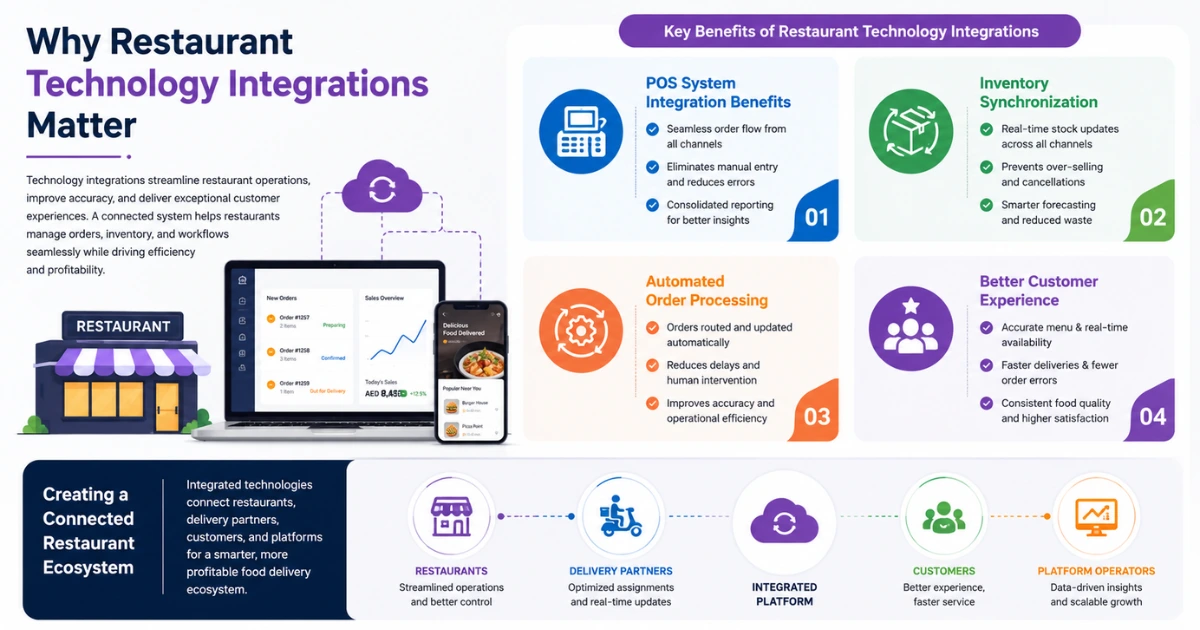
POS System Integration Benefits
Point-of-sale (POS) integration is one of the most valuable technology enhancements for modern food delivery platforms. Restaurants often receive orders from multiple channels, including in-house dining, online ordering systems, food delivery applications, and third-party marketplaces. Without integration, staff may need to manually enter orders into their POS systems, increasing the risk of delays and human errors.
Integrating food delivery applications with modern pos software dubai solutions allows orders to flow directly into restaurant management systems in real time. This eliminates duplicate data entry, reduces processing errors, and improves operational efficiency. Restaurant staff can instantly view incoming orders, manage preparation workflows, and update order statuses without switching between multiple systems.
POS integration also improves reporting accuracy by consolidating sales data from various channels into a single platform. This provides restaurant owners with greater visibility into business performance while simplifying financial management and operational reporting.
Inventory Synchronization
Inventory management is a critical component of successful restaurant operations. Inaccurate inventory information can lead to menu inconsistencies, stock shortages, customer dissatisfaction, and lost revenue opportunities. Manual inventory tracking becomes increasingly difficult as order volumes grow and menu offerings expand.
Inventory synchronization enables real-time communication between restaurant inventory systems and food delivery applications. When stock levels change, menu availability is automatically updated across the platform, ensuring customers only see items that are currently available. This significantly reduces order cancellations and improves customer trust.
Advanced integrations can also help restaurants forecast inventory requirements based on historical sales patterns, seasonal demand fluctuations, and upcoming promotions. By maintaining accurate inventory visibility, restaurants can reduce food waste, improve purchasing decisions, and optimize operational efficiency.
Automated Order Processing
Manual order processing often creates bottlenecks that slow down restaurant operations and increase the likelihood of errors. Automated order processing eliminates many of these challenges by streamlining communication between customers, restaurants, and delivery partners.
When an order is placed, the system automatically routes it to the appropriate restaurant, updates order statuses, notifies kitchen staff, and coordinates delivery assignments. This automation reduces response times, minimizes human intervention, and improves order accuracy throughout the fulfillment process.
Automated workflows also help restaurants manage high-order volumes during peak periods without sacrificing service quality. By reducing administrative tasks and operational delays, automated order processing enables restaurants to focus more on food preparation and customer satisfaction.
Better Customer Experience
Ultimately, the purpose of technology integration is to create a better experience for customers. Consumers expect accurate orders, real-time updates, fast deliveries, and seamless interactions throughout their ordering journey. Integrated restaurant technologies help ensure these expectations are consistently met.
When restaurant systems are connected to the delivery platform, customers benefit from more accurate menu information, real-time inventory visibility, faster order processing, and improved delivery coordination. These improvements contribute to shorter wait times, fewer order errors, and higher overall satisfaction levels.
Additionally, integrating tools such as restaurant recipe management software can help restaurants maintain consistency in food preparation and quality standards across multiple locations. Consistent food quality strengthens customer trust, improves reviews, and increases the likelihood of repeat orders.
Creating a Connected Restaurant Ecosystem
As competition within the UAE food delivery market continues to intensify, operational efficiency is becoming a major differentiator. Businesses that leverage restaurant technology integrations can streamline workflows, reduce costs, and provide superior customer experiences compared to competitors relying on manual processes.
From POS integration and inventory synchronization to automated order management and quality control systems, these technologies help create a connected ecosystem that benefits restaurants, delivery partners, customers, and platform operators alike. For organizations pursuing Food Delivery App Development UAE initiatives, investing in restaurant technology integrations is a strategic step toward building a scalable, profitable, and future-ready food delivery platform.
Estimating Development Costs Without Overspending
One of the most common questions entrepreneurs ask before starting a food delivery project is: "How much will it cost to build and launch a profitable food delivery app?" While there is no one-size-fits-all answer, understanding the factors that influence development costs can help businesses make informed decisions and avoid unnecessary expenses.
Many startups overspend because they focus on building a feature-heavy application before validating market demand. Others underestimate hidden expenses such as infrastructure, integrations, maintenance, and ongoing upgrades. The key to Cost-Effective Food Delivery App Development is understanding where your budget should be allocated and which investments will generate the greatest return.
Businesses planning Food Delivery App Development in UAE should approach budgeting strategically by prioritizing essential features, selecting the right technology stack, and planning for long-term scalability. A clear understanding of development cost drivers can help reduce financial risks while ensuring the application remains competitive and future-ready.
Factors Affecting Development Costs
Several factors influence the overall cost of developing a food delivery application. These include project scope, feature requirements, design complexity, development methodology, technology stack, third-party integrations, security requirements, and ongoing maintenance needs.
Business objectives also play an important role in determining costs. A simple MVP designed to validate a business concept will require a significantly smaller investment than a fully featured multi-vendor marketplace supporting restaurants, delivery agents, customers, and administrators.
The experience and expertise of the development team can also affect project pricing. While choosing a lower-cost provider may seem attractive initially, investing in an experienced Food Delivery App Development Company in UAE often reduces long-term costs by minimizing development errors, technical debt, and future redevelopment requirements.
Feature Complexity
Feature complexity is one of the biggest contributors to application development costs. The more advanced functionality a platform requires, the greater the investment needed for design, development, testing, and maintenance.
Basic features such as user registration, menu browsing, order placement, payment processing, and order tracking generally require less development effort. However, advanced capabilities such as AI-powered recommendations, predictive analytics, route optimization, dynamic pricing, loyalty programs, multi-language support, and automated customer support increase project complexity and development timelines.
Businesses should focus on launching with features that directly support customer acquisition, retention, and revenue generation. Starting with an MVP and gradually expanding functionality based on user feedback is often the most cost-efficient approach.
Platform Selection
The choice of platform significantly impacts both initial development costs and long-term maintenance expenses. Businesses typically choose between Android, iOS, or cross-platform development depending on their target audience and budget requirements.
Developing separate native applications for Android and iOS can provide excellent performance and platform-specific optimization, but it often requires higher development investments due to the need for multiple codebases. Cross-platform technologies such as Flutter and React Native allow businesses to build applications for both platforms using a single codebase, reducing development time and costs.
For startups seeking Cost-Effective Food Delivery App Development, cross-platform solutions often provide the best balance between affordability, performance, and scalability. Platform selection should always align with business goals, target demographics, and expected growth plans.
Third-Party Integrations
Third-party integrations are essential for delivering a seamless food delivery experience, but they can also contribute to development costs. Modern food delivery applications frequently integrate with payment gateways, mapping services, SMS providers, push notification platforms, analytics tools, customer support systems, and restaurant management software.
These integrations help accelerate development by leveraging existing technologies rather than building every feature from scratch. However, businesses must account for licensing fees, subscription costs, API usage charges, and integration complexity when estimating project budgets.
For example, integrating advanced payment solutions, real-time location tracking services, and restaurant management platforms may increase initial development costs but can significantly improve operational efficiency and customer satisfaction over time.
Maintenance and Upgrades
Many businesses focus exclusively on launch costs and overlook the importance of ongoing maintenance and upgrades. In reality, application development does not end when the platform goes live. Continuous maintenance is essential for ensuring security, performance, compatibility, and long-term stability.
Regular updates may include bug fixes, security enhancements, operating system compatibility updates, performance optimization, infrastructure scaling, and feature improvements based on user feedback. As customer expectations evolve, businesses must also invest in innovation to remain competitive.
Planning for maintenance expenses from the beginning helps prevent unexpected financial challenges after launch. Businesses should allocate a portion of their budget to ongoing support and platform improvements to ensure sustainable growth and long-term success.
Comparing Costs Across Different App Categories
Understanding food delivery app costs becomes easier when compared to other application categories. For example, businesses researching app development cost in dubai often discover that food delivery platforms require more complex infrastructure than standard business applications due to real-time tracking, multi-user functionality, and delivery management capabilities.
Similarly, when comparing food delivery solutions with ecommerce app development cost dubai projects, food delivery platforms typically involve additional operational requirements such as logistics management, restaurant integrations, route optimization, and live order tracking. These specialized functionalities contribute to the overall development investment but also create greater opportunities for recurring revenue and customer engagement.
Building Smart, Not Expensive
Successful food delivery platforms are not necessarily the ones with the highest development budgets. Instead, they are built through strategic planning, efficient resource allocation, and a clear understanding of business priorities. By carefully evaluating feature requirements, platform choices, integration needs, and maintenance responsibilities, businesses can control costs while creating a scalable and profitable solution.
For companies pursuing Food Delivery App Development UAE initiatives, the goal should be to invest in technologies and features that directly support business growth rather than spending unnecessarily on functionality that may not provide immediate value. A smart development strategy helps reduce costs, accelerate time-to-market, and create a stronger foundation for long-term profitability.
Scaling Your Food Delivery Business for Long-Term Growth
Launching a food delivery platform is only the beginning of the journey. The real challenge lies in scaling the business sustainably while maintaining operational efficiency, customer satisfaction, and profitability. Many startups successfully enter the market but struggle to expand because they lack a clear growth strategy. Sustainable growth requires more than increasing order volumes—it involves building a scalable business model, expanding into new markets, strengthening partnerships, and leveraging data to make informed decisions.
The UAE food delivery market continues to offer significant opportunities for expansion as digital adoption increases and consumer demand for convenience-driven services grows. Businesses that invest in scalable infrastructure, strategic partnerships, and customer retention initiatives are better positioned to capture long-term market share. Whether you are a startup, restaurant chain, or cloud kitchen operator, the following growth strategies can help transform your platform from a local service into a leading food delivery ecosystem.
Expanding into New Emirates
One of the most effective ways to scale a food delivery business is by expanding beyond a single city or emirate. While many startups initially focus on major markets such as Dubai or Abu Dhabi, significant opportunities also exist in Sharjah, Ajman, Ras Al Khaimah, Fujairah, Umm Al Quwain, and other growing regions.
Geographic expansion allows businesses to reach new customer segments, diversify revenue streams, and reduce dependence on a single market. However, successful expansion requires careful planning. Businesses must evaluate local demand, restaurant availability, delivery infrastructure, competition levels, and operational logistics before entering a new region.
A scalable platform architecture and strong operational framework make it easier to replicate success across multiple emirates. By gradually expanding into underserved markets, businesses can increase their customer base while strengthening brand presence throughout the UAE.
Multi-Vendor Marketplace Models
Many successful food delivery businesses evolve from serving a limited number of restaurants to operating large multi-vendor marketplaces. This model allows multiple restaurants, cafes, cloud kitchens, and food brands to join the platform and offer their services through a single application.
A multi-vendor marketplace creates value for customers by providing greater choice and convenience while generating additional revenue opportunities for the platform. More vendors mean more menu options, increased order volume, and stronger network effects that attract both customers and restaurant partners.
From a business perspective, the marketplace model enables scalable growth without requiring direct ownership of restaurant operations. This approach has become a core strategy in many top food delivery app development projects because it supports rapid expansion while maintaining operational flexibility and profitability.
Cloud Kitchen Partnerships
Cloud kitchens have emerged as one of the fastest-growing business models within the food delivery industry. Unlike traditional restaurants, cloud kitchens operate exclusively for online orders and delivery services, allowing them to significantly reduce overhead expenses associated with physical dining spaces.
Partnering with cloud kitchens enables food delivery platforms to expand restaurant offerings while improving delivery efficiency and market coverage. These partnerships can also help businesses launch exclusive virtual restaurant brands designed specifically for delivery-focused customers.
For organizations working with a food service development company uae, cloud kitchen integrations often provide opportunities to optimize logistics, reduce operational costs, and improve profitability. As the demand for delivery-first dining experiences continues to grow, cloud kitchens are expected to play an increasingly important role in the future of the UAE food delivery market.
Customer Loyalty Programs
Acquiring new customers is important, but retaining existing customers is often more cost-effective and profitable. Customer loyalty programs encourage repeat purchases by rewarding users for continued engagement with the platform.
Effective loyalty initiatives may include reward points, cashback offers, referral bonuses, exclusive discounts, free delivery benefits, tier-based memberships, and personalized incentives. These programs create additional value for customers while strengthening long-term relationships with the brand.
Loyal customers typically place orders more frequently, spend more per transaction, and contribute to positive word-of-mouth marketing. As customer acquisition costs continue to rise, investing in retention-focused strategies becomes increasingly important for sustainable business growth and profitability.
Data-Driven Decision Making
As food delivery businesses scale, relying on assumptions and intuition becomes increasingly risky. Data-driven decision-making enables businesses to identify growth opportunities, optimize operations, and improve customer experiences based on measurable insights rather than guesswork.
Modern food delivery platforms generate large volumes of valuable data related to customer behavior, ordering patterns, restaurant performance, delivery efficiency, marketing campaigns, and revenue trends. By analyzing this information, businesses can make more informed decisions regarding expansion strategies, promotional campaigns, menu optimization, and resource allocation.
Advanced analytics can also help identify high-performing locations, predict customer demand, reduce operational inefficiencies, and improve profitability. Many successful food apps in dubai leverage data analytics to continuously refine their business strategies and maintain a competitive advantage in an increasingly crowded market.
Building a Scalable Future for Your Food Delivery Business
Long-term success in the food delivery industry depends on the ability to scale efficiently while maintaining service quality and profitability. Expanding into new emirates, adopting multi-vendor marketplace models, partnering with cloud kitchens, implementing loyalty programs, and leveraging data-driven insights can help businesses create a strong foundation for sustainable growth.
For companies investing in Food Delivery App Development in UAE, scalability should be considered from the very beginning. Businesses that plan for growth early are better equipped to adapt to changing customer expectations, capitalize on emerging opportunities, and establish themselves as leaders in the rapidly evolving food delivery ecosystem. By combining innovative technology with strategic business planning, organizations can build a food delivery platform capable of delivering long-term success across the UAE market.
Conclusion
Building a profitable food delivery app in the UAE is not about spending the largest budget—it's about making smart strategic decisions that balance cost, scalability, and long-term growth. Businesses that focus on launching with essential features, adopting a scalable technology stack, leveraging AI-powered capabilities, optimizing delivery operations, implementing diverse revenue models, and prioritizing customer experience are more likely to achieve sustainable profitability. Technologies such as artificial intelligence, predictive analytics, automation, and data-driven decision-making can help reduce operational costs while improving efficiency and customer engagement. At the same time, integrating restaurant management systems, cloud infrastructure, and advanced analytics creates a strong foundation for future expansion. Most importantly, partnering with an experienced Food Delivery App Development Company in UAE can help businesses avoid costly mistakes, accelerate time-to-market, and build a secure, scalable, and future-ready platform. By combining the right technology, business strategy, and user-centric approach, startups, restaurants, and entrepreneurs can successfully establish a competitive and profitable presence in the rapidly growing UAE food delivery market.