Food ERP Software & Food Industry IT Solutions in UAE
SISGAIN builds custom food ERP software in UAE for manufacturers, bakeries, restaurants, cloud kitchens, and distributors, connecting procurement, inventory, production, sales, and finance through one integrated platform.
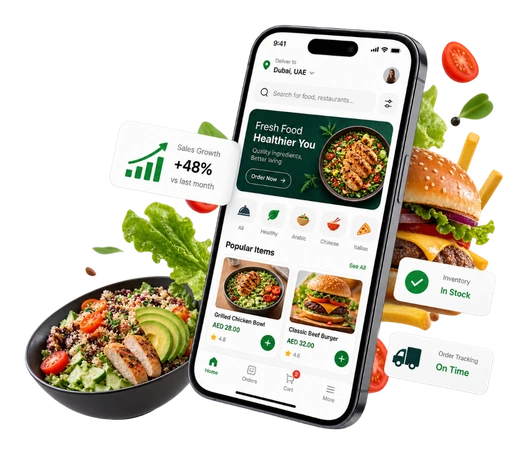
Food ERP Software Solutions for UAE Businesses
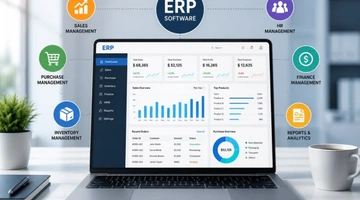
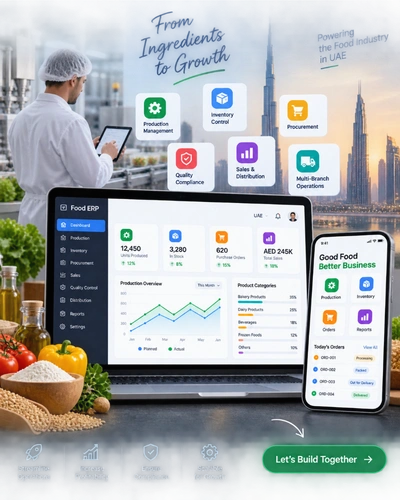
Food ERP software is the system that connects the parts of your business that usually run in isolation — purchasing, stock, kitchen or factory floor, sales, and accounts. Instead of a purchase manager working off one spreadsheet, a production supervisor working off a whiteboard, and finance closing the month from a third system entirely, everything sits in one place.
For a UAE food business, that usually needs to cover:
Procurement
Supplier records, purchase orders, and goods-received tracking, so stock levels update automatically when deliveries arrive.
Inventory management
Real-time stock across one location or a dozen, with alerts before you run short or over-order perishables.
Ingredient & raw material tracking
Knowing exactly what's on hand, what's reserved for production, and what's approaching expiry.
Production planning
Turning sales forecasts or orders into a production schedule your kitchen or factory can actually follow.
Recipe & formulation management
Standard recipes tied to costing, so a change in raw material price flows through to product cost automatically.
Sales & order management
From a single retail counter to bulk B2B orders, tracked from quote to delivery.
Finance & accounting integration
Sales, purchases, and inventory movements reflected in your books without manual re-entry.
Quality & batch workflows
Recording batch numbers, checks, and outcomes at the points that matter to your process.
Multi-branch operations
One system across locations, with reporting that rolls up or breaks down by branch.
Reporting & analytics
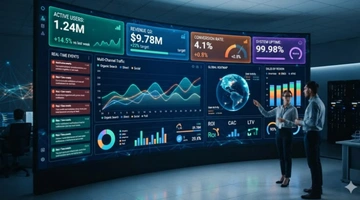
Dashboards built around the numbers you actually check, not a generic report library.
None of this works as a list of features bolted together. The value is in how procurement talks to production, how production talks to sales, and how all three talk to finance — designed around your workflows rather than forcing your business to adapt to someone else's software.
Food Manufacturing ERP Software in UAE
Food manufacturers in the UAE — from packaged foods to beverages to ingredient processors — deal with a specific set of pressures that generic ERP systems weren't built for: perishable raw materials, formulation-driven costing, and production runs that need to be tracked batch by batch.
A food manufacturing ERP software built by SISGAIN typically covers:
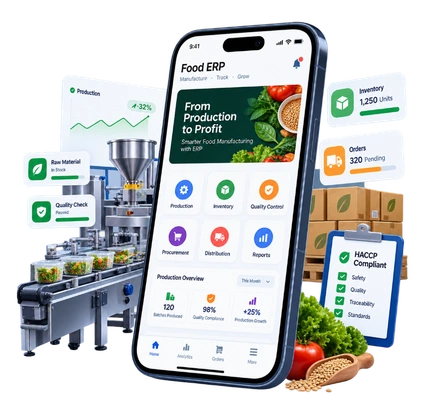
The business case for connecting these workflows is straightforward. When your production plan is built directly from live stock and order data, you spend less time chasing down what's actually available. When batch and lot tracking sits inside the same system as sales, tracing a finished product back to its inputs takes minutes rather than a manual audit. When formulation costs update automatically, your margins reflect reality instead of last quarter's raw material prices.
We don't make claims about specific regulatory certifications or compliance standards on your behalf — that depends on your product category and the authority you report to. What we can do is build the traceability and reporting structure your compliance process needs, so the data is there when you need it.
Bakery ERP Software & Bakery Management ERP UAE
Bakeries don't run like general food manufacturers, and treating them the same way in software usually causes more problems than it solves. Production happens daily, sometimes multiple times a day. Shelf life is measured in hours. A retail bakery in Dubai Marina has different needs from a central production kitchen supplying five outlets across Abu Dhabi.
A bakery ERP UAE businesses actually use day to day needs to handle:
-
Recipe and ingredient managementStandard recipes scaled up or down by batch size, with costing tied to current ingredient prices.
-
Daily production planningProduction runs planned around what's selling and what's expected to sell, not a static weekly schedule.
-
Raw material trackingFlour, dairy, and other perishables tracked with enough precision to avoid both shortages and waste.
-
Batch and expiry managementEvery batch dated and tracked so nothing sits on a shelf past its usable window.
-
Bakery POS integrationSales data flowing back into inventory and production planning without manual reconciliation.
-
Sales and order managementRetail counter sales, café orders, and wholesale or B2B orders handled in one system.
-
Delivery workflowsFor bakeries supplying hotels, cafés, or retail partners, order-to-delivery tracking.
-
Wastage and cost trackingVisibility into what's thrown away and why, so production planning improves over time.
-
Multi-branch bakery managementCentral visibility across outlets, with local flexibility for branch-specific production.
-
ReportingDaily sales, production yield, and wastage reports that a bakery manager can actually act on.
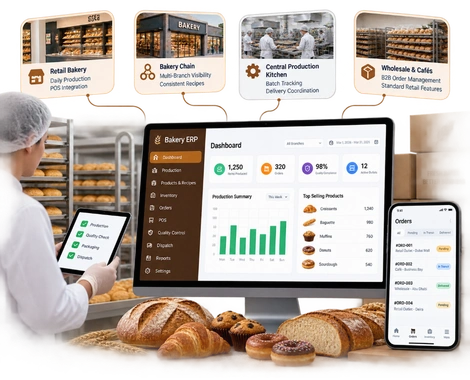
This applies differently depending on the type of bakery you run. A retail bakery cares most about daily production accuracy and POS integration. A bakery chain needs multi-branch visibility and consistent recipe control across outlets. A central production kitchen supplying multiple retail points needs strong batch tracking and delivery coordination. Wholesale bakeries and cafés with in-house production sit somewhere in between — often needing B2B order management alongside standard retail features. We build bakery management ERP UAE systems around which of these you actually are, not a one-size-fits-all bakery template.
Restaurant ERP Software & Restaurant Delivery Software UAE
Restaurant technology in the UAE splits into two related but distinct needs, and it's worth being clear about the difference before choosing what to build.
Restaurant ERP software
Manages the business behind the counter: point-of-sale and billing, menu management, kitchen operations, ingredient and inventory tracking, staff scheduling, branch management, and customer relationship data. It's the system that tells you which dishes are profitable, which branch is overstocked on a particular ingredient, and how staff costs compare across locations.
Restaurant delivery software
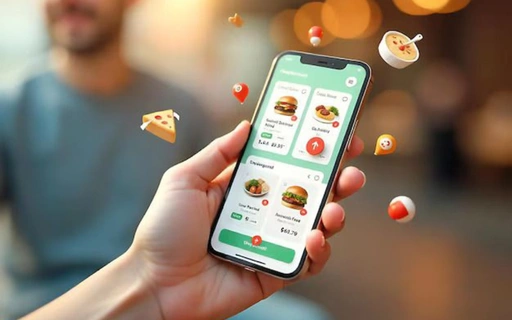
Manages what happens after an order is placed: online ordering, delivery partner coordination, order tracking, and payment handling for delivery-specific transactions. A cloud kitchen might need this more than a full ERP. A dine-in restaurant with a small delivery arm might need the reverse.
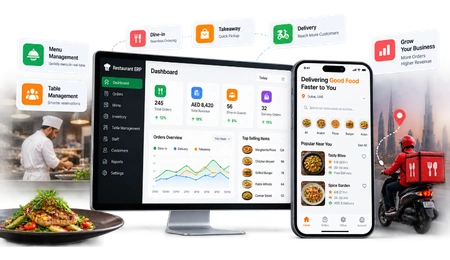
Most UAE restaurant groups need both working together, which is where a lot of off-the-shelf software falls short — ERP and delivery platforms sold separately, requiring manual reconciliation between them. A connected restaurant ERP software UAE build from SISGAIN typically includes:
We develop custom restaurant and delivery software based on how you actually operate — a single dine-in location, a delivery-first cloud kitchen, or a multi-branch group needing one system across all of it.
Food & Beverage Software for Different Business Models
Every food business type has a different operational bottleneck. Here's how that typically breaks down. Click a business type below to open its detail.
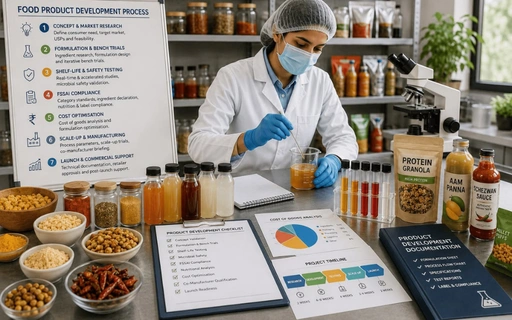
Food manufacturers
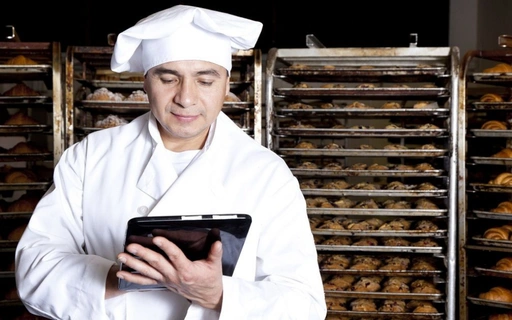
Bakeries and bakery chains
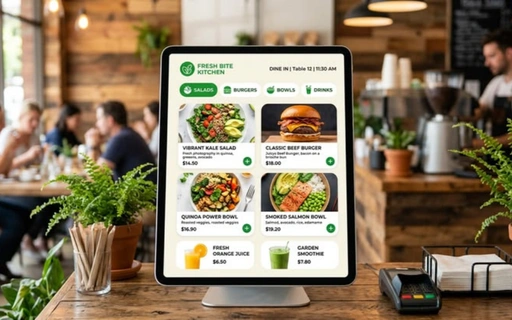
Restaurants and restaurant groups
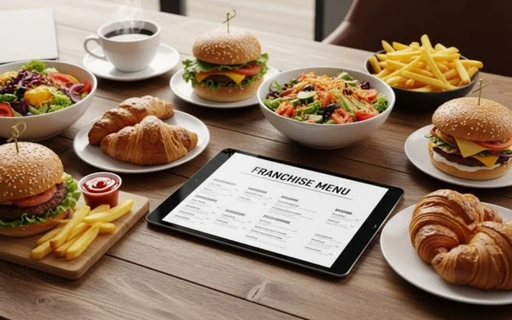
Cloud kitchens
Food distributors
Cafés and beverage brands

Food service businesses (catering, institutional supply)
Food & Beverage Industry IT Solutions in UAE
ERP software solves the operational core, but most UAE food businesses eventually need more than that — modernizing an old system, connecting cloud infrastructure, or simply having a technical partner who can maintain what's already built. SISGAIN supports this through:




These services exist to support the ERP and industry software above, not replace it. If you already have inventory or accounting software and want to know whether it's worth connecting rather than replacing, that's a conversation worth having before any development starts.
Technologies Behind Your Food ERP Build
Modules get selected around your workflow, not a fixed stack — these are the platforms and frameworks we draw on most often for food ERP, POS, and delivery builds.
 React
React Angular
 Vue
Vue Next.js
 Node.js
 Python
 Java
Java PHP
PHP Laravel
 .NET
.NET Flutter
 React Native
 AWS
AWS
 Azure
Azure
 Google Cloud
 Docker
 Kubernetes
 TensorFlow
Why Choose SISGAIN for Food ERP Software in UAE?
Food businesses have workflows that general-purpose software companies often misunderstand — the difference between a production run and a sales order, or why a bakery's Tuesday looks nothing like its Friday. We work specifically in industry-focused software development, which means the conversation starts with your operations, not a fixed product roadmap. A few things worth knowing before you reach out:
We build custom, not off-the-shelf
Your ERP is designed around your recipes, your branches, and your reporting needs — not configured from a rigid template.
Integration is part of the plan
If you already run POS, accounting, or delivery software, we look at what should stay and what should connect before recommending anything new.
We're set up for UAE-based businesses
Time zone, business hours, and working directly with teams based in Dubai and Abu Dhabi matter when a production issue needs a same-day answer.
Development and support sit under one roof
The team that builds your system is positioned to maintain it afterward, rather than handing you off to a separate support desk.
Scalability is built in from the start
A system designed for one branch should still work when you open a third or fourth, without a rebuild.
We're not going to tell you we're the biggest or the best — that's not a claim we can back up, and it's not what determines whether a food ERP project succeeds. What matters is whether the people building your system understand food operations well enough to ask the right questions before writing a line of code.
Our Food ERP Software Development & Implementation Process
Click any step below to expand it and see how it works.
We start by understanding how your business actually runs — procurement cycles, production schedules, branch structure, and the reporting your team relies on. This step exists because ERP projects fail most often when software is built against assumptions rather than actual workflows.
Based on those requirements, we map out which modules you need — inventory, production, POS integration, multi-branch reporting — and how they connect. This gives you a clear picture of scope before development begins, rather than surprises halfway through.
Screens and workflows are designed around the people who'll use them daily: a production supervisor, a branch manager, a finance user. Software that's technically correct but hard to use ends up ignored, so this step protects adoption.
The system is built in stages, with integration to your existing POS, accounting, or delivery platforms handled as part of the build rather than bolted on afterward.
Before go-live, the system is tested against real workflows and data scenarios — not just checked for bugs, but validated against how your team will actually use it day to day.
After deployment, systems get adjusted as your business changes — a new branch, a new product line, a new reporting requirement. Ongoing support keeps the system aligned with the business instead of drifting out of date.
Food ERP Software Integration Capabilities
Very few UAE food businesses are starting from a blank slate. Most already run a POS system, an accounting package, or a delivery platform — and replacing everything at once is rarely the right answer. Food ERP software can connect with:
Already using existing software? SISGAIN can help assess integration opportunities and develop a connected solution around your current systems, rather than assuming everything needs to be replaced. That assessment is usually the first real conversation in any project — what stays, what changes, and what gets built new.
How Food ERP Software Helps UAE Businesses
The operational case for food ERP software comes down to a handful of outcomes that compound over time:
Centralized operational visibility
One system showing procurement, production, sales, and finance instead of four disconnected views.
Better inventory and ingredient control
Stock levels that reflect what's actually on hand, reducing both shortages and overstocking of perishables.
Improved production planning
Schedules built from real demand and stock data rather than manual estimation.
Better order and delivery coordination
Fewer missed or delayed orders because information moves between departments automatically.
Multi-location reporting
Branch-level and consolidated views without manually combining spreadsheets.
Faster business insights
Reports available when a decision needs to be made, not two weeks after month-end.
Connected business operations
Changes in one part of the business (a price update, a stock adjustment) reflected everywhere else automatically.
We're not going to promise a specific percentage reduction in cost or a guaranteed return on investment — that depends on your starting point, your team, and how the system gets used after launch. What a well-built food ERP does reliably is remove the manual coordination that eats into a manager's day, and give ownership a clearer picture of what's actually happening across the business.
Ready to Build Your Food ERP Software in UAE?
Food ERP, manufacturing ERP, bakery ERP, restaurant ERP, and the IT infrastructure behind them all solve the same underlying problem: too many disconnected systems making it harder to run a food business than it needs to be. Whether you're a manufacturer trying to get production planning under control, a bakery managing daily output across branches, or a restaurant group juggling delivery platforms and in-store operations, the fix starts with understanding your actual workflow — not selecting a product off a shelf. SISGAIN works with UAE food businesses on exactly that: custom ERP and food industry software built around how you operate, with the integration and ongoing support to keep it working as your business grows.
Get a Free Food ERP Consultation
Tell us about your business and we'll walk through what a connected system could look like for you.
Get a Free ConsultationRequest a Project Estimate
If you already know roughly what you need, we can scope it and give you a realistic estimate.
Request an Estimate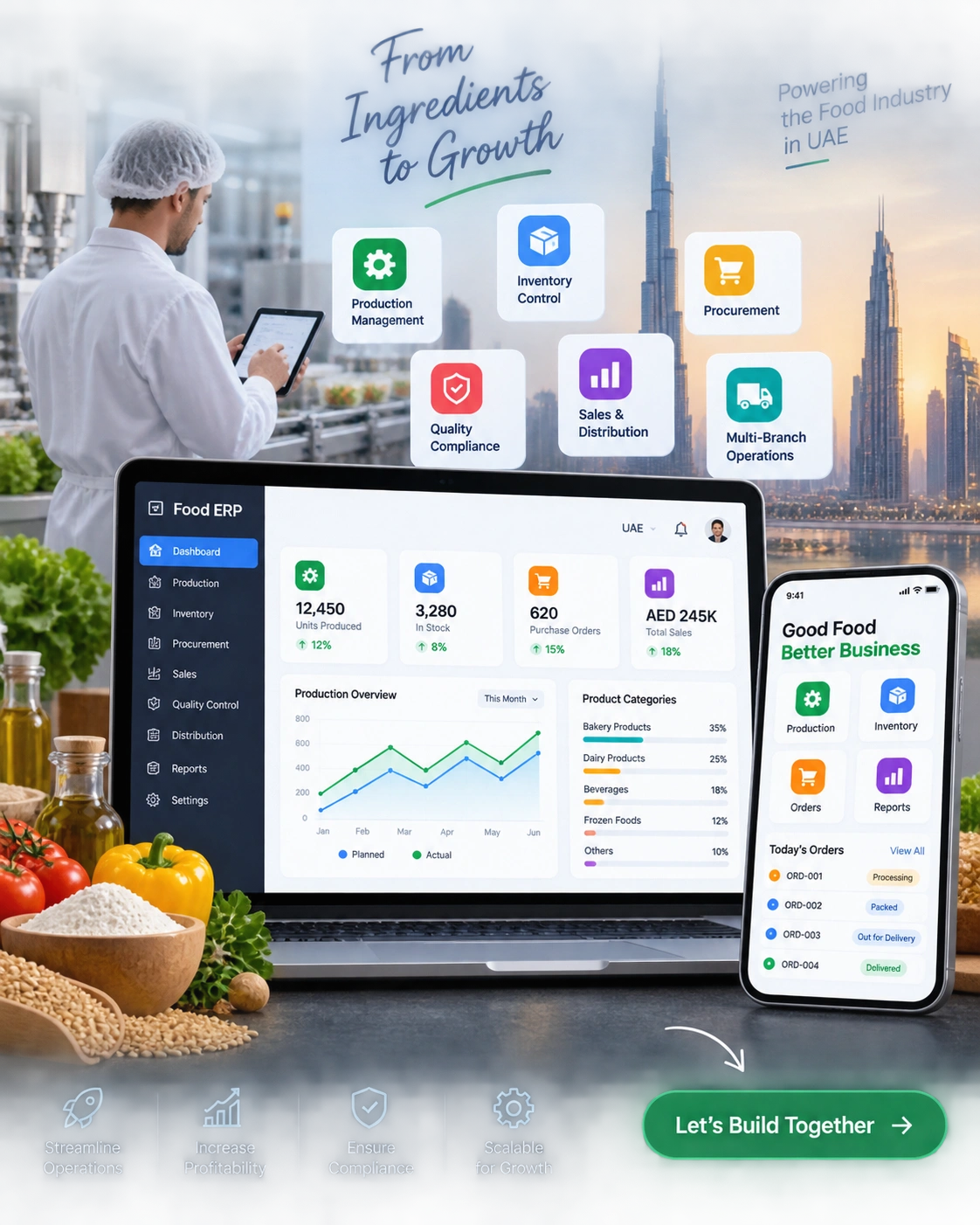
Food ERP Software FAQs
Food ERP software is a system that connects the core operations of a food business — procurement, inventory, production, sales, and finance — into one platform instead of separate spreadsheets or disconnected tools. For UAE food businesses, this typically means managing suppliers, ingredient stock, production schedules, and multi-branch sales in a single system. SISGAIN builds custom food ERP software rather than generic templates, so the system reflects how your specific business — manufacturing, bakery, restaurant, or distribution — actually operates.
A food manufacturing ERP typically covers raw material management, recipe and formulation tracking, production planning, batch and lot tracking, quality checkpoints, warehouse and inventory management, sales and distribution, and reporting. The goal is connecting these functions so a change in one area — a price update or a stock shortage — is visible everywhere else. Exact modules depend on your production process, product range, and how many facilities or warehouses you operate.
Yes. SISGAIN develops custom bakery ERP software for businesses based in Dubai and across the UAE, covering recipe management, daily production planning, batch and expiry tracking, POS integration, and multi-branch reporting. The system is built around your specific bakery type — retail bakery, bakery chain, central production kitchen, or wholesale supplier — rather than a single generic bakery template applied to every business.
Food ERP generally refers to systems built for manufacturing, processing, or production-heavy businesses — tracking raw materials, formulations, and batch production. Restaurant ERP focuses on front-of-house and kitchen operations: POS, menu management, staff scheduling, and branch-level reporting for dine-in and delivery. Some businesses, like bakeries with retail counters, need elements of both. SISGAIN scopes each project around your actual operations rather than assuming one category fits.
Yes, in most cases. Food ERP software can be built to connect with existing POS systems, accounting platforms, CRM tools, and delivery or logistics software, so data flows between systems instead of requiring manual re-entry. Whether integration or replacement makes more sense depends on what you're currently using and how well it fits your future plans — this is usually one of the first things we assess in a consultation.
Yes. SISGAIN develops custom food ERP software for UAE-based food manufacturers, bakeries, restaurants, cloud kitchens, and distributors. Rather than offering a fixed, pre-built ERP product, systems are designed around your specific workflows, branch structure, and reporting requirements, then built and integrated with the tools you already use where that makes sense.
Yes. Restaurant ERP software can be built to handle multiple branches under one system, with centralized reporting alongside branch-specific data — menus, inventory, staffing, and sales performance by location. This is a common requirement for UAE restaurant groups operating across Dubai, Abu Dhabi, and other emirates, and it's typically scoped early in the project based on how many branches you currently run and plan to open.
A typical project includes requirements and workflow analysis, solution architecture and module planning, UI/UX design, development and integration with existing systems, testing against real business scenarios, deployment, and ongoing support. The exact scope — which modules, which integrations, how many locations — is defined during the initial consultation based on your business's specific needs.
Cost depends on several factors: how many modules you need, whether the system integrates with existing POS or accounting software, how many branches or locations are involved, and the complexity of your production or menu workflows. Because of this range, we don't publish fixed pricing — the most accurate way to get a project estimate is a consultation where we understand your requirements first.
Timelines vary based on the scope of the project — a single-branch restaurant POS and inventory system takes considerably less time than a multi-branch bakery ERP with production planning and delivery integration. Rather than quoting a generic timeframe, we outline a realistic schedule after reviewing your specific requirements during the initial consultation.