
17 Years of Software Expertise — 500+ Happy Clients | Across 25+ Industries. EXPLORE NOW! 17 Years of Software Expertise — 500+ Happy Clients | Across 25+ Industries. EXPLORE NOW! 17 Years of Software Expertise — 500+ Happy Clients | Across 25+ Industries. 17 Years of Software Expertise — 500+ Happy Clients | Across 25+ Industries. EXPLORE NOW! 17 Years of Software Expertise — 500+ Happy Clients | Across 25+ Industries. EXPLORE NOW! 17 Years of Software Expertise — 500+ Happy Clients | Across 25+ Industries.
Our Services
500+Projects Delivered
40+Countries Served
200+Expert Developers
98%Client Satisfaction
Didn't find what you're looking for? Let us know your needs, and we'll tailor a solution just for you.

Don't see your industry? We serve every sector - let us know your needs and we'll tailor a solution.

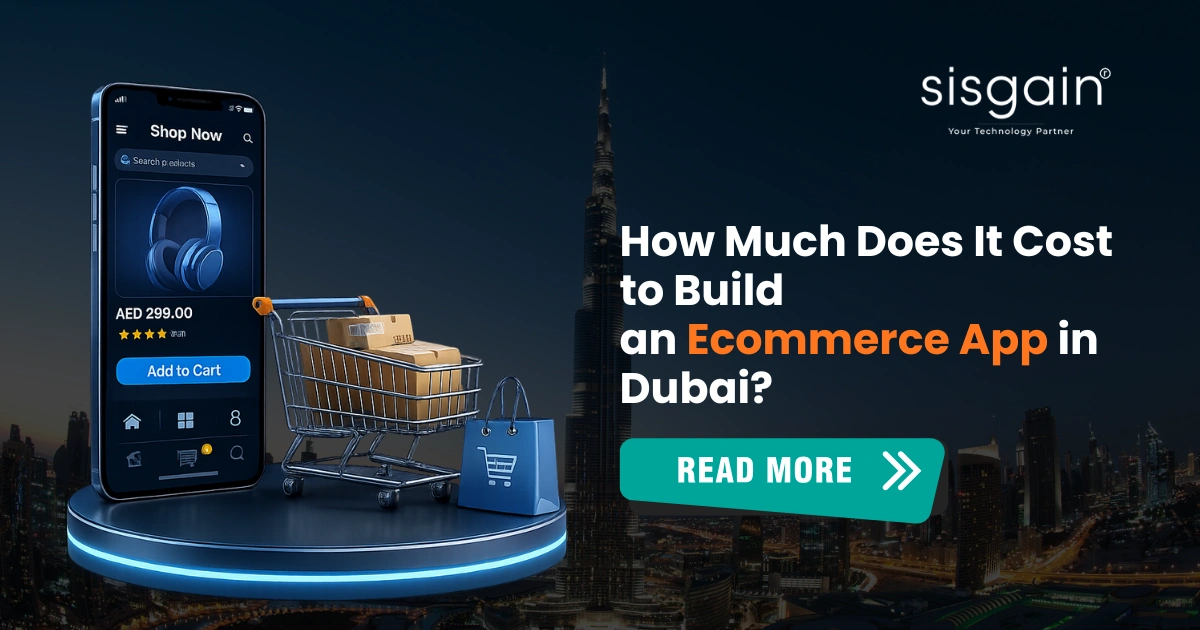
How Much Does It Cost to Build an Ecommerce App in Dubai?

person Vivek Upadhayay event15 Jun 2026

banner img
How Much Does It Cost to Build an Ecommerce App in Dubai? banner

Key Takeaways

  • Ecommerce app development costs in Dubai and the UAE typically range from AED 25,000 to AED 500,000+, depending on app complexity, features, integrations, and scalability requirements.
  • The biggest cost drivers are app complexity, feature set, UI/UX design, technology stack, third-party integrations, and security requirements, making proper planning essential before development begins.
  • Businesses can reduce costs by starting with an MVP (Minimum Viable Product), prioritizing core features, and using cross-platform technologies like Flutter or React Native instead of building separate native apps.
  • Advanced features such as AI-powered recommendations, voice search, AR product visualization, loyalty programs, and multi-vendor marketplace functionality significantly increase development costs but can improve user engagement and revenue.
  • UAE ecommerce apps should support VAT compliance, Arabic and English languages, local payment gateways, multi-currency transactions, and strong data security measures to meet market and regulatory requirements.
  • AI is transforming ecommerce through personalized shopping experiences, predictive analytics, smart search, and AI-powered customer support, helping businesses improve conversions and customer retention.
  • Investing in a scalable ecommerce mobile app can deliver long-term ROI through higher customer retention, increased sales, improved user experience, and stronger brand growth in the UAE's rapidly expanding digital commerce market.

The ecommerce industry in the UAE, especially in Dubai, is growing quickly due to strong digital adoption, high smartphone usage, and easy access to online payments. Businesses across retail, fashion, groceries, and B2B sectors are shifting toward mobile commerce to improve customer reach and increase sales.

Today, companies prefer mobile apps over websites because they offer faster performance, personalized shopping experiences, and better customer engagement. This has increased the demand for ecommerce app development UAE as businesses look for scalable and future-ready solutions.

One of the most common concerns is the cost to build an ecommerce app in UAE, which varies based on features, design complexity, technology stack, and integrations. Simple apps are more affordable, while advanced apps like multi-vendor platforms or enterprise solutions require higher investment.

The growth of ecommerce app development Dubai is also driven by modern technologies like AI, real-time analytics, and personalized recommendations. These features make ecommerce apps more intelligent and user-focused compared to traditional platforms.

In this guide, we will explain the ecommerce app development cost UAE, key pricing factors, hidden expenses, timelines, and cost-saving strategies to help you plan your budget effectively and choose the right development approach.

As demand for digital payment solutions continues to grow, eWallet app development has become a strategic investment for businesses looking to offer secure, convenient, and user-friendly financial services.

Ecommerce Market Growth in Dubai and UAE

The ecommerce landscape in the UAE has evolved rapidly over the past decade, driven by high internet penetration, smartphone adoption, digital payment solutions, and changing consumer behavior. Dubai, in particular, has emerged as a leading hub for digital commerce, attracting startups, SMEs, and enterprise brands looking to expand their online presence.

As consumers increasingly prefer convenience, speed, and personalized shopping experiences, businesses across industries are investing in ecommerce app development UAE to stay competitive. From retail and fashion to grocery delivery and electronics, mobile-first shopping experiences are becoming the standard rather than the exception.

UAE Ecommerce Industry Statistics

The UAE is one of the fastest-growing ecommerce markets in the Middle East, supported by a digitally connected population and strong government initiatives promoting innovation and technology adoption.

Some key trends shaping the market include:

  • Growing online shopping adoption across all age groups.
  • Increased demand for mobile shopping experiences.
  • Rising usage of digital wallets and cashless payment methods.
  • Expansion of cross-border ecommerce opportunities.
  • Strong growth in retail, fashion, electronics, and grocery ecommerce segments.

The rapid growth of digital commerce UAE has encouraged businesses to invest in scalable ecommerce platforms that can support increasing customer expectations and transaction volumes.

For companies planning to enter the market, understanding the ecommerce app development cost UAE is becoming a critical part of their digital transformation strategy.

Mobile commerce, commonly known as m-commerce, is transforming the way consumers shop in Dubai. Today, most online shoppers browse products, compare prices, and complete purchases directly from their smartphones.

Several factors are driving the growth of mobile commerce Dubai:

  • High smartphone penetration rates.
  • Faster mobile internet connectivity.
  • Secure mobile payment solutions.
  • User-friendly shopping applications.
  • Personalized shopping experiences powered by AI and analytics.

As a result, businesses are prioritizing ecommerce mobile app development UAE to create seamless customer journeys that increase engagement and conversions.

Many of the most successful online shopping apps UAE focus on delivering fast loading speeds, personalized recommendations, real-time notifications, and frictionless checkout experiences.

Why Businesses Prefer Ecommerce Mobile Apps Over Websites

While ecommerce websites remain important, mobile applications often deliver better performance, customer retention, and revenue opportunities.

Here are some of the primary reasons businesses choose ecommerce apps:

Better User Experience

Mobile apps offer faster navigation, intuitive interfaces, and smoother shopping experiences compared to mobile websites.

Higher Customer Retention

Apps allow businesses to stay connected with users through push notifications, loyalty programs, and personalized offers.

Increased Conversion Rates

A streamlined checkout process and saved customer preferences help reduce cart abandonment and improve purchase completion rates.

Personalized Shopping Experiences

Businesses can leverage customer behavior data to provide tailored product recommendations and targeted promotions.

Improved Brand Loyalty

A dedicated mobile app keeps the brand visible on customers' devices, increasing engagement and repeat purchases.

These advantages explain why ecommerce app development Dubai continues to gain momentum among businesses seeking sustainable long-term growth.

Future of Ecommerce App Development Dubai

The future of ecommerce in Dubai is being shaped by emerging technologies, evolving customer expectations, and increased digital adoption.

Key trends expected to influence ecommerce app development UAE in the coming years include:

  • Artificial Intelligence-powered product recommendations.
  • AI chatbots for customer support and engagement.
  • Voice-enabled shopping experiences.
  • Augmented Reality (AR) product visualization.
  • Hyper-personalized shopping journeys.
  • Headless commerce architecture.
  • Social commerce integrations.
  • Predictive analytics and demand forecasting.

Businesses that adopt these innovations early will be better positioned to improve customer experiences, increase conversions, and gain a competitive advantage.

As ecommerce competition continues to intensify, investing in a scalable and feature-rich ecommerce application is no longer just an option—it is becoming a strategic business necessity for brands looking to succeed in the UAE's digital economy.

How Much Does Ecommerce App Development Cost in UAE?

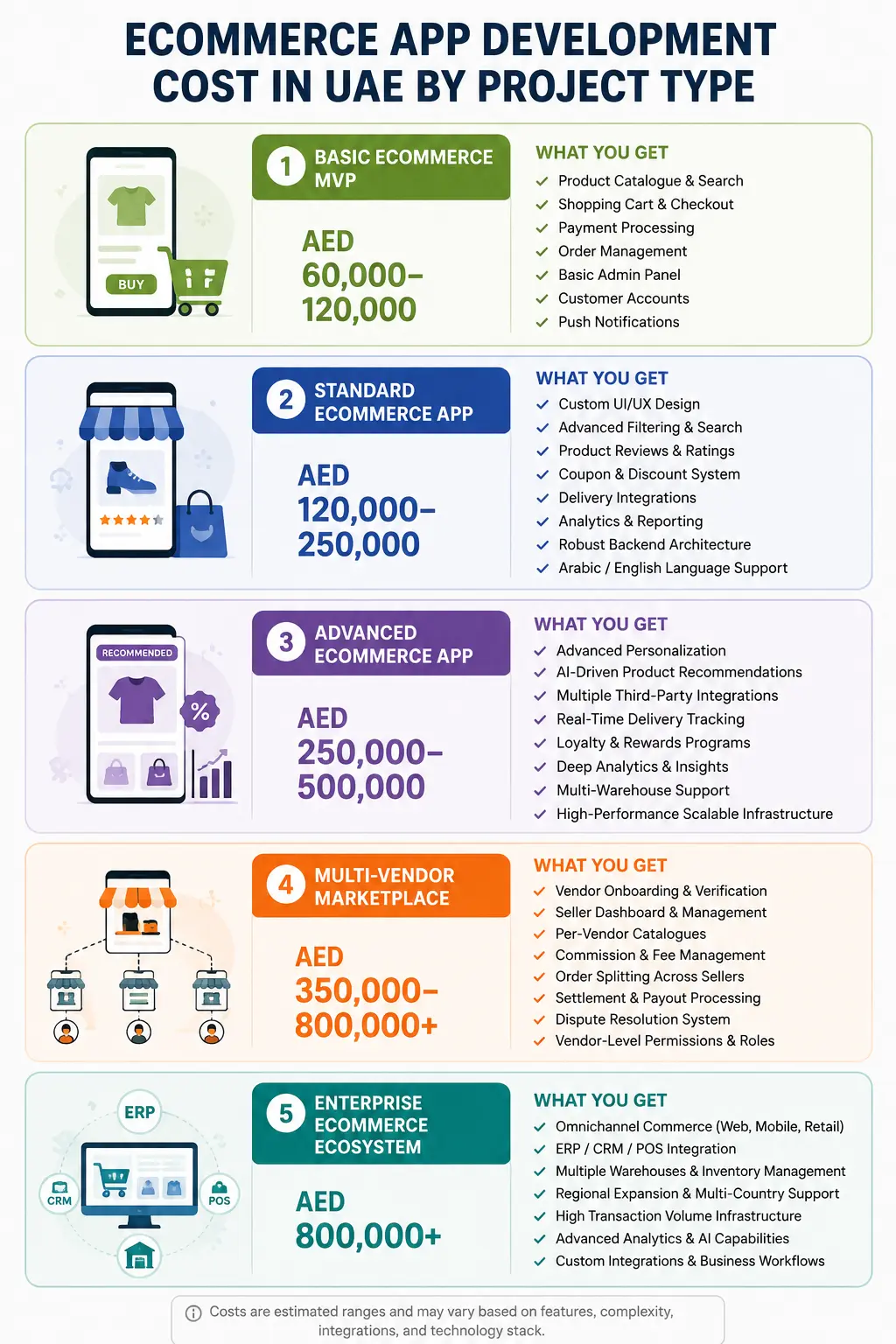
The ecommerce app development cost UAE businesses can expect depends on several factors, including app complexity, features, platform selection, design requirements, integrations, and development approach. While a simple ecommerce application can be built on a relatively modest budget, enterprise-grade platforms with advanced capabilities such as AI recommendations, multi-vendor functionality, and real-time analytics require significantly higher investment.

For businesses planning their digital commerce strategy, understanding the cost to build an ecommerce app UAE is essential before starting the development process. Below is a general pricing overview based on the complexity of the application.

Quick Cost Overview

App Type

Estimated Cost

Basic Ecommerce App

AED 25,000 – AED 60,000

Mid-Level Ecommerce App

AED 60,000 – AED 150,000

Advanced Ecommerce App

AED 150,000 – AED 500,000+

These estimates represent the average range for ecommerce app development UAE projects and may vary depending on custom requirements, integrations, and long-term scalability goals.

Cost Based on Business Size

The budget required for an ecommerce application often depends on the size and growth stage of the business.

Startup Ecommerce Apps

Startups typically focus on launching a Minimum Viable Product (MVP) with essential features such as:

  • User registration and login
  • Product catalog
  • Shopping cart
  • Secure payment gateway
  • Order tracking
  • Push notifications

Estimated Cost: AED 25,000 – AED 80,000

The primary goal at this stage is validating the business idea while keeping development costs under control.

SME Ecommerce Apps

Small and medium-sized enterprises usually require more advanced functionality to support growing customer demand and operational efficiency.

Common features include:

  • Advanced search and filtering
  • Customer reviews and ratings
  • Loyalty programs
  • Inventory management
  • Multi-payment integrations
  • Analytics dashboards

Estimated Cost: AED 80,000 – AED 200,000

For SMEs, investing in scalable ecommerce mobile app development UAE solutions helps support long-term growth without requiring a complete rebuild later.

Enterprise Ecommerce Apps

Large enterprises often need highly customized ecommerce ecosystems capable of handling thousands of products, multiple vendors, and large transaction volumes.

Advanced capabilities may include:

  • AI-powered product recommendations
  • Multi-vendor marketplace functionality
  • ERP and CRM integrations
  • Real-time business intelligence dashboards
  • Personalized shopping experiences
  • Omnichannel commerce solutions

Estimated Cost: AED 200,000 – AED 500,000+

Enterprise projects generally involve extensive planning, custom development, and ongoing optimization to meet complex business requirements.

Cost Based on Platform

The platform you choose plays a significant role in determining the overall development budget.

Android Ecommerce App Development

Android remains one of the most popular platforms in the UAE due to its large user base and device diversity.

Estimated Cost: AED 30,000 – AED 180,000+

Android development may require additional testing across multiple screen sizes and device configurations, which can increase development effort.

iOS Ecommerce App Development

iOS users are known for higher engagement and spending potential, making it an attractive platform for many ecommerce businesses in Dubai and across the UAE.

Estimated Cost: AED 35,000 – AED 200,000+

Although development is often streamlined due to Apple's controlled ecosystem, premium design and performance expectations can increase costs.

Cross-Platform Ecommerce App Development

Frameworks such as Flutter and React Native enable developers to build a single codebase for both Android and iOS platforms.

Estimated Cost: AED 50,000 – AED 250,000+

Cross-platform development is often the most cost-effective option for businesses seeking faster market entry while maintaining a consistent user experience across devices.

Progressive Web App (PWA)

A Progressive Web App combines the accessibility of a website with app-like functionality, allowing users to access the platform directly through a browser.

Estimated Cost: AED 20,000 – AED 100,000+

PWAs are suitable for businesses looking to reduce initial investment while still delivering a mobile-friendly shopping experience.

What Is the Average Ecommerce App Development Cost in UAE?

On average, most businesses spend between AED 60,000 and AED 200,000 on a professionally developed ecommerce application. However, the final budget depends on factors such as feature requirements, design complexity, third-party integrations, security standards, and future scalability plans.

Businesses that invest in custom ecommerce app development Dubai services often achieve better flexibility, performance, and long-term ROI compared to relying solely on off-the-shelf ecommerce solutions.

ALSO READ - App Development Cost in Dubai 2026: Complete Guide

Build a scalable ecommerce app for your business with feature-rich, custom ecommerce development solutions for startups and enterprises.

Key Factors Affecting Ecommerce App Development Cost in Dubai

The cost of ecommerce app development in Dubai depends on multiple technical and business factors. While a basic ecommerce application may require a relatively modest investment, advanced platforms with custom features, AI capabilities, and enterprise-grade infrastructure can significantly increase development expenses. Understanding these cost drivers helps businesses plan their budgets more accurately and avoid unexpected expenses during the development lifecycle.

As businesses evaluate the app development cost in 2026, it is important to recognize that ecommerce projects vary widely based on functionality, scalability requirements, technology stack, and third-party integrations. Whether you are assessing the ecommerce app development cost UAE or estimating the cost to build an ecommerce app UAE, the following factors play a critical role in determining the final project budget and overall development investment in 2026.

App Complexity

App complexity is one of the biggest factors affecting ecommerce app development costs. A simple ecommerce application with basic product listings, shopping carts, and payment gateways requires fewer development hours compared to a feature-rich marketplace platform.

For example, a single-vendor online store is considerably less complex than a multi-vendor marketplace that supports multiple sellers, commission management, inventory synchronization, and advanced analytics. Similarly, apps that include AI-powered product recommendations, real-time tracking, multilingual support, or personalized shopping experiences require additional development effort and specialized expertise.

The more complex the application architecture becomes, the higher the overall cost of ecommerce app development Dubai.

Number of Features

Every feature added to an ecommerce app contributes to the overall development budget. While basic features are essential for launching an online store, advanced functionalities can substantially increase project costs.

Common ecommerce app features include:

  • User registration and login
  • Product catalog management
  • Advanced search and filtering
  • Shopping cart and checkout
  • Payment gateway integration
  • Order tracking
  • Push notifications
  • Customer reviews and ratings
  • Wishlist functionality

Advanced features such as AI-driven recommendations, voice search, loyalty programs, subscription management, and multi-vendor capabilities require additional development resources and testing.

Businesses should prioritize essential features for their Minimum Viable Product (MVP) and introduce advanced capabilities in future development phases to better manage the cost to build an ecommerce app UAE.

UI/UX Design Requirements

User experience plays a major role in the success of an ecommerce application. Modern consumers expect intuitive navigation, visually appealing interfaces, and seamless checkout experiences across devices.

Basic template-based designs generally cost less than custom-designed user experiences tailored to a specific brand identity. Custom UI/UX design involves user research, wireframing, prototyping, usability testing, and visual design optimization.

Additional design requirements such as:

  • Arabic and English language support
  • Custom animations
  • Interactive product displays
  • Personalized shopping journeys
  • Accessibility optimization

can increase design complexity and overall development costs.

Investing in high-quality UI/UX often improves conversion rates and customer retention, making it a valuable long-term investment for businesses pursuing ecommerce mobile app development UAE.

Technology Stack

The technology stack selected for an ecommerce application directly impacts development costs, scalability, and maintenance requirements.

Businesses can choose between:

  • Native Android development
  • Native iOS development
  • Cross-platform frameworks such as Flutter or React Native
  • Progressive Web Applications (PWAs)

Native applications generally deliver superior performance but require separate development efforts for each platform, increasing costs. Cross-platform technologies can reduce development time and costs by enabling code sharing across multiple operating systems.

Backend technologies, databases, cloud infrastructure, and API architecture also influence the total budget for ecommerce app development UAE.

Third-Party Integrations

Most ecommerce applications rely on third-party services to deliver a seamless customer experience. Integrating these external platforms often requires additional development and ongoing maintenance.

Common third-party integrations include:

  • Payment gateways
  • Shipping and logistics providers
  • CRM systems
  • ERP software
  • Inventory management platforms
  • Marketing automation tools
  • Analytics platforms
  • Customer support systems

Each integration requires configuration, testing, security validation, and periodic updates. The greater the number of integrations, the higher the overall ecommerce app development cost.

Businesses seeking personalized customer support may also integrate solutions such as AI-powered assistants and conversational commerce platforms through specialized AI technologies.

Security and Compliance

Security is a critical requirement for any ecommerce platform because customer data, payment information, and transaction records must be protected at all times.

Security-related implementation costs may include:

  • SSL encryption
  • Secure authentication systems
  • Multi-factor authentication
  • Data encryption
  • Fraud prevention mechanisms
  • Secure payment processing
  • Regular security audits

In the UAE market, businesses must also ensure compliance with applicable data protection regulations and payment security standards.

Although security measures increase initial development costs, they help prevent costly breaches, regulatory penalties, and reputational damage in the future.

Development Team Location

The geographical location of the development team significantly affects project pricing.

Development rates typically vary between:

  • UAE-based development agencies
  • Regional development teams
  • Offshore development providers
  • Freelance developers

Working with a local team often provides advantages such as easier communication, better understanding of the UAE market, regulatory compliance expertise, and ongoing support. However, local development rates may be higher than offshore alternatives.

Many businesses choose an experienced mobile app development company in UAE or a provider offering comprehensive mobile app development services in UAE to ensure quality, transparency, and long-term project success.

Testing and Quality Assurance (QA)

Testing is often underestimated during budget planning, yet it plays a vital role in ensuring app performance, security, and reliability.

A comprehensive QA process typically includes:

  • Functional testing
  • Performance testing
  • Security testing
  • Device compatibility testing
  • Usability testing
  • Regression testing
  • Payment gateway testing

As the number of features and integrations increases, testing requirements become more extensive. Skipping quality assurance may reduce initial development expenses but often results in higher maintenance costs and customer dissatisfaction after launch.

For businesses seeking on-demand app development solutions in Dubai, allocating sufficient resources to QA helps ensure a stable, secure, and high-performing application that delivers a better user experience, reduces operational risks, and supports long-term business growth.

Ecommerce App Features and Their Cost Impact

Infographic showing ecommerce app features and their cost impact, including customer, seller, admin, and premium features such as user registration, product management, analytics, live chat, and loyalty rewards.

Ecommerce app development cost in UAE is directly influenced by the type and complexity of features included in the application. Each feature adds specific development effort, backend logic, UI/UX design time, and third-party integrations, which collectively determine the final ecommerce app development UAE budget.

To better understand the cost structure, ecommerce features can be categorized into four major groups: Customer Features, Seller Features, Admin Features, and Premium Features.

Customer Features

Customer features form the core of any ecommerce mobile app development UAE project. These features define user experience, engagement, and conversion rates, making them critical for business success.

Registration / Login

Users can register and log in using:

  • Email and password
  • OTP-based verification
  • Social login (Google, Apple, Facebook)

Cost Impact: Low to Medium
Basic authentication is simple, but adding OTP and social login increases backend integration complexity and security requirements.

Product Search

Includes:

  • Search bar functionality
  • Filters (category, price, brand)
  • Sorting options

Cost Impact: Medium
Advanced search with AI suggestions or elastic search integration increases ecommerce app development cost UAE due to additional backend processing.

Wishlist

Allows users to save products for future purchase and quick access later.

Cost Impact: Low
Simple feature but improves user retention and engagement significantly.

Shopping Cart

Core checkout functionality including:

  • Add/remove products
  • Quantity updates
  • Price calculation
  • Coupon application

Cost Impact: Medium to High
Complexity increases when handling real-time inventory sync, dynamic pricing, and discount rules.

Reviews & Ratings

Users can:

  • Rate products
  • Write reviews
  • Upload images

Cost Impact: Medium
Requires moderation system, spam control, and scalable database handling.

Order Tracking

Provides real-time updates on:

  • Order status
  • Shipping progress
  • Delivery notifications

Cost Impact: Medium to High
Cost increases when integrated with third-party logistics APIs and real-time tracking systems.

Seller Features

Seller features are essential in multi-vendor ecommerce apps and significantly impact backend architecture and scalability.

Inventory Management

  • Stock updates
  • Low stock alerts
  • SKU-level management

Cost Impact: High
Requires real-time database synchronization and strong backend logic.

Product Management

  • Add/edit/delete products
  • Upload images and descriptions
  • Set pricing and discounts

Cost Impact: Medium to High
Complexity increases with bulk uploads and category-based product organization.

Analytics Dashboard

Provides sellers with insights such as:

  • Sales performance
  • Revenue reports
  • Customer behavior analytics

Cost Impact: High
Requires data aggregation, visualization tools, and potentially third-party analytics integration.

Admin Features

Admin features act as the central control system of an ecommerce app development UAE ecosystem, managing users, sellers, and overall platform operations.

User Management

  • Customer and seller verification
  • Role-based access control
  • Account suspension or activation

Cost Impact: Medium
Requires secure authentication systems and admin-level permissions architecture.

Order Management

  • View and manage all orders
  • Update order status
  • Handle cancellations and refunds

Cost Impact: High
Involves complex workflow handling and backend validation systems.

Revenue Tracking

  • Sales monitoring
  • Commission calculations (for marketplaces)
  • Financial reporting dashboards

Cost Impact: High
Requires accurate financial logic, secure calculations, and reporting systems.

Premium Features

Premium features differentiate a basic ecommerce app from a high-performance, scalable digital commerce platform. These features significantly increase ecommerce app development cost UAE but also improve user engagement and ROI.

AI Product Recommendations

Uses machine learning to suggest products based on:

  • User behavior
  • Purchase history
  • Browsing patterns

Cost Impact: Very High
Requires advanced AI models and may involve generative AI software development services for personalization and predictive analytics.

Voice Search

Enables users to search products using voice commands.

Cost Impact: High
Requires NLP processing and speech-to-text API integration.

Multi-Vendor Marketplace

Allows multiple sellers to operate on a single platform.

Cost Impact: Very High
Requires complex architecture including vendor dashboards, commission systems, and order splitting logic.

AR Product Visualization

Allows users to visualize products in real-world environments (e.g., furniture, fashion items).

Cost Impact: Very High
Requires AR SDK integration, 3D modeling, and high-performance rendering capabilities.

Loyalty Programs

Includes:

  • Reward points
  • Cashback systems
  • Tier-based discounts

Cost Impact: Medium to High
Requires custom logic tied to user transactions and behavior tracking.

Ecommerce App Cost Breakdown by Development Stage

Infographic illustrating an ecommerce app cost breakdown by development stage, covering business analysis, UI/UX design, frontend and backend development, API integration, QA testing, deployment, and ongoing maintenance.

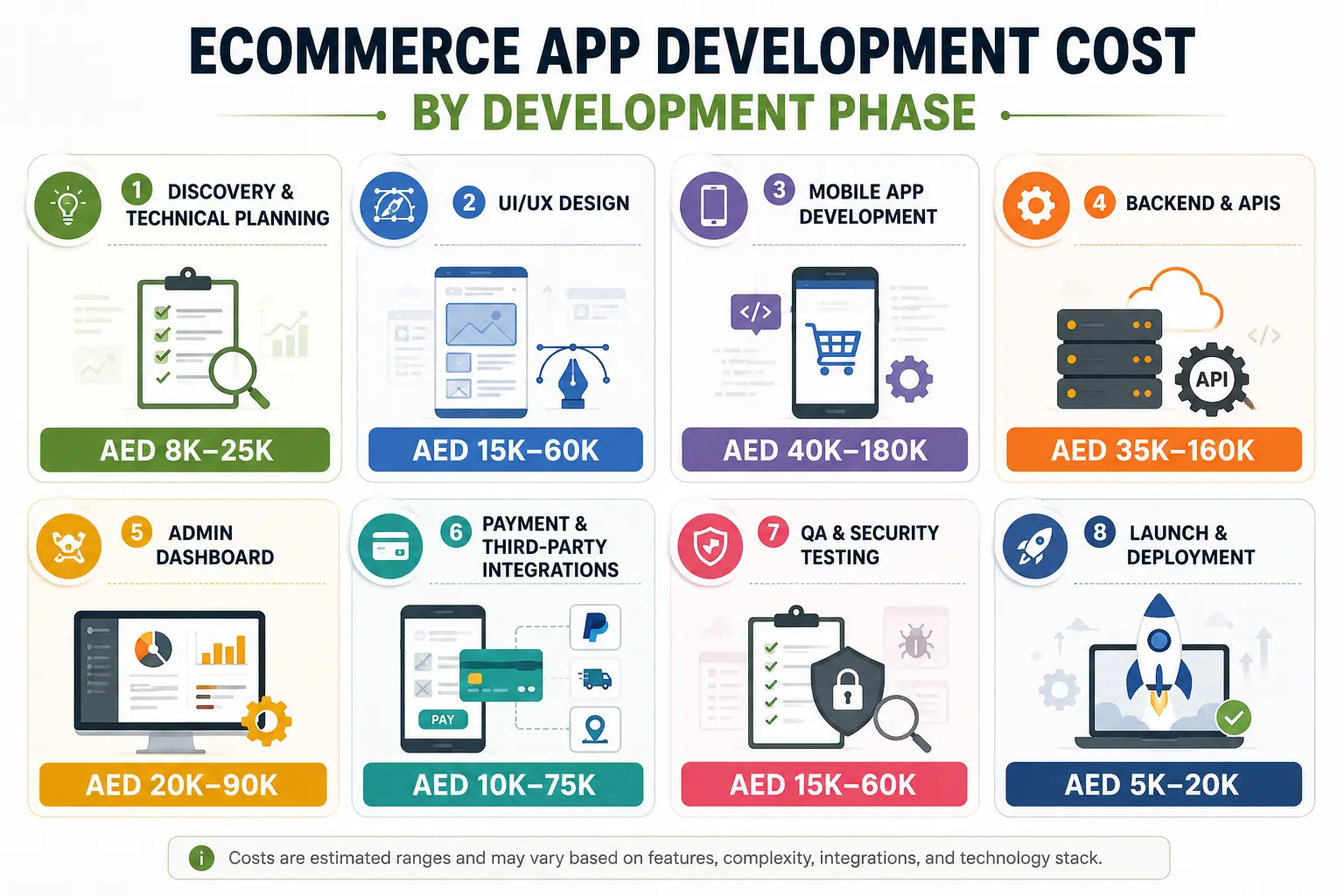
Building an ecommerce application involves multiple development stages, each contributing to the overall project cost. Understanding where your budget is allocated helps businesses plan effectively, avoid unexpected expenses, and make informed decisions throughout the development lifecycle.

The total ecommerce app development cost in UAE depends on factors such as app complexity, design requirements, integrations, platform selection, and ongoing maintenance. Below is a detailed breakdown of the major development stages and their estimated costs.

Business Analysis & Discovery

Every successful ecommerce application starts with a discovery phase. During this stage, business goals, target audience, competitor analysis, feature requirements, and technical specifications are identified.

A thorough discovery process helps reduce development risks, define project scope, and create a roadmap for the entire development cycle. Skipping this phase often leads to scope creep, budget overruns, and delayed launches.

Key Activities:

  • Market and competitor research
  • Business requirement gathering
  • User journey mapping
  • Feature prioritization
  • Technical feasibility assessment
  • Project planning and documentation

Estimated Cost: AED 5,000 – AED 20,000

UI/UX Design

User experience plays a critical role in ecommerce success. A well-designed app improves customer engagement, increases conversion rates, and reduces cart abandonment.

The UI/UX design phase focuses on creating intuitive navigation, appealing product pages, seamless checkout experiences, and mobile-friendly interfaces.

Key Activities:

  • Wireframing
  • User flow creation
  • Interactive prototypes
  • Visual interface design
  • Design system creation
  • Responsive design optimization

Estimated Cost: AED 10,000 – AED 40,000

Frontend Development

Frontend development involves building the user-facing portion of the ecommerce application. This is where designs are transformed into fully functional screens and customer interactions.

The complexity of frontend development increases when features such as personalized recommendations, advanced filtering, multilingual support, and real-time updates are included.

Key Activities:

  • Mobile app interface development
  • Product catalog implementation
  • Shopping cart functionality
  • User authentication screens
  • Search and filtering systems
  • Payment flow integration

Estimated Cost: AED 20,000 – AED 100,000+

Backend Development

The backend serves as the foundation of an ecommerce app. It manages data processing, business logic, user accounts, inventory management, order processing, and security.

A scalable backend is essential for handling increasing traffic, transactions, and product inventories as the business grows.

Key Activities:

  • Database architecture
  • User management systems
  • Product management modules
  • Inventory tracking
  • Order processing workflows
  • Security implementation

Estimated Cost: AED 25,000 – AED 120,000+

API Development & Third-Party Integrations

Modern ecommerce applications rely on APIs to connect with external systems such as payment gateways, logistics providers, CRM platforms, ERP systems, and marketing tools.

The number and complexity of integrations directly affect the overall ecommerce app development cost UAE businesses can expect.

Key Activities:

  • Payment gateway integration
  • Shipping provider integration
  • CRM and ERP connectivity
  • Marketing automation tools
  • Analytics platforms
  • Third-party service integrations

Estimated Cost: AED 10,000 – AED 50,000+

Quality Assurance (QA) Testing

Testing ensures the application performs smoothly across devices, operating systems, and network conditions. This stage helps identify bugs, security vulnerabilities, and performance issues before launch.

Comprehensive testing is essential for delivering a reliable shopping experience and protecting customer trust.

Key Activities:

  • Functional testing
  • Performance testing
  • Security testing
  • Compatibility testing
  • User acceptance testing (UAT)
  • Bug fixing and optimization

Estimated Cost: AED 8,000 – AED 30,000

Deployment & Launch

Once testing is completed, the ecommerce application is prepared for launch on app stores and cloud environments.

This stage includes server configuration, production deployment, app store submissions, and final performance checks.

Key Activities:

  • Cloud setup and configuration
  • App Store submission
  • Google Play Store publishing
  • Production deployment
  • Performance monitoring setup
  • Security verification

Estimated Cost: AED 3,000 – AED 15,000

Maintenance & Ongoing Support

Launching an ecommerce app is only the beginning. Regular updates, security patches, feature enhancements, and technical support are necessary to maintain performance and competitiveness.

Most businesses allocate an annual maintenance budget equivalent to 15%–25% of the original development cost.

Key Activities:

  • Bug fixes
  • Security updates
  • Feature enhancements
  • Performance optimization
  • Server maintenance
  • Technical support

Estimated Annual Cost: AED 10,000 – AED 80,000+

Ecommerce App Development Cost Breakdown Table

Development Stage

Estimated Cost (AED)

Business Analysis & Discovery

5,000 – 20,000

UI/UX Design

10,000 – 40,000

Frontend Development

20,000 – 100,000+

Backend Development

25,000 – 120,000+

API Development & Integrations

10,000 – 50,000+

QA Testing

8,000 – 30,000

Deployment & Launch

3,000 – 15,000

Maintenance & Support (Annual)

10,000 – 80,000+

Total Estimated Ecommerce App Development Cost in UAE

For most businesses, the cost to build an ecommerce app UAE ranges from AED 25,000 for a basic MVP to AED 500,000+ for a fully customized enterprise-grade platform with advanced features, AI-driven personalization, and complex third-party integrations.

Partnering with an experienced ecommerce app development Dubai team can help optimize development costs while ensuring scalability, security, and long-term business growth.

Hidden Costs of Ecommerce App Development UAE

When estimating the ecommerce app development cost UAE, many businesses focus only on design and development expenses. However, the actual cost of launching and running an ecommerce application involves several additional expenses that are often overlooked during the planning stage.

These hidden costs can significantly impact your overall budget, especially as your user base grows. Understanding them in advance helps businesses avoid unexpected expenses and create a more realistic investment plan for long-term success.

App Store Fees

Publishing your ecommerce app on major app stores requires recurring fees. For example, Apple charges an annual developer subscription fee, while Google Play requires a one-time developer registration fee.

Beyond registration costs, app stores may also charge commissions on in-app purchases and subscriptions depending on your business model. Businesses planning premium memberships, loyalty programs, or subscription-based ecommerce services should factor these charges into their overall budget.

Estimated Cost: AED 100–500 annually, plus applicable transaction commissions.

Cloud Hosting Costs

Every ecommerce application requires a reliable hosting infrastructure to manage product catalogs, customer accounts, transactions, and order processing.

Cloud hosting expenses depend on several factors, including:

  • Number of active users
  • Product database size
  • Traffic volume
  • Image and video storage requirements
  • Security and backup configurations

As your ecommerce business scales, hosting costs increase accordingly. While startups may begin with affordable cloud plans, enterprise-level ecommerce applications often require dedicated infrastructure for optimal performance and uptime.

Estimated Cost: AED 200–5,000+ per month depending on traffic and scalability requirements.

Payment Gateway Charges

Payment gateways are essential for processing online transactions securely. Most payment providers charge setup fees, monthly fees, or transaction-based commissions.

Popular payment solutions in the UAE often charge a percentage of each transaction, which can impact profitability as sales volume grows.

Common ecommerce payment costs include:

  • Transaction processing fees
  • Chargeback fees
  • International payment fees
  • Currency conversion fees
  • Gateway integration costs

Businesses targeting regional and international customers should carefully evaluate payment gateway pricing before launch.

Estimated Cost: 2%–4% per transaction, depending on the provider and payment method.

SMS and Notification Costs

Modern ecommerce apps rely heavily on customer notifications to improve engagement and retention.

These notifications may include:

  • OTP verification messages
  • Order confirmations
  • Delivery updates
  • Promotional campaigns
  • Abandoned cart reminders

While push notifications are generally inexpensive, SMS notifications incur recurring costs based on message volume. As your customer base expands, communication expenses can become a significant operational cost.

Estimated Cost: AED 50–2,000+ per month depending on messaging volume.

Security Updates

Cybersecurity is no longer optional for ecommerce businesses. Since ecommerce applications process sensitive customer and payment data, regular security updates are essential for protecting users and maintaining compliance.

Security-related expenses may include:

  • SSL certificates
  • Vulnerability assessments
  • Penetration testing
  • Fraud prevention systems
  • Security monitoring tools
  • Data protection compliance measures

Neglecting security can lead to costly data breaches, legal penalties, and reputational damage.

Estimated Cost: AED 2,000–20,000+ annually depending on security requirements.

Maintenance and Support

Launching an ecommerce app is only the beginning. Ongoing maintenance ensures that the application remains secure, compatible, and optimized for performance.

Typical maintenance activities include:

  • Bug fixes
  • Performance optimization
  • Feature enhancements
  • OS compatibility updates
  • Third-party API updates
  • Server monitoring

Most businesses allocate 15–25% of the original development budget annually for maintenance and support services.

Estimated Cost: AED 10,000–100,000+ annually based on application complexity.

Marketing and User Acquisition

Even the best ecommerce application cannot generate sales without customers. Marketing often becomes one of the largest ongoing investments after development.

User acquisition expenses may include:

  • Search Engine Optimization (SEO)
  • Social media advertising
  • Google Ads campaigns
  • Influencer marketing
  • Email marketing
  • App Store Optimization (ASO)
  • Retargeting campaigns

Many businesses underestimate marketing costs during the planning phase, leading to slower growth after launch.

Estimated Cost: AED 2,000–50,000+ per month depending on growth objectives.

Final Thoughts

Hidden costs play a major role in determining the true cost to build an ecommerce app UAE. While development expenses form the foundation of your investment, businesses must also account for hosting, security, payment processing, maintenance, and marketing to ensure long-term success.

When planning your budget, it is advisable to work with an experienced ecommerce development company UAE that can provide transparent cost estimates and help you identify potential recurring expenses before development begins.

Ecommerce App Development Cost by Business Model

The cost to build an ecommerce app UAE depends heavily on the business model you choose. A simple online store requires fewer features and integrations, while marketplace and enterprise-grade platforms demand advanced functionality, multiple user roles, and scalable infrastructure.

Understanding the differences between ecommerce business models can help businesses estimate development budgets more accurately and choose the right solution for their growth objectives.

Single Vendor Ecommerce App

A single vendor ecommerce app is designed for businesses that sell products directly to customers through their own digital storefront. All products, inventory, pricing, and customer interactions are managed by a single business owner.

Examples include fashion brands, electronics retailers, beauty stores, grocery businesses, and specialty product sellers.

Key Features

  • Product catalog management
  • Secure user registration and login
  • Shopping cart and checkout
  • Payment gateway integration
  • Order tracking
  • Push notifications
  • Customer reviews and ratings
  • Inventory management

Estimated Development Cost

A basic single-vendor ecommerce app typically costs between AED 25,000 and AED 80,000, depending on design complexity, platform selection, and required integrations.

Best For

  • Startups
  • Small and medium-sized businesses
  • Local retailers
  • Direct-to-consumer brands

Since development complexity is relatively low, this model offers the most affordable entry point for businesses seeking ecommerce app development Dubai services.

Multi-Vendor Marketplace App

A multi-vendor marketplace app allows multiple sellers to register, list products, manage orders, and sell through a single platform. Marketplace apps are significantly more complex because they must support different user roles, commission structures, and seller management systems.

Popular examples include Amazon, Noon, Etsy, and other online marketplaces.

Key Features

  • Vendor registration and onboarding
  • Seller dashboards
  • Commission management
  • Product approval workflows
  • Multi-vendor order management
  • Vendor analytics
  • Multiple payment settlements
  • Advanced search and filtering

Estimated Development Cost

The cost to build an ecommerce app UAE with a marketplace model generally ranges from AED 100,000 to AED 500,000+, depending on platform scale and feature requirements.

Best For

  • Marketplace startups
  • Industry-specific marketplaces
  • Retail aggregators
  • B2B trading platforms

Although the initial investment is higher, marketplace apps offer substantial revenue opportunities through vendor subscriptions, transaction fees, and advertising.

B2B Ecommerce App

Business-to-Business (B2B) ecommerce apps are built specifically for transactions between wholesalers, manufacturers, distributors, and corporate buyers. These applications require advanced workflows and enterprise-grade functionality.

Key Features

  • Bulk ordering
  • Custom pricing structures
  • RFQ (Request for Quote) management
  • Corporate account management
  • Purchase approvals
  • Multi-user business accounts
  • Credit payment options
  • ERP and CRM integration

Estimated Development Cost

A B2B ecommerce app typically costs between AED 120,000 and AED 600,000+, depending on integration requirements and business process complexity.

Best For

  • Manufacturers
  • Wholesale distributors
  • Industrial suppliers
  • Enterprise businesses

B2B platforms often require extensive customization, making them one of the most expensive categories within ecommerce app development UAE projects.

B2C Ecommerce App

Business-to-Consumer (B2C) ecommerce apps focus on selling products directly to end users. This is the most common ecommerce model and powers the majority of online shopping experiences worldwide.

Key Features

  • Product browsing
  • Personalized recommendations
  • Wishlist functionality
  • Secure checkout
  • Loyalty programs
  • Customer support integration
  • Discounts and promotions
  • Mobile payment support

Estimated Development Cost

The development cost for a B2C ecommerce app usually falls between AED 50,000 and AED 250,000, depending on personalization features and platform complexity.

Best For

  • Retail brands
  • Lifestyle businesses
  • Fashion stores
  • Electronics retailers
  • Consumer goods companies

Businesses investing in ecommerce mobile app development UAE solutions often choose the B2C model to improve customer engagement and increase repeat purchases.

D2C Ecommerce App

Direct-to-Consumer (D2C) ecommerce apps allow brands to sell directly to customers without intermediaries, distributors, or third-party retailers.

The D2C model has become increasingly popular in Dubai and across the UAE because it enables businesses to maintain full control over branding, customer relationships, and profit margins.

Key Features

  • Branded shopping experience
  • Customer loyalty programs
  • Subscription options
  • Personalized recommendations
  • Customer analytics
  • Marketing automation
  • Social commerce integration

Estimated Development Cost

A modern D2C ecommerce app generally costs between AED 60,000 and AED 300,000, depending on customization and customer engagement features.

Best For

  • Consumer brands
  • Beauty and skincare companies
  • Fashion labels
  • Health and wellness brands
  • Food and beverage businesses

As competition increases, many D2C brands are adopting AI-powered personalization and customer engagement tools. Businesses looking to enhance customer experiences can also benefit from AI Chatbot Services Dubai and generative AI software development services for intelligent product recommendations and automated customer support.

Subscription Ecommerce App

Subscription-based ecommerce apps generate recurring revenue by delivering products or services on a scheduled basis. These apps require specialized billing systems and customer retention features.

Common examples include meal kits, beauty boxes, pet supplies, health supplements, and digital subscription services.

Key Features

  • Recurring billing management
  • Subscription plans
  • Automated renewals
  • Customer account management
  • Flexible delivery scheduling
  • Usage analytics
  • Loyalty rewards
  • Customer retention tools

Estimated Development Cost

Subscription ecommerce apps typically cost between AED 80,000 and AED 350,000+, depending on billing complexity and automation requirements.

Best For

  • Subscription box businesses
  • SaaS providers
  • Health and wellness brands
  • Membership-based businesses

While development costs are higher than traditional ecommerce applications, recurring revenue models often deliver stronger long-term returns and predictable cash flow.

Business Model Cost Comparison

Business Model

Estimated Cost Range

Single Vendor Ecommerce App

AED 25,000 – AED 80,000

B2C Ecommerce App

AED 50,000 – AED 250,000

D2C Ecommerce App

AED 60,000 – AED 300,000

Subscription Ecommerce App

AED 80,000 – AED 350,000+

Multi-Vendor Marketplace App

AED 100,000 – AED 500,000+

B2B Ecommerce App

AED 120,000 – AED 600,000+

The right business model directly impacts your ecommerce app development cost UAE. Businesses should evaluate their target audience, operational requirements, scalability goals, and long-term growth strategy before investing in ecommerce app development Dubai services. Working with an experienced ecommerce development company UAE or a trusted mobile app development company in Dubai can help identify the most cost-effective approach while ensuring future scalability.

Cost Comparison – Custom Ecommerce App vs SaaS Platforms

When planning an ecommerce app, one of the biggest decisions is whether to choose a SaaS platform like Shopify, WooCommerce, or Magento, or invest in custom ecommerce app development. While SaaS solutions offer a faster and more affordable launch, custom development provides greater flexibility, scalability, and long-term business control.

The right choice depends on your business goals, budget, growth plans, and customization requirements. Below is a detailed comparison of the most popular ecommerce development options available in the UAE market.

Shopify

Shopify is one of the most widely used ecommerce platforms for startups and small businesses. It offers a subscription-based model that allows businesses to launch an online store quickly without significant upfront investment.

Advantages of Shopify

  • Fast setup and deployment
  • User-friendly dashboard
  • Built-in hosting and security
  • Large ecosystem of apps and integrations
  • Minimal technical expertise required

Limitations of Shopify

  • Monthly subscription fees
  • Transaction fees on certain payment gateways
  • Limited customization compared to custom development
  • Increasing costs as the business scales

Shopify is ideal for businesses looking for a quick market entry with a limited budget. However, companies with complex workflows or unique customer experiences may eventually outgrow the platform.

WooCommerce

WooCommerce is a WordPress-based ecommerce solution that offers greater flexibility than Shopify while maintaining relatively low development costs.

Advantages of WooCommerce

  • Open-source platform
  • Lower initial investment
  • Extensive plugin ecosystem
  • Greater customization options
  • Strong SEO capabilities

Limitations of WooCommerce

  • Requires hosting and maintenance
  • Security management is the owner's responsibility
  • Performance can be affected by multiple plugins
  • Scalability challenges for large ecommerce operations

WooCommerce works well for small and medium-sized businesses that already use WordPress and require more customization than Shopify can provide.

Magento (Adobe Commerce)

Magento is an enterprise-grade ecommerce platform designed for businesses with large product catalogs, complex operations, and high traffic volumes.

Advantages of Magento

  • Highly scalable architecture
  • Advanced ecommerce functionality
  • Strong multi-store capabilities
  • Extensive customization options
  • Enterprise-level performance

Limitations of Magento

  • Higher development and maintenance costs
  • Requires experienced developers
  • Longer implementation timelines
  • Greater infrastructure requirements

Magento is often chosen by large enterprises that need advanced ecommerce functionality and have the resources to manage a sophisticated platform.

Custom Ecommerce App Development

Custom ecommerce app development involves building a solution from the ground up based on specific business requirements. While the initial investment is higher, businesses gain complete ownership and control over every aspect of the platform.

For companies evaluating ecommerce app development UAE solutions, custom development is often the preferred option when long-term scalability, unique features, and competitive differentiation are priorities.

Advantages of Custom Development

  • Full ownership of the source code
  • Unlimited customization possibilities
  • Better scalability for future growth
  • Enhanced security controls
  • Seamless third-party integrations
  • Personalized user experiences

Limitations of Custom Development

  • Higher upfront investment
  • Longer development timeline
  • Ongoing maintenance responsibilities

Businesses investing in ecommerce app development Dubai projects often choose custom solutions to support complex workflows, AI-driven personalization, advanced analytics, and multi-vendor marketplace capabilities.

Ecommerce Platform Comparison

Factor

Shopify

WooCommerce

Magento

Custom Ecommerce App

Initial Cost

Low

Low to Medium

High

High

Long-Term Cost

Medium to High

Medium

High

Variable

Scalability

Moderate

Moderate

High

Very High

Security

Managed by Shopify

Self-Managed

Advanced

Fully Customizable

Ownership

Limited

Full

Full

Complete Ownership

Customization

Limited

High

Very High

Unlimited

Performance Control

Limited

Moderate

High

Complete Control

Time to Launch

Fast

Fast

Medium

Longer

AI & Advanced Features

Limited

Moderate

High

Unlimited

Best For

Startups

SMBs

Enterprises

Growth-Focused Businesses

Which Option Offers the Best Value?

If your goal is to launch quickly with minimal investment, Shopify and WooCommerce can be practical choices. However, businesses planning long-term growth, advanced customer experiences, AI-powered features, or marketplace functionality often benefit more from custom ecommerce mobile app development UAE solutions.

A custom ecommerce application may require a higher initial investment, but it eliminates platform restrictions, provides complete ownership, and delivers greater flexibility as your business expands. This is why many growing brands partner with an experienced ecommerce development company UAE to build scalable ecommerce ecosystems tailored to their unique requirements.

LEARN MORE - Best Mobile App Development Company UAE

Ecommerce Mobile App Development UAE: Native vs Cross-Platform Cost

When planning an ecommerce mobile app development UAE project, one of the most important decisions is choosing the right development approach. The technology you select directly impacts development cost, launch timeline, performance, maintenance expenses, and future scalability.

Businesses in Dubai and across the UAE generally choose between three popular approaches:

  • Native App Development
  • Flutter App Development
  • React Native App Development

Each option has its own advantages depending on your business goals, budget, and long-term growth strategy.

Native App Development

Native development involves building separate applications for iOS and Android using platform-specific technologies such as Swift for iOS and Kotlin for Android.

This approach delivers the highest level of performance, security, and user experience because the application is specifically designed for each operating system. Native apps can fully utilize device capabilities, including camera functions, GPS, biometric authentication, and push notifications.

For ecommerce businesses handling high traffic volumes, complex product catalogs, advanced payment integrations, and personalized shopping experiences, native development often provides the best long-term performance.

However, because separate codebases are required for iOS and Android, development costs and timelines are typically higher compared to cross-platform solutions.

Best for:

  • Large ecommerce businesses
  • Enterprise-level marketplaces
  • High-performance retail applications
  • Brands prioritizing premium user experience

Flutter Development

Flutter, developed by Google, has become one of the most popular frameworks for ecommerce app development Dubai projects. It enables developers to create a single codebase that works across both iOS and Android platforms.

The biggest advantage of Flutter is cost efficiency. Since developers write code once and deploy it across multiple platforms, businesses can significantly reduce development expenses and accelerate time-to-market.

Flutter also offers near-native performance, attractive user interfaces, and a highly customizable design system. This makes it an excellent option for startups and growing ecommerce brands looking to launch quickly without compromising user experience.

Many businesses seeking cost-effective ecommerce app development UAE solutions choose Flutter because it provides an ideal balance between affordability, speed, and performance.

Best for:

  • Startups
  • Small and medium-sized ecommerce businesses
  • MVP development
  • Businesses seeking faster market entry

React Native Development

React Native, developed by Meta, is another leading cross-platform framework widely used for ecommerce mobile app development UAE projects.

Like Flutter, React Native allows developers to build applications for both Android and iOS using a single codebase. It offers faster development cycles, reduced costs, and easier maintenance compared to native development.

React Native benefits from a large developer community and a mature ecosystem of third-party libraries, making it suitable for ecommerce applications that require integrations with payment gateways, inventory systems, customer relationship management (CRM) tools, and analytics platforms.

While React Native delivers excellent performance for most ecommerce applications, highly complex enterprise-level apps may occasionally require additional native development for advanced functionality.

Best for:

  • Mid-sized ecommerce businesses
  • Omnichannel retail platforms
  • Businesses requiring multiple integrations
  • Brands focused on scalability and faster updates

Native vs Flutter vs React Native: Cost Comparison

Factor

Native Development

Flutter Development

React Native Development

Estimated Cost

Highest

Lower

Lower

Development Time

5–9 Months

3–6 Months

3–6 Months

Performance

Excellent

Very Good

Very Good

User Experience

Premium

Near-Native

Near-Native

Maintenance Cost

High

Moderate

Moderate

Scalability

Excellent

High

High

Code Reusability

Low

High

High

Time to Market

Slower

Faster

Faster

Which Option Is Best for Your Ecommerce Business?

There is no one-size-fits-all solution when choosing a development approach. Native development is ideal for enterprises that prioritize performance and advanced functionality. Flutter offers the best balance between cost, speed, and user experience, making it a preferred choice for many ecommerce startups in the UAE. React Native remains a strong option for businesses that need flexibility, rapid deployment, and extensive third-party integrations.

Ultimately, the right choice depends on your business objectives, target audience, feature requirements, and budget. Working with an experienced mobile app development company in Dubai can help you evaluate the most suitable technology stack for your ecommerce project while optimizing both development costs and long-term ROI.

AI-Powered Ecommerce Apps in Dubai

Infographic showcasing AI-powered ecommerce apps in Dubai with features such as AI product recommendations, personalized shopping experiences, predictive analytics, smart search, and AI customer support.

Artificial Intelligence (AI) is transforming the ecommerce industry across the UAE. Modern consumers expect personalized shopping experiences, instant support, and relevant product suggestions. To meet these expectations, businesses are increasingly investing in AI-powered ecommerce applications that enhance customer engagement, improve operational efficiency, and drive higher conversions.

Whether you are a startup or an established retailer, integrating AI into your ecommerce app can provide a significant competitive advantage. From personalized recommendations to intelligent customer support, AI is reshaping how customers discover, evaluate, and purchase products online.

AI Product Recommendations

AI-powered recommendation engines analyze customer behavior, browsing history, purchase patterns, and preferences to suggest products that are most relevant to individual users. Instead of displaying generic product listings, ecommerce apps can deliver tailored recommendations that encourage customers to explore more products and complete purchases.

For example, if a customer frequently purchases fitness equipment, the app can automatically recommend related accessories, workout apparel, or nutritional supplements. These intelligent recommendations increase average order value, improve cross-selling opportunities, and enhance the overall shopping experience.

Many businesses investing in ecommerce app development Dubai are implementing AI recommendation systems to increase customer retention and maximize revenue growth.

Personalized Shopping Experience

Personalization has become one of the most important factors influencing online purchasing decisions. AI enables ecommerce apps to create unique shopping journeys for every customer based on their interests, demographics, behavior, and purchasing habits.

Personalized experiences can include:

  • Customized homepages
  • Dynamic product recommendations
  • Personalized promotions and discounts
  • Location-based offers
  • Tailored email and push notification campaigns

By delivering relevant content and product suggestions, businesses can improve engagement rates, reduce cart abandonment, and strengthen customer loyalty. Advanced personalization features are increasingly powered by generative AI software development services, enabling brands to create highly contextual shopping experiences at scale.

Predictive Analytics

Predictive analytics uses historical and real-time data to forecast future customer behavior and business outcomes. AI-powered ecommerce applications can identify purchasing trends, predict demand fluctuations, and provide valuable insights that support strategic decision-making.

Key benefits of predictive analytics include:

  • Accurate inventory forecasting
  • Demand prediction
  • Customer lifetime value estimation
  • Churn prediction
  • Sales forecasting

By leveraging predictive analytics, ecommerce businesses can optimize inventory management, reduce operational costs, and improve overall profitability.

Traditional search functionality often struggles to understand user intent, resulting in irrelevant search results and poor customer experiences. AI-powered smart search enhances product discovery by interpreting natural language queries, recognizing synonyms, correcting spelling errors, and understanding customer intent.

Modern smart search capabilities may include:

  • Voice search
  • Visual search
  • Auto-complete suggestions
  • Semantic search
  • Natural language processing (NLP)

These features help customers find products faster, improve user satisfaction, and increase conversion rates. As ecommerce competition continues to grow across the UAE, smart search functionality has become an essential feature for businesses focused on delivering seamless shopping experiences.

AI Customer Support

Customer support plays a critical role in ecommerce success. AI-powered chatbots and virtual assistants can provide instant responses to customer inquiries, process orders, track shipments, and resolve common issues without human intervention.

Benefits of AI customer support include:

  • 24/7 customer assistance
  • Faster response times
  • Reduced support costs
  • Improved customer satisfaction
  • Scalable support operations

AI-powered assistants can handle thousands of customer interactions simultaneously while maintaining consistent service quality. Businesses looking to improve customer engagement and support efficiency can also explore AI Chatbot Services Dubai to enhance their ecommerce customer experience strategy.

As AI technology continues to evolve, intelligent customer support systems are becoming a standard component of successful ecommerce applications, helping businesses deliver exceptional service while reducing operational overhead.

How Long Does It Take to Develop an Ecommerce App?

The timeline for ecommerce app development UAE depends on multiple factors such as app complexity, features, platform choice, and team size. On average, development can take anywhere from 4 weeks to 6+ months depending on whether you are building a basic MVP or a full-scale enterprise ecommerce platform.

Understanding the timeline is essential because it directly influences the cost to build an ecommerce app UAE, resource planning, and go-to-market speed.

Basic App Timeline (4 – 8 Weeks)

A basic ecommerce app is usually an MVP (Minimum Viable Product) designed for startups or small businesses entering the market quickly.

Key Characteristics:

  • Single vendor model
  • Standard UI/UX templates
  • Basic product catalog
  • Simple checkout system
  • Limited integrations
  • No advanced personalization

Development Phases:

  • Requirement analysis: 3–5 days
  • UI/UX design: 5–7 days
  • Frontend + backend development: 2–3 weeks
  • Testing & deployment: 1 week

Ideal For:

  • Startups testing product-market fit
  • Small retail businesses
  • MVP launch in UAE market

Typical Outcome:

A functional but scalable foundation for future upgrades in ecommerce app development Dubai.

Medium Complexity Timeline (2 – 4 Months)

This is the most common category for growing businesses in UAE.

Key Characteristics:

  • Multi-category product system
  • User accounts + wishlists
  • Payment gateway integration (UAE-based gateways)
  • Order tracking system
  • Admin dashboard
  • Basic analytics
  • Push notifications

Development Phases:

  • Discovery & planning: 1–2 weeks
  • UI/UX design: 2–3 weeks
  • Development: 6–10 weeks
  • QA testing: 2–3 weeks
  • Deployment: 1 week

Ideal For:

  • SMEs in UAE expanding online sales
  • Retail brands going digital
  • Businesses investing in ecommerce mobile app development UAE

Typical Outcome:

A scalable commercial-grade app with strong user experience and operational stability.

Enterprise App Timeline (4 – 6+ Months)

Enterprise-level ecommerce apps are complex platforms designed for high traffic, scalability, and advanced business logic.

Key Characteristics:

  • Multi-vendor marketplace support
  • Advanced search & filters
  • AI-based recommendations
  • Multi-language (Arabic + English)
  • Multi-currency support
  • ERP/CRM integrations
  • Advanced security & compliance
  • Cloud-based scalable architecture

Development Phases:

  • Product strategy & architecture: 2–3 weeks
  • UX/UI design system: 3–5 weeks
  • Backend + frontend development: 12–18 weeks
  • AI / integrations / APIs: 4–6 weeks
  • QA, performance testing: 3–4 weeks
  • Deployment + optimization: 1–2 weeks

Ideal For:

  • Large retail chains in UAE
  • Marketplace platforms
  • High-growth ecommerce startups
  • Businesses requiring ecommerce app development UAE at scale

Typical Outcome:

A fully scalable digital commerce ecosystem capable of handling high traffic and complex operations.

Timeline Table: Ecommerce App Development in UAE

App Type

Timeline

Complexity

Ideal Business Type

Basic MVP App

4 – 8 Weeks

Low

Startups / Small Businesses

Medium Ecommerce App

2 – 4 Months

Medium

SMEs / Growing Brands

Enterprise Ecommerce Platform

4 – 6+ Months

High

Large Businesses / Marketplaces

Best Technology Stack for Ecommerce App Development in Dubai

Infographic highlighting the best technology stack for ecommerce app development in Dubai, including frontend, backend, database, cloud infrastructure, and payment integration technologies.

Choosing the right technology stack is one of the most critical decisions in ecommerce app development Dubai projects. It directly impacts app performance, scalability, security, and long-term maintenance cost. Businesses investing in ecommerce mobile app development UAE must align their tech stack with user expectations, UAE market standards, and future growth requirements.

A modern ecommerce stack typically includes frontend frameworks, backend systems, databases, cloud infrastructure, and secure payment integrations.

Frontend Technologies

The frontend is what users interact with, so it must be fast, responsive, and visually optimized for mobile-first users in the UAE.

Common frontend technologies used in ecommerce app development UAE include:

  • Flutter – Ideal for cross-platform ecommerce mobile apps with a single codebase
  • React Native – Popular for scalable and high-performance mobile applications
  • Swift (iOS) – Used for native iOS ecommerce apps targeting premium Apple users
  • Kotlin (Android) – Preferred for high-performance Android ecommerce applications
  • React.js / Next.js – Used for web-based ecommerce dashboards and PWAs

A well-structured frontend ensures smooth navigation, faster product browsing, and higher conversion rates, especially in competitive Dubai ecommerce markets.

Backend Technologies

The backend handles business logic, user authentication, inventory management, and order processing. It is the backbone of any cost to build an ecommerce app UAE project.

Popular backend technologies include:

  • Node.js – Highly scalable and widely used for real-time ecommerce applications
  • Python (Django / Flask) – Best for AI-driven and data-heavy ecommerce platforms
  • PHP (Laravel) – Common in traditional ecommerce systems with fast development cycles
  • Java (Spring Boot) – Enterprise-grade backend for large-scale ecommerce platforms
  • .NET Core – Secure and scalable solution for enterprise ecommerce systems

A strong backend ensures seamless order processing, secure transactions, and efficient database communication.

Database Technologies

Databases store critical ecommerce data such as products, users, orders, and transactions. Choosing the right database is essential for scalability and performance in ecommerce app development cost UAE planning.

Common database technologies include:

  • MySQL – Reliable relational database used in most ecommerce platforms
  • PostgreSQL – Advanced relational database with high performance and security
  • MongoDB – NoSQL database ideal for flexible and scalable ecommerce catalogs
  • Firebase Realtime Database – Useful for real-time updates like order tracking
  • Redis – In-memory database used for caching and improving app speed

A hybrid database architecture is often used for large ecommerce apps in Dubai.

Cloud Infrastructure

Cloud infrastructure ensures high availability, scalability, and performance, especially during peak traffic periods like sales events.

Common cloud platforms used in ecommerce app development UAE include:

  • Amazon Web Services (AWS) – Most widely used cloud platform for ecommerce systems
  • Microsoft Azure – Preferred for enterprise-level security and compliance
  • Google Cloud Platform (GCP) – Strong for AI-driven ecommerce applications
  • DigitalOcean – Cost-effective option for startups and SMEs

Cloud services typically include:

  • Hosting and deployment
  • Auto-scaling
  • Data backup and recovery
  • Load balancing
  • CDN integration for faster content delivery

For Dubai-based businesses, cloud infrastructure also ensures compliance with data security standards.

Payment Integrations

Secure and seamless payment processing is essential for any ecommerce platform in the UAE. It directly impacts customer trust and conversion rates.

Common payment gateways used in ecommerce app development Dubai include:

  • Telr – Popular UAE-based payment gateway
  • PayTabs – Widely used across the Middle East region
  • Stripe – Global payment solution for international ecommerce apps
  • PayPal – Trusted global payment method
  • Apple Pay / Google Pay – Increasingly popular for mobile commerce
  • Cash on Delivery (COD) – Still relevant in UAE ecommerce market

Payment integration must support:

  • Multi-currency transactions (AED, USD, etc.)
  • Secure encryption (PCI-DSS compliance)
  • Fast checkout experience
  • Fraud detection mechanisms

UAE-Specific Requirements for Ecommerce Apps

Building an ecommerce app in the UAE is not just about design and functionality—it must also comply with local financial regulations, language expectations, and data protection laws. Businesses investing in ecommerce app development UAE need to ensure their applications are fully aligned with government and industry standards to operate legally and scale successfully in Dubai and across the Emirates.

VAT Compliance

One of the most critical requirements for any ecommerce platform in the UAE is compliance with Value Added Tax (VAT) regulations introduced by the Federal Tax Authority (FTA).

Ecommerce apps must be designed to:

  • Automatically calculate 5% VAT on eligible goods and services
  • Generate VAT-compliant invoices for customers and businesses
  • Maintain proper tax records for auditing purposes
  • Differentiate between VAT-applicable and zero-rated/exempt products

From a development perspective, VAT logic must be integrated into the backend pricing engine. This directly impacts the ecommerce app development cost UAE, as additional tax modules, reporting systems, and compliance checks increase development complexity.

Businesses working with an experienced ecommerce development company UAE often ensure VAT compliance is built into the system architecture from day one, reducing legal and operational risks.

Payment Gateway Integration

Payment infrastructure is a core part of cost to build an ecommerce app UAE, because the UAE market supports multiple payment methods and strict financial regulations.

A UAE ecommerce app typically requires integration with:

  • Credit/debit card processors (Visa, Mastercard)
  • Local payment gateways (Telr, PayTabs, Network International)
  • Digital wallets (Apple Pay, Google Pay, Samsung Pay)
  • Cash on Delivery (still widely used in the region)
  • BNPL (Buy Now Pay Later) services like Tabby or Tamara

Key requirements include:

  • PCI-DSS compliant payment processing
  • Multi-currency transaction handling
  • Secure tokenization of card data
  • Fraud detection mechanisms

Payment gateway integration is not just a feature—it significantly affects ecommerce app development Dubai cost due to security, API complexity, and compliance requirements.

Arabic Language Support

The UAE is a bilingual market where Arabic is the official language, and English is widely used in business. A successful ecommerce platform must support full Arabic localization.

Key implementation requirements:

  • Right-to-left (RTL) UI support for Arabic screens
  • Fully translated product listings, categories, and checkout flows
  • Localized content for marketing and notifications
  • Dynamic language switching (Arabic ↔ English)

From a UX perspective, Arabic support is not optional—it directly impacts user trust and conversion rates in ecommerce mobile app development UAE.

Apps that ignore localization often face lower engagement in Emirati and wider GCC audiences.

Multi-Currency Support

Since Dubai is a global trade hub, ecommerce apps must support multi-currency transactions to serve both local and international customers.

Typical requirements include:

  • AED (UAE Dirham) as default currency
  • Support for USD, EUR, GBP, and other major currencies
  • Real-time exchange rate updates
  • Currency switcher at product and checkout level
  • Multi-currency invoicing and reporting

This feature is especially important for cross-border ecommerce businesses operating in UAE free zones.

It also increases development complexity in ecommerce app development UAE, because it requires integration with financial APIs and dynamic pricing systems.

Data Security Regulations

Data protection is a major compliance area in the UAE, especially with increasing focus on cybersecurity laws and digital trust frameworks.

Ecommerce apps must implement:

  • Secure user authentication (OTP, 2FA)
  • Encrypted data storage and transmission (SSL/TLS)
  • GDPR-like data handling principles for international users
  • Secure handling of payment and personal data
  • Regular security audits and vulnerability testing

For enterprise-grade platforms, compliance with UAE cybersecurity guidelines is mandatory, especially when working with government-related or large-scale commercial data.

Security implementation is often a key cost driver in ecommerce app development cost UAE, as it requires advanced backend architecture and ongoing maintenance.

Businesses leveraging mobile app development services in UAE often include dedicated security engineering and compliance frameworks as part of the development lifecycle.

How to Reduce Ecommerce App Development Cost Without Compromising Quality

Building an ecommerce app in Dubai or anywhere in the UAE can become expensive if not planned properly. However, reducing cost does not mean reducing quality. The key is to make strategic decisions in the development process that optimize both budget and long-term scalability.

Below are the most effective ways to control your ecommerce app development cost UAE while still building a high-performance product.

Start with MVP (Minimum Viable Product)

One of the smartest ways to reduce initial development cost is to start with an MVP version of your ecommerce app.

An MVP focuses only on the core features required to launch and validate your idea in the market. Instead of building a full-scale platform from day one, you launch with essential features like:

  • User registration and login
  • Product catalog
  • Shopping cart
  • Secure checkout
  • Basic order tracking

This approach helps you test real user behavior in the UAE market before investing heavily in advanced features.

Once your app gains traction, you can gradually scale it with advanced modules like AI recommendations or loyalty programs, reducing unnecessary upfront spending on ecommerce app development Dubai projects.

Prioritize Features Strategically

Not all features are equally important in the first version of your app. Feature overload is one of the biggest reasons for inflated development costs.

Instead, categorize features into:

  • Must-have (core functionality)
  • Good-to-have (enhancements)
  • Future upgrades (advanced capabilities)

For example, features like real-time analytics or AR product previews can be added later, while checkout and product search are essential from day one.

This structured prioritization directly impacts your cost to build an ecommerce app UAE, allowing you to allocate budget where it matters most.

Use Cross-Platform Development

Choosing the right development approach can significantly reduce cost and time.

Instead of building separate native apps for Android and iOS, many businesses in the UAE now prefer cross-platform frameworks like Flutter or React Native.

Benefits include:

  • Single codebase for both platforms
  • Faster development cycles
  • Lower maintenance cost
  • Reduced long-term updates effort

This approach is widely used in modern ecommerce mobile app development UAE projects because it balances performance with cost efficiency.

Choose Scalable Architecture

A scalable architecture ensures that your app grows smoothly without requiring a complete rebuild later.

Using microservices-based or cloud-native architecture allows you to:

  • Add new features without breaking existing systems
  • Handle increased traffic during sales or peak seasons
  • Reduce downtime and performance issues
  • Optimize long-term infrastructure cost

While scalable architecture may require slightly higher planning effort initially, it significantly reduces future redevelopment expenses in ecommerce app development UAE projects.

Partner with Experienced Developers

Choosing the right development partner has a direct impact on both cost and quality.

An experienced team not only writes better code but also helps you avoid costly mistakes in planning, architecture, and feature selection.

A reliable mobile app development company in Dubai or an expert team offering mobile app development services in UAE can:

  • Suggest cost-effective tech stacks
  • Help define MVP scope correctly
  • Prevent unnecessary feature creep
  • Ensure faster time-to-market
  • Improve long-term app performance

Working with the right ecommerce development company UAE often reduces overall project cost by avoiding rework and inefficient development cycles.

Choosing the Right Ecommerce App Development Company in UAE

Selecting the right development partner is a critical decision that directly impacts the success, scalability, and long-term ROI of your ecommerce platform. In a competitive market like the UAE—especially Dubai—businesses need more than just basic development support; they need a strategic technology partner who understands ecommerce architecture, user behavior, and regional compliance requirements.

A well-chosen vendor not only reduces development risks but also ensures faster delivery, better scalability, and lower long-term maintenance costs.

Technical Expertise

The first and most important evaluation criterion is technical capability. An ideal partner should have strong experience in building scalable and secure ecommerce systems, not just general mobile applications.

Key technical areas to assess include:

  • Experience in ecommerce app development UAE projects (B2C, B2B, and multi-vendor platforms)
  • Proficiency in modern tech stacks such as Flutter, React Native, Node.js, Laravel, or microservices architecture
  • Strong backend engineering for inventory, order management, and payment workflows
  • Integration experience with payment gateways commonly used in the UAE (e.g., Stripe, Telr, PayTabs)
  • Knowledge of cloud infrastructure (AWS, Azure, or GCP) for high availability and performance

A technically strong team ensures your ecommerce app is not only functional but also optimized for performance, security, and future scaling.

Portfolio Evaluation

A company’s portfolio is a direct reflection of its capability and execution quality. Reviewing past work helps you understand whether they can handle the complexity of your project.

When evaluating portfolios, focus on:

  • Live ecommerce applications already deployed in real markets
  • UI/UX quality and mobile responsiveness
  • Complexity of features (multi-vendor setup, real-time tracking, AI recommendations, etc.)
  • App performance under high traffic conditions
  • Industry diversity (fashion, grocery, electronics, marketplaces, etc.)

Strong portfolios often indicate proven experience in cost-efficient ecommerce mobile app development UAE projects with measurable business outcomes.

Industry Experience

Industry-specific experience is often underestimated but plays a major role in reducing development errors and improving product-market fit.

A company with prior experience in ecommerce app development Dubai understands:

  • Local consumer behavior and purchasing patterns
  • UAE-specific regulations and VAT compliance requirements
  • Multi-language support requirements (especially Arabic and English)
  • Regional logistics and delivery integration systems

This experience ensures that your product is not just technically sound but also aligned with real market expectations in the UAE ecosystem.

Pricing Transparency

Clear and structured pricing is essential to avoid unexpected cost escalations during development. Many projects fail due to unclear scope definitions and hidden charges.

A reliable ecommerce development company UAE should provide:

  • Detailed cost breakdown (design, development, testing, deployment)
  • Clear milestone-based billing structure
  • Transparency on additional costs (APIs, third-party tools, maintenance)
  • Flexibility for MVP vs full-scale development pricing models

Transparent pricing helps businesses align their budget with the actual cost to build an ecommerce app UAE without compromising on essential features.

Support and Maintenance

Post-launch support is just as important as the development phase. Ecommerce apps require continuous monitoring, updates, and performance optimization to remain competitive.

Key support expectations include:

  • Bug fixes and performance optimization
  • Regular security updates and patch management
  • Feature enhancements based on user feedback
  • Server monitoring and uptime assurance
  • Scalability support during traffic spikes (sales, promotions, festivals)

A strong support system ensures your ecommerce app development UAE investment continues to deliver value long after launch.

Why Choose Sisgain? Trusted Ecommerce App Development Partner in UAE

SISGAIN is a trusted choice for ecommerce app development UAE, delivering scalable, secure, and high-performance mobile solutions tailored for business growth. With expertise in ecommerce app development Dubai, we build feature-rich apps focused on user experience, conversions, and ROI. Our team ensures quality development, timely delivery, and cost-effective solutions, helping businesses reduce ecommerce app development cost UAE while achieving long-term digital success.

Launch your ecommerce app with Dubai’s development experts, offering end-to-end ecommerce app design, development, and deployment services to drive online sales.

ROI of Ecommerce App Development in Dubai

Investing in ecommerce app development in Dubai is not just a technology expense—it is a revenue-generating business decision. In a highly competitive UAE digital commerce ecosystem, the return on investment (ROI) is primarily driven by customer engagement, operational efficiency, and scalable revenue streams enabled through mobile-first shopping experiences.

Unlike traditional websites, ecommerce mobile apps create a persistent, personalized, and high-intent channel that directly impacts user behavior and lifetime value. Below is a breakdown of the key ROI drivers.

Increased Customer Retention

One of the strongest ROI factors of ecommerce app development UAE is improved customer retention. Mobile apps allow businesses to stay connected with users through:

  • Push notifications for offers, discounts, and order updates
  • Personalized product recommendations based on browsing behavior
  • Loyalty programs and reward systems integrated into the app

In the UAE market, where competition among ecommerce platforms is intense, retention is often more valuable than acquisition. A well-designed ecommerce app development Dubai strategy helps reduce churn and increases repeat purchases, which significantly improves customer lifetime value (CLV).

Higher Conversion Rates

Ecommerce apps typically outperform mobile websites in conversion rates due to smoother user journeys and reduced friction in the buying process.

Key conversion-enhancing factors include:

  • Faster load times compared to web platforms
  • Saved user preferences and one-click checkout
  • Integrated payment gateways optimized for UAE users
  • Seamless cart and wishlist functionality

As a result, businesses investing in ecommerce mobile app development UAE often experience higher order completion rates and lower cart abandonment compared to web-only platforms.

Better User Experience

User experience (UX) is a direct contributor to ROI in ecommerce app development UAE. A well-optimized app ensures intuitive navigation, minimal steps to purchase, and a visually engaging interface tailored for mobile users.

Key UX improvements include:

  • Clean, mobile-first UI design
  • AI-based product search and filtering
  • Multilingual support (including Arabic and English)
  • Personalized home screens and dynamic content

A strong UX reduces friction, increases engagement time, and encourages repeat usage—directly influencing revenue generation.

Increased Revenue Opportunities

Ecommerce apps unlock multiple revenue streams beyond simple product sales. Businesses can leverage advanced features to increase average order value (AOV) and overall revenue.

Common revenue expansion strategies include:

  • Upselling and cross-selling through AI recommendations
  • Subscription-based product models
  • Flash sales and limited-time offers
  • Multi-vendor marketplace monetization models

When paired with scalable ecommerce app development UAE architecture, these features allow businesses to continuously expand monetization opportunities without rebuilding core systems.

Long-Term Business Growth

The long-term ROI of ecommerce app development in Dubai is reflected in brand scalability and market expansion. A robust mobile commerce platform becomes a core digital asset that supports long-term growth strategies.

Key long-term advantages include:

  • Stronger brand presence in the UAE digital ecosystem
  • Ability to scale into new product categories and markets
  • Data-driven decision making through customer analytics
  • Integration with emerging technologies like AI and automation

Businesses that invest early in high-quality ecommerce app development dubai solutions position themselves for sustainable growth and competitive advantage in an increasingly digital-first economy.

Ecommerce App Development Cost in UAE – Real Examples

Understanding the ecommerce app development cost UAE becomes much clearer when we look at real-world business models. In practice, the cost is not fixed—it varies significantly based on industry type, feature complexity, integrations, and scalability requirements.

Below are practical cost estimates for different types of ecommerce apps commonly developed in Dubai and across the UAE market.

Fashion Ecommerce App

A fashion ecommerce app is one of the most common use cases in the UAE, especially in Dubai’s luxury and retail-driven market. These apps typically focus on:

  • Product catalogs with high-quality images
  • Size and variant selection
  • Wishlist and personalization
  • Influencer-driven recommendations
  • Smooth checkout experience

Estimated Development Cost:

  • Basic Fashion App: AED 30,000 – AED 70,000
  • Mid-Level App (with personalization & filters): AED 70,000 – AED 150,000
  • Advanced App (AI recommendations, AR try-on): AED 150,000 – AED 300,000+

Fashion apps tend to increase cost when advanced UI/UX design, AR features, or AI-based personalization is included, which is now a growing trend in ecommerce app development Dubai.

Grocery Delivery App

Grocery apps are more operationally complex compared to fashion apps because they require real-time inventory and logistics integration.

Key Features:

  • Real-time product availability
  • Delivery slot scheduling
  • GPS-based tracking
  • Multiple store management
  • Subscription-based orders

Estimated Development Cost:

  • Basic Grocery App: AED 40,000 – AED 90,000
  • Mid-Level App: AED 90,000 – AED 180,000
  • Advanced On-Demand Grocery Platform: AED 180,000 – AED 400,000+

Costs increase significantly due to backend complexity and real-time synchronization systems required in ecommerce mobile app development UAE.

Electronics Store App

Electronics ecommerce apps require strong catalog management and advanced comparison features due to high-value purchases.

Key Features:

  • Product comparison tools
  • Detailed specifications
  • Warranty and support integration
  • EMI/payment plan integration
  • High-performance search filters

Estimated Development Cost:

  • Basic Electronics App: AED 35,000 – AED 80,000
  • Mid-Level App: AED 80,000 – AED 160,000
  • Advanced Feature-Rich App: AED 160,000 – AED 350,000+

Because of high customer expectations and product complexity, cost to build an ecommerce app UAE for electronics platforms is generally higher than basic retail apps.

Multi-Vendor Marketplace

A multi-vendor marketplace is the most complex ecommerce model, similar to platforms like Amazon or Noon. It requires separate dashboards for users, sellers, and admins.

Key Features:

  • Multi-seller onboarding system
  • Commission management
  • Vendor dashboards
  • Advanced analytics
  • Order and logistics management system
  • Scalable cloud infrastructure

Estimated Development Cost:

  • Basic Marketplace MVP: AED 80,000 – AED 180,000
  • Mid-Level Marketplace: AED 180,000 – AED 400,000
  • Enterprise-Level Platform: AED 400,000 – AED 1,000,000+

This category represents the highest investment in ecommerce app development UAE, mainly due to its scalability, security requirements, and complex architecture.

The UAE ecommerce ecosystem is rapidly evolving as we move toward 2026, especially in digitally advanced markets like Dubai and Abu Dhabi. Traditional online stores are no longer limited to a simple “buy and sell” experience. The focus has now shifted toward intelligent, immersive, and highly personalized shopping journeys.

This transformation is driven by several key factors, including strong AI adoption, a mobile-first consumer base, high digital payment penetration, demand for luxury retail experiences, and highly efficient logistics infrastructure. As a result, ecommerce app development in UAE is being shaped by several emerging technology trends.

Below are the most important ecommerce development trends for 2026:

AI Commerce

AI Commerce is becoming a core competitive advantage in ecommerce app development UAE.

AI is no longer limited to basic recommendation engines—it now optimizes the entire customer journey, including:

  • Smart product recommendations based on user behavior
  • Dynamic pricing based on demand patterns and user profiles
  • AI-powered search with natural language understanding
  • Automated customer support through intelligent chat systems
  • Fraud detection and payment security enhancement

In a highly competitive market like Dubai, AI Commerce significantly improves both conversion rates and customer retention.

At this stage, many businesses also integrate advanced solutions like generative AI software development services to build intelligent shopping assistants, automate product descriptions, and enhance marketing personalization.

Voice Commerce

Voice Commerce is gaining strong traction in the UAE, especially due to the region’s bilingual user base (English and Arabic).

Users are increasingly interacting with ecommerce apps using voice commands such as:

  • “Order my previous purchase”
  • “Find black formal shoes under AED 300”
  • “Show grocery deals near me”

Key benefits include:

  • Faster and frictionless checkout experience
  • Hands-free shopping convenience
  • Improved accessibility for all users
  • Higher engagement and repeat purchases

In the future, voice-first experiences may become a standard feature in ecommerce app development Dubai, particularly in grocery, fashion, and quick-commerce applications.

Social Commerce

Social commerce is one of the strongest growth drivers in the UAE ecommerce landscape. Platforms like Instagram, TikTok, and Snapchat are now major sources of product discovery and conversions.

Social commerce includes:

  • In-app shopping directly from social platforms
  • Influencer-driven product promotion and discovery
  • Live shopping events with real-time purchasing
  • User-generated content influencing buying decisions

In Dubai’s luxury and fashion segments, social commerce plays a particularly strong role in purchase decisions.

This trend is pushing brands to evolve their ecommerce mobile app development UAE strategies into a “content + commerce” ecosystem.

AR Shopping (Augmented Reality)

Augmented Reality (AR) is transforming ecommerce apps into immersive shopping platforms in the UAE.

Customers can now:

  • Visualize furniture in their own living space
  • Try makeup products virtually
  • View shoes and accessories in 3D before purchase

Key business impact:

  • Significant reduction in return rates
  • Increased buyer confidence
  • Higher conversion rates for premium products

AR adoption is especially strong in luxury retail, fashion, and home decor segments in Dubai.

Headless Commerce

Headless commerce is becoming increasingly important for enterprise-level ecommerce app development UAE projects.

In this architecture, the frontend and backend are completely decoupled, allowing:

  • Faster UI/UX updates without backend dependency
  • Seamless multi-channel selling (web, mobile apps, kiosks, wearables)
  • Better scalability and performance optimization
  • Easy integration with third-party systems and APIs

This approach is especially valuable for large ecommerce businesses operating in Dubai that require flexibility and high performance across multiple platforms.

Hyper-Personalization

By 2026, UAE ecommerce apps are shifting from generic experiences to fully personalized shopping ecosystems.

Hyper-personalization includes:

  • Personalized home screens for each user
  • Behavior-based product recommendations
  • Location-based offers (Dubai, Abu Dhabi, Sharjah, etc.)
  • Time-sensitive and context-aware promotions
  • AI-driven customer journey mapping

The goal is to make every user feel like the app is uniquely designed for them.

Businesses often combine AI Chatbot Services Dubai with advanced analytics to deliver real-time personalized assistance and enhance customer engagement throughout the shopping journey.

Conclusion

Building an ecommerce app in Dubai is a valuable investment for businesses looking to grow in the UAE’s rapidly expanding digital commerce market. The development cost can range from AED 25,000 to AED 500,000+, depending on factors such as app complexity, features, design, integrations, security, and scalability requirements. Businesses can optimize costs by starting with an MVP, prioritizing essential features, and leveraging cross-platform technologies like Flutter or React Native. Additionally, incorporating AI-driven personalization, secure payment systems, multilingual support, and UAE-specific compliance features can significantly enhance user experience and business performance. As mobile commerce continues to grow, investing in a scalable and future-ready ecommerce application can deliver long-term benefits through increased customer engagement, higher conversions, stronger brand loyalty, and sustainable revenue growth.

Frequently Asked Questions

The cost of ecommerce app development in UAE usually ranges between AED 25,000 to AED 500,000+, depending on app complexity, features, and platform requirements. A basic app is more affordable, while advanced apps with multi-vendor systems, AI features, and custom integrations significantly increase the ecommerce app development cost UAE.

On average, the cost to build an ecommerce app UAE in Dubai is around AED 80,000 to AED 200,000 for a fully functional application. This typically includes UI/UX design, development, payment integration, and testing. For large-scale solutions in ecommerce app development Dubai, the cost can go much higher depending on business needs.

Ecommerce app development usually takes 6 weeks to 9 months, depending on complexity. A simple MVP can be built in a few weeks, while feature-rich or enterprise-level apps require several months due to design, development, and testing cycles.

Yes, Flutter is highly suitable for ecommerce mobile app development UAE because it allows building apps for both Android and iOS using a single codebase. It reduces development time and cost while maintaining high performance and a smooth user experience.

A strong ecommerce app should include features like product browsing, advanced search, secure checkout, payment gateway integration, and order tracking. Advanced apps may also include AI recommendations, push notifications, and multi-language support, especially for UAE users.

A multi-vendor ecommerce app is more complex and usually costs between AED 120,000 to AED 600,000+. The price depends on features like vendor dashboards, commission systems, analytics, and admin control panels.

Hidden costs often include cloud hosting, app store fees, payment gateway charges, maintenance, and marketing. These ongoing expenses can significantly impact the total ecommerce app development cost UAE beyond the initial development phase.

Choosing the right partner depends on their experience, portfolio, and technical expertise. A reliable mobile app development company in Dubai should offer scalable solutions, transparent pricing, and long-term support tailored to your business goals.

A custom ecommerce app offers full control, scalability, and advanced features, while Shopify is quicker to launch but limited in customization. For long-term growth in UAE, many businesses prefer custom solutions from an ecommerce development company UAE.

Yes, AI can reduce costs by automating customer support, improving inventory management, and enabling personalized shopping experiences. Many businesses now use AI Chatbot Services Dubai and generative AI software development services to improve efficiency and reduce operational expenses.

Director of Delivery & Operations specializing in cloud infrastructure, application development, cybersecurity, outsourcing, quality assurance, and support services.

View full profile
‹ Prev Next ›
Our Technology Experts are Change Catalysts

Book a Free Consultation Call with Our Experts Today

Connect with our team

For Business & Service Inquiries

Sales Team

Project quotes, partnerships, implementation

For business and project inquiries only. Job or career-related queries sent here will be automatically rejected.
For Career, Job Application & Verification

HR & Talent

Open roles, referrals, campus hiring