
Introduction
Artificial intelligence is reshaping how businesses engage with customers, manage operations, and automate complex workflows. Two technologies sit at the centre of this transformation: AI chatbots and AI agents. Though often discussed interchangeably, they represent fundamentally different capabilities—and choosing the wrong one for your business needs can mean the difference between genuine operational transformation and an expensive disappointment.
Enterprise investment in conversational AI has accelerated dramatically. Organisations across every sector are deploying AI-powered systems to handle customer queries, automate back-office processes, and support human decision-making at scale. Yet the landscape has evolved far beyond the simple rule-based bots of the early 2010s. Today’s AI systems can hold nuanced conversations, retrieve information from vast knowledge bases, and—in the case of AI agents—independently plan and execute complex, multi-step tasks without human intervention.
Understanding the distinction between these technologies is not merely academic. It determines which business problems you can solve, what investment you will need to make, what governance frameworks you will need to put in place, and what outcomes you can realistically expect. This guide provides a comprehensive comparison to help business and technology leaders make informed decisions.
Understanding AI Chatbots:
What Is an AI Chatbot?
An AI chatbot is a software application designed to simulate conversation with human users, typically through text or voice interfaces. Modern AI chatbots are powered by natural language processing (NLP) and, increasingly, large language models (LLMs) that enable them to understand and generate human-like responses across a wide range of topics.
Unlike the rigid, keyword-matching bots of earlier generations, contemporary AI chatbots can handle variations in phrasing, maintain conversational context within a session, and provide relevant, contextually appropriate responses. However, they are fundamentally reactive systems—they respond to inputs but do not independently initiate actions or pursue goals.
How AI Chatbots Work
AI chatbots process user inputs through a pipeline of natural language understanding, intent recognition, and response generation. In rule-based systems, responses are determined by predefined decision trees. In modern LLM-powered chatbots, responses are generated dynamically based on the conversation context and the model’s training data.
Most enterprise chatbots are integrated with knowledge bases, CRM systems, and ticketing platforms to retrieve relevant information and provide accurate, personalised responses. They operate within a defined scope—handling specific types of queries and escalating to human agents when they reach the boundaries of their capabilities.
Common Business Use Cases
- Customer support – Handling common queries, troubleshooting issues, and routing complex cases to human agents.
- FAQ automation – Delivering instant answers to frequently asked questions without human involvement.
- Lead qualification – Engaging website visitors, collecting contact information, and assessing purchase intent.
- Appointment scheduling – Managing bookings, confirmations, and reminders across service businesses.
- E-commerce support – Assisting customers with product discovery, order tracking, and returns.
Advantages of AI Chatbots
- Lower implementation cost and faster deployment compared to AI agents.
- Well-understood technology with a mature vendor ecosystem and proven use cases.
- Effective for high-volume, repetitive conversational tasks where responses follow predictable patterns.
- Easier to govern and audit, with more straightforward compliance management.
- Can deliver substantial ROI in customer service contexts by reducing support costs and improving response times.
Limitations of AI Chatbots
- Cannot autonomously execute multi-step tasks or orchestrate workflows across systems.
- Limited context retention across sessions constrains the depth of ongoing relationships.
- Struggle with ambiguous, novel, or highly complex requests that fall outside their training or defined scope.
- Require ongoing maintenance as products, policies, and knowledge bases evolve.
- The ai agent vs chatbot distinction becomes most apparent when businesses need more than conversation—they need action.
ALSO READ- 10 AI Innovations that Helping Dubai Companies Grow Fast
Understanding AI Agents
What Is an AI Agent?
An AI agent is an autonomous system capable of perceiving its environment, reasoning about goals, planning sequences of actions, and executing those actions across connected systems—all without continuous human direction. Where a chatbot responds to a question, an agent pursues an objective.
AI agents can break complex goals into sub-tasks, use tools and APIs to gather information and trigger actions, evaluate outcomes, and adjust their approach based on results. They represent a qualitative leap beyond conversational AI into the realm of genuine automation.
How AI Agents Work
At their core, AI agents operate through a perceive-reason-act loop. They receive inputs from their environment—which might include user instructions, data from connected systems, or the results of previous actions—then reason about what steps are needed to achieve their goal, execute those steps using available tools, and evaluate whether the goal has been achieved.
Modern AI agents are built on large language models that provide the reasoning backbone, augmented with tool-use capabilities that allow them to interact with external systems—searching the web, querying databases, calling APIs, writing and executing code, and more.
Core Components of AI Agents
- Planning module – Decomposes high-level goals into sequences of actionable sub-tasks.
- Memory systems – Maintains context across sessions, storing relevant information for future reference.
- Tool integration – Enables interaction with external APIs, databases, web browsers, and enterprise systems.
- Reasoning engine – Evaluates options, makes decisions, and adapts plans based on new information.
- Execution layer – Carries out actions in connected systems and monitors outcomes.
Enterprise Use Cases
- Autonomous research and analysis – Gathering data from multiple sources, synthesising findings, and producing reports without human direction.
- Complex customer journey management – Orchestrating multi-touchpoint interactions across channels and systems.
- Financial process automation – Executing multi-step reconciliation, compliance checking, and reporting workflows.
- IT operations – Monitoring systems, diagnosing issues, and implementing remediation actions autonomously.
- Supply chain optimisation – Monitoring inventory, identifying disruptions, and coordinating responses across supplier networks.
Advantages of AI Agents
- Can execute complex, multi-step workflows that would require multiple human specialists to coordinate.
- Operate continuously without fatigue, handling tasks outside business hours without oversight.
- Learn from outcomes and improve performance over time, delivering increasing value as they accumulate experience.
- Enable genuinely transformative automation that changes what is operationally possible.
- Scale efficiently across enterprise processes, multiplying the capacity of human teams.
Limitations and Challenges
- Higher implementation complexity and cost than chatbot deployments.
- Require robust governance frameworks to manage autonomous decision-making risks.
- Can make errors that propagate through automated workflows before human review occurs.
- Demand careful integration architecture to operate effectively across enterprise systems.
- Regulatory and compliance requirements for autonomous AI decision-making are still evolving in many jurisdictions.
AI Agents vs AI Chatbots: The Key Differences
The comparison between ai agents vs chatbots goes well beyond surface-level features. The table below captures the most critical dimensions across which these technologies differ:
|
Feature |
AI Chatbot |
AI Agent |
|
Autonomy |
Low – follows predefined scripts |
High – reasons and acts independently |
|
Decision Making |
Rule-based or limited ML |
Dynamic, multi-step reasoning |
|
Learning Capability |
Static or periodically updated |
Continuously adapts from outcomes |
|
Workflow Automation |
Single-step, isolated tasks |
Multi-step, cross-system workflows |
|
Context Retention |
Session-limited or minimal |
Extended, persistent context windows |
|
System Integration |
Limited APIs |
Deep, multi-platform integration |
|
Cost |
Lower initial investment |
Higher investment, greater long-term ROI |
|
Scalability |
Scales for conversation volume |
Scales across complex enterprise processes |
|
Security Requirements |
Standard data handling |
Advanced access controls, audit trails |
|
Compliance Management |
Basic logging |
Comprehensive governance frameworks |
The fundamental difference between AI agents and AI chatbots is one of agency. Chatbots communicate. Agents act. This distinction should be the starting point for any enterprise AI strategy.
ALSO READ- 10 Proven Ways to Make Your Enterprise AI Development Process More Successful
Why Businesses Are Moving Beyond Traditional Chatbots
The difference between ai agents and chatbots has become increasingly consequential as business complexity grows. Traditional chatbots, while valuable for high-volume, repetitive customer service tasks, are reaching the limits of their utility in enterprise environments that demand end-to-end automation.
The limitations of chatbots become apparent when businesses need AI to not merely answer questions but to take action—to research, decide, coordinate, and execute across multiple systems simultaneously. Processing a customer’s insurance claim, onboarding a new enterprise client, or managing a complex logistics exception all require capabilities that far exceed what a conversational interface can deliver.
Forward-thinking organisations are recognising that the ROI of AI investment is dramatically higher when AI systems can act as well as speak. The productivity gains from autonomous workflow execution—eliminating handoffs, reducing processing times, and operating around the clock—dwarf the savings achievable through chatbot-based FAQ deflection alone.
This does not make chatbots obsolete. It makes them a component of a broader AI strategy rather than the ceiling of what is possible.
Cost Considerations: AI Agents vs AI Chatbots
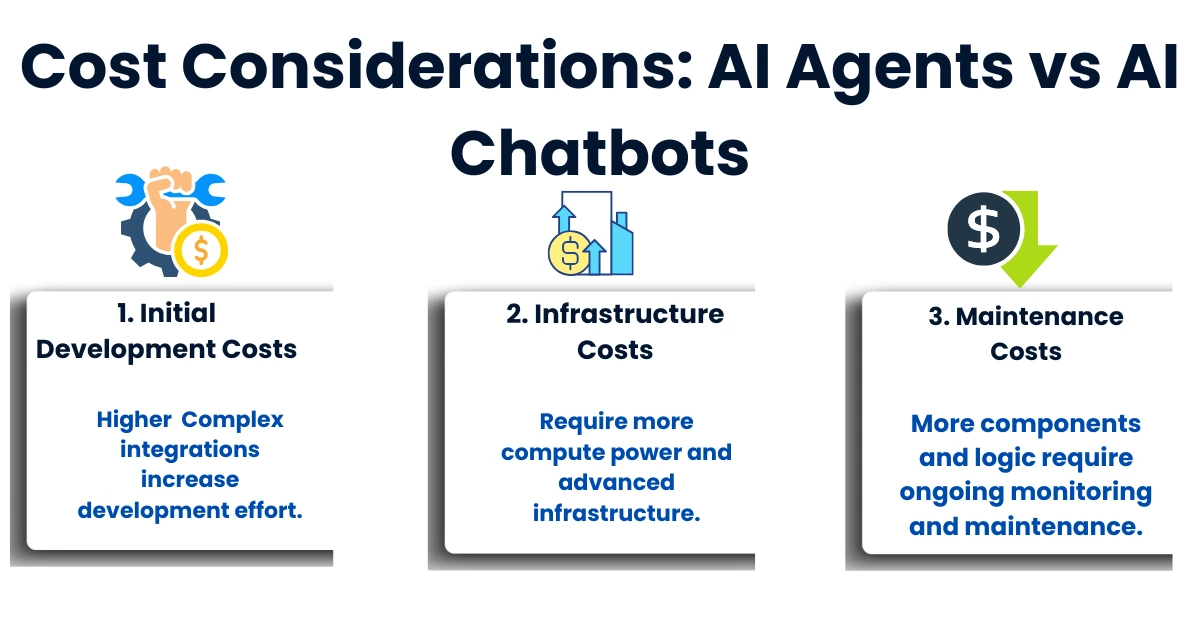
Initial Development Costs
depending on factors such as project complexity, data requirements, technology stack, integration needs, and the level of customization involved. While initial investment may vary, AI solutions often deliver significant long-term value through automation, predictive analytics, intelligent decision-making, and improved business performance. From machine learning models and generative AI applications to intelligent automation platforms and AI-powered enterprise systems, businesses across Dubai are leveraging advanced technologies to gain a competitive edge. Understanding AI Development Cost in Dubai helps organizations allocate resources effectively, evaluate return on investment, and choose the right development approach for their specific objectives.
Infrastructure Costs
Chatbot infrastructure is typically lightweight—a hosted NLP service, a knowledge base, and integration with existing platforms. AI agents require more sophisticated infrastructure: persistent memory stores, orchestration layers, tool execution environments, and comprehensive logging and monitoring systems to support audit requirements.
Maintenance Costs
Both technologies require ongoing maintenance, but the nature of that maintenance differs. Chatbots need regular updates to knowledge bases, intent models, and conversation flows as business needs evolve. Agents require maintenance of the reasoning models, tool integrations, and governance controls that underpin autonomous operation.
Long-Term ROI
The ROI picture favours AI agents for organisations with complex automation needs. While the initial investment is higher, the value unlocked by end-to-end workflow automation—particularly in knowledge-intensive industries such as financial services, healthcare, and professional services—can generate returns that vastly exceed those achievable through conversational automation alone.
Businesses that treat AI investment purely as a cost reduction exercise often underinvest in agents and overinvest in chatbots. The organisations that generate the greatest AI returns are those that ask not “how can AI answer questions?” but “how can AI complete entire workflows?
Security, Governance, and Compliance Considerations
Data Privacy
Both AI chatbots and agents process sensitive user data, but agents present a more complex privacy challenge. Because agents interact with multiple systems, retrieve data from diverse sources, and maintain persistent memory, the scope of data they access and process is broader—and the potential impact of a privacy incident is correspondingly greater. Data minimisation strategies, purpose limitation controls, and comprehensive privacy impact assessments are essential for agent deployments.
Regulatory Compliance
The regulatory landscape for AI is evolving rapidly. Chatbot deployments must comply with data protection regulations (GDPR, PDPA, and sector-specific requirements) and consumer protection rules governing automated communications. AI agents—particularly those making or influencing consequential decisions—face additional scrutiny under emerging AI governance frameworks, including requirements for explainability, human oversight, and non-discrimination.
Audit Trails
Comprehensive audit trails are non-negotiable for enterprise AI deployments, and they are more complex to implement for agents than for chatbots. Every action an agent takes—every API call, every data retrieval, every decision point—must be logged with sufficient detail to enable post-hoc review and investigation. This is not merely a governance requirement; it is essential for debugging, continuous improvement, and incident response.
Risk Management
AI agents introduce risks that do not exist with chatbots. Autonomous decision-making can propagate errors through automated workflows before human review occurs. Tool-use capabilities create potential attack surfaces for prompt injection and other adversarial techniques. Risk management frameworks for agent deployments must address these novel risks through carefully designed sandboxing, least-privilege access controls, and human-in-the-loop checkpoints for high-stakes decisions.
Human Oversight
Effective human oversight is the most important governance control for autonomous AI systems. AI agents should be designed with clear escalation pathways, approval workflows for consequential actions, and monitoring capabilities that allow human operators to identify and intervene when agent behaviour deviates from expectations. The goal is not to eliminate AI autonomy, but to calibrate it appropriately to the stakes and context of each task.
AI Agents in Regulated Industries
Banking and Financial Services
The banking and financial services sector has emerged as one of the earliest and most aggressive adopters of AI agents. Financial institutions are leveraging advanced AI solutions to automate critical processes such as compliance monitoring, fraud detection, credit risk assessment, and customer onboarding. These use cases require sophisticated decision-making capabilities, real-time data analysis, and seamless integration with core banking systems. As a result, organizations are increasingly investing in Top 12 generative AI development services to build intelligent, secure, and scalable solutions that improve operational efficiency while maintaining regulatory compliance.The business case in financial services is compelling: agents can process loan applications end-to-end, monitor transactions for suspicious activity across thousands of accounts simultaneously, and generate regulatory reports without human intervention. The governance requirements are correspondingly stringent, with regulators requiring comprehensive audit trails, explainable decision-making, and clear human accountability for consequential outcomes.
Healthcare
Healthcare AI deployments face some of the most demanding governance requirements of any industry, given the patient safety implications of erroneous decisions. AI agents are being deployed to support clinical decision-making, manage prior authorisation workflows, coordinate care across multidisciplinary teams, and automate administrative burden that currently consumes significant clinical capacity.
The key governance principle in healthcare AI is that agents augment clinical judgement rather than replace it. Human oversight of agent outputs remains mandatory in clinical contexts, with agents handling the information retrieval, synthesis, and administrative orchestration that allows clinicians to focus on the decisions that require human expertise and accountability.
ALSO READ- NVIDIA & HOPPR Transform Medical Imaging with Advanced AI Integration
Insurance
Insurance is a natural fit for AI agents given the complexity of underwriting, claims processing, and fraud detection. Agents can automate the data gathering and analysis that supports underwriting decisions, process straightforward claims end-to-end, and identify potentially fraudulent activity through pattern recognition across large claims datasets. The efficiency gains are substantial: claims that previously required days of manual processing can be resolved in minutes.
Government Services
Government agencies are deploying AI agents to improve citizen service delivery, automate administrative processing, and manage complex multi-agency workflows. The governance requirements for government AI are among the most demanding, with requirements for transparency, non-discrimination, and accessibility that must be built into agent design from the outset. The AI vs chatbot question in government contexts often comes down to whether the task is informational (favours chatbots) or operational (favours agents).
Industry Applications of AI Agents and Chatbots
Travel Industry
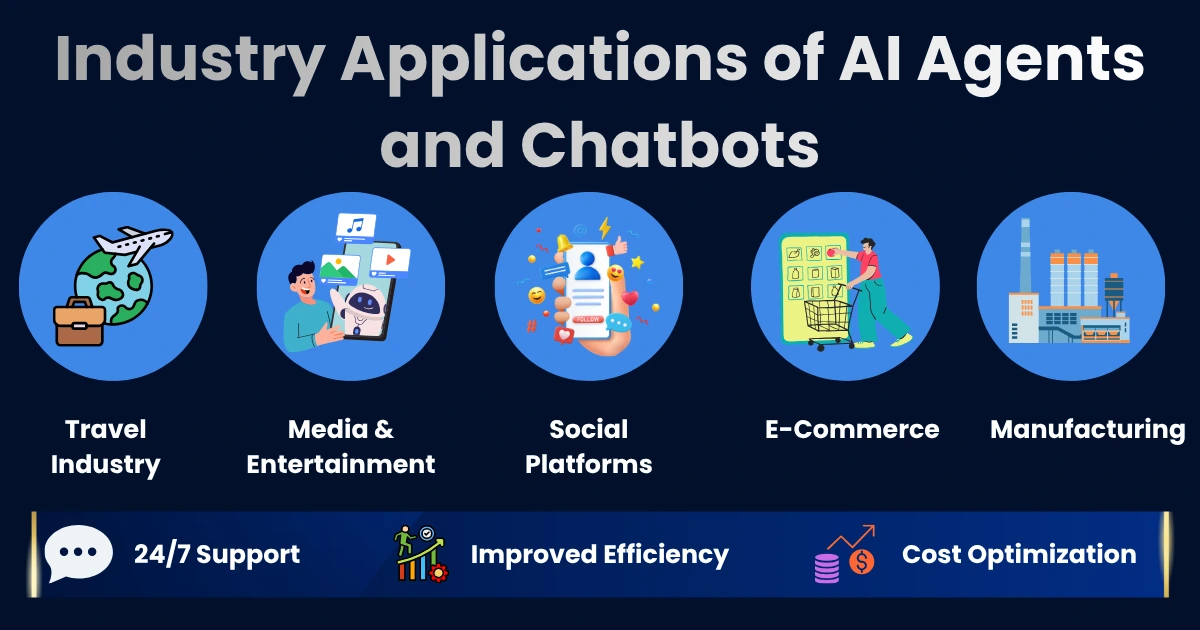
AI agents, however, go a step further by orchestrating complex workflows—rebooking disrupted itineraries across multiple airlines and hotels, coordinating ground transportation, and proactively communicating updates to affected travelers in real time. This distinction highlights why many travel companies are evolving beyond traditional conversational AI toward more autonomous, action-oriented systems. Organizations evaluating these technologies should also consider implementation budgets, infrastructure requirements, and the overall AI Chatbot Building Cost in UAE when planning customer engagement and automation initiatives across regional and global travel operations.
Generative AI replacing in 2026 explores how content platforms are using AI to enhance discovery, personalisation, and audience engagement. Chatbots power conversational content discovery and audience interaction, while agents manage content scheduling, rights clearance workflows, and personalised content delivery at scale. The combination of both technologies enables media organisations to deliver more relevant experiences at a fraction of the cost of human curation.
Social Platforms
AI Agents Are Entering Social Networks signals a significant evolution in how AI is deployed across social media platforms. Beyond the chatbots that handle moderation and customer support, agents are being deployed for content moderation at scale, trend analysis, advertiser support, and the increasingly complex task of detecting coordinated inauthentic behaviour. The governance implications of agents operating at the scale of major social platforms are significant and actively debated.
E-Commerce
E-commerce represents one of the most mature AI deployment environments. Chatbots handle product discovery, customer support, and order management, while agents manage more sophisticated tasks: dynamic pricing optimisation, inventory reordering, personalised promotion orchestration, and supplier communication. The result is an increasingly autonomous retail operation where human decision-making is focused on strategy rather than execution.
Manufacturing
In manufacturing, AI agents are being deployed to monitor production systems, predict maintenance requirements, manage supply chain exceptions, and optimise scheduling across complex production environments. The integration requirements are substantial—effective manufacturing agents must interface with OT systems, ERP platforms, and supplier APIs—but the operational efficiency gains, measured in reduced downtime, lower inventory costs, and improved throughput, are transformative.
When Should Your Business Choose AI Chatbots?
AI chatbots remain the right choice for many business use cases. The chatbot vs AI agent decision should favour chatbots when:
- Customer support – Your primary need is handling high volumes of customer queries with consistent, accurate responses. Chatbots excel at deflecting common queries from human agents, reducing support costs, and improving response times.
- FAQ automation – You need to make a large knowledge base accessible through a conversational interface without requiring users to search or browse.
- Lead qualification – Your goal is to engage website visitors, collect contact information, and assess purchase intent in a scalable, consistent way.
- Appointment scheduling – You need to automate booking workflows without the complexity of multi-system orchestration.
- Simple workflow automation – Your automation requirements involve single-step or limited-step tasks that can be handled through a conversational interface without complex reasoning.
If your use case is well-defined, high-volume, and primarily conversational, a well-implemented AI chatbot will deliver strong ROI at lower cost and risk than an agent deployment.
When Should Your Business Choose AI Agents?
AI agents are the appropriate choice when the scope of what you need AI to do extends beyond conversation into action:
- Complex enterprise workflows – You need to automate end-to-end processes that span multiple systems, require conditional logic, and involve varied data inputs and outputs.
- Autonomous decision-making – You need AI to make or support consequential decisions based on complex, multi-source information without requiring human direction at each step.
- Multi-step process execution – Your automation requirements involve sequences of interdependent tasks that must be coordinated across time and systems.
- Knowledge-intensive operations – Your business requires continuous synthesis of large volumes of information from diverse sources to support high-quality decisions.
- Cross-platform automation – You need AI to operate seamlessly across multiple enterprise platforms, APIs, and data sources as a unified operational intelligence.
How Generative AI Is Changing Both Technologies
The emergence of powerful large language models has transformed both chatbots and agents. Custom generative AI development services are enabling businesses to build AI systems that go far beyond the capabilities of previous generations, creating new possibilities for both conversational engagement and autonomous action.
- Large Language Models (LLMs) provide the reasoning backbone that enables both chatbots to hold sophisticated, context-aware conversations and agents to plan and execute complex multi-step workflows.
- RAG Architecture – Retrieval-Augmented Generation enables AI systems to ground their responses in up-to-date, organisation-specific knowledge rather than relying solely on training data—dramatically improving accuracy and relevance in enterprise deployments.
- Multimodal AI extends the capabilities of both chatbots and agents beyond text to encompass images, documents, audio, and video—enabling new use cases in healthcare diagnostics, content analysis, and visual customer service.
- Agentic AI Systems represent the convergence of LLM reasoning with tool use, planning, and memory—creating AI that can pursue complex goals autonomously across extended time horizons.
Building Enterprise AI Solutions That Scale
Selecting the right AI technology is only the first step. Building enterprise AI solutions that deliver sustainable value requires careful architectural planning, a mature AI software development company partner, and a governance framework that can evolve alongside the technology.
- Architecture planning – Effective enterprise AI architectures separate concerns cleanly—isolating model inference, tool execution, memory management, and orchestration into modular components that can be maintained and scaled independently.
- Model selection – The choice of foundation model must balance capability, cost, latency, and data sovereignty requirements. Not every enterprise use case requires the most capable (and most expensive) available model.
- Integration strategy – AI systems that cannot integrate effectively with existing enterprise platforms deliver limited value. Integration architecture must be planned from the outset, not bolted on after deployment.
- Security framework – Security must be embedded in AI architecture from the ground up—covering data access controls, prompt injection defences, output validation, and comprehensive monitoring.
The Role of Software Engineering in AI Success
Behind every successful enterprise AI deployment is world-class software engineering. Whether you engage a software development company in dubai or a local partner, the engineering quality of your AI implementation will determine whether you achieve the outcomes your business requires.
- Infrastructure – Robust, scalable infrastructure that can handle the computational demands of LLM inference, agent orchestration, and high-volume API integration is a prerequisite for production AI deployments.
- APIs – Clean, well-documented, and secure APIs are the connective tissue of effective AI systems, enabling models and agents to interact reliably with enterprise data and services.
- Security – AI systems must be engineered with security as a first-class concern—not an afterthought—with threat modelling, penetration testing, and continuous monitoring built into the development process.
- Cloud deployment – Cloud-native deployment architectures provide the scalability, reliability, and global reach that enterprise AI systems require, while enabling cost optimisation through dynamic resource allocation.
- Enterprise integration – Effective enterprise AI requires seamless integration with ERP, CRM, HCM, and industry-specific platforms—a capability that demands both deep engineering expertise and domain knowledge.
Future Trends for AI Agents and AI Chatbots
The AI landscape is evolving at a pace that makes confident long-range prediction difficult—but several trends are clearly shaping the trajectory of both technologies through to 2030 and beyond.
- Agentic AI – The shift from AI as a conversational tool to AI as an autonomous actor is accelerating. Within five years, agentic AI will be a standard component of enterprise technology stacks, not an experimental capability.
- Multi-Agent Systems – Complex tasks will increasingly be handled by networks of specialised agents that collaborate, delegate sub-tasks, and check each other’s work—delivering capabilities that no single agent could provide.
- Autonomous Workflows – End-to-end business processes—from lead generation to customer onboarding to invoice processing to compliance reporting—will increasingly be executed by autonomous AI systems with human oversight at defined control points.
- Digital Employees – AI agents capable of performing defined job functions—research analyst, compliance officer, customer service manager—will become a standard element of enterprise workforce planning.
- AI Governance – Regulatory frameworks for AI are maturing rapidly in the EU, UK, US, and Asia-Pacific. Organisations that build governance capabilities now will have significant competitive advantages as compliance requirements tighten.
- Industry Predictions for 2030 – By 2030, most enterprises in developed markets will deploy AI agents for core operational functions, chatbots will be ubiquitous in all customer-facing channels, and the boundary between human and AI work will be actively managed rather than passively observed.
Why Choose SISGAIN for AI Development?
SISGAIN has built its reputation as a trusted enterprise AI partner by delivering solutions that combine deep technical expertise with genuine understanding of the business challenges our clients face. We don’t deploy technology for its own sake—we build AI systems that create measurable, sustainable business value.
Deep AI Expertise
Our team has extensive experience delivering enterprise-grade AI solutions across industries including banking and financial services, healthcare, travel, logistics, retail, and media. We have witnessed firsthand how Artificial Intelligence is transforming modern industries in 2026 by enabling automation, predictive analytics, intelligent decision-making, and personalized customer experiences. We understand the specific use cases, governance requirements, and integration challenges of each sector—and we apply that knowledge to every engagement, helping organizations accelerate digital transformation and achieve sustainable growth.End-to-End Development.
SISGAIN supports clients through the complete AI development lifecycle—from initial strategy and use case definition through architecture design, model selection, integration development, security testing, and ongoing maintenance. We are your partner from vision to production and beyond.
Security-First Development
Security, privacy, governance, and risk management are not features we add to AI systems—they are principles we apply from the first day of every engagement. Our AI deployments are designed to meet the most demanding regulatory requirements and to give our clients the confidence to scale their AI capabilities without creating unacceptable risk.
Industry-Specific Solutions
We build AI solutions tailored to the specific requirements of each industry we serve. Our healthcare AI respects clinical governance requirements. Our BFSI solutions meet APRA, FCA, and other regulatory frameworks. Our retail and logistics deployments integrate with the complex technology ecosystems our clients operate. We don’t offer one-size-fits-all solutions because we know they don’t exist.
Custom AI Implementation
Every SISGAIN engagement begins with a thorough understanding of your specific business goals, constraints, and existing technology landscape. We design solutions that are precisely fitted to your requirements—not adapted from a generic template that happened to be available.
Scalable Architecture
We build AI systems designed to grow with your business. Our architectures are modular, cloud-native, and designed to accommodate the evolution of AI capabilities over the coming decade—so your investment today creates a foundation that supports your ambitions tomorrow.
Conclusion
The distinction between AI chatbots and AI agents matters because it determines what your business can actually achieve with AI investment. Chatbots excel at conversational tasks—answering questions, deflecting support queries, qualifying leads—and they deliver real value when deployed for the right use cases. Agents go further, enabling genuine operational transformation through autonomous workflow execution, multi-system orchestration, and intelligent decision support.
Both technologies have a place in a mature enterprise AI strategy. The question is not which is better in the abstract, but which is right for the specific outcomes your business needs to achieve. Start with your goals—the workflows you want to automate, the costs you want to reduce, the customer experiences you want to improve—and let those objectives guide your technology choices.
Strategic business alignment, not technological trend-following, is the foundation of AI success. The organisations that will derive the greatest value from AI over the next decade will be those that invest in the right capabilities for their specific context, build the governance frameworks to deploy those capabilities responsibly, and work with partners who understand both the technology and the business.