
The UAE Government Isn't Waiting — And Neither Should You
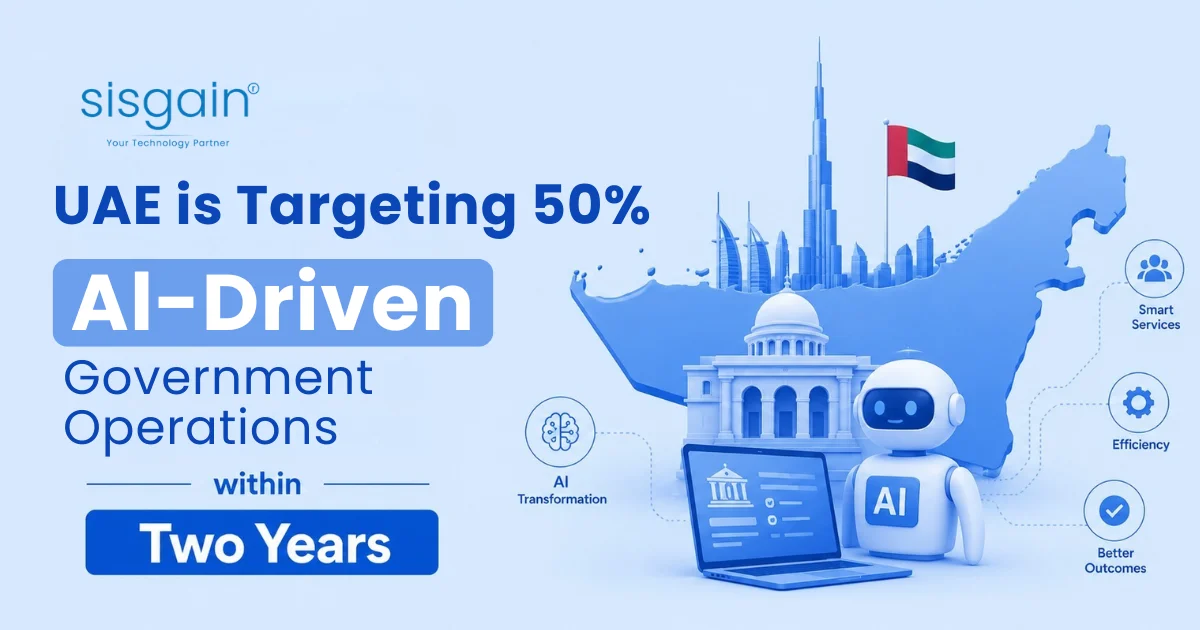
Let me be direct about something: the UAE's 50% AI-driven government operations target isn't a vision document collecting dust on a ministry shelf. It's a live mandate backed by budgets, timelines, and the kind of institutional will that turns policy into procurement.
I've been working with technology and digital transformation for nearly two decades, and I've seen enough government tech initiatives globally to know which ones have teeth and which ones are just branding exercises. What's happening in the UAE right now is different. The country has already built a significant part of the infrastructure, trained the talent, and embedded the cultural appetite for digital-first governance. The 50% AI target isn't a moonshot — it's the next logical step in a journey that started years ago.
But here's what most enterprise leaders I talk to miss: the real commercial opportunity isn't in AI for AI's sake. It's specifically in AI-Powered Citizen Service Platforms — the systems that interface between government entities and the millions of residents, businesses, tourists, and investors who interact with UAE public services every day.
If you're a technology company, a digital transformation firm, or an enterprise looking to align your service offerings with where public-sector spending is headed in the UAE, this is the article you need to read carefully. Not because it gives you a quick summary, but because it maps the full landscape — the "why," the "what," and critically, the "how" — of building and deploying AI government service platforms in one of the world's most ambitious digital governance ecosystems.
Let's get into it.
Understanding the UAE's 50% AI Target — The Policy Context
Where Did This Target Come From?
The UAE's ambition for AI-driven governance didn't emerge in a vacuum. It builds on a foundation of deliberate, sequential policy-making:
UAE Vision 2021 laid the groundwork for smart government, embedding digital transformation as a national priority. UAE Strategy for Artificial Intelligence 2031 went further — it positioned the UAE as a global leader in AI adoption, with government services being one of the primary application domains. The National AI Agenda followed, with specific mandates for federal and emirate-level government bodies to integrate AI into service delivery.
Now, the 50% AI-driven operations target adds execution pressure to those strategic ambitions. This isn't just about automating back-office processes — it's about redesigning how citizens experience government entirely.
What does "50% AI-driven" actually mean in practice? It means that half of all government service interactions, decision-making processes, and operational workflows should either be handled autonomously by AI systems or significantly augmented by AI tools. We're talking about visa processing, health service navigation, business licensing, traffic and infrastructure management, social services, and more.
The Numbers Behind the Ambition
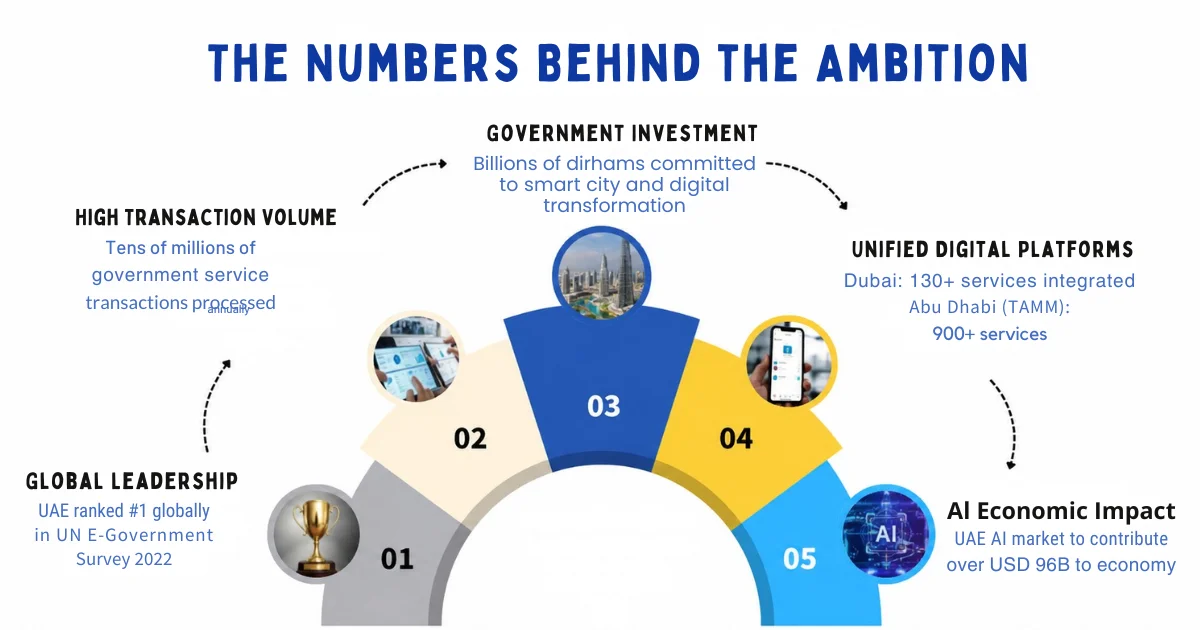
The scale of what the UAE government is undertaking becomes clearer when you look at it through data:
- The UAE currently processes tens of millions of government service transactions annually across federal and emirate platforms
- The government has publicly committed billions of dirhams toward smart city and digital transformation investments
- The UAE ranked first globally in the UN E-Government Survey 2022 for online service delivery, a position it is actively defending and extending
- Dubai's Smart City initiative alone has integrated over 130 government services under its unified digital umbrella
- Abu Dhabi's TAMM platform serves as a single touchpoint for over 900 government services, with AI-driven routing and personalization already live
- The UAE AI market is projected to contribute over USD 96 billion to the country's economy by 2030, according to PwC estimates
- Smart Dubai's digital services see over 20 million transactions per year — a volume that is simply not manageable without AI-powered automation at scale
These aren't aspirational figures. They are current baselines that the 50% AI target is meant to dramatically expand and deepen.
For enterprises in the AI and software space, what this signals is straightforward: there is a structured, funded, and policy-backed procurement pipeline forming around AI-Powered Public Services in the UAE, and the companies best positioned to capture it are those who understand the technical architecture of citizen service platforms specifically — not just AI in general.
Why "50% AI-Driven" Is a Harder Target Than It Sounds
I want to push back against any reading of this target as incremental or easy. Achieving 50% AI-driven operations across a complex, multi-entity government structure like the UAE's is genuinely ambitious. Here's why:
Fragmented starting point. While the UAE has been digitizing government services for over a decade, the underlying systems are heterogeneous. Different ministries run different ERP platforms. Different emirates have built their platforms on different technology stacks. Unifying all of this under an AI orchestration layer — without breaking existing functionality — is a major systems integration challenge.
Population complexity. The UAE serves one of the world's most diverse resident populations: over 200 nationalities, dozens of language groups, huge variation in digital literacy, and a massive temporary population of tourists and business visitors with time-sensitive, high-stakes service needs. A citizen service AI must work equally well for a senior Emirati grandmother in Ras Al Khaimah, a young tech entrepreneur in Dubai, a construction worker from South Asia managing his labor contract, and a European investor renewing their business license from abroad. That diversity is not a standard requirement in most government AI implementations globally.
Regulatory sensitivity. Government decisions have legal consequences. An AI system that makes an error in a visa decision, a business license denial, or a social benefit eligibility assessment exposes the government to legal challenges. The AI systems powering these decisions must be not just accurate but explainable, auditable, and defensible under UAE administrative law.
Institutional inertia. Even in a country with strong executive will and institutional capacity for change, shifting 50% of operations to AI requires persuading thousands of individual government employees, managers, and department heads to change how they work. That is a human challenge as much as a technology one.
None of this diminishes the ambition or the commitment. But it does clarify why building AI-Powered Citizen Service Platforms for the UAE market is a complex, specialized discipline — and why the enterprises that build genuine expertise in this space will command significant competitive advantage.
What Are AI-Powered Citizen Service Platforms — and Why They're the Central Piece
Defining the Term Properly
An AI-Powered Citizen Service Platform is not a chatbot. I want to be precise about this because I've seen far too many vendors pitch a WhatsApp bot or a basic FAQ automation tool as an "AI-powered government solution." That's not what we're talking about.
A true AI-Powered Citizen Service Platform is an integrated digital ecosystem that uses artificial intelligence — across its multiple layers including machine learning, natural language processing, predictive analytics, computer vision, and autonomous decision systems — to:
- Understand citizen needs in real time, across multiple languages and communication channels
- Route, process, and fulfill service requests with minimal human intervention
- Predict and proactively serve citizens before they even raise a request
- Personalize the experience based on individual profiles, history, and context
- Learn and improve continuously from every interaction
- Integrate with backend government systems — databases, legal frameworks, payment systems, ID verification — without friction
This is fundamentally different from a digitized form or a portal with a search bar. It's an end-to-end intelligent system that transforms how government delivers value to residents and businesses.
The Architecture of a Modern Citizen Service Platform
From a technical standpoint, a well-built Citizen Service Platform Development initiative typically involves:
Frontend Intelligence Layer: Multi-channel interfaces — web, mobile, voice, kiosk, WhatsApp, smart TV — all unified under a single AI layer that maintains context regardless of where the citizen started their interaction.
Natural Language Processing Engine: Capable of understanding Arabic, English, Urdu, Hindi, Tagalog, and other languages common in the UAE's diverse population. Sentiment detection, intent classification, entity extraction — all in real time.
Process Orchestration Layer: AI-driven workflow engines that route requests, trigger approvals, escalate edge cases, and manage SLAs without manual intervention.
Predictive Analytics Module: Uses historical interaction data to anticipate service demand, identify at-risk service failures, and proactively notify citizens of upcoming renewals, deadlines, or eligibility changes.
Identity and Verification Integration: Connects with UAE PASS, Emirates ID databases, biometric systems, and other national identity infrastructure to enable frictionless authentication.
Decision Support and Automation: For processes that require judgment — approvals, eligibility assessments, exception handling — AI models assist or automate decisions within defined regulatory boundaries.
Data and Compliance Layer: Ensures all citizen data is handled in accordance with UAE data protection laws and cybersecurity mandates from the UAE Cybersecurity Council.
This is the kind of platform architecture that actually delivers on the 50% AI-driven operations target. And building it requires a very specific set of capabilities — which brings me to why this is both a technical and commercial conversation.
The Commercial Landscape — Who Builds These Platforms?
The Supplier Ecosystem Is Taking Shape
One of the most important things to understand about the UAE's AI government services push is that the government is not trying to build everything itself. The UAE has a long track record of partnering with private sector technology firms — both global players and regional specialists — to design, build, and operate digital government infrastructure.
This creates a significant market opportunity for:
- AI software development companies with deep government sector experience
- System integrators who can bridge legacy government systems with modern AI platforms
- Cloud infrastructure providers with UAE data residency compliance
- Domain-specific AI solution vendors (identity, Arabic NLP, predictive analytics, etc.)
- Digital transformation consultancies that can advise on change management and implementation strategy
The question for any enterprise in these categories isn't whether there's a market — there clearly is. The question is how to position yourself credibly within it.
If you're exploring where AI development services fit within the UAE government tech ecosystem, it's worth understanding that the UAE government evaluates vendors not just on technology but on local presence, regulatory compliance readiness, Arabization capability, and long-term support commitment.
What Government Clients Are Actually Looking For
Having worked on digital transformation projects across multiple sectors, I can tell you that government clients evaluating Smart Citizen Engagement Platforms consistently prioritize the following:
Integration Depth: How well does your solution connect with existing government systems — including legacy ERP platforms, ministry-specific databases, and cross-entity data sharing frameworks?
Arabic Language Excellence: This is non-negotiable. A citizen service platform that doesn't handle Arabic — including dialects, formal government language, and mixed Arabic-English inputs — will not pass evaluation. Many vendors underestimate how technically complex this is.
Scalability Under Peak Load: UAE government services see enormous traffic spikes — during Eid, UAE National Day, end-of-fiscal-year processing, new regulation rollouts. Your platform needs to handle 10x normal load without degradation.
Security and Data Sovereignty: All citizen data must remain within UAE borders. The platform must meet UAE Information Assurance Standards and align with the UAE Cybersecurity Council's framework.
Measurable Outcomes: Government clients want KPIs — reduction in processing time, decrease in in-person visits, citizen satisfaction scores, cost per transaction. Your platform must instrument these from day one.
Post-Deployment Support: UAE government entities operate 24/7. Your support model must reflect that.
Quick Question: What Is an AI-Powered Citizen Service Platform?
Short Answer: It's an integrated government technology system that uses AI — including NLP, machine learning, and predictive analytics — to automate, personalize, and optimize how government agencies deliver services to residents and businesses. It goes far beyond basic chatbots to include autonomous workflows, real-time translation, identity verification, and proactive service delivery.
Where AI in Citizen Services Is Already Making an Impact in the UAE
Real Use Cases Across UAE Government Entities
The UAE isn't waiting for the future — several AI-in-government applications are already live and delivering measurable results. Understanding these gives enterprises a realistic benchmark for what "mature" looks like and where the next wave of investment will flow.
Dubai Police — AI Crime Prediction and Smart Reporting Dubai Police has integrated AI into predictive policing tools and offers an AI-powered digital reporting interface that allows citizens to report incidents without visiting a station. The system uses NLP to parse reports, classify incident types, and route them to the correct department automatically. Resolution times for low-complexity cases have dropped significantly. The system also supports reporting in Arabic, English, Urdu, Hindi, and several other languages common in Dubai's resident population.
MOHRE (Ministry of Human Resources and Emiratisation) — Smart Labor Compliance MOHRE's Tasheel system now uses AI to process labor contracts, verify compliance, detect anomalies in working conditions reports, and flag potential labor law violations before they escalate. This is a strong example of AI in citizen services extending beyond convenience into regulatory enforcement. The system processes millions of labor contracts annually and has significantly reduced both processing times and compliance violation rates.
Abu Dhabi Department of Health — Predictive Patient Navigation Using AI, Abu Dhabi's health services now proactively notify patients about upcoming screenings, appointment gaps, and chronic condition management steps — reducing emergency room visits and improving health outcomes. This is proactive citizen service at its most impactful. It represents the shift from government responding to citizens to government anticipating citizen needs before they become crises.
Federal Authority for Identity, Citizenship, Customs & Port Security (ICP) — AI-Accelerated Visa Processing ICP has integrated AI into document verification, risk-scoring for visa applications, and biometric matching. Processing times that previously took days now take hours for standard applications. The biometric matching system cross-references Emirates ID data, travel document data, and historical records to flag anomalies in milliseconds — a task that would require dozens of human reviewers to replicate at comparable accuracy.
RTA (Roads and Transport Authority) — Smart Transit Management RTA's AI ecosystem manages traffic flow, public transit scheduling, and citizen complaints through an integrated platform. AI models predict congestion, adjust signal timing, and reroute buses in real time — all while the citizen-facing interface remains simple and accessible. The RTA chatbot handles hundreds of thousands of citizen queries monthly in both Arabic and English with high resolution rates.
Dubai Land Department — AI-Powered Real Estate Services DLD has implemented AI to assist with property valuation, transaction verification, and investment advisory services for both buyers and developers. The AI system can analyze market trends, assess property documentation, and guide citizens through complex real estate transactions — a domain that has historically been opaque and friction-heavy for non-specialist users.
Ministry of Justice — Smart Legal Guidance The UAE Ministry of Justice has deployed AI-powered legal guidance tools that help citizens understand their rights, navigate dispute resolution procedures, and access court services without requiring lawyer engagement for preliminary steps. This democratization of legal information access — particularly for low-income residents and those with language barriers — is a social equity application of AI in citizen services with significant humanitarian value.
These examples share a common thread: they are not isolated technology experiments. They are production systems integrated into core government service delivery workflows. That's the level of ambition the 50% AI target demands — and the level at which any serious AI Government Service Platform vendor needs to operate.
What These Use Cases Reveal About the Next Wave of Investment
Analyzing these UAE government AI deployments reveals a clear pattern of maturity. The first wave — chatbots, digital forms, basic self-service portals — is largely complete. The second wave — AI-driven process automation, document intelligence, predictive analytics — is active and accelerating. The third wave — fully agentic AI that proactively manages citizen service journeys end-to-end without human initiation — is where the 50% target lives.
Understanding this maturity curve is critical for enterprises positioning their offerings. If you're still selling first-wave solutions in a market that's buying third-wave capabilities, you will lose deals to competitors who have moved ahead. The procurement conversations happening right now in UAE government entities are about autonomous, multi-step, multi-channel service delivery — not about making existing portals smarter.
Building AI-Powered Citizen Service Platforms — The Development Roadmap
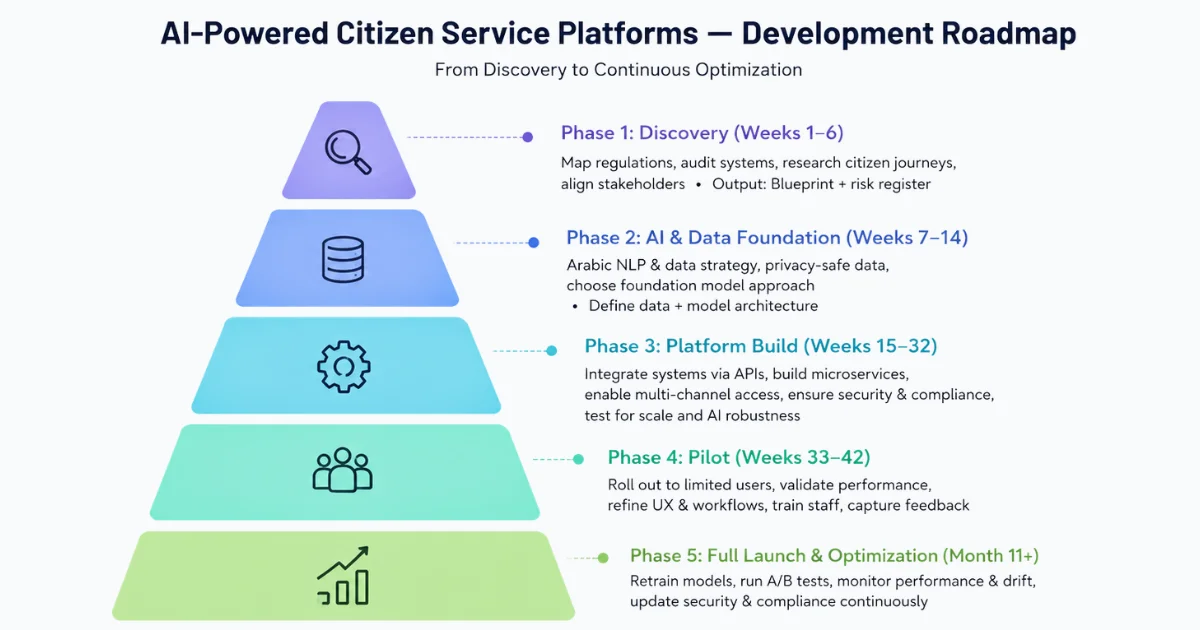
Phase 1: Discovery and Government Context Mapping (Weeks 1–6)
This is where most failed government AI projects go wrong. Teams jump into technology selection before they fully understand the regulatory environment, the existing system landscape, or the actual citizen journey.
A proper discovery phase for citizen service platform development in the UAE context includes:
- Regulatory mapping: Understanding which laws govern the service domain — whether healthcare, labor, residency, licensing, or education — and how AI-generated decisions interact with those regulations
- Existing system audit: Cataloging legacy systems, APIs, and data sources the platform must integrate with
- Citizen journey research: Conducting research with actual residents across demographic segments — Emiratis, expat professionals, low-income workers, elderly residents, business owners — to understand pain points and expectations
- Stakeholder alignment: Mapping the political and operational stakeholders within the government entity who will influence, approve, and champion the project
This phase produces an architectural blueprint and a risk register that governs everything downstream.
Phase 2: AI Model Selection and Data Foundation (Weeks 7–14)
The intelligence of your platform is only as good as the data and models that power it. For UAE government platforms specifically:
Arabic NLP model selection is a critical decision. Off-the-shelf models trained primarily on English data underperform significantly on Arabic. You need models fine-tuned on Gulf Arabic, formal Modern Standard Arabic, and mixed Arabic-English code-switching — which is extremely common in UAE citizen interactions.
Training data curation must account for data protection requirements. You cannot simply scrape citizen data to train models. You need privacy-preserving techniques, synthetic data generation, and in some cases federated learning approaches.
Foundation model choices — whether to use GPT-class models via API, fine-tuned open source models, or domain-specific models built from scratch — each carry different cost, performance, and data sovereignty implications.
For context on what AI software development actually involves in the UAE market, and how development costs break down for government-grade projects, it's worth understanding the full scope before entering procurement conversations. You can explore a detailed breakdown of AI development cost in Dubai 2026 to calibrate your expectations.
Phase 3: Platform Architecture and Integration Build (Weeks 15–32)
This is the core engineering phase. It involves:
API Gateway Development: A unified API layer that connects the AI platform with government backend systems — including ministries' proprietary systems, UAEPAS/UAE PASS, national databases, and cloud infrastructure.
Microservices Architecture: Each functional component — NLP engine, workflow orchestrator, identity verifier, analytics module — built as an independent microservice for scalability and maintainability.
Multi-Channel Interface Development: Web portal, mobile app (iOS and Android), WhatsApp Business API integration, voice interface (including Arabic speech-to-text), and kiosk interfaces for service centers.
Security Architecture: Zero-trust security model, end-to-end encryption, role-based access control, audit logging, and compliance with UAE's Information Assurance Standards and cybersecurity framework.
Testing and Quality Assurance: Given the zero-tolerance expectation for government service failures, testing must include load testing at 10x peak, adversarial testing for AI model robustness, and accessibility testing for users with disabilities.
This phase is where working with an experienced software development company UAE partners with deep government project experience becomes critical. The complexity of integrating with UAE government systems specifically — their data standards, security requirements, and operational constraints — is not something you want to figure out for the first time on a live government contract.
Phase 4: Pilot Deployment and Iteration (Weeks 33–42)
A controlled pilot with a defined user cohort — typically 5,000 to 50,000 citizens depending on the service domain — allows you to:
- Validate AI model performance in real-world conditions
- Identify integration failures that didn't surface in testing
- Measure actual KPIs against projected targets
- Gather citizen feedback for UX refinement
- Train government staff on platform management and exception handling
Pilot findings almost always result in significant model retraining, workflow adjustments, and UX iterations before the platform is ready for full deployment.
Phase 5: Full Rollout and Continuous Improvement (Month 11+)
Full deployment is followed by an ongoing improvement cycle. AI-Powered Public Services improve with scale — more interactions generate more training data, which feeds better models, which deliver better experiences. This is the flywheel that compounds over time.
Continuous improvement in this context includes:
- Monthly model retraining cycles incorporating new interaction data
- A/B testing of interface variations for conversion and satisfaction optimization
- Proactive monitoring for model drift — where AI predictions become less accurate as real-world patterns shift
- Regular security audits and compliance reviews
Quick Question: How Long Does It Take to Build an AI Citizen Service Platform in the UAE?
Short Answer: A production-ready AI-Powered Citizen Service Platform for a mid-sized government service domain typically takes 10–14 months from discovery to full deployment, with a controlled pilot live around month 9–10. Emergency or limited-scope solutions can be deployed faster, but platforms designed for scale and integration depth require this timeline for quality and compliance.
The Technology Stack That Powers Smart Citizen Engagement Platforms
What "Best-in-Class" Looks Like in 2026
The technology landscape for Smart Citizen Engagement Platforms has evolved significantly. What was cutting-edge in 2022 — basic conversational AI and RPA — is now table stakes. In 2026, best-in-class platforms for the UAE market integrate:
Large Language Models with Arabic Fine-Tuning Models like GPT-4 and its successors, Anthropic's Claude, and purpose-built Arabic LLMs are being deployed to power conversational interfaces that feel genuinely intelligent. The key differentiator for UAE government applications is fine-tuning on government-specific language, legal terminology, and Gulf Arabic dialects.
Agentic AI for Autonomous Service Completion The next evolution beyond conversational AI is agentic AI — systems that don't just respond to citizen queries but autonomously take action on their behalf. An agentic citizen service system can receive a request for a business license renewal, verify eligibility, pull required documents from connected databases, submit the application, process payment, and deliver the license — all without human intervention at any step.
This shift from reactive to agentic AI is where the 50% autonomy target truly lives.
Computer Vision for Document Processing UAE citizens frequently need to submit physical documents — Emirates ID, trade licenses, medical certificates, educational credentials. Computer vision models now handle document intake, authenticity verification, data extraction, and cross-database validation in seconds rather than days.
Predictive Service Delivery Rather than waiting for citizens to request services, advanced platforms proactively push relevant services. If a citizen's visa expires in 60 days, the platform doesn't wait for them to realize it — it proactively initiates the renewal workflow and guides them through it. This is the shift from responsive to anticipatory government.
Omnichannel Orchestration Citizens start service requests on mobile, continue on desktop, complete payment via WhatsApp, and receive confirmation via SMS. A unified orchestration layer maintains state, context, and progress across every touchpoint without requiring the citizen to repeat information.
Explainable AI for Government Accountability Government decisions must be explainable and auditable. Modern AI platforms for citizen services embed explainability tools that can document why a specific decision was made, what data was considered, and what regulatory basis applies. This is essential for public trust and legal compliance.
Federated Learning for Privacy-Preserving AI In the UAE context, where citizen data from multiple ministries needs to contribute to smarter AI models without centralizing sensitive data in ways that violate privacy regulations, federated learning architectures are increasingly important. This allows AI models to improve from distributed data sources without ever moving the raw data itself — a technically sophisticated but compliance-critical capability.
Real-Time Translation and Multilingual Interface Management With over 200 nationalities in the UAE resident population, multilingual interface management is not optional. Modern Smart Citizen Engagement Platforms integrate real-time translation capabilities, automatic language detection, and culturally adapted interface variants. This goes beyond simply translating text — it includes adapting content presentation, examples, and communication style for different cultural contexts.
Robotic Process Automation Integration RPA remains relevant as a bridge technology — connecting AI platforms to legacy government systems that don't have modern APIs. While the long-term direction is API-first integration, RPA allows AI platforms to interact with older systems in the interim, extending the value of AI investments without requiring wholesale legacy system replacement.
The shift from traditional software to AI-driven platforms is not incremental — it's architectural. For those looking to understand this transition more deeply, the detailed analysis of why AI software is replacing traditional software across industries is a useful reference point for both technical teams and executive decision-makers.
The Infrastructure Layer: Cloud, Edge, and Sovereignty
One aspect of AI-Powered Public Services architecture that receives insufficient attention in most vendor conversations is infrastructure sovereignty. The UAE has very clear requirements: citizen data must reside in UAE-based infrastructure, and critical government AI systems must be operable even in degraded connectivity scenarios.
This creates specific architectural requirements:
UAE-Based Cloud Deployment: AWS, Microsoft Azure, and Google Cloud all have UAE data center regions. Oracle, Alibaba Cloud, and G42 Cloud also have significant UAE infrastructure. Any production deployment must route and store UAE citizen data exclusively through UAE-region nodes, with architectural controls that prevent data from transiting non-UAE infrastructure.
Edge AI for Service Centers: Government service centers in remote locations — across Fujairah, Al Ain, Umm Al Quwain, and rural areas — often have unreliable connectivity. AI capabilities that need to function in these locations must be deployable at the edge, with local inference capability that synchronizes with central platforms when connectivity is available.
Disaster Recovery and Business Continuity: Government AI systems operate at criticality levels that require 99.99%+ uptime commitments. This demands geographically distributed deployment within UAE infrastructure with sub-minute failover capabilities.
These infrastructure requirements are not afterthoughts — they should be designed into the platform architecture from day one, as retrofitting them after initial build is expensive and often technically difficult.
Challenges in Building AI Government Service Platforms — What Most Vendors Underestimate
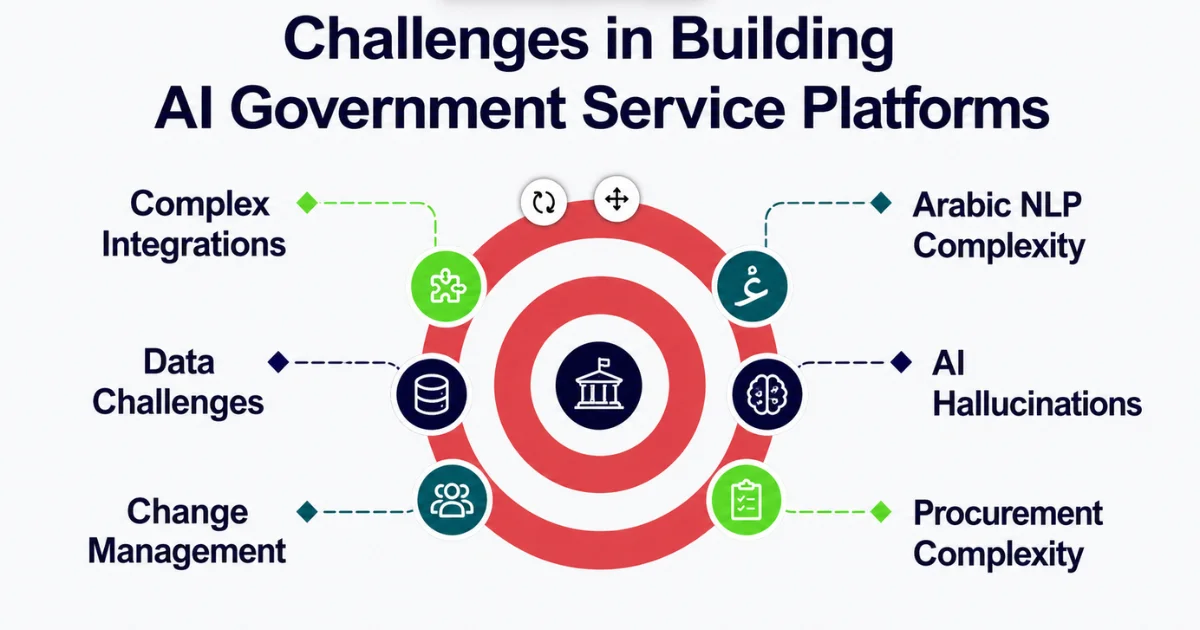
The Gaps Between Demo and Production
Every government AI vendor has a polished demo. The platforms that actually go live and deliver results are a much smaller subset. Here's what separates them.
The Integration Reality
Government IT systems are notoriously complex and fragmented. A single citizen service journey might touch systems from five different ministries, built on different technology stacks, with different data standards, maintained by different vendors, and subject to different access protocols. Building an AI platform that integrates cleanly with this reality — not the clean, well-documented API environments of a demo — requires deep government IT expertise.
Working with established Government IT Services Dubai providers who have existing knowledge of UAE government system architectures significantly reduces integration risk and project timelines.
The Data Problem
AI models require data — ideally large volumes of high-quality labeled data. Government agencies often have data that is siloed, inconsistently formatted, partially digitized, or subject to privacy restrictions that limit its use for AI training. Building data pipelines, establishing data governance frameworks, and generating synthetic training data where real data is insufficient are all major engineering challenges that are often underestimated in project scoping.
The Human Change Management Challenge
One of the most common reasons government AI projects underdeliver isn't technical — it's organizational. Front-line government employees who have built careers around established processes can resist AI systems that change or eliminate their workflows. Executive champions who initially drove the project move to other roles. Citizen-facing staff who need to guide residents through new digital interfaces aren't adequately trained.
Successful AI Government Service Platform deployments invest as much in change management as in technology. That means training programs, incentive structures, clear communication plans, and feedback loops that incorporate staff insights into platform improvement.
The Arabic Language Depth Problem
I mentioned this earlier but it deserves its own emphasis. Arabic NLP is genuinely harder than English NLP. The morphological complexity of Arabic — where a single word can encode the meaning of an entire English sentence — creates challenges for every NLP task from intent classification to entity extraction. Gulf Arabic dialect variations add another layer. Mixed Arabic-English code-switching, extremely common in UAE citizen interactions, requires models specifically trained on this linguistic pattern. Most enterprise AI vendors are much weaker in this area than they present, and it surfaces as a critical failure in live deployment.
The Hallucination Problem in Government AI
Large language models can generate plausible-sounding but incorrect information. In a consumer context, this is annoying. In a government citizen service context, it can be catastrophic — imagine a citizen making a major life decision based on incorrect information about visa eligibility, business licensing requirements, or benefit entitlements provided by a government AI system.
Managing AI hallucination in government platforms requires:
- Grounding AI responses in authoritative, regularly updated knowledge bases (not open-ended generation)
- Implementing confidence thresholds below which queries are escalated to human agents
- Continuous monitoring for response quality, with feedback loops for retraining
- Clear disclosure to citizens when they are interacting with AI and when they should seek human confirmation for critical decisions
This is a non-trivial engineering and design challenge that requires specific expertise. Vendors who haven't built government-grade AI systems often underestimate how different the quality bar is compared to consumer or enterprise AI applications.
The Procurement and Contracting Challenge
Even when a vendor has outstanding capability, navigating UAE government procurement is a process skill of its own. Government tenders in the UAE involve specific documentation requirements, pre-qualification criteria, security clearance processes, and evaluation frameworks that differ from commercial procurement. Vendors new to this market regularly disqualify themselves through process errors — incorrect document formats, missing attestations, failure to meet local content requirements — rather than capability gaps.
Understanding the procurement landscape, building relationships with procurement officials, and having experienced government contract managers is as important as the technology itself for winning business in this market.
Quick Question: What Are the Biggest Challenges in Deploying AI in UAE Government Services?
Short Answer: The top three challenges are: (1) Integration complexity with legacy government systems, (2) Arabic NLP quality at the level government interactions demand, and (3) organizational change management — getting government staff and citizens to adopt new AI-driven workflows. Data quality and cybersecurity compliance are close behind.
The Business Case — Return on Investment for AI-Powered Public Services
Making the Numbers Work
For enterprises advising government clients or building business cases for AI-Powered Public Services investment, the ROI data is compelling:
Cost Per Transaction Reduction Manual government service transactions — those requiring human agents, physical document handling, and multiple touchpoints — cost significantly more than AI-automated equivalents. Global benchmarks show AI-powered government service transactions reducing cost per interaction by 35–65% depending on service complexity.
In UAE context, where government service volumes are high and labor costs are significant, this translates into hundreds of millions of dirhams in potential efficiency savings across the federal and emirate government portfolio over a 5-year horizon.
Service Delivery Speed AI-powered platforms reduce average service resolution time dramatically:
- Visa application status queries: from 48 hours to under 5 minutes
- Business license information: from in-person visit to sub-30-second self-service
- Document verification: from 3–5 days to under 2 hours
- Social service eligibility assessment: from weeks to days
Speed improvements translate directly into economic value — both for citizens who spend less time navigating bureaucracy and for businesses that can operate more efficiently when regulatory processes are faster.
Citizen Satisfaction and Trust Governments that deliver superior digital experiences see measurable improvements in citizen satisfaction metrics. In the UAE context — where the government actively tracks and publishes happiness metrics — high citizen satisfaction has both political and competitive value (the UAE actively competes for global talent and investment partly on quality of life and ease of doing business).
Revenue and Compliance Impact AI-powered compliance monitoring in government services improves collection rates, reduces regulatory evasion, and increases the accuracy of eligibility assessments for both benefits and taxes. These are direct revenue impacts that government finance ministries quantify carefully.
The Investment Required
Building a production-grade AI-powered citizen service platform for a significant government service domain in the UAE is not a small investment. Depending on scope, integration complexity, and desired AI sophistication, initial platform development can range from AED 2 million for a narrowly scoped solution to AED 50 million or more for a comprehensive multi-service platform with deep AI integration.
Ongoing operation, maintenance, model retraining, and improvement cycles typically run at 20–30% of initial build cost annually.
These numbers are important context for enterprises positioning themselves in this market—both for understanding what they need to bid to win and for advising government clients on realistic budget expectations.
The AI revolutionizing government in UAE is already well documented — but understanding the cost and value dynamics is what turns strategic awareness into actionable business planning.
Vertical Deep Dives — Where AI Citizen Service Platforms Create the Most Value
Health Services
UAE's health sector serves a diverse, multilingual population across multiple insurance frameworks. AI platforms in health citizen services address:
- Appointment booking and management across public and private healthcare networks
- Chronic disease management through proactive engagement and remote monitoring integration
- Health insurance eligibility verification and pre-authorization automation
- Prescription management and pharmacy coordination
- Maternal health program enrollment and tracking
The potential impact here extends beyond convenience — proactive AI engagement in preventive health can measurably improve population health outcomes, which has direct economic value for the UAE healthcare system.
Business and Licensing Services
For the UAE's massive expatriate business community and the growing ecosystem of startups and SMEs, business licensing services are high-frequency, high-stakes interactions. AI platforms can:
- Guide businesses through license type selection based on activity classification
- Automate document verification and compliance checking
- Predict processing timelines and proactively notify applicants of delays or missing requirements
- Integrate with free zone authorities, DED, ADIO, and other regulatory bodies
- Enable fully digital license renewal and modification workflows
Reducing the friction of doing business in the UAE is a direct contributor to the country's economic competitiveness — which means this is a government priority with both political and economic drivers.
Education and Social Services
Family-oriented government services — school enrollment, scholarship applications, social benefit eligibility — are often the most complex citizen service journeys because they involve multiple household members, cross-ministry data, and sensitive personal circumstances.
AI platforms in this domain can:
- Consolidate family service needs under a unified profile
- Automatically identify households eligible for support programs they haven't applied for
- Guide applicants through complex eligibility criteria in plain language, in their preferred language
- Process applications with AI-assisted eligibility assessments
- Track case status and proactively update applicants
The equity dimension here is significant — AI that identifies and reaches underserved citizens who didn't know they were eligible for benefits delivers social value that manual systems cannot match at scale.
Quick Question: Which Government Service Domains Benefit Most from AI Citizen Platforms?
Business licensing and visa/residency services see the fastest ROI because of high transaction volumes and clear documentation standards. Health services offer the deepest long-term impact through preventive care and chronic disease management. Education and social services deliver the highest equity value by proactively reaching underserved citizen segments.
The Competitive Landscape for UAE Government AI Contracts
Who Is Currently Playing and Where the Gaps Are
The UAE government AI services market is competitive, but it's not closed. The current landscape includes:
Global Technology Giants: Microsoft, Google, IBM, Oracle, and SAP all have significant UAE government relationships and are positioning their AI platforms (Azure AI, Google Cloud AI, Watson, etc.) for government workloads. They have scale and brand credibility advantages but often lack the local customization depth and agility that purpose-built solutions offer.
Regional System Integrators: Companies like Injazat, DarkMatter, G42, and Moro Hub have deep UAE government relationships and local presence. They typically act as system integrators rather than platform builders, which creates partnership opportunities for specialized AI vendors.
Specialized AI Vendors: A growing ecosystem of UAE-based and regional AI companies are building domain-specific capabilities—Arabic NLP tools, government workflow automation, andsoftware development company uae identity verification AI — that get integrated into larger platform builds.
International Boutique Consultancies: Companies with deep government sector AI expertise from global markets (UK, Singapore, Estonia, South Korea) are increasingly active in UAE government AI tenders, bringing proven playbooks from advanced digital government markets.
The genuine gap in this market is at the intersection of deep AI software engineering capability + UAE government sector expertise + Arabic language excellence + local presence and compliance readiness. Companies that can credibly address all four dimensions have significant competitive advantage.
For companies evaluating their positioning, understanding the full AI use cases in UAE government services provides important context for where to specialize.
How to Position Your Enterprise for UAE Government AI Contracts
From my experience advising technology companies entering the UAE public sector market, the positioning strategies that work are the following:
Lead with specific use cases, not general AI capability. Government clients are skeptical of broad "AI solutions" claims. They respond to vendors who can say, "We've built an Arabic NLP-powered case management system that reduced processing time by 65% for a comparable government entity. " Specificity earns credibility.
Demonstrate UAE-specific compliance readiness. Arrive at conversations with documented readiness for UAE cybersecurity standards, data residency requirements, and GDPR-equivalent protections under UAE PDPL. Don't treat this as a future deliverable — it needs to be a current capability.
Build relationships at multiple levels. UAE government decisions involve technical evaluators, legal teams, financial controllers, and executive sponsors. Vendors who only engage at one level often lose deals at another. Invest in relationship-building across all relevant stakeholders.
Partner strategically. If you don't have existing UAE government relationships, partnering with an established local integrator or IT services firm for your first major bid significantly improves your probability of success. The partnership needs to be genuine—government clients can identify contractual arrangements of convenience.
Invest in local presence. Having UAE-based team members — not just a sales office but actual technical capability — signals long-term commitment and gives government clients confidence in your support capability.
The Road Ahead — What the Next Two Years Look Like
The Procurement Pipeline Is Real and Accelerating
Based on the policy commitments, existing platform maturity assessments, and procurement signals from UAE government entities, the next 24 months will see significant AI platform procurement activity in:
- Federal ministry citizen service portals (health, education, labor, justice)
- Emirate-level smart city platforms (Dubai, Abu Dhabi, Sharjah, Ras Al Khaimah)
- Free zone authority service digitization (DIFC, ADGM, Jafza, and others)
- Cross-entity citizen data integration platforms (the "citizen 360" concept)
- Arabic-first AI assistant deployments for government call centers and service counters
- AI-powered regulatory compliance platforms for business licensing and inspection
The 50% target creates a hard deadline that drives these procurements — government entities that miss the target face reputational and potentially political consequences. That creates urgency that accelerates buying decisions.
The Role of a Digital Transformation Partner
Delivering on these ambitions requires more than buying an AI tool. It requires end-to-end transformation—of processes, data architectures, organizational capabilities, and citizen-facing experiences. That's the role of a genuine digital transformation company in the UAE —one that can guide government clients from strategy through implementation to continuous improvement.
Enterprises positioning themselves in this market need to decide: are we a technology vendor, a transformation partner, or both? The answer determines your sales motion, your team composition, your pricing model, and ultimately your competitive positioning.
The transformation partner role commands higher margins, longer relationships, and stronger competitive moats—but requires deeper commitment to outcomes. For companies with the capability and the appetite, it's the more valuable position to occupy.
Practical Steps for Enterprises Ready to Enter the UAE Government AI Market
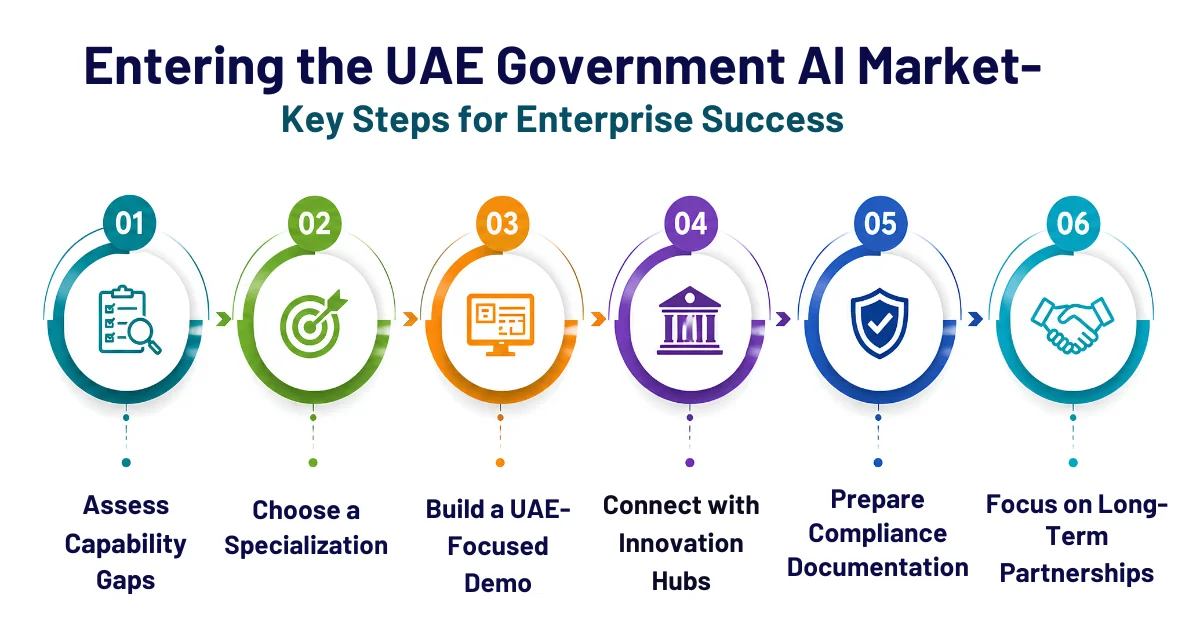
Step 1: Assess Your Genuine Capability Gap
Before approaching a single government client, do an honest internal assessment:
- What is your actual Arabic NLP capability? (Test it against real government interaction transcripts, not English-only benchmarks.)
- What UAE government systems do you have experience integrating with?
- Do you have UAE-resident technical resources?
- Are you compliant with UAE cybersecurity and data protection requirements?
- Do you have case studies from comparable government AI implementations?
Where you find gaps, address them before market entry — either through capability development or strategic partnerships.
Step 2: Define Your Specialization
The UAE government AI market is large enough that generalists will struggle while specialists will thrive. Pick your domain — health, labor, business licensing, smart cities, Arabic NLP infrastructure — and build demonstrably deep capability in it. Own a niche before expanding.
Step 3: Develop Your UAE-Specific Proof of Concept
Build a functional, Arabic-capable demo environment that simulates a relevant government service workflow. This shouldn't be a slide deck—it should be interactive, realistic, and testable by government evaluators. Government clients increasingly require working prototypes before shortlisting vendors for major tenders.
Step 4: Engage Early with Government Innovation Labs
Dubai Future Foundation, Abu Dhabi's Advanced Technology Research Council, UAE AI Office, and similar bodies run programs specifically designed to connect innovative technology companies with government procurement pathways. Engaging with these bodies early — before active RFPs are published — gives you visibility, credibility, and insight into upcoming procurement opportunities.
Step 5: Build Your Compliance Documentation Package
Prepare a complete compliance and security documentation package aligned with UAE requirements. This should include data residency architecture, cybersecurity assessment frameworks, PDPL compliance mapping, and incident response protocols. Having this ready before due diligence requests speeds procurement timelines significantly.
Step 6: Position for Long-Term Partnership, Not One-Time Projects
The most successful vendors in the UAE government AI space are those who structure their engagements as ongoing managed service relationships—not one-time implementation projects. This aligns with government clients' desire for continuous improvement and vendor accountability, and it provides vendors with recurring revenue streams that justify the investment in deep client relationships.
Measuring Success — KPIs That UAE Government Clients Actually Care About
Beyond Vanity Metrics
One of the most common mistakes I see AI vendors make when presenting to UAE government clients is leading with technology metrics rather than outcome metrics. Government clients don't care about model accuracy percentages in isolation — they care about what those accuracy improvements translate to in real-world service delivery terms.
Here are the KPIs that matter in AI Government Service Platform evaluation and ongoing performance management:
Tier 1: Service Delivery KPIs (What Citizens Experience)
- First-Contact Resolution Rate: What percentage of citizen service requests are fully resolved in the first interaction, without handoffs or return visits? Mature AI-powered citizen service platforms target 75–85% FCR rates for applicable service categories.
- Average Handling Time: How long does it take from service request initiation to resolution? AI targets vary by service type but typically aim for 70%+ reduction versus manual benchmarks.
- Channel Shift Rate: What percentage of previously in-person or call center interactions have shifted to digital self-service? A well-deployed smart citizen engagement platform should drive a 40–60% channel shift within 18 months of full deployment.
- Citizen Satisfaction Score (CSAT/NPS): Measured via post-interaction surveys, with UAE government benchmarks typically targeting CSAT above 4.2/5.0 for digital services.
- Language Resolution Rate: For Arabic-language interactions specifically, what percentage are correctly understood and resolved without language-related failures?
Tier 2: Operational KPIs (What Government Entities Experience)
- Cost Per Transaction: Total operational cost divided by transaction volume. AI platforms should drive a measurable year-over-year reduction in this metric.
- Agent Escalation Rate: What percentage of AI-handled interactions require escalation to human agents? This is a direct measure of AI capability quality. Elite platforms target sub-15% escalation rates for routine service categories.
- SLA Compliance Rate: What percentage of service requests are resolved within their defined service level timeframe? AI platforms should improve this metric by reducing processing bottlenecks.
- Automation Rate by Service Category: Tracking which service types are fully automated versus partially automated versus requiring human intervention helps identify where additional AI investment will have the highest impact.
Tier 3: Strategic KPIs (What Government Leadership Tracks)
- Digital Inclusion Metrics: Is the AI platform equally effective for all citizen segments—elderly users, low-income residents, non-Arabic speakers, and people with disabilities? Inclusive design is explicitly valued by UAE government leadership.
- Proactive Service Delivery Rate: What percentage of services are delivered proactively (government-initiated) versus reactively (citizen-initiated)? Growth in this metric signals a maturing, anticipatory AI platform.
- Data Quality Improvement: How is the platform contributing to the accuracy and completeness of government data assets over time? Good AI platforms improve data quality as a byproduct of their operation.
- Cross-Entity Integration Depth: How many government entities and systems is the platform successfully integrating with? Broader integration creates more complete citizen service coverage.
Structuring your platform evaluation, pilot reporting, and ongoing service delivery reporting around these KPIs — rather than technical metrics alone — positions you as a partner who understands government outcomes, not just a technology vendor.
The Ethics of AI in Citizen Services — A Non-Negotiable Dimension
Why Government AI Ethics Is Both a Compliance and a Competitive Issue
AI ethics in government is not abstract philosophy. It is a practical, regulatory, and reputational concern that directly affects platform deployability and public trust. UAE government clients are increasingly sophisticated about AI ethics requirements—influenced both by global standards (EU AI Act, NIST AI Risk Management Framework) and UAE-specific guidance from the UAE AI Office.
The key ethical dimensions for AI in citizen services that developers and operators must address:
Algorithmic Fairness: Does the AI platform treat all citizen segments equally? Bias in AI decision-making — whether in visa processing, benefit eligibility assessment, or business license evaluation — can have discriminatory effects on specific demographic groups. Testing for disparate impact across nationality, age, gender, and income groups is mandatory for responsible deployment.
Transparency and Explainability: Citizens have the right to understand when AI is involved in decisions that affect them and to receive explanations of AI-driven decisions in plain language. This is increasingly codified in the UAE's evolving regulatory framework.
Human Override and Appeals: AI decisions in government must always be subject to human review and citizen appeal. The platform architecture must support exception handling, manual review workflows, and clear escalation paths that citizens can access when they disagree with an AI outcome.
Consent and Data Use: Citizens interacting with AI government services must understand how their data is being used, how long it is retained, and what rights they have over it. This is governed by the UAE PDPL and must be embedded in the platform's user experience design.
Avoiding Automation Bias: Government staff who work alongside AI platforms must be trained to critically evaluate AI recommendations rather than automatically accepting them. This is called automation bias — the tendency to trust AI outputs uncritically — and it is a genuine operational risk in government AI deployments.
Vendors who engage thoughtfully with these ethical dimensions—building them into platform architecture rather than treating them as afterthoughts—differentiate themselves meaningfully. UAE government procurement. It signals maturity, responsibility, and a long-term orientation that government clients value highly.
Final Thoughts:
Let me bring this back to what matters most for enterprise decision-makers reading this.
The UAE's 50% AI-driven government operations target isn't just a national policy milestone. It's a market signal of extraordinary clarity and size. The government has stated what it wants, backed it with policy, established the institutional machinery to pursue it, and created a timeline that makes procurement urgency real.
The question for every technology company, digital transformation firm, and AI software vendor operating in or considering the UAE market is simple: are you positioned to capture part of this?
The companies that win the largest share of this market over the next two years will not be the ones with the most impressive AI technology in the abstract. They'll be the ones who combine genuine technical capability—particularly in Arabic language AI, government system integration, and compliant platform architecture—with deep sector understanding, local presence, and the ability to function as true transformation partners rather than product vendors.
AI-powered citizen service platforms are the central infrastructure of the UAE's AI governance vision. Building them well requires expertise that goes well beyond typical software development. It requires understanding of public sector dynamics, regulatory environments, multilingual user populations, legacy system landscapes, and the organizational change journeys that determine whether platforms get adopted or quietly sidelined.
If your enterprise has that combination of capability—or can build it through strategic partnerships—the opportunity in front of you is significant, near-term, and growing.
The UAE is not waiting. And if you intend to be part of its AI governance journey, neither should you.