
Introduction: The Silent Crisis in Modern Supply Chains
Over the past three years, more than 70% of global companies have experienced significant supply chain disruptions, according to multiple industry reports from firms like Gartner and McKinsey. What was once considered a back-end operational function has now become one of the biggest risk factors for business continuity and growth.
The impact is not theoretical—it is happening in real time. Delayed shipments are leading to missed revenue targets. Inventory mismanagement is increasing operational costs. Customers, now accustomed to speed and reliability, are quick to switch brands when expectations are not met. From manufacturing and retail to healthcare and e-commerce, no industry has been immune to the ripple effects of fragile supply chains.
At the center of this challenge lies a critical shift in perspective. Supply chain management is no longer just about moving goods from point A to point B. It has evolved into a strategic function that directly influences profitability, customer experience, and long-term competitiveness. Businesses that treat it as a support function are falling behind, while those that invest in modern, intelligent systems are gaining a measurable edge.
This raises an important question—what do you know about supply chain management in today’s context? If the answer still revolves around logistics, procurement, and inventory tracking, then it is already outdated.
In this blog, we go beyond the traditional definitions. Instead of simply explaining concepts, we uncover why most supply chain management strategies fail in the real world, where the gaps exist, and how emerging technologies are fundamentally reshaping how businesses operate. The goal is not just to inform, but to provide a clear, experience-driven perspective that helps you understand what it takes to build a resilient and future-ready supply chain management system.
What is Supply Chain Management
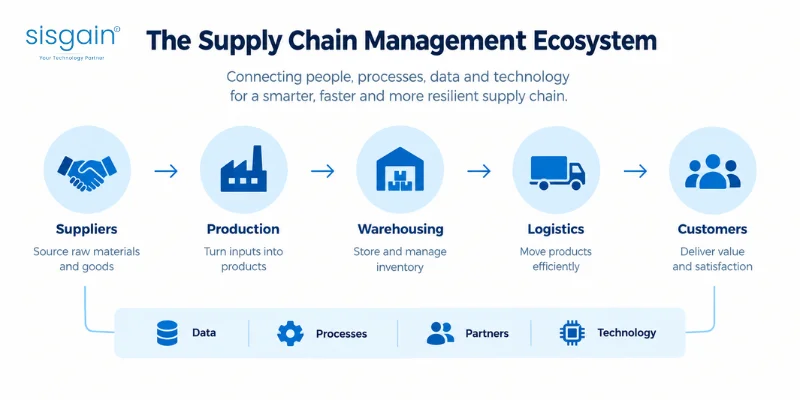
In today’s business environment, supply chain management is no longer limited to coordinating the movement of goods. It represents the complete orchestration of data, processes, partners, and technologies that ensure products and services are delivered efficiently, predictably, and at scale. A modern supply chain management system connects procurement, production, warehousing, logistics, and customer delivery into a unified, intelligent framework that operates in real time.
Traditionally, management supply chain management was viewed through a narrow lens—focused primarily on transportation, inventory control, and supplier coordination. While these elements still exist, they no longer define the discipline. The role of supply chain management has expanded from operational execution to strategic intelligence. It now influences critical business decisions such as demand planning, pricing strategies, risk mitigation, and customer experience optimization.
From an expert perspective shaped by decades of IT and enterprise transformation, the biggest shift is this: supply chain management today is driven by data, automation, and predictive decision-making. Organizations are no longer reacting to disruptions after they occur. Instead, they are using advanced analytics to anticipate demand fluctuations, identify potential risks, and optimize operations before problems arise. Automation reduces dependency on manual processes, while real-time data visibility allows leaders to make faster and more accurate decisions across the entire value chain.
This transformation has redefined what businesses should expect from their supply chains. It is no longer about efficiency alone—it is about intelligence, adaptability, and resilience. Companies that embrace this evolution are turning their supply chains into competitive advantages, while those relying on outdated models are struggling to keep up with increasing complexity and market volatility.
This leads to a critical realization: the traditional understanding of supply chain management is no longer sufficient. To understand why so many organizations continue to face disruptions despite having established systems in place, it is essential to examine where conventional approaches fall short.
Why Traditional Supply Chain Management Systems Are Failing
Despite years of investment in infrastructure and software, many organizations are still struggling to build resilient and responsive supply chains. The issue is not a lack of systems—it is the reliance on outdated approaches that were never designed for today’s level of complexity and speed.
One of the most critical gaps is the lack of real-time visibility. In many businesses, data is still siloed across departments, spreadsheets, and disconnected tools. This creates blind spots where decision-makers cannot accurately track inventory levels, shipment status, or supplier performance in real time. As a result, even minor disruptions can escalate into major operational failures.
Manual decision-making further compounds the problem. Traditional supply chain management systems often depend heavily on human intervention for forecasting, planning, and execution. While experience plays a role, manual processes are inherently slower and prone to error, especially when dealing with large volumes of dynamic data. In fast-moving markets, delayed decisions directly translate into missed opportunities and increased costs.
Another major limitation is system fragmentation. Many organizations operate with a patchwork of legacy tools that do not communicate effectively with each other. Procurement, warehousing, logistics, and sales functions often run on separate platforms, leading to inconsistencies and inefficiencies. Without a unified system, achieving end-to-end optimization becomes nearly impossible.
According to Gartner, only 21% of supply chains today can be classified as truly resilient. This statistic highlights a significant gap between the perceived capability of existing systems and their actual performance under pressure. The reality is that many businesses still rely on outdated supply chain management systems that lack the intelligence and integration required for modern operations.
The consequences are visible across industries. Delays in delivery disrupt customer commitments. Poor demand forecasting leads to overstocking or stockouts, both of which impact profitability. Inefficient processes increase operational costs and reduce overall agility. In a competitive landscape where speed and precision are critical, these inefficiencies are no longer sustainable.
Core Components of an Efficient Supply Chain Management System
To move beyond these challenges, businesses must understand what defines an efficient and future-ready supply chain management system. While the core components remain consistent, their execution has evolved significantly with technology and data-driven practices.
Planning and demand forecasting form the foundation. Accurate forecasting ensures that production and inventory levels are aligned with actual market demand. Modern systems use predictive analytics rather than historical assumptions, allowing businesses to anticipate changes and respond proactively.
Supplier management is equally critical. Strong supplier relationships, supported by performance tracking and real-time communication, ensure a reliable flow of materials and services. Businesses are increasingly focusing on diversification and transparency to reduce dependency risks.
Inventory optimization plays a central role in balancing cost and availability. The objective is no longer just to maintain stock, but to maintain the right stock in the right place at the right time. Advanced systems continuously adjust inventory levels based on demand patterns, lead times, and external variables.
Logistics and distribution connect the entire chain to the end customer. Efficient transportation planning, route optimization, and real-time tracking are essential for ensuring timely and cost-effective delivery. This is where technology-driven coordination becomes a major differentiator.
Returns and reverse logistics, often overlooked, are now a strategic component. Managing product returns efficiently not only improves customer satisfaction but also reduces waste and recovers value from returned goods.
What is important to understand is that these components cannot operate in isolation. An efficient supply chain management system functions as a connected ecosystem where every element is integrated and continuously informed by real-time data. The strength of the system lies not in individual functions, but in how seamlessly they work together to create a responsive, intelligent, and adaptive supply chain.
The Rise of AI-Driven Supply Chain Management (2026 Shift)
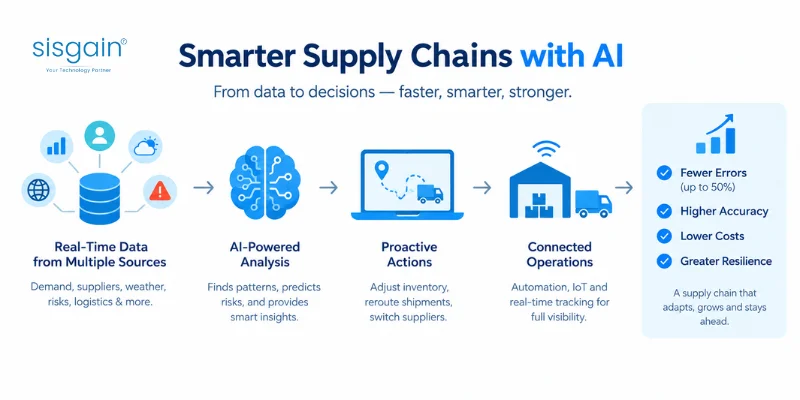
The evolution of supply chain management has reached a defining moment. What was once driven by historical data and manual planning is now being transformed by artificial intelligence, automation, and predictive analytics. In 2026, leading organizations are no longer reacting to disruptions—they are anticipating and preventing them.
At the core of this transformation is the ability to process vast amounts of data in real time. Modern supply chain management systems are leveraging AI to analyze demand patterns, supplier performance, weather conditions, geopolitical risks, and logistics constraints simultaneously. This level of intelligence enables businesses to make faster, more accurate decisions across the entire supply chain.
With the growing adoption of AI in Logistics, companies are now predicting disruptions before they happen. Instead of responding to delays or shortages after they occur, businesses can proactively adjust inventory levels, reroute shipments, or switch suppliers based on predictive insights. This shift from reactive to proactive operations is fundamentally changing how supply chains are managed.
The impact is measurable. According to McKinsey, AI-driven supply chain solutions can reduce errors by up to 50%, significantly improving forecasting accuracy, operational efficiency, and cost control. These improvements are not incremental—they represent a step-change in performance that traditional systems cannot match.
Automation is another key driver of this shift. Repetitive tasks such as order processing, inventory updates, and demand forecasting are increasingly being handled by intelligent systems. This reduces human error and frees up resources for more strategic decision-making. At the same time, IoT-enabled devices provide real-time data from across the supply chain, from warehouse inventory levels to shipment tracking, creating a fully connected and transparent ecosystem.
Real-time analytics ties everything together. Decision-makers no longer rely on delayed reports; they have access to live dashboards that provide immediate visibility into operations. This enables faster responses, better coordination, and continuous optimization.
The result is a supply chain management system that is not only efficient but also adaptive and resilient—capable of evolving in response to changing market conditions.
Real Business Impact: How Smart Companies Are Winning
The difference between traditional and modern supply chains becomes most evident when looking at real business outcomes. Organizations that have embraced AI-driven supply chain management are achieving results that were previously difficult to attain.
Consider a typical scenario. In a traditional setup, a company relies on historical data and periodic forecasts to plan inventory and logistics. When demand suddenly spikes or a supplier faces delays, the system struggles to adapt. This leads to stockouts, delayed deliveries, and dissatisfied customers. The entire process is reactive, with decisions made after problems have already impacted operations.
Now compare this with a modern, technology-driven approach. In an AI-enabled environment, the system continuously monitors data from multiple sources. When it detects a potential disruption—such as a delay in raw material supply or a sudden increase in demand—it automatically triggers adjustments. Inventory levels are recalibrated, alternative suppliers are identified, and logistics routes are optimized in real time. The result is a seamless, proactive response that minimizes disruption and maintains service levels.
This transformation is not limited to a single industry. Businesses investing in advanced automotive logistics software and transportation software services are seeing measurable returns in terms of reduced operational costs, improved delivery timelines, and higher customer satisfaction. These systems enable end-to-end visibility and control, allowing companies to operate with a level of precision that was previously unattainable.
The competitive advantage is clear. While traditional supply chains struggle with inefficiencies and delays, AI-driven systems enable businesses to move faster, adapt quicker, and operate with greater confidence. In a market where customer expectations continue to rise, this shift is no longer optional—it is essential for sustained growth and long-term success.
Key Technologies Powering Modern Supply Chain Management Systems
The transformation of supply chain management is being driven by a set of advanced technologies that are redefining how businesses operate, compete, and scale. These technologies are not standalone tools—they work together to create an intelligent, connected, and highly responsive ecosystem.
Artificial Intelligence and Machine Learning are at the forefront of this shift. These technologies enable systems to analyze vast datasets, identify patterns, and generate predictive insights. From demand forecasting to route optimization, AI is allowing businesses to move from assumption-based planning to data-driven precision. As organizations adopt these capabilities, understanding AI Development Cost is becoming essential for businesses planning digital transformation, as it directly impacts scalability and long-term ROI.
The Internet of Things (IoT) is enabling real-time tracking and visibility across the entire supply chain. Sensors, RFID tags, and connected devices provide continuous data on inventory levels, shipment status, and asset performance. This level of transparency allows businesses to monitor operations in real time and respond instantly to any deviations.
Cloud-based supply chain management platforms are providing the foundation for integration and scalability. Unlike legacy systems, cloud solutions enable seamless data sharing across departments, geographies, and partners. They allow businesses to scale operations without significant infrastructure investment while ensuring that all stakeholders have access to a single source of truth.
Blockchain technology is addressing one of the most critical challenges in supply chains—trust and transparency. By creating an immutable and decentralized record of transactions, blockchain ensures that every step in the supply chain is traceable and verifiable. This is particularly valuable in industries where compliance, authenticity, and product integrity are critical.
Together, these technologies are transforming supply chain management systems into intelligent networks that are capable of learning, adapting, and evolving in real time.
Choosing the Right Supply Chain Management System for Your Business
Selecting the right supply chain management system is no longer just a technical decision—it is a strategic investment that can define the future of your business. With a wide range of solutions available, organizations must evaluate their options carefully to ensure alignment with both current needs and long-term goals.
Scalability is one of the most important factors to consider. As businesses grow, their supply chain operations become more complex. A system that works today must be capable of handling increased data volumes, expanded networks, and evolving business models without compromising performance.
Integration capability is equally critical. A modern supply chain does not operate in isolation. It must connect seamlessly with existing enterprise systems such as ERP, CRM, and financial platforms. Without proper integration, data silos will persist, limiting visibility and efficiency.
Customization plays a key role in ensuring that the system aligns with specific industry requirements. Every business has unique processes, and a one-size-fits-all approach often leads to inefficiencies. Tailored solutions allow organizations to optimize workflows and gain maximum value from their investment.
In this context, leading Software Companies in Dubai are now offering tailored Application Development solutions for supply chain management, enabling businesses to build systems that are aligned with their operational and strategic objectives. Choosing the right partner among IT software development companies can define long-term success, as the implementation quality and ongoing support directly impact system performance and scalability.
Future Trends: Where Supply Chain Management is Heading
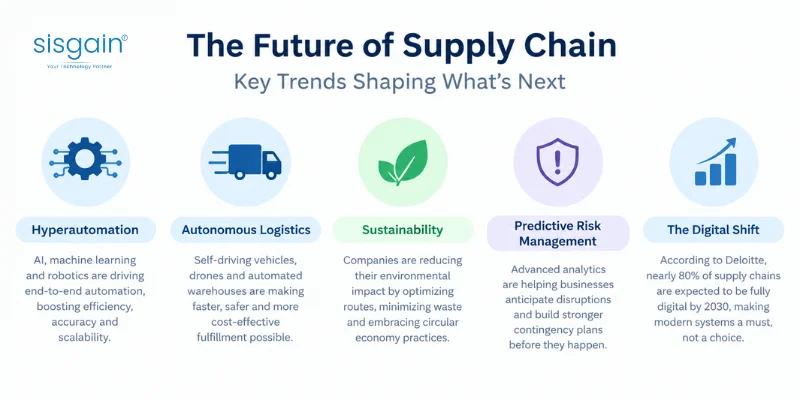
The future of supply chain management is being shaped by rapid technological advancements and changing market expectations. Businesses that want to stay competitive must not only adapt to current trends but also prepare for what lies ahead.
Hyperautomation is set to redefine operational efficiency. By combining AI, machine learning, and robotic process automation, organizations are automating end-to-end processes, reducing human intervention, and increasing accuracy at scale.
Autonomous logistics is another emerging trend. Self-driving vehicles, drones, and automated warehouses are gradually becoming a reality, enabling faster and more cost-effective transportation and fulfillment.
Sustainability is no longer optional. Companies are under increasing pressure to reduce their environmental impact and adopt sustainable practices across their supply chains. This includes optimizing routes to reduce emissions, minimizing waste, and embracing circular economy principles.
Predictive risk management is becoming a core capability. Instead of reacting to disruptions, businesses are using advanced analytics to anticipate risks and develop contingency plans in advance. This shift is critical in an increasingly volatile global environment.
According to Deloitte, nearly 80% of supply chains are expected to be fully digital by 2030. This statistic underscores the urgency for businesses to invest in modern systems and capabilities today, rather than waiting for disruption to force change.
Conclusion: From Cost Center to Competitive Advantage
Supply chain management has undergone a fundamental transformation. What was once viewed as a cost center focused on operational efficiency is now a strategic function that drives growth, resilience, and competitive advantage.
Businesses that continue to rely on outdated approaches will struggle to keep pace with increasing complexity and rising customer expectations. In contrast, those that invest in modern supply chain management systems are positioning themselves to lead in their respective industries. These systems provide the visibility, intelligence, and agility required to navigate uncertainty and capitalize on new opportunities.
The shift is clear—supply chain management is no longer optional; it is a critical pillar of business success. Organizations that embrace digital transformation, leverage advanced technologies, and partner with the right experts will not only overcome current challenges but also build a foundation for long-term growth.
If your business is looking to modernize its operations and unlock the full potential of its supply chain, now is the time to take action. The right strategy, combined with the right technology partner, can transform your supply chain into a powerful engine of efficiency, innovation, and sustained competitive advantage.