
Artificial Intelligence (AI) is rapidly transforming the way businesses operate, innovate, and grow across the globe, and Dubai is emerging as one of the leading hubs for AI-driven transformation. With strong government initiatives, a thriving digital ecosystem, and increasing investments in advanced technologies, companies across industries are embracing AI to improve efficiency, reduce operational costs, and create new growth opportunities.
Today, AI innovation in Dubai is helping organizations automate repetitive tasks, enhance customer experiences, optimize decision-making, and streamline complex business processes. From generative AI and predictive analytics to intelligent automation and AI-powered cybersecurity, businesses are leveraging cutting-edge solutions to achieve more with fewer resources.
As competition intensifies and customer expectations continue to evolve, AI is no longer a future consideration—it has become a strategic necessity for sustainable growth. In this guide, we explore 10 powerful AI innovations that are helping Dubai companies scale faster, improve productivity, and gain a competitive advantage in an increasingly digital economy.
Why AI Innovation Is Reshaping Business Growth in Dubai
Dubai is rapidly positioning itself as a global leader in artificial intelligence by fostering innovation, accelerating digital transformation, and encouraging AI adoption across industries. Businesses are increasingly leveraging AI technologies to streamline operations, improve customer experiences, and make data-driven decisions. As organizations face growing competition and rising operational demands, AI has become a key driver of efficiency, scalability, and sustainable growth. This shift is enabling companies to achieve faster results while maximizing the value of their existing resources.
Dubai's Vision for an AI-Driven Economy
Dubai's commitment to becoming a global technology hub is reflected in its ambitious AI strategies and smart city initiatives. Government-led programs are encouraging businesses to adopt advanced technologies that enhance innovation, operational efficiency, and economic competitiveness. By investing in digital infrastructure and AI ecosystems, Dubai is creating an environment where organizations can accelerate transformation and unlock new growth opportunities.
Government Initiatives Supporting AI Adoption
The Dubai government has launched several AI-focused strategies and innovation programs to encourage technology adoption across public and private sectors. These initiatives help businesses access advanced digital capabilities, foster innovation, and accelerate economic growth. Such support creates a favorable environment for organizations looking to implement AI solutions and remain competitive in a rapidly evolving market.
Smart City Projects and Digital Transformation Strategies
Dubai's smart city initiatives are integrating AI into transportation, healthcare, public services, and urban infrastructure. These projects demonstrate how intelligent technologies can improve efficiency, enhance citizen experiences, and optimize resource management. Businesses can leverage this digital ecosystem to innovate faster and align with the city's vision for a technology-driven future.
Why Businesses Are Investing in AI Solutions
meet evolving customer expectations. Artificial intelligence enables businesses to automate repetitive processes, gain valuable insights, and scale operations efficiently. However, successful AI adoption often requires strong digital foundations and tailored software platforms. Many organizations partner with experts in custom software development in dubai to build scalable systems that integrate AI capabilities seamlessly and support long-term business growth while maintaining operational flexibility and competitive advantage.
Rising Operational Costs
Increasing labor expenses, infrastructure costs, and operational complexities are driving businesses to seek more efficient ways of working. AI helps organizations automate time-consuming tasks, optimize workflows, and reduce unnecessary expenditures. This enables companies to maintain profitability while improving overall operational performance.
Demand for Efficiency and Scalability
Modern businesses require systems that can adapt quickly to changing market conditions and growing customer demands. AI-powered technologies help organizations streamline operations, improve productivity, and scale without significantly increasing resources. This flexibility allows businesses to expand more efficiently while maintaining service quality and operational control.
Increasing Customer Expectations
Today's customers expect faster responses, personalized experiences, and seamless interactions across digital channels. AI enables businesses to analyze customer behavior, predict preferences, and deliver tailored experiences at scale. Meeting these expectations helps organizations strengthen customer relationships, improve satisfaction, and increase long-term loyalty.
ALSO READ- How Artificial Intelligence Is Transforming Modern Industries in 2026
The Connection Between AI and Sustainable Growth
AI is becoming a critical enabler of sustainable business growth by helping organizations improve efficiency, optimize resources, and make smarter decisions. Companies that integrate AI into their operations can enhance productivity, reduce waste, and respond more effectively to market opportunities. These advantages create a strong foundation for long-term success in an increasingly competitive business environment.
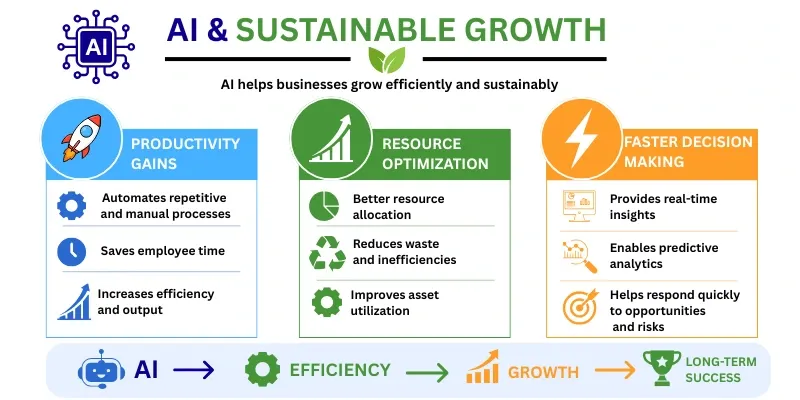
Productivity Gains
AI automates repetitive and manual processes, allowing employees to focus on strategic and high-value activities. By reducing administrative workloads and accelerating task completion, businesses can improve overall productivity and achieve better outcomes with existing resources.
Resource Optimization
Effective resource management is essential for sustainable growth. AI helps organizations analyze data, forecast demand, and allocate resources more accurately. This reduces inefficiencies, minimizes waste, and ensures that business assets are utilized to their full potential.
Faster Decision-Making
Access to real-time insights and predictive analytics enables businesses to make informed decisions more quickly. AI processes large volumes of data faster than traditional methods, helping leaders identify opportunities, mitigate risks, and respond proactively to changing market conditions. This agility provides a significant competitive advantage.
1. Generative AI for Content Creation and Business Automation
Generative AI is one of the most impactful innovations driving business transformation in Dubai. Organizations are increasingly using AI-powered tools to automate content creation, streamline workflows, and improve productivity across departments. From marketing and customer support to documentation and internal collaboration, generative AI enables businesses to accomplish more tasks with fewer resources while maintaining quality and consistency.
How Generative AI Is Transforming Business Operations
Marketing Content Generation
Generative AI helps businesses create blogs, social media content, email campaigns, product descriptions, and marketing materials in significantly less time. This allows marketing teams to scale content production, maintain consistent messaging, and focus on strategic initiatives rather than repetitive content creation tasks.
Automated Documentation
Organizations generate large volumes of documents, reports, contracts, and internal communications daily. Generative AI can automate document creation and formatting, reducing administrative effort and improving accuracy. This helps teams save valuable time while ensuring information remains organized and accessible.
Internal Knowledge Management
Many businesses struggle to manage and retrieve information stored across multiple systems. Generative AI can centralize knowledge, provide instant answers to employee queries, and simplify information access. This improves collaboration, enhances productivity, and reduces time spent searching for critical business information.
Business Benefits
Reduced Manual Workload
By automating repetitive and time-consuming tasks, generative AI enables employees to focus on higher-value activities that contribute directly to business growth. This leads to better workforce utilization and improved operational performance.
Faster Content Production
AI-powered content generation significantly reduces the time required to create marketing assets, reports, and business documents. Companies can respond more quickly to market demands while maintaining content quality and consistency.
Improved Operational Efficiency
Generative AI streamlines workflows, minimizes bottlenecks, and accelerates decision-making processes. Businesses can optimize operations, reduce costs, and improve overall efficiency across departments.
Organizations looking to maximize these benefits often invest in Generative AI development services to build customized solutions that align with their specific business goals and operational requirements.
2. Predictive Analytics for Smarter Business Decisions
Predictive analytics is helping Dubai businesses move from reactive decision-making to proactive business planning. By analyzing historical data and identifying patterns, AI-powered predictive models enable organizations to forecast future outcomes, anticipate challenges, and uncover growth opportunities before they emerge.
Understanding Predictive Analytics
Historical Data Analysis
Predictive analytics uses machine learning algorithms to analyze large volumes of historical business data. By identifying trends, patterns, and relationships within datasets, organizations can gain deeper insights into operational performance and customer behavior.
Forecasting Future Trends
AI-powered forecasting models help businesses predict future demand, market changes, customer preferences, and potential risks. These insights enable leaders to make informed strategic decisions and prepare for evolving business conditions.
How Dubai Companies Use Predictive AI
Sales Forecasting
Businesses use predictive analytics to estimate future sales performance based on historical trends and market conditions. Accurate forecasting helps organizations optimize inventory, allocate resources effectively, and improve revenue planning.
Customer Behavior Analysis
AI can analyze customer interactions, purchasing habits, and engagement patterns to identify future behavior. These insights enable businesses to create personalized experiences, improve retention rates, and strengthen customer relationships.
Risk Assessment
Predictive AI helps organizations identify potential operational, financial, and market-related risks before they become significant challenges. Early risk detection allows businesses to implement preventive measures and make more confident strategic decisions.
As AI-driven business growth in Dubai continues to accelerate, predictive analytics is becoming an essential tool for organizations seeking greater agility, efficiency, and long-term competitive advantage.
3. AI-Powered Customer Service and Virtual Assistants
Customer expectations are evolving rapidly, and businesses must provide faster, more personalized support across multiple channels. AI-powered customer service solutions and virtual assistants are helping Dubai companies improve customer experiences while reducing operational costs. By leveraging conversational AI, organizations can deliver instant responses, handle large volumes of inquiries, and maintain consistent service quality around the clock.
The Rise of Conversational AI
Conversational AI combines natural language processing (NLP), machine learning, and automation to enable human-like interactions between businesses and customers. Modern AI assistants can understand customer intent, answer complex questions, resolve common issues, and guide users through various processes. As AI technology for Dubai companies continues to advance, conversational AI is becoming a critical component of digital customer engagement strategies.
Benefits for Dubai Businesses
24/7 Support
AI-powered virtual assistants can provide continuous customer support without interruptions. This ensures that customers receive assistance whenever they need it, regardless of business hours, improving satisfaction and enhancing the overall customer experience.
Faster Response Times
Traditional support teams often struggle to manage high volumes of inquiries. AI assistants can instantly respond to customer requests, reducing wait times and helping businesses resolve issues more efficiently.
Reduced Support Costs
By automating routine customer interactions, businesses can significantly reduce support costs while allowing human agents to focus on more complex and high-value customer needs. The growing discussion around AI Agents vs AI Chatbots Guide 2026 highlights how businesses can optimize customer support operations by combining conversational AI with intelligent task automation. This approach improves resource utilization, enhances operational efficiency, and delivers faster, more personalized customer experiences.4. Intelligent Process Automation (IPA)
Intelligent Process Automation (IPA) combines artificial intelligence, machine learning, and robotic process automation to automate complex business workflows. Unlike traditional automation, which follows predefined rules, IPA can learn from data, adapt to changing conditions, and make intelligent decisions. This makes it one of the most valuable AI solutions for businesses in Dubai seeking greater efficiency and scalability.
Moving Beyond Traditional Automation
Traditional automation is effective for repetitive tasks but lacks flexibility when handling exceptions or dynamic business scenarios. Intelligent Process Automation enhances automation by incorporating AI capabilities that allow systems to analyze information, identify patterns, and continuously improve performance. This enables businesses to automate more sophisticated processes while maintaining accuracy and consistency.
Common Business Applications
Invoice Processing
IPA can automatically extract information from invoices, validate data, detect errors, and process payments. This reduces manual effort, minimizes processing delays, and improves financial accuracy.
HR Workflows
Human resource departments use IPA to automate employee onboarding, leave management, recruitment screening, and payroll administration. These capabilities improve efficiency while enhancing employee experiences.
Document Management
Businesses generate large volumes of documents that require organization, classification, and retrieval. Intelligent automation streamlines document management processes, reducing administrative workloads and improving accessibility.
5. AI-Driven Cybersecurity Solutions
As organizations become increasingly digital, cybersecurity has become a top business priority. Cyber threats are growing in both sophistication and frequency, making traditional security approaches less effective. AI-driven cybersecurity solutions help businesses proactively identify threats, strengthen defenses, and respond to incidents faster than ever before.
Why Cybersecurity Matters More Than Ever
Data breaches, ransomware attacks, and unauthorized access can result in significant financial losses and reputational damage. Businesses must continuously monitor their digital environments and protect sensitive information from evolving threats. AI provides advanced capabilities that enhance security operations and reduce response times.
How AI Improves Threat Detection
Real-Time Monitoring
AI-powered systems continuously analyze network activity, user behavior, and security events to identify potential threats as they occur. This enables businesses to respond quickly and minimize potential damage.
Anomaly Detection
Machine learning algorithms can recognize unusual patterns and behaviors that may indicate malicious activity. By detecting anomalies early, organizations can prevent security incidents before they escalate.
Automated Response Systems
AI can automate incident response processes by isolating affected systems, blocking suspicious activities, and triggering security protocols. This reduces response times and improves overall cybersecurity resilience.

6. Computer Vision for Operational Excellence
Computer vision is transforming how businesses analyze visual information and automate decision-making processes. By enabling machines to interpret images and videos, computer vision helps organizations improve accuracy, enhance operational efficiency, and reduce human error across various business functions.
What Is Computer Vision?
Computer vision is a branch of artificial intelligence that allows machines to recognize objects, analyze visual data, and extract meaningful insights from images and video streams. This technology enables businesses to automate tasks that traditionally required human observation and intervention.
Industry Applications
Manufacturing Quality Checks
Manufacturers use computer vision systems to inspect products, identify defects, and maintain quality standards throughout production processes. This improves product consistency while reducing waste and operational costs.
Retail Analytics
Retail businesses leverage computer vision to analyze customer behavior, monitor store traffic, and optimize product placement strategies. These insights help improve customer experiences and increase sales performance.
Security Monitoring
Computer vision enhances security operations by monitoring facilities, detecting suspicious activities, and providing real-time alerts. This improves situational awareness and strengthens organizational security measures.
7. AI-Powered Supply Chain Optimization
Efficient supply chain management is essential for business success, particularly in today's fast-changing and highly competitive market environment. Many organizations face challenges such as fluctuating customer demand, inventory imbalances, supply disruptions, and rising logistics costs. AI-powered supply chain optimization helps businesses overcome these obstacles by providing real-time insights, improving forecasting accuracy, and enabling smarter operational planning. As AI-driven business growth in Dubai continues to accelerate, organizations are increasingly adopting AI technologies to build more agile, resilient, and cost-effective supply chains.
Addressing Supply Chain Challenges
Traditional supply chain management often relies on historical data and manual planning processes, which can make it difficult to respond quickly to changing market conditions. AI enables businesses to analyze large volumes of data from multiple sources, identify patterns, and predict future demand with greater accuracy. This allows organizations to make proactive decisions, reduce inefficiencies, and improve overall supply chain performance.
Key AI Applications
Demand Forecasting
AI-powered forecasting models analyze historical sales data, market trends, seasonal fluctuations, and customer behavior to predict future demand more accurately. Improved forecasting helps businesses avoid stock shortages, reduce excess inventory, and ensure products are available when customers need them. This leads to better customer satisfaction and more efficient resource utilization.
Inventory Optimization
Managing inventory effectively is crucial for maintaining profitability and operational efficiency. AI helps businesses determine optimal inventory levels by continuously monitoring demand patterns, supplier performance, and stock movement. This minimizes carrying costs, reduces waste, and ensures efficient inventory management across the supply chain.
Logistics Planning
AI enhances logistics operations by optimizing transportation routes, delivery schedules, and warehouse processes. Businesses can reduce fuel costs, improve delivery times, and increase operational efficiency through intelligent route planning and real-time logistics monitoring. These improvements contribute to a more responsive and cost-effective supply chain ecosystem.
8. Personalized Customer Experiences Through AI
Modern customers expect businesses to understand their preferences, anticipate their needs, and deliver relevant experiences at every touchpoint. Personalization has become a critical factor in customer satisfaction, loyalty, and long-term business growth. AI enables organizations to analyze customer data, identify behavioral patterns, and create highly personalized interactions that improve engagement and strengthen customer relationships. As AI innovation in Dubai continues to evolve, personalized customer experiences are becoming a major competitive differentiator across industries.
The Importance of Personalization
Generic customer experiences are becoming less effective in today's digital landscape. Customers are more likely to engage with brands that provide relevant recommendations, personalized communication, and tailored offers. AI helps businesses understand customer preferences at scale, enabling them to deliver experiences that feel more relevant and valuable. This not only improves customer satisfaction but also increases conversion rates and customer lifetime value.
AI-Powered Recommendation Engines
AI-powered recommendation systems use machine learning algorithms to analyze customer interactions, purchasing history, browsing behavior, and preferences. These insights enable businesses to deliver highly targeted recommendations and personalized experiences that drive engagement and business growth.
Product Recommendations
AI can recommend products and services based on a customer's previous interactions and preferences. These personalized suggestions help customers discover relevant offerings more quickly, increasing purchase likelihood and improving the overall shopping experience.
Personalized Marketing Campaigns
Businesses use AI to create customized marketing messages that resonate with specific customer segments. By delivering relevant content at the right time through the right channels, organizations can improve campaign performance, increase engagement, and maximize marketing return on investment.
Customer Retention Strategies
Retaining existing customers is often more cost-effective than acquiring new ones. AI helps businesses identify customers who may be at risk of disengagement and enables proactive retention efforts. Personalized offers, targeted communications, and predictive insights help strengthen customer loyalty and improve long-term retention rates.
As organizations continue implementing AI solutions Dubai businesses rely on for growth, personalized experiences will play an increasingly important role in building stronger customer relationships and achieving sustainable competitive advantage.
9. AI in Financial Planning and Risk Management
Financial planning and risk management are critical components of long-term business success. As markets become increasingly dynamic and data-driven, organizations require more accurate insights to make informed financial decisions. AI is transforming financial operations by enabling businesses to analyze vast amounts of data, identify potential risks, and improve forecasting accuracy. By leveraging AI-powered financial intelligence, companies can strengthen financial performance, reduce uncertainty, and make more confident strategic decisions. Today, many organizations are adopting AI solutions for businesses in Dubai to gain greater visibility into their financial health and improve risk management capabilities.
Data-Driven Financial Intelligence
Traditional financial planning often relies on historical reports and manual analysis, which can limit decision-making speed and accuracy. AI-powered financial intelligence systems analyze real-time and historical data to uncover trends, detect anomalies, and generate actionable insights. These capabilities enable organizations to make proactive financial decisions, optimize investments, and improve overall business performance. As AI technology for Dubai companies continues to evolve, financial intelligence is becoming a key driver of operational and strategic success.
Business Benefits
Fraud Detection
Financial fraud remains a significant concern for organizations across industries. AI can continuously monitor transactions, identify unusual patterns, and detect suspicious activities in real time. By recognizing anomalies that may indicate fraudulent behavior, businesses can reduce financial losses, strengthen security measures, and improve regulatory compliance.
Budget Optimization
AI helps organizations allocate financial resources more effectively by analyzing spending patterns, operational costs, and business priorities. These insights allow companies to identify inefficiencies, control expenses, and maximize the return on their investments. Better budget management supports sustainable growth and improves overall financial stability.
Financial Forecasting
Accurate forecasting is essential for effective business planning. AI-powered forecasting models analyze historical performance, market conditions, and emerging trends to predict future financial outcomes. These insights help organizations prepare for market changes, optimize resource allocation, and make data-driven investment decisions with greater confidence.
10. AI-Powered Decision Intelligence Platforms
Modern businesses generate enormous volumes of data every day, yet many organizations struggle to convert that information into meaningful business actions. AI-powered decision intelligence platforms bridge this gap by combining artificial intelligence, advanced analytics, and business intelligence tools to transform complex data into actionable insights. These platforms empower leaders to make faster, smarter, and more informed decisions that drive growth and operational excellence. As AI-driven business growth in Dubai continues to accelerate, decision intelligence is becoming an essential capability for forward-thinking organizations.
From Data to Actionable Insights
Decision intelligence platforms analyze information from multiple business systems, including sales, marketing, finance, operations, and customer interactions. AI processes this data to identify patterns, uncover opportunities, and generate recommendations that support strategic decision-making. Instead of relying solely on intuition or manual analysis, executives gain access to real-time insights that help improve business performance and reduce uncertainty.
Why Executives Are Adopting AI Decision Systems
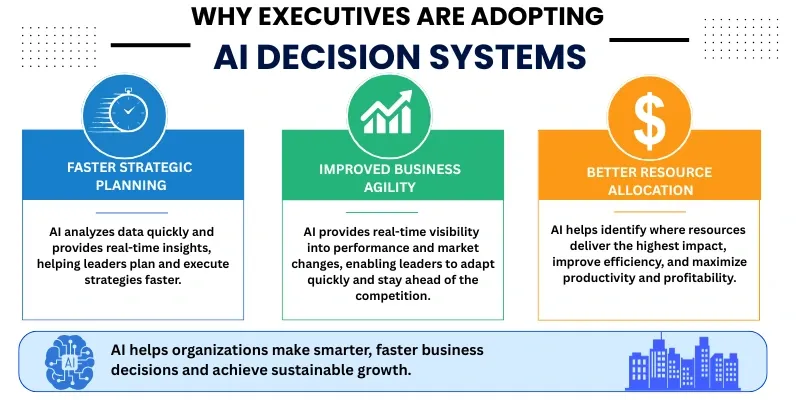
Faster Strategic Planning
AI significantly reduces the time required to analyze data and evaluate business scenarios. Leaders can access real-time insights and predictive recommendations, allowing them to develop and execute strategies more quickly. This speed enables businesses to respond effectively to changing market conditions and emerging opportunities.
Improved Business Agility
Organizations must continuously adapt to evolving customer expectations, industry trends, and competitive pressures. AI-powered decision systems provide ongoing visibility into business performance, helping leaders identify changes early and make proactive adjustments. This flexibility strengthens organizational resilience and supports long-term growth.
Better Resource Allocation
Effective resource management is critical for maximizing productivity and profitability. AI helps businesses identify where resources can deliver the greatest impact by analyzing operational performance, workforce utilization, and financial data. These insights enable organizations to optimize investments, improve efficiency, and achieve stronger business outcomes.
Companies seeking to implement advanced AI capabilities often partner with an experienced AI Software Development in UAE provider or a trusted custom software development company to build scalable decision intelligence solutions tailored to their business objectives. These platforms demonstrate how AI software across industries is enabling organizations to make smarter decisions, improve operational efficiency, and create sustainable competitive advantages in an increasingly data-driven economy.
Challenges Businesses Must Address Before Implementing AI
While artificial intelligence offers significant opportunities for innovation, efficiency, and growth, successful implementation requires careful planning and preparation. Many organizations underestimate the challenges associated with AI adoption, which can lead to delayed projects, higher costs, and limited business outcomes. Before investing in AI solutions, businesses must evaluate their technological readiness, workforce capabilities, and governance frameworks to ensure long-term success. Addressing these challenges early can help organizations maximize the value of their AI investments and achieve sustainable results.
Data Quality and Readiness
The effectiveness of any AI solution depends heavily on the quality of the data used to train and operate it. Inaccurate, incomplete, or outdated data can lead to poor predictions and unreliable outcomes. Businesses should establish strong data management practices, ensure data consistency, and create centralized data repositories that support AI initiatives. High-quality data serves as the foundation for successful AI implementation and long-term performance.
Integration with Existing Systems
Many organizations operate with legacy software and complex technology infrastructures that may not be designed for AI integration. Businesses must assess how AI solutions will connect with existing applications, databases, and workflows. A well-planned integration strategy helps minimize disruptions, improve interoperability, and ensure that AI technologies deliver measurable business value without compromising operational continuity.
Skills and Talent Requirements
AI adoption requires expertise in data science, machine learning, software engineering, and business strategy. However, many organizations face challenges in acquiring and retaining qualified talent. Businesses should invest in employee training, upskilling programs, and strategic partnerships to bridge knowledge gaps and support successful AI implementation. Building a skilled workforce is essential for maximizing the benefits of AI technologies.
Responsible AI and Governance
As AI becomes more deeply integrated into business operations, organizations must ensure that systems are transparent, secure, ethical, and compliant with regulatory requirements. Responsible AI governance includes data privacy protection, bias mitigation, accountability frameworks, and ongoing monitoring of AI performance. Establishing clear governance policies helps build trust among customers, stakeholders, and regulatory bodies.
Organizations evaluating AI adoption should also consider factors such as AI Development Cost in Dubai, implementation complexity, and long-term scalability. Partnering with experts in AI Software Development in UAE can help businesses overcome technical challenges and successfully deploy AI solutions that deliver measurable outcomes. As AI software across industries continues to evolve, organizations that prepare effectively will be better positioned to achieve sustainable growth and innovation.
How to Choose the Right AI Solution for Your Business
Selecting the right AI solution is one of the most important decisions an organization can make during its digital transformation journey. With a growing number of AI technologies available, businesses must focus on solutions that align with their objectives, operational needs, and future growth plans. A strategic approach helps organizations maximize return on investment while minimizing implementation risks and unnecessary complexity.
Identify Business Objectives
Before adopting any AI technology, businesses should clearly define the problems they want to solve and the outcomes they expect to achieve. Whether the goal is improving customer service, automating workflows, optimizing supply chains, or enhancing decision-making, clearly established objectives provide a roadmap for successful implementation and performance measurement.
Evaluate Data Infrastructure
AI systems rely on data to generate insights and drive automation. Organizations should assess the quality, availability, and accessibility of their data before selecting an AI solution. A strong data infrastructure enables more accurate predictions, better decision-making, and improved system performance over time.
Select Scalable AI Technologies
Business needs evolve as organizations grow, making scalability an important consideration when choosing AI solutions. Companies should invest in technologies that can adapt to increasing data volumes, changing business requirements, and future innovation opportunities. Scalable AI platforms help organizations avoid costly system replacements and support long-term growth strategies.
Partner with an Experienced Development Team
The success of an AI project often depends on the expertise of the implementation partner. Working with a reputable custom software development company or an experienced provider of AI development services in dubai can help organizations design, develop, and deploy AI solutions that align with their business goals. Expert guidance reduces implementation risks and ensures that AI technologies deliver maximum value.
The Future of AI-Driven Business Growth in Dubai
Artificial intelligence is expected to play an increasingly important role in shaping Dubai's economic future. As organizations continue investing in digital transformation initiatives, AI technologies will become more deeply integrated into business operations, customer experiences, and strategic decision-making processes. The companies that embrace innovation today will be better positioned to compete, adapt, and thrive in tomorrow's digital economy.
Emerging AI Trends
Several emerging trends are driving the next phase of AI innovation in Dubai. Generative AI, autonomous systems, predictive analytics, intelligent automation, and advanced machine learning models are creating new opportunities for businesses to improve efficiency and unlock growth. These technologies are expected to transform how organizations operate, collaborate, and deliver value to customers.
Industry-Wide Adoption
AI adoption is expanding across industries, including healthcare, finance, retail, logistics, manufacturing, education, and government services. As implementation costs decrease and technology becomes more accessible, organizations of all sizes are leveraging AI to solve complex challenges and gain competitive advantages. This widespread adoption is accelerating innovation throughout Dubai's business ecosystem.
Dubai's Position as a Global AI Hub
Dubai has established itself as one of the most forward-thinking technology destinations in the world. Through strategic investments, supportive government policies, and a strong focus on innovation, the city continues to attract global technology companies, startups, and investors. These initiatives are strengthening Dubai's reputation as a leading center for AI innovation and digital transformation.
What Businesses Should Do Next
Businesses looking to remain competitive should begin evaluating how AI can support their growth objectives and operational priorities. Developing a clear AI strategy, investing in the right technologies, and partnering with experienced technology providers can help organizations achieve successful outcomes. Companies that take proactive steps today will be better equipped to capitalize on future opportunities and drive long-term success through AI-driven innovation.
As AI innovation in Dubai continues to accelerate, organizations that embrace intelligent technologies will be able to improve efficiency, enhance customer experiences, and unlock new opportunities for sustainable business growth in an increasingly digital and data-driven world.
Conclusion
AI is no longer an experimental technology reserved for large enterprises. Today, AI innovation in Dubai is enabling organizations of all sizes to improve efficiency, automate operations, strengthen customer engagement, and accelerate growth with fewer resources. From predictive analytics and intelligent automation to generative AI and decision intelligence, businesses are discovering new ways to increase productivity while reducing costs. As a result, enterprise AI development success is becoming a key priority for businesses seeking to accelerate digital transformation, optimize decision-making, and maximize return on technology investments.
Organizations that invest in the right AI solutions for businesses in Dubai today will be better prepared to adapt, compete, and lead in an increasingly digital economy. As AI technology continues to evolve, companies that embrace innovation strategically will be positioned to achieve sustainable growth and long-term success.