
By 2026, AI Software Development UAE has moved far beyond experimentation. Enterprises across Dubai, Abu Dhabi, and Sharjah are no longer investing in AI to showcase innovation—they are deploying it to stabilize operations, improve decision accuracy, and build scalable digital infrastructure. AI is now embedded inside ERPs, logistics systems, healthcare platforms, and financial workflows. The focus has shifted from “Can we build it?” to “Will it survive production pressure, compliance review, and long-term cost control?”
Yet many AI initiatives still fail after promising pilots. The reasons are rarely technical. Most projects collapse due to weak data foundations, fragile integrations with legacy systems, unclear governance, underestimated infrastructure costs, and lack of operational ownership after launch. A working demo is not the same as a production-ready enterprise system.
Enterprises that succeed in AI Software Development UAE approach it differently. They prioritize architecture before algorithms, governance before scale, and measurable business outcomes before expansion. They treat AI as a managed capability—not a one-time deployment.
This guide is written for CTOs, CIOs, digital transformation leaders, and enterprise decision-makers in the UAE who want clarity—not hype. It outlines how AI systems are being built in 2026, what separates scalable implementations from expensive experiments, and how to deliver AI solutions that remain reliable, compliant, and cost-effective long after launch.
What Is AI Software Development UAE?
AI Software Development in UAE refers to the design, integration, and deployment of artificial intelligence systems within enterprise and government digital infrastructures across the United Arab Emirates. It involves embedding machine learning, predictive analytics, and intelligent automation into existing platforms while ensuring compliance with UAE data regulations, scalability, and long-term operational governance.
Enterprise AI vs Startup AI
AI built for startups and AI built for enterprises operate under very different constraints.
Startup AI typically focuses on speed, experimentation, and rapid iteration. The goal is product-market fit. Risk tolerance is higher, compliance layers are lighter, and integration complexity is limited because systems are often built from scratch.
Enterprise AI in the UAE, however, is engineered for stability. It must integrate with ERP systems, CRM platforms, legacy databases, and regulated workflows. Accuracy alone is not enough. Predictability, auditability, explainability, and cost control matter more. AI systems must function under heavy data loads, strict compliance reviews, and cross-department usage without disrupting core operations.
This distinction defines modern AI Software Development in 2026—less experimentation, more controlled implementation.
Embedded AI vs Standalone AI
Another critical shift in AI Software Development UAE is the move from standalone AI tools to embedded intelligence.
Standalone AI platforms operate independently—dashboards, chatbots, or analytics engines running outside core systems. While useful, they often create data silos and require manual context switching.
Embedded AI integrates directly into existing enterprise software. It works inside supply chain systems, healthcare management platforms, fintech tools, and logistics dashboards. Users do not interact with “AI” as a separate product; they experience improved workflows and faster decisions within familiar systems.
In UAE enterprises, embedded AI is becoming the preferred model because it reduces disruption and improves adoption rates.
UAE-Specific Regulatory Environment
AI deployment in the UAE operates within a structured regulatory landscape shaped by:
-
Federal data protection regulations
-
Sector-specific compliance standards (finance, healthcare, government)
-
Data residency expectations
-
Cybersecurity governance requirements
Enterprises must ensure that AI systems log decisions, protect sensitive data, and maintain traceable oversight mechanisms. Governance is no longer optional—it is a design requirement.
As AI becomes embedded in regulated workflows, compliant architecture has become central to AI Software Development in UAE strategies.
Role of Dubai & Abu Dhabi Innovation Ecosystem
Dubai and Abu Dhabi play a significant role in shaping enterprise AI maturity.
Dubai has positioned itself as a regional digital transformation hub, encouraging AI-driven innovation across logistics, retail, real estate, and smart city infrastructure. Meanwhile, Abu Dhabi has accelerated AI adoption in energy, finance, healthcare, and public services through structured investment and institutional support.
Together, these ecosystems provide:
-
Advanced cloud infrastructure
-
AI research collaboration opportunities
-
Government-backed digital initiatives
-
Access to enterprise-grade technology talent
This regional momentum has transformed AI Software Development UAE from experimental adoption to enterprise-level infrastructure planning.
UAE AI Market Landscape 2026
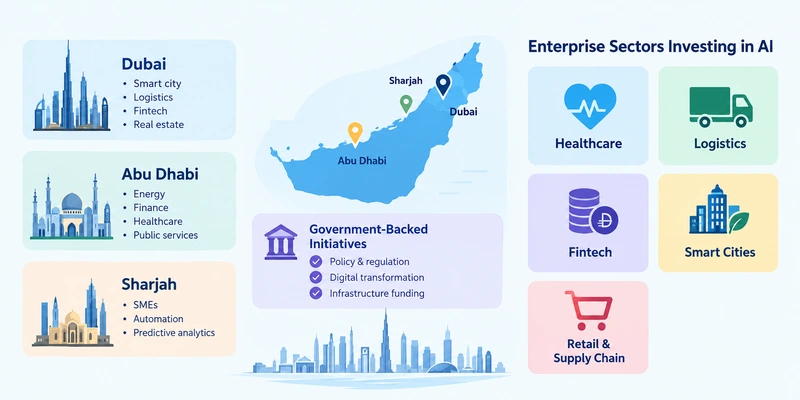
By 2026, AI Software Development UAE is no longer driven by curiosity. It is driven by infrastructure-level transformation. Enterprises are embedding AI into operational cores rather than innovation labs. What makes the UAE distinct is not just adoption speed—but structured, government-aligned execution.
3.1 AI Adoption Across Emirates
Dubai
Dubai has positioned itself as a digital-first economy where AI is tied directly to smart city initiatives, logistics modernization, fintech acceleration, and real estate intelligence systems. Enterprises in Dubai are moving aggressively from pilot models to integrated AI layers within ERP and CRM ecosystems. The focus is on measurable operational efficiency rather than experimentation.
AI in Dubai is increasingly evaluated by:
-
Compliance resilience
-
Integration scalability
-
Infrastructure sustainability
-
Cross-department adoption
Abu Dhabi
Abu Dhabi has taken a structured, investment-led approach to AI. With strong backing from sovereign funds and technology-focused institutions, AI deployment is particularly mature in energy, finance, healthcare, and public services.
Enterprise AI initiatives here emphasize:
-
Long-term governance
-
Secure data environments
-
High-stakes operational reliability
-
Public sector transformation
AI systems deployed in Abu Dhabi often operate under stricter audit conditions, making architecture discipline central to success.
Sharjah
Sharjah is emerging as a growing digital and SME innovation hub. While AI adoption here may not match Dubai or Abu Dhabi in scale, momentum is rising, especially among mid-sized enterprises exploring automation and predictive analytics.
Organizations evaluating local ecosystem strength often review capabilities of IT Companies in Sharjah to assess technical depth and implementation maturity before scaling AI initiatives.
Government-Backed Initiatives
The UAE’s national AI direction has significantly accelerated enterprise readiness. Strategic policy frameworks, digital transformation programs, and smart governance initiatives have normalized AI investment across industries.
The result:
-
AI is no longer optional for competitive enterprises
-
Regulatory alignment is built into digital planning
-
Infrastructure funding reduces experimentation risk
This structured top-down support is one reason AI Software Development UAE has matured faster than many comparable markets.
Enterprise Sectors Investing in AI
AI investment in the UAE is highly sector-driven. Enterprises are targeting operational bottlenecks rather than abstract innovation goals.
Healthcare
AI is being used to:
-
Improve patient triage systems
-
Enhance diagnostic decision support
-
Optimize hospital resource allocation
-
Predict treatment outcomes
Healthcare AI must operate within strict compliance frameworks, making explainability and traceability critical.
Logistics
Logistics has become one of the strongest AI adoption verticals due to the UAE’s role as a regional trade and transportation hub.
AI applications include:
-
Demand forecasting
-
Route optimization
-
Warehouse automation
-
Predictive maintenance
Enterprises exploring deeper integration strategies often align with frameworks similar to those discussed in AI in Logistics, where AI directly supports supply chain resilience.
Fintech
AI in fintech focuses on:
-
Fraud detection
-
Risk scoring
-
Algorithmic decision support
-
Regulatory monitoring
Accuracy alone is insufficient—AI systems must justify decisions under audit scrutiny.
Smart Cities
AI powers:
-
Traffic optimization
-
Energy usage analytics
-
Public safety monitoring
-
Urban planning simulations
Dubai’s smart city roadmap has accelerated embedded AI infrastructure development.
Retail & Supply Chain
Retail enterprises use AI for:
-
Inventory optimization
-
Customer demand prediction
-
Dynamic pricing
-
Behavioral insights
Supply chain AI is increasingly embedded inside enterprise systems rather than operating as separate analytics platforms.
Why UAE Enterprises Are Moving from Pilots to Production
Several structural forces are pushing enterprises beyond experimental AI.
Compliance Pressure
AI systems now influence regulated workflows. Enterprises must demonstrate oversight, audit trails, and risk controls. Pilot environments do not satisfy regulatory expectations.
Data Localization Requirements
UAE data governance expectations encourage controlled hosting environments and structured access management. AI architectures must align with these requirements from day one.
Enterprise Digitization Maturity
Most large UAE organizations have already completed major digital transformation phases—ERP modernization, CRM integration, cloud migration. AI is now a logical next layer, not an isolated experiment.
The result is clear: AI Software Development UAE in 2026 is defined by structured production deployment, not prototype experimentation.
Why Most AI Projects Fail After Pilot Stage
Despite market maturity, failure rates remain high once AI leaves the lab environment. These failures rarely stem from poor models. They stem from system-level weaknesses.
Below are the seven patterns that consistently derail enterprise AI initiatives.
1. The Integration Illusion
The model works perfectly in isolation. But once integrated with ERP systems, CRM platforms, or operational databases, performance degrades.
Why it happens:
-
Latency miscalculations
-
API instability
-
Schema inconsistencies
-
Legacy system rigidity
AI must be architected around integration realities—not added afterward.
2. The Data Readiness Trap
Enterprises assume they have “big data.” In reality, they have fragmented, inconsistent, poorly labeled datasets.
Common issues:
-
Duplicate entities
-
Missing fields
-
Inconsistent formats
-
No data ownership
Without structured data governance, even the best AI models fail.
3. The Governance Shock
Governance questions often arise after deployment:
-
Who approves model updates?
-
How are outputs logged?
-
Can decisions be explained?
-
Who intervenes if AI is wrong?
When governance is retrofitted instead of designed, systems become unstable and expensive to fix.
4. The Model Drift Collapse
Over time:
-
Customer behavior changes
-
Market conditions shift
-
Operational inputs evolve
If monitoring mechanisms are absent, model accuracy deteriorates quietly. Enterprises lose trust—not because AI is flawed, but because it is unmanaged.
5. Vendor Lock-in
Many AI projects rely heavily on proprietary tools or specific cloud providers without architectural flexibility.
When costs rise or compliance requirements shift, enterprises struggle to adapt. Sustainable AI Software Development UAE requires modular, replaceable architecture.
6. Underestimated Infrastructure Costs
Build cost is rarely the true problem.
The hidden costs include:
-
Ongoing cloud usage
-
Monitoring systems
-
Data storage expansion
-
Retraining cycles
-
Security audits
Without cost forecasting models, AI projects slowly exceed budget expectations.
7. Lack of Ownership Post-Launch
The most common failure pattern.
After launch:
-
The implementation team moves on
-
No one monitors performance
-
No one manages retraining
-
No one reviews outputs
AI systems degrade without visible warning. Over time, confidence erodes.
Successful enterprises define operational ownership before deployment—not after.
Strategic Insight
These failure patterns are predictable. Organizations that acknowledge them early significantly reduce risk.
In 2026, AI success in the UAE is not defined by model sophistication. It is defined by architectural discipline, governance maturity, and long-term operational clarity.
This is where serious enterprise AI initiatives separate themselves from expensive experiments.
Enterprise AI Architecture Framework for UAE Organizations
In 2026, successful AI Software Development UAE initiatives follow a layered architecture model. Enterprises no longer treat AI as a standalone engine. Instead, it is positioned as an intelligent layer embedded within secure, compliant, and observable enterprise systems.Below is a visual-style breakdown of how mature AI architecture is structured in UAE organizations.
Layer 1: Data Layer (Foundation of Stability)
Everything begins here.If the data layer is unstable, every layer above it becomes fragile.Core Components:
- Structured and unstructured data sources
- ERP databases
- CRM records
- IoT and logistics feeds
- Third-party integrations
Data Governance
Enterprises must clearly define:
- Data ownership
- Access permissions
- Entity standardization
- Data cleaning pipelines
Data pipelines should be stabilized before AI model integration—not after.
UAE Compliance Alignment
AI systems operating in the UAE must:
- Respect data residency expectations
- Classify sensitive information
- Mask or anonymize restricted fields
- Align with sector-specific regulations (finance, healthcare, government)
In production-grade environments, compliance is built into data flow—not managed externally.
Layer 2: AI Model Layer
This is where intelligence lives—but it should never operate without boundaries.
LLMs vs Predictive Models
- Large Language Models (LLMs) support document analysis, conversational systems, and decision support tools.
- Predictive models power forecasting, anomaly detection, risk scoring, and optimization engines.
Enterprise AI in the UAE often combines both:
- LLMs for knowledge assistance
- Predictive models for operational precision
Custom vs Pre-Trained Models
Enterprises must evaluate:
| Approach | Strength | Risk |
|---|---|---|
| Pre-trained models | Faster deployment | Limited customization |
| Custom-trained models | Higher precision | Higher cost & maintenance |
The right decision depends on data sensitivity, performance expectations, and long-term cost strategy.
Layer 3: API & Integration Layer
This is where most AI projects succeed—or fail.AI must integrate seamlessly into existing enterprise systems rather than disrupt them.
ERP Integration
AI enhances:
- Forecasting modules
- Resource planning
- Inventory optimization
- Financial risk assessment
ERP remains the system of record. AI acts as an intelligence enhancer—not a replacement.
CRM Integration
AI improves:
- Lead scoring
- Customer behavior analysis
- Automated insights
- Sentiment tracking
The goal is to embed AI within workflows users already trust.
Logistics Systems
AI powers:
- Route optimization
- Fleet analytics
- Warehouse intelligence
- Demand forecasting
Integration stability determines long-term success.
Layer 4: Governance & Compliance Layer
In UAE enterprise environments, governance is not optional.It is architected directly into the system.
Logging
Every AI decision should:
- Capture input context
- Record output confidence
- Track timestamps
- Store metadata
Without logging, AI becomes untraceable.
Human-in-the-Loop
High-risk decisions require:
- Manual review triggers
- Confidence thresholds
- Override mechanisms
AI should recommend—humans should validate when necessary.
Audit Trails
Enterprises must maintain:
- Version history of models
- Prompt or parameter changes
- Deployment timelines
- Incident reports
Auditability strengthens regulatory alignment and internal trust.
Layer 5: Monitoring & Cost Control Layer
AI is dynamic. It requires ongoing oversight.This layer ensures sustainability.Core Components:
- Model performance monitoring
- Drift detection
- Infrastructure usage tracking
- Cost dashboards
- Automated alerts
Without monitoring:
- Accuracy declines
- Costs rise silently
- Trust erodes
In 2026, mature AI Software Development UAE projects treat monitoring as permanent—not temporary.
AI Software Development UAE Cost in 2026
Cost remains one of the most searched and misunderstood aspects of enterprise AI.Executives do not just ask, “Can we build it?”They ask:
- What will it cost long-term?
- How do we control it?
- How does it compare to traditional software?
Let’s break it down clearly.
How Much Does AI Software Development Really Cost?
The true cost of AI development extends beyond model creation. It includes data preparation, integration, governance, infrastructure, and lifecycle management.For a deeper breakdown of pricing structures and hidden variables, you can review our detailed guide on AI software development really cost, where we explain real-world enterprise budgeting scenarios.In the UAE, enterprise AI costs vary widely depending on complexity and compliance requirements.
Project Cost Ranges (2026 UAE Market)
| Project Type | Cost Range (AED) | Use Case |
|---|---|---|
| AI Feature Integration | 150,000 – 300,000 | Adding AI to existing ERP or CRM modules |
| Mid-Scale Enterprise AI | 300,000 – 750,000 | Predictive analytics + workflow automation |
| Production-Grade AI System | 750,000 – 1,800,000+ | Multi-system integration with compliance controls |
| AI + Real-Time Optimization | 1.8M+ | Logistics, fintech, healthcare mission-critical systems |
These figures reflect enterprise-grade implementations—not experimental prototypes.
What Impacts AI Development Cost?
Several factors significantly influence budget.
1. Data Preparation
Often underestimated, this includes:
- Cleaning datasets
- Structuring inconsistent records
- Labeling training data
- Aligning schemas
In many projects, data preparation consumes 25–40% of total effort.
2. Integration Complexity
Costs increase when:
- Multiple systems must communicate
- Legacy infrastructure is involved
- APIs require customization
- Real-time processing is required
Integration often costs more than model development itself.
3. Compliance Requirements
Highly regulated industries require:
- Audit mechanisms
- Explainability tools
- Access controls
- Data encryption
Compliance-driven design increases development scope—but reduces long-term risk.
4. Cloud Infrastructure
AI consumes computational resources.Cost drivers include:
- GPU usage
- Storage growth
- Inference calls
- Model retraining
Without monitoring, infrastructure spending grows gradually but significantly.
5. Ongoing Monitoring & Optimization
AI is not static.Budget must include:
- Model updates
- Drift management
- Performance audits
- Security reviews
Enterprises that budget only for build-phase costs often face financial surprises later.
Comparing AI vs Traditional Development
AI development differs from conventional software projects.Traditional systems follow fixed logic.
AI systems learn, adapt, and evolve—requiring lifecycle governance.When compared with broader software development cost in 2026 benchmarks, AI projects typically:
- Require higher upfront architecture planning
- Demand more integration effort
- Include ongoing operational costs
- Deliver higher long-term automation ROI
The key difference is sustainability.Traditional software is built once and maintained.
AI software is built, monitored, retrained, and governed continuously.
Strategic Cost Insight
The enterprises that control AI spending most effectively:
- Scope narrowly before scaling
- Architect for flexibility
- Monitor infrastructure in real time
- Embed governance from day one
- Assign operational ownership early
In 2026, managing AI Software Development UAE cost is less about cutting budgets—and more about designing systems that remain financially predictable over time. You have not enough Humanizer words left. Upgrade your Surfer plan.
Case Study: Enterprise AI Deployment in UAE Logistics Sector Company Background
A mid-sized UAE-based logistics enterprise operating across Dubai, Abu Dhabi, and Northern Emirates was managing:
-
6 warehouse facilities
-
120+ fleet vehicles
-
Cross-border GCC shipments
-
B2B and B2C delivery channels
The organization had strong operational volume but limited predictive intelligence. Despite digital ERP infrastructure, planning decisions were largely reactive.
The company leadership decided to invest in AI Software Development UAE capabilities to transition from operational reporting to predictive decision-making.
The Problem
1. Demand Forecasting Errors
Manual forecasting based on historical averages resulted in:
-
Inventory misallocation
-
Stock imbalances between warehouses
-
Emergency shipments
Forecast accuracy variance: ±28%
2. Delivery Delays
Route decisions were static and manually reviewed.
-
No real-time traffic intelligence
-
No predictive route optimization
-
Delays during peak hours and seasonal spikes
On-time delivery rate: 74%
3. Manual Review Process
Operations managers:
-
Reviewed spreadsheets daily
-
Manually adjusted dispatch plans
-
Reacted to delays instead of preventing them
Decision cycle time: 48–72 hours
The leadership realized they needed predictive infrastructure — not more dashboards.
The Solution
The enterprise partnered with a UAE-based AI engineering team to implement a production-grade solution aligned with enterprise architecture standards.
The initiative aligned with strategic digital transformation goals and leveraged best practices in AI in Logistics (internal reference).
1. AI-Powered Demand Forecasting System
A predictive model was developed using:
-
Historical shipment data (3 years)
-
Seasonal fluctuations
-
Weather patterns
-
Regional demand signals
-
SKU velocity patterns
Model Type:
-
Hybrid time-series forecasting
-
Gradient boosting ensemble model
Result:
Forecast accuracy improved to ±9%
2. Real-Time Route Optimization Engine
The system integrated:
-
Live traffic APIs
-
Historical congestion data
-
Fuel consumption modeling
-
Delivery window prioritization
Optimization Algorithm:
-
Reinforcement learning-based routing
-
Dynamic rerouting every 15 minutes
3. ERP Integration
The AI engine was integrated with the company’s ERP and warehouse systems through API architecture.
Integration Covered:
-
Order ingestion
-
Inventory sync
-
Fleet dispatch
-
Billing triggers
No legacy system replacement required — only enhancement.
Implementation Timeline
| Phase | Duration | Key Activities |
|---|---|---|
| Discovery | 12 weeks | Data audit, compliance mapping, architecture planning |
| MVP Development | 16 weeks | Model training, validation, sandbox deployment |
| Enterprise Integration | 8 weeks | API integration, testing, rollout |
Total timeline: 36 weeks
This phased rollout reduced operational risk and ensured governance compliance.
Governance Framework Implemented
To prevent common AI deployment failures, the company embedded governance early:
Model Validation Protocol
-
Quarterly performance reviews
-
Automated drift detection alerts
Human-in-the-Loop Oversight
-
Operations managers approve high-impact routing overrides
-
Manual override capability retained
Compliance Logging
-
Full audit trails of prediction decisions
-
Data localization alignment with UAE regulatory standards
Role-Based Access Control
-
Separate permissions for analysts, operations, and executives
Monitoring System
A real-time monitoring dashboard was built to track:
-
Forecast deviation percentage
-
Route optimization effectiveness
-
Fuel cost per delivery
-
Model drift score
-
API latency
Automated alerts triggered retraining workflows when deviation crossed predefined thresholds.
This prevented silent model degradation — a common cause of AI project collapse.
Results (Within 9 Months Post Deployment)
22% Reduction in Delivery Delays
On-time delivery improved from 74% to 91%
18% Cost Savings in Fuel Optimization
Fuel cost per route reduced significantly due to dynamic routing
35% Faster Decision Cycles
Planning time reduced from 72 hours to under 24 hours
15% Inventory Holding Cost Reduction
Improved demand forecasting reduced overstocking
Strategic Impact
The AI deployment did more than optimize routes.
It:
-
Shifted the organization from reactive to predictive operations
-
Reduced dependence on manual spreadsheet-based planning
-
Created a scalable digital logistics foundation
-
Enabled executive-level forecasting visibility
The enterprise moved from pilot experimentation to production-grade AI infrastructure — the key differentiator in AI Software Development UAE maturity in 2026.
AI Implementation Roadmap for UAE Enterprises (Step-by-Step)
This roadmap reflects best practices observed across successful UAE AI deployments.
Phase 1: Discovery & Feasibility (8–12 Weeks)
Objective: Validate business case and data readiness.
Activities:
-
Use-case prioritization
-
ROI modeling
-
Data audit
-
Compliance assessment
-
Architecture blueprint
Deliverable:
Executive-approved AI transformation roadmap.
Phase 2: Data Stabilization (8–16 Weeks)
Objective: Make enterprise data usable for AI.
Activities:
-
Data cleaning
-
Standardization
-
Data warehouse consolidation
-
Governance policy definition
-
Data labeling frameworks
Without this phase, AI models will fail post-deployment.
Phase 3: MVP Development (12–20 Weeks)
Objective: Build a limited-scope AI system.
Activities:
-
Model development
-
Sandbox deployment
-
Performance testing
-
Bias testing
-
Cost monitoring simulation
Deliverable:
Controlled pilot with measurable KPIs.
Phase 4: Controlled Deployment (8–12 Weeks)
Objective: Limited real-world rollout.
Activities:
-
API integration
-
Human-in-the-loop implementation
-
Security penetration testing
-
Infrastructure scaling
Focus:
Stability over expansion.
Phase 5: Governance Hardening (Ongoing – 6 Weeks Initial Setup)
Objective: Avoid post-launch collapse.
Activities:
-
Drift monitoring automation
-
Logging infrastructure
-
Audit workflows
-
Retraining pipelines
This phase separates enterprise AI from experimental AI.
Phase 6: Enterprise Scaling (12–24 Weeks)
Objective: Expand AI across departments.
Activities:
-
Multi-location rollout
-
Additional model layers
-
Load balancing
-
Cloud cost optimization
-
Department-level adoption training
Typical End-to-End Timeline
| Enterprise Size | Estimated Timeline |
|---|---|
| Mid-size | 8–12 months |
| Large enterprise | 12–18 months |
| Multi-national UAE group | 18–24 months |
Final Strategic Insight
In 2026, AI Software Development UAE success is no longer about building models.
It is about:
-
Architecture discipline
-
Governance maturity
-
Integration capability
-
Cost control visibility
-
Long-term monitoring
Enterprises that treat AI as infrastructure — not experimentation — achieve sustainable ROI.
Data Security & Compliance for AI in UAE
Enterprise AI success in the UAE is not only about model accuracy — it is about regulatory alignment, explainability, and risk governance.
In 2026, AI Software Development UAE initiatives are evaluated as much on compliance posture as on performance outcomes.
UAE Data Protection Laws
The primary legal framework governing personal data in the UAE is:
-
Federal Decree-Law No. 45 of 2021 on the Protection of Personal Data (PDPL)
This law establishes:
-
Data subject rights
-
Lawful processing requirements
-
Cross-border transfer conditions
-
Breach notification obligations
For AI systems, this means:
-
Explicit consent management
-
Defined processing purposes
-
Data minimization architecture
-
Secure data lifecycle policies
AI models trained on personal data must align with lawful processing frameworks under PDPL.
Data Residency Requirements
Certain sectors in the UAE require strict data localization.
Examples include:
-
Healthcare records
-
Government data
-
Financial transaction records
Organizations operating in regulated free zones must also comply with:
-
Dubai International Financial Centre (DIFC) data regulations
-
Abu Dhabi Global Market (ADGM) data protection frameworks
Enterprise AI systems must therefore:
-
Define hosting geography (UAE cloud zones)
-
Implement encrypted storage
-
Establish cross-border transfer agreements
Data residency is no longer optional — it is architectural.
Sector-Specific Compliance Requirements Healthcare
-
Patient data protection standards
-
EMR confidentiality controls
-
Audit trail retention policies
Fintech
-
Anti-money laundering (AML) alignment
-
Risk scoring transparency
-
Transaction monitoring explainability
Logistics
-
Trade documentation security
-
Supply chain traceability
-
Fleet tracking data safeguards
Each vertical requires customized AI governance design — not generic implementation.
Explainability (XAI – Explainable AI)
In regulated industries, AI decisions must be interpretable.
Enterprises must answer:
-
Why was this loan rejected?
-
Why was this shipment flagged as high risk?
-
Why did this patient receive this prediction score?
Enterprise-grade AI frameworks implement:
-
Model interpretability layers
-
Feature importance logging
-
Decision trace visualization
-
Bias testing protocols
Explainability reduces regulatory risk and builds executive confidence.
Risk Control Architecture
Enterprise AI governance in the UAE must include:
Role-Based Access Controls
Limit who can retrain, override, or modify models.
Model Drift Monitoring
Automatic alerts when prediction accuracy degrades.
Audit Logging
Immutable logs of model decisions and changes.
Human-in-the-Loop Controls
High-impact decisions require human validation.
Incident Response Framework
Defined process for AI-related compliance breaches.
Why This Section Matters for Enterprises
In 2026, regulatory scrutiny is increasing across:
-
Smart city infrastructure
-
Financial AI models
-
Healthcare automation
-
Public-private digital partnerships
Organizations investing in AI Software Development UAE must embed compliance from day one — not retrofit it after deployment.
Security-first architecture is now a competitive advantage.
AI vs Automation: Where Enterprises Get Confused
One of the biggest strategic misunderstandings in UAE enterprises is confusing automation with artificial intelligence.
This confusion leads to misallocated budgets and unrealistic expectations.
Let’s clarify.
1. Traditional Automation
Traditional automation follows predefined rules.
Examples:
-
If invoice received → send approval email
-
If stock below threshold → reorder
-
If form submitted → update CRM
Characteristics:
-
Rule-based
-
Deterministic
-
No learning capability
-
Static logic
This is typically implemented through RPA tools and workflow systems.
2. AI-Powered Automation
AI-powered automation adds predictive or adaptive capability.
Examples:
-
Predict stock demand before threshold breach
-
Auto-prioritize invoices based on fraud probability
-
Route shipments dynamically based on congestion forecasts
Characteristics:
-
Data-driven
-
Learns from historical patterns
-
Improves over time
-
Requires monitoring
This is where many companies exploring Automation Tools Implementation in Dubai begin transitioning from static workflows to intelligent systems.
3. Intelligent Decision Systems
This is the highest maturity level.
Intelligent decision systems:
-
Combine multiple AI models
-
Integrate across ERP, CRM, and analytics systems
-
Make recommendations with confidence scoring
-
Include governance and explainability layers
Examples:
-
Autonomous supply chain planning
-
AI-driven credit risk scoring
-
Smart city traffic optimization systems
Unlike simple automation, these systems:
-
Continuously retrain
-
Monitor performance drift
-
Adapt to environmental changes
-
Require structured AI architecture
Key Differences Summary
| Capability | Traditional Automation | AI-Powered Automation | Intelligent Decision Systems |
|---|---|---|---|
| Rule-based logic | Yes | Partial | Minimal |
| Learning ability | No | Yes | Yes |
| Predictive capability | No | Yes | Advanced |
| Governance requirement | Low | Medium | High |
| Infrastructure complexity | Low | Medium | Enterprise-level |
Why Enterprises Get Confused
Confusion happens when:
-
Vendors label simple RPA as AI
-
Leadership expects learning behavior from rule-based systems
-
Budgets are allocated for automation but expectations are AI-level
The result:
-
Underperforming pilots
-
Misaligned ROI projections
-
Frustration among stakeholders
Strategic Insight for 2026
In the UAE’s rapidly maturing digital ecosystem:
-
Automation reduces manual effort
-
AI improves decision quality
-
Intelligent systems transform business models
Organizations investing in AI Software Development UAE must clearly define which maturity level they are targeting before budget allocation begins.
Industry-Specific AI Use Cases in UAE
AI adoption in the UAE is no longer experimental. Enterprises across regulated and high-volume sectors are moving from proof-of-concept to production-grade deployment.
Below are practical, enterprise-ready use cases shaping AI Software Development UAE in 2026.
AI in Healthcare
The UAE healthcare ecosystem is investing heavily in predictive care and operational optimization.
Enterprise Scenarios:
1. Clinical Decision Support Systems
AI models assist doctors by:
-
Predicting patient deterioration risk
-
Recommending treatment pathways
-
Flagging abnormal lab patterns
2. Hospital Resource Optimization
-
Predictive bed allocation
-
ICU demand forecasting
-
Staff scheduling optimization
3. Radiology & Imaging AI
Computer vision models analyze:
-
MRI scans
-
CT images
-
Mammography results
This reduces diagnostic time and improves early detection rates.
Healthcare AI deployments in the UAE must integrate:
-
EMR systems
-
Compliance frameworks
-
Data localization policies
Production-grade healthcare AI is governance-intensive, not plug-and-play.
AI in Logistics
The UAE’s position as a global trade hub makes logistics one of the fastest-growing AI sectors.
Enterprise Scenarios:
1. Predictive Demand Forecasting
AI models analyze:
-
Seasonal trade flows
-
Port congestion patterns
-
SKU movement history
2. Intelligent Route Optimization
Real-time routing using:
-
Traffic feeds
-
Weather conditions
-
Fuel optimization algorithms
3. Warehouse Robotics Optimization
-
Smart picking sequence optimization
-
Inventory allocation prediction
-
Automated restocking decisions
For deeper enterprise logistics transformation insights, see our coverage on AI in Logistics.
AI-driven logistics systems in the UAE increasingly integrate with:
-
Customs systems
-
Port authority APIs
-
Enterprise ERP platforms
AI in Fintech
Fintech in the UAE is heavily regulated and innovation-driven.
Enterprise Scenarios:
1. AI-Based Credit Risk Scoring
Models analyze:
-
Transaction history
-
Behavioral spending patterns
-
Fraud signals
2. Anti-Money Laundering (AML) Monitoring
Real-time anomaly detection:
-
Suspicious transaction patterns
-
Cross-border fund transfers
-
Risk-tiered customer segmentation
3. Intelligent Customer Support
AI-powered financial assistants:
-
Policy explanation
-
Dispute resolution triage
-
Loan eligibility pre-screening
Fintech AI requires explainability, bias mitigation, and compliance mapping — especially in regulated financial zones.
AI in Government Digital Services
The UAE government continues to push digital-first initiatives.
Enterprise Scenarios:
1. Smart City Traffic Optimization
-
AI-driven congestion prediction
-
Adaptive signal control
-
Accident probability modeling
2. Public Service Automation
-
Intelligent document processing
-
Application eligibility scoring
-
Permit approval acceleration
3. Predictive Urban Planning
AI models simulate:
-
Population growth
-
Infrastructure demand
-
Energy consumption forecasting
Government AI requires:
-
High transparency
-
Strong cybersecurity
-
Public trust alignment
Production AI in this sector must meet rigorous audit and explainability standards.
AI in Retail & Supply Chain
Retail enterprises in Dubai and Abu Dhabi are moving toward predictive commerce.
Enterprise Scenarios:
1. Dynamic Pricing Engines
AI adjusts prices based on:
-
Competitor analysis
-
Demand elasticity
-
Customer segmentation
2. Inventory Optimization
-
Stock replenishment forecasting
-
Dead stock reduction
-
Multi-warehouse balancing
3. Personalized Recommendation Engines
-
Behavioral segmentation
-
Real-time cross-sell suggestions
-
Loyalty scoring
Retail AI in the UAE integrates with:
-
POS systems
-
CRM platforms
-
E-commerce engines
This transforms static retail operations into intelligent commerce ecosystems.
Strategic Insight
Across industries, AI in the UAE is evolving from isolated models to interconnected enterprise intelligence systems.
Successful deployments require:
-
Scalable architecture
-
Compliance-first design
-
Deep integration capability
-
Ongoing monitoring
That is the maturity shift defining AI Software Development UAE in 2026.
Choosing the Right AI Development Partner in UAE
Selecting an AI partner is not a vendor decision — it is a long-term infrastructure decision.
In 2026, enterprises must evaluate AI partners with the same rigor as ERP or core banking providers.
What to Evaluate Before Choosing an AI Partner Architecture Capability
Ask:
-
Can they design enterprise-grade AI architecture?
-
Do they understand multi-layer AI frameworks?
-
Can they build scalable cloud infrastructure?
-
Do they support hybrid and on-prem deployments?
A qualified partner should demonstrate:
-
Data pipeline engineering expertise
-
MLOps implementation capability
-
Drift monitoring systems
-
API-first integration strategy
Architecture maturity determines whether your AI scales — or collapses post-pilot.
Compliance Knowledge
The partner must understand:
-
UAE data protection laws
-
Sector-specific regulations
-
Data residency requirements
-
Audit logging frameworks
Ask for documented governance frameworks, not just marketing claims.
Compliance misalignment can shut down enterprise AI initiatives.
Enterprise Integration Experience
AI rarely operates standalone.
Your partner must demonstrate experience integrating with:
-
ERP systems
-
CRM platforms
-
Warehouse systems
-
Banking infrastructure
-
Government APIs
Review case studies where integration complexity was handled successfully.
You may evaluate leading ecosystem players such as Top Software Companies in Dubai and Software Companies in Abu Dhabi for comparison benchmarks when shortlisting.
Long-Term Support Model
AI is not a one-time build.
It requires:
-
Continuous model retraining
-
Infrastructure monitoring
-
Cost optimization
-
Governance audits
Ask:
-
What is the post-launch support framework?
-
Is there an SLA-backed monitoring agreement?
-
Do they provide AI lifecycle management?
If support ends at deployment, risk begins.
Red Flags to Avoid
-
Vendors who promise AI without discussing data readiness
-
No monitoring or drift control framework
-
No documented compliance mapping
-
One-size-fits-all architecture
-
Overemphasis on tools instead of strategy
Final Strategic Guidance
The right AI development partner in the UAE should combine:
-
Technical depth
-
Regulatory awareness
-
Enterprise integration capability
-
Long-term operational support
Choosing correctly determines whether your AI Software Development UAE initiative becomes a scalable competitive advantage — or another failed pilot.
Future of AI Software Development in UAE (2026–2030 Outlook)
The next five years will redefine how enterprises approach AI. Between 2026 and 2030, AI Software Development UAE will transition from competitive advantage to operational necessity.
Here’s what enterprise leaders should anticipate.
1. AI Governance Will Tighten
Regulatory oversight across the UAE is expected to intensify, particularly in:
-
Financial services
-
Healthcare
-
Smart city infrastructure
-
Public-private digital ecosystems
Future enterprise AI systems will require:
-
Mandatory explainability layers
-
Algorithm audit documentation
-
Bias reporting mechanisms
-
Model risk classification
AI governance will shift from “recommended best practice” to “enforced compliance standard.”
Organizations that design governance-first architecture today will avoid costly retrofits later.
2. Rise of Edge AI Adoption
As IoT infrastructure expands across logistics hubs, retail environments, and smart cities, Edge AI will become mainstream.
Instead of sending all data to centralized cloud servers:
-
AI models will process data locally
-
Decision latency will decrease
-
Bandwidth costs will reduce
-
Real-time decision-making will improve
Use cases:
-
Smart warehouse robotics
-
Traffic signal optimization
-
Retail shelf analytics
-
Industrial safety monitoring
Edge AI will require lightweight, optimized model architectures — a shift in how AI is engineered.
3. AI + IoT Convergence
The UAE’s infrastructure investments make AI + IoT integration inevitable.
Examples by 2030:
-
AI predicting infrastructure failures before breakdown
-
Autonomous warehouse orchestration
-
Smart energy grid optimization
-
Predictive maintenance in oil & gas facilities
IoT generates data.
AI extracts intelligence.
Together, they create autonomous operational ecosystems.
This convergence will define next-generation AI Software Development UAE initiatives.
4. AI + Blockchain Integration
As transparency and trust become regulatory priorities, AI systems will increasingly integrate with blockchain frameworks.
Use cases:
-
Immutable AI decision logs
-
Verified supply chain traceability
-
Fraud-resistant financial modeling
-
Smart contract-triggered AI events
AI provides intelligence.
Blockchain provides trust and immutability.
For enterprises operating in regulated environments, this dual-stack architecture will strengthen compliance posture and audit confidence.
5. AI as an Enterprise Infrastructure Layer
By 2030, AI will no longer be a “feature.”
It will function as:
-
A core infrastructure layer
-
Embedded within ERP systems
-
Integrated into CRM platforms
-
Native within supply chain tools
-
Standard inside government platforms
Enterprises will not “deploy AI.”
They will operate on AI-enabled infrastructure.
Just as cloud computing became foundational, AI will become embedded into digital operating models.
Strategic Forecast for UAE Enterprises
Between 2026–2030, organizations that:
-
Treat AI as infrastructure
-
Invest in governance frameworks
-
Prioritize integration architecture
-
Build internal AI maturity
…will dominate their sectors.
Those treating AI as experimentation will fall behind.
The future of AI Software Development UAE is structured, compliant, scalable intelligence — not isolated models.
Final Executive Insight
The question is no longer:
“Should we invest in AI?”
The real question is:
“Are we architecting AI correctly for long-term enterprise scale?”
If your organization is serious about building production-grade, compliant, scalable intelligence — now is the time to act.
AI Software Development UAE in 2026 is not about experimentation. It is about disciplined execution.