

Travel booking software is the system that runs a travel agency's entire operation — from the moment an enquiry comes in to the moment a booking is confirmed, paid for, and reported on. Agencies that still run this process across spreadsheets, WhatsApp, and email lose bookings to slower quotes, pricing errors, and manual data entry that a connected platform eliminates.
This guide covers what the software actually does, how it differs from an OTA platform, what it costs, how to choose a provider, and when custom development makes more sense than an off-the-shelf tool.
1. What Is Travel Booking Software?
Travel booking software is a platform that manages the full booking lifecycle for a travel business — enquiry, quotation, booking, payment, and post-booking service — in one connected system.
Instead of an agent checking supplier rates in one tab, building a quote in Word, and confirming payment over email, the software pulls live inventory, generates the quote, processes payment, and logs everything against the customer record automatically.
The core workflow it supports looks like this:
- Enquiry — a lead comes in from a website form, WhatsApp, phone, or a B2B partner.
- Quotation — the agent (or the system) builds a priced itinerary from live or cached supplier data.
- Booking — the customer confirms, and the system locks the fare, hotel, or package.
- Payment — the platform processes payment and reconciles it against the booking.
- Post-booking — vouchers, e-tickets, and any changes or cancellations are handled from the same record.
Four types of connectivity make this possible:
- GDS (Global Distribution Systems) — Amadeus, Sabre, and Travelport feed live flight and fare data.
- API connections — direct links to hotel chains, low-cost carriers, and activity suppliers that don't sit on a GDS.
- CRM — tracks the customer relationship before and after the booking.
- Payment and supplier connectivity — handles collection from the customer and settlement with suppliers.
Agencies evaluating this space for the first time are usually deciding between a ready-made platform and a custom build — a distinction covered in detail in Travel Booking Software Development: Build vs Buy.
2. How Does Travel Booking Software Work?
The software works by connecting to supplier systems in real time, pricing what it finds, and turning that into a bookable, payable, and trackable record.
Here's the sequence, end to end:
| Step | What happens |
|---|---|
| Supplier/API connectivity | The platform connects to GDS, hotel APIs, and other suppliers |
| Inventory search | The agent or customer searches for flights, hotels, or packages |
| Pricing & markup | The system applies the agency's margin rules automatically |
| Quote generation | A branded, itemized quote is produced in minutes, not hours |
| Booking confirmation | The selected option is locked with the supplier |
| Payment | The customer pays through an integrated gateway |
| Voucher/e-ticket generation | Confirmation documents are issued automatically |
| Settlement & reporting | The back office reconciles what was collected against what's owed to suppliers |
Every step after "inventory search" used to be manual for most agencies. That's the specific gap this software closes — not search, but everything downstream of it.
This is also where the real evaluation criteria live: how deep the supplier connectivity goes, and how much of the quote-to-settlement chain runs without an agent re-keying data. Agencies comparing providers on this basis should look closely at what travel booking API integration actually covers before signing a contract.
3. Travel Booking Software vs OTA Platform: What's the Difference?
An OTA platform is what customers book through; travel booking software is what the agency runs its business on. They solve different problems, and most agencies eventually need both.
OTA Platform
An OTA (Online Travel Agency) platform is customer-facing. It exists to sell directly.
- B2C or B2B booking portal
- Self-service for customers or agent-partners
- Live, bookable inventory
- Online checkout and payment
Travel Booking Software
Travel booking software is back-office infrastructure. It exists to run the business behind the sale.
- Operations management
- CRM
- Quotation building
- Itinerary management
- Supplier management
- Accounting and reconciliation
Which One Does Your Business Need?
| If you're... | You primarily need... |
|---|---|
| Selling directly to consumers online, no agents involved | An OTA platform |
| Running a team of agents who quote and book on behalf of customers | Travel booking software |
| Doing both — direct sales and agent-assisted bookings | Both, integrated |
A pure OTA platform without back-office software leaves agents no faster at building complex, multi-supplier itineraries. Back-office software without an OTA front end leaves no self-service sales channel. Agencies scaling past a handful of agents typically need the operational layer first, since it's what removes the manual bottleneck in every booking.
ALSO READ - Software Development Costs in 2026: A Comprehensive Guide
4. Core Features of Modern Travel Booking Software
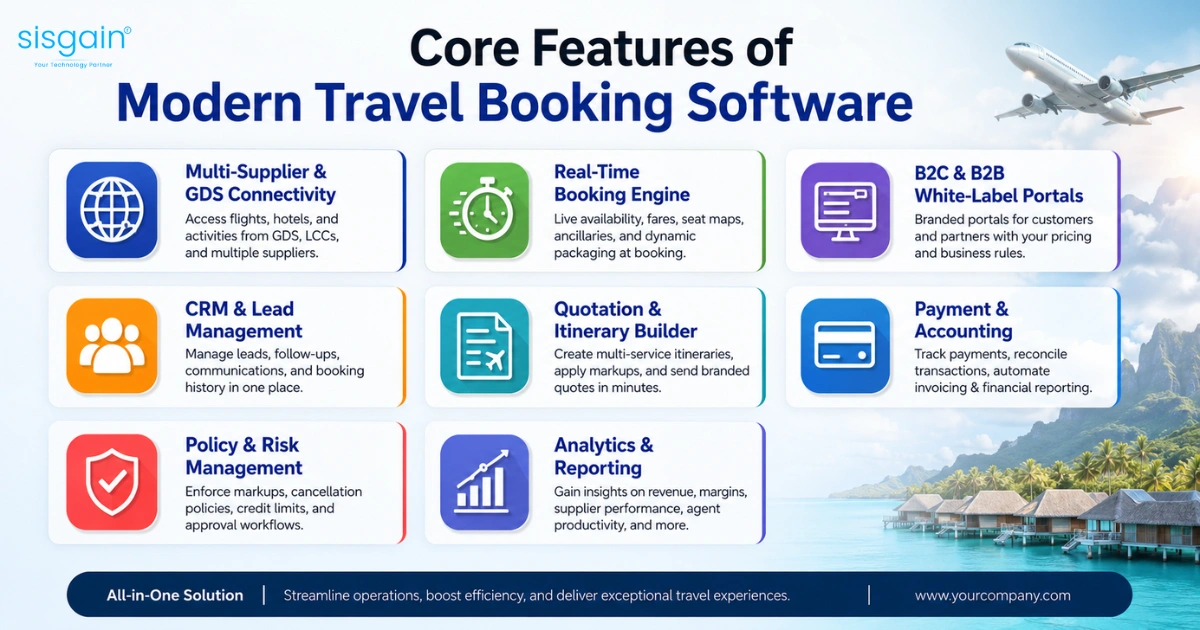
Rather than looking at modern travel booking software as a simple feature checklist, it's more useful to understand each capability as a solution to a specific operational problem.
Multi-Supplier & GDS Connectivity
The problem: Agents often have to check multiple supplier portals to build a single itinerary, making the process slow and increasing the risk of errors.
The fix: A unified search interface connected to GDS platforms such as Amadeus, Sabre, and Travelport, along with LCC APIs, hotel APIs, and activity and transfer suppliers.
Real-Time Booking Engine
The problem: A fare, room rate, or availability shown during the initial search may no longer be available when the customer is ready to book.
The fix: Real-time availability, fare and pricing validation, seat maps, ancillaries, and dynamic packaging retrieved at the point of booking rather than relying on outdated cached data.
B2C & B2B White-Label Portals
The problem: Travel agencies may lack dedicated self-service channels for direct customers and sub-agent partners.
The fix: A branded B2C or B2B portal that operates on the same inventory, pricing, markup, and business rules as the agency's internal booking system.
CRM & Lead Management
The problem: Customer enquiries can go cold when follow-ups are missed, while repeat customers may not receive personalized service because their previous interactions are scattered across different systems.
The fix: A centralized CRM that connects customer profiles with enquiries, quotations, communications, and booking history, while enabling agents to track and manage follow-ups.
Quotation & Itinerary Builder
The problem: Creating multi-day itineraries involving flights, hotels, transfers, activities, and other services manually in Word or Excel is time-consuming and difficult to maintain.
The fix: An itinerary builder that allows agents to combine multiple travel components, apply pricing and markups, and generate branded, shareable quotations and itineraries within minutes.
Payment & Accounting
The problem: Manual reconciliation makes it difficult to track customer payments, supplier costs, refunds, commissions, and outstanding balances accurately.
The fix: Integrated payment collection, transaction tracking, automated reconciliation, invoicing, and financial reporting that connect bookings with their associated payments and supplier liabilities.
Policy & Risk Management
The problem: Different agents may apply inconsistent markup, cancellation, refund, or approval rules, creating revenue leakage and operational risk.
The fix: Centralized business rules that automatically enforce markup bands, refund and cancellation policies, credit limits, approval thresholds, and other operational controls.
Analytics & Reporting
The problem: Without consolidated data, agencies may struggle to determine which suppliers, routes, products, agents, or customer segments are generating the best margins.
The fix: Centralized dashboards and reports that provide visibility into bookings, revenue, margins, supplier performance, agent productivity, and overall business performance.
Agencies whose requirements span several of these capabilities — particularly B2B and B2C portals, custom markup logic, CRM workflows, and multiple supplier integrations — often find that a standard off-the-shelf platform cannot accommodate their processes without significant compromises. In such cases, working with a custom software development company in Dubai can make it possible to build a travel booking platform around the agency's specific workflows, supplier ecosystem, pricing structure, and customer experience.
This is where travel software solution development for a custom platform can offer a stronger alternative to packaged software, particularly for agencies that need greater control, scalability, and integration flexibility.

5. Types of Travel Booking Software
Not every agency needs the same platform. The right category depends on business model, not company size.
| Type | Built for |
|---|---|
| Travel Agency Software | Retail agencies managing enquiries, quotes, and bookings for individual travelers |
| Tour Operator Software | Businesses packaging and selling their own tours or itineraries |
| Corporate Travel Management Software | Managing employee travel, policy compliance, and expense reporting |
| DMC & B2B Wholesale Platforms | Destination management companies and wholesalers selling through agent networks |
| MICE & Luxury Travel Software | Complex, high-touch bookings — meetings, incentives, conferences, and bespoke luxury travel |
| OTA Booking Platforms | Direct-to-consumer or direct-to-agent online sales |
A DMC selling only through B2B wholesale channels doesn't need the same features as a retail agency serving walk-in customers, and a corporate travel manager doesn't need a consumer-facing OTA portal at all. Matching the category to the actual business model is the first filter — before comparing individual travel software companies against each other.
6. Benefits of Travel Booking Software for Travel Agencies
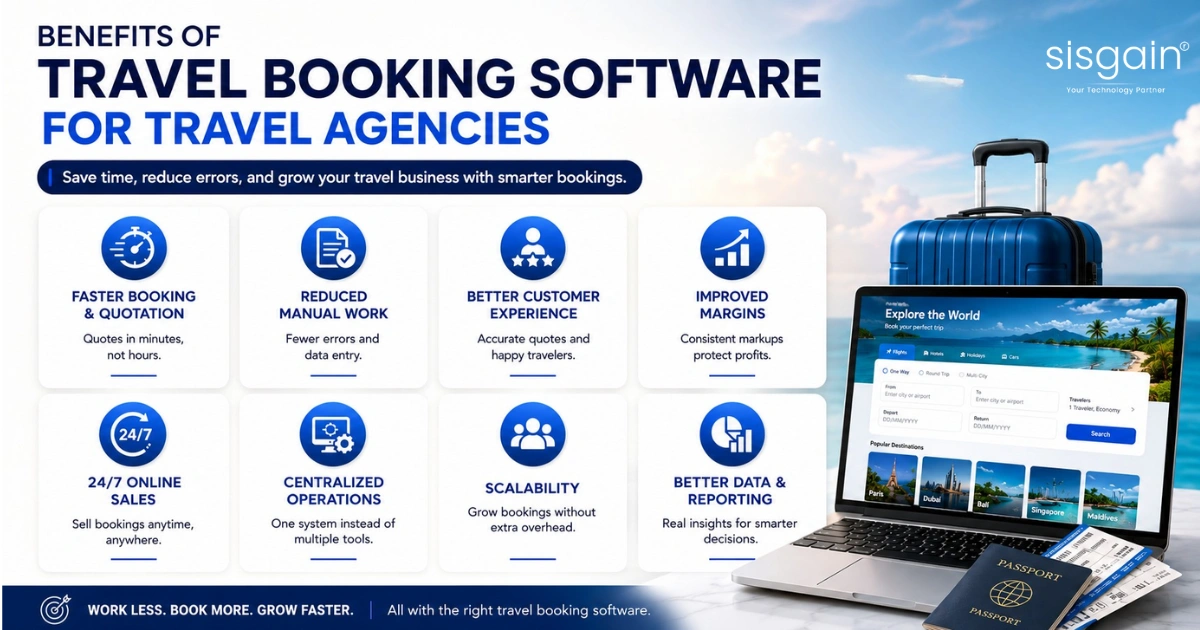
The core benefit is time: every manual step the software removes is time an agent can spend selling instead of processing.
- Faster booking & quotation — quotes that took an hour now take minutes.
- Reduced manual work — fewer re-keyed bookings means fewer pricing and data-entry errors.
- Better customer experience — faster, more accurate quotes and self-service options where relevant.
- Improved margins — consistent markup rules and fewer errors protect margin on every booking.
- 24/7 online sales — a customer-facing portal keeps selling outside office hours.
- Centralized operations — one system instead of five disconnected tools.
- Scalability — adding agents or booking volume doesn't require proportionally more back-office headcount.
- Better data & reporting — margin, supplier, and agent performance become visible instead of anecdotal.
Agencies modernizing their booking infrastructure typically start by mapping which of these gaps costs them the most — often it's quote turnaround time or reconciliation errors — then evaluate travel technology providers against that specific gap rather than a generic feature list.
7. OTA Platform vs Custom Travel Booking Software
This is a different question from Section 3. Section 3 compared categories of software. This section compares how you acquire your back-office platform: buy a ready-made product, or build one.
Ready-Made OTA Platform
- Faster deployment
- Lower initial development effort
- Standard, proven feature set
- Limited customization
Custom Travel Booking Software
- Custom workflows built around how the agency actually operates
- Custom supplier and API integrations, including ones no packaged tool supports
- Full branding and control over the customer and agent experience
- Architecture that scales with the business rather than around a vendor's roadmap
- Higher upfront development investment
Which Model Should You Choose?
A ready-made platform is the right call when the agency's workflow is fairly standard and speed to market matters more than customization. Custom development earns its higher cost when the business has a workflow, supplier mix, or B2B/B2C structure that packaged software wasn't built to handle — at that point, forcing the business into a generic tool costs more in workarounds than the custom build would have cost upfront.
Agencies in this position are usually already evaluating travel software solution development in Dubai providers rather than product demos, since the decision has shifted from "which product" to "which development partner."
8. How to Choose the Right Travel Booking Software in 2026
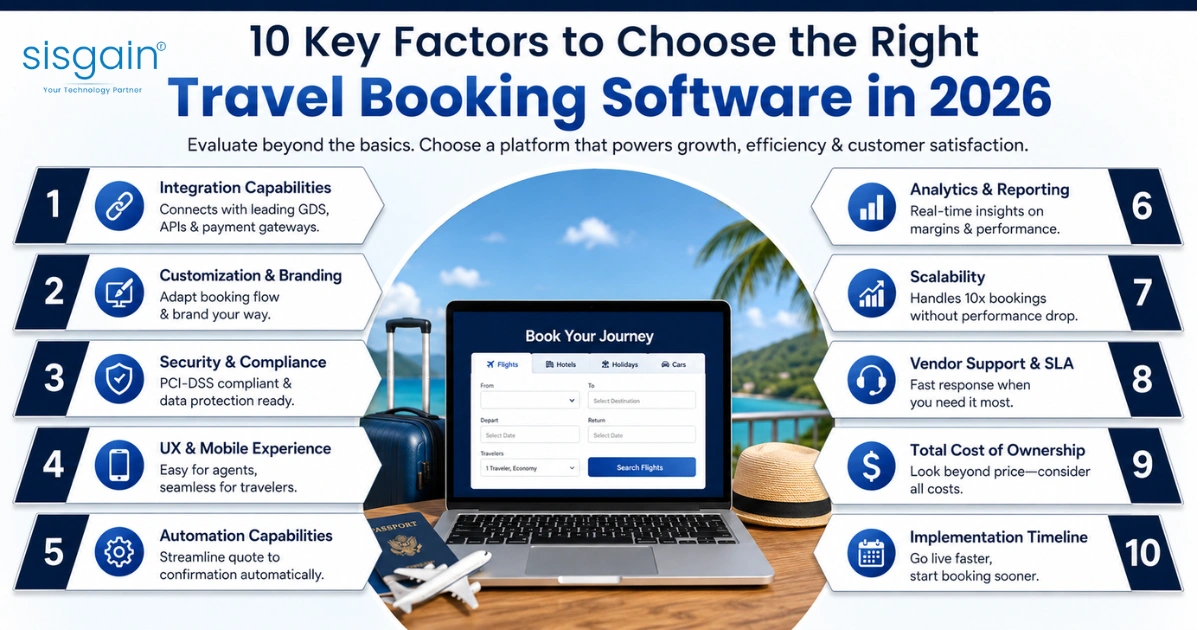
Choosing the right platform comes down to ten evaluation criteria — most agencies only check two or three of these before signing.
- Integration capabilities — which GDS, hotel APIs, and payment gateways does it actually connect to today, not on a roadmap?
- Customization & white labeling — can the booking flow and branding be adapted, or is the agency locked into the vendor's template?
- Security & compliance — PCI-DSS for payment data, and data protection compliance relevant to the markets served.
- UX & mobile experience — can an agent complete a booking on the interface without a workaround, and does the customer-facing side work on mobile?
- Automation capabilities — how much of quote-to-confirmation runs without manual intervention?
- Analytics & reporting — is margin and performance data available natively, or does it require exporting to a spreadsheet?
- Scalability — does performance and pricing hold up at 10x current booking volume?
- Vendor support & SLA — what's the actual response time commitment when something breaks during a live booking?
- Total cost of ownership — licensing plus integration, training, and ongoing support costs, not just the sticker price.
- Implementation timeline — how long from contract signature to agents actually booking live customers on the system?
Before selecting a platform, agencies should compare these ten criteria directly across the top travel software companies they're considering — not just the marketing feature list each vendor leads with.
9. Travel Technology Providers: What Should Agencies Look For?
A travel technology provider is the company that builds, integrates, or customizes the booking infrastructure — as distinct from a single software product an agency simply subscribes to.
What Does a Travel Technology Provider Do?
They handle the technical layer an in-house team usually can't: connecting to GDS and supplier APIs, building or customizing booking engines, and maintaining the system after launch.
Booking Engine & API Integration
Look for direct experience integrating the specific suppliers and GDS the agency already works with — not just generic "API integration" as a line item.
GDS & Supplier Connectivity
Confirm live, working connections to Amadeus, Sabre, or Travelport (whichever the agency needs), plus the specific hotel and activity APIs relevant to the agency's markets.
B2B/B2C Portal Development
If the agency needs both a consumer-facing and a partner-facing portal, confirm the provider has actually shipped both, not just one.
CRM & Back-Office Integration
The booking engine is only half the system — check that CRM, accounting, and reporting are integrated, not bolted on separately.
Payment & Accounting Integration
Payment gateway integration should include automated reconciliation, not just collection.
Customization & Scalability
Ask for evidence the provider has scaled a client's system past initial launch volume, not just delivered a working demo.
Implementation & Post-Launch Support
Confirm what support looks like after go-live — many providers are strong on delivery and weak on the first six months of production support.
Agencies vetting travel technology providers at the vendor-shortlist stage should treat this checklist as the actual interview script, not a background read — ask each provider to answer 9.2 through 9.8 with specific past examples.
10. Travel Booking Software Development: Build vs Buy
| Factor | Ready-Made Software | Custom Development |
|---|---|---|
| Launch time | Faster | Longer |
| Customization | Limited–moderate | High |
| Initial cost | Lower | Higher |
| Scalability | Vendor-dependent | Fully controllable |
| Integrations | Existing, pre-built | Custom-built |
| Ownership | Vendor | Business |
| Best for | Standard workflows | Complex or specific workflows |
When Should You Consider Custom Travel Software Development?
Custom development is worth the higher cost when the business has:
- A business model that doesn't map to a standard workflow
- Complex or unusual supplier integrations
- A combined B2B/B2C hybrid sales model
- Non-standard pricing or markup logic
- CRM requirements beyond what packaged tools support
- Operations across multiple countries with different compliance needs
- Proprietary workflows that are actually a competitive advantage
If none of these apply, a ready-made platform is very likely the faster, cheaper, and lower-risk choice. Agencies that do match this list should treat travel software solution development as the primary evaluation path rather than continuing to shop packaged products that will require workarounds regardless of which one they pick.
11. How Much Does Travel Booking Software Cost?
There's no reliable single number here — published "$X–$Y" ranges for travel booking software are rarely grounded in real data and vary enormously by scope. What actually drives cost is the combination of the following factors:
- Number of GDS/API integrations required
- Whether B2B and/or B2C portals are needed
- CRM scope and complexity
- Payment gateway integrations
- Whether a mobile app is in scope
- How much of the workflow needs custom logic
- Cloud infrastructure requirements
- Ongoing maintenance and support commitments
The practical approach: get a scoped quote based on the agency's actual supplier list, portal requirements, and expected booking volume, rather than budgeting off a generic published range.
12. Travel Booking Software Implementation Roadmap
A realistic implementation follows this sequence:
- Business & requirements discovery — map the current workflow before choosing a system to replace it.
- Supplier/API assessment — confirm every supplier the agency needs can actually be connected.
- Vendor shortlist — narrow to providers matching the requirements from Section 8.
- Demo & technical evaluation — test the system against real, not sample, booking scenarios.
- Pilot implementation — run a limited rollout with a small agent group before full deployment.
- Data migration — move existing customer, booking, and supplier data across cleanly.
- Team training — agents need to be genuinely fluent, not just shown the interface once.
- Testing — validate the full quote-to-settlement chain before go-live.
- Go-live — launch to the full team.
- KPI monitoring & optimization — track the metrics in Section 13 from day one, not after a problem appears.
Vendor evaluation at step 3 is where most agencies lean on outside comparisons of travel technology providers, since it's the step with the highest cost of getting wrong.
13. Key KPIs to Measure After Implementation
Implementation isn't done at go-live — it's proven or disproven by what these numbers do over the following quarter:
- Booking conversion rate
- Quote-to-booking ratio
- Average booking value
- Gross margin per booking
- Customer acquisition cost
- Online vs. offline booking split
- Supplier performance (fulfillment, pricing accuracy)
- Cancellation and refund rate
- Agent productivity (bookings per agent, per hour)
- Repeat booking rate
An agency that doesn't see quote-to-booking ratio and agent productivity improve within a quarter of go-live has either an adoption problem or a system that doesn't fit the actual workflow — both worth investigating immediately rather than waiting out the contract term.
14. Travel Booking Software Trends in 2026
- AI-powered travel search and recommendations — search results shaped by traveler preference data, not just filters.
- Intelligent itinerary generation — AI-assisted first-draft itineraries that agents refine rather than build from scratch.
- Dynamic packaging — real-time bundling of flights, hotels, and activities at the point of quote.
- API-first travel architecture — platforms built to integrate rather than operate as closed systems.
- Automation & AI agents — routine quote and follow-up tasks handled without agent intervention.
- Mobile-first booking — both agent tools and customer portals designed for mobile as the primary interface, not an afterthought.
- Real-time disruption management — automated rebooking and customer notification when flights or suppliers are disrupted.
- Personalized pricing & offers — margin and offer logic that adapts to customer segment and booking history.
- Embedded payments — payment collection built directly into the booking flow rather than a separate step.
- B2B travel distribution — wholesale and sub-agent distribution treated as a first-class feature, not a workaround.
These are directional shifts worth planning around, not features every agency needs immediately — the priority list should still start from the operational gaps identified in Section 6.
15. Top Travel Booking Software Options in 2026
Rather than a ranked "best" list, here's how the main categories compare on what they're actually strongest at:
| Software Type | Best For | Key Strength |
|---|---|---|
| Tour/activity booking software | Activity-based businesses | Availability management and distribution |
| Agency management software | Retail travel agencies | Combined CRM and day-to-day operations |
| Itinerary software | Independent advisors and agents | Itinerary building and client experience |
| OTA platform | Direct online travel sales | B2C and B2B self-service bookings |
| Custom software | Agencies with complex requirements | Flexibility and non-standard integrations |
The right choice depends on which row matches the agency's actual business model — the selection criteria in Section 8 should be applied within whichever category fits, not across all five.