
Dubai has never been a follower in digital transformation — it has consistently positioned itself as a global leader in innovation, smart governance, and technology-driven economic growth. As we move deeper into 2026, automation is no longer an optional efficiency upgrade. It has become a strategic business mandate.
Across sectors — banking, healthcare, logistics, retail, government, and real estate — organizations are actively investing in Automation Tools Implementation in Dubai to enhance operational efficiency, ensure regulatory compliance, reduce costs, and build scalable digital infrastructures that support long-term growth.
What has changed in recent years is not just the availability of automation technologies, but the maturity of their application. Businesses in Dubai are now moving beyond isolated robotic scripts or basic workflow tools. They are adopting structured automation frameworks that combine:
-
Robotic Process Automation (RPA)
-
Artificial Intelligence and predictive analytics
-
Low-code workflow platforms
-
Cloud-native automation environments
-
Data-driven performance monitoring systems
This evolution aligns directly with Dubai’s Smart City ambitions, UAE digital economy initiatives, and the region’s focus on AI integration across public and private sectors.
However, successful Automation Tools Implementation in Dubai requires more than purchasing software. It demands strategic planning, process reengineering, regulatory awareness, change management, and continuous optimization. Organizations that approach automation without a defined roadmap often experience cost overruns, integration failures, or low employee adoption.
With over two decades of IT sector transformation experience across enterprise environments, one thing remains consistent: automation delivers measurable ROI only when it is aligned with business objectives and executed through a structured implementation framework.
This comprehensive guide will break down:
-
The strategic foundations of automation in Dubai
-
A step-by-step implementation process
-
Cost considerations and ROI expectations
-
Key benefits and risk mitigation strategies
-
Future trends shaping automation in the UAE
Whether you are an enterprise decision-maker, IT director, operations head, or founder exploring digital transformation, understanding how Automation Tools Implementation in Dubai works in 2026 will help you make informed, ROI-driven decisions.
What is Automation Tools Implementation?
Automation Tools Implementation in Dubai refers to the strategic deployment of digital technologies that automate business processes, IT operations, and decision-making workflows within organizations operating in the UAE ecosystem. It is not merely about installing software — it involves analyzing operational gaps, redesigning processes, integrating intelligent tools, and aligning automation with regulatory and industry standards specific to Dubai.
At its core, automation in Dubai operates on two levels:
1. Business Automation
This focuses on automating repetitive, rule-based operational tasks such as invoicing, HR onboarding, compliance reporting, procurement approvals, and customer service workflows. The objective is to improve speed, accuracy, and scalability while reducing manual intervention.
2. IT Automation
This targets backend infrastructure — server provisioning, security monitoring, cloud management, data synchronization, and system integrations. IT automation ensures performance stability, cybersecurity compliance, and seamless digital operations across enterprise systems.
Understanding the Different Types of Automation
To properly approach Automation Tools Implementation in Dubai, it’s critical to understand the distinctions between automation technologies:
Robotic Process Automation (RPA)
RPA uses software bots to mimic human actions within applications — such as data entry, report generation, or transaction processing. It is ideal for structured, repetitive tasks. Many enterprises begin their automation journey with robotic process automation in uae because of its quick ROI and minimal system disruption.
AI Automation
AI-driven automation goes beyond rule-based actions. It incorporates machine learning, natural language processing, and predictive analytics to handle unstructured data, decision-making, and pattern recognition. Modern enterprises leverage advanced ai applications to power intelligent chatbots, fraud detection systems, and demand forecasting models.
Workflow Automation
This focuses on streamlining business processes through predefined rules and triggers. For example, when a purchase request is submitted, it automatically routes for approval based on hierarchy and policy logic.
Hyperautomation
Hyperautomation integrates RPA, AI, analytics, and process mining into a unified ecosystem. It enables end-to-end automation across departments — creating what many refer to as a “self-optimizing enterprise.”
Why Regional Customization Matters in Dubai
Dubai’s regulatory landscape — including DIFC compliance standards, healthcare regulations, VAT requirements, and data protection frameworks — requires automation systems to be locally aligned. Off-the-shelf global automation tools often need customization to:
-
Meet UAE data residency laws
-
Support bilingual (Arabic-English) operations
-
Integrate with region-specific ERP systems
-
Align with sector-specific compliance mandates
Therefore, successful Automation Tools Implementation in Dubai is not just technical deployment — it is a strategic, regulatory-aware transformation initiative tailored to the UAE business environment.
Why Dubai Businesses Are Prioritizing Automation in 2026
In 2026, Automation Tools Implementation in Dubai is no longer driven by experimentation — it is driven by necessity. Organizations across the UAE are embedding automation into their digital transformation strategies to maintain operational resilience, regulatory readiness, and global competitiveness.
Several strategic drivers are accelerating this shift.
1. Labor Cost Optimization
Dubai remains a premium global business hub. While this offers access to world-class infrastructure and talent, it also brings higher operational costs. Automation allows businesses to:
-
Reduce dependency on repetitive manual tasks
-
Minimize processing errors that lead to financial losses
-
Reallocate human capital toward strategic and revenue-generating functions
According to regional digital transformation reports, UAE enterprises implementing automation have reported operational cost reductions ranging between 20–35% within the first year, particularly in finance and back-office operations.
2. Emiratization & Talent Productivity
With strong Emiratization initiatives across government and semi-government sectors, organizations are focusing on increasing workforce productivity rather than expanding headcount for routine administrative tasks.
Automation supports this by:
-
Handling repetitive compliance workflows
-
Enabling skilled professionals to focus on decision-making and innovation
-
Reducing burnout associated with manual processing
In essence, automation complements workforce nationalization strategies by elevating the value contribution of human talent.
3. Regulatory Compliance & Governance
Dubai operates under strict regulatory frameworks — including VAT regulations, DIFC financial compliance, healthcare governance, and data protection laws aligned with global standards.
Manual processes increase audit risk. Automation ensures:
-
Real-time documentation tracking
-
Automated compliance reporting
-
Audit trail generation
-
Policy-based workflow approvals
Many UAE banks and healthcare institutions have implemented structured automation frameworks to reduce compliance-related risks and penalties.
4. 24/7 Customer Expectations
Dubai’s economy operates in a global time zone ecosystem. Customers expect instant services — from digital banking approvals to real-time logistics tracking.
Automation enables:
-
AI-powered customer support
-
Instant transaction processing
-
Real-time inventory updates
-
Continuous backend monitoring
Businesses that fail to automate struggle to meet modern service benchmarks.
5. Competitive Global Positioning
Dubai competes with global financial and technology hubs. To attract international investors and clients, organizations must demonstrate operational efficiency and technological maturity.
Automation enhances:
-
Service delivery speed
-
Data-driven decision making
-
Scalable infrastructure
-
Investor confidence
Enterprise-level adoption of automation tools in Dubai increased significantly between 2023–2026, especially in banking, logistics, and healthcare sectors — reflecting strong regional digital maturity.
Industry Adoption Snapshot
| Industry | Automation Use Case | Impact | ROI Timeline |
|---|---|---|---|
| Banking | Loan Processing Automation | 60% Faster TAT | 6–9 months |
| Healthcare | Patient Data Management | 45% Efficiency Gain | 8 months |
| Logistics | Shipment Tracking Systems | 70% Accuracy Boost | 6 months |
| Retail | Inventory Automation | 30% Cost Reduction | 5–7 months |
Major UAE enterprises across these industries have publicly acknowledged digital automation as a cornerstone of their transformation strategies, reinforcing the urgency of Automation Tools Implementation in Dubai as a competitive differentiator.
Step-by-Step Framework for Automation Tools Implementation in Dubai
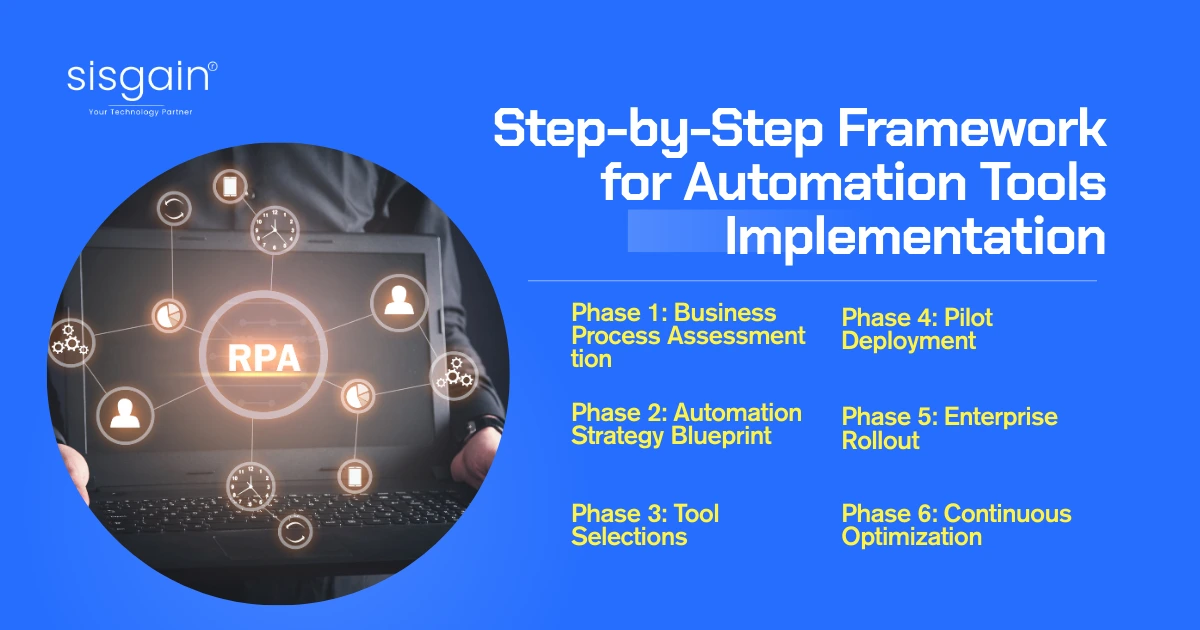
Successful Automation Tools Implementation in Dubai is never accidental. Enterprises that achieve measurable ROI follow a structured, governance-driven framework rather than deploying isolated bots or disconnected tools. In Dubai’s highly regulated and fast-paced economy, automation must be strategic, compliant, and scalable from day one.
Below is a proven six-phase framework used by mature organizations across the UAE.
Phase 1: Business Process Assessment
Automation begins with clarity — not technology.
Process Mining
Using digital process mining tools, organizations analyze how workflows actually operate (not how they are documented). This reveals redundancies, manual interventions, and inefficiencies across departments.
Bottleneck Mapping
Identify:
-
Delays in approvals
-
High-error manual entries
-
Duplicate data processing
-
Compliance gaps
In Dubai’s finance and healthcare sectors, bottleneck mapping often reveals regulatory documentation delays that significantly impact turnaround time.
Automation Readiness Score
Before implementation, businesses should evaluate:
-
System integration maturity
-
Data structure quality
-
Leadership alignment
-
Change readiness
This assessment reduces the risk of automation failure and ensures strategic alignment.
Phase 2: Automation Strategy Blueprint
Once processes are mapped, a formal automation roadmap must be created.
Goal Alignment
Automation objectives should align with measurable business KPIs such as:
-
30% cost reduction
-
40% faster turnaround time
-
50% compliance error reduction
Clear alignment prevents technology-first decisions.
ROI Estimation
Estimate:
-
Implementation costs
-
Licensing and infrastructure expenses
-
Productivity savings
-
Error reduction value
In Dubai’s enterprise sector, ROI for structured automation projects typically ranges between 6–12 months, depending on scale.
Governance Model
Establish:
-
Automation steering committee
-
Data governance policies
-
Compliance review checkpoints
-
Performance accountability metrics
Given UAE regulatory standards, governance is non-negotiable.
Phase 3: Tool Selection
Choosing the right technology stack determines long-term scalability.
RPA vs AI vs Low-Code
-
RPA → Best for repetitive, rule-based processes
-
AI Automation → Suitable for decision-making and predictive workflows
-
Low-Code Platforms → Enable faster workflow customization
Often, enterprises implement hybrid ecosystems rather than relying on a single solution.
Vendor Evaluation Checklist
Evaluate vendors based on:
-
UAE regulatory compliance experience
-
Integration capability with ERP/CRM
-
Cybersecurity certifications
-
Scalability
-
Local technical support
Cloud vs On-Premise
-
Cloud → Scalable, flexible, lower upfront infrastructure cost
-
On-Premise → Preferred for sensitive financial or healthcare data
Dubai-based financial institutions often prefer hybrid models for data security compliance.
Phase 4: Pilot Deployment
Before enterprise-wide rollout, controlled testing is critical.
Sandbox Testing
Deploy automation within a limited environment to simulate real workflows without operational risk.
Risk Mitigation
Monitor:
-
Data errors
-
Integration failures
-
Compliance misalignment
-
Employee usability feedback
KPI Tracking
Track performance against pre-defined KPIs such as:
-
Processing time reduction
-
Accuracy improvement
-
Cost savings
A well-executed pilot significantly reduces rollout risk.
Phase 5: Enterprise Rollout
After validation, automation expands organization-wide.
Change Management
Employee resistance is one of the largest barriers to automation. Clear communication, leadership involvement, and transparency are essential.
Employee Training
Upskilling ensures:
-
Effective tool utilization
-
Reduced dependency on IT teams
-
Higher adoption rates
In Dubai’s Emiratization-driven workforce strategy, training aligns automation with productivity enhancement.
Integration with ERP/CRM
Automation must seamlessly integrate with:
-
SAP / Oracle systems
-
Salesforce CRM
-
HRMS platforms
-
Accounting software
Poor integration leads to fragmented automation and limited ROI.
Phase 6: Continuous Optimization
Automation is not a one-time deployment — it is an evolving digital capability.
AI Model Training
AI-driven automation requires continuous refinement using updated data patterns.
Analytics Dashboards
Real-time dashboards allow leadership to:
-
Monitor performance
-
Detect inefficiencies
-
Identify new automation opportunities
Automation Expansion
Once core processes are optimized, automation expands to additional departments, creating enterprise-wide digital maturity.
Implementation Timeline Overview
| Phase | Duration | Key Stakeholders | Risk Level |
|---|---|---|---|
| Assessment | 2–4 weeks | IT + Operations | Low |
| Strategy | 2 weeks | Leadership | Medium |
| Pilot | 1–2 months | IT | Medium |
| Full Rollout | 3–6 months | Cross-Department | High |
Organizations that follow this structured framework significantly increase their chances of achieving measurable success in Automation Tools Implementation in Dubai. Those that skip assessment, governance, or pilot stages often encounter cost overruns, integration failures, and resistance challenges.
In Dubai’s competitive digital ecosystem, disciplined execution separates experimental automation from enterprise transformation.
Cost of Automation Tools Implementation in Dubai
One of the most searched questions around Automation Tools Implementation in Dubai is simple: How much does it cost?
The answer depends on business size, complexity, compliance requirements, and integration scope. However, understanding the cost structure helps decision-makers evaluate automation as a strategic investment rather than an expense.
Key Cost Components
1. Licensing
This includes software subscriptions for RPA platforms, AI tools, workflow automation systems, analytics dashboards, and enterprise connectors. Licensing costs vary depending on:
-
Number of bots or users
-
Cloud vs on-premise model
-
Advanced AI capabilities
Enterprise-grade platforms typically operate on annual subscription models.
2. Development
This covers:
-
Process analysis and workflow design
-
Bot creation and AI model configuration
-
Custom feature development
-
Testing and optimization
Highly customized automation projects require experienced developers and solution architects, increasing initial setup costs.
3. Integration
Automation must connect seamlessly with:
-
ERP systems (SAP, Oracle)
-
CRM platforms
-
HRMS and accounting software
-
Government portals (VAT, compliance reporting)
Integration complexity directly impacts implementation cost in Dubai’s multi-system enterprise environments.
4. Infrastructure
Costs depend on deployment model:
-
Cloud hosting subscriptions
-
On-premise server infrastructure
-
Cybersecurity enhancements
-
Data backup and redundancy systems
Financial and healthcare institutions often invest more heavily in secure infrastructure.
5. Training
Employee training programs ensure successful adoption. This may include:
-
Workshops
-
Admin certification
-
Internal automation champions
Without training, ROI timelines extend significantly.
6. Ongoing Maintenance
Automation requires:
-
Performance monitoring
-
Bot updates
-
AI model retraining
-
Compliance updates
Ongoing support is critical for sustainable automation success.
Estimated Investment in Dubai (2026)
| Business Size | Estimated Budget (AED) | Complexity Level |
|---|---|---|
| SME | 50K – 150K | Moderate |
| Mid-Size | 150K – 500K | Advanced |
| Enterprise | 500K+ | High |
Understanding ROI
ROI in Automation Tools Implementation in Dubai is typically calculated using:
ROI = (Annual Cost Savings – Implementation Cost) ÷ Implementation Cost × 100
Cost savings usually come from:
-
Reduced labor hours
-
Error reduction
-
Faster transaction processing
-
Compliance penalty avoidance
-
Increased revenue through improved service speed
For example, if a mid-size company invests AED 300,000 and saves AED 450,000 annually through operational efficiencies, the ROI becomes:
(450,000 – 300,000) ÷ 300,000 × 100 = 50% ROI within the first year
Most Dubai-based enterprises report ROI realization between 6 to 12 months, depending on implementation scale and execution discipline.
When strategically planned, automation is not a cost center — it becomes a profit multiplier.
Benefits of Automation Tools Implementation in Dubai

When executed strategically, Automation Tools Implementation in Dubai delivers measurable, multi-layered business value. Beyond cost savings, automation strengthens governance, enhances customer experience, and builds long-term competitive advantage — especially within the fast-evolving GCC market.
Below are the most impactful benefits organizations experience.
1. Operational Efficiency
Automation dramatically reduces process cycle times. Tasks that previously required hours of manual coordination can now be completed in minutes.
For example:
-
UAE banking institutions implementing automated loan verification workflows have reduced turnaround time (TAT) by up to 50–60%.
-
Logistics firms using automated shipment reconciliation systems report up to 40% faster dispatch processing.
By eliminating repetitive manual tasks, businesses free up skilled employees to focus on strategic initiatives rather than administrative processing.
2. Compliance & Audit Readiness
Dubai’s regulatory ecosystem — including VAT regulations, corporate tax compliance, DIFC governance, healthcare mandates, and data protection laws — requires precise documentation and reporting.
Automation ensures:
-
Real-time compliance tracking
-
Automated audit trails
-
Policy-based approval hierarchies
-
Instant report generation
Healthcare providers in the UAE that automated patient documentation and reporting processes have reported significant reductions in compliance-related discrepancies during audits. Automated systems reduce dependency on manual tracking, which is prone to oversight.
3. Reduced Human Error
Manual data entry, spreadsheet management, and repetitive transaction processing are common sources of costly errors.
Automation eliminates inconsistencies by:
-
Applying standardized logic
-
Enforcing rule-based validation
-
Maintaining structured documentation
Retail companies in Dubai implementing inventory automation have reported up to 30% reduction in stock reconciliation errors, directly improving profit margins.
Accuracy translates directly into financial protection and brand reputation stability.
4. Scalability Without Proportional Cost Growth
Dubai businesses often scale rapidly — whether expanding across the GCC or onboarding international clients.
Automation enables organizations to:
-
Process higher transaction volumes
-
Handle seasonal demand spikes
-
Expand service capacity without significant hiring
For example, e-commerce businesses operating across UAE and Saudi Arabia have leveraged automation to manage peak sales periods without increasing administrative staff by the same ratio.
Scalability becomes technology-driven rather than manpower-dependent.
5. Data-Driven Decision Making
Modern automation systems generate real-time analytics dashboards, offering leadership actionable insights.
Organizations gain:
-
Performance tracking metrics
-
Bottleneck identification reports
-
Forecasting models
-
Predictive demand analysis
UAE enterprises using AI-powered analytics within automated workflows have improved operational forecasting accuracy by nearly 25–35%, enhancing strategic planning capabilities.
Automation transforms raw data into executive intelligence.
6. Competitive Advantage in GCC Markets
Dubai competes regionally and globally. Businesses that adopt structured automation frameworks signal operational maturity to investors, partners, and regulators.
Automation improves:
-
Service reliability
-
Response speed
-
Compliance credibility
-
Customer satisfaction
Companies expanding into Saudi Arabia, Qatar, and other GCC markets often rely on automation to maintain service consistency across borders. In competitive tenders and enterprise partnerships, digitally mature organizations frequently outperform manual-process competitors.
In summary, Automation Tools Implementation in Dubai strengthens efficiency, governance, scalability, and strategic positioning. It moves businesses from reactive operations to proactive digital enterprises — a critical shift in the 2026 GCC economic landscape.
Common Challenges in Automation Tools Implementation in Dubai — And How to Overcome Them
While Automation Tools Implementation in Dubai offers substantial strategic advantages, organizations must navigate implementation risks carefully. Many automation initiatives fail not because of technology limitations, but due to poor planning, governance gaps, or cultural resistance.
Below are the most common challenges faced by UAE businesses — and proven mitigation strategies.
1. Employee Resistance
Automation often triggers concern among employees who fear job displacement or role redundancy. In Dubai’s diverse workforce environment, unclear communication can quickly slow adoption rates.
Why it happens:
-
Fear of job loss
-
Lack of transparency
-
Limited understanding of automation’s purpose
Solution:
-
Structured upskilling programs
-
Clear leadership communication
-
Position automation as productivity enhancement, not replacement
-
Appoint internal “automation champions”
Organizations that invest in workforce training typically experience significantly higher adoption success and faster ROI realization.
2. Integration Failure
Dubai enterprises often operate on legacy ERP systems, region-specific accounting tools, and government compliance portals. Poor integration planning can create system silos rather than streamlined workflows.
Why it happens:
-
Outdated infrastructure
-
Poor API compatibility
-
Inadequate system mapping
Solution:
-
API-first integration strategy
-
Conduct pre-implementation IT audits
-
Choose automation tools with strong integration capabilities
-
Consider hybrid cloud architectures when necessary
Integration planning should occur before tool deployment — not after issues arise.
3. Cost Overruns
One of the biggest risks in automation projects is uncontrolled scope expansion.
Why it happens:
-
Undefined KPIs
-
Expanding feature requests mid-project
-
Lack of governance oversight
Solution:
-
Phased deployment strategy
-
Clear ROI benchmarks
-
Dedicated project management team
-
Automation steering committee
Enterprises that deploy automation in structured phases avoid budget escalation and maintain strategic clarity.
4. Compliance Risk
Dubai’s regulatory framework is dynamic. Automation systems that lack compliance controls can create audit vulnerabilities.
Why it happens:
-
Poor governance structure
-
Lack of audit trail documentation
-
Inadequate data security planning
Solution:
-
Establish automation governance framework
-
Build compliance checkpoints into workflows
-
Regularly review audit logs
-
Involve legal and compliance teams during strategy phase
Challenge Mitigation Overview
| Challenge | Why It Happens | Solution |
|---|---|---|
| Employee Resistance | Fear of Job Loss | Upskilling Programs |
| Integration Failure | Legacy Systems | API Strategy |
| Cost Overruns | Scope Creep | Phased Deployment |
| Compliance Risk | Poor Governance | Audit Framework |
Addressing these challenges proactively ensures that Automation Tools Implementation in Dubai becomes a strategic transformation initiative rather than a fragmented technology experiment.
Best Automation Tools Used in Dubai (2026 Edition)
The success of Automation Tools Implementation in Dubai depends heavily on selecting the right technology stack. In 2026, Dubai enterprises are no longer experimenting with basic automation scripts — they are investing in enterprise-grade platforms that integrate RPA, AI, analytics, and workflow orchestration into unified ecosystems.
Below are the most widely adopted automation categories in the UAE market.
1. RPA Platforms
Robotic Process Automation (RPA) remains the entry point for many organizations. Leading platforms such as UiPath, Automation Anywhere, and Microsoft Power Automate are widely used across Dubai’s banking, healthcare, and logistics sectors.
RPA is ideal for:
-
Invoice processing
-
Payroll automation
-
VAT reporting
-
Data reconciliation
-
Customer onboarding workflows
Companies beginning their automation journey often start with robotic process automation in uae because it delivers fast ROI without requiring major infrastructure changes.
2. AI Automation Platforms
AI-driven automation is rapidly expanding across Dubai’s enterprise landscape. These platforms integrate machine learning, natural language processing, and predictive analytics into business workflows.
Common use cases include:
-
Intelligent chatbots
-
Fraud detection systems
-
Demand forecasting
-
Risk assessment automation
-
Document classification
Organizations leveraging advanced ai applications are achieving higher decision accuracy and predictive capabilities, especially in finance and retail industries.
3. Low-Code Automation Platforms
Low-code and no-code tools allow businesses to design automated workflows without heavy programming dependency. Platforms like Mendix, OutSystems, and Microsoft Power Apps enable rapid digital process creation.
Benefits include:
-
Faster deployment
-
Reduced development cost
-
Business-user involvement in workflow design
Many top software companies in dubai recommend low-code ecosystems for SMEs and mid-sized enterprises seeking agile digital transformation.
4. Enterprise Workflow & Integration Tools
Large enterprises require comprehensive automation suites that integrate seamlessly with ERP, CRM, HRMS, and accounting systems.
Enterprise tools focus on:
-
Cross-department orchestration
-
Governance management
-
Data analytics dashboards
-
Multi-cloud integrations
A trusted software company specializing in enterprise automation can design hybrid ecosystems combining RPA, AI, and workflow automation for long-term scalability.
In 2026, automation in Dubai is no longer about isolated tools — it is about building interconnected digital infrastructure. Organizations that strategically combine these technologies achieve stronger ROI, regulatory alignment, and competitive differentiation in the GCC market.
How to Choose the Right Automation Partner in Dubai
Selecting the right partner is often the single most important decision in Automation Tools Implementation in Dubai. The technology stack matters — but execution, governance, and long-term scalability matter more.
In Dubai’s fast-evolving regulatory and competitive environment, businesses must evaluate automation vendors through an EEAT lens: Experience, Expertise, Authoritativeness, and Trustworthiness.
1. Proven UAE Portfolio
Look for a partner with a strong implementation history in the UAE or GCC. A vendor that has delivered automation projects for local banks, healthcare providers, logistics companies, or government entities understands:
-
UAE compliance structures
-
VAT and financial reporting standards
-
Data localization requirements
-
Cultural and operational nuances
Request documented case studies with measurable ROI outcomes (cost savings, efficiency gains, turnaround reduction).
2. Regulatory & Compliance Knowledge
Dubai operates under strict frameworks from:
-
Central Bank of UAE
-
DHA (Dubai Health Authority)
-
DIFC regulations
-
UAE Data Protection Law
Your automation partner must demonstrate governance frameworks, audit trail capabilities, and role-based access controls embedded into the system architecture.
Compliance-ready automation reduces legal risk and builds enterprise resilience.
3. Industry-Specific Case Studies
Generic automation experience is not enough.
A banking automation strategy differs significantly from a logistics or retail workflow. The right partner should offer:
-
Sector-specific implementation playbooks
-
Industry benchmarking data
-
Custom KPI frameworks
This ensures the automation blueprint aligns with operational realities.
4. Integration Expertise
Dubai enterprises often operate hybrid ecosystems — SAP, Oracle, Salesforce, legacy ERPs, and cloud-native applications.
Your automation provider must demonstrate:
-
API integration capabilities
-
Cloud and on-prem deployment expertise
-
Data migration proficiency
-
Scalable architecture design
Weak integration is one of the top causes of automation failure in the GCC market.
5. Long-Term Support & Optimization Model
Automation is not a one-time project — it is an evolving capability.
Choose a partner offering:
-
Continuous monitoring
-
AI model retraining
-
Performance optimization
-
Automation expansion roadmap
The right automation partner becomes a long-term digital transformation advisor — not just a vendor.
Future Trends: Automation in Dubai Beyond 2026
Dubai’s automation landscape is rapidly evolving beyond traditional RPA into fully autonomous enterprise ecosystems.
1. Hyperautomation
Hyperautomation combines RPA, AI, process mining, analytics, and low-code platforms into unified ecosystems. Enterprises will automate not just tasks — but entire decision cycles.
2. AI Agents & Autonomous Workflows
AI-powered digital agents will:
-
Manage customer interactions
-
Execute financial approvals
-
Predict supply chain disruptions
-
Auto-generate compliance reports
These systems will move from assistance to autonomous execution.
3. Predictive Automation
Predictive analytics integrated with automation will enable:
-
Risk forecasting
-
Demand prediction
-
Revenue optimization
-
Intelligent resource allocation
Automation will shift from reactive to proactive.
4. Blockchain + Automation
Dubai’s smart city initiatives are accelerating blockchain integration for:
-
Smart contracts
-
Supply chain verification
-
Secure identity management
Combining blockchain with automation enhances transparency and auditability.
5. The Autonomous Enterprise Model
By 2030, forward-thinking Dubai enterprises will operate on semi-autonomous digital infrastructures where:
-
Processes self-optimize
-
AI continuously learns
-
Decisions are data-driven
-
Human roles shift toward strategy and innovation
Automation Tools Implementation in Dubai is no longer optional — it is foundational to competing in the global digital economy.
Conclusion
Automation is no longer a competitive advantage in Dubai — it is a strategic necessity. As we move deeper into 2026 and beyond, businesses that delay digital transformation risk operational inefficiencies, compliance exposure, rising costs, and loss of global positioning.
Automation Tools Implementation in Dubai has evolved from basic process digitization to enterprise-wide intelligent ecosystems powered by RPA, AI, analytics, and hyperautomation frameworks. Organizations that approach automation strategically — through proper assessment, governance, tool selection, and continuous optimization — are achieving measurable ROI within months, not years.
Dubai’s regulatory maturity, Smart City initiatives, AI strategy roadmap, and global trade positioning make it one of the most automation-ready markets in the world. Enterprises that invest now are building scalable, resilient, and future-proof digital infrastructures.
The key is not simply adopting tools — it is building a structured automation roadmap aligned with business outcomes.
If your organization is planning to implement or scale automation, the time to act is now. Partner with experts who understand UAE regulations, industry-specific workflows, and enterprise integration complexities.
Start your automation journey today — and position your business as a digital leader in the GCC market.