
Decentralized finance has moved far beyond experimentation. Enterprises, fintech startups, and Web3 ventures are now launching full-scale decentralized trading platforms that rival centralized exchanges in liquidity, performance, and user experience. At the center of this transformation sits the DEX website—a decentralized interface that connects users directly to on-chain liquidity and enables trustless trading.
Whether you are a founder exploring how to create a decentralized cryptocurrency exchange, a product leader designing a dex exchange app, or a CTO planning an easy dex MVP for rapid market entry, understanding the architecture, security requirements, regulatory realities, and cost structure is critical.
This guide explains—at enterprise depth—how modern dex web platforms are built, how dex swap mechanisms function under the hood, and how to future-proof your platform for scale, compliance, and institutional adoption.
What Is a DEX Website and How Does It Work?
A DEX website is the user-facing interface that allows traders to interact directly with decentralized smart contracts deployed on a blockchain network. Instead of holding customer funds in centralized wallets, the platform connects to non-custodial wallets like MetaMask, Coinbase Wallet, or hardware devices.
Behind the interface, smart contracts manage:
• Liquidity pools
• Pricing formulas
• Token swaps
• Fee distribution
• Governance rights
The dex web frontend simply orchestrates transactions and displays real-time blockchain data. Once a user initiates a dex swap, the transaction is signed locally in their wallet and executed on-chain.
This model eliminates custodial risk, reduces single points of failure, and enables open, permissionless markets—one of the main reasons decentralized exchanges now handle billions in daily volume.
Why Enterprises Are Building DEX Exchange Apps in 2026
Large organizations are no longer experimenting casually with decentralized finance. In 2026, banks, fintech leaders, hedge funds, and payment providers are launching production-grade dex exchange apps as core components of their digital asset strategies. What once began as developer-driven DeFi protocols has evolved into enterprise-ready infrastructure capable of powering global liquidity, regulated token markets, and programmable financial products.
For many organizations, a dedicated DEX website is no longer viewed as a speculative innovation—it is becoming a strategic trading venue, distribution channel, and settlement layer embedded within broader financial ecosystems. The ability to deploy a scalable dex web interface, integrate compliance tooling, and orchestrate secure dex swap flows across multiple blockchains is now seen as a competitive advantage rather than an experimental initiative.
Several structural forces are accelerating this shift.
Institutional DeFi Adoption
Traditional financial institutions are steadily integrating decentralized liquidity rails into their core operations. Asset managers use DEX infrastructure for portfolio rebalancing, treasury optimization, and on-chain yield strategies. Banks explore decentralized pools for foreign-exchange settlement and collateralized lending. Payment platforms incorporate on-chain swap routing to reduce dependence on legacy correspondent networks.
The appeal lies in transparency, programmability, and real-time settlement. A modern dex exchange app allows institutions to access deep liquidity without relinquishing custody of funds, while smart contracts enforce execution rules automatically. As regulatory frameworks mature, these platforms increasingly resemble digital financial market infrastructure rather than experimental protocols.
Tokenized Real-World Assets and Regulated Markets
Another powerful driver is the rapid growth of tokenized real-world assets. Equities, bonds, commodities, real estate interests, and private credit funds are being issued as blockchain-native instruments. Once assets move on-chain, organizations require compliant marketplaces where they can be traded efficiently.
This demand is pushing enterprises to build specialized DEX websites that include permissioned pools, investor whitelisting, reporting layers, and jurisdiction-specific controls. Unlike early DeFi platforms that focused purely on crypto-to-crypto trading, the new generation of dex web products must support regulatory oversight, settlement finality, and institutional-grade custody integrations.
For fintech innovators, this evolution highlights how blockchain for fintech is shifting from experimentation toward full-scale capital-markets infrastructure.
Cross-Border Settlement and Treasury Optimization
Global enterprises manage billions in daily cross-border transactions. Traditional settlement systems rely on multiple intermediaries, delayed reconciliation, and expensive FX conversions. Decentralized exchanges offer an alternative.
By using on-chain liquidity pools and automated dex swap routing, organizations can move value across currencies and jurisdictions in minutes rather than days. Stablecoins and tokenized deposits can be exchanged instantly, while smart contracts automate compliance checks and reconciliation processes.
Treasury teams increasingly view a private or consortium-based dex exchange app as a way to streamline global cash management, hedge exposure, and reduce operational friction—especially in regions with fragmented banking systems.
Embedded Finance and Super-App Strategies
Consumer platforms and digital ecosystems are also driving enterprise DEX adoption. Ride-hailing apps, marketplaces, neobanks, and payment super-apps now embed financial services directly into their interfaces. Adding a native dex swap module enables users to convert tokens, stablecoins, loyalty points, or digital assets without leaving the host application.
In this context, a white-labeled DEX website or API-driven dex web layer becomes part of a larger digital experience rather than a standalone trading terminal. Enterprises design these systems to integrate with identity services, rewards programs, lending protocols, and custody solutions—creating seamless financial journeys for millions of users.
Strategic Shift From Experiments to Core Infrastructure
What unites these trends is a fundamental change in mindset. Enterprises no longer build decentralized exchanges as proof-of-concept projects. They treat them as regulated market infrastructure, engineered for uptime, compliance, liquidity depth, and long-term scalability.
This is where blockchain for fintech becomes a strategic capability rather than a research initiative. Companies increasingly partner with seasoned Fintech App developers and blockchain engineering teams to:
• Architect multi-chain trading systems
• Design regulatory-aware frontends
• Implement institutional custody integrations
• Coordinate third-party security audits
• Build analytics and reporting layers
• Launch staged MVPs before full-scale rollout
Instead of assembling experimental prototypes, enterprises demand production-ready dex exchange apps that can serve thousands of concurrent users, handle complex asset classes, and withstand regulatory scrutiny across multiple jurisdictions.
How to Create a Decentralized Cryptocurrency Exchange: Step by Step
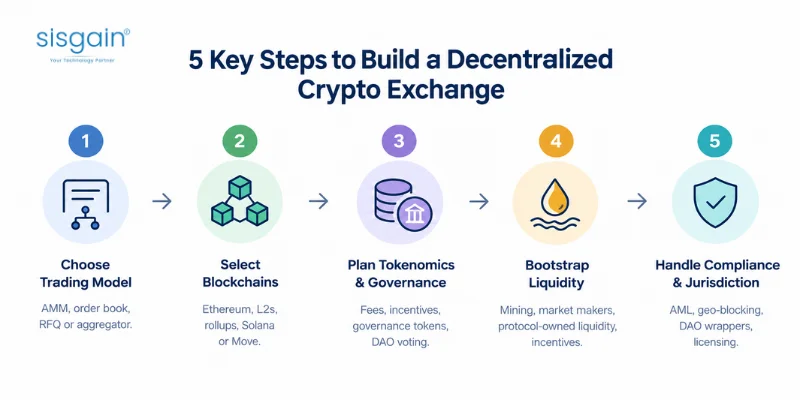
Anyone serious about learning how to create a decentralized cryptocurrency exchange must begin with business design—not code.
1. Define the Trading Model
Choose between:
• AMM-based pools (Uniswap-style)
• Order-book hybrids
• RFQ systems
• Aggregators routing liquidity across protocols
Each impacts UX, liquidity strategy, and regulatory exposure.
2. Select Blockchain Networks
Most modern dex website deployments support:
• Ethereum mainnet
• Layer-2s like Arbitrum and Base
• Optimistic and ZK rollups
• Solana or Move-based chains
Multi-chain support increases reach but complicates infrastructure.
3. Design Tokenomics and Governance
Consider:
• Fee structures
• Liquidity incentives
• Governance tokens
• DAO voting
• Treasury management
4. Liquidity Bootstrapping
A dex exchange app is useless without depth. Early strategies include:
• Liquidity mining
• Partner market makers
• Protocol-owned liquidity
• Incentivized pools
5. Compliance and Jurisdiction Strategy
Even decentralized platforms must consider:
• AML tooling
• Geo-blocking
• DAO wrappers
• Licensing pathways
Professional legal review is no longer optional.
DEX Architecture Explained: From Smart Contracts to Dex Web UI
A modern dex exchange app is not a single smart contract or a simple trading screen—it is a layered, distributed system that blends on-chain execution with off-chain infrastructure, analytics engines, compliance tooling, and enterprise-grade security frameworks. The most successful dex web platforms are engineered around modular architectures that can evolve as networks, regulations, and user expectations change.
At scale, a production-ready DEX website resembles financial market infrastructure rather than a hobbyist protocol. Each architectural layer is independently auditable, upgradeable under strict governance controls, and resilient to network congestion, oracle failures, and attack vectors.
Below is how leading platforms design decentralized exchange systems in 2026.
Smart Contract Layer: The Trading Engine
The smart contract layer forms the core of every decentralized exchange. These contracts hold liquidity, calculate prices, execute dex swap transactions, and enforce protocol rules without human intervention.
Core modules typically include:
Liquidity Pool Factories
Contracts that deploy and configure new pools, set fee tiers, and define supported token pairs.
Swap Routers
Routing contracts that determine optimal paths across multiple pools or chains to provide the best execution price.
Liquidity Position Managers
Systems that mint LP tokens or NFT-based positions, track deposited capital, and calculate yield.
Fee Distribution Engines
Logic that allocates trading fees between liquidity providers, protocol treasuries, and governance programs.
Governance Contracts
DAO modules that manage parameter changes, upgrades, emissions schedules, and treasury control.
Because these components directly custody assets, gas efficiency and correctness are paramount. Enterprise-grade teams employ:
• Optimized math libraries
• Storage packing strategies
• Minimal proxy patterns
• Formal verification
• Extensive fuzz testing
Upgradeability is handled through proxy architectures governed by multisig wallets and timelocks, ensuring that changes to the dex exchange app cannot be pushed instantly without community or board oversight.
Indexing and Data Services: The Intelligence Layer
While smart contracts execute trades, most real-time data displayed on a DEX website is delivered through off-chain indexing systems.
These services ingest blockchain events and transform raw transactions into user-friendly dashboards, charts, and portfolio views.
Typical components include:
Subgraphs and Indexers
Protocols like The Graph—or custom indexing pipelines—track pool activity, liquidity depth, historical prices, and governance proposals.
RPC Providers and Node Infrastructure
Dedicated blockchain nodes ensure fast transaction simulation, wallet connections, and state queries even during network congestion.
Event Streaming Systems
Message queues and data pipelines push live updates to the dex web frontend for order confirmations, balance refreshes, and analytics.
Oracle Networks
External price feeds from providers such as Chainlink or Pyth protect pools from manipulation and enable advanced routing logic.
Together, these systems form the analytical backbone of the dex exchange app, powering everything from slippage estimation to regulatory reporting and institutional dashboards.
Frontend Dex Web Layer: Where Users Interact
The DEX website is the primary touchpoint for traders, liquidity providers, and governance participants. In competitive markets, UX quality often determines whether a platform succeeds or disappears.
Most modern dex web interfaces are built with:
• React or Next.js frameworks
• Web3 wallet adapters
• State management libraries
• Data-visualization components
• Real-time charting engines
Key modules typically include:
Trading Terminals
Swap widgets, advanced routing previews, limit-style order simulations, and gas breakdowns.
Portfolio Dashboards
Token balances, LP positions, yield projections, and historical performance.
Liquidity Management Panels
Deposit and withdrawal flows, fee earnings, impermanent-loss modeling.
Governance Portals
Proposal creation, voting dashboards, and treasury analytics.
For enterprise adoption, frontends increasingly integrate compliance overlays, identity verification tools, jurisdiction-based access rules, and institutional custody APIs—transforming the dex web layer into a regulated financial interface rather than a purely permissionless portal.
Cross-Chain Infrastructure: Liquidity Without Borders
As users demand access to assets across multiple blockchains, cross-chain functionality has become central to every major dex exchange app.
Bridges, routers, and liquidity aggregators enable:
• Token transfers between networks
• Unified liquidity across chains
• Cross-chain arbitrage
• Best-price routing
• Atomic settlement workflows
Instead of fragmenting liquidity on separate networks, advanced platforms build orchestration layers that abstract complexity away from users. A single dex swap request might traverse multiple pools across different chains while appearing instantaneous on the DEX website.
Because bridges remain one of the highest-risk components in DeFi, enterprise teams invest heavily in:
• Validator decentralization
• Light-client verification
• Circuit breakers
• Insurance mechanisms
• Real-time anomaly detection
Security Controls: The Non-Negotiable Foundation
Security architecture distinguishes experimental platforms from institutional-grade dex web systems.
Production deployments include multiple layers of defense:
Multisignature Admin Wallets
Prevent unilateral upgrades or emergency actions.
Timelock Controllers
Force delays before critical changes, giving auditors and the community time to review.
Emergency Pause Mechanisms
Allow protocols to halt trading during active exploits or oracle failures.
Monitoring Bots and Alerting Systems
Detect abnormal volumes, price deviations, flash-loan patterns, or governance attacks in real time.
Audit Pipelines
Continuous static analysis, third-party reviews, and post-deployment monitoring.
These measures transform the DEX website into a resilient trading venue capable of protecting institutional capital and maintaining uptime during market volatility.
What Makes an Easy DEX for Users and Liquidity Providers
An easy dex does not mean simplistic infrastructure—it means frictionless user experience.
Key design principles include:
• One-click wallet connection
• Gas estimation previews
• Slippage sliders
• Transaction simulation
• Mobile-optimized layouts
• Clear pool APY dashboards
• Risk disclosures
Institutional liquidity providers demand analytics, risk modeling, and transparency before depositing funds into a dex exchange app.
How Dex Swap Actually Works Behind the Scenes
At the heart of every dex swap is a sophisticated pricing and routing engine designed to execute trades without intermediaries while preserving market integrity and minimizing slippage. What appears to users as a simple “Swap” button on a DEX website actually triggers a multi-stage process involving smart contracts, liquidity algorithms, oracle systems, and cross-chain infrastructure.
Understanding how this machinery works is essential for anyone serious about building a production-ready dex exchange app or learning how to create a decentralized cryptocurrency exchange that can compete with established platforms.
Automated Market Makers and the Constant-Product Model
Most decentralized exchanges rely on Automated Market Makers (AMMs) rather than traditional order books. Instead of matching buyers and sellers directly, AMMs maintain pools of two or more assets supplied by liquidity providers.
The simplest model follows the constant-product equation:
x × y = k
Here, x and y represent the quantities of two tokens in a pool, and k is a constant. When a trader swaps one asset for another, the pool’s balances shift in such a way that the product remains stable—causing the price to adjust automatically.
In a dex web environment, this mechanism allows continuous trading without relying on centralized market makers. However, naive implementations suffer from capital inefficiency and high slippage for large trades. That is why modern dex exchange apps incorporate several enhancements.
Concentrated Liquidity and Capital Efficiency
Advanced AMMs allow liquidity providers to allocate capital within specific price ranges rather than across the entire curve. This approach dramatically improves depth around the current market price, reduces slippage, and increases fee generation.
For a DEX website, this means:
• Better execution for traders
• Higher yields for liquidity providers
• More competitive pricing against centralized exchanges
From an engineering standpoint, concentrated liquidity introduces NFT-style positions, range management tools, and sophisticated accounting logic—raising both the complexity and the security requirements of the platform.
Multiple Fee Tiers and Dynamic Pricing
Enterprise-grade dex web platforms no longer rely on a single trading fee for every pool. Instead, they support multiple tiers optimized for different risk profiles and asset volatilities.
Stablecoin pools may charge minimal fees, while exotic or illiquid assets require higher compensation for liquidity providers. Some protocols experiment with dynamic fees that adjust automatically based on:
• Volatility
• Trade size
• Liquidity depth
• Market conditions
A well-designed dex exchange app exposes these parameters transparently through its interface, allowing traders to choose optimal routes and understand execution costs before signing a transaction.
Dynamic Routing Across Pools and Chains
Large trades are rarely executed against a single pool. Instead, routing engines break a dex swap into multiple segments across several pools—or even multiple blockchains—to minimize price impact.
Behind the scenes, the DEX website queries:
• On-chain liquidity levels
• Historical pricing curves
• Fee tiers
• Gas costs
• Bridge latency (for cross-chain swaps)
Algorithms then compute the optimal combination of routes to deliver the best net execution price. This capability has become a competitive differentiator, particularly for institutional users trading at scale.
Oracle-Based Price Checks and Slippage Protection
To prevent manipulation and protect traders from abnormal price movements, most serious dex exchange apps integrate oracle systems.
External price feeds provide reference values that smart contracts use to:
• Reject trades that deviate too far from market rates
• Enforce slippage limits
• Detect flash-loan attacks
• Trigger circuit breakers
On the dex web frontend, these protections are surfaced as warnings, price-impact indicators, and confirmation screens—critical trust-building features for enterprise adoption.
MEV Resistance and Fair Execution
Miner Extractable Value (MEV) remains one of the biggest challenges in decentralized trading. Sophisticated bots can reorder transactions to extract profit, often at the expense of ordinary users.
To counter this, modern dex website designs increasingly rely on:
• Private transaction relays
• Batch auctions
• Time-weighted execution
• Intent-based trading systems
• Fair-ordering protocols
These mechanisms reduce front-running and sandwich attacks, making the dex swap experience safer and more predictable—an essential requirement for institutional-grade platforms.
RFQ Systems and Hybrid Execution Models
For large trades or illiquid assets, some dex exchange apps incorporate Request-for-Quote (RFQ) systems alongside AMMs. In these models, professional market makers submit signed price quotes off-chain, which users can execute on-chain if they find the terms acceptable.
This hybrid approach:
• Improves execution for block trades
• Reduces price impact
• Attracts institutional liquidity
• Enables structured products
From the perspective of a DEX website, RFQ functionality appears seamless—yet it dramatically expands the platform’s addressable market.
Why Routing Excellence Defines Competitive Dex Websites
Ultimately, the quality of a decentralized exchange is measured by execution outcomes: price, speed, and reliability. Users gravitate toward platforms where dex swap transactions consistently outperform competitors, especially during periods of volatility.
For builders, this means investing heavily in:
• Routing algorithms
• Liquidity aggregation
• Oracle integration
• MEV protection
• Cross-chain orchestration
Any team seeking to launch a leading dex web product or scalable dex exchange app must treat swap mechanics as a core differentiator rather than a commodity feature.
Tech Stack for a Production-Ready Dex Exchange App
Launching a scalable dex exchange app demands far more than writing Solidity contracts and deploying a frontend interface. Enterprise platforms operate as distributed financial systems that combine blockchain engineering, data infrastructure, security operations, regulatory tooling, and performance optimization across multiple networks.
Teams designing a production-grade DEX website typically build around a layered technology stack that can evolve with new chains, regulatory frameworks, and liquidity strategies.
Smart Contract Frameworks and Languages
At the protocol layer, contracts define pool logic, routing algorithms, governance rules, and treasury management.
Most enterprises rely on:
Solidity for EVM networks due to its maturity and tooling ecosystem.
Vyper for reduced attack surface and auditability in specialized modules.
Rust for Solana-based deployments and high-performance environments.
Contracts are modularized into factories, routers, position managers, vaults, and governance modules so upgrades can be deployed selectively without disrupting the entire dex web platform.
Testing, Simulation, and DevOps Pipelines
Before any dex swap logic touches mainnet, it must survive exhaustive testing.
Professional teams deploy automated pipelines that include:
Foundry and Hardhat for unit testing, fork simulations, and deployment automation.
Slither and MythX for static analysis and vulnerability detection.
Echidna and fuzzing engines to stress contracts with adversarial inputs.
Mainnet-fork testing to simulate real-world liquidity and attack scenarios.
Continuous integration systems run these suites on every code change, preventing regressions and enforcing audit-ready discipline across the dex exchange app lifecycle.
Frontend Engineering for the Dex Web Interface
The DEX website is built to handle volatile markets, rapid state changes, and thousands of concurrent wallet interactions.
Common frontend frameworks include:
Next.js for server-side rendering, SEO optimization, and routing.
Wagmi and ethers.js for wallet interactions and transaction signing.
WalletConnect and institutional custody SDKs for enterprise access.
Beyond visuals, production frontends include:
• Transaction simulators
• Gas-fee forecasting
• Slippage visualizations
• Compliance prompts
• Portfolio analytics
• Governance dashboards
These components transform the dex web interface into a professional trading terminal rather than a simple token-swap widget.
Indexing, Analytics, and Data Pipelines
Raw blockchain data is not user-friendly. Dex exchange apps rely on indexing layers to provide responsive interfaces and institutional-grade reporting.
Most systems combine:
The Graph for real-time pool indexing and queryable APIs.
Custom ETL pipelines that stream blockchain events into data warehouses.
Analytics engines that power dashboards, historical charts, and regulatory exports.
These services underpin routing algorithms, risk management tools, and liquidity-provider portals—making them critical to the performance of any DEX website.
Oracle Networks and Market Integrity
Price feeds are among the most sensitive dependencies in a dex web platform.
Protocols integrate:
Chainlink for decentralized reference pricing.
Pyth for high-frequency market feeds.
Custom TWAP oracles derived from internal liquidity.
Oracles are often combined with fallback mechanisms and sanity checks to prevent manipulation during volatile market conditions—protecting both traders and liquidity providers.
Infrastructure, Hosting, and Monitoring
Behind every reliable dex exchange app sits hardened infrastructure.
Key components include:
• Dedicated RPC nodes across regions
• Load-balanced gateway services
• IPFS or Arweave for decentralized hosting
• Observability stacks for performance metrics
• Incident-response dashboards
• Alerting systems for abnormal behavior
High-availability design is non-negotiable for institutional adoption.
Because of this complexity, many organizations work with experienced blockchain development companies to design early architectures and launch secure MVP Apps before expanding into multi-chain enterprise platforms.
Security First: Audit Checklist for Any DEX Website
Security failures have drained billions from DeFi ecosystems, making security architecture the defining factor for trust in any DEX website.
Before public launch, enterprise platforms implement layered defensive strategies across code, infrastructure, and governance.
Core Smart Contract Protections
Professional dex exchange apps enforce:
Reentrancy guards and checks-effects-interactions patterns.
Flash-loan simulations to stress pricing curves and oracle dependencies.
Slippage bounds enforced at the contract level.
Rate limits and circuit breakers for abnormal volume spikes.
Oracle and Routing Defense
Testing focuses heavily on:
• Oracle manipulation attacks
• Stale data scenarios
• Liquidity-draining routes
• Cross-chain failure modes
These systems protect the dex swap engine from cascading failures.
Upgrade Safety and Governance Controls
Because most protocols evolve, upgrades must be carefully controlled.
Production systems rely on:
• Multisignature approval flows
• Timelocked execution
• Governance proposals
• Emergency rollback procedures
This ensures no single operator can unilaterally modify the dex web platform.
Formal Verification and Bug Bounties
High-value components often undergo:
• Mathematical proofs of correctness
• Third-party security audits
• Continuous bounty programs
• Post-deployment monitoring
Institutional capital simply will not enter unaudited ecosystems.
Regulatory and Compliance Considerations for Dex Web Platforms
Despite their decentralized architecture, dex web platforms operate within real legal systems. Enterprises building decentralized exchanges must align technology with jurisdictional requirements, especially when targeting financial institutions.
Governance Wrappers and Legal Entities
Many projects establish:
• Foundations or DAO LLC structures
• Regulated operating subsidiaries
• Licensing partnerships
These entities manage IP rights, compliance tooling, and service agreements.
On-Chain Identity and KYC Systems
Regulated dex exchange apps integrate:
• Wallet screening tools
• Credential-based access controls
• Zero-knowledge KYC proofs
• Investor whitelisting contracts
This allows institutions to trade without compromising regulatory obligations.
Travel Rule and Transaction Monitoring
For cross-border settlement, platforms implement:
• Counterparty data sharing
• Transaction-screening engines
• Risk scoring
• Audit trails
Geo-Fencing and Frontend Compliance Layers
The DEX website itself often restricts access based on jurisdiction, asset class, or investor type.
Frontend compliance modules enforce:
• IP filtering
• Wallet sanctions screening
• Disclosure acknowledgments
• Regulatory notices
Compliance as a Pillar of Blockchain for Fintech
For fintech operators, aligning decentralized infrastructure with regulatory frameworks is central to responsible blockchain for fintech adoption.
Forward-thinking teams treat compliance as a core product feature—not a post-launch patch—embedding regulatory logic into both smart contracts and dex web interfaces from day one.
Cost to Build a Dex Exchange App and Development Timeline
Launching a dex exchange app is a strategic investment, not just a coding exercise. Costs vary widely depending on the platform’s ambition, target audience, and regulatory environment. Enterprise-grade dex web platforms require careful planning across smart contracts, front-end interfaces, liquidity engineering, compliance tooling, and cross-chain infrastructure.
MVP Dex Website: Testing the Waters
For organizations looking to validate demand before committing significant capital, a staged Minimum Viable Product (MVP) is often the first step. Typical investment ranges:
| MVP Scope | Estimated Cost | Development Timeline |
|---|---|---|
| Single-chain DEX website with basic swap functionality, wallet integration, and analytics dashboard | $80,000 – $200,000 | 3–5 months |
Key cost drivers include:
-
Smart Contract Development – Core dex swap logic, token pools, and routing algorithms.
-
Security Audits – Professional auditing firms ensure contracts are resistant to reentrancy, oracle attacks, and flash-loan exploits.
-
Frontend UI/UX – User-friendly DEX website with swap components, balances, and portfolio views.
-
Infrastructure – Dedicated RPC nodes, monitoring systems, and hosting for frontend and indexing services.
-
Liquidity Bootstrapping – Initial incentives to attract early liquidity providers.
An MVP allows enterprises to gauge user adoption, gather feedback, and iterate on both functionality and tokenomics before investing in a multi-chain or feature-rich rollout.
Enterprise Multi-Chain Dex Platforms: Full-Scale Production
For institutional-grade deployments, costs escalate due to complexity, scale, and regulatory requirements. Typical ranges:
| Enterprise Scope | Estimated Cost | Development Timeline |
|---|---|---|
| Multi-chain dex exchange app with advanced routing, concentrated liquidity, governance, analytics dashboards, compliance modules, and cross-chain bridging | $300,000 – $1,000,000+ | 6–12 months |
Major cost drivers:
-
Smart Contract Complexity – Multi-chain liquidity management, modular router design, upgradeable contracts, and tokenomics implementation.
-
Audits & Security Testing – Multiple rounds of static analysis, formal verification, bug bounties, and penetration testing across smart contracts, oracles, and frontend layers.
-
Liquidity Incentives & Tokenomics – Launch incentives, staking programs, and LP reward mechanics.
-
Infrastructure Scaling – Redundant RPC nodes, cross-chain relays, IPFS hosting, monitoring dashboards, and alerting systems.
-
Frontend & UX – Advanced trading dashboards, portfolio tracking, governance modules, and regulatory overlays.
-
Compliance Tooling – KYC/AML integration, travel-rule reporting, geo-fencing, and sanctions screening.
-
Marketing & Community Development – Educating users, building token adoption, and securing early liquidity.
Launching in stages with an MVP first and then expanding to a full-scale DEX website reduces financial risk and allows teams to optimize routing engines, dex swap execution, and UI/UX before handling large capital inflows.
Development Timeline Considerations
A production-grade dex web platform’s timeline depends on the following factors:
-
Scope Definition – Single-chain MVP vs. multi-chain enterprise-grade system.
-
Smart Contract Development & Audit Cycles – Core dex swap functionality, routing logic, and governance contracts. Each layer often requires 2–3 audit iterations.
-
Frontend & UX Design – Crafting trading dashboards, portfolio views, and governance portals that are intuitive and responsive.
-
Infrastructure Setup – Dedicated nodes, indexers, monitoring systems, and cross-chain bridges.
-
Compliance & Regulatory Alignment – KYC integration, jurisdictional geofencing, and reporting modules.
-
Liquidity Bootstrapping – Early-stage incentives, pool testing, and market-making simulations.
By managing these stages carefully, development teams can minimize delays and ensure the dex exchange app is enterprise-ready upon launch.
Why Work With Professional Fintech App Developers for DEX Projects
Building a secure dex exchange app is far more complex than spinning up a wallet-to-wallet swap. Weekend hackathon prototypes cannot meet the technical, regulatory, and operational standards required for production deployments. Professional Fintech App developers bring a combination of blockchain expertise, UX research, and regulatory knowledge that mitigates risks and accelerates time-to-market.
Core advantages of partnering with experienced developers:
-
Regulatory Coordination – Understanding local and international compliance requirements, embedding KYC/AML, sanctions screening, and reporting.
-
Audit Relationships – Pre-established connections with top smart contract auditors for fast, reliable security reviews.
-
Tokenomics Modeling – Designing incentive programs that attract liquidity, reward early adopters, and sustain long-term growth.
-
Liquidity Strategy – Planning initial pool deployment, staking mechanisms, and cross-chain liquidity routing.
-
UX Research & Interface Design – Building intuitive dex web platforms that retain users and optimize swap efficiency.
-
Infrastructure Hardening – Deploying high-availability RPC nodes, monitoring pipelines, cross-chain bridges, and data indexing systems.
-
Go-to-Market Planning – Advising on staged launches, MVP rollouts, and liquidity bootstrapping strategies.
By partnering with specialist blockchain teams and Fintech App developers, enterprises reduce launch risk, safeguard institutional capital, and accelerate adoption of their DEX website or dex web platform.
Common Mistakes When Launching a Dex Website
Many promising platforms fail due to avoidable errors:
• Skipping audits
• Thin liquidity
• Poor routing
• Clunky UX
• No compliance roadmap
• Over-complex tokenomics
• Centralized admin keys
• Weak monitoring
Avoiding these pitfalls is as important as smart contract correctness.
Future-Proofing Your Dex Web Platform
The next generation of dex web systems will incorporate:
• ZK-rollups
• Intent-based trading
• AI-driven routing
• Modular blockchains
• Account abstraction
• On-chain identity layers
• Tokenized securities
Planning for these capabilities early ensures longevity.
Build Your Dex Website With Enterprise-Grade Blockchain Experts
Launching a scalable DEX website today requires far more than smart contracts—it demands security engineering, regulatory planning, liquidity strategy, and future-ready architecture.
Organizations serious about how to create a decentralized cryptocurrency exchange work with proven blockchain development companies that understand fintech realities, audit processes, and global deployment.
If you’re exploring decentralized trading platforms, blockchain for fintech solutions, or early-stage MVP Apps, partnering with expert Fintech App developers can accelerate launch timelines while protecting your reputation.