
After 18 years designing enterprise software platforms—spanning banking systems, healthcare networks, government digitization programs, and large-scale property platforms—we can say with confidence: few industries have embraced immersive technology as quickly as real estate in Dubai.
we watched architects shift from hand-drawn blueprints to CAD. Then BIM replaced static modeling. Today, virtual reality, digital twins, and AI-driven simulations are rewriting how property is marketed, sold, leased, and managed.
Dubai’s market makes this evolution inevitable:
-
Buyers are global.
-
Projects are massive.
-
Timelines are compressed.
-
Off-plan sales dominate.
-
Competition among developers is intense.
In that environment, traditional showrooms and site visits are no longer enough.
VR tours—when engineered properly—shorten sales cycles, qualify leads faster, reduce physical visits, and unlock international demand.
But most articles online barely scratch the surface.
In this guide, We’ll share what enterprise developers, brokers, and CIOs actually need to know:
-
How VR systems are architected
-
Real ROI metrics
-
2026 cost considerations
-
AI-powered future models
-
Compliance in the UAE
-
Procurement frameworks
-
Risks and mitigation
-
Where digital twins and smart cities fit next
Let’s go beyond marketing hype—and into how Dubai’s smartest developers are winning with immersive technology.
Why Speed Matters in Dubai’s Property Market
Dubai is not merely a fast-moving real-estate ecosystem—it is one of the most capital-intensive and globally competitive property markets in the world. Developers routinely launch multi-billion-dirham master-planned communities. Brokers manage portfolios spanning luxury waterfront towers, branded residences, logistics parks, and hospitality developments. At the same time, a large percentage of buyers originate overseas—from Europe, India, China, the GCC, and institutional investment funds—many of whom will not set foot on site until they are close to signing contracts.
That combination creates a simple reality: time directly impacts revenue.
Every additional week between inquiry and reservation increases carrying costs for developers, extends marketing budgets, exposes inventory to price fluctuations, and slows cash-flow recognition for off-plan projects. Showrooms become congested during major launches. Brokers spend hours escorting poorly qualified prospects. International leads drop out of the funnel because scheduling physical visits becomes inconvenient or expensive. Hospitality and commercial leasing teams face similar pressures, where long evaluation cycles can stall anchor tenants and delay broader development phases.
In traditional sales models, property discovery is linear and slow. A prospect requests information, waits for availability, books a site visit, travels across the city, views limited unit types, returns home to discuss options, and then schedules additional appointments to see alternative layouts or floors. Multiply that process across dozens of prospects and hundreds of units, and friction quickly accumulates across the entire sales pipeline.
Virtual reality fundamentally restructures that process.
Instead of weeks of back-and-forth coordination, buyers can step into a property within minutes of clicking a link. They can move room to room, switch between floor plans, explore balcony orientations, test furnished versus unfurnished interiors, evaluate daylight at different times of day, and examine amenity decks or podium levels without waiting for a broker to unlock a door or arrange transport. International investors can conduct meaningful due diligence from thousands of kilometers away. Families relocating to Dubai can shortlist towers before booking flights. Commercial tenants can review fit-out potential across multiple floors during a single session.
From an enterprise perspective, the strategic advantage is not merely convenience—it is qualification at scale.
When VR is embedded into the top of the funnel, physical site visits become confirmation steps rather than discovery exercises. Buyers who arrive at showrooms already understand layouts, pricing tiers, views, and community planning. Brokers shift from basic explanations to negotiations. Sales managers gain clearer forecasts because leads have self-filtered through immersive exploration rather than static brochures.
Across large real-estate programs I have advised on in the Gulf, this single architectural shift—moving immersive tours upstream in the buyer journey—has consistently reduced unproductive site visits, compressed decision cycles, and improved conversion rates among overseas investors. Broker travel time drops. Marketing teams spend less nurturing casual browsers. International prospects remain engaged longer because they can explore inventory on their own schedules rather than waiting for time-zone-aligned appointments.
Speed, in this context, is not about rushing decisions. It is about removing structural friction from the sales system.
In Dubai’s market—where inventory turns quickly, global capital flows constantly, and competition between developers is fierce—that operational velocity becomes a differentiator. The firms that close faster are not necessarily those with the most spectacular towers; they are the ones that make buying easier, clearer, and more confident from the very first interaction.
What “Virtual Tours” Really Mean at Enterprise Scale
Most online articles reduce virtual tours to simple “3D walkthroughs”—a few stitched photographs or a rotating model embedded on a property website. In enterprise real-estate environments, especially in markets as ambitious as Dubai, that definition is dangerously incomplete.
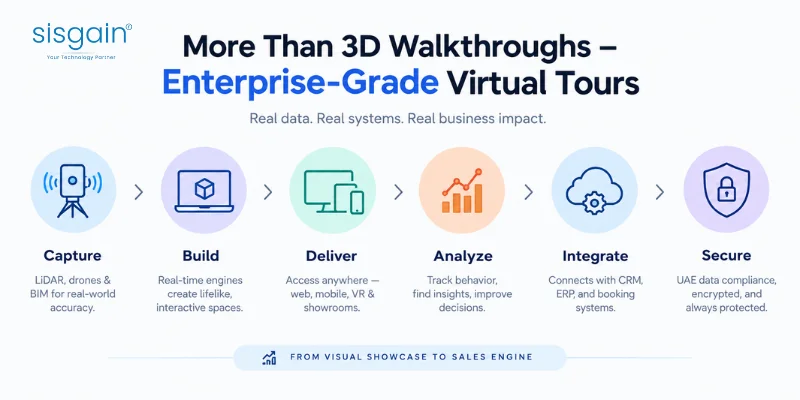
When developers invest in immersive platforms today, they are not buying visual assets. They are commissioning distributed software systems that sit inside their sales stack alongside CRMs, ERP platforms, leasing engines, data warehouses, and analytics tools.
A modern enterprise-grade VR deployment begins at the capture layer. Completed units are scanned using LiDAR systems capable of millimeter-level accuracy, producing spatial datasets that replicate real geometry rather than approximations. Drone-based photogrammetry is often layered on top to model façades, podium levels, rooftop amenities, and surrounding infrastructure. For off-plan developments, Building Information Modeling files are converted directly into interactive environments, allowing structural designs, MEP layouts, and unit typologies to be experienced long before construction starts. Terrain modeling and landscape simulations ensure that master-planned communities, beach access, road networks, and skyline views are rendered with engineering-grade realism rather than artistic guesswork.
These raw spatial datasets then flow into high-performance visualization engines—typically built on platforms such as Unreal Engine or Unity—where real-time lighting models replicate sunrise and sunset angles, reflections off water or glass, and seasonal atmospheric conditions. Materials libraries allow marble finishes, wood textures, fixtures, and appliances to be swapped dynamically. In premium deployments, ray-tracing is enabled to deliver photorealistic reflections and shadows that mirror how a completed unit will actually feel when occupied. This is not aesthetic polish; it is a persuasion tool that replaces imagination with experience.
Delivery, meanwhile, is no longer confined to headsets sitting inside sales galleries. Enterprise platforms are engineered for omnichannel distribution. Prospects may access immersive tours directly through browsers, tablets, or mobile devices using cloud-streamed rendering, while showrooms deploy high-end VR rigs for deeper engagement. WebGL environments allow lightweight exploration from marketing campaigns, while private investor sessions may involve headset-based walkthroughs guided by sales consultants. The same core system powers all these touchpoints, ensuring consistency of pricing, layouts, availability, and branding.
What elevates these systems from visual showcases into strategic infrastructure is the intelligence layer wrapped around them.
Every movement inside a virtual environment can be captured and analyzed. Heatmaps reveal which rooms buyers linger in. Analytics show whether prospects focus on balconies, kitchens, views, or amenity decks. Sales teams can see which unit types are repeatedly compared, where users abandon sessions, and which features correlate with booking requests. Over time, these behavioral datasets feed predictive models that help developers refine layouts, marketing messaging, pricing strategies, and even architectural decisions in future projects.
Integration with commercial systems is equally critical. In enterprise deployments, VR platforms connect directly to CRMs such as Salesforce or HubSpot, proprietary property-management systems, and booking engines. When a buyer completes a tour, their engagement data updates their lead profile automatically. Brokers receive alerts when high-intent prospects revisit specific units. Reservation workflows, payment plans, and mortgage calculators can be triggered from inside the immersive experience rather than after it. This tight coupling between exploration and transaction is what converts curiosity into contracts.
Finally, none of this is viable without rigorous infrastructure planning. Hosting environments must respect UAE data-residency requirements while supporting global access for overseas investors. Secure cloud clusters, encrypted content delivery networks, identity management systems, and audit logging are standard in serious deployments. ISO-aligned security practices, disaster-recovery planning, and role-based access controls ensure that sensitive floor plans, pricing models, and buyer data remain protected across distributed teams.
This is why seasoned developers no longer treat immersive platforms as marketing line items.
When leadership teams calculate Real Estate Software Development in UAE Cost, VR systems increasingly appear alongside CRM modernization programs, leasing platforms, ERP upgrades, and marketing-automation stacks. They are budgeted as multi-year digital infrastructure investments—systems designed to accelerate revenue, sharpen forecasting, and scale international sales operations.
In other words, enterprise-grade virtual tours are not visual candy.
They are sales engines built in code.
How Tier-1 Dubai Developers Deploy VR Systems
From consulting on multiple Gulf region programs, I can tell you that winning deployments follow a layered architecture.
Capture & Modeling Layer
-
BIM models exported directly into visualization engines
-
Drone surveys for master plans
-
Photorealistic material libraries
-
Furniture and finish configurators
VR Application Layer
-
Multi-language UX
-
Arabic & English voice guidance
-
Gesture navigation
-
Accessibility modes
-
Device-agnostic delivery
Sales Automation Integration
-
Unit availability sync
-
Pricing tiers
-
Payment plans
-
Mortgage calculators
-
Reservation workflows
Analytics Layer
-
Which layouts attract buyers
-
Balcony vs interior focus
-
Kitchen dwell time
-
View simulations driving conversions
Compliance & Hosting
-
UAE-based cloud clusters
-
GDPR alignment for overseas buyers
-
Secure content delivery networks
-
Disaster recovery
-
Audit trails
This enterprise thinking is what separates gimmicks from systems that move inventory at scale.
ROI Metrics: What VR Actually Improves
Decision-makers don’t fund immersive platforms because they look impressive.
They fund them because numbers change.
Across global PropTech deployments, VR typically drives:
-
Faster sales cycles
-
Higher international conversion rates
-
Fewer unnecessary site visits
-
Improved broker productivity
-
Stronger off-plan pre-sales
-
Better qualified leads
Key KPIs include:
-
Lead-to-visit ratio
-
Days from inquiry to booking
-
Overseas buyer close rate
-
Marketing cost per unit
-
Broker hours per transaction
-
Cancellation percentages
When layered with analytics and CRM automation, VR becomes a revenue acceleration engine, not a branding tool.
Cost of VR Adoption in Dubai & 2026 Budgets
When immersive technology is discussed in boardrooms, the first question is almost always the same:
“What will this actually cost us—and what do we get in return?”
By 2026, most serious Dubai developers no longer view VR as an experimental marketing expense. They evaluate it in the same way they assess ERP upgrades, CRM replacements, leasing platforms, or AI-driven analytics systems—as capital investments that reshape revenue velocity, international reach, and operational efficiency.
Budgets therefore vary widely, not because vendors are inconsistent, but because the scope of deployment can differ dramatically.
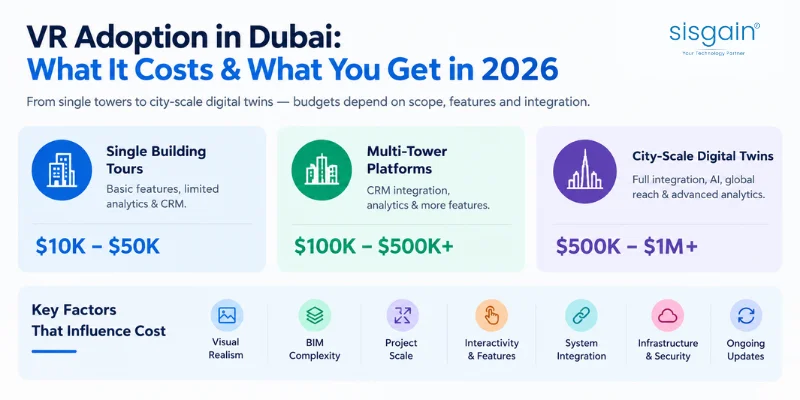
At the lower end, a developer might commission photorealistic walkthroughs for a single residential tower, delivered through browsers and tablets, with limited analytics and basic CRM hand-offs. At the upper end sit city-scale digital twins spanning multiple districts, integrated with live inventory systems, predictive analytics, AI-guided tours, multilingual interfaces, and regional cloud infrastructure built for millions of global visitors.
Several architectural variables drive where a project lands on that spectrum.
The first is the level of photorealism required. High-end luxury projects demand cinematic lighting models, physically accurate materials, reflective glass façades, and shoreline simulations that change throughout the day. Achieving that fidelity requires heavier rendering pipelines, more complex asset production, and stronger cloud streaming infrastructure than simpler mid-market developments.
BIM complexity is another major factor. Converting clean architectural models into interactive environments is straightforward for some towers; for sprawling master-planned communities with mixed-use zones, underground parking systems, transport links, and phased construction schedules, the engineering effort multiplies quickly.
Scale also matters. A single building is one thing. Modeling an entire waterfront district, business park, or hospitality cluster—with multiple unit types, retail spaces, amenities, landscaping, and skyline contexts—pushes immersive systems into true digital-twin territory.
Interactivity adds further layers of cost. Buyers increasingly expect to switch finishes, compare floor plans, simulate furnishing packages, toggle views, explore payment plans, or receive AI-driven guidance inside the experience itself. Each of those capabilities requires additional application logic, data integrations, and testing.
Integration work is often underestimated. Connecting VR platforms to CRMs, inventory management systems, booking engines, pricing databases, mortgage calculators, and marketing-automation tools can rival the cost of the visualization layer itself. For enterprise organizations, this is where much of the long-term value is created—and where serious engineering hours accumulate.
Infrastructure decisions also influence budgets. Browser-based delivery backed by cloud streaming, regional data residency, content-delivery networks for overseas investors, disaster-recovery systems, and security monitoring all add to operational expenditure. Hardware deployments in showrooms—high-end headsets, GPUs, motion-tracking systems, and maintenance contracts—must be factored in as well.
Then there are ongoing costs that sophisticated buyers now plan for from day one: updating content as construction phases progress, refreshing interiors for new campaigns, adding future towers into the same environment, upgrading AI models, retraining sales teams, and renewing security certifications.
When these elements are combined, typical investment ranges become clearer.
Lightweight interactive tours for individual buildings often fall into the tens of thousands of dollars. Enterprise off-plan sales platforms spanning multiple towers, integrated with CRM systems and analytics engines, frequently cross into the six-figure range. City-scale digital twins or multi-portfolio immersive platforms designed to support global marketing, leasing, operations, and long-term planning can push into seven-figure territory.
These numbers closely mirror broader discussions around software development cost in 2026, where AI-powered features, behavioral analytics, compliance frameworks, and cloud infrastructure have become standard expectations rather than premium add-ons. Costs rise—but so does the strategic impact.
That is why Dubai developers increasingly frame immersive platforms within wider digital-transformation programs. When executives evaluate Real Estate Software Development in UAE Cost, VR systems now appear alongside CRM modernization, leasing engines, ERP integrations, and data platforms in multi-year roadmaps.
The mindset shift is crucial.
Organizations that treat VR as a one-off marketing experiment typically deploy narrow tools with limited integration and short lifespans. Those that fund it as long-term sales infrastructure build platforms that compound in value—supporting new launches, attracting international capital, accelerating leasing cycles, and feeding behavioral data back into design and pricing decisions for years to come.
In 2026, the real question is no longer whether immersive technology is affordable.
It is whether developers can afford to compete without it.
VR vs AR vs 3D Walkthroughs: What Should Developers Choose?
| Technology | Immersion | Hardware | Cost | Buyer Reach | Best For |
|---|---|---|---|---|---|
| 3D Walkthrough | Medium | None | Low | High | Online browsing |
| AR | Medium | Mobile | Medium | High | On-site visualization |
| VR | High | Optional headset | Higher | Global | Off-plan sales & luxury |
In practice, enterprise platforms combine all three—meeting buyers wherever they are.
AI + VR: The Next PropTech Advantage
Where immersive systems become transformative is when paired with advanced AI applications.
Forward-thinking developers are deploying:
-
AI tour guides that adapt to buyer interests
-
Voice-driven navigation
-
Predictive lead scoring
-
Layout recommendations
-
Dynamic furnishing simulations
-
Price-sensitivity modeling
-
Automated follow-ups
-
Heatmap-driven sales coaching
The future showroom is not static.
It is adaptive, conversational, and personalized.
Procurement Framework: Choosing a VR Partner in UAE
Selecting a vendor is not about flashy demos.
It is about enterprise readiness.
When evaluating a VR development firm in UAE, executives should examine:
-
Real estate domain experience
-
BIM & CAD pipelines
-
Arabic UX support
-
Data residency
-
Security audits
-
ISO compliance
-
SLA commitments
-
Long-term roadmap
-
Integration capability
-
Support coverage
Procurement teams that treat immersive platforms like core enterprise systems—rather than marketing experiments—see far higher ROI.
Use Cases Beyond Sales
VR is not only for showrooms.
Leading developers extend immersive systems into:
-
Commercial leasing portals
-
Tenant onboarding
-
Mall leasing negotiations
-
Hospitality previews
-
Facility management training
-
Asset inspections
For portfolios that include leasing operations, integration with Real Estate Rent and Leasing Software in Dubai allows immersive tours to feed directly into:
-
Tenant qualification
-
Lease negotiation
-
Digital contracts
-
Maintenance workflows
-
Property analytics dashboards
Challenges, Risks & How Enterprises Mitigate Them
No serious executive team deploys immersive technology without scrutinizing risk.
In Dubai’s property sector—where projects involve hundreds of millions or billions of dirhams, regulatory oversight is significant, and brand reputation is tightly protected—VR platforms are evaluated with the same rigor as financial systems or tenant-management software. The organizations that succeed are not those that ignore obstacles; they are the ones that design mitigation strategies into the architecture from the outset.
The first hurdle is usually financial perception. Immersive systems often appear expensive when viewed purely as marketing assets, particularly when compared with traditional brochures or video fly-throughs. That framing leads to underfunded pilots and fragmented tools that never scale. Mature enterprises counter this by embedding VR inside multi-year digital-transformation programs, tying budgets to measurable KPIs such as sales-cycle compression, international conversion rates, reduction in site visits, and broker productivity. When boards evaluate immersive platforms as revenue infrastructure rather than promotional experiments, funding decisions become far more rational.
Hardware adoption is another frequent concern. Early VR deployments depended heavily on headsets inside showrooms, which limited reach and created logistical complexity. Leading developers now architect platforms for browser-based and mobile access first, using cloud-streamed rendering so international buyers can explore properties without specialized equipment. Headsets remain valuable in premium galleries and VIP sessions, but they are treated as enhancement layers rather than the foundation of the system.
Change management often proves more challenging than technology itself. Brokers accustomed to traditional tours may resist new workflows. Sales managers worry about disruptions to established funnels. Marketing teams fear losing control over campaigns. Enterprises that navigate this successfully invest early in training programs, redesign broker playbooks around immersive discovery, and align incentive structures so staff benefit directly from digital adoption rather than viewing it as an imposed experiment.
Operational complexity does not end at launch. VR platforms must comply with data-protection regulations, particularly when overseas investors are involved. Floor plans, pricing models, and buyer behavior data are commercially sensitive. High-performing organizations therefore insist on regional hosting strategies aligned with UAE data-residency requirements, encrypted content delivery, role-based access controls, and continuous security monitoring. Regular audits and certification renewals become part of standard operations rather than afterthoughts.
Bandwidth and performance present another technical challenge, especially when delivering photorealistic environments to global audiences. Enterprises mitigate this through edge caching, adaptive streaming, regional cloud nodes, and progressive loading techniques that maintain smooth experiences even on consumer-grade connections. The goal is to make immersive exploration feel effortless, regardless of whether the buyer is in Dubai, London, or Singapore.
Content maintenance is frequently underestimated. Developments evolve. Interiors change. Construction phases progress. New towers launch. Prices shift. Enterprises avoid rework spirals by building modular asset pipelines that allow individual units, finishes, or amenity decks to be updated without rebuilding entire environments. Continuous analytics feed back into optimization cycles, guiding which scenes need enhancement and which features drive the most engagement.
What unites successful deployments is planning horizon.
Organizations that treat VR as a standalone campaign tool typically produce impressive demos that fade after a single launch. Those that design immersive platforms as part of a broader digital roadmap—integrated with CRM systems, leasing engines, analytics platforms, and AI-driven sales tools—build capabilities that compound in value year after year.
In Dubai’s competitive property market, resilience matters as much as innovation.
The winners are not the firms that deploy VR fastest.
They are the ones that deploy it deliberately, securely, and at enterprise scale.
The Future of Dubai Property Sales: Digital Twins & Smart Cities
Dubai’s ambition goes beyond selling apartments.
The next frontier includes:
-
City-scale digital twins
-
AI-powered planning simulations
-
Infrastructure forecasting
-
Tokenized assets
-
Smart-contract closings
-
Metaverse-ready sales centers
-
Sustainability modeling
-
ESG reporting overlays
In five years, the difference between leaders and laggards will not be who uses VR—it will be who integrates immersive platforms into every stage of the property lifecycle.
Conclusion: VR Is No Longer Optional in Dubai Real Estate
After decades working on enterprise digital transformations, I see the pattern clearly:
VR has moved from novelty to necessity in Dubai’s property market.
Developers that treat immersive platforms as strategic infrastructure—not just marketing tools—are:
-
Selling faster
-
Reaching global buyers
-
Reducing friction
-
Qualifying leads better
-
Scaling portfolios intelligently
If your organization is evaluating immersive sales systems, now is the time to design them properly—with enterprise architecture, AI intelligence, compliance readiness, and long-term ROI in mind.