
What happens when an aircraft is on the ground, the part you need exists somewhere in your network, and nobody can prove in minutes that it is serviceable and certified? In aerospace, that gap between “we have it” and “we can prove we can fit it” is where AOG costs, audit findings and safety risk live.
Yet many aerospace inventory RFPs are recycled ERP templates. They ask about reports and user interfaces, and they barely test the things that actually decide success: serial-level traceability, certificate control, rotable lifecycle, regulator-ready evidence and integration with the MRO system of record.
In this blog, we walk through an RFP checklist built for UAE Procurement and CIO teams at airlines, MROs, lessors, defence-support organisations and parts distributors. It covers what to require, how to score bidders, and how to run a demo that exposes weak answers before you sign.
Quick Answer: What should an RFP for aerospace inventory management software include?
An effective RFP should specify serial, lot and expiry traceability; capture and validation of release certificates such as FAA Form 8130-3 and EASA Form 1; rotable and repair management; GCAA CAR-145 and CAR-M evidence support; ERP and MRO/M&E integration; PDPL-aligned data protection; a migration and training plan; SLAs and exit terms; a weighted scorecard; and a scripted demonstration.
1. Why UAE aerospace buyers need a different RFP
The UAE is one of the world’s busiest aviation and MRO hubs, and inventory sits at the centre of it. One widely cited estimate from BlueWeave Consulting values the UAE aircraft MRO market at about USD 3.06 billion in 2025, rising to USD 4.33 billion by 2032 at a 5.09% CAGR. Other research houses publish different numbers, with current market estimates ranging from roughly USD 3.1 billion to USD 3.7 billion and growth rates between about 3% and 5% a year. Treat these figures as directional context, and validate your own demand plan before building a business case on them.
Scale is easier to see at company level. Dubai-headquartered DAE Engineering reported more than 1.8 million man-hours, over 320 aircraft checks and more than 60 airline customers across over 30 countries in 2025. Large fleet orders, such as Emirates’ Dubai Airshow Boeing order, point the same way: more aircraft, more checks, more parts moving across more sites.
That volume creates requirements a generic stock module cannot meet:
- Serialised rotables: a single component can be removed, repaired, loaned, exchanged and reinstalled several times. You need lifecycle history, not a quantity on hand.
- Regulatory evidence: GCAA CAR-145 expects approved maintenance organisations to use approved data and material, with documentation linking parts to their specification, conformity statement, manufacturing source and supplier source.
- Complex ownership: bonded stock, consignment stock, customer-owned parts and pooled components often sit in the same warehouse.
- Multi-entity operations: multiple companies, currencies, languages and sites are the norm, not the exception.
The cost of getting this wrong is practical: parts shortages stretch turnaround times, AOG exposure grows, and an unsupported certificate can block an installation or fail an audit.
Quick Answer: Why can’t a generic ERP inventory module cover aerospace needs? Because aerospace inventory is governed by airworthiness documentation, not just quantities. It needs serial-level history, certificate validation, shelf-life control, repair cycles and audit trails that standard ERP stock modules usually do not provide natively.
2. Before you write the RFP: do the groundwork
A strong RFP starts with your own data. Bidders will promise improvement, but you can only hold them to it if you know where you are today.
- Baseline your numbers: inventory value, AOG frequency, stock-out rate, excess and obsolete stock, certificate exceptions and repair turnaround times.
- Define the target operating model: who owns what across procurement, stores, planning, quality, maintenance, finance and IT.
- Sort requirements into three groups: mandatory, desirable and exclusionary. An exclusionary requirement, such as “no certificate-blocked issuance means disqualification,” saves everyone time.
- Draw the scope boundary: will the system be a standalone inventory platform, or part of a wider MRO/M&E programme?
If your team lacks the capacity to run this discovery properly, bringing in IT consulting services in Dubai for requirements workshops and vendor-neutral scoring support can prevent expensive rework later.
RFP Checklist: Require every bidder to confirm in writing that its response is based on your stated baseline and not on generic assumptions.
3. Core functional requirements checklist
This is where most RFPs are either too vague or too long. Aim for specific, testable statements, and require bidders to demonstrate them with realistic aerospace scenarios.
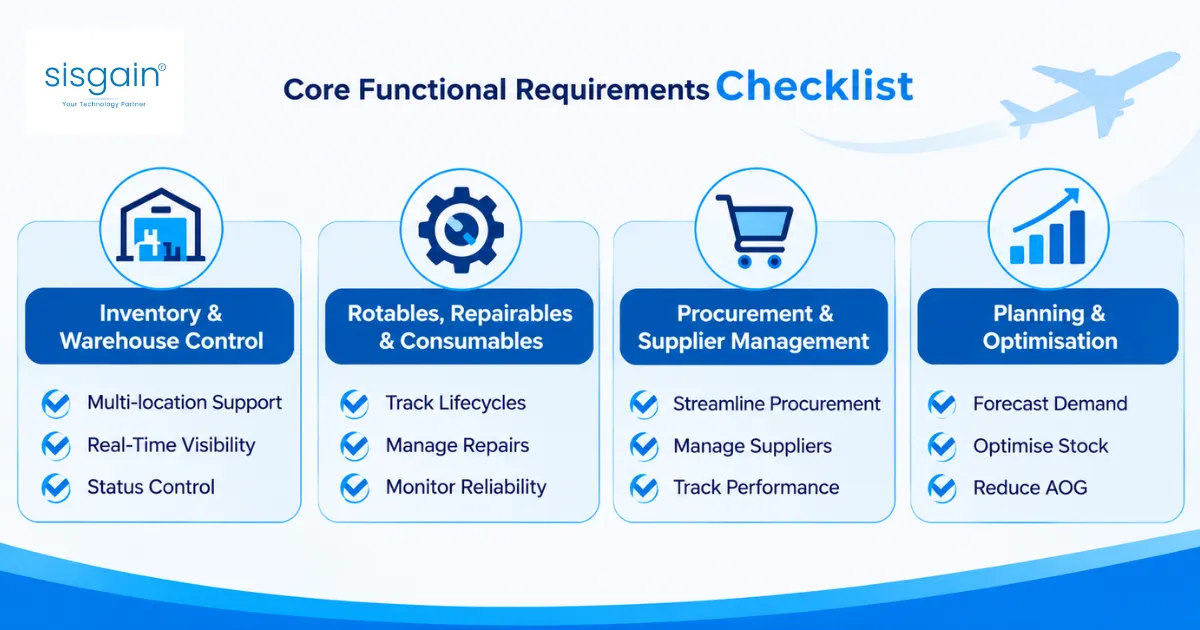
Inventory and warehouse control
- Multi-everything: multi-company, multi-currency, multi-language, multi-site and multi-warehouse support, natively.
- Bin-level visibility: stock movements, transfers, physical counts, cycle counts and reconciliation, with approval workflows for variance adjustments.
- Status control: serviceable, unserviceable, quarantined, conditional, repaired, modified and scrapped stock statuses.
- Ownership models: bonded and non-bonded stock, consignment, customer-owned material and vendor-managed inventory.
- Specialised storage: temperature, humidity, ESD and hazardous-material requirements where applicable.
- Scanning: barcode, QR code, RFID and mobile workflows for receiving, put-away, picking and counting.
- Work-order flow: kitting, reservation, allocation, backorder management and inter-site transfer.
Rotables, repairables and consumables
Rotables need lifecycle visibility. Ask for serialised master records, removal, installation, swap, loan and exchange workflows, plus repair-order tracking by vendor, turnaround time, cost and warranty. Look for repair-versus-replace decision support, reliability metrics such as removal rates and no-fault-found, and warranty recovery reporting.
In practice, rotables, repairables, expendables, consumables, tooling and chemicals each behave differently. Ask bidders to explain those differences instead of claiming one “inventory item” model fits all.
Procurement and supplier management
- Requisition, RFQ, purchase order, receipt, inspection and invoice-match workflows.
- Supplier qualification, an approved vendor list, scorecards and non-conformance tracking.
- Lead-time monitoring, promised-date tracking, expedite management and price variance reporting.
- Contract, blanket-order, exchange, loan, pool and core-charge handling.
Planning and optimisation
Demand forecasting should draw on maintenance schedules, consumption history, fleet plans and reliability data, with safety stock, reorder points and min/max planning on top. Ask for AOG prioritisation rules, excess and slow-moving stock identification, and what-if modelling for fleet growth or lead-time changes. If a vendor claims advanced forecasting, ask how it uses AI predictive maintenance signals, and what data it needs from your MRO system to do so.
For a deeper grounding in the operational fundamentals behind these requirements, our guide to the key elements of strong aviation inventory management is a useful companion for your internal stakeholders.
Some organisations find that off-the-shelf products fit 80% of the need but not the final, business-critical 20%, such as unusual pooling arrangements or legacy interface constraints. In that case, custom aviation software development may be worth evaluating alongside packaged options.
RFP Checklist: Require the bidder to demonstrate a serialised rotable being issued to a work order, removed, sent for repair, replaced, and returned, with full certification and transaction history retained at every step.
4. Traceability and certification: the non-negotiables
Traceability is the foundation of the whole evaluation. If a platform is weak here, strong dashboards and clean screens will not rescue it.
GCAA guidance expects material to carry documentation that relates it to the required specification and includes a conformity statement, manufacturing source and supplier source. Your system must make that documentation easy to capture, find and prove. Require support for:
- Full chain of custody: supplier, receipt, inspection, storage, issue, installation, removal, repair and disposal.
- Certificate capture and version control: FAA Form 8130-3, EASA Form 1, UK CAA Form 1, authorised release certificates and other documents recognised by the GCAA.
- Key identifiers: part number, serial number, lot and batch number, manufacture date, shelf-life expiry, overhaul date and next-certification date.
- Supplier controls: approval status, performance history, purchase-order linkage, receiving inspection records and non-conformance reporting.
- Counterfeit prevention: approved-vendor validation and document verification at receipt.
- Immutable audit logs: user, timestamp, action, before and after values, and reason for change.
- Records retention: aligned with your retention policy and audit obligations.
Just as important is what the system prevents. Ask bidders precisely how it blocks issuance of material with missing, expired or invalid certification, and how it handles quarantined stock.
Quick Answer: What documents should the system capture for each aerospace part? At minimum, the release certificate (for example FAA Form 8130-3 or EASA Form 1), purchase order, receiving inspection record, supplier approval status and any repair, overhaul or modification records, all linked to the part and serial number.
RFP Checklist: Ask for a live traceability report for a single serialised component, showing every certificate, movement, status change, repair event and approval, then ask them to export it as an audit pack.
5. UAE regulatory and data protection requirements
Civil aviation compliance
GCAA CAR-145 governs approved maintenance organisations, including approved data, material and spare parts and the control of subcontracted tools, equipment and personnel. CAR-M addresses continuing airworthiness, including maintenance data and spare consumption. Always check the current revisions on the GCAA website when finalising your requirements.
For the RFP, require support for:
- CAR-145-aligned documentation and audit evidence.
- CAR-M-aligned material and spare-consumption records.
- Role-based approval workflows for receiving, certification, scrap, adjustment and transfer.
- Configurable alerts for expired certificates, missing documents, expired shelf life, unapproved suppliers and non-conforming parts.
- Audit packs exportable by part number, serial number, work order, aircraft registration, supplier, warehouse and date range.
If you work to AS9100 or AS9120 quality systems, ask how the platform supports those as well.
RFP Checklist: Require bidders to mark each compliance function as standard, configured or custom-developed, and to state limitations in writing. Do not accept unsupported claims.
Data protection and cybersecurity
UAE Federal Decree-Law No. 45 of 2021 (the Personal Data Protection Law) sets obligations to protect personal data and prevent breach, alteration or tampering. Aerospace inventory systems hold less personal data than HR or patient systems, but they still process user, supplier-contact and technician records. Free zones such as DIFC and ADGM operate their own data protection regimes, so confirm applicability with your legal counsel.
Require:
- A data-processing inventory and, where relevant, a privacy impact assessment.
- Data minimisation, retention schedules and deletion or anonymisation workflows.
- Role-based access, least privilege and segregation of duties.
- Encryption in transit and at rest, key management, logging and monitoring.
- Breach-notification procedures, sub-processor disclosure and cross-border transfer controls.
- Clear answers on where your data is hosted and who can access it.
Security should not be left to the vendor’s questionnaire alone. Many buyers add independent validation through cybersecurity services in Dubai, such as penetration testing and architecture review, before contract award.
6. Integration and architecture requirements
An aerospace inventory system that cannot talk to your MRO/M&E and ERP platforms becomes another silo. Treat integration as a core requirement, not an afterthought.
Integration area | What to require |
ERP | Purchasing, accounts payable, general ledger, fixed assets, cost centres, master data |
MRO/M&E | Work orders, aircraft registration, maintenance programme, component removal and installation, technical records |
Maintenance planning | Demand forecasts, scheduled checks, material reservations |
Warehouse execution | Barcode and RFID devices, label printing, put-away, picking, cycle counting |
Finance | Inventory valuation, cost accounting, accruals, invoice matching |
Customs and logistics | Shipment tracking, customs status, bonded-stock movements, freight documents |
Identity and access | Single sign-on, directory integration, role provisioning |
Business intelligence | Data warehouse, analytics platform or enterprise reporting layer |
With the interfaces defined, set the technical minimums:
Area | Minimum RFP requirement |
Deployment | Cloud, private cloud, hybrid or on-premises, with clear hosting locations and data-residency options |
Scalability | Support for current and five-year transaction, user, warehouse and SKU volumes |
Availability | Documented uptime commitment, backup frequency, disaster recovery, RTO and RPO |
Integration | Open REST APIs, webhooks, file-based integration, middleware support, prebuilt connectors |
Data quality | Duplicate detection, master-data governance, validation rules, bulk-load tools |
Mobile | Offline-capable or resilient workflows for warehouse, receiving and line stations |
Extensibility | Low-code configuration, workflow designer, custom fields, controlled extension framework |
Exit | Full data export, documented API access, transition assistance |
Integration is also where projects most often slip, which is why we recommend reading our aviation fleet and MRO software guide to understand how maintenance, fleet and inventory data should flow together.
If your landscape includes older platforms or unusual middleware, plan for software integration services early so interface build and testing are scoped realistically rather than discovered during go-live.
RFP Checklist: Require a detailed integration matrix with interface specifications, data frequency, error-handling rules, reconciliation reports and named integration owners on both sides.
7. Implementation, data migration and training
A capable product can still fail through poor delivery. Make the supplier prove it has a credible plan for the project, not only the software.
Implementation plan
Require coverage of discovery and gap analysis, configuration, integrations, testing, training, pilot scope, phased rollout, cutover, hypercare and a continuous-improvement roadmap. Insist on named project roles, escalation paths, governance cadence and milestone-based acceptance criteria. Ask for a work breakdown structure, resource plan, dependency register and risk register.
Data migration
In our experience, data migration is often the largest implementation risk. Legacy records are incomplete, serial numbers are duplicated, and certificates are scattered across scanned files and email. Ask bidders for:
- A migration approach covering parts, suppliers, stock balances, serial numbers, certificates, open orders, repair orders and historical transactions.
- A data-quality assessment, cleansing rules and a duplicate-resolution process.
- Trial migrations, user validation, reconciliation reports and rollback procedures.
- Clear ownership of decisions on incomplete or inconsistent historical records.
If your legacy environment is a concern, our post on legacy system modernization costs and ROI explains how to scope that work.
Training and change management
Require role-based training for stores, buyers, planners, quality, finance, IT and executives, with train-the-trainer and refresher options. Where relevant, ask for Arabic and English interfaces, documentation and support, plus a communications plan and adoption metrics.
Quick Answer: What is the biggest risk in an aerospace inventory implementation? Data migration. Poor-quality legacy data, duplicate serial numbers and missing certificates can delay go-live and undermine trust in the new system. Require trial migrations, reconciliation and a rollback plan from every bidder.
8. Commercial and contractual requirements
Commercial terms decide how the relationship behaves after the demo glow fades. Make bidders price and define the following clearly:
Area | What to require |
Pricing | Separate prices for implementation, licence or subscription, integration, support and optional services |
Licensing | Definitions of user types, transaction, API-call and storage limits, and environment entitlements |
Support | SLAs by severity, response and resolution targets, escalation and 24/7 AOG-critical support |
Warranty | Functional warranty, defect remediation and regression-testing commitments |
IP | Ownership of your configurations, data, reports, interfaces and custom developments |
Exit | Data export, transition assistance, termination rights and, where appropriate, source-code escrow |
Insurance | Professional indemnity, cyber liability and general liability appropriate to contract value |
Local presence | UAE or regional implementation, support and escalation capability |
Watch for hidden costs. API-call limits, extra environments and separately priced integrations can change a five-year total cost of ownership significantly.
9. How to score bidders: a weighted evaluation model
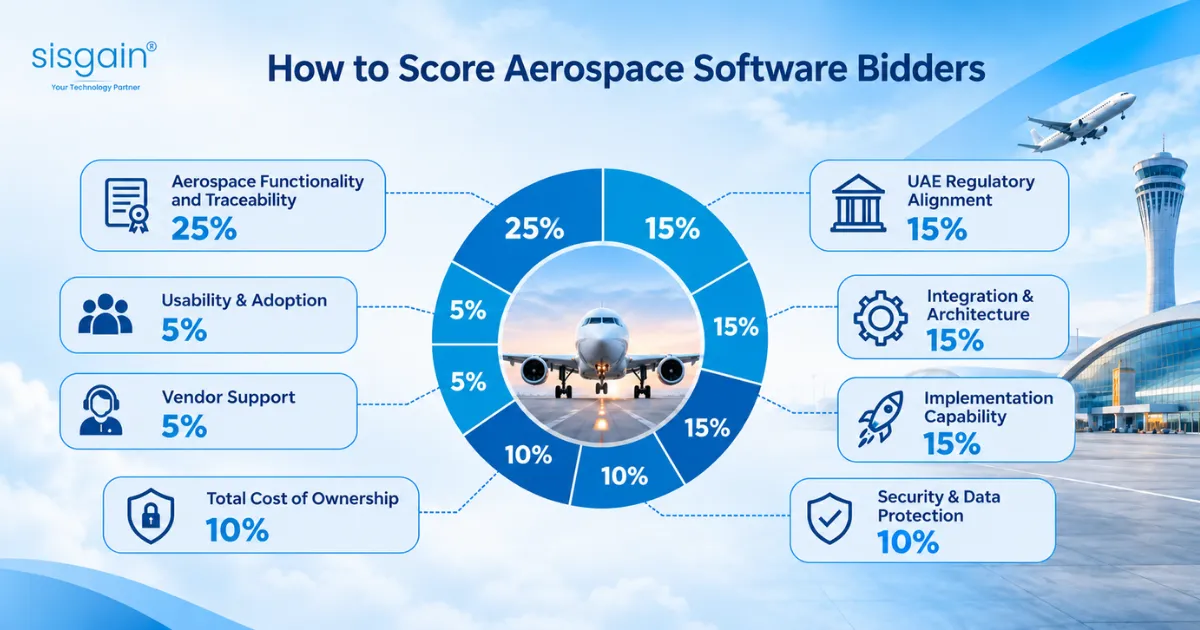
Price should matter, but it should not decide the award. A weighted scorecard keeps the evaluation defensible. The weights below are a suggested starting model; adjust them to your risk profile.
Criterion | Suggested weight | What to assess |
Aerospace functionality and traceability | 25% | Certification, serial and lot control, rotables, repair workflows, audit trail |
UAE regulatory alignment | 15% | GCAA CAR-145 and CAR-M support, release documents, audit evidence |
Integration and architecture | 15% | ERP and MRO integration, APIs, scalability, data model |
Implementation capability | 15% | Aerospace references, UAE delivery team, migration approach |
Security and data protection | 10% | PDPL alignment, cybersecurity, access control, resilience |
Total cost of ownership | 10% | Licence, implementation, integration, support and five-year cost |
Vendor viability and support | 5% | Financial stability, roadmap, local support, references |
Usability and adoption | 5% | Mobile workflows, user experience, training, change management |
Have each bidder score itself against your requirements and provide evidence for every “fully compliant” answer. Then shortlist three to five suppliers on aerospace-domain evidence and integration capability, not on presentation polish.
10. The scripted demo and the questions that expose weak bidders
A scripted demo is the single most effective filter in the process. Give every shortlisted supplier the same scenario, ideally using your own representative data:
- Create an urgent AOG demand for a serialised rotable component.
- Check availability across warehouses, consignment stock and repair vendors.
- Reserve the component and issue it to a maintenance work order.
- Capture the certificate, serial number, shelf-life data and inspection result.
- Remove the unserviceable component and create a repair order.
- Track vendor turnaround time, repair status, warranty and cost.
- Receive the repaired component, validate certification and return it to serviceable stock.
- Produce a complete traceability and audit report.
- Handle exceptions: a missing certificate, expired shelf life, an unapproved supplier and a stock discrepancy.
- Show dashboards for AOG risk, inventory value, fill rate, excess stock and supplier performance.
Then put the hard questions to each bidder:
- Which of these functions are standard product capabilities, and which are custom development?
- How does the system block issuance of material with missing, expired or invalid certification?
- How does it prevent duplicate serial-number records and manage ownership across legal entities?
- Where will our data be hosted, who can access it, and how are cross-border transfers controlled?
- What UAE-based implementation and support resources will be assigned?
- What are the five-year total cost of ownership, support SLA and exit terms?
- What are the top three implementation risks for us, and how will you mitigate them?
A confident bidder answers these with specifics and examples. A weak one retreats to brochures.

Conclusion
Choosing an aerospace inventory management system is a decision about airworthiness evidence, operational resilience and audit confidence, not just stock accuracy. A well-built RFP gives your Procurement and CIO teams a defensible basis to compare suppliers, protect regulatory and data obligations, and hold the winner to measurable outcomes such as better fill rates, fewer AOG events, less excess stock and shorter procurement cycles.
Your next steps are straightforward: confirm the business case with your own data, define the operating model, issue a structured RFP with mandatory, desirable and exclusionary requirements, run scripted demos, call comparable references, complete security and legal due diligence, and approve a phased rollout with clear go-live acceptance criteria.
If you are planning an aerospace inventory programme or need a second opinion on your requirements, talk to our aviation software team. SISGAIN brings scalable engineering, integration experience and a practical understanding of how UAE aviation teams actually work.