
Most ambulance operators in Abu Dhabi now know that ADEMSIS and JAWDA apply to them. Far fewer can say, with evidence, what a “ready” electronic patient care report system looks like. That gap is where ePCR implementation in Abu Dhabi most often goes wrong. Products are shortlisted on the strength of a polished demonstration, yet many were designed around other national data schemes, particularly US/NEMSIS-oriented structures. They store records well. They cannot always prove the record is complete, structured, time-stamped and reportable under Department of Health (DoH) rules.
Under DoH Circular No. 2026/110, licensed ambulance providers have six months to align with ADEMSIS through the ePCR, with a stated deadline of 30 December 2026. DoH states that non-compliance may adversely affect ambulance registration or renewal eligibility. We covered the mandate itself in our guide to the ADEMSIS mandate and data compliance requirements. This article goes one step further. It defines what “ready” means, how to score vendors, and how to implement without discovering gaps at the first JAWDA submission.
Throughout, we separate what DoH states from what we recommend. Confirm every regulatory detail against the original DoH documents before building a plan around it.
Quick Answer: What Must an ePCR Do in Abu Dhabi?
An electronic patient care report (ePCR) system in Abu Dhabi must capture ADEMSIS-aligned, structured and time-stamped data for every patient encounter. It must support electronic signatures, role-based access and encryption, and retain audit logs for at least 25 years. It must connect to dispatch and hospital systems, or provide an approved electronic method for pre-arrival information. It must also produce auditable JAWDA EMS indicator data, including exclusions and missing timestamps, and be available to DoH on request.
What “Ready” Means for an ePCR in Abu Dhabi
An electronic patient care report system that UAE operators can defend in front of a regulator is not defined by how quickly crews can move through a form. It is defined by whether every record is structured, time-stamped, attributable and reportable.
ADEMSIS is a data framework, not a product
The Abu Dhabi Emergency Medical Services Information System (ADEMSIS) is DoH’s standardised data framework for EMS reporting. It defines required and recommended data elements across agency, dispatch, response, patient care, clinical care, transport and outcome. No application “is” ADEMSIS. Providers meet it by configuring, and where necessary extending, the ePCR they use. For that reason, ADEMSIS ePCR readiness is a question of field mapping and validation, not of brand names.
What the DoH EMS Standard asks of the ePCR
The DoH Abu Dhabi EMS standard sets out the baseline. The ePCR is expected to provide encryption, role-based access controls and compliance with DoH data-privacy requirements. Entries must be time-stamped, and audit logs must be retained for at least 25 years, or longer where UAE law requires. The system must collect the mandatory elements of the Abu Dhabi EMS Data Dictionary and the current JAWDA EMS indicators, support electronic clinician signatures and be available to DoH on request. It must also integrate with hospital medical records, or use an alternative electronic method to transmit pre-arrival information.
Why products built for other markets often leave a gap
Many ePCR products were designed around US/NEMSIS-oriented structures. They can be capable clinical tools. The difficulty is fit, and it usually appears in the same places:
- Field definitions that do not map one-to-one to the ADEMSIS Data Dictionary.
- No separation between ambulance arrival at scene and patient-side arrival, which JAWDA treats differently.
- No native handling of UMOC and special pathway (SPP) activation.
- Exclusions captured as free text instead of coded reasons.
- Limited Arabic and English support in reporting and the user interface.
None of these is impossible to close. Each is a mapping, configuration or development task that should be identified and priced before contract award, not after go-live.
The eight-point readiness test
Our recommendation is to judge any ePCR, existing or proposed, against eight questions.
|
Test |
Question to ask |
|
Fields |
Does every ADEMSIS element map to a system field, with its obligation level classified? |
|
Timestamps |
Are system timestamps automatic, sequential and protected from overwriting? |
|
Validation |
Does the system enforce mandatory and required rules at the point of care? |
|
Audit |
Can it show who created or changed any entry, retained for 25 years? |
|
Integration |
Does it connect to dispatch, hospitals and devices, or offer an approved alternative? |
|
Offline |
Does it work without connectivity and synchronise without conflicts? |
|
JAWDA output |
Does it calculate indicators, exclusions and missing timestamps without manual work? |
|
Inspection readiness |
Can records and evidence be produced for DoH on request? |
If you cannot answer yes to all eight with evidence, the system is not yet ready. A short self-check against this list is the most useful first step before any procurement conversation.
Timeline, Jurisdiction and the Reality of the Calendar
Circular No. 2026/110 sets a six-month compliance period, which gives the stated deadline of 30 December 2026. DoH’s Pre-Hospital EMS JAWDA guidance (Version 2.0) takes effect from Q1 2027. As of this update, roughly seven weeks remain before the ADEMSIS date, and the first JAWDA 2.0 reporting period follows closely behind.
For Dubai-headquartered operators, hospital groups and procurement teams, a point of scope is worth stating. These requirements apply to DoH-licensed EMS providers in Abu Dhabi. If your organisation operates under DoH licences, or is bidding for work that does, the rules apply to that activity. Confirm which regulator governs each service line.
The timeline has a practical consequence. A full programme, as described in Section 9, runs to about 22 weeks. A provider starting now cannot complete it before 30 December. Our recommendation is to work a compliance-critical path first: field mapping, mandatory validation and timestamp integrity, then integrations, analytics and optimisation. This sequencing is our suggestion, not a DoH stage.
The Business Case: The ePCR as the Data Backbone
The strongest procurement position treats the ePCR not as a documentation tool but as the operational data backbone for compliance, clinical quality, dispatch integration and performance reporting.
The cost of inaction
The principal exposures are well defined:
- Regulatory risk, including effects on registration or renewal eligibility.
- Unreliable JAWDA submissions, because incomplete or poorly structured records feed directly into reported performance.
- Incomplete clinical records. DoH’s guidance treats missing documentation as non-compliance with documentation requirements.
- Manual reporting effort and an inability to evidence exclusions or missing timestamps.
Organisations still running paper or loosely structured systems face a harder version of this problem. If that describes your environment, our note on modernising legacy systems covers the cost and sequencing questions.
Where the value comes from
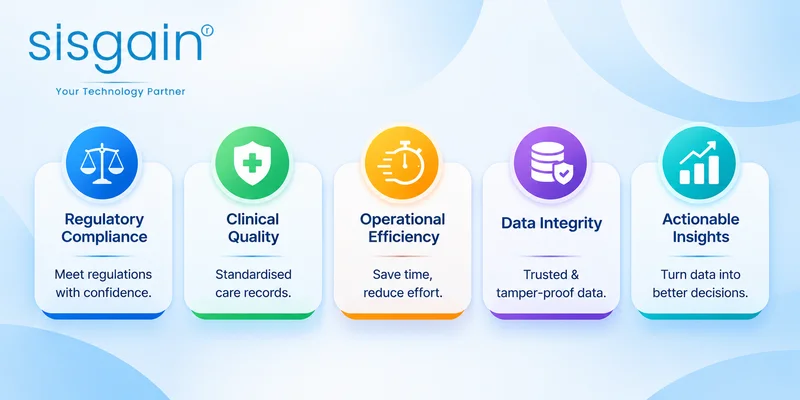
A properly implemented platform delivers value in five areas: regulatory assurance through automated field capture, clinical quality through protocol-driven documentation, operational efficiency through reduced duplicate entry, data integrity through system timestamps and immutable audit trails, and management intelligence through dashboards for response times, clinical bundles and data-quality exceptions.
Target Operating Model for an Ambulance ePCR System
The design principle is a single source of truth for each patient encounter. Dispatch, vehicle, clinical, device and handover data should reconcile into one structured record that serves both frontline care and regulatory reporting.
|
Layer |
Required capability |
|
Field capture |
Offline-capable mobile ePCR, structured clinical forms, ID capture, electronic signature |
|
Clinical workflow |
Protocol-driven assessments, vitals, treatments, pain scores, trauma, burn and stroke tools |
|
Integration |
CAD and dispatch, UMOC, hospital pre-alert, monitors and defibrillators, fleet data |
|
Data governance |
ADEMSIS mapping, validation rules, audit logs, role-based access, encryption |
|
Quality reporting |
JAWDA indicator engine, exclusion logic, exception queues, submission files |
|
Analytics |
Executive dashboards, crew and unit performance, data-quality monitoring, clinical audit |
The core workflow
- A dispatch event is created and synchronised to the mobile ePCR.
- The crew records call receipt, response, arrival, patient contact, assessment, interventions and transport timestamps.
- Clinical protocols trigger required fields for ACS, stroke, trauma, burns, cardiac arrest and pain management.
- UMOC or special pathway activation is documented before transport where applicable.
- Device data from monitors, defibrillators and ECG systems is linked to the encounter.
- The record is electronically signed, validated, synchronised and locked.
- JAWDA logic calculates indicators, exclusions and missing timestamps.
- Governance reviews exceptions, data-quality failures and corrective actions.
The dispatch link in step 1 is where many programmes stumble. A clean hand-off between CAD and ePCR depends on consistent identifiers and timestamp reconciliation. Our overview of the features a computer-aided dispatch system should include explains what to require on the dispatch side, and our computer-aided dispatch software UAE page describes how we approach it.
ADEMSIS ePCR Compliance Requirements in Practice
ADEMSIS requires providers to align data collection and reporting with the Data Dictionary. The ePCR must therefore capture standardised fields across the full prehospital encounter, not merely free-text notes. The Data Dictionary, not this article, determines which elements are mandatory, required, recommended or optional.
|
Domain |
Examples of required capability |
|
Agency |
Provider identity, unit, crew, licensure, shift, resource type |
|
Dispatch |
Call receipt, dispatch, assignment, response mode, cancellation status |
|
Response |
Location, scene arrival, patient-side arrival, access constraints |
|
Patient care |
Demographics, complaint, assessment, vitals, triage, interventions |
|
Clinical |
ECG, glucose, pain assessment, analgesia, cardiac arrest, ROSC, defibrillation |
|
Transport |
Scene departure, destination, transport priority, handover |
|
Outcome |
Disposition, transfer of care, clinical response, SPP activation |
|
Governance |
User identity, licence number, timestamps, audit trail, e-signature |
Obligation levels shape validation design
The Data Dictionary assigns each element an obligation level. Our implementation recommendation is to configure validation to match. A mandatory field should reject prohibited “not” values and flag the record as incomplete until a valid entry exists. A required field should permit only the “not” values the dictionary allows, and log the choice. Do not invent handling rules beyond the specification.
Non-negotiable controls
- A record must exist for every patient transported. Missing or incomplete records are treated as a compliance deficiency.
- All entries must be time-stamped, with audit logs retained for at least 25 years or longer where UAE law requires.
- The system must support electronic signatures confirming documentation accuracy.
- The ePCR must transmit pre-arrival information to receiving hospitals, or use an alternative electronic method.
- DoH must be able to access records on request.
A note on interoperability standards: ADEMSIS does not, on the evidence we have reviewed, mandate a particular exchange standard such as HL7 or FHIR. They remain widely used for the hospital and exchange connections the EMS Standard anticipates.
JAWDA EMS Reporting: Designing for the Numbers
JAWDA, meaning “quality”, is Abu Dhabi’s healthcare quality framework. The Pre-Hospital EMS JAWDA guidance applies to all DoH-licensed EMS providers, public and private, and requires quarterly reporting through the JAWDA online portal. Version 2.0 applies from Q1 2027.
Each submission must include the raw numerator and denominator, exclusion counts by category, the exclusion rate, the count of invalid or missing timestamps, and the raw case volume. Exclusions must be auditable through structured ePCR, dispatch, UMOC, device or operational data fields.
The core indicator portfolio
|
KPI |
Measure |
Target |
|
EMS001 |
Urban ambulance responses arriving at scene within 7 minutes |
90% or higher |
|
EMS002 |
Rural ambulance responses arriving at scene within 15 minutes |
90% or higher |
|
EMS003 |
UMOC activation for eligible STEMI, stroke, burn and trauma SPP cases |
90% or higher |
|
EMS004 |
ACS-suspected patients given aspirin before hospital arrival |
90% or higher |
|
EMS005 |
ACS-suspected patients receiving a 12-lead ECG within 10 minutes of patient-side arrival |
90% or higher |
|
EMS006 |
ACS, STEMI and stroke patients departing scene within 15 minutes |
90% or higher |
|
EMS007 |
Criteria-met trauma and burn SPP patients departing scene within 10 minutes |
90% or higher |
|
EMS008 |
Cardiac-arrest patients achieving sustained ROSC before handover |
20% or higher |
|
EMS009 |
Shockable-rhythm cardiac-arrest patients defibrillated before hospital arrival |
100% |
|
EMS010 |
Stroke-suspected patients with documented glucose measurement |
90% or higher |
These figures reflect the JAWDA guidance as summarised for this article. Verify them against the current DoH document before using them in a specification.
Design rules that decide success
Separate the two arrival times. JAWDA uses patient-side arrival for the 10-minute ECG measure, not the moment the vehicle reaches the scene. An ePCR that records one “arrival” will produce a wrong numerator.
Make exclusions structured. “Aspirin contraindicated” should be a coded reason with supporting clinical context. A free-text note cannot be counted by category or audited.
Capture clinical findings as fields. Structured BEFAST stroke findings, ACS symptoms, shockable rhythms, defibrillation events, glucose results and pain scores should all be discrete data, not narrative.
Consider EMS005. The measure depends on the patient-side arrival time, the ECG acquisition time, an ACS-suspected flag and any coded exclusion. If any of the four is missing or unstructured, the case cannot be placed correctly in the numerator or denominator, and it falls into the invalid or missing timestamp count that DoH expects you to report.
ePCR Vendor Selection: A Weighted Scorecard
Use a weighted scorecard rather than selecting on demonstrations alone. The following weighting is our recommendation. It deliberately puts regulatory fit ahead of generic features.
|
Criterion |
Weight |
What “excellent” looks like |
|
ADEMSIS alignment |
20% |
Native mapping to the current Data Dictionary, configurable without custom coding |
|
JAWDA reporting |
20% |
Automated indicator calculation, exclusion logic, missing-timestamp reporting, portal-ready output |
|
Abu Dhabi EMS fit |
15% |
Demonstrated UAE or Abu Dhabi deployments, DoH and UMOC familiarity, Arabic and English support |
|
Interoperability |
15% |
CAD, dispatch, UMOC, hospital, monitor, ECG, fleet and billing integrations |
|
Clinical usability |
10% |
Fast offline documentation, protocol-driven workflows, few taps, crew adoption |
|
Security and compliance |
10% |
Encryption, role-based access, audit logs, retention, privacy controls, DoH access readiness |
|
Implementation and support |
5% |
Local team, training, 24/7 support, data-migration plan |
|
Commercial value |
5% |
Transparent licensing, implementation, integration, support and change-request pricing |
Mandatory requirements before contract award
Any shortlisted vendor should evidence, not assert, the following:
- Native or configurable support for the current ADEMSIS Data Dictionary.
- Automated calculation and auditability of all current JAWDA EMS indicators.
- Structured exclusion categories and missing or invalid timestamp reporting.
- Time-stamped records, electronic signatures, role-based access, encryption and long-term audit retention.
- Integration with dispatch and, where applicable, UMOC and hospital pre-alert systems.
- Offline capability with automatic synchronisation and conflict resolution.
- Device integration or structured import for ECG, monitor and defibrillator data.
- Arabic and English interface, reporting and support.
- Readiness for DoH inspection and data requests.
Proof, not promises
Request the following during evaluation:
- A live demonstration using Abu Dhabi scenarios: an urban 7-minute response, a rural 15-minute response, ACS with ECG, stroke with glucose, a trauma or burn SPP case, and cardiac arrest with ROSC and defibrillation.
- A sample JAWDA quarterly file showing numerator, denominator, exclusions, exclusion rate, invalid timestamps and case volume.
- A field-mapping matrix from ADEMSIS elements to system fields, validation rules and reports.
- Integration architecture for CAD, UMOC, hospital systems and EMS devices.
- Reference calls with comparable UAE or GCC operators.
- Security documentation, including hosting location, disaster-recovery commitments and audit-retention evidence.
- An implementation plan naming clinical, technical, data and training leads.
Red flags
- “ADEMSIS-approved” claims. In the DoH sources we reviewed, we found no approved-vendor list. Ask what the claim actually means and who verified it.
- Custom coding for core fields. If standard ADEMSIS elements need bespoke development, cost and update risk both rise.
- Manual KPI calculation. Spreadsheet reconciliation is where audit weakness starts.
- No offline conflict resolution. Field records are created where connectivity is least reliable.
Configure, extend or replace?
Replacement is not always the answer. A provider with a capable existing ePCR may close its gaps through configuration, targeted development and integration work. A structured gap assessment should come before any decision to replace, and the vendor scorecard works equally well for assessing a current system. On the integration side, the questions are practical: which connections exist, which use standards such as HL7, and which need building. Our work on HL7 integration solutions UAE and software integration services Dubai addresses exactly this layer. Dispatch evaluation follows a similar discipline, outlined in our guide on how to evaluate dispatch software.
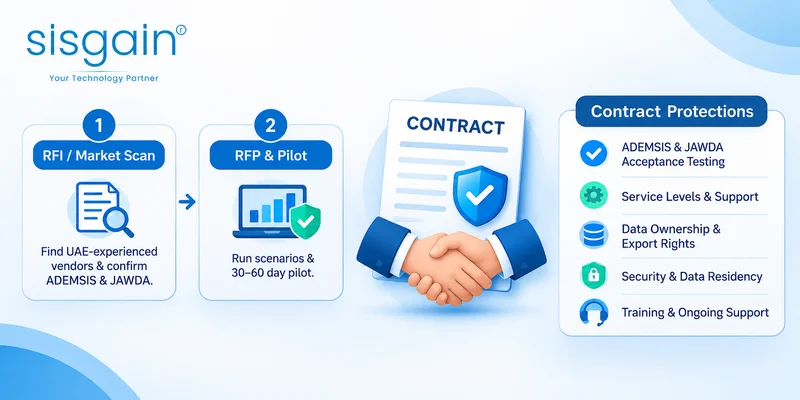
Procurement Approach and Contract Protections
We recommend a two-stage competitive process.
Stage one: RFI or market scan. Identify vendors with Abu Dhabi or UAE EMS experience and confirm ADEMSIS and JAWDA capability on paper.
Stage two: scenario-based RFP and proof of value. Run the demonstration scenarios from Section 7 and a 30 to 60 day pilot using de-identified or controlled live data. Avoid selecting on generic ePCR functionality. The deciding factor should be whether the vendor can prove automated, auditable JAWDA reporting and field-level ADEMSIS alignment under real operating conditions.
Suggested contract protections
- Acceptance testing tied to ADEMSIS field mapping and JAWDA indicator validation.
- Service levels for uptime, support response, synchronisation and defect resolution.
- Data ownership, export rights, exit assistance and transition support.
- No additional charge for mandatory regulatory updates during an agreed period.
- Integration delivery milestones with remediation or penalty mechanisms.
- Local data-residency, privacy, cybersecurity and audit-access commitments.
- Training, hypercare and post-go-live optimisation within scope.
Hosting is a decision to settle early, because it shapes residency, security and update responsibility. Our comparison of SaaS versus on-premise healthcare software sets out the trade-offs.
Implementation Roadmap for ePCR in Abu Dhabi
The plan below is our recommended 120-day programme. It is not a DoH-mandated sequence.
|
Phase |
Duration |
Key deliverables |
|
Mobilise |
Weeks 1–2 |
Steering committee, compliance gap assessment, data-owner map, success criteria |
|
Design |
Weeks 3–6 |
ADEMSIS field mapping, JAWDA logic, workflows, integration architecture, security design |
|
Configure |
Weeks 7–10 |
Forms, rules, roles, dashboards, device interfaces, dispatch integration |
|
Validate |
Weeks 11–14 |
UAT, indicator reconciliation, audit, offline and security testing |
|
Pilot |
Weeks 15–18 |
Controlled live pilot, crew feedback, data-quality dashboard, corrective actions |
|
Scale |
Weeks 19–22 |
Full rollout, training completion, hypercare, JAWDA dry run |
|
Sustain |
Ongoing |
Monthly data-quality reviews, quarterly governance, annual control testing |
If time is short
With the 30 December date close, run Mobilise and Design in parallel, and limit the first release to the compliance-critical path: mapped fields, mandatory validation, timestamp integrity and audit logging. Defer analytics and secondary integrations to a second release, and keep a documented plan for them. Keep configuration, testing and training records throughout, since DoH may ask for evidence of implementation.
Critical success factors
- Appoint an executive sponsor, an EMS clinical lead, a data lead, an IT integration lead and a JAWDA reporting owner.
- Make data quality a frontline responsibility, not only an IT task.
- Use structured fields and mandatory validation at the point of care.
- Reconcile ePCR, dispatch, UMOC and device data before each quarterly submission.
- Track exception queues daily during go-live and weekly afterwards.
- Complete a full JAWDA dry run before the first formal submission.
Two disciplines tend to decide the outcome. The first is integration, covered in our playbook for integrating healthcare software. The second is testing: UAT, indicator reconciliation and offline scenarios need independent verification, which is where QA testing services Dubai are most useful.
Risk Register
|
Risk |
Impact |
Mitigation |
|
ADEMSIS fields mapped incorrectly |
Failed compliance, unreliable reporting |
Independent mapping review and UAT sign-off |
|
Missing timestamps |
Numerator or denominator errors |
Automatic system timestamps, exception dashboard, crew training |
|
Manual indicator calculation |
Reporting delays, audit weakness |
Automated engine with traceable logic |
|
Poor offline performance |
Incomplete field records |
Offline-first design, synchronisation testing, field pilot |
|
Weak dispatch integration |
Inaccurate response-time indicators |
CAD interface with timestamp reconciliation |
|
Low clinician adoption |
Incomplete documentation |
Workflow simplification, super-users, feedback loops |
|
Privacy breach |
Regulatory and reputational exposure |
Encryption, access logging, privacy impact assessment |
|
Vendor lock-in |
Costly future change |
Export rights, open APIs, exit provisions |
Governance and Operational KPIs
Establish a monthly ePCR Compliance and Data Quality Council, chaired by the EMS operations or clinical director, with clinical, quality, IT, dispatch, analytics, compliance, training and vendor representation.
The following internal targets are our recommendations, not DoH figures:
|
Measure |
Recommended target |
|
ePCR completion within required timeframe |
100% |
|
Mandatory-field completeness |
98% or higher |
|
Valid timestamp rate |
98% or higher |
|
JAWDA submission on time |
100% |
|
Integration reconciliation accuracy |
98% or higher |
|
Critical system availability |
99.9% or higher |
|
Unresolved data-quality exceptions |
Declining month on month |
Governance also covers access and privacy. For the wider obligations on health data in the UAE, see our guide to UAE healthcare data-protection requirements.
Illustrative Use Cases
The following scenarios are illustrative, not customer cases. Most EMS data teams will recognise the patterns.
A missing patient-side timestamp. A crew records scene arrival but not patient contact. The 12-lead ECG time cannot be measured against the 10-minute standard, so the case lands in the missing-timestamp count. The fix is a system rule that requires patient-side arrival before the ACS pathway fields unlock.
An uncoded exclusion. A paramedic withholds aspirin for a sound clinical reason and writes it in the narrative. At audit, the exclusion cannot be categorised or counted, and the case reads as a failure. A coded contraindication field with supporting context resolves it.
A mismatched dispatch identifier. The CAD incident number differs from the ePCR incident number for a subset of calls. Response-time indicators cannot be reconciled, and manual matching delays the quarterly submission. Interface testing with timestamp reconciliation before go-live prevents it.
How SISGAIN Supports ePCR Readiness
SISGAIN works across healthcare software, computer-aided dispatch and HL7 integration from our Dubai headquarters, and we have followed the ADEMSIS mandate closely. Our healthcare software development Dubai practice applies that experience to EMS data workflows.
The ePCR readiness assessment is designed to give your leadership a clear, evidence-based position before you commit to a vendor or a build. It covers:
- A gap review of your current ePCR, paper processes and reports against the ADEMSIS Data Dictionary.
- A JAWDA data-flow review, tracing each indicator from field capture to submission.
- An integration map for dispatch, UMOC, hospital and device connections.
- A vendor-scoring workshop using the scorecard in this guide, tailored to your priorities.
- A prioritised, time-bound remediation plan, including a compliance-critical path.
Conclusion
Successful ePCR implementation in Abu Dhabi comes down to a compliance-first, interoperability-led and workflow-aware approach. Define readiness before you buy, score vendors on evidence, protect yourself contractually, and prove the data through a full JAWDA dry run before the first submission. With the December date approaching, the sensible next step is a clear view of where you stand today. Request an ePCR readiness assessment to get one.