
The Abu Dhabi Emergency Medical Services Information System (ADEMSIS) now comes with a deadline. According to Department of Health Abu Dhabi (DoH) Circular No. 2026/110, issued on 30 June 2026, licensed ambulance service providers have six months to comply, which gives a stated deadline of 30 December 2026. For any provider assessing its position on ADEMSIS Abu Dhabi, the question has moved from whether to act to how much work separates current systems from the Data Dictionary.
That work rarely sits with one team. ADEMSIS affects how dispatchers record times, how crews document care, how the electronic Patient Care Record (ePCR) validates each entry, how interfaces move data, and how quality teams report. A weakness in any one of these can show up as a weakness in the records DoH may ask to see.
This guide explains what ADEMSIS is, who it applies to, what data it covers, how its quality rules work and how to prepare. It keeps DoH’s stated requirements separate from implementation recommendations, and you should confirm every circular detail against the original DoH documents before building a plan around it.
Quick Answer: What Is the ADEMSIS Compliance Deadline in Abu Dhabi?
ADEMSIS stands for the Abu Dhabi Emergency Medical Services Information System, the standardised EMS data framework of the Department of Health Abu Dhabi (DoH). Under Circular No. 2026/110, dated 30 June 2026, all licensed ambulance service providers operating in the Emirate have a six-month compliance period, ending on the stated deadline of 30 December 2026. Compliance is to be achieved through an electronic Patient Care Record (ePCR) system, with the ADEMSIS Data Dictionary (Version 1.0, May 2026) defining the data elements.
What Is ADEMSIS in Abu Dhabi?
Understanding the Abu Dhabi Emergency Medical Services Information System
ADEMSIS is, in DoH’s words, its standardised data framework for EMS reporting across the Emirate. It defines the core data elements that licensed ambulance service providers are required or recommended to collect and submit, covering agency, dispatch, response, patient care, clinical, transport and outcome information. DoH directs it at licensed providers, operational and clinical leads, and provider data and reporting teams.
Why Abu Dhabi Needs Standardised EMS Data
DoH states that standardised collection supports consistent reporting, service monitoring, performance measurement, clinical quality improvement and system-wide planning for prehospital care. The practical logic is simple. If one provider logs “arrival” when the vehicle stops and another logs it when the crew reaches the patient, the two response times cannot be compared. Shared definitions remove that ambiguity.
What the ADEMSIS Data Dictionary Does
The Data Dictionary is the working document behind the framework. It sets out field definitions, data structures, validation rules, code lists and usage requirements, so every provider records the same thing in the same way. Per your brief, Version 1.0 is dated May 2026 and runs to 664 pages.
ADEMSIS is a standardised data framework, not a standalone software product. No application “is” ADEMSIS. Providers meet it by configuring and, where needed, extending the ePCR, interfaces and workflows they already use.
Why ADEMSIS Is Mandatory in 2026
DoH’s ADEMSIS page tells all relevant providers and stakeholders to download, review and align their data collection and reporting systems with the framework to ensure compliance with DoH requirements. This is a compliance requirement, not a voluntary best practice.
Understanding Circular No. 2026/110
According to the circular, DoH Abu Dhabi issued it on 30 June 2026 to licensed ambulance service providers in the Emirate. It sets a six-month compliance period, names the ePCR as the compliance channel and points to the ADEMSIS Data Dictionary, Version 1.0 (May 2026).
How the Six-Month Compliance Window Works
Six months from 30 June 2026 gives the stated deadline of 30 December 2026. The following internal milestones are our suggestion, not official regulatory milestones:
- July–August: Review and baseline assessment.
- September–October: Field mapping, configuration and workflow updates.
- November: Testing, training and issue resolution.
- December: Final readiness assessment and evidence review.
Providers that have not yet started should run the first two phases in parallel rather than in sequence. A rapid baseline assessment can begin within days, and configuration of the highest-risk gaps can start while the review continues.
Why This Is More Than a Reporting Update
Aligning with ADEMSIS changes how work is done, not only how it is reported. Technology teams must map and validate fields. Dispatchers and crews must capture timestamps and codes consistently. Operations must confirm that workflows produce the data. Governance teams must control access and keep evidence. Quality teams must trust the data enough to measure performance with it. A late fix at the reporting stage rarely repairs a gap created at the point of care.
Who Must Comply With ADEMSIS?
Licensed Ambulance Service Providers in Abu Dhabi
The obligation falls on licensed ambulance service providers operating in the Emirate of Abu Dhabi. DoH’s page names providers, their operational and clinical leads, and their data and reporting teams as the intended audience. Check the circular itself for exactly how it defines in-scope licence holders, particularly if your organisation runs several service lines.
Which Internal Teams Are Involved?
Compliance is a regulated organisation’s responsibility, but delivering it is shared work. This does not mean every employee carries an identical legal obligation.
- Operations and dispatch: call, dispatch and response records.
- Paramedics, EMTs and clinical leadership: assessments, interventions and patient documentation.
- Quality and reporting: data-quality review and performance measurement.
- IT and ePCR administrators: field mapping, validation, interfaces and access.
- Compliance and information governance: evidence, privacy and audit readiness.
- Management and project owners: resourcing, sign-off and accountability.
What Data Must Ambulance Providers Capture Under ADEMSIS?
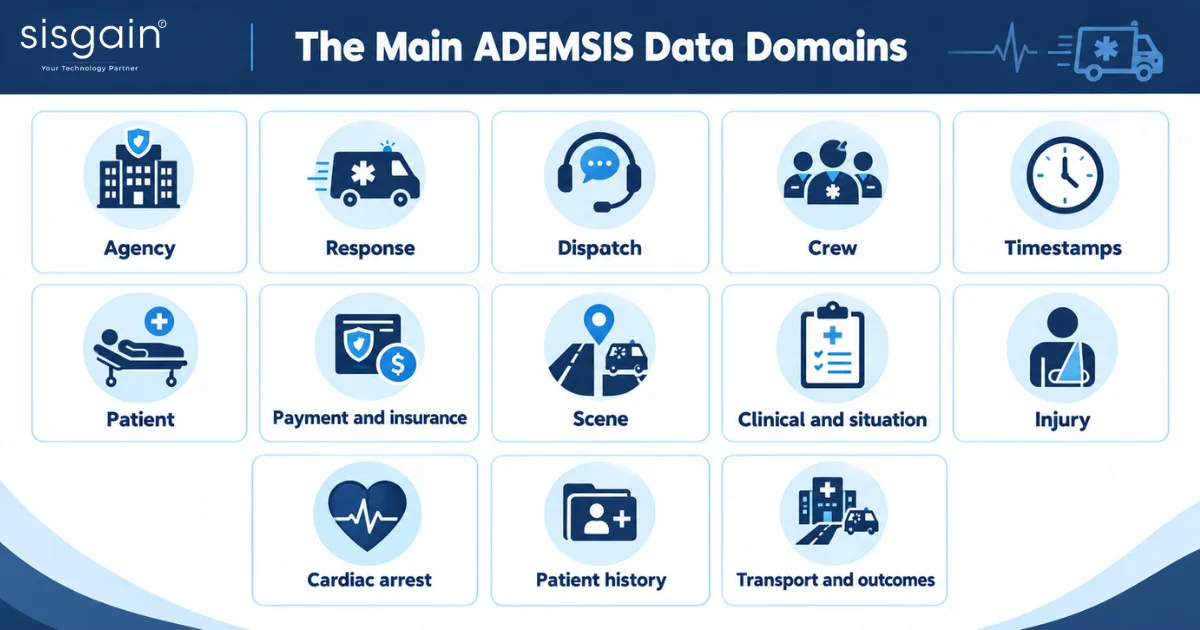
The Data Dictionary, not this article, determines which elements are mandatory, required, recommended or optional. The table below gives representative examples only and does not imply that every listed element is mandatory.
The Main ADEMSIS Data Domains
|
Domain |
Representative examples |
Why it matters |
|
Agency |
Agency name, DoH licence number, Emirate |
Identifies the reporting provider |
|
Response |
Incident and response identifiers, unit capability, vehicle, call sign, GPS, response mode, delays |
Links a record to a specific unit and response |
|
Dispatch |
Dispatch reason, EMD status, determinant code, dispatch centre, priority, acuity, CAD record ID |
Connects call-taking decisions to the patient record |
|
Crew |
Crew-member ID, level, role |
Attributes care to the right personnel |
|
Timestamps |
999 call, dispatch notification, acknowledgement, en route, scene arrival, patient contact, care transfer, scene departure, destination arrival, handover, return to service, cancellation, completion |
Supports response-time and interval analysis |
|
Patient |
Applicable identifiers, demographics, contact details, preferred language |
Supports identification and continuity |
|
Payment and insurance |
Payment, insurer, policy, assessment and administrative details |
Supports administrative processes where applicable |
|
Scene |
Incident location, GPS, facility, number of patients, other agencies involved |
Places the incident in context |
|
Clinical and situation |
Chief complaint, symptoms, provider impression, acuity, transfer justification |
Records clinical reasoning |
|
Injury |
Cause, mechanism, trauma triage, vehicle impact, safety equipment |
Supports trauma review |
|
Cardiac arrest |
Witnessed status, resuscitation, AED use, CPR type, rhythm, return of spontaneous circulation, timestamps, cessation reasons |
Supports resuscitation review |
|
Patient history |
Relevant history, barriers to care, practitioner information |
Informs care and handover |
|
Transport and outcomes |
Destination, transport justification, handover, recorded outcome |
Closes the record |
Why Each Data Domain Matters Operationally
Small data defects have large downstream effects. A missing en route timestamp makes a response interval impossible to calculate. An incomplete chief complaint weakens clinical review. A CAD record ID that does not match the ePCR incident number breaks the link between dispatch and care. Free-text entries where a coded value is expected cannot be counted, filtered or compared. These are illustrative examples, not customer cases, but most EMS data teams will recognise them.
The Full EMS Data Journey
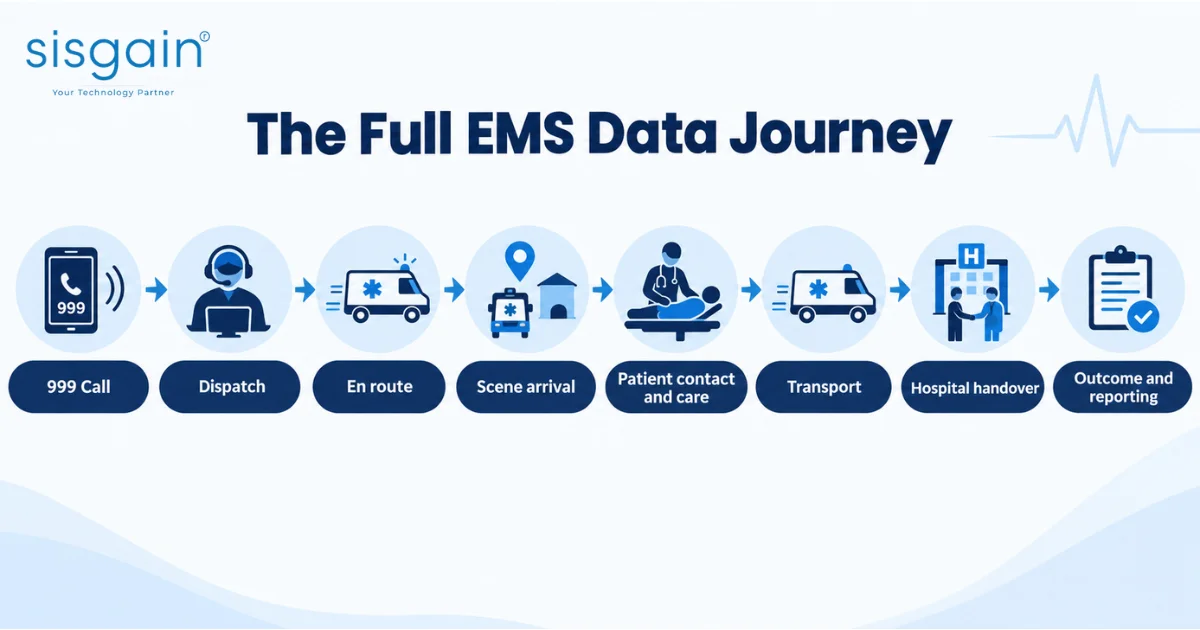
An ADEMSIS record follows the patient pathway: 999 call → Dispatch → En route → Scene arrival → Patient contact and care → Transport → Hospital handover → Outcome and reporting. Each stage creates timestamps, identifiers and clinical entries that must connect to the next.
Visual 1 (recommended): The ADEMSIS EMS Data Journey. A horizontal flow of the eight stages above, with the key data captured under each. Alt text: “EMS data journey under the ADEMSIS framework from emergency call and dispatch to patient care, hospital handover and outcome reporting.”
The applicable Data Dictionary determines which elements at each stage are mandatory, required, recommended or optional.
ADEMSIS Data Quality and Validation Rules Explained
Mandatory, Required, Recommended and Optional Fields
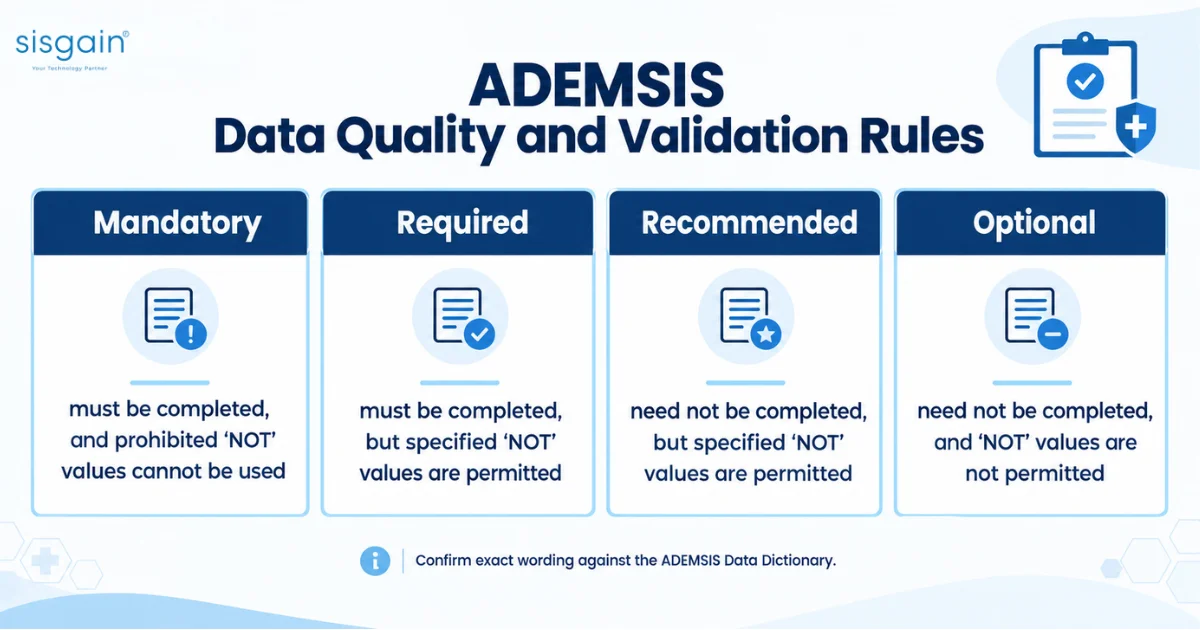
As summarised in your brief (confirm the exact wording in the Data Dictionary):
- Mandatory: must be completed, and prohibited “NOT” values cannot be used.
- Required: must be completed, but specified “NOT” values are permitted.
- Recommended: need not be completed, but specified “NOT” values are permitted.
- Optional: need not be completed, and “NOT” values are not permitted.
Understanding Not Applicable, Not Recorded and Not Reporting
These structured values stop a blank field from meaning three different things. In general EMS data usage, they separate an element that does not apply to the incident (Not Applicable), one that applies but was not captured (Not Recorded), and one the provider does not report (Not Reporting). Each field’s permitted values and exact meanings come from the Data Dictionary. Used correctly, they reduce ambiguity and make reports easier to interpret.
Validation Rules, Code Lists and Missing Data
Validation works best when it is built into the ePCR, backed by consistent code lists and followed by exception reporting and corrective action.
Consider a field the Data Dictionary classes as Required, which the crew cannot complete because the information was not collected. As an implementation recommendation, the ePCR should not let the field stay silently empty, nor accept free text. It should offer only the “NOT” values the dictionary permits for that field and log the choice. For a Mandatory field, the ePCR should reject any “NOT” value and flag the record as incomplete until a valid value is entered. Do not invent handling rules beyond the specification.
How ADEMSIS Improves EMS Performance and Clinical Quality
From Documentation to Performance Measurement
Standardised data lets providers and DoH review performance on a like-for-like basis. DoH describes the framework as supporting performance measurement and clinical quality improvement. That is an enabling effect: consistent data makes measurement possible, but it does not by itself improve outcomes.
Seven Performance-Measure Areas to Understand
Your brief identifies seven topics:
- Airway management
- Out-of-hospital cardiac arrest
- Acute paediatric care
- EMS response time
- STEMI care
- Acute stroke care
- Acute injury and trauma care
Each depends on specific data. Response time needs reliable timestamps. Cardiac arrest review needs witnessed status, rhythm and resuscitation events. STEMI and stroke pathways need accurate times and clinical assessments. Trauma review needs mechanism and triage data.
DoH also publishes a separate Pre-Hospital EMS Jawda guidance document (Version 2, September 2026, effective Q1 2027). Check how its indicator definitions relate to the data your ePCR captures.
Why Accurate Timestamps and Clinical Records Matter
In time-critical pathways, minutes between events are central to review, and those intervals are only as reliable as the timestamps behind them. Incomplete clinical records make appropriate review harder. We cannot promise clinical improvement from better data, and we do not suggest numerical targets, because none are given in the sources we reviewed.
ePCR, Malaffi, ESTIJABAH and EMS Data Interoperability
Why ePCR Is Central to ADEMSIS Readiness
The ePCR is where structured prehospital care documentation is created, validated and made available for reporting. Because the circular names it as the compliance channel, ePCR configuration is the centre of any readiness effort. DoH’s Standard for EMS and Ambulance Services (CEPAR, June 2026) also states that ePCR documents shall be made available to DoH on request, which makes record quality an audit matter as well as a reporting one. Review the ePCR provisions in the standard directly. ePCR is a form of structured clinical record, so providers building or extending one will recognise the design disciplines used in EHR and EMR software development.
Connecting Ambulance Records With the Wider Healthcare Ecosystem
Your brief refers to earlier DoH guidance on ePCR interoperability with receiving hospital EMR systems, Unified Medical Operations Command, ESTIJABAH and Malaffi, and to earlier NEMSIS-related guidance. That guidance predates the 2026 circular. Unless the applicable source confirms it, do not treat each integration as a new ADEMSIS obligation. Confirm each against the original DoH documents.
On the data side, a hospital handover that reaches the receiving hospital’s EMR, or a dispatch record that links cleanly to its ePCR incident, depends on computer-aided dispatch integration and consistent identifiers. Connection to a health information exchange such as Malaffi depends on health information exchange integration done to the applicable specification.
HL7, FHIR and Structured Healthcare Data Exchange
HL7 integration and FHIR are widely used ways to exchange structured healthcare data. They are relevant interoperability concepts, but we have no evidence that ADEMSIS mandates any particular standard. These terms are often confused:
|
Concept |
What it is |
EMS example |
|
Data standard |
An agreed definition of data elements and values |
The ADEMSIS Data Dictionary |
|
ePCR application |
Software that captures the patient care record |
The crew’s documentation tool |
|
Interface or integration |
A technical connection that moves data between systems |
ePCR to hospital EMR |
|
Operational workflow |
The human process that creates the data |
Recording handover time at the bedside |
|
Compliance verification |
Evidence that the above meet requirements |
Test results and review records |
ADEMSIS Compliance Risks and Regulatory Consequences
Registration and Renewal Implications
Per your brief, the circular states that non-compliance may adversely affect ambulance registration or renewal eligibility and may result in additional regulatory action. We do not describe specific fines, suspensions or automatic licence consequences, because we have not seen any in the sources reviewed.
Audit Readiness and Evidence of Implementation
Per the brief, DoH may request evidence of implementation, system alignment, data availability and compliance status during regulatory reviews, audits and licensing procedures. Useful evidence includes configuration documentation, test results, training records, sample data extracts and remediation logs. Keep them organised and dated.
Operational and Clinical Risks of Incomplete Data
Disconnected systems force manual re-entry, which introduces errors. Missing timestamps distort response-time review. Inconsistent coding makes comparison unreliable. Incomplete records weaken handover and later clinical audit. These are practical risks of poor data, separate from any regulatory consequence.
How to Prepare for the ADEMSIS Deadline
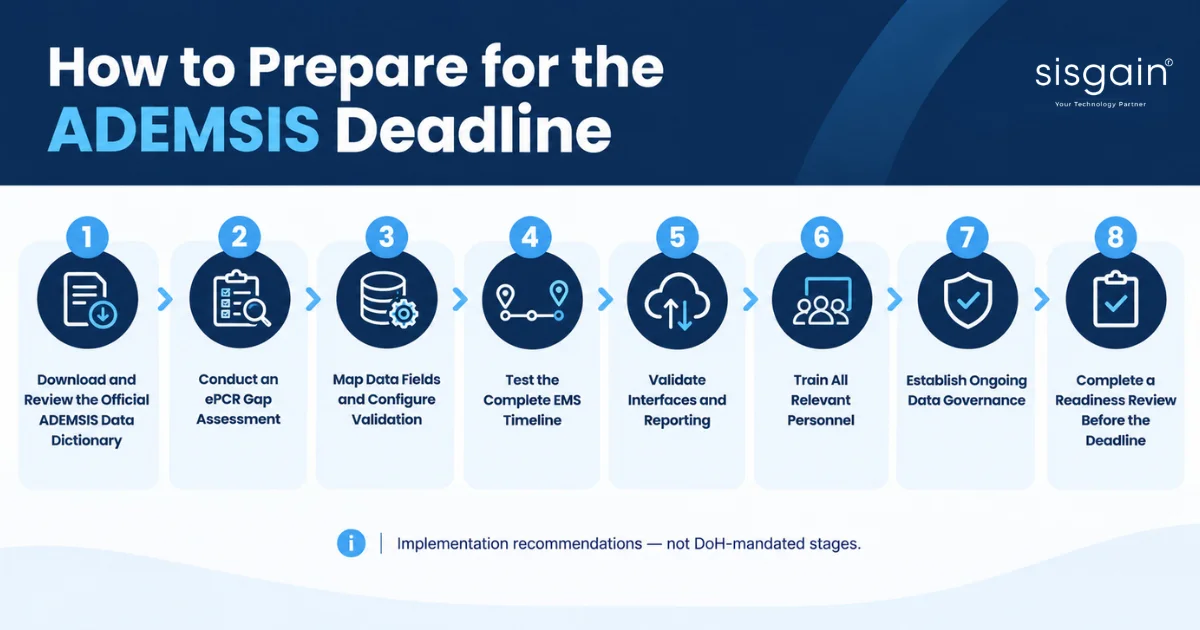
The eight steps below are our implementation recommendations, not DoH-mandated stages.
Step 1 — Download and Review the Official ADEMSIS Data Dictionary
Obtain the Data Dictionary from DoH’s ADEMSIS resource page. Record the version and date, name an owner, and check regularly for updates. Work from the official source, never a copy of a copy.
Step 2 — Conduct an ePCR Gap Assessment
Compare your current fields, records, reports and workflows with the dictionary, domain by domain. Include manual and paper-based processes, since the obligation covers both electronic and manual data collection. Record every gap with an owner.
Step 3 — Map Data Fields and Configure Validation
Map each ADEMSIS element to an ePCR field. Classify its obligation level, then configure code lists, permitted values and validation to match. Flag fields that need new development, not just configuration.
Step 4 — Test the Complete EMS Timeline
Run test incidents through the full journey: call, dispatch, response, scene, care, transport, handover and return to service. Include exceptions such as cancellations, no-transport outcomes and cardiac arrest, and check every timestamp is captured in sequence.
Step 5 — Validate Interfaces and Reporting
Test each relevant integration with realistic data. Confirm error handling, retry behaviour and reconciliation, so a failed transfer is detected and fixed rather than silently lost. Generate the reports you will rely on.
Step 6 — Train All Relevant Personnel
Train by role. Dispatchers need timestamps and dispatch codes. Paramedics and EMTs need clinical and “NOT” value usage. Clinical leads and quality teams need review reports. Administrators need configuration and access control. Keep attendance records.
Step 7 — Establish Ongoing Data Governance
Assign data ownership, role-based permissions and audit trails. Define how data-quality exceptions are reported, corrected and reviewed. Compliance is not a single event, and your brief lists maintaining ongoing compliance as a provider obligation.
Step 8 — Complete a Readiness Review Before the Deadline
Hold a cross-functional review with sign-off from operations, clinical, quality, IT and compliance. Document every remaining gap with a remediation plan and owner.
ADEMSIS Compliance Checklist
- Official ADEMSIS framework and Data Dictionary reviewed
- Current ePCR fields mapped to ADEMSIS elements
- Field obligations (mandatory, required, recommended, optional) classified
- Missing and inconsistent data identified
- Validation rules tested
- Timestamps verified across the full EMS timeline
- Relevant integrations tested
- Staff training completed and recorded
- Data-quality controls established
- Audit and implementation evidence organised
How to Evaluate ePCR and EMS Software Readiness for ADEMSIS
Essential Capabilities to Assess
- Configurable fields that can be added or changed without rebuilding the platform
- Structured coding with maintainable code lists
- Validation that respects each field’s obligation level
- Timestamps captured in sequence and protected from accidental overwriting
- Reporting and export that reflect the Data Dictionary structure
- Audit trails showing who created or changed a record
- Access control based on role
- Relevant integrations with hospital, dispatch and exchange systems
- Testing support, including test environments and evidence
- Maintenance, including updates when DoH revises the framework
Questions to Ask Your ePCR Vendor or Technology Partner
- Can the current ePCR system be mapped to the applicable ADEMSIS data definitions?
- Which gaps require configuration, integration or software development?
- How are data-quality issues and failed transfers monitored?
- What evidence can be provided for implementation and testing?
- How will updates, training and maintenance be handled?
The right answer is often configuration or targeted remediation, not replacing the whole platform. Be cautious of any claim of “ADEMSIS approval”: in the DoH sources we reviewed, we found no approved-vendor list. Where gaps do need development or integration work, a healthcare software development partner such as SISGAIN Technologies can be assessed on relevant integration and testing experience, and on how it would approach workflow modernisation within a wider digital transformation programme.
Prepare Your EMS Data Workflows for ADEMSIS Compliance
ADEMSIS Abu Dhabi readiness depends on five things working together: accurate data mapping, a configured ePCR, tested interoperability, trained staff and clear governance. SISGAIN Technologies is a healthcare software development partner you can speak to about technical assessment, integration planning and workflow modernisation. Contact SISGAIN Technologies to discuss your ADEMSIS readiness review.