
What is an IT Health Check?
An IT health check is a structured review of your technology environment, covering servers, networks, endpoints, cloud services, Microsoft 365, backups and the policies that govern them. It answers three questions. Is your environment secure? Will it keep running? Can it recover when something goes wrong?
A health check is different from an informal tune-up. Every finding is traced to a specific configuration, log or test result, and every finding is rated by business impact, so leadership can decide what to fix first and why. Many organisations in Dubai start with a review like this when they are looking for a IT Consulting Company Dubai that can give an independent view of their environment.
Why do businesses in Dubai need regular IT health checks?
Dubai’s organisations run on a mix of on-premise servers, cloud platforms and SaaS tools. Many are managed by small internal teams, by external providers, or by both. Growth, new branches, acquisitions and staff changes alter an environment faster than documentation keeps up. Gaps often surface only during an incident, a client’s security questionnaire or a regulator’s request. By then, fixing them is expensive and stressful.
A regular health check gives you a current picture before those moments arrive.
What a health check helps you do
- Identify security vulnerabilities, infrastructure weaknesses and operational risks.
- Understand the actual health of your IT environment and its impact on the business.
- Work from a structured, evidence-based assessment rather than assumptions or vendor claims.
Why Your Business Needs an IT Health Check
Most IT problems do not announce themselves. A forgotten admin account, a backup job that has reported “success” for months, or a firewall rule added for a one-off project can sit unnoticed until it matters. A health check brings these issues to the surface while they are still inexpensive to fix.
Specifically, a health check helps you:
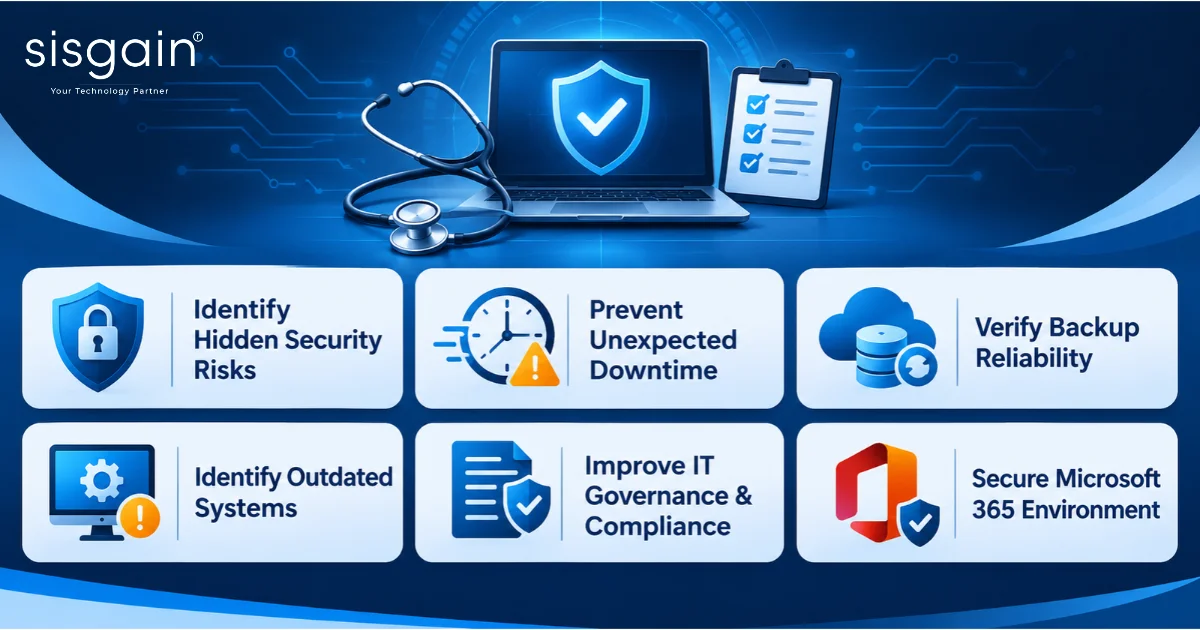
- Find hidden security risks before they become incidents, such as weak authentication, excessive administrator rights or exposed services. If the review points to ongoing security monitoring, our team can explain options for Managed Cybersecurity Services Dubai.
- Test backup reliability and disaster recovery readiness. A green backup status is not the same as a recoverable system.
- Identify outdated systems that no longer receive security patches or vendor support.
- Assess Microsoft 365 security and identity management, including how users sign in, how privileged accounts are protected and how email is secured.
- Improve IT governance and compliance readiness, so you can answer client, insurer and regulator questions with documents rather than memory.
- Reduce unexpected downtime by addressing the causes of recurring disruption before they interrupt operations.
IT Health Check Services We Provide in Dubai
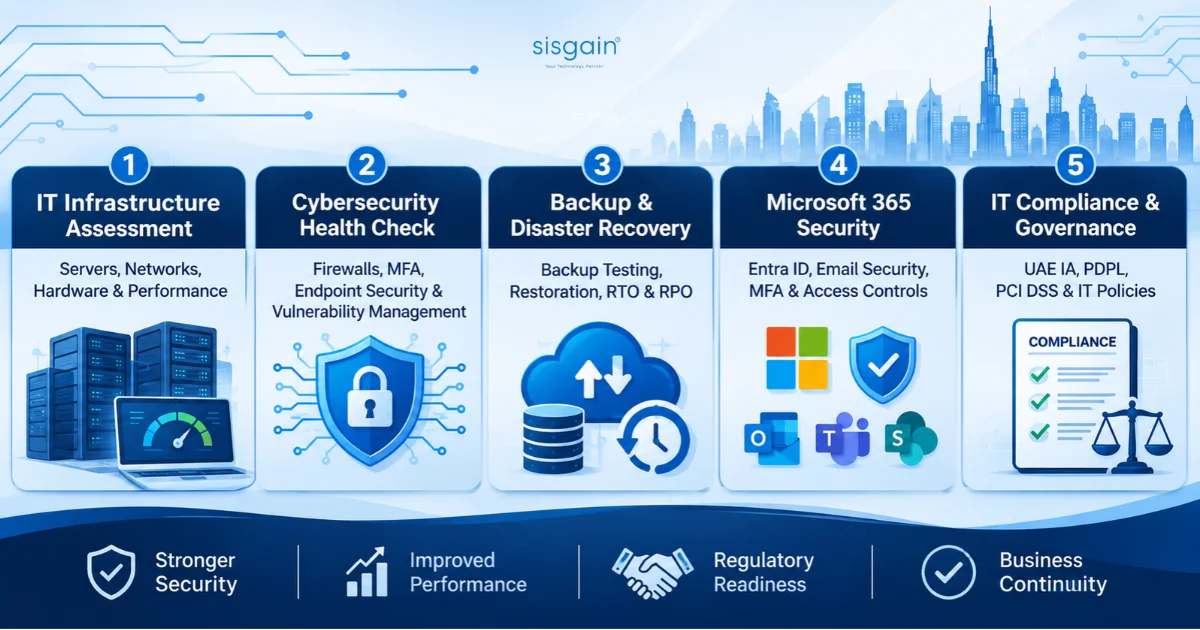
Our health check is modular. Every engagement covers the core areas below, scoped to your environment and priorities.
IT Infrastructure Assessment
We review the health of your servers and network, looking at resource utilisation, hardware age, redundancy, and the configuration of core services. We evaluate infrastructure performance to find bottlenecks and single points of failure. We also review your hardware and software inventory and identify equipment or software that is out of vendor support or nearing end of life. Where ongoing day-to-day support is needed after the assessment, our IT support Services in Dubai cover monitoring, helpdesk and maintenance.
Cybersecurity Health Check
This review covers the controls that protect your environment from common threats. We assess firewall configuration, including rule sets, management access and logging. We review endpoint security coverage across laptops, desktops and servers. We check your vulnerability and patch management process, including how quickly critical updates are applied. We review Multi-Factor Authentication (MFA) coverage and exceptions, and assess identity and access management, including who has access to what and whether that access is still needed.
Backup and Disaster Recovery Assessment
We review backup configuration, including what is backed up, how often, where copies are stored and how long they are retained. We analyse backup success and failure history to find patterns rather than relying on a single dashboard figure. Most importantly, we test restoration. We check whether selected systems and files can actually be recovered within acceptable time. We assess your disaster recovery readiness and review your Recovery Time Objective (RTO), which is how long the business can tolerate being offline, and your Recovery Point Objective (RPO), which is how much data loss is acceptable. Then we compare those targets with what your current setup can achieve.
Microsoft 365 Security Assessment
Microsoft 365 is central to most businesses, and its security depends heavily on configuration. We review your Microsoft 365 security settings and assess Entra ID identity and access controls, including conditional access policies, sign-in risk handling and guest access. We check MFA and privileged account protection, including how many administrators exist and whether they use separate accounts for administrative work. We review email security configuration, covering authentication records such as SPF, DKIM and DMARC, along with anti-phishing and anti-malware settings. Finally, we review your Microsoft 365 backup and recovery arrangements, since Microsoft’s platform availability is not the same as a backup of your data.
IT Compliance and Governance Assessment
We help you understand which regulatory frameworks apply to your business and how your current controls measure up. Depending on your sector, this may include UAE Information Assurance (UAE IA) requirements, NESA requirements where applicable, UAE Personal Data Protection Law (PDPL) considerations, ADHICS requirements for healthcare providers in Abu Dhabi where applicable, PCI DSS for payment card environments, and CBUAE requirements for applicable financial institutions. We also review your IT policies and documentation, since regulators, auditors and clients expect written evidence of how you manage technology.
Common IT Risks We Identify During Health Checks
These are issues we see frequently in organisations of different sizes. Not every environment has all of them.
- Missing or weak Multi-Factor Authentication, especially on email, remote access and administrator accounts.
- Backups configured but restoration never tested. The backup job reports success, but nobody has confirmed that a file, server or mailbox can be restored within the required time.
- Misconfigured firewall rules, such as broad “allow any” rules left from old projects or remote management interfaces exposed to the internet.
- Outdated operating systems and missing security patches, particularly on servers and older devices that sit outside regular update cycles.
- Unsecured Microsoft 365 accounts, including former staff who still have active licences, shared mailboxes without MFA, and too many global administrators.
- Missing IT asset registers, which makes it difficult to know what you own, where it sits and when it needs replacing.
- Incomplete IT policies and documentation, including no formal acceptable use policy, no access review process or no written incident response steps.
- Lack of disaster recovery procedures, meaning the recovery plan exists only in one person’s head.
Our IT Health Check Process
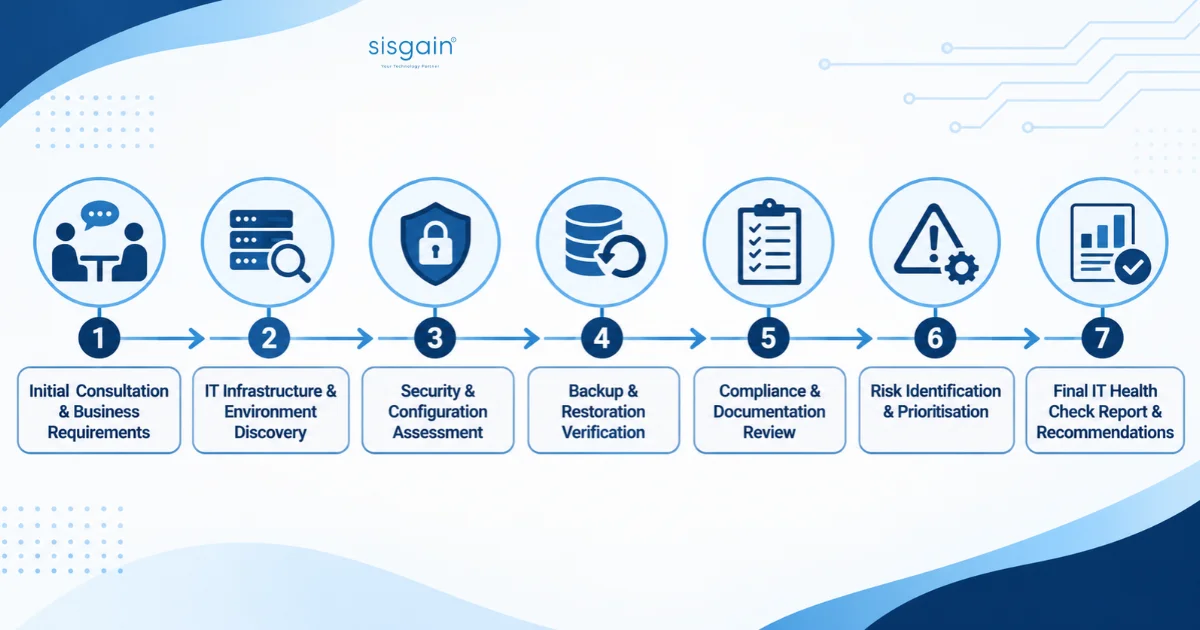
A typical engagement follows seven stages.
- Initial consultation and business requirement understanding. We begin by learning how your business depends on technology, which systems matter most, and what you need from the assessment.
- IT infrastructure and environment discovery. We map your servers, network, endpoints, cloud services and key applications, and confirm access and scope with your team.
- Security and configuration assessment. We review the controls described in Section 3, using configuration reviews, logs and, where agreed, supervised technical checks.
- Backup and restoration verification. We review backup records and perform restoration tests on agreed systems to confirm recoverability.
- Compliance and documentation review. We check your policies, procedures and records against the frameworks that apply to your business.
- Risk identification and prioritisation. Each finding is rated by likelihood and business impact and placed on a Red, Amber or Green scale.
- Final IT Health Check Report and recommendations. You receive a report with findings, evidence and a remediation roadmap, followed by a walkthrough with your leadership and technical teams.
What Makes Our IT Health Check Different?
Many assessments produce long technical lists that leadership cannot act on. Our approach is designed to be used.
- Business-impact-based reporting. We translate technical issues into business risks, such as possible customer data exposure, extended downtime or failed client audits, so decision-makers can weigh them properly.
- RAG-rated risk assessment. Every finding is classified as Red, Amber or Green, giving a clear view of what needs immediate attention and what can be planned.
- Backup restore evidence. We test restoration rather than relying only on backup status. A report should show whether recovery works, not just whether a job ran.
- Microsoft 365 identity focus. Identity is now the main security boundary for most organisations. We give identity, access and privileged accounts dedicated attention.
- Compliance-oriented assessment. We consider UAE regulatory and sector-specific requirements, and we are clear about which ones apply to you.
- Actionable remediation roadmap. You receive a practical 30/60/90-day improvement plan with priorities that match your resources.
Organisations evaluating an IT Risk Consulting Company Dubai often ask how risk is scored and reported. Our RAG model and risk register are designed to answer that question in a form both boards and technical teams can use.
IT Health Check Report: What Will You Receive?
Your report is written for two audiences: executives who need to understand risk, and technical staff who need to act on it. It includes:
- An executive summary in plain language.
- An overall IT health status.
- A RAG-rated risk assessment.
- Detailed technical findings, with the evidence behind each one.
- A business impact analysis for the most significant risks.
- Backup restoration test results, including what was tested and what was observed.
- Compliance gap observations against the frameworks that apply to you.
- Recommended corrective actions, each with an indication of effort.
- A prioritised risk register you can keep and update.
- A 30/60/90-day remediation roadmap.
Who Needs IT Health Check Services?
Different people in an organisation care about different outcomes. The health check serves each of them.
Managing Directors and Business Owners
You need to understand your overall IT risk exposure and how it could affect revenue, reputation and continuity. A health check gives you a clear view of that exposure, with priorities you can discuss without needing technical training.
CFOs and Finance Heads
Technology spending is often large but hard to evaluate. A health check helps you identify spending that does not reduce risk, understand the financial consequences of the risks you carry, and plan budgets around actual priorities rather than vendor proposals. Finance leaders comparing support models often look at the benefits of IT outsourcing in the UAE alongside in-house options, and the health check gives them the baseline needed for that comparison.
IT Managers
You already know many of the problems. A health check gives you documented evidence to support your priorities, a structured list of weaknesses and a sequence for addressing them, which makes it easier to secure time and budget.
CTOs and Technology Leaders
You need to know whether the architecture can support the business’s growth and resilience goals. A health check assesses infrastructure maturity, highlights technology gaps and identifies where architecture changes will improve resilience.
Compliance and Risk Owners
Client due diligence, insurance reviews and regulatory audits all require evidence. A health check identifies likely compliance gaps, reviews your security controls and documentation, and helps you prepare before an auditor or client asks.
IT Health Check Service Packages
We offer a free initial assessment and several paid options. The right package depends on your environment, your sector and what you need to decide.
Free Initial IT Assessment
This is a discussion-based first step. We talk through your IT environment, identify early risk areas, provide high-level recommendations and advise on the most suitable next step. It is designed to help you decide whether a deeper assessment is worth doing, with no obligation.
Comprehensive IT Health Check
This is our full assessment. It includes detailed infrastructure review, cybersecurity and identity assessment, backup and recovery assessment, a RAG-rated report and remediation recommendations. It suits organisations that want a complete, evidence-based view of their environment.
Backup Restore Testing Add-On
This add-on tests selected backup restorations and documents the results, including restoration evidence, observed recovery performance and any recovery gaps. It can be added to the comprehensive assessment or purchased separately for organisations that already have a health check but want confidence in their recovery.
IT Compliance Gap Assessment
This package reviews the regulatory requirements that apply to your business, assesses your documentation, identifies control gaps and recommends improvements. It is a gap assessment, not a formal certification or compliance audit.
IT Remediation Programme
Once the assessment is complete, many clients want help fixing what was found. This programme covers prioritised risk remediation, security configuration improvements, infrastructure optimisation and ongoing IT governance support.
Pricing depends on the size and complexity of your environment, the number of sites, and the scope you choose. We provide a fixed quote after the initial consultation, so you know the cost before work begins. Readers researching budgets can also review our guide to it support cost dubai, which explains how the main cost factors are structured.
UAE IT Compliance and Regulatory Considerations
The UAE has several technology and data frameworks, and their application depends on your sector, your regulatory status and your contracts. These are the areas we commonly review:
- UAE Information Assurance Regulation, which sets information security requirements for government entities and organisations within their supply chains.
- NESA requirements and applicability. NESA’s former standards now sit within the UAE’s broader cybersecurity framework. We confirm which requirements are relevant to your organisation.
- UAE Personal Data Protection Law (PDPL), which governs how personal data is collected, processed, stored and protected.
- Abu Dhabi Healthcare Information and Cyber Security Standard (ADHICS), which applies to healthcare entities regulated in Abu Dhabi.
- PCI DSS for organisations that store, process or transmit payment card data.
- CBUAE requirements for financial institutions within the Central Bank’s scope.
- Client security questionnaires and vendor due diligence, which often ask for evidence of backups, access controls, incident response and policies.
Applicability depends on your sector, regulatory status and contractual obligations. An IT health check does not automatically constitute a formal certification or compliance audit. It gives you a structured view of your current position, identifies gaps and tells you what evidence you will need.
Industries We Support in Dubai
We work with organisations across several sectors, and each has different priorities:
- Healthcare and medical organisations, where patient data protection and system availability are critical.
- Financial services and banking, where regulatory expectations and transaction security are central.
- Retail and eCommerce businesses, where payment security and website uptime affect revenue directly.
- Real estate and construction, where project files, email and remote site access need consistent protection.
- Professional services and consulting, where client confidentiality and document recovery matter most.
- Logistics and transportation, where operational systems and connectivity must stay available.
- SMEs and growing enterprises, where a lean team often needs an independent view of its environment.
Our 30/60/90-Day IT Improvement Roadmap
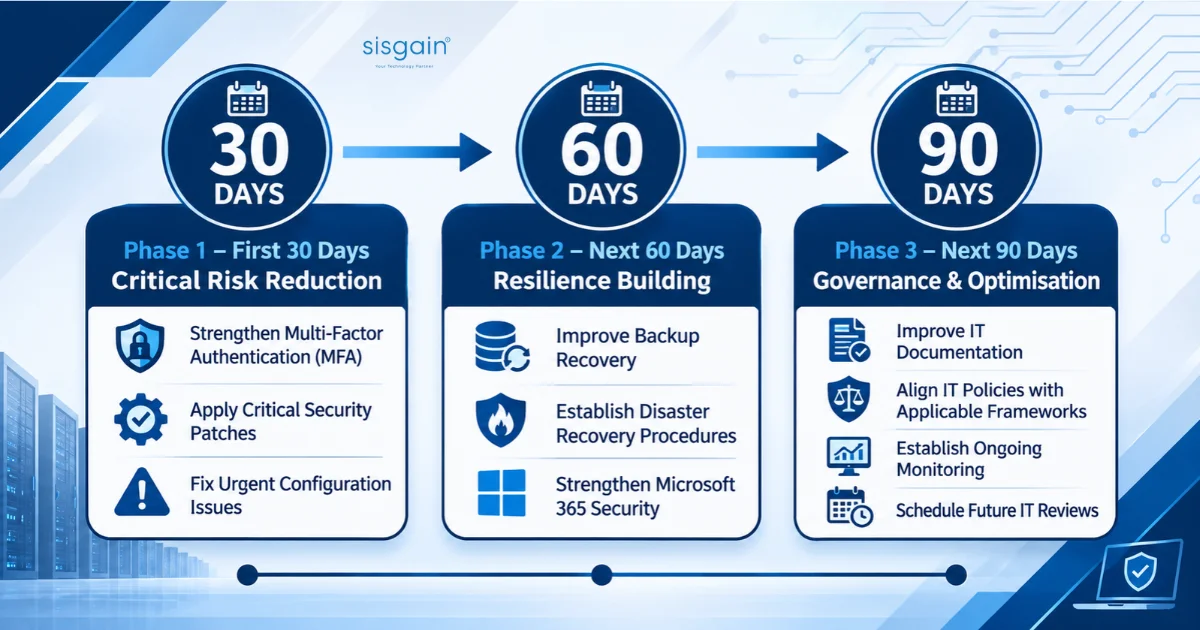
A health check is most valuable when it leads to action. Our roadmap groups remediation into three phases.
First 30 days: critical risk reduction. We address the highest-priority items, such as weak or missing MFA, critical security patches and urgent configuration problems. These steps are usually the fastest to implement and reduce the most immediate exposure.
Next 60 days: resilience building. We focus on backup recovery, disaster recovery procedures and Microsoft 365 security improvements. This phase turns recovery from an assumption into a tested capability.
Next 90 days: governance and optimisation. We strengthen documentation, align policies with the frameworks that apply to you, establish ongoing monitoring and set a schedule for future reviews. This phase keeps improvements from fading.
The exact timing depends on your resources and the findings, and we agree the roadmap with you before work starts.
Why Choose SISGAIN Technologies for IT Health Check Services in Dubai?
Choosing an assessment provider is a decision about trust as much as technical skill. Many businesses searching for a choose IT support company Dubai look for the same qualities: clear communication, defined processes and accountability for results. Here is how we approach it.
- Structured and systematic assessment. Every engagement follows the same documented method, so results are consistent and comparable over time.
- Business-focused risk reporting. We explain what each risk means for your operations, your clients and your finances.
- Evidence-based backup restoration assessment. We test recovery rather than trusting backup reports.
- Security and compliance-focused approach. We consider the regulatory frameworks that apply to your business and are honest about the ones that do not.
- Clear remediation priorities. You get a ranked list, not an undifferentiated set of findings.
- Practical recommendations. We recommend changes your team can realistically carry out, and we are clear about what needs more investment.
Understand Your IT Risks Before They Impact Your Business
A clear view of your IT environment is the first step toward reducing risk. With a structured health check, you can:
- Get visibility into your infrastructure, security and identity controls.
- Identify security and operational weaknesses before they cause disruption.
- Verify whether your backups can actually be restored, and how long it would take.
- Receive a prioritised IT improvement roadmap your team can act on.
Book your free initial IT assessment with SISGAIN Technologies today. We will discuss your environment, highlight early risk areas and recommend the most suitable next step. If you are also reviewing managed cybersecurity services or IT support services in Dubai, we can explain how each fits into your roadmap.