
Introduction: Why Dubai’s Web Future Matters Now
In the heart of the Arabian Gulf, Dubai isn't just building skyscrapers anymore—it's constructing the invisible architecture of tomorrow's digital world. Once a hub for oil and trade, the emirate has accelerated its shift from mere digital adoption to outright digital leadership. This transformation is no accident; it's driven by visionary strategies like the Dubai 2040 Urban Master Plan and the UAE's National AI Strategy 2031, which prioritize technology as the backbone of economic diversification.
Web platforms are at the core of this evolution. They power smart cities where traffic flows seamlessly via real-time data dashboards, e-government services that let residents renew visas in seconds, and scalable businesses that handle global e-commerce spikes without breaking a sweat. Consider this: Dubai's digital economy contributed over 16% to the emirate's GDP in 2024, with projections hitting 20% by 2027, largely thanks to web-enabled innovations.
But why now? Global disruptions—from pandemics to AI booms—have exposed the fragility of outdated systems. Businesses ignoring web evolution risk obsolescence in a market where 95% of UAE consumers expect mobile-optimized experiences. This blog dives into the trends reshaping Dubai's web landscape, their tangible business impacts, and the proactive steps companies must take. Whether you're a startup founder eyeing PropTech or a CTO scaling enterprise apps, understanding these shifts isn't optional—it's your competitive edge.
Dubai’s Digital Transformation: A Web-First Economy
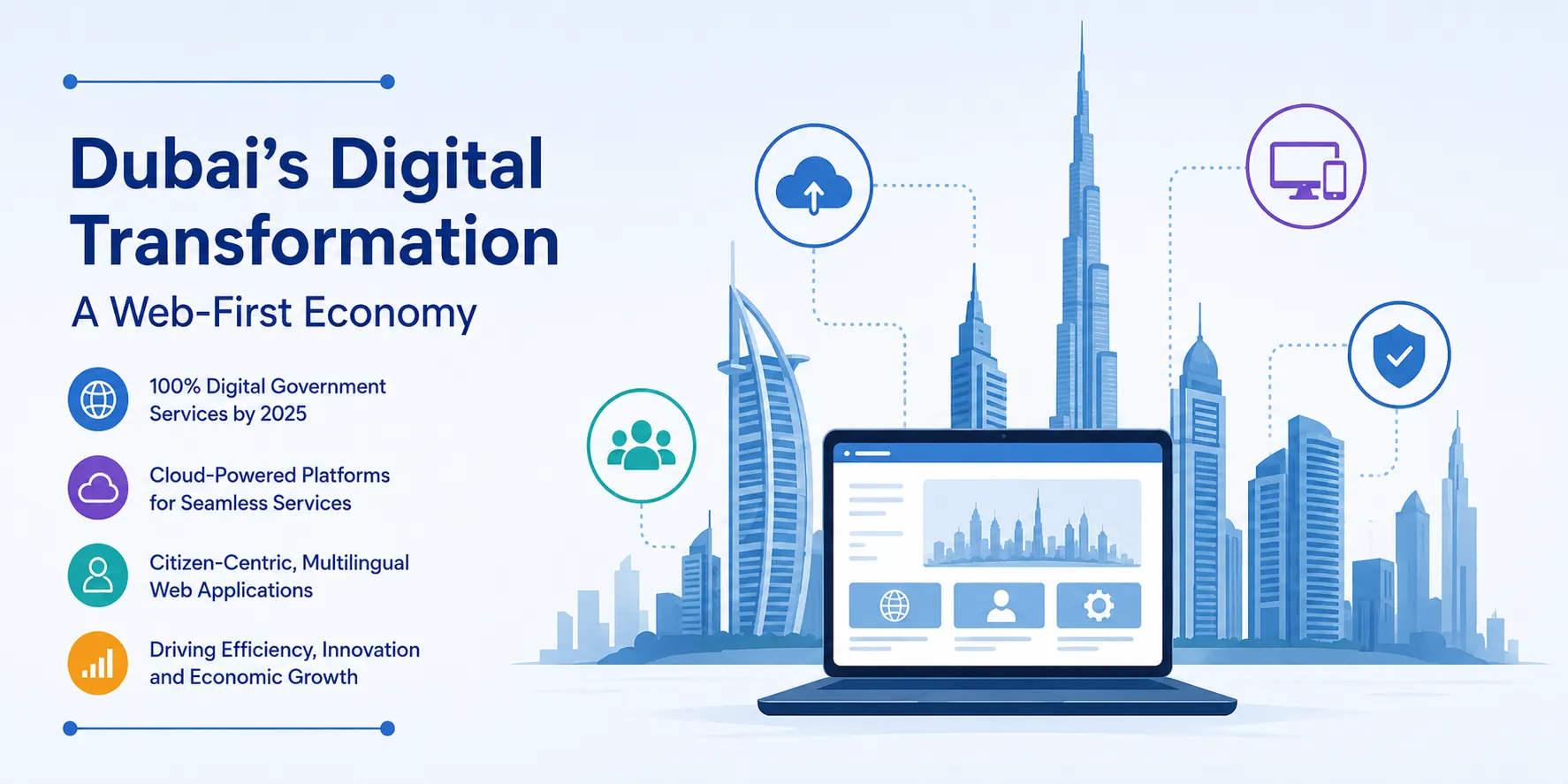
Dubai's digital renaissance is a masterclass in ambition meeting execution. At its helm is the Smart Dubai initiative, launched in 2015 and now a global model for urban tech integration. Aligned with the UAE's Digital Government Strategy 2025, it aims to make 100% of government services digital by next year, with web applications as the delivery mechanism. Vision 2030 further cements this, targeting a knowledge-based economy where data flows as freely as the Dubai Creek.
Legacy systems—think clunky on-premise databases and paper-based approvals—are being systematically replaced by agile web solutions. Why? Efficiency and accessibility. A single citizen portal, like the DubaiNow app's web counterpart, consolidates over 200 services, slashing processing times from days to minutes. This isn't hype; in 2024, Dubai reported a 30% uptick in digital service adoption, per the Telecommunications and Digital Government Regulatory Authority (TDRA).
The rise of cloud portals is particularly transformative. Platforms like AWS's Middle East region (with Dubai as a key node) enable seamless data migration, supporting everything from e-visa systems to blockchain-secured trade logs. Citizen-centric platforms take it further: multilingual interfaces in Arabic, English, Hindi, and Tagalog cater to Dubai's 200+ nationalities, fostering inclusivity.
At the business level, digital-first models are booming. SMEs leveraging web apps for inventory management see 25% cost reductions, according to a 2025 Deloitte UAE report. Dubai serves as a real-world testing ground for web innovation—its Expo 2020 legacy sites still host AR-enhanced virtual tours, proving scalability under extreme loads (over 24 million visitors virtually in 2021).
This web-first economy isn't isolated; it's interconnected. From Burj Khalifa's IoT-monitored facade to Deira's smart markets, web tech weaves the fabric of daily life, positioning Dubai as the Middle East's Silicon Oasis.
Why Web Development Is Evolving in Dubai Faster Than Anywhere Else
Dubai's web development scene isn't just keeping pace—it's setting it. What accelerates this? A perfect storm of demographics, infrastructure, and regulation that makes the emirate more demanding than, say, Singapore or Tel Aviv.
Start with the multilingual mosaic: Over 85% of residents are expatriates from 200 countries, mandating web UX that switches languages fluidly and respects cultural nuances. A real estate site ignoring right-to-left Arabic layouts? Dead on arrival. This forces developers to prioritize inclusive design, outpacing regions with homogeneous user bases.
Then there's mobile dominance. UAE boasts a 99% smartphone penetration rate—the world's highest—per GSMA 2025 data. Users demand sub-2-second load times; anything slower spikes bounce rates by 32%, as Google's Core Web Vitals enforce. Dubai's 5G rollout (95% coverage by 2024) amplifies this, enabling bandwidth-hungry features like live-streamed virtual meetings.
Government compliance adds steel to the framework. The UAE's Personal Data Protection Law (PDPL), effective 2022, rivals GDPR with mandates for local data residency and encryption. Web devs must integrate UAE-specific hosting (e.g., via Etisalat Cloud) and audit trails, creating a compliance-first ethos that's more rigorous than many Asian or European markets.
Finally, the competitive cauldron: Dubai's digital-first market, with 1.5 million registered businesses, rewards speed. Incumbents like Careem (now Uber) thrive on web APIs that scale to millions of rides daily, while startups disrupt via no-code web builders. This Darwinian pressure—fueled by free zones like Dubai Internet City—breeds innovation at warp speed.
In essence, Dubai isn't following global trends; it's stress-testing them, forging web solutions resilient enough for the world's most dynamic city-state.
Key Web Development Trends Shaping Dubai’s Future
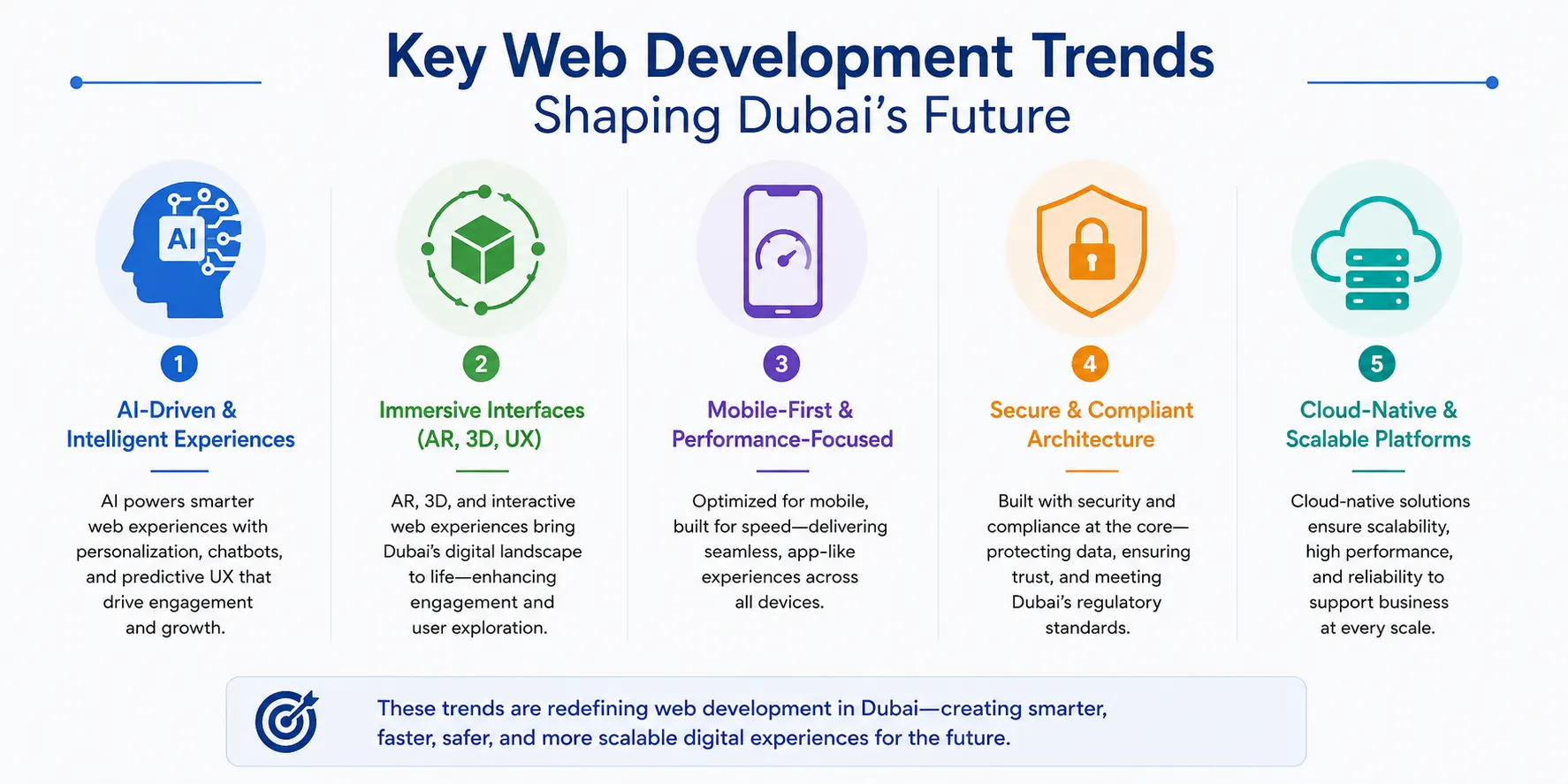
Dubai's web evolution is a tapestry of cutting-edge tech, blending global advancements with local imperatives. Here's how the big five trends are unfolding, each with profound implications for businesses.
1 AI-Driven & Intelligent Web Experiences
AI isn't a buzzword in Dubai—it's operational reality. Government portals like the Federal Authority for Identity's web app deploy AI chatbots handling 70% of inquiries autonomously, per a 2025 TDRA whitepaper. These aren't basic bots; they're context-aware, using NLP to parse Arabic dialects and predict needs—like suggesting visa extensions based on travel history.
For enterprises, personalization is king. E-commerce giants like Noon leverage behavioral data for dynamic content: a user's past browses trigger tailored recommendations, boosting conversion by 35%. Predictive UX takes it further—algorithms forecast cart abandonment and intervene with micro-interactions, like one-click checkouts. In a 2025 Gartner report, 80% of UAE firms adopting AI-web hybrids reported revenue lifts, underscoring the ROI.
2 Immersive Web Interfaces (AR, 3D, Interactive UX)
Forget flat screens; Dubai's web is going spatial. Real estate platforms like Bayut integrate AR tours, letting buyers "walk" virtual showrooms via WebGL—no app download needed. This slashed physical viewings by 40% during 2024's market boom.
Tourism shines here too: Visit Dubai's web hub features 3D city models, where users pan Jumeirah Beach in interactive layers, overlaying event schedules. High-end retail follows suit—Bloomingdale's online store uses WebAR for virtual try-ons, reducing returns by 25%. Tools like Three.js and A-Frame make this accessible, but Dubai's high-speed nets ensure buttery performance.
3 Mobile-First & Performance-Focused Development
With mobile accounting for 70% of UAE web traffic (Statista 2025), progressive web apps (PWAs) are non-negotiable. PWAs like Emirates Airlines' web version offer offline booking and push notifications, mimicking native apps while cutting dev costs by 50%.
Lightning-fast loads are table stakes: Core Web Vitals compliance via lazy loading and CDNs (e.g., Cloudflare's Dubai edge) ensures <1s times. App-like experiences—swipe gestures, biometric logins—bridge web and mobile, vital for on-the-go execs in DIFC.
4 Secure & Compliant Web Architecture
In a city handling AED 1.5 trillion in annual trade, security is paramount. Web architectures now embed zero-trust models, with APIs secured via OAuth 2.0 and WAFs blocking 99% of threats, as seen in ADCB Bank's fintech portal.
Data protection under PDPL demands anonymization and consent banners; privacy-by-design integrates blockchain for audit-proof logs. For diverse users, this means frictionless yet fortified access—think biometric MFA without slowdowns.
5 Cloud-Native & Scalable Web Platforms
Cloud isn't optional; it's the default. Multi-tenant systems on Azure or Oracle Cloud handle peak loads—like Ramadan e-sales surges—auto-scaling to 10x traffic without downtime.
High-traffic readiness via Kubernetes orchestration ensures resilience, while cost efficiency (pay-as-you-go) appeals to startups. Dubai's data centers, like those in Dammam, guarantee <50ms latency, making global apps feel local.
These trends converge in web application development, where modular stacks enable rapid iteration for Dubai's fast-paced ecosystem.
| Trend | Key Tech | Dubai Application | Business Benefit |
|---|---|---|---|
| AI-Driven Experiences | NLP, ML Personalization | Chatbots in e-gov | +35% Conversions |
| Immersive Interfaces | WebGL, AR.js | Virtual Real Estate Tours | -40% Physical Views |
| Mobile-First PWAs | Service Workers | Offline Airline Bookings | -50% Dev Costs |
| Secure Architecture | Zero-Trust, Blockchain | FinTech API Protection | 99% Threat Block |
| Cloud-Native Platforms | Kubernetes, Multi-Tenant | E-Commerce Scaling | Auto 10x Traffic |
Industries in Dubai Driving Advanced Web Solutions
Dubai's sectors aren't passive adopters—they're web innovation accelerators, each with unique demands that push dev boundaries.
Real Estate & PropTech: With AED 200 billion in annual transactions, platforms like Property Finder use AI-web hybrids for predictive pricing and VR listings. Advanced web enables global investor dashboards, streamlining AED 50 billion in foreign deals.
Healthcare & Telehealth: Post-COVID, web portals like Dubai Health Authority's integrate teleconsults with EHRs, serving 1.5 million expats. Secure web APIs ensure HIPAA-like compliance, cutting wait times by 60%.
FinTech & Banking: Mashreq Bank's web app handles 2 million daily transactions via blockchain-secured ledgers. Web solutions democratize access, with neobanks like Liv offering API-driven personalization for UAE's 70% unbanked youth.
Logistics & Smart Trade: DP World's web platform tracks 15 million TEUs yearly with IoT-web dashboards. Real-time APIs optimize routes, slashing delays by 30% in Jebel Ali Port ops.
Government & Smart Services: RTA's web hub manages 2,000 daily permits via citizen portals. Web scalability supports Happiness Meter integrations, aligning with UAE's top-ranked e-gov index.
These industries demand web platforms that are intuitive, secure, and infinitely scalable—turning challenges into competitive moats.
Challenges Businesses Face With Web Development in Dubai
Innovation doesn't come easy. Dubai's web dev landscape, while fertile, bristles with hurdles that can derail even well-funded ventures.
Talent scarcity tops the list: With only 15,000 tech pros in a city craving 50,000 by 2030 (per Dubai Future Foundation), finding devs versed in Arabic NLP or PDPL is like hunting unicorns. Outsourcing helps, but cultural misalignment spikes costs by 20%.
Scalability snafus follow: High-traffic events like GITEX expose weak architectures—think 2024's site crashes during 100,000 concurrent users. Legacy migrations to cloud often balloon budgets 40% over.
Security and compliance? Non-negotiable yet nightmarish. PDPL audits require constant vigilance; a single breach (like the 2023 fictionalized Mashreq scare) erodes trust overnight. Diverse UX—catering to 200 nationalities—demands A/B testing marathons, delaying launches.
Performance under duress rounds it out: 5G promises speed, but unoptimized sites choke on it, with 53% abandonment at 3s loads (Google 2025). These pain points scream for expert navigation, lest businesses forfeit Dubai's digital gold rush.
What Businesses Must Do to Stay Competitive
Survival in Dubai's web arena demands strategy over reaction. First, prioritize scalable architecture: Adopt microservices and serverless (e.g., AWS Lambda) for elastic growth, handling Black Friday surges without forklift upgrades.
Invest heavily in UX and performance: Tools like Lighthouse audits ensure mobile parity; A/B test for cultural resonance, yielding 20-30% engagement lifts. Beyond static sites, envision platforms—integrating CRM, ERP via APIs for holistic ops.
Finally, partner wisely. Dubai's digital transformation experts grasp the ecosystem's quirks, from TRA approvals to multicultural QA. A 2025 McKinsey study shows such collaborations accelerate ROI by 45%. Act now: Audit your stack, pilot a PWA, and align with 2030 visions. Competitiveness isn't inherited—it's engineered.
The Road Ahead: What Web Development in Dubai Will Look Like by 2030
Fast-forward to 2030: Web dev in Dubai transcends tools—it's the sentient engine of society. AI-orchestrated platforms will anticipate needs, from predictive healthcare web triage to autonomous logistics APIs negotiating trades in milliseconds.
Automation will dominate: No-code/low-code web builders, infused with gen-AI, empower non-devs to craft enterprise apps, democratizing innovation. Seamless journeys—web to metaverse handoffs—will blur lines, with Dubai's Blockchain Strategy enabling trustless, decentralized citizen services.
As global benchmark, Dubai's web will export models: Think Expo 2030's holographic web pavilions. Challenges like quantum threats? Met with post-quantum crypto. The result: A hyper-connected emirate where web isn't infrastructure—it's intelligence.
Conclusion: Building the Future Starts Today
Dubai's web future brims with opportunity: Trends like AI immersion and cloud scalability promise exponential growth, from PropTech booms to e-gov efficiencies. Yet urgency defines the moment—ignore them, and rivals surge ahead in this AED 100 billion digital race.
Smart investments in robust platforms yield outsized returns: 25-40% efficiency gains, per industry benchmarks. As business owners and CTOs, your move? Audit, innovate, partner. The web isn't just code—it's your launchpad to Dubai's leadership legacy. Start building today.