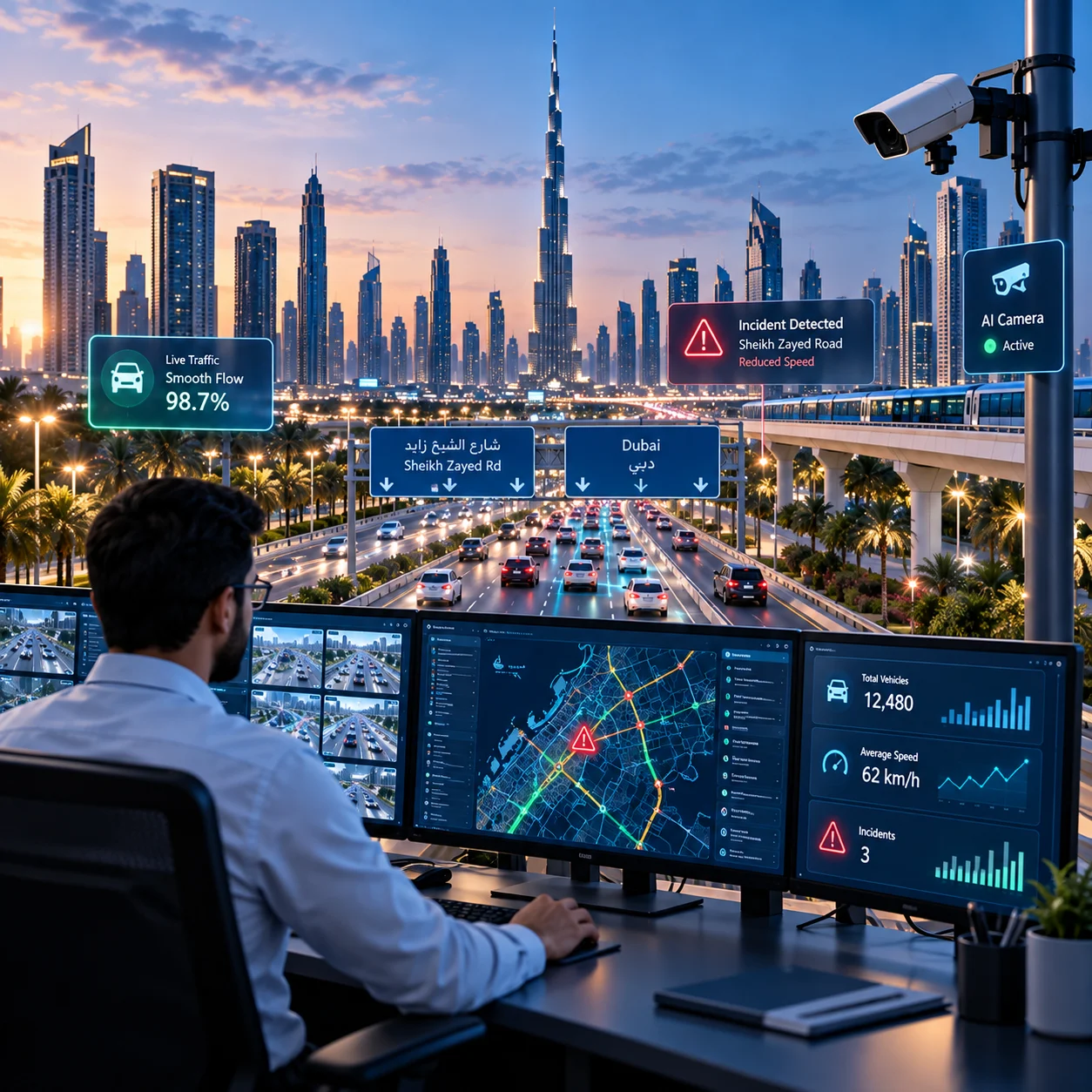
Traffic Monitoring Software
Live dashboards that aggregate feeds from cameras, sensors, and GPS sources, giving operators a real-time view of vehicle flow, density, and road conditions across the entire monitored network.
SISGAIN develops custom traffic management systems in Dubai, combining AI, IoT, and real-time analytics for intelligent traffic control, incident detection, predictive insights, and centralized road network management.
Dubai’s road network faces rising traffic volumes, peak-hour congestion, and increasing demand for connected infrastructure and real-time incident response.
As the city’s mobility ecosystem expands, traffic operators need more than cameras and sensors scattered across a network — they need a unified system that turns raw transportation data into operational intelligence. SISGAIN builds software platforms that consolidate traffic monitoring, signal management, and analytics into a single operational layer, giving control room teams a clearer, faster path from detection to response.
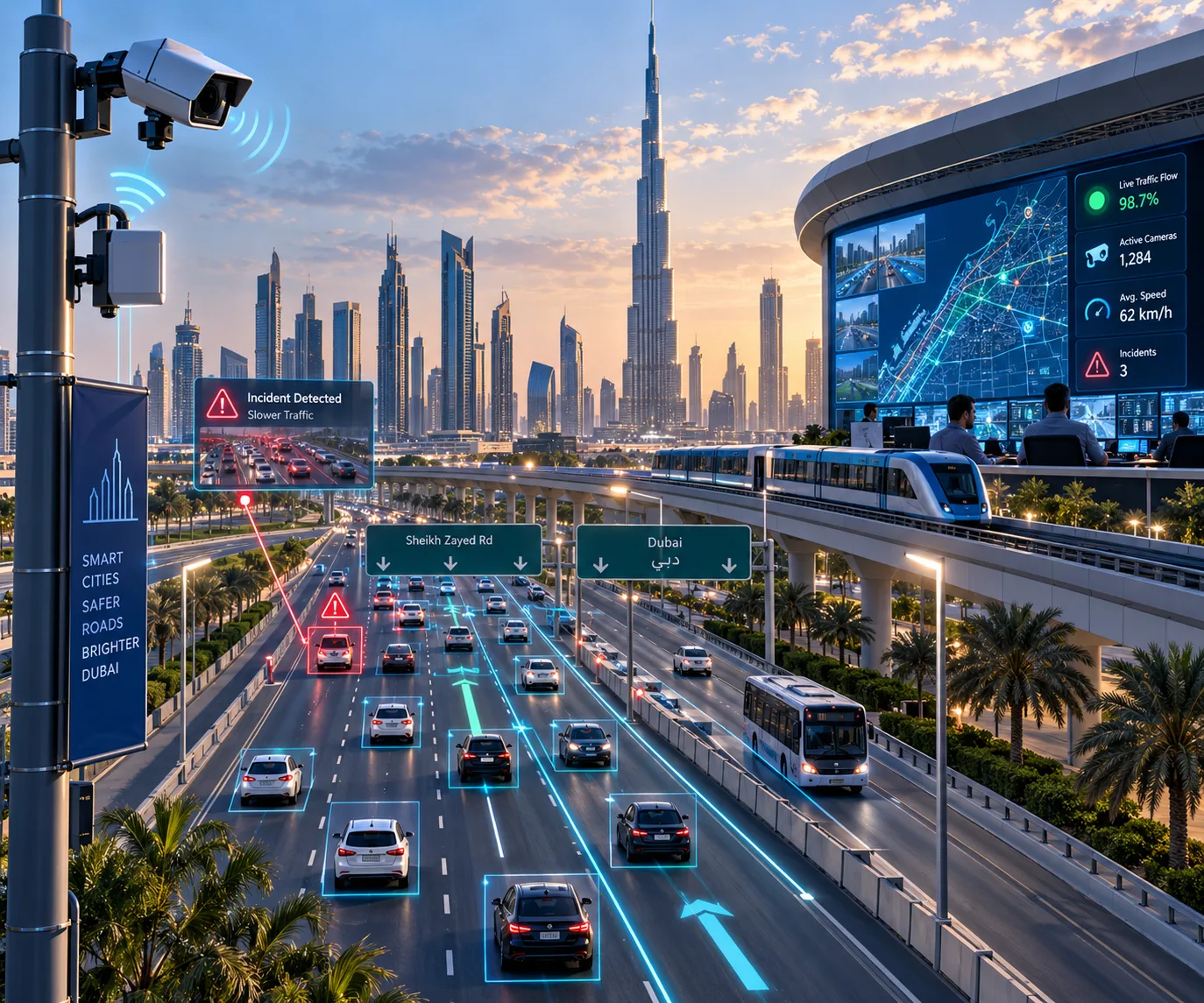
A traffic management system is software that monitors, analyzes, and helps control traffic flow across a road network using connected data sources and centralized control tools.
Modern systems bring together traffic monitoring, traffic control, and analytics by combining AI, IoT sensors, CCTV and computer vision, GIS mapping, and real-time data feeds. Instead of managing each data source in isolation, operators get one platform for visibility, decision-making, and response.
What We Build
SISGAIN develops purpose-built traffic management software across monitoring, control, analytics, and prediction — tailored to your city’s or facility’s specific operational requirements.
Live dashboards that aggregate feeds from cameras, sensors, and GPS sources, giving operators a real-time view of vehicle flow, density, and road conditions across the entire monitored network.
Centralized software that lets operators manage signals, lane usage, and traffic response actions from a single interface, reducing the need to coordinate across disconnected legacy systems.
Machine learning models that process live traffic data to identify patterns, flag anomalies, and support faster, better-informed operational decisions across signals, routes, and incidents.
Software that connects monitoring, analytics, and control into one intelligent layer, helping operators move from reactive traffic handling to a more coordinated, data-informed approach.
Reporting and visualization tools that convert traffic volume, speed, and incident data into dashboards and reports transportation planners can use for operational and infrastructure decisions.
Analytics models that use historical and live traffic data to forecast congestion trends and support proactive planning for peak periods, events, and road maintenance.
Tools that help detect, log, and coordinate responses to accidents, breakdowns, and road obstructions, connecting relevant teams and systems for faster resolution.
Software for monitoring and adjusting signal timing based on live traffic conditions, supporting more responsive intersection management than fixed-timing setups.
Platforms that extend beyond road traffic to support broader mobility use cases — connecting traffic data with parking, public transport, and fleet systems where required.
Applied AI
AI adds pattern recognition and predictive capability to traffic operations, helping teams detect issues earlier and make decisions grounded in live and historical data.
Machine learning models trained on camera and sensor data to detect vehicles, classify traffic types, and identify unusual road conditions across monitored zones in real time.
Video analytics that process CCTV feeds to count vehicles, track movement patterns, and support use cases such as lane occupancy and vehicle classification.
Analytics that identify developing congestion from live traffic data and use historical patterns to anticipate where and when slowdowns are likely to occur.
AI-assisted logic that adjusts signal timing recommendations based on real-time traffic volume, helping intersections respond more dynamically than static timing plans.
Systems that flag stopped vehicles, accidents, or debris from video and sensor feeds automatically, reducing reliance on manual monitoring across large road networks.
Models that learn recurring traffic behavior — daily peaks, weekend patterns, event-driven surges — to give operators context for current conditions.
Forecasting tools that combine historical trends with live inputs to project near-term traffic conditions, supporting planning and resource allocation decisions.
Dashboards that translate model outputs into clear, actionable recommendations for control room operators, rather than raw data requiring manual interpretation.
Tap or hover a card to read more
Analytics Layer
Traffic analytics turns continuous data streams into structured insight, helping operators and planners understand what’s happening across the network and why.
Vehicle counts and flow rates across roads and intersections.
Average and real-time vehicle speeds by segment.
Density levels and slowdown patterns across the network.
Frequency, location, and type of traffic incidents.
Common routes, diversions, and traffic distribution.
Long-term traffic trends and seasonal patterns.
Forecasted congestion and demand scenarios.
System and infrastructure operational performance.
Platform Capabilities
Feature sets are configured around your operational priorities, infrastructure, and the scale of your road network.
The platform follows a structured data pipeline — from collection to response — so operators can trust the intelligence behind every decision.
Cameras, IoT sensors, GPS feeds, and third-party data sources continuously capture traffic conditions across the monitored road network in real time.
Raw data is cleaned, structured, and standardized so it can be analyzed consistently across different sources, formats, and device types.
Machine learning models and analytics engines process the structured data to detect patterns, anomalies, and emerging traffic conditions.
Processed insights are converted into dashboards, alerts, and forecasts that give operators a clear, current picture of network conditions.
Operators act on the intelligence — adjusting signals, dispatching response teams, or informing the public — supported by the platform’s control tools.
Engineering Stack
Technology choices are made based on project scope, existing infrastructure, and integration requirements — not a fixed template applied to every deployment.
Built to Connect
Most traffic management projects build on infrastructure that already exists, not a blank slate — so integration capability is central to how we design every platform.
SISGAIN’s software is built to connect with CCTV cameras, ANPR systems, IoT sensors, and traffic signal controllers, as well as GPS data, GIS platforms, and broader smart-city systems. Integration can also extend to emergency response systems, public transportation platforms, parking systems, weather data feeds, roadside infrastructure, third-party APIs, and existing command and control centers — keeping your current investments in place while adding intelligence on top.
Discuss Your Integration Requirements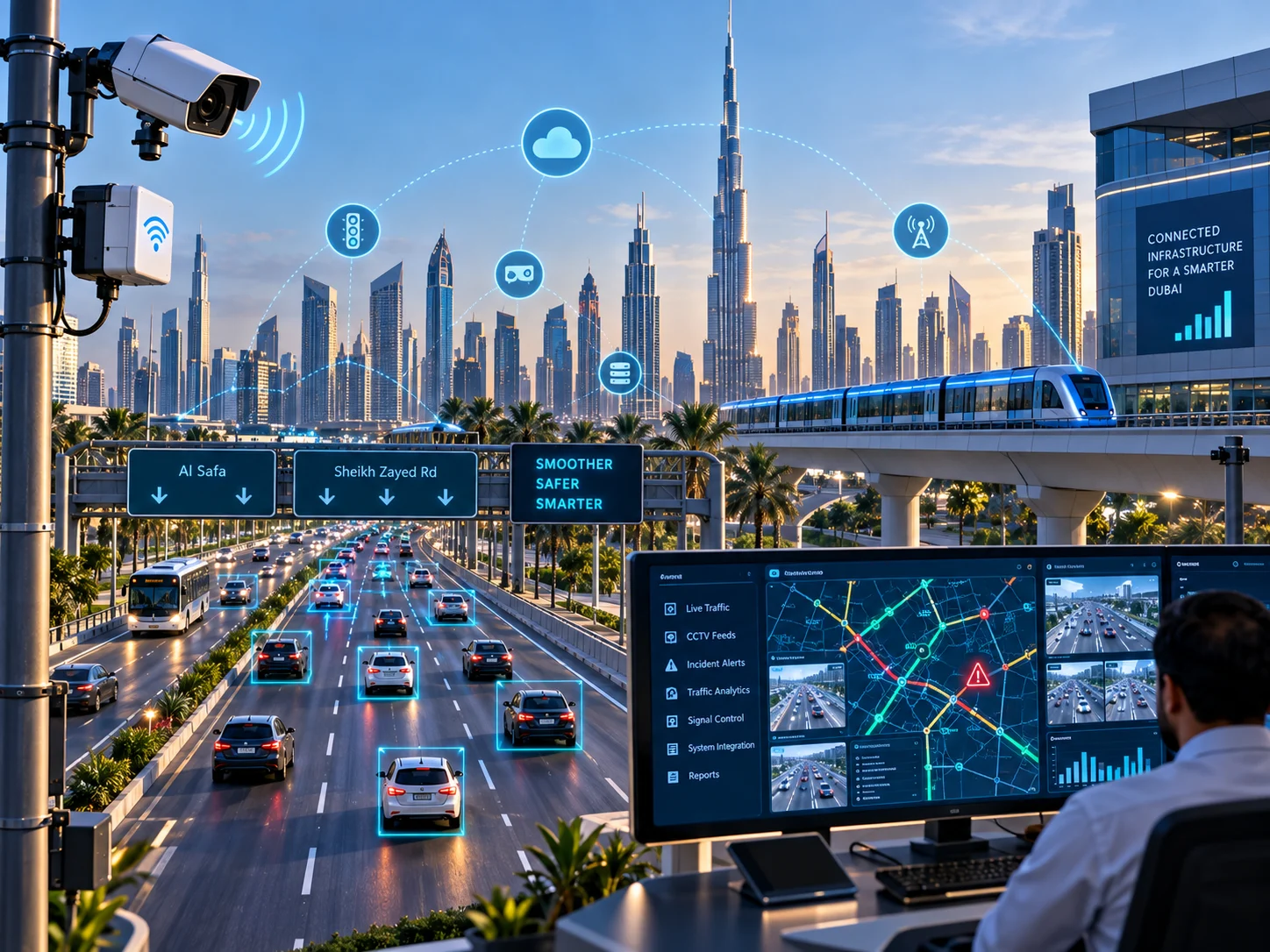
Different organizations across Dubai’s transportation network need different capabilities — our platforms are configured to match each operating environment.
Centralized platforms that give city agencies unified visibility across road networks, supporting coordinated traffic operations and long-term transportation planning decisions.
Software that connects monitoring, signal control, and analytics for authorities managing large-, multi-zone road networks with diverse traffic conditions and priorities.
Traffic intelligence layers designed to integrate with broader smart-city platforms, connecting mobility data with other urban systems and infrastructure.
Traffic and ground-transportation monitoring tailored to airport road networks, terminal access points, and the operational demands of high-turnover vehicle flow, built by our airport systems developers.
Monitoring and incident detection built for high-speed, high-volume corridors where early detection and fast response are operationally critical.
Traffic visibility solutions for dense urban zones managing high pedestrian and vehicle interaction, congestion, and parking-related traffic pressure.
Temporary or scalable traffic monitoring configurations that support surges in vehicle volume around stadiums, exhibition centers, and major public events.
Route and traffic visibility tools that help logistics operators plan movements around live congestion and incident data across the road network, and that can feed into your fleet operations software, built by a transportation software development company that understands your network. Our logistics software development team can connect these tools to your dispatch and delivery workflows.
Trusted Technologies
Dubai’s urban mobility environment continues to evolve alongside its smart-city ambitions, creating growing demand for connected, intelligent transportation infrastructure.
SISGAIN builds traffic management technology designed for this environment — combining AI, IoT, and real-time analytics into software that supports connected infrastructure and future-ready mobility. Our platforms are architected to grow with the UAE’s transportation landscape, adapting to new data sources, new infrastructure, and evolving operational requirements as the network expands.
Why SISGAIN
We approach traffic management as an enterprise software problem — one that requires solid architecture, real integration capability, and long-term maintainability.
We design software around your specific road network, data sources, and operational workflows rather than adapting a fixed, one-size-fits-all product.
Our engineering teams build machine learning and computer vision capabilities directly into traffic platforms, from detection to predictive analytics, supported by our ai development services dubai team.
Systems are architected to expand — more sensors, more zones, more data sources — without requiring a rebuild as your network grows.
We build with integration as a core requirement, connecting new software to CCTV, IoT, GIS, and existing command center systems.
Traffic platforms handle operationally sensitive data, so we build with encryption, role-based access control, and secure API practices throughout, backed by our cybersecurity solution dubai expertise.
From architecture and UI/UX to AI integration and deployment, our team delivers the full software development lifecycle under one roof.
Delivery Roadmap
Every engagement follows a structured, transparent process — from initial discovery through to long-term support.
Understanding your operational goals, stakeholders, and constraints.
Reviewing existing systems, data sources, and network scope.
Designing a platform architecture aligned to your requirements.
Building interfaces suited to control room and field use.
Engineering the core platform and its modules.
Embedding machine learning and analytics capabilities.
Connecting to cameras, sensors, and existing systems.
Validating performance, reliability, and data protection.
Rolling out the platform into your operating environment.
Ongoing maintenance, updates, and performance tuning.
Applications
A traffic management platform supports a broad range of operational and planning use cases across a road network.
The core value of a traffic management platform lies in giving operators clearer visibility and faster, better-informed responses.
Proven Foundation
SISGAIN’s traffic management capabilities are grounded in broader experience across AI, IoT, enterprise software, and cloud-based platform development.
We’ve built AI-driven analytics systems, IoT-connected platforms, and large-scale enterprise software across multiple industries — experience that directly informs how we architect traffic management systems, from real-time data processing to secure, scalable deployment, backed by the best devops services in uae.
Discuss Your Traffic Management Project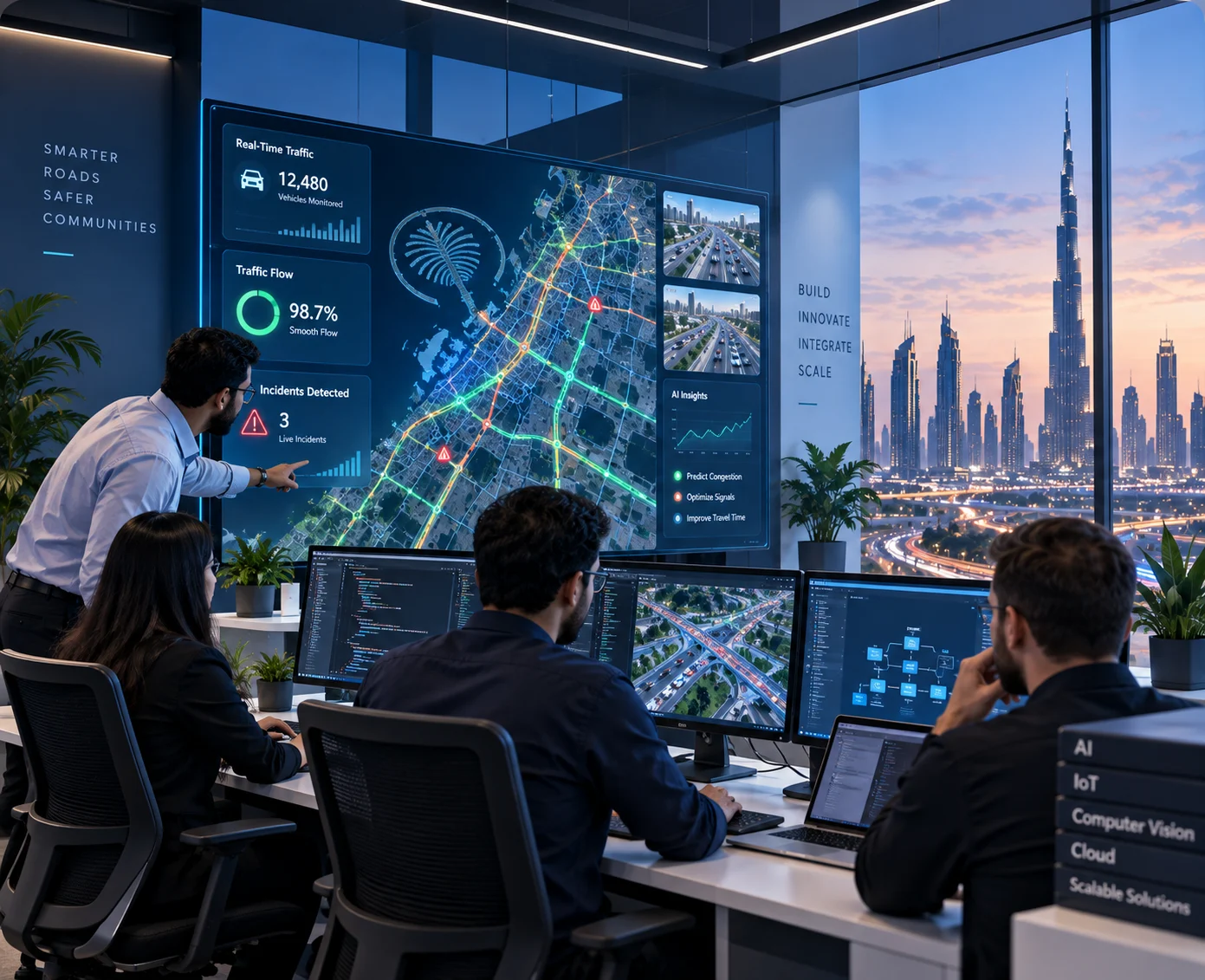

Developed a unified healthcare platform combining EMR, telemedicine, and remote patient monitoring to streamline patient care. Doctors can access real-time medical records, vitals, and treatment history from a centralized database while providing 24/7 telehealth services.

Built a comprehensive digital health platform integrating telemedicine, mobile lab services, and preventive health screening. Patients can consult doctors through video, voice, or chat while also scheduling home lab sample collection.

Developed a telemedicine platform integrated with the insurance ecosystem, allowing members to access virtual healthcare directly through their insurance policies while automating claims processing and policy management.

Created a cross-platform Remote Patient Monitoring (RPM) application enabling continuous vitals tracking through cellular-enabled medical devices. Clinicians receive real-time alerts when patient readings cross risk thresholds, enabling faster medical intervention.

Designed a comprehensive Hospital Information System (HIS) to unify clinical, operational, and administrative workflows across departments. The platform integrates modules for patient records, lab management, pharmacy, billing, scheduling, and inventory.

Developed an advanced Remote Patient Monitoring platform integrated with OxiTone devices enabling continuous health tracking with automated alerts for abnormal readings.

Developed an OTT streaming platform bringing live TV and on-demand content into a single interface supporting Smart TVs, mobile apps, and Android devices.

Created a scalable OTT platform delivering live TV, on-demand content, and third-party streaming integrations across multiple devices with cloud-based architecture.

Developed a cloud-native healthcare ecosystem integrating EMR, telemedicine, patient engagement, remote monitoring, and AI-powered clinical insights to improve care coordination and operational efficiency.

Built an AI-driven business intelligence platform that consolidated enterprise data from multiple sources, enabling predictive analytics, automated reporting, and real-time decision-making across departments.

Designed and deployed a scalable multi-cloud infrastructure with automated provisioning, disaster recovery, monitoring, and security controls to support business-critical applications with high availability.

Implemented an intelligent operations management platform leveraging AI and workflow automation to streamline processes, reduce manual intervention, and improve organizational productivity.

Developed a secure digital banking and fintech solution featuring automated KYC, fraud detection, payment processing, AI-based risk assessment, and cloud-hosted infrastructure for seamless scalability.

Created an end-to-end logistics and supply chain management platform with route optimization, fleet tracking, warehouse automation, predictive demand forecasting, and real-time operational visibility.

Implemented a centralized data lake and analytics platform enabling organizations to collect, process, and visualize large-scale business data while supporting AI and machine learning initiatives.

Created an AI-powered customer support ecosystem featuring conversational chatbots, automated ticket management, sentiment analysis, and omnichannel communication to improve service delivery.

Designed a telehealth platform combining virtual consultations, electronic prescriptions, remote patient monitoring, AI-assisted triage, and secure cloud hosting for healthcare providers.

Established an enterprise cybersecurity framework incorporating identity management, threat monitoring, vulnerability assessments, compliance controls, and cloud security governance.

Built a smart manufacturing solution integrating IoT devices, production monitoring, predictive maintenance, inventory optimization, and AI-driven operational analytics.

Developed a modern learning platform featuring virtual classrooms, adaptive learning paths, AI-powered assessments, student analytics, and cloud-based content delivery.

Created a real estate management ecosystem supporting property listings, CRM, document management, AI-powered lead scoring, and analytics for enhanced sales performance.

Implemented a digital transformation platform for public sector organizations, streamlining citizen services, workflow automation, document management, and cloud-based governance systems.

Established a CI/CD-driven DevOps framework with automated testing, containerization, Kubernetes orchestration, infrastructure as code, and cloud deployment pipelines for faster software releases.

Developed an enterprise AI platform enabling predictive analytics, generative AI integrations, intelligent document processing, and workflow automation across business functions.

Transformed legacy systems into scalable cloud-native applications using microservices architecture, API integrations, containerized deployments, and automated infrastructure management.
If you’re evaluating a traffic management platform — new or replacing an existing system — SISGAIN can work with you on requirements, infrastructure, integration, AI capabilities, analytics, and deployment roadmap.
Whether you’re at an early planning stage or ready to scope a development project, our team can help translate your operational goals into a concrete technical plan.
Common Questions
It’s software that monitors, analyzes, and helps control traffic flow using data from cameras, sensors, and other connected sources, giving operators a centralized view of the road network.
AI helps detect vehicles and incidents faster, recognizes recurring traffic patterns, and supports predictive analytics — giving operators earlier, more informed input for decision-making.
Cost depends on scope, network size, integrations, and AI capabilities required. We provide project-specific estimates after understanding your requirements in a consultation.
Timelines vary by complexity and integration scope. A defined project roadmap, including phases and milestones, is provided after the initial assessment.
Yes. Our platforms are built to connect with existing CCTV networks, IoT sensors, ANPR systems, and other data sources as part of the overall architecture.
Yes. We design and develop traffic control software tailored to your specific road network, infrastructure, and operational requirements.
Yes. Integration with existing command centers, GIS platforms, and third-party systems is a core part of how we architect traffic management solutions.
Yes. We build analytics and reporting tools covering traffic volume, speed, congestion, incidents, and historical and predictive trends.
Yes. We integrate AI capabilities including computer vision, pattern recognition, and predictive analytics into intelligent traffic management platforms.
Yes. Our engagement includes ongoing support, updates, and performance optimization after deployment.