
How Education Technology Is Evolving in 2026–2027
The most important education technology trends for the next two years share one theme: the shift from standalone digital tools to connected, intelligent learning environments. Schools and universities have already digitized the classroom. The next step is making digital learning personal, measurable, and genuinely useful to teachers and students.
For UAE school leaders, higher-education administrators, and EdTech businesses, this shift raises a practical question. How do you adopt AI, adaptive platforms, and immersive tools without losing sight of learning outcomes, accessibility, and data protection? The answer shapes the future of education far more than any single product.
This guide walks through ten trends worth watching, with realistic classroom examples and implementation advice. It is written for school leaders, educators, parents, and technology decision-makers who want a clear view of what matters and what is still hype.
Quick Answer: What Are the Top Education Technology Trends for 2026–2027?
The leading trends are AI tutoring, personalized and adaptive learning, AI-integrated learning platforms, teacher enablement, authentic assessment, immersive learning, skills-based education, responsible AI governance, blended learning, and learning analytics. Their value depends on how well schools combine them with strong teaching, learner support, accessibility, and measurable outcomes.
1. AI Tutoring Becomes a Personalized Learning Companion
From Instant Answers to Guided Learning
Early AI tools were mostly answer machines. The more promising direction is AI tutoring that behaves like a patient study partner: it explains a concept step by step, asks guiding questions, offers practice exercises, and gives immediate feedback. A student stuck on a physics problem is nudged toward the next step rather than handed the solution.
This matters because the value of tutoring has always been in the dialogue. Research from Kaspersky reported that 18% of Gen Z respondents considered personalized AI tutors among the most promising future education technologies, a signal that learners themselves expect this shift. As with any survey, the figure reflects stated opinion in a specific sample rather than proven classroom impact.
Practical Applications in UAE Schools
In UAE classrooms, where many schools serve multilingual, multi-curriculum student bodies, AI tutoring has several natural uses:
- Additional practice in mathematics and science.
- Language-learning support for students working across Arabic, English, and other languages.
- Revision assistance outside classroom hours.
- Differentiated explanations for students with varying abilities.
What AI Tutors Cannot Replace
Teachers remain essential for motivation, safeguarding, emotional support, and critical thinking. They also validate what AI produces, because AI can be confidently wrong. The best model treats the tutor as an extension of the teacher's reach, not a substitute. Schools exploring guided educational assistance and task automation can look at purpose-built AI agents solutions as one way to structure this support within clear boundaries.
2. Personalized and Adaptive Learning at Scale
How Adaptive Learning Works
Adaptive learning systems adjust content, difficulty, pace, and practice based on a learner's demonstrated performance. Instead of moving a whole class through the same worksheet, the platform responds to each student's answers in real time.
Identifying Learning Gaps Earlier
Because these systems track progress continuously, patterns surface sooner. A teacher can see that several students are consistently missing questions on fractions weeks before a formal exam would reveal it, and can step in while the gap is still small.
A Practical Classroom Example
Consider a student struggling with algebra. The platform detects errors in a particular type of equation and serves simpler explanations and targeted exercises. Once the student shows understanding, it introduces more complex problems. The student stays challenged but not overwhelmed, and the teacher sees exactly where the difficulty was.
Benefits and Limitations
Adaptive learning supports differentiated instruction, advanced learner enrichment, remedial practice, and adult upskilling. But personalization is only as good as its inputs. It depends on reliable data, suitable content, teacher oversight, and accessible design. Many institutions deliver these features through a Learning Management System that connects content, assessments, and reporting in one place.
3. AI Becomes Core Infrastructure in Education Platforms
Beyond Standalone AI Chatbots
A year or two ago, AI in education often meant a separate chatbot. Increasingly, AI capabilities are being built directly into learning management systems, digital assessments, content creation workflows, and student-support services. Teachers will not need to switch tools to use them.
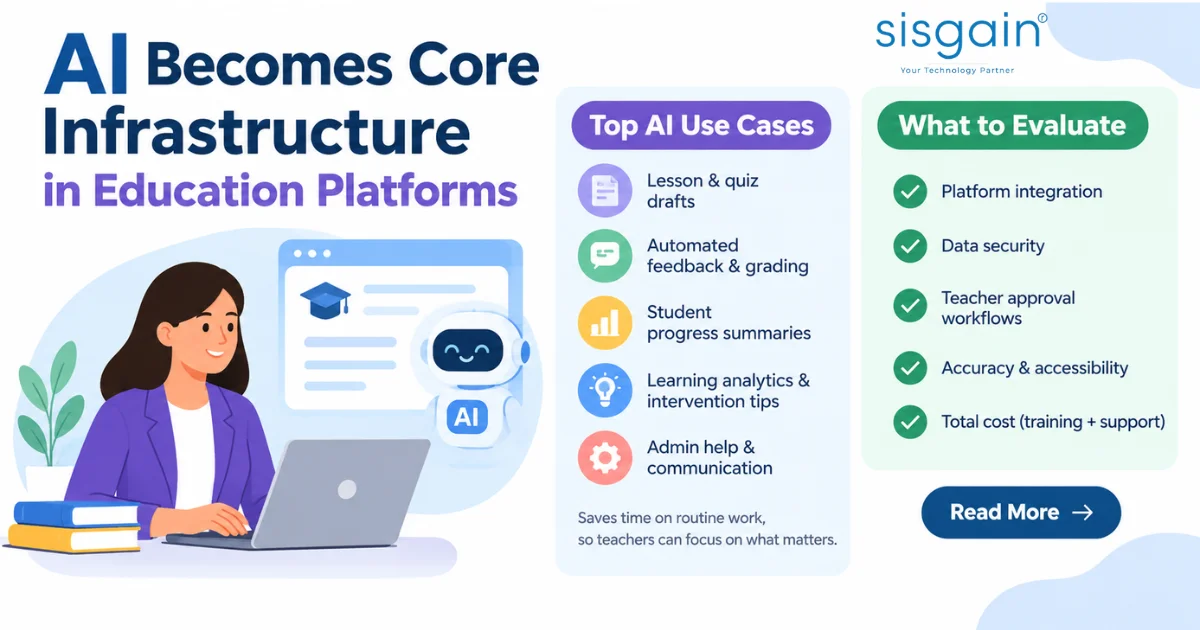
Key AI-Powered Education Use Cases
- Curriculum-aligned lesson and quiz drafts.
- Automated feedback and selected grading workflows.
- Student progress summaries.
- Learning analytics and intervention recommendations.
- Administrative assistance and routine communication.
These uses save time on routine work, freeing teachers for the human parts of the job.
What Schools Should Evaluate
Not every AI feature is worth buying. Institutions should assess integration with existing platforms, data security, teacher approval workflows, accuracy, accessibility, and the total cost of implementation, including training and support. Reviewing Learning Management System Features against your own teaching needs, rather than a vendor's feature list, is a sensible starting point for this evaluation.
4. Teacher Enablement Becomes a Priority
The Gap Between Student AI Use and Teacher Readiness
Giving schools access to technology does not automatically produce better teaching. Students often adopt AI tools faster than staff feel prepared to guide them. A report from Instructure found that 45% of educators had received no AI training, while educators who used AI weekly reported saving nearly six hours per week. These findings come from a specific survey and should be read in that context, but they point to a clear opportunity: training unlocks the benefit.
Essential AI Skills for Educators
Teachers do not need to become engineers. They do need to know how to:
- Write effective prompts.
- Verify AI-generated content.
- Recognize bias in outputs.
- Protect student information.
- Set academic-integrity expectations.
- Choose suitable use cases.
Building a Practical School AI Adoption Plan
The most effective plans are modest and iterative: short training sessions, small pilot projects, clear policies, peer learning among teachers, and regular reviews of workload and student outcomes. When schools need help with implementation, integration, and ongoing support, working with a trusted IT software development company can reduce the burden on internal teams, provided the partner understands education workflows.
5. Assessment Is Being Rebuilt for an AI-Enabled Classroom
Why Traditional Assessment Methods Face New Challenges
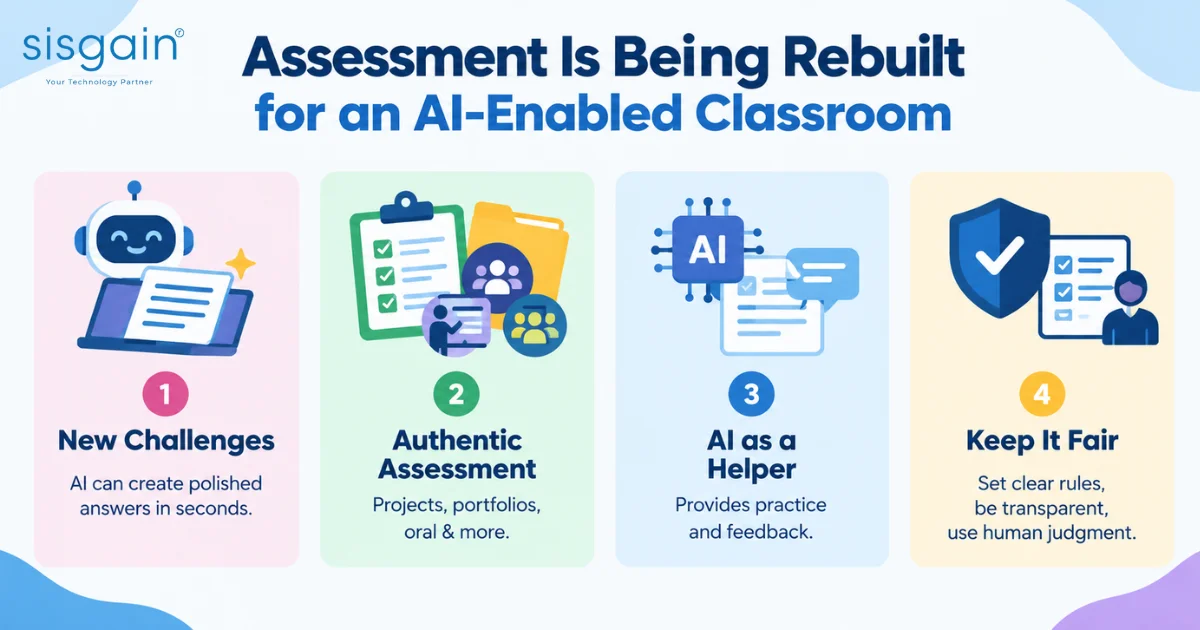
Generative AI complicates take-home essays and problem sets. When a polished answer can be produced in seconds, the final product says less about what a student knows. Understanding how students reach an answer becomes more important than the answer itself.
The Rise of Authentic Assessment
Many educators are moving toward authentic assessment: project-based assignments, portfolios, oral examinations, classroom demonstrations, reflective writing, collaborative projects, and process-based evaluation. These formats reward understanding and original thinking, and they are harder to outsource.
AI as a Formative Assessment Assistant
AI still has a constructive role. It can generate practice questions and draft feedback for students to learn from. The key principle is that teachers keep responsibility for grading decisions and educational judgment.
Maintaining Academic Integrity
Clear, transparent rules work better than prohibition. Define when AI use is permitted, how students should disclose it, and which tasks must be done independently. Schools should be cautious about relying on AI-detection software, which is not completely reliable. Fair assessment design and human review are stronger safeguards.
6. Immersive Learning Expands Through AR, VR, and XR
Moving Beyond Textbooks and Screens
Augmented, virtual, and extended reality (AR, VR, and XR) allow learners to experience concepts rather than only read about them. Simulations and interactive visualizations can make abstract or inaccessible subjects tangible.
High-Value Use Cases
- Virtual science laboratories.
- Historical and geographical simulations.
- Medical and technical training.
- Language immersion.
- Career exploration and workplace simulations.
When Immersive Learning Makes Sense
Immersive technology is not right for every lesson. Start with the learning objective, then consider device availability, accessibility, teacher preparation, physical comfort, and content costs. A headset is worth buying only if the experience teaches something a video or diagram cannot.
For UAE schools and universities, the most promising places to evaluate immersive learning are science, vocational education, and applied technical training, where practice in a safe virtual environment can complement hands-on work. Adoption varies widely between institutions, so a pilot with clear success measures is a sensible first step.
7. Skills-Based Education and Lifelong Learning Gain Momentum
Learning Beyond Traditional Degrees
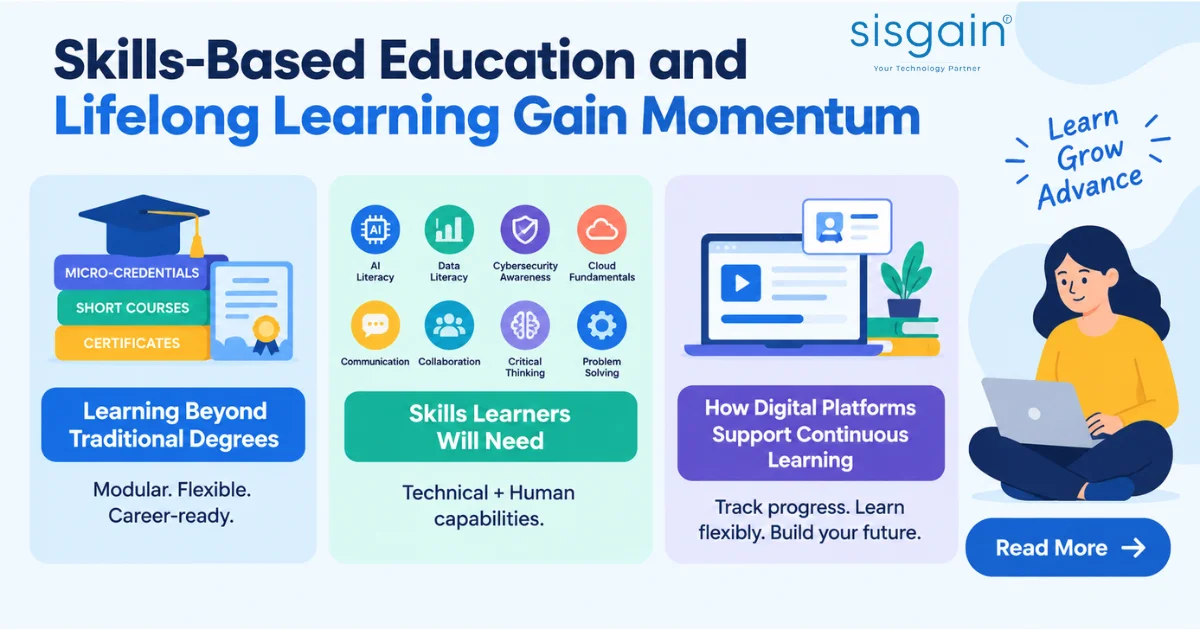
Learning is increasingly modular. Micro-credentials, short courses, flexible pathways, professional certificates, and demonstrable competencies sit alongside traditional qualifications, particularly for working professionals who need to update their skills without pausing their careers.
Skills Learners Will Need
The skills in demand blend technical and human capabilities: AI literacy, data literacy, cybersecurity awareness, cloud fundamentals, communication, collaboration, critical thinking, and problem-solving.
How Digital Platforms Support Continuous Learning
Digital platforms make this practical through progress tracking, modular content, digital portfolios, and flexible access. For a region investing heavily in workforce development, these tools can support ongoing professional upskilling at scale. The edtech trends for 2027 point toward learning that continues long after graduation.
8. Responsible AI, Data Privacy, and Accessibility Become Non-Negotiable
Protecting Student and Institutional Data
Education systems hold sensitive information about minors. Responsible adoption requires appropriate access controls, secure data handling, clear retention policies, and careful vendor assessment. UAE institutions should confirm which data-protection requirements and education-sector rules apply to their operations before deploying new tools, and seek legal or compliance advice where needed.
Addressing Bias, Accuracy, and Transparency
AI feedback can be inaccurate, can perform unevenly across learner groups, and can make decisions that are hard to explain. Schools should ask vendors how accuracy is tested and ensure that important decisions are always reviewed by a person.
Academic Integrity and Appropriate AI Use
Policies should define permitted uses, disclosure requirements, and the role of teacher review, so that students and staff share the same expectations.
A Practical AI Governance Checklist
Before adopting an AI-enabled tool, evaluate:
- Data protection and security.
- Accessibility and inclusive design.
- Accuracy and explainability.
- Integration and data ownership.
- Teacher oversight and escalation procedures.
- Evidence of educational effectiveness.
This is also where vendor selection matters. When comparing AI development companies, look beyond feature lists. Assess security practices, integration experience, ongoing support, and evidence of results in comparable settings.
9. Human-Centered Blended Learning Returns to Focus
Technology Should Support Teaching, Not Dominate It
Screen time and the number of digital tools are poor measures of educational success. A school can use dozens of apps and still deliver weak learning. The question is whether each tool improves understanding.
Combining Digital Flexibility With Human Interaction
The strongest models blend independent digital practice with classroom discussion, peer collaboration, mentoring, hands-on activities, and project-based learning. Students get flexibility and immediate feedback without losing the social side of learning.
Building a Balanced Learning Environment
AI can handle repetition, practice, and feedback. Teachers provide context, empathy, motivation, and social learning. Together they do more than either could alone.
UAE schools can evaluate blended models according to curriculum requirements, student needs, device access, and teacher capacity. A coordinating platform helps keep resources, assignments, and classroom activities in one place, and a learning management system guide can help leaders think through platform selection.
10. Learning Analytics and Early Intervention Become More Actionable
From Student Activity to Meaningful Learning Insights
Assessment performance, assignment completion, engagement patterns, and progress over time can reveal what students need. The trend is toward dashboards that translate raw data into clear next steps for teachers.
Identifying Students Who Need Additional Support
Good analytics flag possible difficulties for a teacher to review. They should not automatically label or penalize a student. A drop in activity might signal a learning problem, or it might simply mean the student was ill.
Turning Data Into Better Educational Decisions
Beyond individual students, analytics support intervention planning, progress monitoring, curriculum evaluation, and institutional reporting. Some institutions will want dashboards or applications tailored to their own workflows, which is where Education app development services in Dubai can help turn requirements into working tools.
Avoiding the Risks of Over-Monitoring
More data is not always better. Watch for poor data quality, privacy concerns, false alerts, and bias, and always interpret metrics in context.
Education Technology Trends at a Glance
The table below summarizes each trend, its main opportunity, and the key consideration for adoption.
|
Trend |
Primary opportunity |
Key consideration |
|
AI tutoring |
Guided individual practice |
Accuracy and teacher oversight |
|
Adaptive learning |
Targeted learning pathways |
Quality of learner data |
|
AI-enabled platforms |
More efficient workflows |
Integration and security |
|
Teacher enablement |
Better classroom adoption |
Training and support |
|
Authentic assessment |
Evidence of real understanding |
Fair assessment design |
|
AR, VR, and XR |
Experiential learning |
Cost and accessibility |
|
Skills-based learning |
Practical competencies |
Assessment of skills |
|
Responsible AI |
Safer adoption |
Governance and privacy |
|
Blended learning |
Balanced learning experiences |
Appropriate tool selection |
|
Learning analytics |
Earlier support |
Human interpretation |
These trends are connected. AI tutoring depends on personalization, personalization depends on useful learning data, platforms and teachers make these capabilities practical, and responsible governance ensures innovation serves learners rather than creating new risks.
Preparing for the Next Phase of Education Technology
Successful adoption in 2026–2027 will not come from buying the most tools. It will come from weaving AI, adaptive learning, teacher support, authentic assessment, and responsible data practices into one coherent learning strategy.
Three practical recommendations for education leaders:
- Start with a defined teaching or learning challenge, not a technology.
- Pilot solutions and measure educational outcomes before scaling.
- Involve teachers and students in evaluating usability, accessibility, and effectiveness.
If your school or education organization is exploring software and AI-enabled solutions to support its learning objectives, SISGAIN's team can help you assess where to begin.