Key facts
- Announcement
- Abu Dhabi introduces Exposure AI and Emission AI to assess traffic-related air pollution
- Company
- SISGAIN Technologies
- Announced
- 03 October 2026
- Market
- Abu Dhabi, United Arab Emirates
- Built for
- Smart-city planning, environmental intelligence, sustainable mobility
- Availability
- Public-sector and smart-city deployment
- Why it matters
- AI is moving urban environmental monitoring from location-based readings to people-centred exposure insight, supporting more targeted planning decisions.
SISGAIN Technologies, an IT and software engineering company with a regional presence in the UAE, today shared its perspective on Abu Dhabi's newly introduced AI tools for understanding traffic-related air pollution, and what they signal for the emirate's smart-city and enterprise technology landscape.
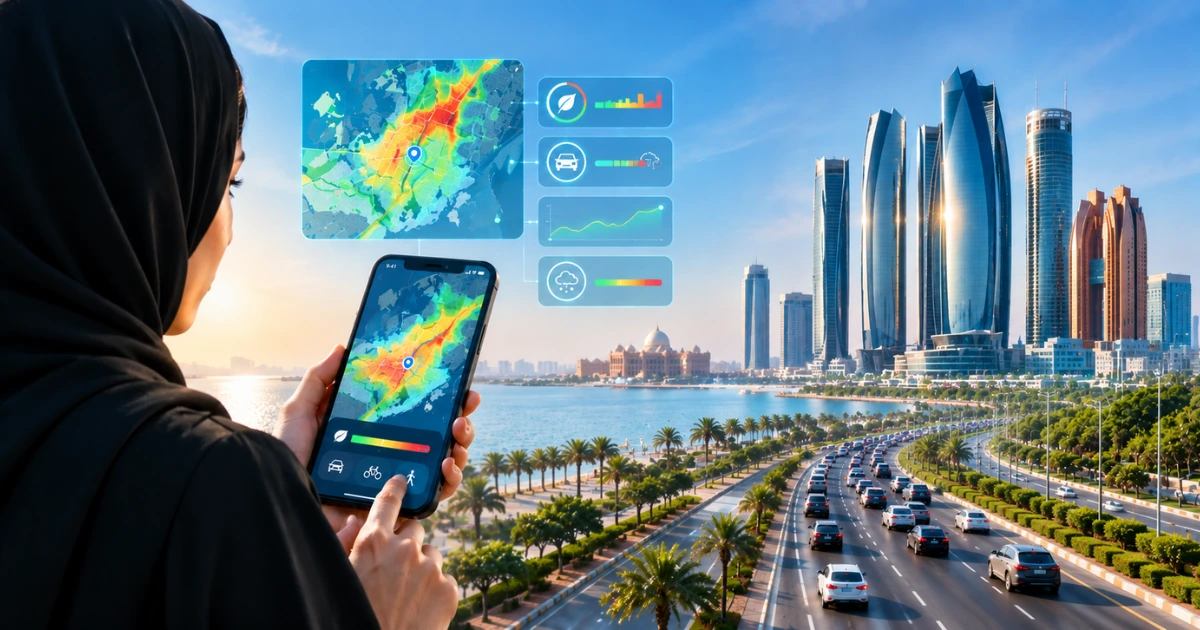
The initiative, delivered by the Department of Municipalities and Transport (DMT) in partnership with MIT's Senseable City Lab, introduces two tools, Exposure AI and Emission AI. Together they aim to give planners a more detailed, real-time understanding of how vehicle emissions relate to what pedestrians may breathe as they travel through streets and neighbourhoods.
SISGAIN views the development as a practical example of applied urban AI: artificial intelligence used not only to digitise city operations, but to understand how urban systems affect people at street level.
What Has Been Announced
According to published reports, the two tools address different sides of the same problem:
| Tool | Primary Function | Practical Value |
|---|---|---|
| Exposure AI | Estimates pedestrians' exposure to traffic emissions in real time as they move through urban areas. | Helps identify where residents may experience higher exposure. |
| Emission AI | Analyses dashcam footage with AI to estimate emissions from individual vehicles. | Helps identify the roads, traffic patterns and vehicle types contributing most to pollution. |
Key points:
- Fixed stations provide readings from one specific location.
- Exposure AI adds a human-centred layer by modelling what pedestrians may encounter along their routes.
- Emission AI provides an upstream view of emissions, vehicle by vehicle.
- Used together, the systems can connect pollution sources with the areas and populations most exposed to them.
From Roadside Sensors to Resident Exposure
Conventional air-quality stations remain essential. They are accurate and well established, but they measure conditions at a fixed point. A resident walking from a metro station through a busy junction, past a construction zone and into a residential street may experience very different conditions along the way, none of which a single sensor can fully describe.
The new approach seeks to capture that variation. By modelling exposure along movement paths and estimating emissions at the vehicle level, planners can ask more precise questions. Which corridors carry the highest exposure? Which traffic patterns contribute most? Where would an intervention make the greatest difference?
SISGAIN notes that this is best understood as decision-support intelligence for planners. It complements, rather than automatically replaces, conventional monitoring.
Varun Arora, Director of Innovation & Growth, SISGAIN Technologies, said:
"What stands out about Abu Dhabi's approach is the shift in the question being asked, from 'what is the air quality at this location?' to 'what are people likely to be exposed to as they move through the city?' That is a meaningful step for urban AI, and it reflects a broader shift toward data that is built around people, not just infrastructure."
A Foundation for Wider Environmental Intelligence
The renewed DMT–MIT agreement, signed at LIVEX 2026 by DMT Acting Executive Director of Strategy Fatema Al Mutawa and MIT Senseable City Lab Director Carlo Ratti, also enables further research under the DMT Future Hub. The next-stage projects include:
- Trees in My Backyard: AI-guided tree-planting decisions focused on areas with greater heat and pollution exposure.
- Re-Leaf: an initiative using AI to support greener, healthier urban environments.
- Stellar Oasis: a project aimed at addressing light pollution across the emirate.
Together, these projects point to a larger environmental-intelligence agenda in which AI helps Abu Dhabi prioritise where greening, shading, mobility and lighting interventions can have the greatest impact.
What This Means for Abu Dhabi's Technology Ecosystem
For organisations operating in Abu Dhabi and across the UAE, the announcement carries several practical signals:
- People-first planning: Data that reflects residents' everyday experience, not only citywide averages, is increasingly shaping infrastructure decisions.
- Computer vision at city scale: Emission AI's use of dashcam imagery shows how visual data can be turned into environmental insight, a pattern relevant to mobility, logistics, fleet and infrastructure operators.
- Evidence-based mobility: Exposure and emissions modelling can inform traffic management, street design, active-mobility routes and low-emission interventions.
- Research-to-deployment partnerships: The DMT–MIT model shows how public-sector implementation and global academic research can be combined.
- Targeted use of resources: AI insight can help authorities direct limited resources to where they may matter most.
SISGAIN Technologies provides Computer Vision Solutions, AI Software Development and IoT Development for organisations building data-driven, connected and intelligent systems across sectors, including government and smart-city use cases.
Data Governance: The Question to Watch
The reported use of dashcam footage places data governance at the centre of any enterprise or public-sector replication of this model. Published reports confirm the footage-analysis approach but do not specify the consent, anonymisation or data-governance protocols involved.
For organisations considering similar vision-based or mobility-data analytics, SISGAIN recommends addressing several questions early:
- What data is collected, and what is the lawful basis for collecting it?
- How is personal or identifiable information removed or protected?
- Where is data processed and stored, and does this align with applicable UAE and Abu Dhabi requirements?
- Who is accountable for reviewing AI-generated estimates before they inform decisions?
Any further detail on these protocols should come from official DMT sources.
What Organisations Should Do Now
Businesses, developers and public-sector teams in the UAE exploring AI for urban, environmental or mobility intelligence can take the following steps:
- Identify decision-ready use cases where people-level exposure, movement or usage data can improve planning outcomes.
- Combine data sources such as sensors, visual data and mobility data rather than relying on a single stream.
- Design governance first, with privacy, consent, anonymisation and data-residency rules defined before deployment.
- Use cautious language and validated outputs. Treat AI results as estimates and models that support decisions.
- Pilot before scaling, testing models in defined districts or corridors before wider rollout.
- Plan for explainability, so planners and regulators can understand how AI findings were produced.
- Build for interoperability with existing city, fleet, IoT and monitoring platforms.
The significance of this development extends beyond air quality. It reflects a direction of travel toward intelligent, healthier and more responsive city planning, in which AI is judged by its civic purpose and its measurable usefulness.
These observations are forward-looking and should not be interpreted as predictions of specific outcomes. The tools are described as supporting planning decisions. They do not directly measure any individual's personal health outcomes, and no public-health or pollution-reduction results have been reported at this stage.
About SISGAIN Technologies
SISGAIN Technologies is an IT and software engineering company in UAE delivering AI and intelligent solutions, application development, healthcare technology, enterprise and product engineering, cybersecurity, cloud and infrastructure, digital transformation, UI/UX and QA, and consulting services.
The company works with organisations across the USA, UAE, UK, Canada and other international markets, with an office in Dubai, UAE.
Learn more at SISGAIN Technologies.
This press release is issued by SISGAIN Technologies. Details about Exposure AI, Emission AI, the DMT–MIT partnership and related research are based on information published by third-party media and have not been independently verified by SISGAIN Technologies. Forward-looking statements represent observations about emerging technology trends and are not predictions of specific outcomes.
Frequently Asked Questions
How does this announcement impact SISGAIN’s enterprise healthcare solutions?
This release enhances our core healthcare technology ecosystem, providing clients and health systems with improved workflow capabilities, security compliance, and seamless EHR interoperability.
When will these features or programs be accessible to clients?
Pilot deployments and technical discovery consultations are available immediately. Full general availability rollouts follow our phased release schedule.