
Most enterprise app modernisation projects in the UAE do not fail because of bad code. They fail because the wrong partner was chosen on the strength of a polished pitch deck and a low quote. The app launches, but it cannot talk to the ERP, the Arabic screens look broken, the data sits in the wrong place, and the contract leaves you dependent on the vendor.
This guide is for CIOs, CTOs and digital transformation leaders who want to avoid that outcome. It gives you a ten-step checklist, a weighted scorecard, a practical selection process, current cost and timeline ranges, and the red flags that should end a conversation early. It is written around UAE realities: PDPL, UAE PASS, Arabic right-to-left design, local payment gateways, and the e-invoicing rollout that begins binding in 2027.
If you are earlier in your search and still comparing general app vendors, start with our guide on how to choose a mobile app development company in the UAE. This article goes deeper on the enterprise modernisation case.
Quick Answer
Choose a partner that can prove UAE-specific delivery (UAE PASS, Arabic RTL, local payment gateways), explain PDPL and data residency directly, integrate with your ERP and CRM through secure APIs, and commit in writing to IP transfer, SLAs and handover. Score finalists on a weighted scorecard, not on price alone.
Why UAE enterprises are modernising now
Three shifts in 2026 make this a pressing decision rather than a someday project.
Regulation is tightening around data. The federal Personal Data Protection Law (Federal Decree-Law No. 45 of 2021, the PDPL) has been in force since 2 January 2022, but its Executive Regulations had still not been issued as of mid-2026. On 14 June 2026 the UAE announced a new Federal Authority for Artificial Intelligence and Data, and the market expects it to finalise those regulations and bring more meaningful enforcement. Enterprises that build compliance into their apps now will not have to retrofit later.
E-invoicing is moving from pilot to mandate. The Ministry of Finance opened a pilot and voluntary adoption phase on 1 July 2026. The deadline for Phase 1 businesses to appoint an Accredited Service Provider was extended to 30 October 2026, while the Phase 1 go-live remains 1 January 2027. That phase covers businesses above roughly AED 50 million in annual revenue, with later phases following for others. Any mobile app that touches invoicing, orders or ERP data needs to be designed with this in mind. Our guide to UAE e-invoicing and ERP readiness explains the technical side, and the ERP guide for Dubai businesses covers the system context.
Legacy cores are the real bottleneck. Many enterprises run SAP, Oracle, mainframe or monolithic .NET and Java back ends that were never designed for mobile. Reskinning the front end does not fix that. Real application modernization services in the UAE for enterprises rework the architecture underneath, and for older systems that often means a phased approach to legacy system modernization in Dubai. For background, see modernizing legacy systems in Dubai.
Part 1: The 10-step buyer's checklist
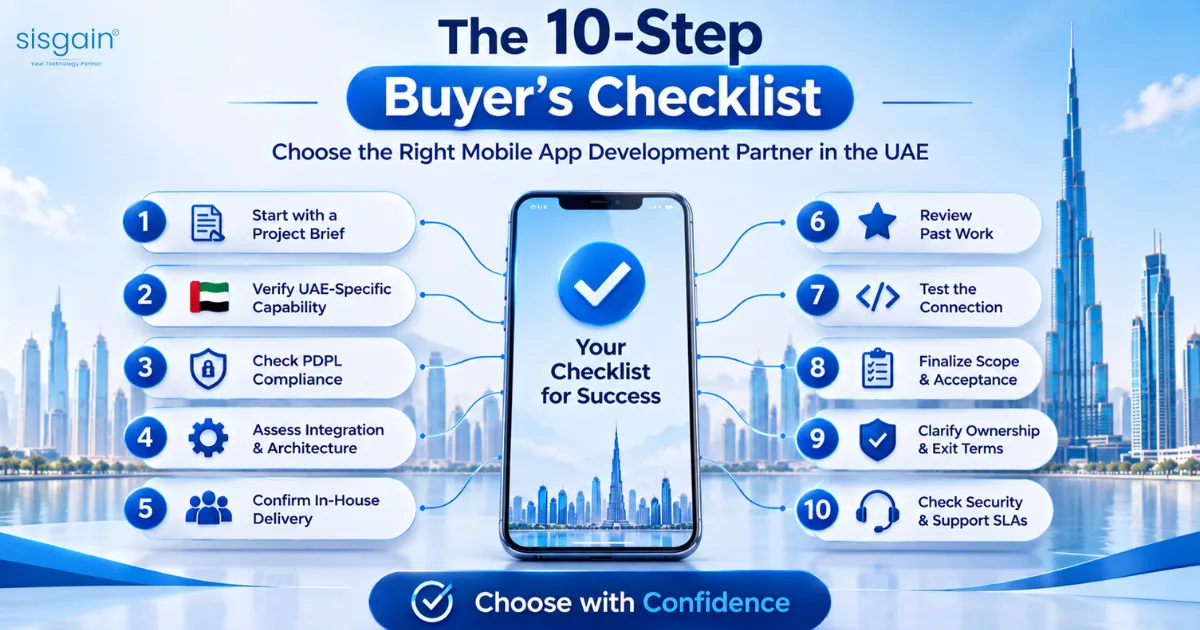
1. Start with a strict project brief
Define your objectives, the pain points in the current app, your target users and your success metrics before any commercial conversation. A precise brief lets you compare proposals on scope and value rather than price alone, and it forces vendors to state their assumptions, phases and exclusions.
What to ask: Does the proposal restate our goals, name its assumptions and list what is out of scope?
Red flag: A quote that arrives within days, with no questions asked about your systems.
2. Verify UAE-specific technical capability first
Before discussing money, ask every shortlisted firm three concrete questions:
- Have you built UAE PASS integration in a production app?
- Can you show Arabic RTL QA screenshots from a live project?
- Which UAE payment gateways (for example Network International, PayTabs, Telr or Checkout.com) have you integrated, and for which industries?
Genuine right-to-left experience means layouts, typography and navigation were designed for Arabic, not translation bolted on at the end.
Red flag: English-only mockups with a promise to mirror them later.
3. Check PDPL and data-hosting understanding
Ask for a direct answer on data residency and on how the vendor handles the PDPL. Remember that the UAE has three separate data protection layers: the federal PDPL for mainland entities, and the separate DIFC and ADGM regimes for those free zones. Your vendor should be able to tell you which applies to you and why.
For regulated sectors, probe further. Banking and fintech work touches Central Bank of the UAE (CBUAE) requirements, healthcare work touches DHA and DOH rules, and government work touches national information assurance standards. Ask about local cloud regions from the major providers and sovereign options such as Core42, and about ISO 27001 certification and OWASP Mobile Top 10 practices.
For more depth, read our guide to mobile app security and PDPL compliance, the notes on secure cloud migration in the UAE, and, for financial services, fintech app compliance in Abu Dhabi.
Red flag: Answering a residency question with a link to a generic security page.
4. Assess integration and architecture depth
Enterprise modernisation lives or dies on integration. Ask vendors:
- Can you integrate with our ERP, CRM and HRMS?
- How will you prevent direct mobile-to-database access?
- How is role-based access control (RBAC) implemented, and how does offline synchronisation work?
- How are API failures, versioning and third-party API changes handled?
- What monitoring and disaster-recovery approach will you use?
A strong partner will propose a modular architecture, such as microservices or a Backend-for-Frontend layer, connected to your core systems through secure APIs or middleware. Good API governance matters as much as the mobile code, so look for proven API development services and experienced software integrators in Dubai. The underlyin enterprise architecture development services should be part of the conversation from day one.
Red flags: Direct ERP database access, no explanation of RBAC, no plan for offline scenarios, or a portfolio that is only UI screenshots.
5. Confirm in-house delivery and team continuity
Ask who actually writes the code, and meet the architect and engineers proposed for your project. Insist on a named delivery team rather than a rotating bench, and check that the firm can own the whole product: design, mobile, backend, integrations and support. A local presence in Dubai or Abu Dhabi for workshops and user acceptance testing is a real advantage.
For an overview of what a full-service partner looks like, see this mobile app development company in the UAE and our notes on enterprise mobile app development in Abu Dhabi.
Red flag: Claiming a Dubai in-house team while outsourcing all coding to unvetted third parties.
6. Review comparable work, not just industry logos
A logo wall proves little. Request a comparable business workflow and confirm the provider's actual role in it. Ask specifically for UAE or MENA client references that you can verify directly or on a platform such as Clutch, and match the vendor's size and capacity to your project's complexity.
What to ask: Which part of that project did your team own, and can I speak to the client?
7. Test the difficult connection early
Validate the identity provider, ERP, CRM or legacy interface most likely to block delivery during discovery, not after signing. For projects above AED 150,000, consider a paid discovery sprint of two to four weeks, which typically costs in the range of AED 15,000 to 50,000, before committing to full development. It turns assumptions into evidence and gives you a fair basis for comparing two finalists.
8. Nail down scope, acceptance and change orders
Agree who approves each workflow, which users test it, and what evidence marks a milestone complete. Demand a documented change-order process rather than a verbal promise, and confirm that the engagement can shift from project-based to a dedicated team if scope grows. If you need extra capacity at any point, ask about staff augmentation in the UAE.
9. Clarify ownership and exit terms
Put the following in the contract: access to source code, designs, documentation, cloud accounts, build pipelines and third-party components, plus explicit transfer of 100% of intellectual property on payment. Document migration, rollback, training, support, termination assistance and transfer of operating knowledge so you are never locked in.
Red flag: Vague language on IP, or no structured handover plan.
10. Scrutinise security and support SLAs
Expect a threat model, an access design and an update plan aligned with recognised guidance such as NIST. Get SLA response times in writing. Enterprise and government-facing apps need defined post-launch support, including bug fixes, annual iOS and Android release updates and security patches. A partner with strong cybersecurity services in the UAE and dependable IT support services reduces risk after launch. For what a good agreement looks like, see our notes on server support SLAs in Dubai.
Red flag: No post-launch SLA, or support described only as "available on request".
Weighted evaluation scorecard
Use this to compare finalists objectively. Score each criterion from 1 to 5, multiply by the weight, and add up the total.
Criterion | Weight | What to verify |
Enterprise-scale delivery references | 20% | A comparable project, not just a comparable industry |
Systems integration depth | 15% | ERP, CRM and HRMS connectivity, not standalone builds |
UAE compliance readiness | 15% | A direct data-residency answer, not a security-page link |
Change-order process | 10% | Documented, not verbal |
Engagement model flexibility | 10% | Can scale from project to dedicated team |
Technical stack fit | 10% | Matches your stack, not their preference |
Post-launch support terms | 10% | SLA response times in writing |
Bilingual delivery capability | 5% | Real Arabic interface experience |
Team continuity | 5% | Named team, not a rotating bench |
On stack fit, a good partner gives objective advice on cross-platform (Flutter, React Native) versus native (Swift, Kotlin) based on your performance needs and your internal hiring capability. Our comparison of native vs cross-platform app development can help you pressure-test their recommendation.
Practical guide: from shortlist to signature
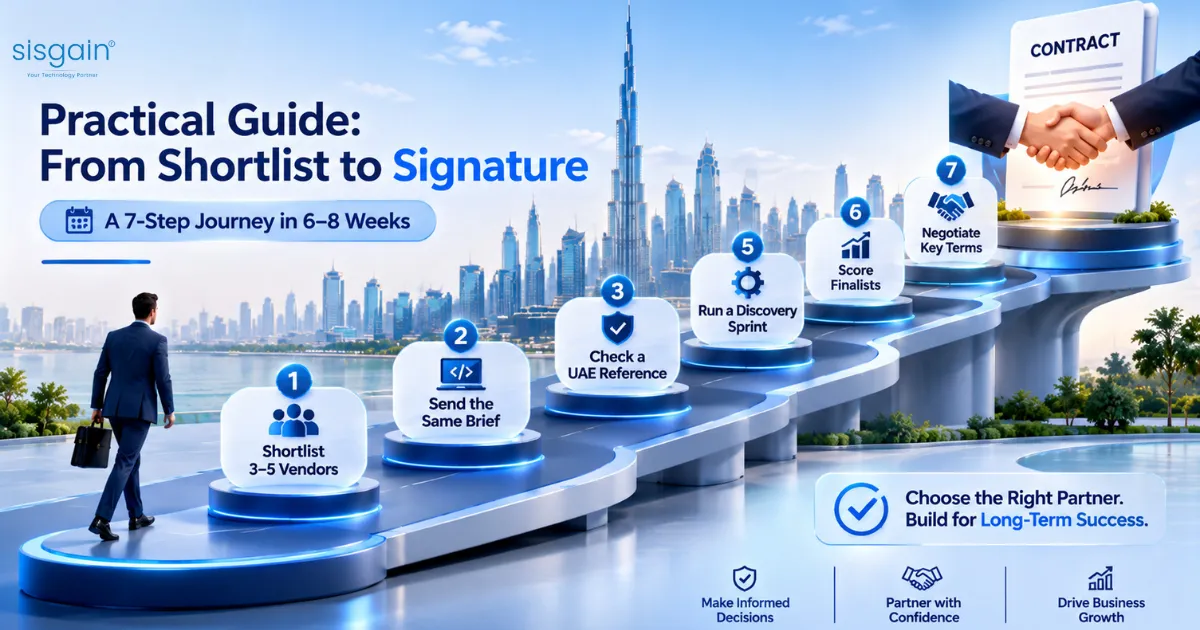
Here is a seven-step process you can run in about six to eight weeks.
- Shortlist three to five vendors. Use references, UAE delivery evidence and size fit to narrow the field.
- Send every vendor the same brief. Identical inputs make proposals comparable.
- Run a 60-minute technical session with the proposed architect. Ask the integration, RBAC, offline and monitoring questions from step 4.
- Request a UAE or MENA reference call. Ask what went wrong and how it was handled.
- Commission a paid discovery sprint with your top one or two. Test the hardest integration, such as the ERP or UAE PASS connection.
- Score finalists with the scorecard. Compare total ownership cost, security, methodology and long-term maintainability, not just development price.
- Negotiate IP, SLA and exit clauses before signing. Do not leave them for later.
Cost and timeline snapshot
Costs vary widely with complexity, integrations and compliance. The ranges below are indicative for enterprise modernisation in the UAE, so treat them as planning figures and confirm them against detailed proposals. For more context, see our guides to mobile app development cost in Abu Dhabi and app development cost in Dubai.
Project type | Indicative budget (AED) |
UI/UX overhaul and frontend migration | 150,000 to 350,000 |
Mid-scale modernisation (API refactoring, cross-platform rebuild, UAE PASS and payments) | 350,000 to 800,000 |
Complex core transformation (heavy ERP or legacy integration, strict sector compliance, AI features) | 800,000 to 2,000,000+ |
Phase | Typical duration |
Discovery and technical audit | 3 to 6 weeks |
MVP or Phase 1 launch | 3 to 5 months |
Full enterprise rollout and legacy decommissioning | 6 to 12+ months |
If you want to validate scope on a smaller scale first, an MVP approach can reduce risk, as covered in our guide to MVP app development in Abu Dhabi.
Red flags that should end the conversation
Walk away from vendors who:
- Quote a fixed price without reviewing your codebase, APIs and security posture
- Treat Arabic as an afterthought
- Focus only on UI screenshots
- Cannot explain integration architecture or propose direct ERP database access
- Have no API governance strategy
- Ignore offline scenarios or cannot explain monitoring
- Offer no post-launch SLA or architecture plan
- Are unclear about subcontracting
Conclusion
The right modernisation partner is the one who can prove UAE delivery, explain compliance plainly, integrate with your real systems and put ownership and support terms in writing. Run the checklist, use the scorecard, and test the hardest integration before you commit.
If you want an independent view, our team can review your current app, architecture and integrations and outline a phased modernisation plan. Talk to our enterprise mobile team to arrange a technical audit or discovery sprint.
Sources and further reading: the UAE Ministry of Finance e-invoicing announcements, including its Ministerial Decisions on the Electronic Invoicing System, and legal commentary on the PDPL and the new Federal Authority for Artificial Intelligence and Data. Regulations change, so confirm current requirements with qualified advisers.